Yes, the Yamaha NMAX 125 is one of the best 125cc commuter scooters you can buy in Britain — and no, you cannot buy one new in the United States. That split is the whole story of this Yamaha NMAX 125 review: a smart, frugal, well-equipped maxi-scooter that Yamaha has never sold through its American dealer network, so US riders can only read about it, import one under strict rules, or buy the closest thing Yamaha does sell here. This Yamaha NMAX 125 review covers what the bike actually is, what it costs in the UK, how the three generations differ, and why the American answer is a different scooter.
The short version: a 125cc liquid-cooled Blue Core single with variable valve actuation, 12.2 PS, ABS, traction control, Smart Key and stop-start tech, a 7.1-litre tank and an official 2.2 litres per 100 km. In the UK the 2025 standard bike lists from £3,600 and the Tech MAX from £3,900. This Yamaha NMAX 125 review separates Yamaha’s figures from independent tests, explains the imperial-versus-US gallon trap that inflates its quoted mpg, and keeps every price and spec labelled by market and year.
Yamaha NMAX 125 Overview and Model-Year Updates
The NMAX 125 is Yamaha’s mid-size entry in its MAX scooter family — bigger than a basic 125, smaller and lighter than the XMAX. This Yamaha NMAX 125 review treats that middle position as its appeal: motorway-capable looks and equipment, learner-legal running costs.
What Is the Yamaha NMAX 125 and Who Is It Designed For?
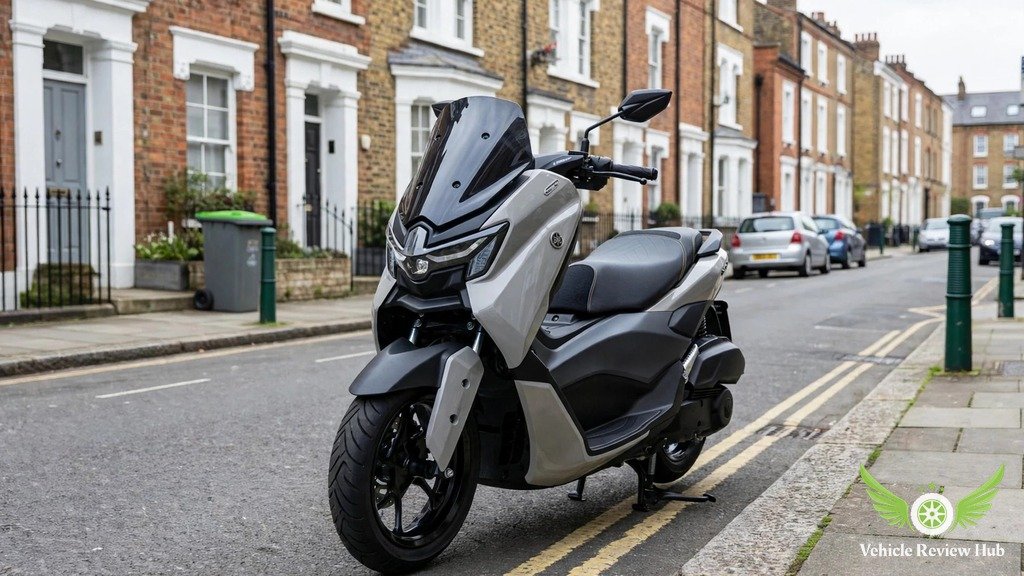
The Yamaha NMAX 125 is a step-through maxi-scooter built around a steel backbone frame, 13-inch wheels and a V-belt automatic — twist and go, no clutch, no gears. Yamaha designed it for city commuters, students and delivery riders who want a motorcycle feel on a UK A1 licence — the audience this Yamaha NMAX 125 review keeps in mind. This Yamaha NMAX 125 review finds that pitch fits: the riding position is roomy, the underseat storage swallows a full-face helmet, and the fuel bills are tiny.
Compared with Yamaha’s own XMAX, the NMAX is lighter, narrower and cheaper to run, but gives up freeway pace and storage. This Yamaha NMAX 125 review judges it as a city and suburban machine first: brilliant in traffic, honest about its limits on faster roads.
Generations Explained: 2015 Launch, 2021 Euro 5 Redesign and 2025 Update
The first generation arrived in 2015 at £2,599, undercutting Honda’s best-selling PCX 125 by £100, with variable valve actuation and ABS as standard — both firsts on a 125cc scooter at the time. This Yamaha NMAX 125 review notes the launch price because it explains the bike’s reputation: premium tech at a mainstream price.
The second generation, launched for 2021, was a comprehensive redesign: a new, more rigid frame, Euro 5 compliance with no loss of power, switchable stop-start, traction control, Smart Key keyless ignition and a Bluetooth-connected LCD dash via Yamaha’s MyRide app. The tank grew to 7.1 litres and the launch price was £3,399. The third generation, announced in November 2024 and on sale from January 2025 (Tech MAX from May 2025), brought a compact new body, dual-eye projector headlights, Euro 5+ compliance and the range split: standard from £3,600, Tech MAX from £3,900. This Yamaha NMAX 125 review keeps those generations separate, because a 2015 bike and a 2025 bike share a name and little else in equipment terms.
| Generation | Years | Key changes | UK launch price |
|---|---|---|---|
| First generation | 2015–2020 | VVA and ABS standard, 6.6-litre tank, 765 mm seat | £2,599 |
| Second generation | 2021–2024 | New frame, Euro 5, stop-start, traction control, Smart Key, connected LCD, 7.1-litre tank | £3,399 |
| Third generation | 2025–present | New body, dual-eye projector headlights, Euro 5+, Tech MAX split with TFT and Garmin | £3,600 (£3,900 Tech MAX) |
Yamaha NMAX 125 Engine and Specifications
The NMAX 125 runs Yamaha’s Blue Core 125cc single, updated steadily since launch and tuned for clean pull from traffic lights and relaxed suburban cruising, not outright speed.
125cc Blue Core Engine With VVA, 12.2 PS and CVT Automatic
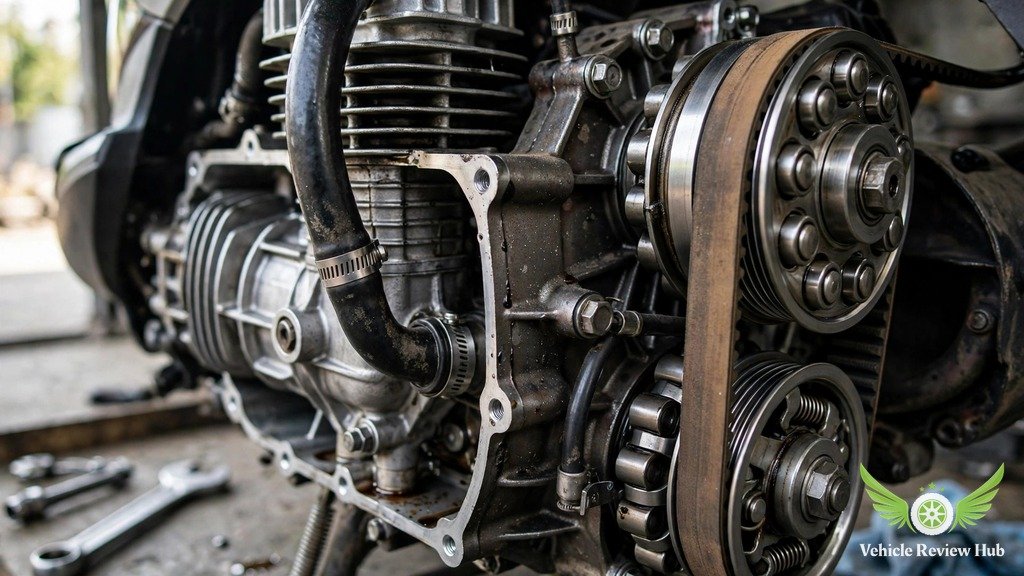
The engine is a 125cc liquid-cooled, four-stroke SOHC single with four valves, fuel injection and Yamaha’s Variable Valve Actuation (VVA), which changes intake valve timing as revs rise for stronger low-end torque and freer top-end breathing. Yamaha’s EU fact sheets list 9 kW (12.2 PS) at 8,000 rpm and 11.2 Nm of torque at 6,000 rpm, from a 52.0 mm bore and 58.7 mm stroke at 11.2:1 compression. Those are EU figures — Yamaha USA publishes nothing for this bike, because it does not sell it there — and this Yamaha NMAX 125 review labels them as such. Drive is a V-belt automatic with a centrifugal clutch: twist and go, with no gears to learn — the simplicity this Yamaha NMAX 125 review keeps coming back to.
One honest gap matters for American readers of this Yamaha NMAX 125 review: no US horsepower rating, no EPA economy figure, no US specification sheet at all. The 12.2 PS figure converts to about 12 bhp, which is why British outlets quote 12 bhp, and the torque figure converts to about 8.3 lb-ft. Treat those as EU facts, not American ones.
Weight 132 kg, Seat Height 770 mm, Dimensions and 23.3-Litre Storage
Yamaha’s 2026 dealer specification lists the current bike at 132 kg wet, with a 1,935 mm length, 740 mm width, 1,340 mm wheelbase and 125 mm ground clearance. Seat height needs a year label: the 2015–2024 bikes sit at 765 mm, while the 2025 redesign lists 770 mm — a small rise that most riders will not notice, but this Yamaha NMAX 125 review states both rather than picking one. The 2025 standard bike’s underseat storage is listed at 25 litres, up from 23 litres on the 2021 bike, and holds a full-face helmet with room for small extras; front pockets add phone-sized storage, with a USB-C port on the 2025 bike.
That storage is a genuine strong point for a 125: the 2021 bike’s 23 litres already swallowed a full-face helmet, and the 2025 bike’s 25 litres make the NMAX a realistic car replacement for errands. This Yamaha NMAX 125 review rates the package ahead of most rivals at the price, though it still trails the XMAX’s cavernous underseat space, as this Yamaha NMAX 125 review notes.
Yamaha NMAX 125 Price and Market Availability
New-bike pricing is where the NMAX’s value case lives — and this Yamaha NMAX 125 review quotes UK prices only, because no US price exists.
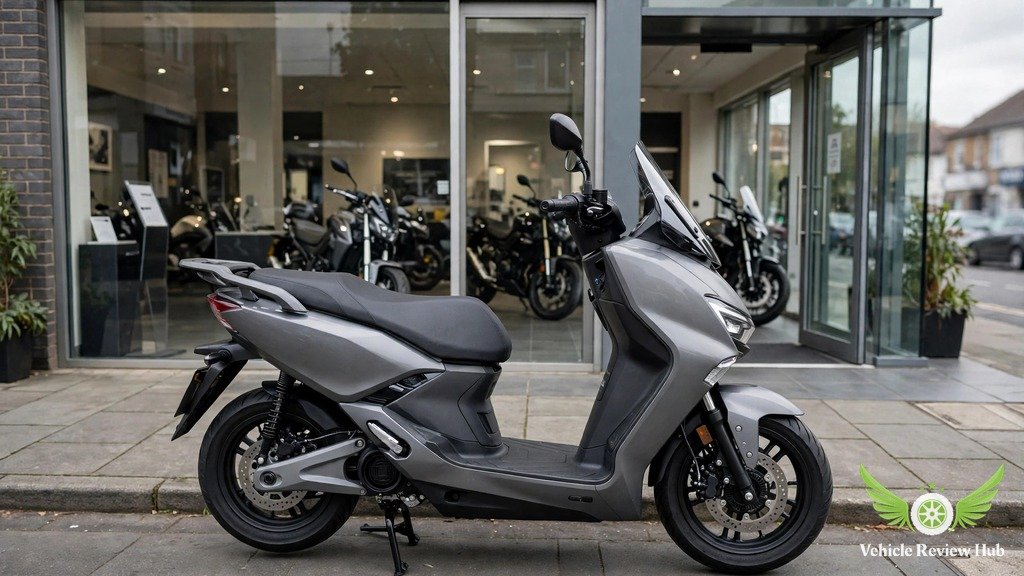
Yamaha NMAX 125 Price in the UK: £3,600 and £3,900 Tech MAX
The price ladder in this Yamaha NMAX 125 review is short: £2,599 at the 2015 launch, £3,399 for the 2021 redesign, and £3,600 for the 2025 standard bike with the Tech MAX at £3,900 — a £300 premium for the TFT dash, Garmin navigation, leather seat and special colours. UK dealer listings in October 2026 vary around those figures (one dealer lists the 2026 standard at £3,451 and the Tech MAX at £3,701), so check a current offer before buying. Road tax is £27, and warranty terms vary — MCN lists two years for the 2021-on bike, while 2026 dealer listings advertise three — so check the bike you buy.
| Model year | UK price | Notes |
|---|---|---|
| 2015 launch | £2,599 | Undercut the Honda PCX 125 by £100 |
| 2021 redesign | £3,399 | £230 more than the rival PCX at the time |
| 2025 standard | £3,600 | New body, Euro 5+, connected LCD |
| 2025 Tech MAX | £3,900 | 4.2-inch TFT, Garmin navigation, leather seat |
Why the Yamaha NMAX 125 Was Never Sold in the USA
Yamaha has never listed the NMAX 125 in the United States, and this Yamaha NMAX 125 review states that plainly rather than speculating about a launch. The American 125cc scooter slot is filled by the Zuma 125, a rugged, simpler machine built for the US market, while the NMAX was developed as a European A1-licence product with Euro emissions certification rather than US FMVSS certification. That means no US dealer stock, no US warranty and no US parts pipeline — the practical reasons an American cannot simply order one. Importing one is a separate question with its own rules, covered in the buying guide, and this Yamaha NMAX 125 review offers that section as general information only, not legal advice.
Yamaha NMAX 125 Design, Features and Technology
The NMAX has always looked more substantial than a typical 125, and the 2025 redesign leans further into the MAX family look with a sporty fairing, twin-eye lights and a stepped seat.
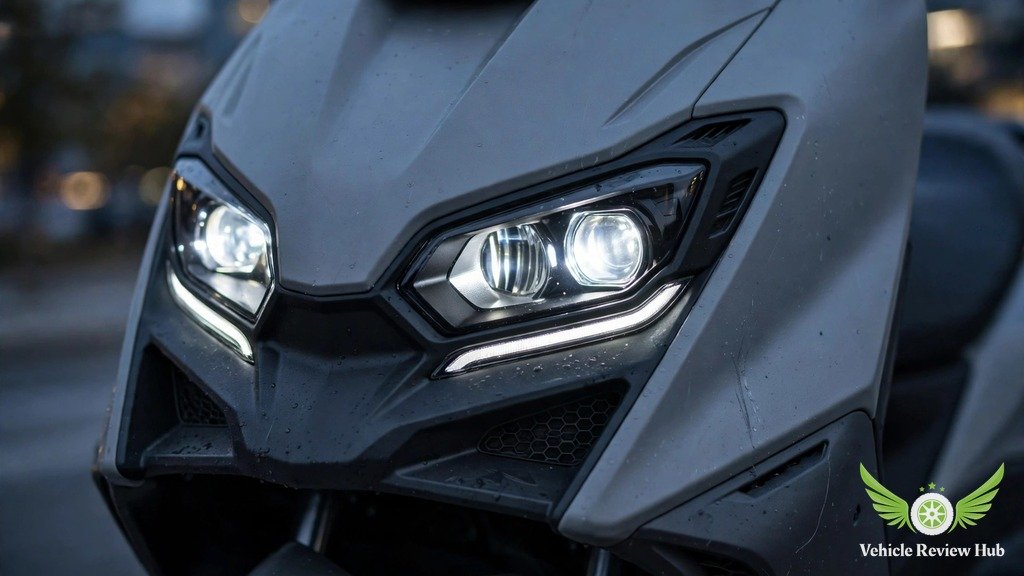
MAX Family Styling, Projector LED Headlights and TFT on Tech MAX
The signature cue is the dual-eye projector headlight setup, carried across all three generations and sharpened for 2025 with integrated LED lamps and flashers. The 2025 body is more compact and angular than the 2021 bike’s, with better wind protection from the reshaped fairing. The display split is the key trim difference: the standard 2025 bike keeps a connected LCD dash with Bluetooth and MyRide pairing, while the Tech MAX adds a dual display — a 3.7-inch LCD plus a 4.2-inch TFT with Garmin navigation. This Yamaha NMAX 125 review stresses that split: listings sometimes describe every 2025 bike as having a TFT; only the Tech MAX does.
Colours follow the same split: 2025 standard in Icon Black and Milky White, Tech MAX in Ceramic Grey and Dark Magma; for 2026 the standard adds Icon Blue and Crystal Graphite — and this Yamaha NMAX 125 review lists them by year because a colour dates a used bike at a glance.
Start and Stop, Traction Control, ABS and Smart Key Since 2021
The technology story divides cleanly at 2021. The 2015 bike already had ABS as standard and VVA — remarkable for a 125 at the time — but the 2021 redesign added the rest: a switchable stop-start system that shuts the engine at idle and restarts it on throttle, traction control, Smart Key keyless ignition, and the Bluetooth-connected dash. Braking is a 230 mm disc front and rear with single-piston calipers and ABS, on 13-inch wheels with 110/70-13 front and 130/70-13 rear tyres. Suspension is a 30 mm telescopic fork (100 mm travel) and twin rear shocks with adjustable preload (91 mm travel). This Yamaha NMAX 125 review notes what the bike does not have, too: no ride modes and no electronic CVT — those belong to the larger NMAX 155, not the 125 — a trap this Yamaha NMAX 125 review flags because listings get it wrong.
Yamaha NMAX 125 Riding Experience and Comfort
On the road, the NMAX 125 is light, narrow and instantly familiar, with genuinely roomy ergonomics for a 125 and a seat that suits taller riders better than most learner scooters.
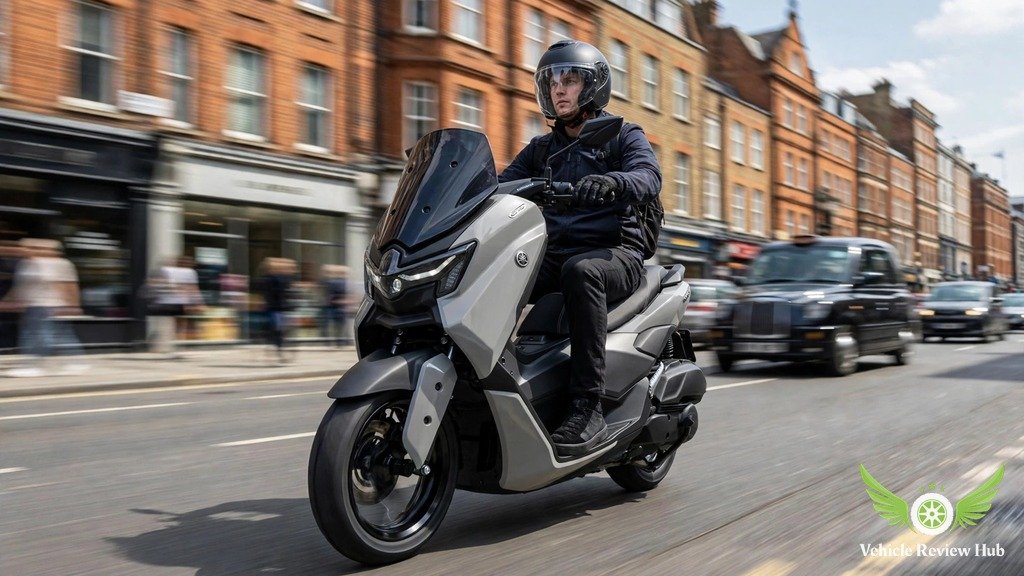
Riding Position, Handling and Low-Speed Maneuverability
Handling is the NMAX’s quiet strength: at 132 kg with a 1,340 mm wheelbase and 13-inch wheels, it turns tightly, filters confidently and parks where motorcycles cannot, while the larger wheels cope with potholes better than 12-inch wheels. The ride is firm rather than plush — tuned for control — and this Yamaha NMAX 125 review agrees its size is an advantage no bigger scooter can match.
The seat deserves an honest note in this Yamaha NMAX 125 review. It is wide and roomy, but the high-mounted frame means a taller step-over than a flat-floor city scooter, so shorter riders should sit on one first, as this Yamaha NMAX 125 review recommends.
City Riding, Suburban Roads and Everyday Practicality
Where the NMAX shines is the daily grind: stop-and-go traffic, suburban arterials and grocery runs. The CVT pulls smoothly from every light, and the official 2.2 litres per 100 km gives a claimed 322 km (about 200 miles) from the 7.1-litre tank. The performance figures behind that claim are covered in the performance guide, and this Yamaha NMAX 125 review keeps the headline honest: around 60 mph is the everyday reality.
The video below is a first ride of the 2025 bike, covering the new styling, the TFT-equipped Tech MAX option and how the updated scooter feels on the road.
Practicality extends beyond the ride: low insurance groups, inexpensive 13-inch tyres, and light weight at parking speeds. UK readers should check current DVLA rules for their licence category. This Yamaha NMAX 125 review also notes the bike’s delivery-rider popularity in the UK, which says more about its durability and economy than any brochure could.
Yamaha NMAX 125 Review: Pros, Cons and Verdict
Weighing generations, specs and riding reality, this Yamaha NMAX 125 review lands clearly: an excellent city and suburban scooter, a poor motorway scooter, and buyers who accept that trade will love it.
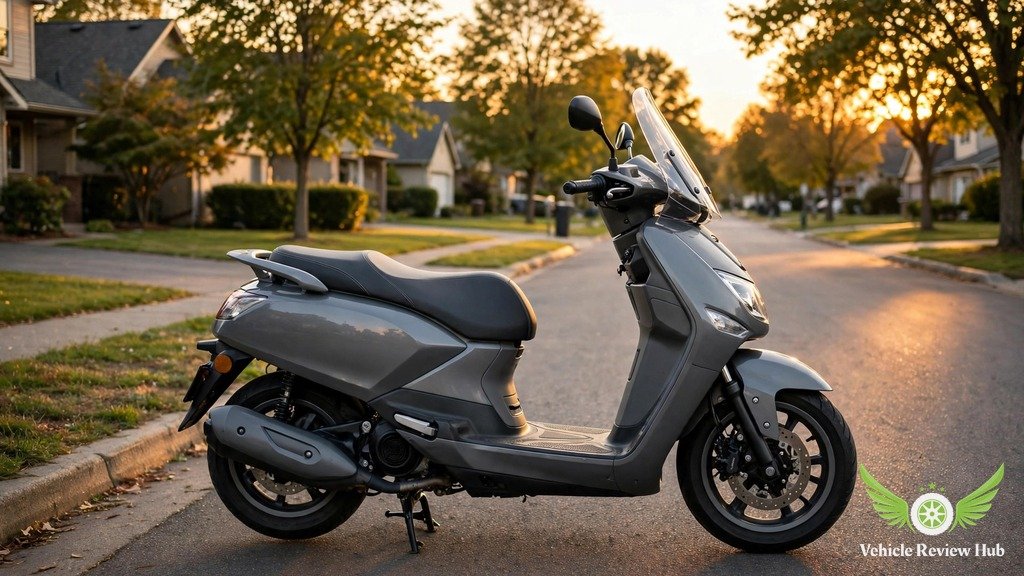
Main Advantages and Limitations of the Yamaha NMAX 125
The advantages stack up quickly: a £3,600 price for the 2025 standard bike, an official 2.2 litres per 100 km, ABS and traction control as standard since 2021, Smart Key, stop-start, 25 litres of underseat storage on the 2025 bike, and a dealer network that has stocked the bike since 2015. This Yamaha NMAX 125 review also credits the 13-inch wheels and 230 mm discs for stopping confidence beyond the price.
The limitations are equally clear in this Yamaha NMAX 125 review. There is no US sale or dealer support, the roughly 67 mph top speed rules out comfortable motorway use, wind protection is limited, the TFT and Garmin cost £300 extra on the Tech MAX, and the quoted 128 mpg is imperial — about 107 mpg in US gallons.
Who Should Consider the Yamaha NMAX 125 Over the Zuma 125?
The American comparison comes down to availability first. The Zuma 125 is the Yamaha a US buyer can actually walk into a dealer and buy: $3,799, 282 pounds, a 30.9-inch seat, linked UBS braking with no ABS, and none of the NMAX’s traction control, Smart Key or stop-start tech. The NMAX is more sophisticated and better equipped — but only a UK or European buyer can buy one new. This Yamaha NMAX 125 review recommends the Zuma for US buyers who want a Yamaha 125 today, and the NMAX for UK and European buyers who want the best-equipped 125 commuter on sale there.
Yamaha NMAX 125 Review FAQs
Direct answers to the questions buyers ask most about the Yamaha NMAX 125, drawn from the verified facts in this Yamaha NMAX 125 review.
How much does a Yamaha NMAX 125 cost?
According to this Yamaha NMAX 125 review, the 2025 standard bike lists from £3,600 in the UK and the Tech MAX from £3,900, with some dealer variation in October 2026 listings. There is no US price because Yamaha does not sell the bike in the USA.
What engine does the Yamaha NMAX 125 have?
This Yamaha NMAX 125 review confirms a 125cc liquid-cooled, four-stroke SOHC single with four valves, fuel injection and Variable Valve Actuation, making 12.2 PS at 8,000 rpm and 11.2 Nm at 6,000 rpm on Yamaha’s EU figures, driving the rear wheel through a V-belt automatic.
How fast does the Yamaha NMAX 125 go?
MCN lists a 67 mph top speed for the 2021-on bike, and independent reviewers describe about 60 mph as the everyday reality, with 65–70 mph possible on a favourable road. Those are speedometer-indicated figures, not GPS-verified top speeds, and this Yamaha NMAX 125 review labels them as such.
Does the Yamaha NMAX 125 have ABS?
Yes — and this Yamaha NMAX 125 review stresses it because the American Zuma 125 does not. The NMAX has had ABS as standard since its 2015 launch, with 230 mm discs front and rear, plus traction control since the 2021 redesign.
What is the fuel economy of the Yamaha NMAX 125?
Yamaha quotes 2.2 litres per 100 km, which is 128 mpg in imperial gallons and about 107 mpg in US gallons — the gallon difference matters, and this Yamaha NMAX 125 review states both, and the 7.1-litre tank gives a claimed 322 km (200 miles).
How much does the Yamaha NMAX 125 weigh?
This Yamaha NMAX 125 review lists the current bike at 132 kg wet; the 2021 bike was listed at 131–132 kg depending on source, and the original 2015 bike at 127 kg.
Is the Yamaha NMAX 125 good for beginners?
Yes, for city and suburban riding — and this Yamaha NMAX 125 review recommends it as a first maxi-scooter. The twist-and-go CVT means no clutch or shifting to learn, the 770 mm seat (765 mm before 2025) is low by motorcycle standards, and traction control adds confidence.
Can I buy a Yamaha NMAX 125 in the USA?
No, not new through a dealer. This Yamaha NMAX 125 review is blunt: Yamaha has never sold the NMAX 125 in the United States, so there is no US price, no US dealer stock and no US warranty. Importing one involves NHTSA and EPA rules covered in the buying guide, offered as general information only.
What is the difference between the NMAX 125 and the NMAX 125 Tech MAX?
The Tech MAX costs £300 more and adds a dual display — a 3.7-inch LCD plus a 4.2-inch full-colour TFT with built-in Garmin navigation — plus a leather seat and special colours. The standard 2025 bike keeps a connected LCD dash — the split this Yamaha NMAX 125 review flags as the key trim decision. Both share the same engine, brakes and chassis.
Does the Yamaha NMAX 125 have a TFT display?
Only the Tech MAX, since 2025. This Yamaha NMAX 125 review corrects a common listing error: the standard bike’s dash is an LCD unit with Bluetooth pairing, while the 4.2-inch TFT with Garmin navigation is exclusive to the Tech MAX.
Should I buy a new or used Yamaha NMAX 125?
This Yamaha NMAX 125 review says: buy new at £3,600 for the latest body, Euro 5+ engine and full warranty, or buy a 2021-on bike used for the stop-start, traction control and Smart Key kit. A 2015–2020 bike is cheaper but gives up those features and the 7.1-litre tank.