This Yamaha WR250F review covers the bike Yamaha pitches as the fastest way through tight single-track: a 250cc four-stroke enduro with a headlight, a kickstand and a radiator fan, built from the YZ250F motocross platform but tuned for trails. It is an off-road-only machine — no plate, no street use — and this Yamaha WR250F review treats that status as absolute. For 2025 the bike received its biggest overhaul since 2020 — new frame, slimmer bodywork, four-level traction control — and the 2026 model carries that bike forward at $9,199 with an ECU lock function and fresh graphics.
The short version of this Yamaha WR250F review: if your riding is woods, single-track and enduro events, and you want a light, electric-start 250 four-stroke with real trail equipment, this is the benchmark Japanese bike in its class. If you need a plate, a low seat or a beginner-friendly first dirt bike, look elsewhere — this Yamaha WR250F review explains why on each count.
Yamaha WR250F Overview and Model-Year Updates
The subject of this Yamaha WR250F review has survived for a quarter century by staying close to Yamaha’s motocross program while keeping the equipment trail riders actually need. That formula is the thread through every generation covered in this Yamaha WR250F review.

What Is the Yamaha WR250F and Who Is It Designed For?
The Yamaha WR250F review starts with its job description: a closed-course competition off-road bike tuned for enduro and trail riding. It shares its 250cc four-stroke platform with the YZ250F motocrosser and the YZ250FX cross-country racer, but Yamaha tunes the WR for the mellower end of that spectrum — smoother power, softer suspension and a wide-ratio six-speed gearbox that suits slow technical woods as well as faster fire roads. Cycle World calls it the last remaining quarter-liter four-stroke with a headlight and kickstand sold in the United States: a race-bred engine with trail manners and trail equipment.
Who should buy one? In this Yamaha WR250F review, the answer is a rider who already rides off-road and wants a light, capable woods weapon — enduro racers, hare-scramble riders and serious trail riders. The 37.6-inch seat height and competition focus make it a poor first dirt bike for most beginners, and its off-road-only status rules out anyone who needs to ride to the trailhead on public roads. The performance figures show what that trade-off buys on the trail.
History 2001 to 2027: 2015 Reverse-Cylinder Redesign and 2025 Update
Yamaha launched the WR250F in 2001 as the off-road sibling of the YZ250F; early bikes were carbureted five-speeds with a conventional cylinder layout. The first great divide came in 2015, when Yamaha redesigned the WR250F around the then-new YZ250F platform: a rearward-slanted, fuel-injected 249cc engine with a reverse cylinder head, a bilateral beam frame, KYB SSS suspension, electric start and a sixth gear. The 2015 bike retailed at $7,990 and was described by Yamaha as 50-state off-road compliant, and that architecture carried the model, with updates, through 2019, as Racer X reported at launch.
The second great divide came in 2020, when the WR250F went all-new on the current YZ250F design: a forged-piston engine with higher compression, a 12-hole Denso injector with a 44mm Mikuni throttle body, a new bilateral beam frame, and — for the first time — smartphone tuning through the Yamaha Power Tuner app plus a bar-mounted dual map switch, as MCN reported. The third divide is the 2025 model: a redesigned aluminum bilateral beam frame, slimmer bodywork, revised suspension with a lower center of gravity, a new air intake, and four-level traction control through the next-generation Power Tuner app. No verified United States 2027 MSRP was found at the time of writing, so this Yamaha WR250F review prices the bike through 2026 and flags the 2027 figure as unconfirmed rather than guessing it.
Yamaha WR250F Engine and Specifications
The engine is the heart of this Yamaha WR250F review: a YZ-derived 250 that Yamaha deliberately softens and stretches for enduro duty, with a gearbox built for woods work rather than motocross starts.
250cc Reverse-Cylinder Engine, 13.8:1 Compression and Six-Speed Gearbox
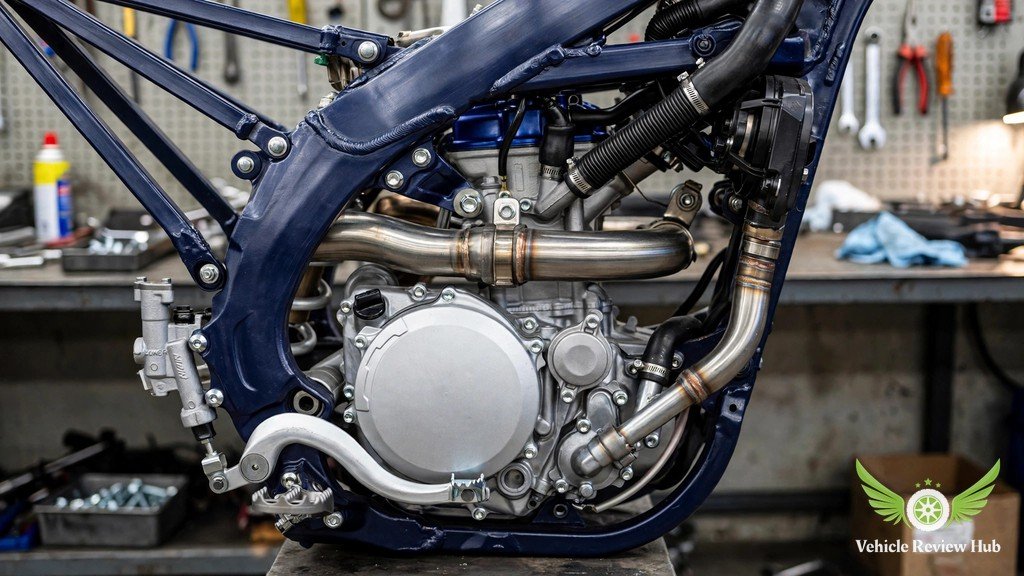
The WR250F runs a liquid-cooled, DOHC, four-valve single-cylinder displacing 250cc, with a 77.0 x 53.6 mm bore and stroke and a 13.8:1 compression ratio. The cylinder is rearward-slanted with a reverse head: intake forward, airbox ahead of the fuel tank, exhaust at the rear. That layout centralizes mass and straightens the intake path, and it matches the YZ250F architecture, retuned with enduro-specific fuel and ignition maps, a spark-arrestor muffler and a wider spread of usable power. Yamaha publishes no horsepower figure for the WR250F, so this Yamaha WR250F review quotes no factory power claim.
The gearbox covered in this Yamaha WR250F review is a six-speed wide-ratio unit driving the rear wheel by chain, a defining WR trait: first gear is low enough for crawling through rocks and roots, while sixth lets the bike cruise open trails without buzzing. A wet multiplate clutch, electric start and a balancer to calm vibration complete a package built for long days in the woods.
| Specification | 2025–2026 Yamaha WR250F |
|---|---|
| Engine | Liquid-cooled DOHC 4-stroke single, 4 titanium valves |
| Displacement / bore x stroke | 250cc / 77.0 x 53.6 mm |
| Compression ratio | 13.8:1 |
| Fuel system | Mikuni fuel injection, 44mm throttle body |
| Transmission / final drive | 6-speed wide-ratio / chain |
| Starter / clutch | Electric / wet multiplate |
Weight 249 lb, Seat Height 37.6 Inches, KYB Suspension Travel
Yamaha claims a 249 lb wet weight for the WR250F, measured with all fluids including a full 2.0-gallon tank, a figure Motorcycle.com’s 2026 spec page also lists. The seat height is 37.6 inches, the wheelbase 57.9 inches, ground clearance 13.0 inches, and overall dimensions 85.4 x 32.5 x 49.8 inches. That tall seat is the bike’s most honest ergonomic filter: shorter riders will struggle at stops, and the 2025 model’s 10mm-lower suspension and slimmer body only partly offset it.
Suspension, a highlight of this Yamaha WR250F review, is Yamaha’s class-leading KYB package: a fully adjustable 48mm coil-spring inverted fork with speed-sensitive damping, offering 11.8 inches of travel, and a fully adjustable linkage-type KYB shock with 12.0 inches of travel. The 2025 revisions lowered the center of gravity, added a hand-adjustable compression knob on the fork, and revised shock settings to reduce pitching on corner entry and exit. Brakes are hydraulic discs, 270mm front and 240mm rear, and the bike rolls on a 21-inch front and 18-inch rear wheel shod with Dunlop Geomax MX33 tires (80/100-21 front, 110/100-18 rear). Rake is 27.0 degrees with 4.8 inches of trail.
Yamaha WR250F Price and Market Availability
Pricing is where this Yamaha WR250F review gets practical: the bike has climbed steadily from under $8,600 to over $9,100 in five years, and it remains a dealer-only, off-road-only purchase.

Yamaha WR250F Price by Year in the USA: 2021 to 2027
Every price below in this Yamaha WR250F review is a verified United States MSRP, before tax, destination and dealer charges. The 2026 destination charge is $650. The 2027 United States MSRP was not verified at the time of writing and is not guessed here.
| Model year | US MSRP | Notes |
|---|---|---|
| 2021 | $8,599 | Mechanically unchanged from the all-new 2020 bike |
| 2022 | $8,799 | Carryover platform, Team Yamaha Blue |
| 2023 | $8,899 | Carryover platform, Team Yamaha Blue |
| 2024 | $8,999 | Carryover platform, Team Yamaha Blue |
| 2025 | $9,099 | Redesigned frame, slimmer body, four-level traction control |
| 2026 | $9,199 | ECU lock function, blue seat, new graphics |
| 2027 | Not verified | No confirmed US MSRP found — check with a dealer |
The ladder tells a simple story in this Yamaha WR250F review: roughly $100–$200 a year through 2024, then a $100 step for the substantially redesigned 2025 bike and another $100 for 2026. Out the door, this Yamaha WR250F review advises budgeting destination, tax and dealer preparation on top of MSRP.
Team Yamaha Blue Only and Official US Dealer Availability
The current WR250F is sold in Team Yamaha Blue only in the United States, a single-colour policy that has held across the 2021–2026 models covered in this Yamaha WR250F review. It is sold through Yamaha off-road dealers as a closed-course competition model, and this Yamaha WR250F review notes two availability caveats. First, the 2025 model was reported by Dirt Bike Test as not available in California due to evaporative emissions regulations, a change from the 2015 bike’s 50-state off-road compliance — check current state availability with a dealer before assuming anything. Second, competition models carry only a one-month limited factory warranty per Yamaha’s 2026 listing. The buying guide covers used prices and what to check before paying.
Yamaha WR250F Design, Features and Technology
The WR’s design brief is simple: take the YZ motocrosser, add everything a trail rider needs, and nothing they don’t. This Yamaha WR250F review walks through the equipment that separates it from its racing siblings.
Enduro Design, Headlight, Enduro Meter, Skid Plate and Radiator Fan
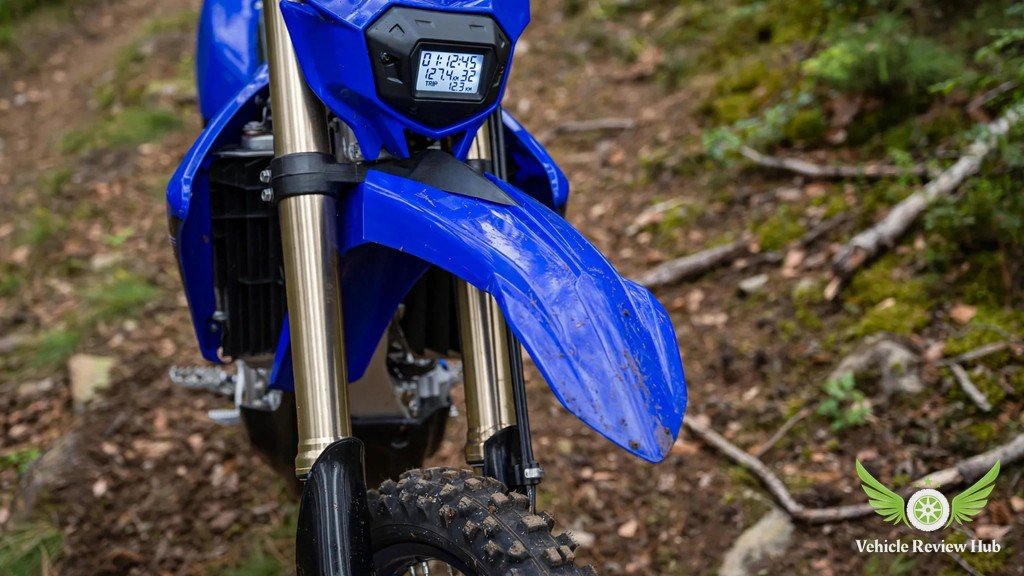
The visual giveaway is the lighting: a halogen H4 headlight and LED taillight, which the YZ250FX racer does without. Behind the front number plate sits a multifunction enduro computer with a speedometer, trip meter, fuel-level warning lamp, lap timer and warning lights — the instrument that makes the WR a real trail bike rather than a racer with a headlight bolted on. Underneath, a rugged plastic skid plate protects the engine cases, and an electric radiator fan keeps temperatures in check when the trail slows to a crawl — the exact situation where a motocrosser would boil over.
The rest of the trail kit in this Yamaha WR250F review is equally deliberate: a forged aluminum sidestand, a sealed O-ring chain, an 18-inch rear wheel, wide platform footpegs, four-position rubber-mounted handlebar clamps, and a spark-arrestor muffler for riding where forestry rules require one, all listed on Yamaha’s 2025 feature page. The 2025 bike’s bodywork is slimmer throughout — two-inch-narrower shrouds, a lower, narrower airbox cover and a flatter seat — with more legroom and the bars moved slightly forward. The reliability and maintenance picture explains what that equipment costs to keep in shape.
Yamaha Power Tuner App, Two Map Switch and Four-Level Traction Control
Electronics are where the modern bike in this Yamaha WR250F review pulls away from older trail bikes, and this Yamaha WR250F review keeps the generations straight. The 2020 bike introduced smartphone tuning: an onboard Communication Control Unit with WiFi links the bike to the free Yamaha Power Tuner app, and a bar-mounted dual map switch swaps between two engine maps on the fly.
The 2025 bike moves to the next-generation Power Tuner app, adding four-level traction control, a lap timer, data logging and setup guides, plus a new multifunction handlebar switch. One honest caveat from the 2025 launch coverage: on the stock WR, the app adjusts traction control and related settings, but full fuel and ignition map editing requires Yamaha’s accessory GYTR ECU. Traction control itself is new for 2025 on the WR; earlier WR250Fs had the map switch but no traction control.
Yamaha WR250F Riding Experience and Comfort
On the trail, the reputation of the bike in this Yamaha WR250F review rests on one quality: it makes hard terrain feel slower than it is. That is the consistent thread in testers’ riding impressions, and the focus of this Yamaha WR250F review’s riding section.

Riding Position, Handling and Low-Speed Trail Maneuverability
The riding position is slim, flat and built for movement: the 2025 bike’s narrower shrouds, flatter seat and extra legroom let the rider slide forward for climbs and back for descents. At 249 lb wet with a low center of gravity — lower again for 2025 thanks to the revised frame and 10mm-shorter suspension — the bike changes direction with less effort than its spec sheet suggests, and testers cited in this Yamaha WR250F review consistently praise its planted feel in tight turns.
Low-speed maneuverability is the WR’s home ground: the wide-ratio gearbox, smooth low-end delivery and radiator fan mean crawling through technical sections brings no overheating or clutch abuse. The tall 37.6-inch seat is the counterweight at walking pace and at stops.
Woods Riding, Enduro Use and Why It Is Not a Road Bike
In the woods, the bike in this Yamaha WR250F review is in its element: single-track, enduro loops, hare scrambles and cross-country events are exactly what the suspension, gearing and equipment were chosen for.
Why it is not a road bike needs stating plainly in any Yamaha WR250F review. The WR250F is a closed-course competition off-road motorcycle: no plate, no road-legal lighting package for street use, no mirrors or indicators in United States trim, and knobby tires that would be miserable on pavement. Australian WR250Fs are supplied in road-registerable trim, which is why overseas reviews sometimes show a plated WR — that trim does not exist in the United States.
The video below, from MXTV, is a riding review of the revised 2025 WR250F featured in this Yamaha WR250F review — the same redesigned bike sold in the United States, reviewed on the trail rather than in a studio.
Yamaha WR250F Review: Pros, Cons and Verdict
This Yamaha WR250F review’s verdict lands firmly on the buy side for the right rider — and names the wrong rider just as clearly.

Main Advantages and Limitations of the Yamaha WR250F
The advantages in this Yamaha WR250F review start with the engine and chassis: a YZ-derived 250 with a wide-ratio six-speed, class-leading KYB SSS suspension, and a 249 lb wet weight that flatters every rider. The trail equipment — headlight, enduro computer, fan, skid plate, sidestand, spark arrestor — is genuinely useful rather than decorative.
The limitations found in this Yamaha WR250F review are equally concrete. The 37.6-inch seat excludes shorter riders. The 2.0-gallon tank limits range between fuel stops on longer loops.
Who Should Consider the Yamaha WR250F Over the YZ250FX?
The YZ250FX is the closest relative of the bike in this Yamaha WR250F review. Both bikes shared the same $9,099 MSRP for 2025, the same redesigned frame and the same basic engine, but the FX is a closed-course cross-country racer: sharper engine character, firmer suspension, no headlight, enduro computer, fan or kickstand, and a larger 2.1-gallon tank.
Choose the WR250F for tight technical trails, enduro events and all-day woods riding. Choose the YZ250FX for cross-country racing and hare scrambles, where the sharper, firmer race package pays off. For riders torn between the two, the honest tiebreaker in this Yamaha WR250F review is speed: the slower and tighter your trails, the stronger the WR’s case; the faster and more open your racing, the stronger the FX’s.
Yamaha WR250F Review: Frequently Asked Questions
These questions answer what buyers actually ask in this Yamaha WR250F review, from pricing and legality to the electronics that separate the generations.
What is the Yamaha WR250F?
The Yamaha WR250F review subject is a 250cc four-stroke enduro motorcycle: a trail and enduro version of Yamaha’s YZ250F motocrosser, with a wide-ratio six-speed gearbox, a headlight, an enduro computer, a skid plate, a radiator fan and a kickstand.
How much does a new Yamaha WR250F cost?
The 2026 bike in this Yamaha WR250F review costs $9,199 MSRP before tax, destination ($650) and dealer charges. The 2025 bike cost $9,099, the 2024 $8,999, the 2023 $8,899, the 2022 $8,799 and the 2021 $8,599.
Is the Yamaha WR250F street legal?
No. In the United States the bike in this Yamaha WR250F review is a closed-course competition off-road motorcycle with no plate, no street-legal lighting package and no road registration. Australian models are supplied in road-registerable trim, which is why overseas reviews sometimes show a plated bike — that trim is not sold in the United States.
How tall is the Yamaha WR250F seat?
The seat height in this Yamaha WR250F review is 37.6 inches, which is tall — one of the tallest in the 250 enduro class. Shorter riders should sit on one before buying.
How much does the Yamaha WR250F weigh?
Yamaha claims 249 lb wet for the bike in this Yamaha WR250F review, measured with all fluids including a full 2.0-gallon fuel tank. That light wet weight is central to the bike’s flickable feel in tight woods.
What changed on the 2025 Yamaha WR250F?
The 2025 Yamaha WR250F review highlight is a full redesign: a new aluminum bilateral beam frame, slimmer bodywork with two-inch-narrower shrouds, revised KYB suspension with a lower center of gravity and a hand-adjustable fork compression knob, a new air intake, and four-level traction control through the next-generation Power Tuner app.
Does the Yamaha WR250F have traction control?
Four-level traction control is standard on the 2025 and 2026 bikes in this Yamaha WR250F review, adjusted through the Power Tuner app and the handlebar switch. Earlier WR250Fs (2020–2024) had the two-map switch and app connectivity but no traction control.
What is the Yamaha Power Tuner app?
The Yamaha Power Tuner app is Yamaha’s free smartphone tuning tool, introduced on the WR250F for 2020, and covered in depth in this Yamaha WR250F review. It connects to the bike’s Communication Control Unit over WiFi and offers ride logging, diagnostics, data logging and setup guides, plus traction control adjustment on 2025-on bikes. On the stock 2025 WR, full fuel and ignition map editing requires the accessory GYTR ECU.
Should I buy a WR250F or a YZ250FX?
Buy the WR250F for tight technical trails, the core recommendation of this Yamaha WR250F review. Buy the YZ250FX for cross-country racing and faster, more aggressive off-road riding, where its sharper engine and firmer suspension pay off.
Is the Yamaha WR250F good for beginners?
Mostly no, and this Yamaha WR250F review is blunt about why. The tall 37.6-inch seat, competition power delivery and off-road-only status make it a demanding first dirt bike. Riders new to dirt should start on a milder trail bike first.