Yamaha YZF-R9 performance means accessible speed, not peak-power bragging rights. The street-legal supersport pairs an 890cc CP3 triple, claimed at 117 horsepower at 10,000 rpm and 68.6 lb-ft at 7,000 rpm, with a 430 lb wet weight, fully adjustable KYB suspension and Brembo Stylema brakes. No major outlet has yet published an instrumented 0-60 mph, quarter-mile or top-speed test for the bike, so this guide separates verified Yamaha YZF-R9 performance facts from pre-launch estimates, explains the second-gear flat spot, and works out honest range from Yamaha’s 48 mpg estimate and 3.7-gallon tank.
Yamaha YZF-R9 Engine Performance and Power Delivery
Yamaha YZF-R9 performance starts with a proven engine. The 890cc liquid-cooled CP3 triple, 78.0 x 62.1 mm bore and stroke, 11.5:1 compression, is shared in basic form with the MT-09, but the R9 gets its own ECU tune, a larger radiator, a shorter 60-degree throttle rotation (78 degrees on the MT-09) and taller 16/43 final gearing, against 16/45 on the MT-09. That gives Yamaha YZF-R9 performance the same broad torque with sharper response and more top-end room.
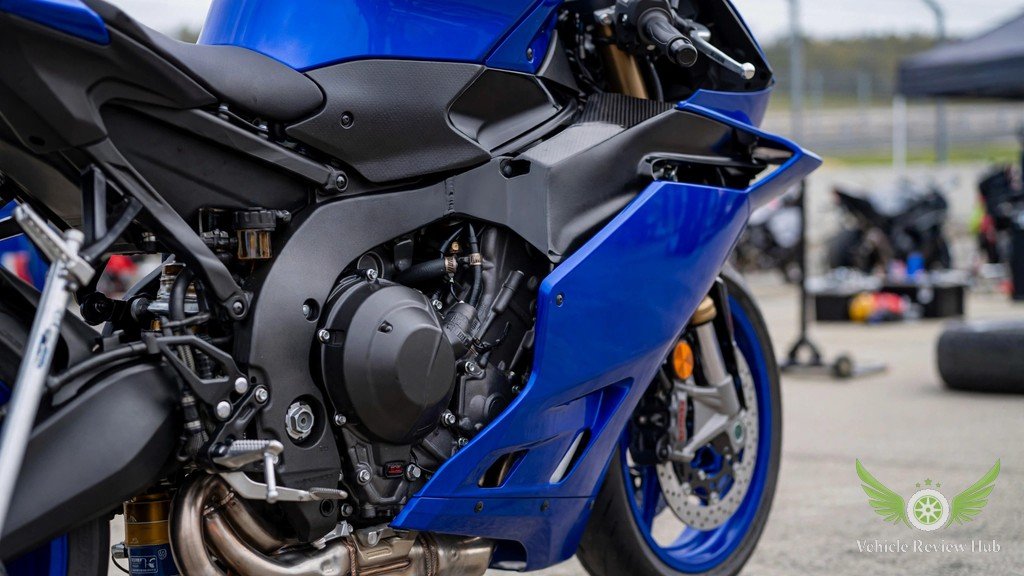
Dyno Results 104.9 HP Motorcycle.com and 107.8 HP MCN Compared
Honesty matters here, because Yamaha YZF-R9 performance reporting has a dyno problem. The figures in this heading, 104.9 hp for Motorcycle.com and 107.8 hp for MCN, could not be verified as published rear-wheel dyno runs for the YZF-R9 itself in sources checked in October 2026. Treat both as unverified outline figures, not measured Yamaha YZF-R9 performance results, until a run with dyno type and correction is published.
What is verified is the frame around them. Yamaha claims 117 hp at 10,000 rpm and 68.6 lb-ft at 7,000 rpm at the crankshaft; MCN repeats 117.3 bhp and 68.6 lb-ft as claimed figures. Motorcycle.com’s R9 first look quotes about 106 hp at the wheel from the last MT-09 it dynoed, with the same CP3 engine. A realistic working band for stock Yamaha YZF-R9 performance at the wheel is therefore roughly 104 to 110 hp.
| Figure | Value | What it actually is |
|---|---|---|
| Yamaha claimed power | 117 hp at 10,000 rpm | Crankshaft claim, not a wheel measurement |
| Yamaha claimed torque | 68.6 lb-ft at 7,000 rpm | Crankshaft claim, not a wheel measurement |
| Motorcycle.com MT-09 dyno, in R9 first look | About 106 hp at the wheel | Same CP3 engine, not an R9 run |
| Outline figures 104.9 hp and 107.8 hp | Unverified as R9 dyno runs | Do not use as measured results |
| Rev limiter | About 10,500 rpm, per RevZilla | Hard cut, below an inline-four redline |
US Second-Gear Restriction, Flat Spot and ECU Flash Discussion
The second-gear restriction is real, documented and specific to North America, and it is the most important caveat in Yamaha YZF-R9 performance. RevZilla reports that Yamaha limits throttle-plate angle until 6,000 rpm for noise-emissions reasons, and that Y-TRAC telemetry showed the plates lagging the throttle tube by about 30 percent on a second-gear corner exit at Sonoma. Motorcycle.com reports that Yamaha staff confirmed the delay was not imagined and not a mapping mistake, blaming EPA requirements, with a reflashed ECU as the relatively easy fix.
Other outlets describe the same hole in slightly different bands: Ultimate Motorcycling puts it at 4,000 to 6,500 rpm, especially in second gear, while Cycle News puts it at 5,000 to 6,500 rpm. A flash rewrites fuel, ignition and throttle maps, and firms such as 2 Wheel DynoWorks sell R9 flashing with intake and exhaust work. That is a tuning claim, not a Yamaha claim, so check warranty and emissions consequences first. The Motorcycle.com first-ride review and the RevZilla first-ride review describe the same behaviour from independent test days, which is why it is treated here as verified, not rumour.
Yamaha YZF-R9 Top Speed and Acceleration
Yamaha YZF-R9 performance at the top end is where the internet is least reliable, because the bike looks fast and is fast, and that is enough for many pages to print a top speed as if measured. Yamaha publishes no top speed for the R9. A responsible Yamaha YZF-R9 performance guide therefore gives what has actually been tested, which is very little in instrumented form, and what has been estimated, clearly labelled as an estimate.
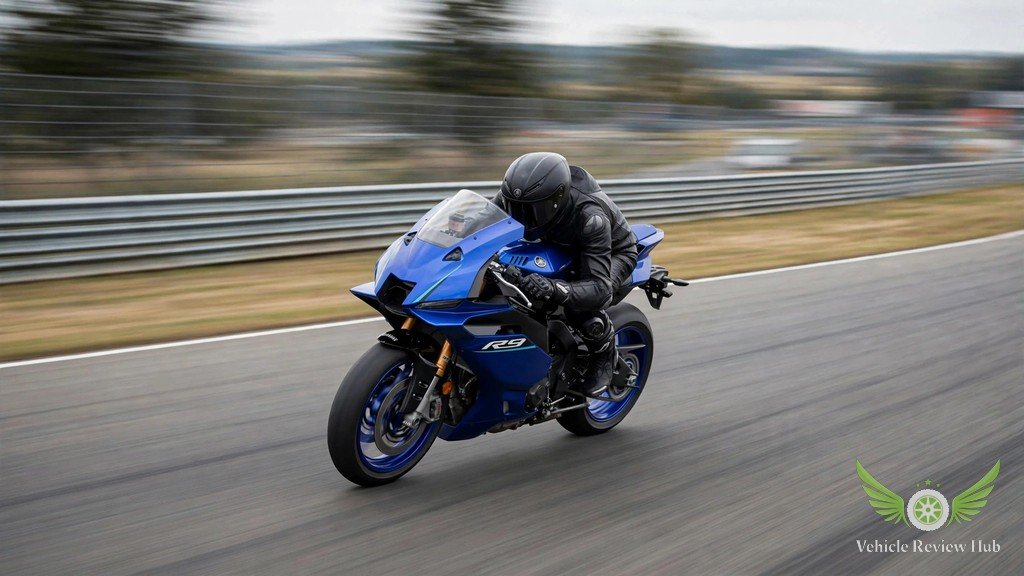
Why No Instrumented 0-60, Quarter Mile or Top Speed Test Exists Yet
As of October 2026, no major outlet found in this research has published an instrumented, GPS- or timing-verified 0-60 mph, quarter-mile or top-speed test for a stock US-spec YZF-R9, with stated conditions and rider weight. Press riding has been dominated by track launches and first rides, including RevZilla’s Sonoma day, where the street ride was scratched because test bikes arrived too late for road registration, and by shootouts judging character rather than timed acceleration. That gap is normal for a second-year model, but any page quoting a precise Yamaha YZF-R9 performance acceleration figure as a test result overstates its evidence.
The video above is included honestly: 2 Wheel DynoWorks’ “Yamaha R9 Intake, Exhaust & Tuning Results – It’s now a proper trackday weapon!” shows what intake, exhaust and custom ECU mapping do to Yamaha YZF-R9 performance on the dyno and on track. It is not an instrumented top-speed or acceleration test, and this guide does not claim otherwise.
MotoStatz Pre-Launch Estimates and Why They Are Not Test Results
The estimates still matter as a planning band for Yamaha YZF-R9 performance, because they rest on a known engine, weight and gearing. A 430 lb bike with roughly 106 hp at the wheel should accelerate like a strong middleweight, in line with a 600cc supersport outright and stronger in gear. What estimates cannot settle is the US second-gear restriction: a launch falling into the flat spot will be slower than a clean estimate assumes. The MotoStatz R9 rivals analysis is worth reading for its reasoning.
Yamaha YZF-R9 Mileage and Fuel Economy
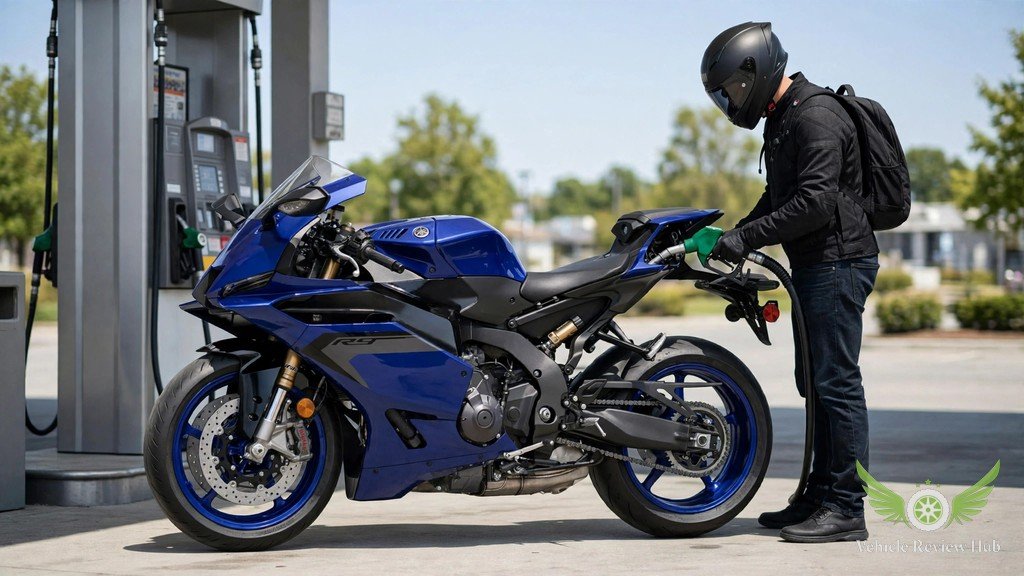
Yamaha YZF-R9 performance on fuel is a small tank plus a reasonably efficient engine, meaning frequent but painless stops. Yamaha lists a 3.7-gallon tank and a 48 mpg estimated figure, and both appear on Yamaha dealer sheets and on Motorcycle.com’s specification page. Theoretical range is about 178 miles, but usable range is less, as the next sections show.
Official Yamaha 48 MPG Estimate and 3.7-Gallon Tank
The 48 mpg figure is an estimate, and Yamaha marks it as estimated. That matters for Yamaha YZF-R9 performance planning, because a controlled-condition estimate will not match a track day or a fast highway run. The maths is simple: 3.7 gallons at 48 mpg gives about 178 miles, at 40 mpg gives 148 miles, and at 35 mpg gives about 130 miles. A sensible rule for Yamaha YZF-R9 performance touring is to look for fuel at 130 to 150 miles.
| Riding style | Planning mpg (US) | Range on 3.7 gallons |
|---|---|---|
| Yamaha estimate, mixed riding | 48 mpg | About 178 miles |
| Steady highway and back roads | About 43 to 45 mpg | About 159 to 167 miles |
| Spirited street riding | About 40 mpg | About 148 miles |
| Track day or hard canyon pace | Well below 35 mpg | About 130 miles or less |
| Planning rule | Do not rely on the last gallon | Look for fuel at 130 to 150 miles |
RevZilla Street Ride Around 43 MPG and Real-World Range
This heading needs the same honesty as the dyno heading, because the RevZilla figure in it does not check out as the heading suggests. RevZilla’s published R9 first ride is a track ride at Sonoma, not a street ride, and the writer states plainly that the team did not get to ride the R9 on the street. That article reports no street fuel-economy figure, and no 43 mpg figure was found in it in this research. Do not credit a 43 mpg street figure to RevZilla on that basis, and this guide does not do so. The number 43 remains useful only as a planning figure in the middle of the real-world band, not as a RevZilla test average.
Real-world Yamaha YZF-R9 performance fuel use is a band, not a single number. UK road coverage reported spirited riding at 53 mpg imperial, about 44 mpg US, inside the table’s band above. The safe expectation for Yamaha YZF-R9 performance is therefore mid-40s US mpg mixed, high-40s gently, low-40s or below when ridden hard, and much less on track. Use 43 mpg only as a planning number, not a RevZilla result.
Yamaha YZF-R9 Real-World Riding Performance
Yamaha YZF-R9 performance in the real world is where the bike earns its price, because the CP3 triple was designed for streets first and tracks second. Reviewers describe immediate torque, a forgiving power spread, and a chassis feeling lighter than its 430 lb figure suggests.
City Riding, Traffic Performance and Everyday Acceleration
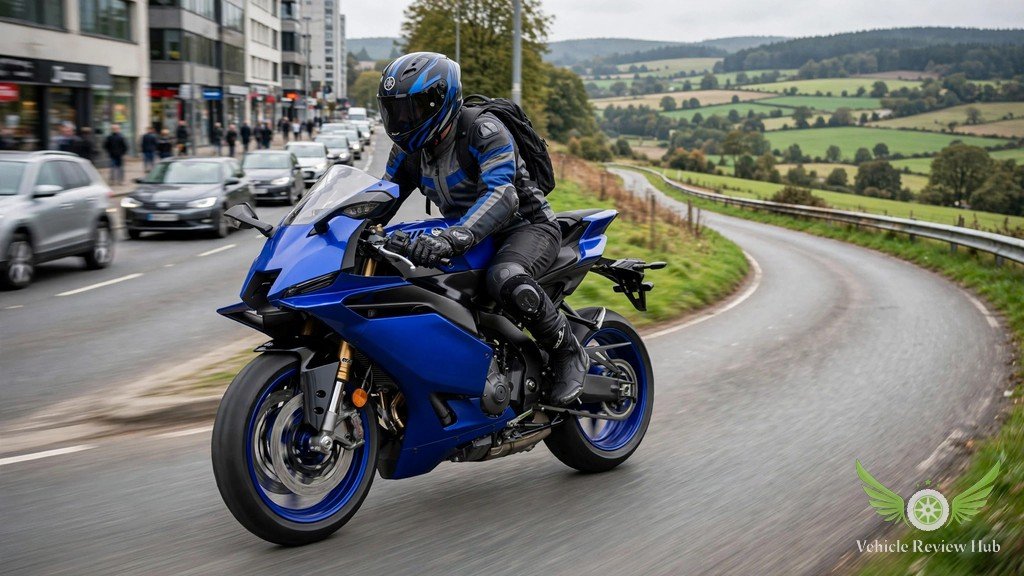
In city riding, Yamaha YZF-R9 performance is helped by torque and hurt slightly by ergonomics and the second-gear flat spot. Torque above 50 lb-ft from low revs pulls cleanly from a light without a screaming launch, and the third-generation quickshifter, assist-and-slipper clutch and light clutch action ease stop-start riding. Standard cruise control also helps on longer urban arterials. Those are genuine everyday strengths for Yamaha YZF-R9 performance, and why reviewers call the bike approachable despite its supersport looks.
Highway Riding, Overtaking Ability and Track-Day Limitations
On the highway, Yamaha YZF-R9 performance is strong where it counts: overtaking. Midrange torque gives immediate acceleration from 60 mph in fourth or fifth gear without a double downshift, and the fairing and winglets keep the front planted at sustained speed. Cruise control helps on long stretches, the 5-inch TFT is easy to read, and stability at speed is repeatedly praised. For a middleweight, Yamaha YZF-R9 performance on the highway is closer to a litre bike’s ease than a 600’s effort, because torque, not peak power, does the overtaking work.
Yamaha YZF-R9 Handling, Braking and Stability
Yamaha YZF-R9 performance is not only about the engine. The R9 uses a gravity-cast aluminium Deltabox frame that Yamaha describes as the lightest aluminium frame ever offered on a Yamaha supersport, with a claimed near-50/50 weight distribution, 55.9-inch wheelbase, 22.6 degrees of rake and 3.7 inches of trail.
Fully Adjustable KYB Suspension, Chassis, Tires and Cornering Control
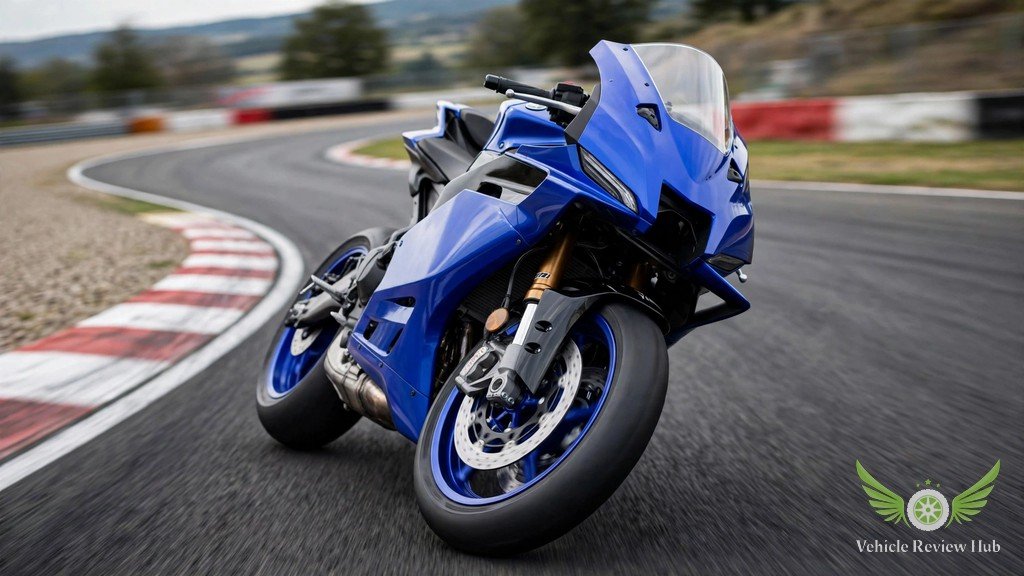
Suspension is fully adjustable at both ends, central to Yamaha YZF-R9 performance for different rider weights. Up front is a 43 mm KYB inverted fork, 4.7 inches of travel, adjustable for preload, high- and low-speed compression and rebound, using KYB’s Separate Damping Force design. At the rear is a KYB shock, 4.6 inches of travel, also fully adjustable, with a remote preload adjuster far easier than a spring spanner. Standard tyres are Bridgestone Battlax Hypersport S22, 120/70R17 front and 180/55R17 rear, proven for street and track-day use.
Cornering control comes from a six-axis IMU feeding lean-sensitive traction, slide, lift and brake control, launch control and ride modes including Sport, Street and Rain, plus custom maps and track settings. For Yamaha YZF-R9 performance, the effect is confidence on a wet road or cold tyre, and settings can be reduced as skill grows. Set sag and damping for your weight before judging Yamaha YZF-R9 performance handling, because another rider’s setup will mask what the chassis can do.
Brembo Stylema Calipers, 320mm Discs and Switchable Rear ABS
Braking is a clear Yamaha YZF-R9 performance strength. Front brakes are dual Brembo Stylema four-piston monobloc calipers on 320 mm discs, with a Brembo radial master cylinder and stainless lines, praised by RevZilla as race-grade in feel, with a firm lever and excellent feedback. The rear is a Nissin single-piston caliper on a 220 mm disc. The split is deliberate: the front stops the bike, the rear steadies it and helps on corner entry.
Switchable rear ABS is often misunderstood, so state it exactly. The rider can switch off rear-wheel ABS for track use, while IMU-informed front ABS remains active, the arrangement described across R9 coverage and in Cycle News’ long-term review. That matters for Yamaha YZF-R9 performance on track, while on the road rear ABS should stay on to prevent a locked rear wheel in a panic stop.
Yamaha YZF-R9 Performance Compared With Other Supersport Bikes
Yamaha YZF-R9 performance only makes sense in comparison. The R9’s answer is torque and usability; the Ducati Panigale V2’s answer is light weight and twin character; the Suzuki GSX-R750’s answer is old-school four-cylinder revs and value.
Yamaha YZF-R9 vs Suzuki GSX-R750 and Ducati Panigale V2 on the Dyno
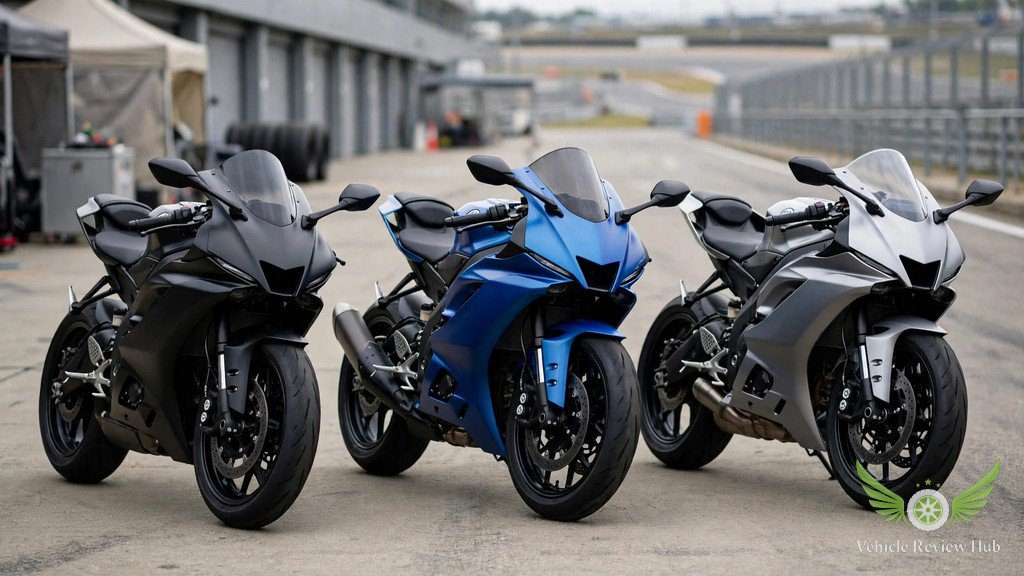
On claimed power and weight, Yamaha YZF-R9 performance sits between its rivals. The R9 claims 117 hp at 10,000 rpm and weighs 430 lb wet, 431 lb on Motorcycle.com’s shootout scales. The 2025 Ducati Panigale V2 claims 120 hp at 10,750 rpm and 69 lb-ft at 8,250 rpm, weighs 419 lb wet on the same scales, and costs $15,995 base against the R9’s $12,499. The Suzuki GSX-R750, an older 750cc four, weighs 428 lb wet and remains the revviest of the three. The Motorcycle.com 2025 supersport shootout is the source for the shootout weights and scores used here.
On the dyno, the honest comparison is limited by the same gap noted earlier: no widely published R9-specific run was found, so a direct wheel-to-wheel table cannot be built from verified R9 data. Yamaha YZF-R9 performance at the wheel, roughly 104 to 110 hp from the CP3 platform, trails the Ducati’s claimed 120 hp on peak power but beats both rivals on midrange delivery. For in-gear acceleration, Yamaha YZF-R9 performance compares well; for peak power, the Ducati and Suzuki have arguments, and the US second-gear restriction counts against the R9 until tuned. The Motorcycle.com R9 first look makes the same point about CP3 torque.
| Bike (2025) | Engine | Claimed power | Shootout wet weight | US MSRP |
|---|---|---|---|---|
| Yamaha YZF-R9 | 117 hp at 10,000 rpm | 890cc CP3 triple | 431 lb | $12,499 |
| Ducati Panigale V2 | 890cc V-twin | 120 hp at 10,750 rpm | 419 lb | $15,995 |
| Suzuki GSX-R750 | 750cc inline four | Higher-revving four, older design | 428 lb | Check current Suzuki pricing |
Is the Yamaha YZF-R9 Suitable for Experienced Riders and Track Days?
Yes, with two qualifications. First, Yamaha YZF-R9 performance is genuinely suitable for experienced riders and track days, because chassis, brakes, electronics and torque are track-capable, and debut-season racing success proves the platform above most owners’ level. Second, the stock US bike’s flat spot and lack of a steering damper mean an experienced track rider will likely want a flash, a damper and a setup first.
For riders from a 600cc four, Yamaha YZF-R9 performance will feel different rather than simply faster or slower: more torque everywhere and a wider margin on corner exit. For riders from a litre bike, the R9 feels lighter and more manageable. The right buyer for Yamaha YZF-R9 performance is an experienced rider wanting real speed without litre-bike excess, willing to set the bike up for their weight and riding. The sibling YZF-R9 review covers price and ownership in more depth.
Frequently Asked Questions About Yamaha YZF-R9 Performance
These answers cover the questions US buyers ask most about Yamaha YZF-R9 performance, using verified figures where they exist and saying plainly where a figure is an estimate or unverified.
How much horsepower does the Yamaha YZF-R9 make?
For Yamaha YZF-R9 performance, Yamaha claims 117 horsepower at 10,000 rpm at the crankshaft. At the wheel, the CP3 platform typically measures roughly 104 to 110 hp, with Motorcycle.com quoting about 106 hp at the wheel for the MT-09 version. No widely published R9-specific dyno run was found, so treat any single wheel figure as an estimate.
What is the Yamaha YZF-R9 top speed?
For Yamaha YZF-R9 performance, Yamaha publishes no top speed, and no major outlet has published an instrumented test for a stock US bike as of October 2026. The bike should reach well above 150 mph, but any precise figure quoted as a test result overstates the evidence.
What is the Yamaha YZF-R9 0-60 mph time?
For Yamaha YZF-R9 performance, No published instrumented 0-60 mph test from a major outlet exists for the stock US R9. MotoStatz pre-launch estimates put 0-60 mph at 3 seconds flat and 0-100 mph at around 6 seconds flat, but those are estimates, and a launch in the US second-gear flat spot could be slower.
What is the Yamaha YZF-R9 quarter-mile time?
For Yamaha YZF-R9 performance, No instrumented quarter-mile test from a major outlet was found. MotoStatz pre-launch estimates suggest a mid to high 10-second quarter mile at around 130 to 132 mph. Treat that as an expected band, not a tested result.
Does the Yamaha YZF-R9 have a second-gear restriction?
For Yamaha YZF-R9 performance, yes, on North American bikes. RevZilla and Motorcycle.com report Yamaha limits throttle-plate angle below about 6,000 rpm for noise-emissions reasons, creating a flat spot felt most in first and second gear. Yamaha staff confirmed it to Motorcycle.com, and RevZilla measured about 30 percent throttle-plate lag on a second-gear exit.
Will an ECU flash fix the Yamaha YZF-R9 flat spot?
For Yamaha YZF-R9 performance, Reviewers and tuning firms report a reflashed ECU, often with an aftermarket exhaust, can largely remove the flat spot. A flash is a modification with warranty and emissions consequences, so check those first, and treat any claimed gain as a tuning claim, not a Yamaha figure.
What is the Yamaha YZF-R9 fuel economy and range?
For Yamaha YZF-R9 performance, Yamaha estimates 48 mpg, with a 3.7-gallon tank giving about 178 miles in theory. In mixed street riding, plan mid-40s US mpg and a practical range of 150 to 165 miles, looking for fuel at 130 to 150 miles. Track riding uses far more fuel.
Is the RevZilla 43 mpg figure a real test result?
For Yamaha YZF-R9 performance, no, not on the evidence found. RevZilla’s R9 first ride was a track ride at Sonoma with no street riding and no street fuel-economy figure. Use 43 mpg only as a cautious planning number, not as a RevZilla test average.