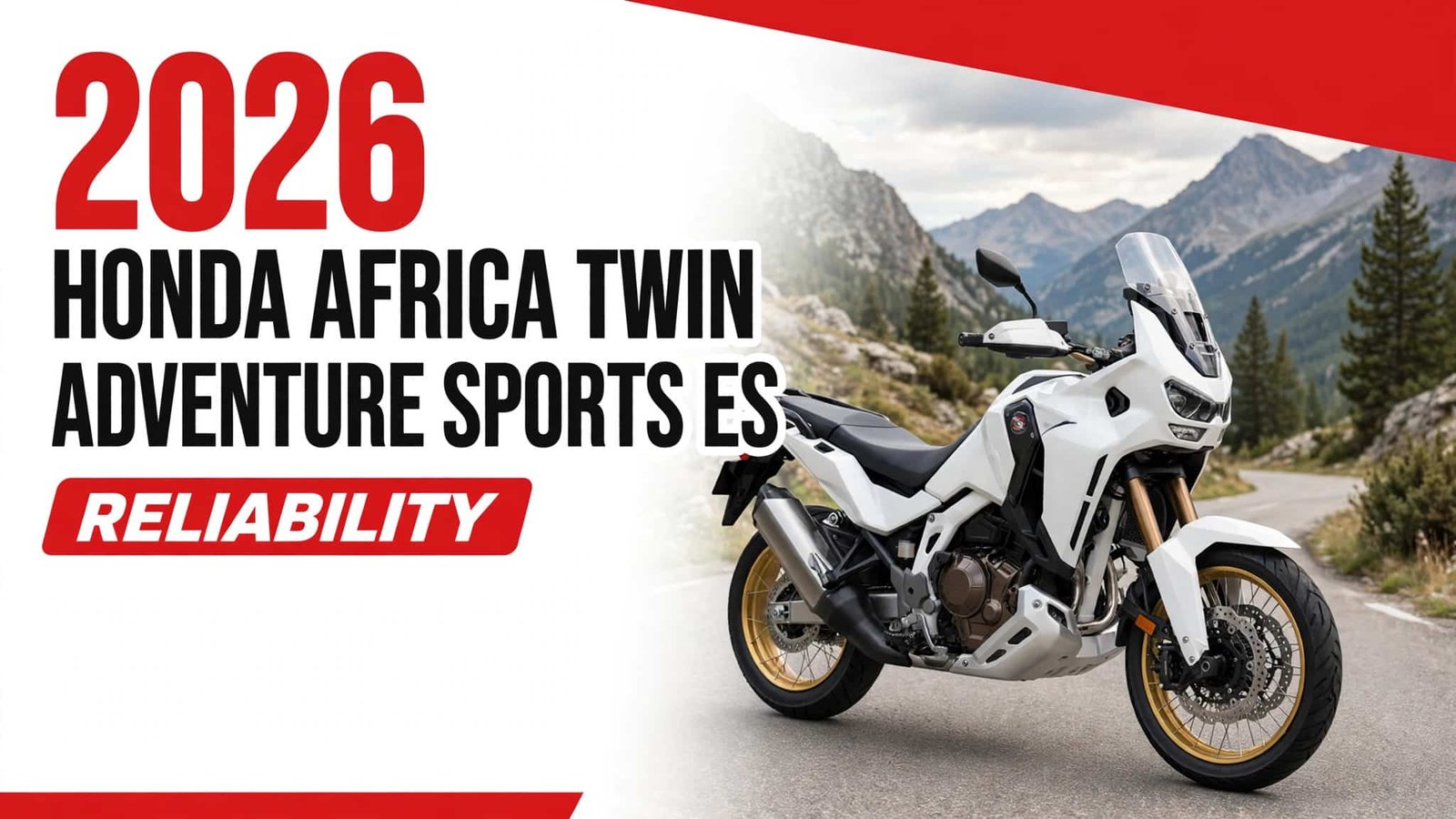
Yes, the Honda Africa Twin Adventure Sports ES is reliable — with two honest qualifications that matter more than any headline score. Its engine, gearbox and frame share the proven CRF1100 platform, and the big-ticket failures owners fear most are rare. But its touchscreen and electronic suspension are also its known weaknesses. This guide to Honda Africa Twin Adventure Sports ES reliability covers owner data, the touchscreen fault, the service schedule, tires, brakes, EERA checks, costs, and the recalls to check by VIN.
The short version of Honda Africa Twin Adventure Sports ES reliability is simple: buy on history and paperwork, not on a star rating. Judge an ES by its file, a cold screen test, an EERA check, and a VIN lookup — those four checks tell you more about Honda Africa Twin Adventure Sports ES reliability on one bike than any averaged score could.
Honda Africa Twin Adventure Sports ES Reliability Overview
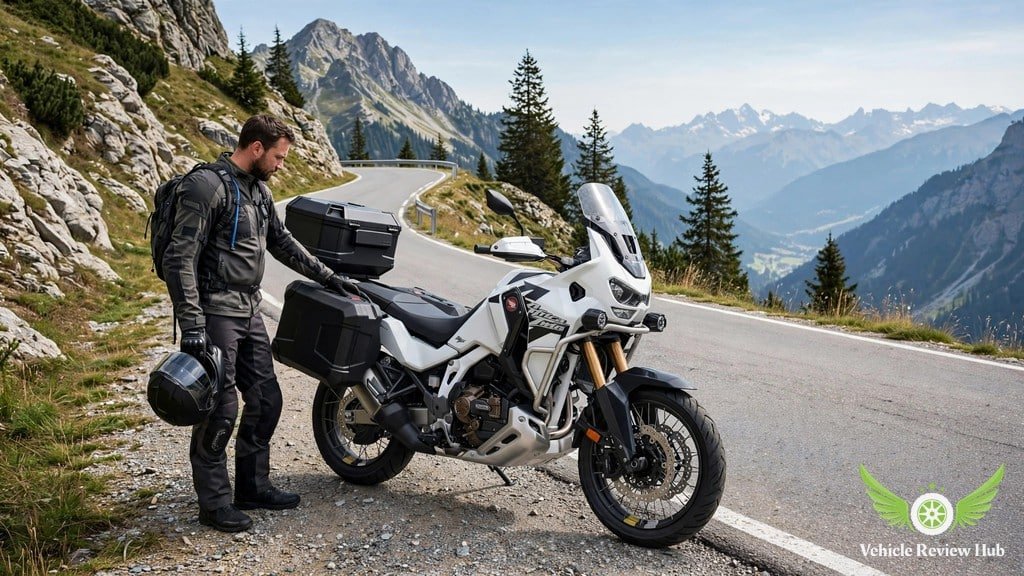
Honda Africa Twin Adventure Sports ES reliability starts from a strong base: the 1084cc Unicam parallel twin, the six-speed manual or DCT gearbox, and the steel frame are shared with the standard Africa Twin, a platform with a long record of high-mileage service. The ES adds a 6.6-gallon tank, larger fairing, heated grips and EERA suspension. For Honda Africa Twin Adventure Sports ES reliability, the powertrain is the least of your worries; the screens, sensors and suspension electronics deserve the attention.
Why Owner Data for This Variant Is Too Small to Quote as a Rating
Any seller or article quoting an owner rating for this variant should be challenged, because the numbers behind it are too thin to mean anything. Published owner-review counts are a handful for the Adventure Sports line and just one for the ES DCT. A single review cannot be an average, and four reviews cannot support a decimal-point score. That is why this guide refuses to print a star rating for Honda Africa Twin Adventure Sports ES reliability: presenting one would dress up a tiny sample as a measurement. For Honda Africa Twin Adventure Sports ES reliability, treat any quoted owner score as marketing until the reviewer shows you a sample size in the dozens at least. The full Adventure Sports ES review covers how it rides.
Before going further, watch a comparison ride that shows the ES as it really is on the road. The video below is a comparison test against a rival, not a service guide, but it shows the ES touring character in real riding — useful context for Honda Africa Twin Adventure Sports ES reliability as a lived-with machine.
How Mileage, Maintenance History and Previous Use Affect Reliability
Mileage alone tells you little about Honda Africa Twin Adventure Sports ES reliability. A 40,000-mile ES with dealer stamps every 8,000 miles, valve receipts at 16,000 and 32,000 miles, and completed recall paperwork is usually safer than a 10,000-mile ES that sat unridden, missed services and never had its recalls checked. Service history matters more than the odometer because the expensive ES items — valves, EERA diagnostics, screen replacement — are interval-driven. Ask for receipts, not just stamps. Previous use matters too: touring bikes show even wear, hard off-road bikes show bent levers and damaged fairing bodywork. For Honda Africa Twin Adventure Sports ES reliability, the file beats the odometer every time.
Honda Africa Twin Adventure Sports ES Common Problems and Wear Items
Honda Africa Twin Adventure Sports ES reliability has no single defining engine fault. Its known problems are electronic and consumable: the touchscreen, the DCT service items, the chain, and the battery and switchgear.
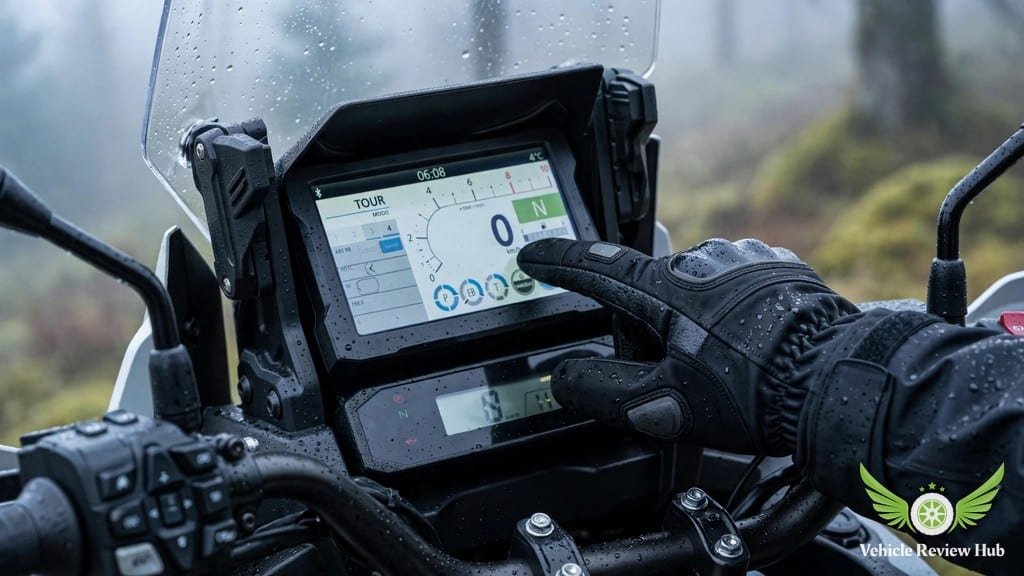
TFT Touchscreen Failures in Cold Weather and Screen Checks
The touchscreen is the best-documented ES niggle, and it deserves a careful telling for Honda Africa Twin Adventure Sports ES reliability. MotorCycle News, in its long-running Adventure Sports coverage, reports that the touchscreen dash introduced on the 2021 model can stop responding to touch altogether, especially in colder climates, and that years later the issue still appears without a permanent fix. Owners have had faulty units replaced under warranty, though MCN notes a replacement can develop the same issue. The practical consequence for Honda Africa Twin Adventure Sports ES reliability is a check procedure, not panic. Test the screen cold: tap every zone including edges, switch modes from the screen, pair Bluetooth, and confirm the handlebar switches still drive the menus. If any zone is dead when cold, price in a dealer visit: the display is a unit replacement. Read the full account in MCN’s Adventure Sports review before you judge a used bike’s screen.
DCT Clutch Filters, Chain, Sprockets, Battery and Electrical Checks
The DCT system itself has a good record for Honda Africa Twin Adventure Sports ES reliability, and gearbox trouble is rare. What the DCT adds is servicing cost: a second oil filter, the clutch oil filter (part 15412-MGS-D21), replaced when the engine oil filter is replaced, The chain affects day-to-day Honda Africa Twin Adventure Sports ES reliability more than any gearbox part: Honda calls for inspection and lubrication every 600 miles, and a dry or uneven chain wears sprockets fast. Replace chain and sprockets as a set when either is worn. Electrically, check battery condition, heated grips heating on both settings, horn and beam switching from the left handlebar (loss of either is the 25V-583 symptom), and all indicators plus the brake-light switch. For Honda Africa Twin Adventure Sports ES reliability, the chain and the switchgear are the items that catch buyers out — both are cheap to check and expensive to ignore.
Honda Africa Twin Adventure Sports ES Maintenance Schedule and Servicing
The factory schedule is the backbone of Honda Africa Twin Adventure Sports ES reliability, and it is the same schedule for the standard bike, the DCT and both Adventure Sports versions. Oil every 8,000 miles and valves every 16,000, with the ES extras checked alongside.
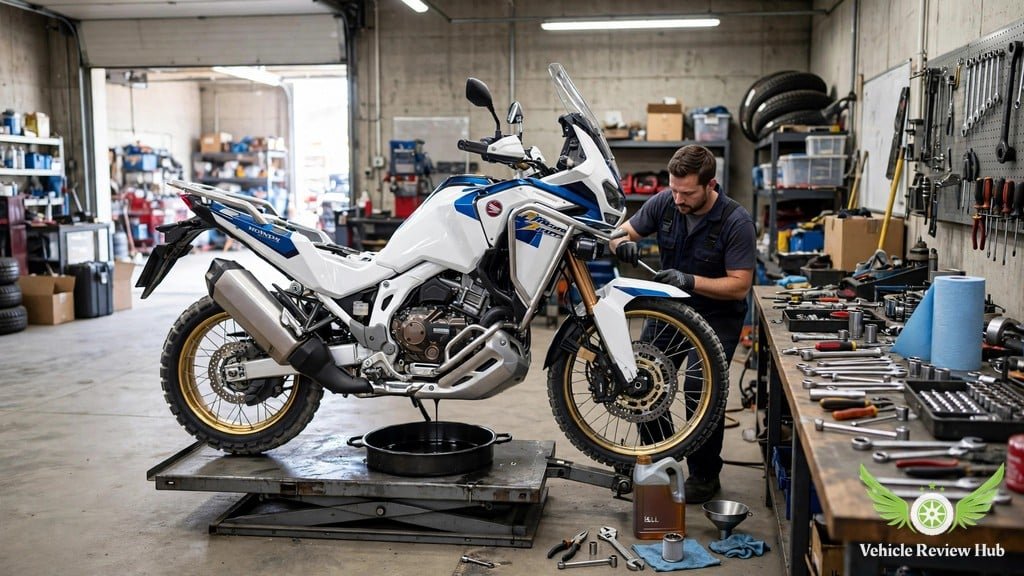
First Service at 600 Miles, Oil Every 8,000 Miles and Routine Checks
Engine oil changes fall every 8,000 miles or 1 year, whichever comes first, after an initial service at 600 miles: the single most important habit for Honda Africa Twin Adventure Sports ES reliability. The manual specifies JASO MA, SAE 10W-30, API SJ or higher. Capacities: manual 4.1 quarts drained / 4.2 with filter; DCT 4.2 / 4.4 with engine and clutch filters. The chain is inspected and lubricated every 600 miles with freeplay kept at 35–45 mm, plus the routine checklist (fuel lines, throttle, cooling, brakes, suspension, lights, bearings, fasteners). See the CRF1100L maintenance schedule for the full chart. Skipped oil services are the fastest way to damage Honda Africa Twin Adventure Sports ES reliability.
| Item | Interval | Notes |
|---|---|---|
| First service | 600 miles | Initial service |
| Engine oil | Every 8,000 miles or 1 year | 10W-30, JASO MA |
| Oil filter (+ clutch filter on DCT) | Every 16,000 miles | DCT adds clutch filter 15412-MGS-D21 |
| Valve clearance | Every 16,000 miles or 2 years | Adjust if needed |
| Air cleaner | Every 24,000 miles or 2 years | Dealer service item |
| Spark plugs | Every 32,000 miles | Inspect at 16,000 |
| Chain care | Every 600 miles | Freeplay 35–45 mm |
| Brake fluid | Every 2 years | Replace, DOT 4 |
| Radiator coolant | Every 3 years | Honda Long-life, 50-50 premix |
Valve Inspection at 16,000 Miles, Plugs at 32,000 and Air Cleaner at 24,000
Valve clearance is the small camshaft-to-valve gap, which changes slowly as valves and seats wear. The manual calls for inspection every 16,000 miles or 2 years, adjusting only valves outside specification. Treat a used ES approaching 16,000 or 32,000 miles without a valve receipt as a bike with a bill coming. Spark plugs are inspected at 16,000 miles and replaced at 32,000, and the air cleaner is replaced every 24,000 miles or 2 years per the manual — one review states 16,000 for the air cleaner, but this guide follows the manual. Valve receipts at the right intervals tell you more about Honda Africa Twin Adventure Sports ES reliability on one bike than any advert claim.
Honda Africa Twin Adventure Sports ES Tires, Brakes and Suspension Maintenance
Tires, brakes and suspension decide how an ES feels and stops, and good maintenance here protects Honda Africa Twin Adventure Sports ES reliability directly.
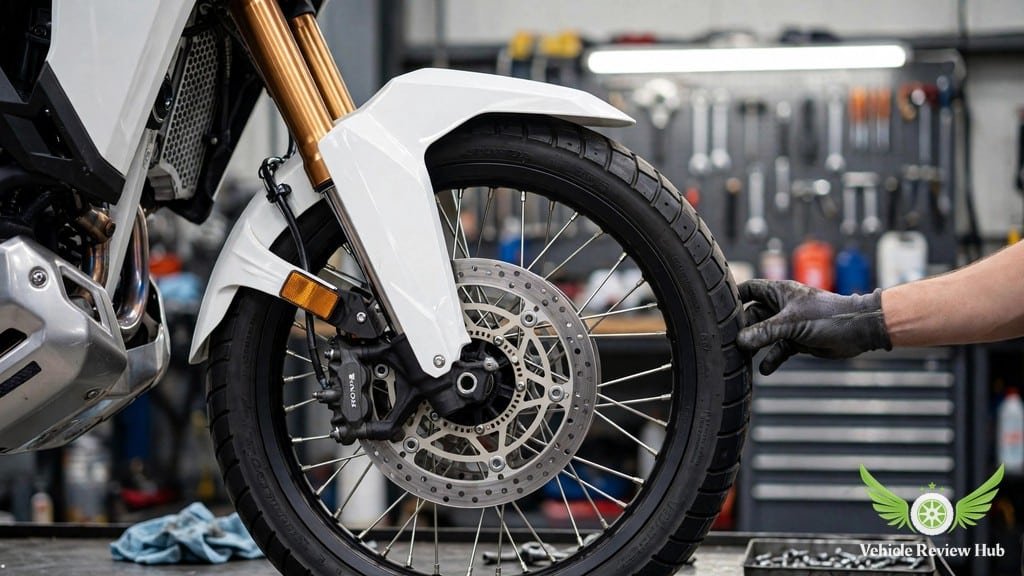
Tire Condition, Pressure, Tread Wear and Replacement
Tire sizes changed with the ES generations, so check the year before ordering rubber. The 2024-on ES runs a 110/80-19 front and a 150/70-18 rear on tubeless spoked wheels, while the 2020–2022 ES ran a 90/90-21 front with the same 150/70-18 rear. The CRF1100 manual label lists 33 psi front and 36 psi rear for rider only, and 33 psi front and 41 psi rear with a passenger; confirm against the label on your own bike, since the front size changed in 2024. Correct tire care is part of Honda Africa Twin Adventure Sports ES reliability: keep the sizes year-correct and the pressures at the label figures.
Brake Pads, Brake Fluid Every Two Years and EERA Suspension Checks
Braking comes from dual 310 mm front discs with four-piston calipers and a single 256 mm rear disc, ; cornering ABS is standard. Check pad thickness at every service: worn pads score discs. Check discs for warping, scoring or a lip, and replace DOT 4 fluid every 2 years. The EERA suspension needs its own checks on top of the mechanical ones. Cycle all suspension modes and confirm damping changes; run electronic preload through its range; look for oil mist on fork tubes and shock; send any frozen mode or warning to dealer diagnostics. For Honda Africa Twin Adventure Sports ES reliability, maintained EERA suspension feels precise at high mileage, while a neglected system is why a used ES can feel tired despite a healthy engine. See the performance figures for what the chassis delivers.
Honda Africa Twin Adventure Sports ES Maintenance and Ownership Costs
Costs are moderate for a big adventure bike — fuel, tires and servicing dominate — but the ES adds an electronics contingency. That is the practical meaning of Honda Africa Twin Adventure Sports ES reliability for your wallet.
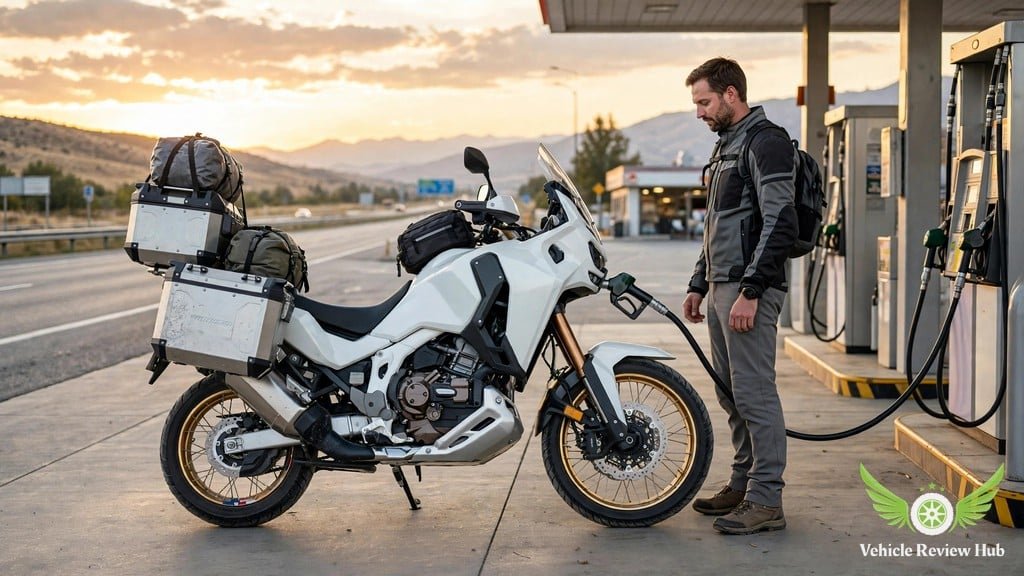
Fuel, Routine Servicing, Tires and Replacement Parts
Fuel is the most frequent cost. Honda USA publishes no official MPG figure for this bike, so owner data and arithmetic have to do the work — honestly labelled. Owners commonly report roughly 40–50 mpg mixed use; on the 6.6-gallon tank that is roughly 264–330 miles. The oft-quoted 47.8 mpg figure is Fuelly’s owner-logged average for the 2017 CRF1000L ABS standard model, not an ES test; as arithmetic on the ES tank it implies roughly 315 miles, but it is not a measured ES result. Replacement parts are a strength for Honda Africa Twin Adventure Sports ES reliability: pads, chains, sprockets, filters and fork seals are stocked items, not special orders.
Repair Expenses, Parts Availability and Long-Term Ownership Costs
Repair expenses stay low when maintenance stays on schedule, because expensive powertrain failures are rare. Low repair frequency is itself a Honda Africa Twin Adventure Sports ES reliability strength. The repairs owners do face are mostly this guide’s items: screen replacement, EERA diagnostics, fork work and fairing damage. Parts availability is good, and the one-year transferable warranty plus optional HondaCare help long-term costs. Budget a contingency for electronics. A TFT unit or an EERA component is a dealer-priced part in a way a chain is not, so a used ES without warranty cover deserves a larger first-year reserve than a standard bike. That contingency, kept aside, is what makes Honda Africa Twin Adventure Sports ES reliability affordable in practice.
How to Keep a Honda Africa Twin Adventure Sports ES Reliable
Keeping Honda Africa Twin Adventure Sports ES reliability strong means doing the small jobs on time, checking the electronics deliberately, and never letting a recall go unchecked.
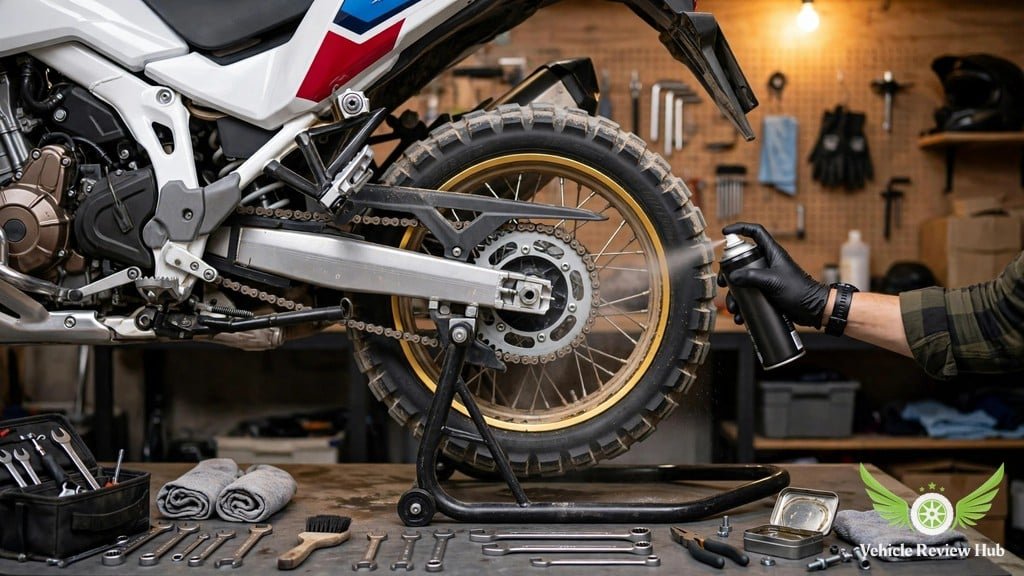
Preventive Maintenance, Coolant Every Three Years and Regular Inspections
Start with the chain: inspect and lubricate every 600 miles, keep freeplay at 35–45 mm, and replace chain and sprockets together when worn. Change the oil every 8,000 miles or yearly with the specified 10W-30 JASO MA oil, not a car oil with friction modifiers. Replace coolant every 3 years with Honda Long-life 50-50 premix, and check level and fan operation at every service. Once a year, check fork seals, linkage play, fluid age, air cleaner, spokes, TFT response and EERA operation. All of it is what Honda Africa Twin Adventure Sports ES reliability consists of in practice: a strong engine protected by an owner who does the routine work and checks the electronics on purpose.
Recall Checks: Fuel Tank 20V-797, ECU 24V-882 and Switch Harness 25V-583
Recall checks belong in every purchase, because all three recalls are free to remedy and checked by VIN in minutes. Run the VIN through Honda’s recall lookup and the NHTSA recall tool before you buy, One scope warning matters for Honda Africa Twin Adventure Sports ES reliability: the ECU and switch-harness filings name the CRF1100 line generally, not the ES trim specifically, so a given ES may or may not be inside each campaign — only a VIN check answers that. The fuel-filter recall is the exception: it is Adventure Sports line history, and it does apply here.
| Recall | Scope | Units | Remedy |
|---|---|---|---|
| Fuel filter 20V-797 (Honda KL4) | Certain 2018–2019 CRF1000L Adventure Sports + certain 2020 CRF1100L Adventure Sports | 2,690 | Drain and clean tank, replace filter, free |
| ECU 24V-882 (Honda KR1) | Certain 2022 + 2024–2025 CRF1100 — VIN check whether an ES is included | 4,205 | FI-ECU reprogram, free; letters Jan 2025 |
| Switch harness 25V-583 (Honda KS8) | Certain 2020–2022 + 2024–2025 CRF1100 — VIN check whether an ES is included | 7,492 | Redesigned switch assembly, free; remedy letters Jan 2026 |
| Also check: 2020–2021 ECU/DCT recall (Honda KNB) | Certain 2020–2021 CRF1100, incl. early ES | ~1,561 | ECU reprogram, free |
The fuel-filter recall covers weld contaminants clogging the filter; dealers drain and clean the tank and replace the filter free. The ECU recall covers an FI-ECU error that can stall the engine when Wheelie Control activates. The switch-harness recall covers corrosion at the left handlebar switch terminals that can cause horn or beam loss, failing FMVSS No. 108; ADV Pulse’s report confirms the 7,492-unit scope and redesigned part. See the buying guide and the standard reliability guide for more. For Honda Africa Twin Adventure Sports ES reliability, an unchecked VIN is an unfinished inspection.
Honda Africa Twin Adventure Sports ES Reliability FAQs
These are the questions buyers and owners ask most about Honda Africa Twin Adventure Sports ES reliability.
Is the Honda Africa Twin Adventure Sports ES reliable?
Yes, with the qualifications in this guide. Honda Africa Twin Adventure Sports ES reliability rests on a proven engine and frame, with the known weaknesses concentrated in the touchscreen and the electronic suspension rather than the powertrain.
What is the most common problem on an Adventure Sports ES?
The touchscreen. Honda Africa Twin Adventure Sports ES reliability reporting consistently names the 2021-onward TFT dash stopping responding to touch, especially in colder climates, as the best-documented niggle, with warranty replacement the usual remedy.
How often does an Adventure Sports ES need an oil change?
Every 8,000 miles or 1 year, whichever comes first, after an initial service at 600 miles. That interval is the foundation of Honda Africa Twin Adventure Sports ES reliability. Use SAE 10W-30 meeting JASO MA and API SJ or higher.
When does the ES need a valve-clearance inspection?
Every 16,000 miles or 2 years. Honda Africa Twin Adventure Sports ES reliability depends on this check, which measures the camshaft-to-valve gap and adjusts only valves outside specification.
Does the DCT version affect reliability?
The DCT system has a good record for Honda Africa Twin Adventure Sports ES reliability, with gearbox trouble rare, though servicing costs slightly more for its clutch oil filter and parking brake.
What recalls should I check on an Adventure Sports ES?
Three recalls matter for Honda Africa Twin Adventure Sports ES reliability: fuel filter 20V-797 (Adventure Sports line), ECU 24V-882, and switch harness 25V-583 — plus the earlier 2020–2021 ECU/DCT recall on early bikes. Check every one by VIN, since the CRF1100-wide filings do not name the ES trim specifically.
Does the fuel-filter recall affect the Adventure Sports ES?
Yes — unlike the standard model, this is Adventure Sports line history. Honda Africa Twin Adventure Sports ES reliability reporting is often confused here, but 20V-797 covers certain 2018–2019 CRF1000L Adventure Sports and certain 2020 CRF1100L Adventure Sports models, 2,690 units in total.
How often should the coolant be changed?
Every 3 years, using Honda Long-life coolant as a 50-50 premix. Honda Africa Twin Adventure Sports ES reliability suffers when coolant is forgotten, so check the level and fan operation at every service.
What tire sizes and pressures does the ES use?
The 2024-on ES uses a 110/80-19 front and 150/70-18 rear on tubeless spoked wheels; the 2020–2022 ES used a 90/90-21 front. Honda Africa Twin Adventure Sports ES reliability includes checking the manual-label pressures — 33 psi front, 36 psi rear solo, 41 psi rear two-up — cold, against your own bike’s label.
Is the EERA suspension reliable?
Mechanically it is conventional Showa hardware, but its electronics need deliberate checks. Honda Africa Twin Adventure Sports ES reliability for the suspension means cycling all modes, running the electronic preload through its range, checking for oil mist, and sending any frozen mode or warning to dealer diagnostics.
Is a high-mileage Adventure Sports ES worth buying?
Often yes, provided the service history is complete. Honda Africa Twin Adventure Sports ES reliability at high mileage depends on the file, not the odometer: on-schedule servicing, a working touchscreen and EERA system, and recall completions usually beat a low-mileage bike with patchy records.