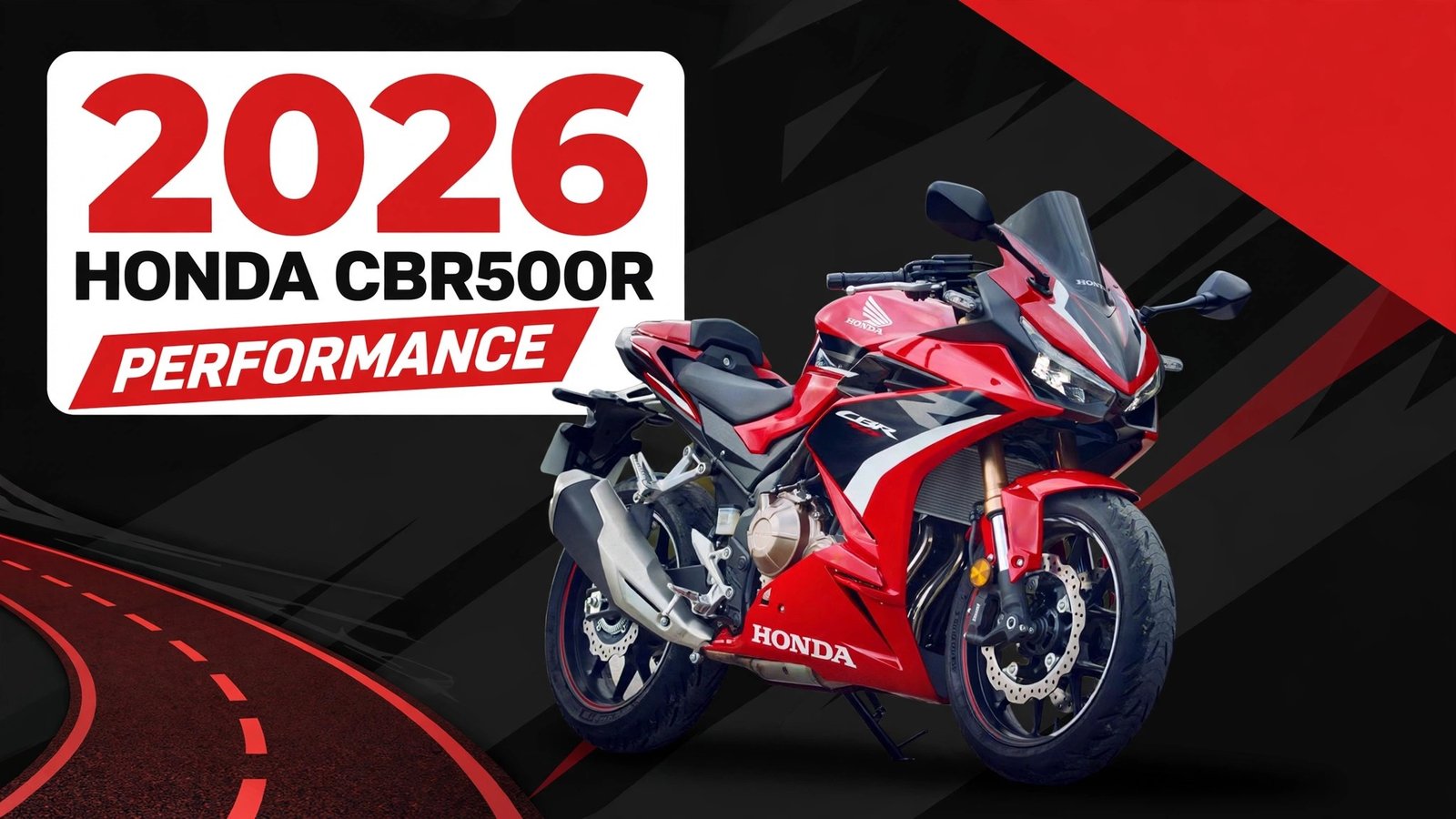
Short answer: Honda CBR500R performance is friendly, usable speed — not superbike speed. The 2026 CBR500R costs $6,399 plus a $600 destination charge and pairs a 471cc liquid-cooled parallel-twin engine with a six-speed gearbox, a 421-pound curb weight and a 4.5-gallon tank. This Honda CBR500R performance guide covers the measured dyno figures, the honest top speed, the tested fuel economy and the real-world riding character, separating verified test data from the licence-limited claims that follow this bike around the internet.
That framing matters because Honda CBR500R performance is easy to misread. European sources quote 47 horsepower, aggregator pages guess at top speed, and fuel-economy claims swing widely depending on who rode the bike. This Honda CBR500R performance guide sticks to named tests: Cycle World on the dyno, MotoStatz on acceleration, RevZilla and Cycle World on fuel economy, and the 2026 price story from RevZilla’s current review.
Honda CBR500R Engine Performance and Power Delivery
The engine is the heart of Honda CBR500R performance: a 471cc liquid-cooled, double-overhead-cam, eight-valve parallel twin with programmed fuel injection through twin 34mm throttle bodies, a 67.0 x 66.8mm bore and stroke and a 10.7:1 compression ratio.
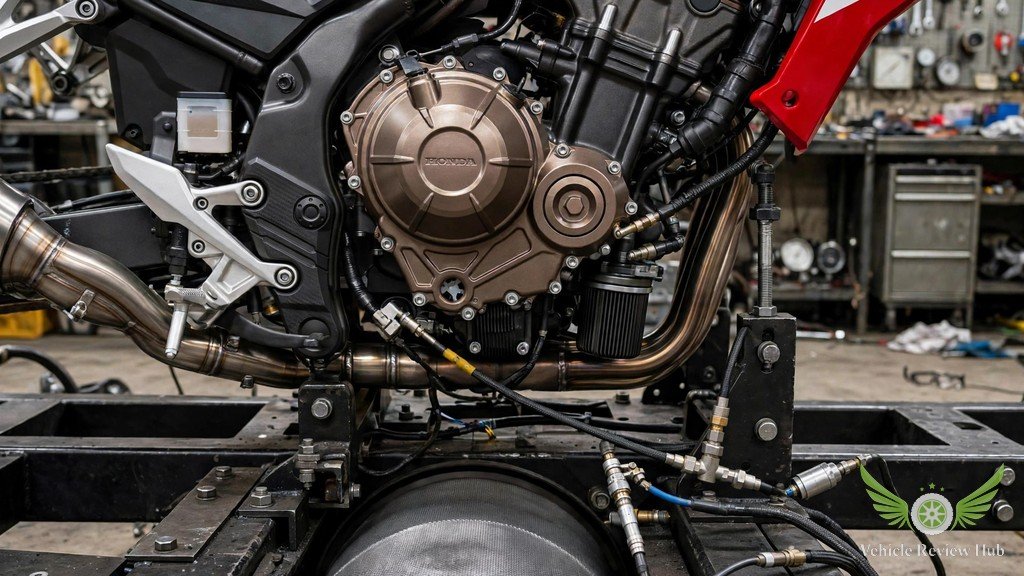
Cycle World Dyno 43.20 HP at 8,280 RPM and 29.77 lb-ft at 6,450
The single most useful Honda CBR500R performance figure comes from Cycle World’s dyno test of the 2022 bike, run on the magazine’s Dynojet 250i dynamometer ahead of its ride review. The CBR500R produced a peak 43.20 horsepower at 8,280 rpm and 29.77 pound-feet of torque at 6,450 rpm at the rear wheel. The shape of the curve matters as much as the peak: Cycle World noted the flat torque curve and linear power delivery, which is exactly what makes the bike easy to ride fast in normal traffic. Peak power arrives high, but usable torque arrives early, so the bike pulls cleanly from low revs without demanding constant gear changes. Honda itself publishes no horsepower figure for the US CBR500R, which is why independent dyno runs carry so much weight in Honda CBR500R performance coverage.
EU Claim 47 HP Is an A2 Licence Figure, Not a US Restriction
Search for Honda CBR500R performance and the number 47 horsepower appears everywhere. That figure is a European A2 licence story, not an American restriction. Cycle World explained the design brief plainly: as a global model sold in many markets, the 471cc twin was engineered to slide under the 47-horsepower limit that qualifies the bike for Europe’s and Southeast Asia’s mid-level A2 learner licences. The US bike carries no such restriction. The honest Honda CBR500R performance reading is therefore two-part: the engine was designed around a 47-horsepower ceiling for licence reasons, and the measured US reality is 43.20 rear-wheel horsepower on Cycle World’s dyno. Quoting 47 horsepower as a US dyno figure would be wrong, and quoting it without the A2 context would mislead buyers about why the number exists. For the full model story, see our full CBR500R review.
Honda CBR500R Top Speed and Acceleration
Top speed is where Honda CBR500R performance claims get loosest, so this section names its source for every number and says plainly where no source exists.
MotoStatz 116.8 MPH at the Limiter and Quarter Mile in 13.51 Seconds
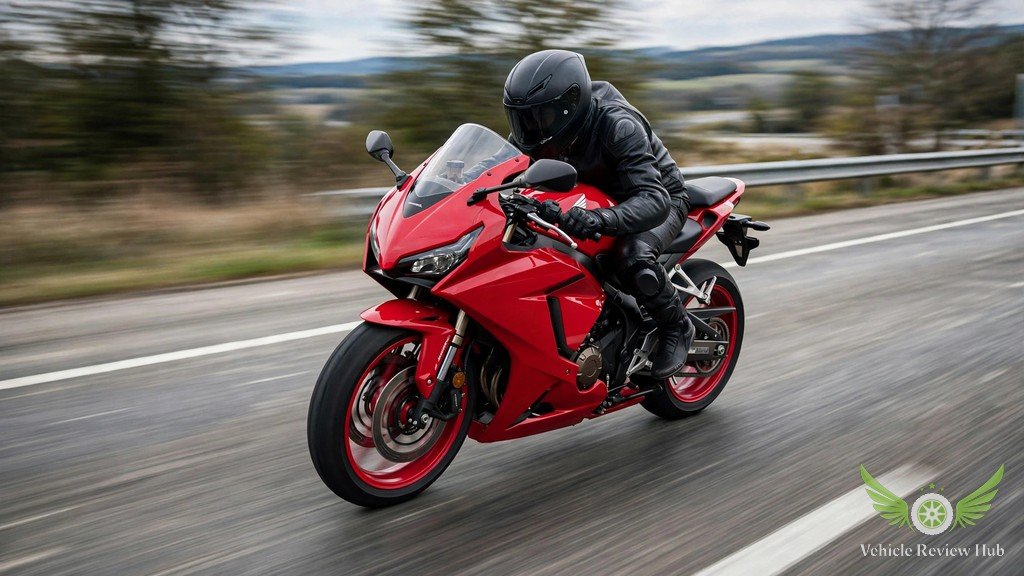
The best instrumented Honda CBR500R performance acceleration data comes from MotoStatz, which tested the bike to 0-60 mph in 4.72 seconds, 0-100 mph in 14.17 seconds and the quarter mile in 13.51 seconds at 98 mph. Top speed, with the rider tucked chin-on-tank, was reached right at the rev limiter in top gear at 116.8 mph — the bike simply has no more to give, because sixth gear runs out of revs rather than running out of power. That limiter detail is important for Honda CBR500R performance honesty: the top speed is a gearing limit, not an aerodynamic wall, so a taller final gear would change it and a lighter rider would not change it much. TopSpeed’s 2023 guide corroborates it at around 115 mph. No Honda CBR500R performance discussion should quote 120 mph or higher; nothing tested supports it.
Why No Major US Outlet GPS Top Speed Run Exists
Here is the gap in Honda CBR500R performance coverage: no major American outlet has published a GPS-verified top-speed run for this bike. Cycle World dyno-tested it and ride-reviewed it, RevZilla reviewed the 2026 bike, and Ultimate Motorcycling ran its fast-facts review — but none of them published a GPS top-speed figure. The bike’s indicated speed is not a verified measurement, and testers have not treated it as one. That is why this Honda CBR500R performance guide leans on MotoStatz for the top-speed number while labelling it as the cited test, rather than presenting 116.8 mph as a universally confirmed GPS fact. Buyers should treat any precise top-speed claim without a named test the same way: interesting, but unverified.
Honda CBR500R Mileage and Fuel Economy
Fuel economy is the CBR500R’s quiet superpower in Honda CBR500R performance terms: a 4.5-gallon tank and a frugal twin mean the bike goes a long way between fill-ups, and the tested numbers back that up.
RevZilla Tested 64 MPG and Around 250 Miles of Real Range
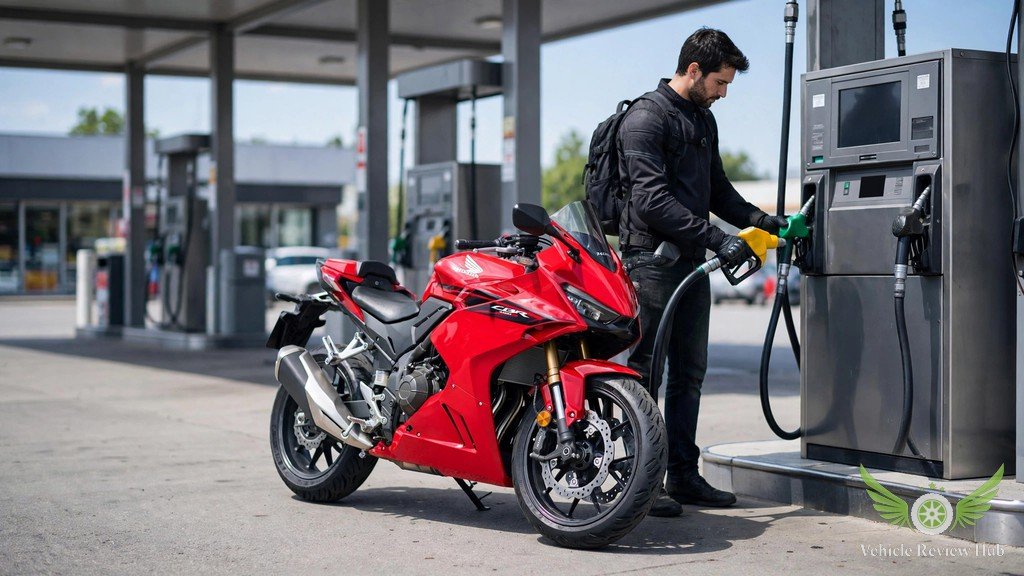
RevZilla’s testing returned 64 miles per gallon for the CBR500R, which works out to around 250 miles of real range from the 4.5-gallon tank once a sensible reserve is kept. Visordown’s two-week test pointed the same way, reporting roughly 60 to 70 mpg and around 250 miles from a full tank. The spread between testers is normal — fuel economy follows riding style — but the centre of the tested band sits in the low-to-mid 60s, not in the 70s. For Honda CBR500R performance buyers, the honest planning number is 250 miles per tank in mixed riding, stretching further on gentle highway runs and shrinking when the bike is ridden hard.
Cycle World Tested 58.4 MPG and the 4.5-Gallon Tank
Cycle World’s tested figure sits lower in the band at 58.4 miles per gallon, and the difference from RevZilla’s 64 mpg is instructive for Honda CBR500R performance readers. Cycle World’s test riding is typically harder and faster than a commuter loop, and aggressive throttle use costs fuel on any motorcycle. At 58.4 mpg, the same 4.5-gallon tank still delivers around 260 miles in theory and roughly 230 to 240 miles before the fuel light demands attention in practice. Honda’s own comparison figure of 72 mpg, quoted by Ultimate Motorcycling with the caveat that it is for comparison purposes only, is a laboratory-style number — and Ultimate Motorcycling’s own tester routinely saw 65 mpg even while riding hard at high speeds in the mountains. Across sources, the fuel story is consistent: mid-50s at worst, mid-60s in normal use.
| Honda CBR500R performance item | Figure | Source |
|---|---|---|
| Engine | 471cc liquid-cooled DOHC parallel twin, 67.0 x 66.8mm, 10.7:1 | Honda specifications |
| Dyno (rear wheel) | 43.20 hp @ 8,280 rpm; 29.77 lb-ft @ 6,450 rpm | Cycle World Dynojet 250i |
| Top speed / quarter mile | 116.8 mph at the limiter; 13.51 sec @ 98 mph | MotoStatz instrumented test |
| 0-60 mph / 0-100 mph | 4.72 sec / 14.17 sec | MotoStatz instrumented test |
| Tested fuel economy | 64 mpg (RevZilla); 58.4 mpg (Cycle World) | Named outlet tests |
| Tank / range | 4.5 gallons; around 250 miles real range | Tank size Honda; range from tests |
| Weight / seat height | 421 lb curb; 31.1-inch seat | Honda specifications |
Honda CBR500R Real-World Riding Performance
On the road, Honda CBR500R performance feels bigger than its numbers suggest, because the torque arrives early and the bike never asks the rider to work hard for its speed.
City Riding, Traffic Performance and Everyday Acceleration
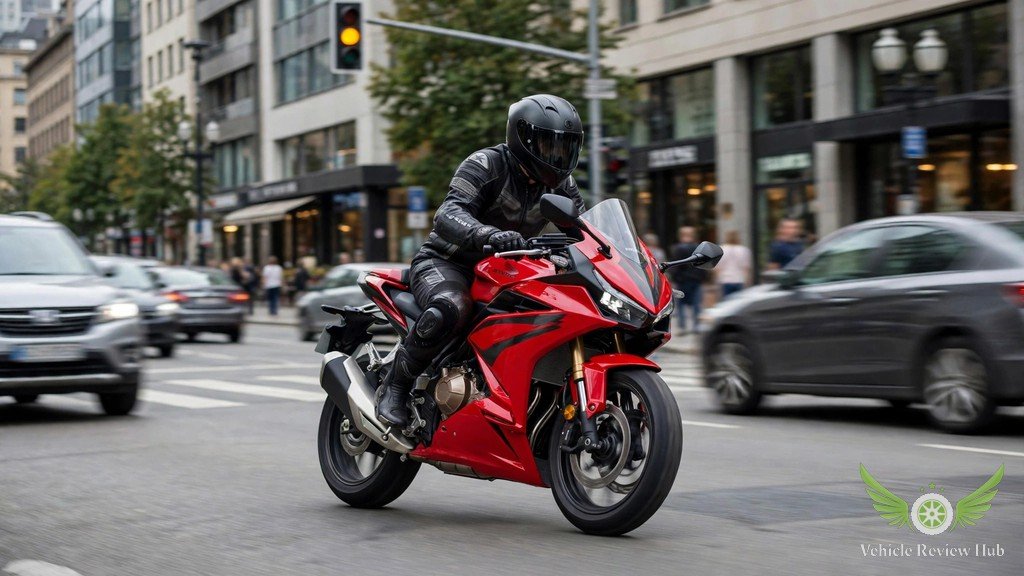
City riding is where Honda CBR500R performance earns its keep. The twin’s flat torque curve means the bike pulls away from lights cleanly without a handful of revs, and the very short first gear that Cycle World noted helps new riders avoid stalling while still giving brisk launches. The 421-pound curb weight and 31.1-inch seat height keep the bike manageable at stops and easy to paddle through parking lots, and the light clutch — assisted by the slipper clutch fitted since 2019 — keeps stop-and-go traffic from tiring the left hand. Testers consistently describe the same everyday acceleration: smooth, linear, and quick enough to stay ahead of traffic without ever feeling frantic. The video below shows MOTOBOB’s 2022 review of the updated bike, covering the engine, chassis and everyday ride in real-world conditions.
One honest city limit belongs in any Honda CBR500R performance account: the fairing and clip-on bars look racy but the riding position is closer to neutral than a supersport crouch, which is good for comfort and slightly less good for filtering through the tightest gaps. For the servicing picture behind everyday use, see our reliability guide.
Highway Riding, Overtaking Ability and Load Capacity
Highway riding is the second half of Honda CBR500R performance, and the bike handles it better than its beginner-friendly reputation suggests. Testers report relaxed cruising at 75 mph at around 6,000 rpm in sixth gear, with enough reserve for overtaking without a downshift in most situations — and a quick drop to fifth when a faster pass is needed. The fairing earns its keep here: wind protection is genuinely useful at highway speed, and the bike’s stability at speed is one of its most praised traits. Load capacity is honest rather than generous: the CBR500R carries a passenger and a weekend’s luggage without complaint, but it is not a touring bike, and a heavy pillion plus full luggage will blunt the acceleration that makes the bike feel quick solo. Two-up highway work suits short to medium distances; for long two-up tours, a larger bike is the better tool.
Honda CBR500R Handling, Braking and Stability
Handling is where the 2022 update changed Honda CBR500R performance most. The engine barely changed; the front end transformed.
2022 SFF-BP Fork and Dual Discs Transformed Front-End Confidence
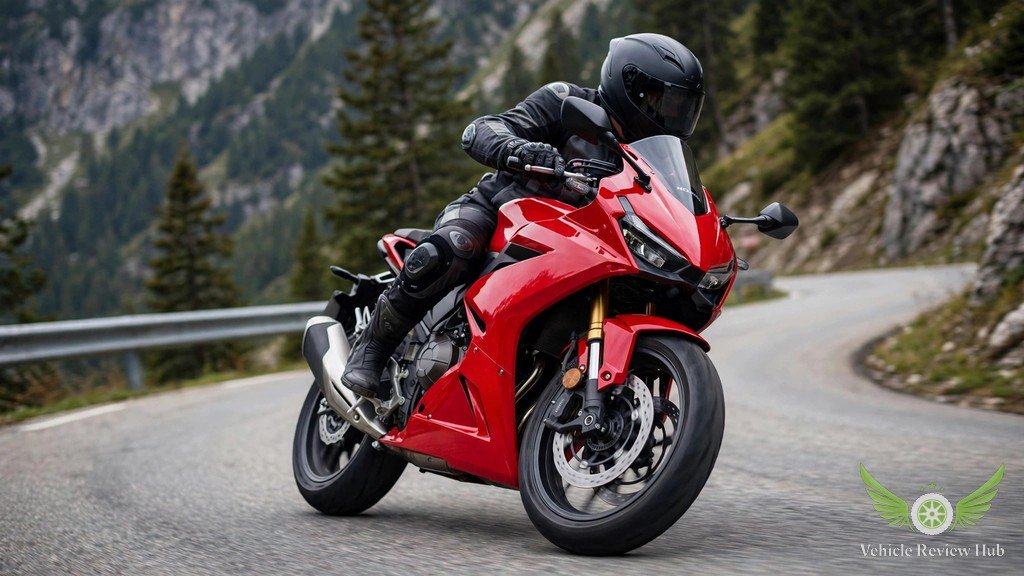
For 2022 Honda fitted a 41mm Showa Separate Function Fork Big Piston (SFF-BP) inverted fork with 4.7 inches of travel, replacing the conventional fork, and swapped the single front disc for dual 296mm discs with radially mounted four-piston calipers. The effect on Honda CBR500R performance was immediate and widely praised: stronger, more consistent braking, less dive under braking, and front-end feel that lets a newer rider trust the tyre. The chassis underneath — a steel diamond frame, 25.5-degree rake, 4.0 inches of trail and a 55.5-inch wheelbase — stayed familiar, so the improvement came from the fork and brakes rather than a geometry revolution. For a buyer choosing between model years, the 2022 update is the single most important Honda CBR500R performance dividing line.
Single 320mm Disc on Pre-2022 Bikes and ABS Standard From 2021
Pre-2022 CBR500R bikes carry a single 320mm front disc with a two-piston caliper and a 240mm rear disc, and that older setup is the honest Honda CBR500R performance compromise on used bikes: perfectly adequate for normal riding, noticeably less strong than the dual-disc setup when braking hard from highway speed, and worth a test-ride comparison before buying. ABS history needs care too. The doc states ABS standard from 2021, and US listings for 2021-on bikes carry ABS as standard equipment; earlier years sold ABS as a separate trim in the US, so a pre-2021 bike’s ABS status must be checked by its actual trim rather than assumed. The rear brake stays a single 240mm disc, and rear suspension is preload-adjustable only — normal at this price, and a limit worth knowing for track days.
Honda CBR500R Performance Compared With Other Middleweight Sport Bikes
Comparison is where Honda CBR500R performance numbers need the most care, because the two closest rivals are built for slightly different riders.
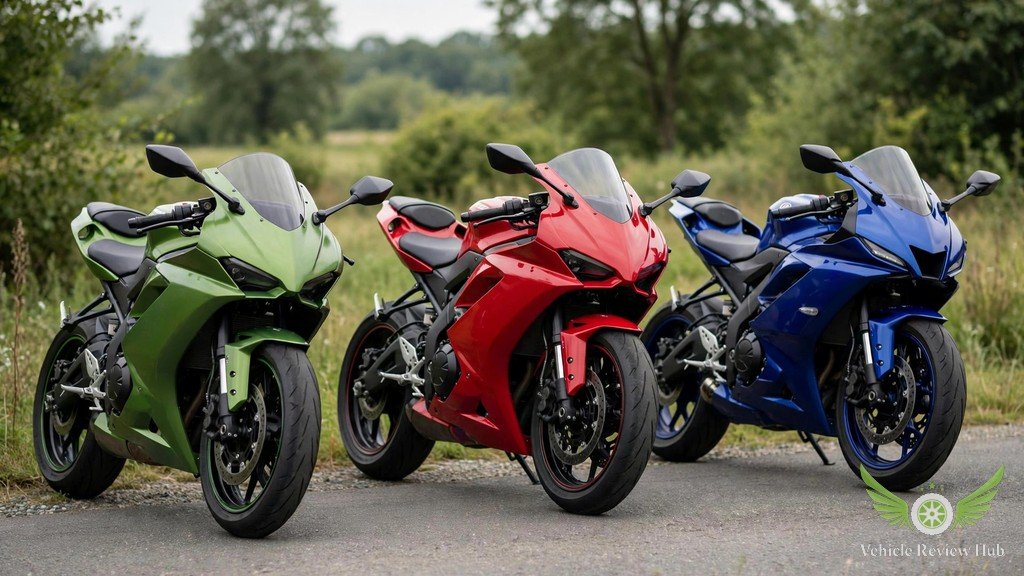
Honda CBR500R vs Kawasaki Ninja 500 and Yamaha YZF-R3
The Kawasaki Ninja 500 is the closest rival on paper and on price. Its 451cc parallel twin makes a claimed 51 horsepower, and its 2026 trim ladder runs $5,399 for the base bike, $5,799 for ABS and $6,499 for the SE ABS — the SE ABS costs $100 more than the Honda’s $6,399 before destination, while the base Ninja undercuts the Honda by $1,000. The Ninja is also lighter at around 377 pounds with ABS, against the Honda’s 421, and quicker in a straight line by most accounts. The Honda answers with torque, range and solidity: a bigger engine that pulls harder at low revs, a 4.5-gallon tank, and a feeling of substance that RevZilla’s 2026 review said pushes it toward the sport-touring edge of the class. The Yamaha YZF-R3 is a different proposition: a 321cc twin at $5,499 for 2026, weighing 373 pounds wet, with Cycle World measuring 36 rear-wheel horsepower — noticeably less power than the Honda, but a lighter, more agile bike that costs $900 less. For Honda CBR500R performance buyers, the choice is simple: the R3 is the lighter learner tool, the Ninja is the sharper and lighter rival, and the Honda is the torquier, longer-legged all-rounder. Our buying guide works through the used prices and ownership costs in full.
| Model (2026) | Price | Key performance note |
|---|---|---|
| Honda CBR500R | $6,399 + $600 destination | 471cc, 43.20 hp dyno, 421 lb, 4.5-gal tank |
| Kawasaki Ninja 500 | $5,399 base / $5,799 ABS / $6,499 SE ABS | 451cc, 51 hp claimed, ~377 lb with ABS |
| Yamaha YZF-R3 | $5,499 + $650 destination | 321cc, 36 hp dyno, 373 lb, 3.7-gal tank |
Is the Honda CBR500R Suitable for Beginners and Track Days?
For beginners, the Honda CBR500R performance verdict is an easy yes with one condition: respect the weight. The power delivery is linear and forgiving, the seat is low, the clutch is light, and the bike’s manners forgive the mistakes new riders make — stalling is hard, throttle response is gentle, and the brakes are strong without being grabby. The 421-pound weight is the only beginner caveat, and it is a modest one: heavier than the Ninja 500 or the R3, but still light enough for most adults to manage at parking speeds. For track days, the answer is a qualified yes. The CBR500R is a capable track-day learner: predictable handling, brakes that hold up for novice and intermediate pace, and enough power to learn lines without intimidating speed. Its limits at the track are the non-adjustable fork damping, the early-touching footpegs that testers noted, and power that will leave a rider wanting more once pace rises past intermediate level. As a first track bike it is excellent; as a long-term track weapon it is a stepping stone.
Honda CBR500R Performance FAQs
Direct answers to the Honda CBR500R performance questions riders and buyers ask most often.
How much horsepower does the Honda CBR500R make?
Cycle World measured 43.20 rear-wheel horsepower at 8,280 rpm on its dyno. The often-quoted 47 horsepower is a European A2 licence design figure, not a US dyno result, and this Honda CBR500R performance guide quotes the measured number.
What is the top speed of the Honda CBR500R?
MotoStatz tested 116.8 mph at the rev limiter in top gear. No major US outlet has published a GPS top-speed run, so Honda CBR500R performance top speed rests on that cited test, not on a GPS figure.
What is the Honda CBR500R 0-60 mph time?
MotoStatz measured 0-60 mph in 4.72 seconds and the quarter mile in 13.51 seconds at 98 mph. Those are the best instrumented Honda CBR500R performance acceleration figures available.
What MPG does the Honda CBR500R get?
Tested figures span 58.4 mpg (Cycle World) to 64 mpg (RevZilla), with most testers in the low-to-mid 60s. Honda’s 72 mpg figure is a comparison-only claim, not a tested result, in this Honda CBR500R performance guide.
How far can the Honda CBR500R go on a tank?
Around 250 miles of real range from the 4.5-gallon tank in mixed riding. Gentle highway riding stretches it further; hard riding shrinks it, per Honda CBR500R performance test data.
Is the Honda CBR500R good for beginners?
Yes. Linear power, a low 31.1-inch seat, a light clutch and forgiving manners make it one of the best beginner sport bikes, with its 421-pound weight the only modest caveat in this Honda CBR500R performance guide.
Is the Honda CBR500R good for highway riding?
Yes. Relaxed cruising at 75 mph around 6,000 rpm in sixth gear, useful fairing wind protection and stable manners make it a capable highway bike for Honda CBR500R performance buyers.
What is the difference between the CBR500R and the Ninja 500?
The Honda has a bigger 471cc engine, more low-end torque, a larger 4.5-gallon tank and a heavier 421-pound build; the Ninja 500 is lighter at around 377 pounds with ABS, sharper, and cheaper in base trim, per this Honda CBR500R performance comparison.
Does the Honda CBR500R have ride modes?
No. The US CBR500R uses a cable throttle with no ride modes and no E-Clutch, unlike the larger CBR650R. That simplicity is part of the Honda CBR500R performance character.
How much does the 2026 Honda CBR500R cost?
The 2026 model costs $6,399 plus a $600 destination charge, a $1,000 cut from 2025 with no mechanical changes — a key Honda CBR500R performance value fact for shoppers.
What changed on the CBR500R in 2022?
The 2022 update brought the 41mm Showa SFF-BP fork, dual 296mm front discs with radial four-piston calipers, lighter wheels and a larger 4.5-gallon tank — the biggest Honda CBR500R performance chassis change in the model’s history.
Is the Honda CBR500R suitable for track days?
Yes, as a learner and intermediate track-day bike. Predictable handling and strong brakes suit novice pace; non-adjustable fork damping and modest power limit it at advanced pace, per this Honda CBR500R performance guide.
Does the Honda CBR500R have ABS?
Yes, ABS is standard on 2021-on US bikes. Pre-2021 bikes sold ABS as a separate trim, so check the actual bike’s trim, advises this Honda CBR500R performance guide.
What size is the Honda CBR500R fuel tank?
The tank holds 4.5 gallons, about a gallon more than its closest rivals, which is a major part of the bike’s real-world Honda CBR500R performance range advantage.