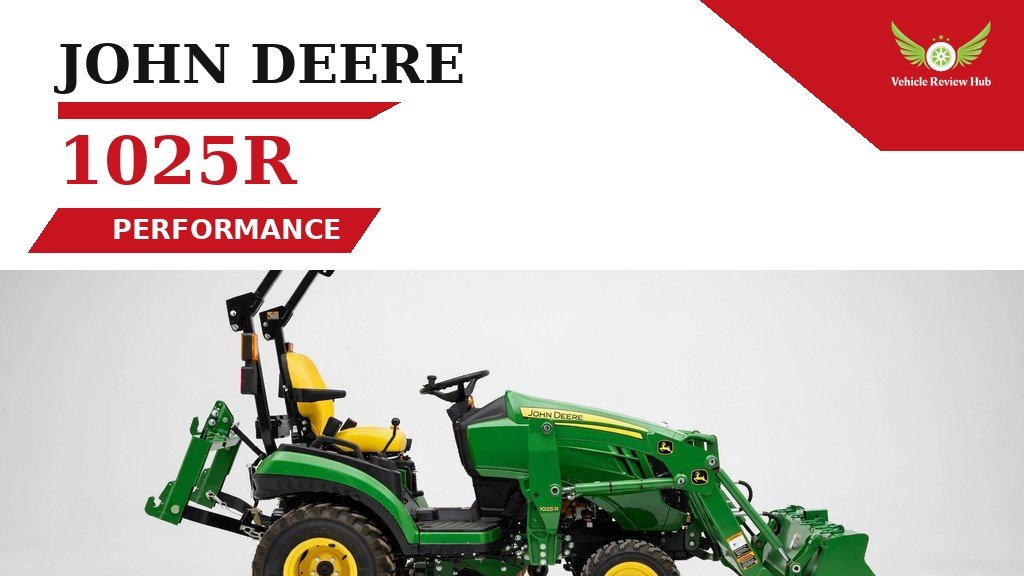
The John Deere 1025R performance story comes down to this: a 23.9-horsepower Yanmar diesel in a sub-compact frame that burns roughly a gallon of diesel per hour while mowing, runs five-plus hours on its 6.3-gallon tank, and handles loader work, grading, and snow removal on two-to-ten-acre properties. Owners report a transmission anyone can master in an afternoon, a deluxe suspension seat that makes long days bearable, and enough PTO power for 54- and 60-inch decks. It is not a big-acreage machine — heavy brush cutting and constant maximum-load loader cycles will expose its limits — but for the homeowner workload it was built for, John Deere 1025R performance is honest, refined, and well matched.
Under the hood sits the Yanmar 3TNV80F-NCJT, a three-cylinder, 1.267-litre diesel rated at 23.9 gross horsepower at 3,200 rpm. It is naturally aspirated, meets Final Tier 4 standards with no diesel particulate filter and no regeneration cycles. The rear PTO is rated at 17.2 horsepower (some sources round it to 18), and the two-range hydrostatic transmission drives all four wheels with a standard differential lock. Those numbers shape every part of the John Deere 1025R performance picture below, from fuel burn to what it can realistically lift and pull.
John Deere 1025R Fuel Consumption and Runtime
Fuel economy is where the 1025R quietly wins over a lot of buyers. Small diesels are efficient at part load, and this Yanmar spends most of its life well below maximum output. Current 1025R spec listings put the tank at 24 litres (6.3 U.S. gallons), though older model years carried a 5.6-gallon tank — worth knowing when you read older owner reports. John Deere 1025R performance in real yards comes down less to the spec sheet and more to how many hours that tank gives you between fill-ups.
Fuel Usage During Mowing, Loader Work and Idling
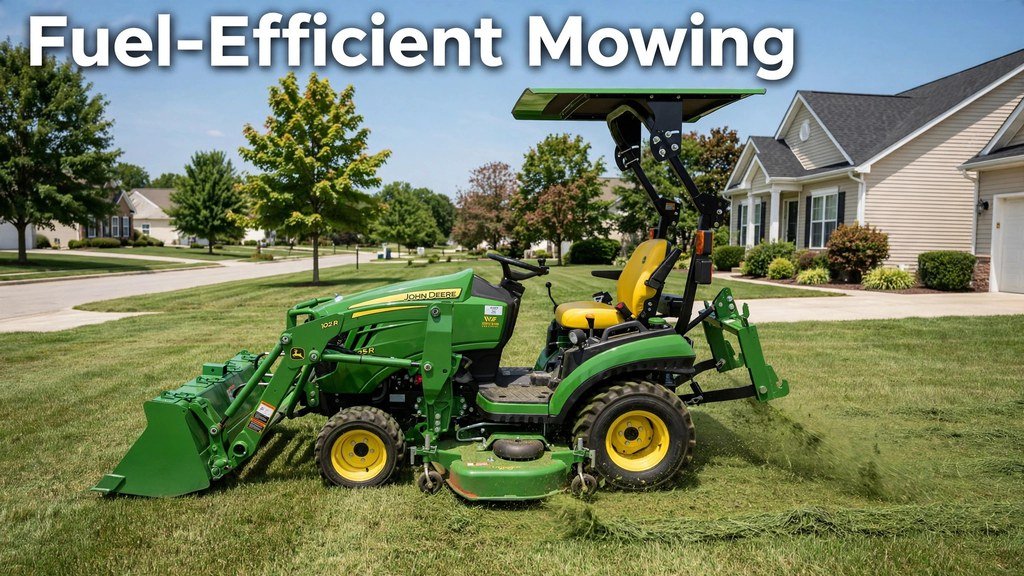
Mowing is where John Deere 1025R performance shows its strengths, and it is also where the most consistent fuel data exists. Owners on TractorByNet owner reviews and the closely related 1023E threads report roughly a gallon per hour at 2,000 to 2,200 rpm with the deck engaged — the 1025R’s slightly larger engine burns marginally more than its smaller sibling at full load, but in typical mowing the difference is small. Spec aggregators and comparison guides describe the 1 Series as sipping diesel at about 1 to 2 gallons per hour for moderate tasks.
Loader work is the tougher test of John Deere 1025R performance, because engine load is far less steady: scooping, carrying, and dumping spike the revs and work the hydraulics hard, pushing consumption into the 1.0 to 1.5 gallon-per-hour range during an intense hour. Lighter loader chores — spreading mulch, moving a few bucket loads of soil — sit closer to mowing figures. Idling and low-speed maneuvering barely register: expect roughly 0.3 to 0.5 gallons per hour with the engine warm and no PTO load.
With the 6.3-gallon tank, a typical mowing session at about a gallon per hour gives five to six hours of seat time per fill. That relaxed rhythm is why John Deere 1025R performance gets praised in owner forums — a full day’s work on a single tank for most residential jobs.
Factors Affecting Fuel Economy and Runtime per Tank
John Deere 1025R performance at the fuel pump depends on how you run the machine. Engine speed is the biggest lever: lugging at very low rpm under load or running full throttle for light work both waste fuel. Holding a steady 2,000–2,200 rpm for mowing, rather than running wide open at 3,200, keeps consumption at that sweet spot of about a gallon per hour.
Maintenance condition matters just as much. Dull blades force the engine to work harder, wet grass spikes fuel use, and restricted air or fuel filters quietly rob efficiency — a sharp blade and clean filters matter more than any driving trick, and our 1025R maintenance and reliability guide covers the full service schedule. Tire pressure, ballast, and a dragging implement left half-lowered all add load the engine must burn diesel to overcome.
| Task | Typical fuel use (gal/hr) | Notes |
|---|---|---|
| Idling / warm-up | 0.3–0.5 | Warm engine, no PTO load |
| Light mowing (flat, dry lawn) | 0.75–1.0 | Sweet spot at 2,000–2,200 rpm with 54D/60D deck |
| Heavy mowing (tall or wet grass) | 1.0–1.3 | Dull blades, wet conditions |
| Typical loader work | 1.0–1.5 | Stop-start cycles, hydraulic load |
| Heavy PTO work (tilling, snow blowing) | 1.2–1.6 | Sustained high load; owner-reported ranges |
Figures are typical owner-reported and spec-published ranges, not laboratory test data. At roughly a gallon per hour, fuel stays the smallest line item in the budget — our 1025R ownership cost guide puts the five-year numbers together.
John Deere 1025R Performance for Everyday Work
What matters is finished work — mowed acres, moved material, graded driveways — and across owner reports and dealer demos, the verdict is consistent: John Deere 1025R performance covers the standard small-property task list with power to spare, provided you respect the machine’s size class.
Mowing, Landscaping, Grading and Property Maintenance
With the 54D or 60-inch AutoConnect mid-mount deck, John Deere 1025R performance is at its best as a mowing tractor. The 17.2-hp rear PTO — with the mid PTO spinning the deck at 2,100 rpm — holds blade speed steady in normal grass, and owners report clean cuts at a good ground speed without the engine note changing. The AutoConnect drive-over deck removes in minutes, so the same tractor becomes your loader or grading machine for the afternoon.
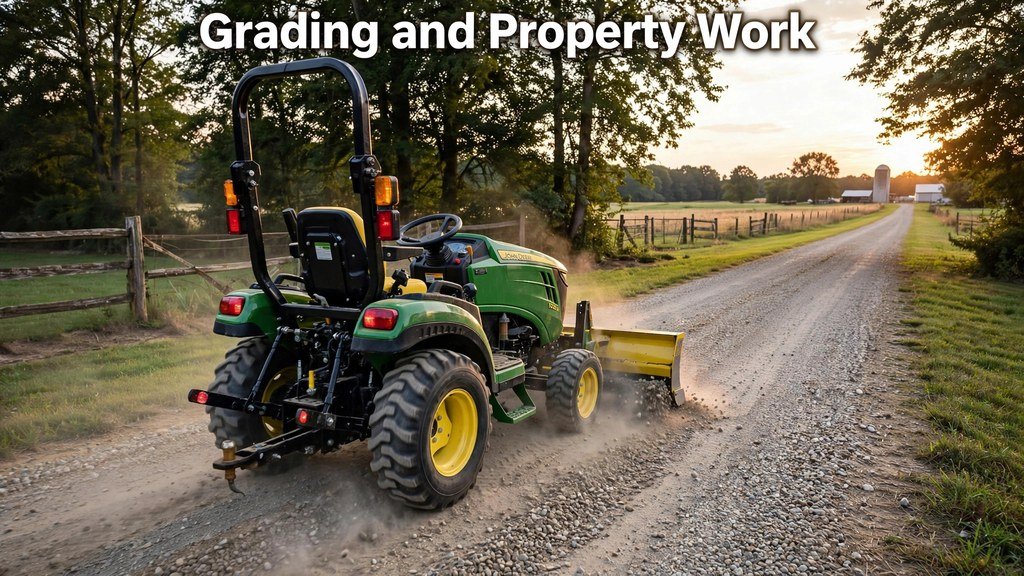
For landscaping and grading, the limited Category 1 hitch lifts 758 lb at the link arms — enough for box blades, landscape rakes, and rear blades for gravel driveways. Position control on the rockshaft, standard on the R, makes grading work far more precise than on the E: set the height and the hitch holds it there. A 4- or 5-foot rotary cutter handles field edges and light brush, and the 540-rpm rear PTO runs post-hole augers and small chippers without complaint — which is why John Deere 1025R performance reviews call it the rare machine that replaces both a lawn tractor and a separate utility tractor on up to ten acres.
Loader Work, Material Handling and Light Tilling
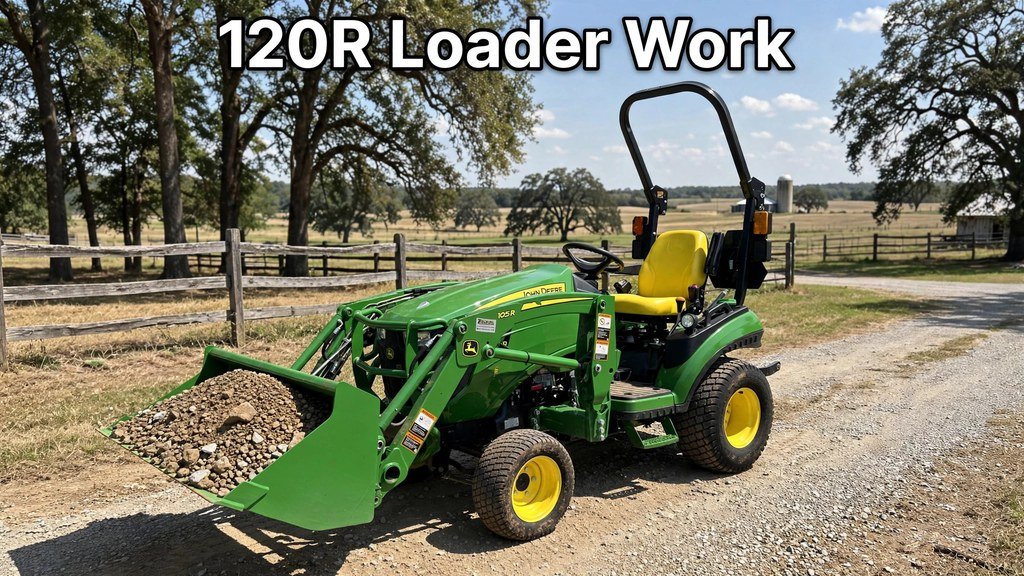
The 120R front-end loader is the attachment that turns John Deere 1025R performance up a notch, from mower into workhorse. Dealer-published specs list roughly 550 lb of standard lift capacity and up to about 725 lb with the mechanical self-leveling option, with a 72-inch lift height — enough to load a pickup bed, and solid John Deere 1025R performance numbers for the class. Quik-Park mounting lets one person remove or reinstall the loader without tools, so switching between mowing and dirt work takes minutes.
Owners move soil, gravel, mulch, and firewood by the bucketful, with infinite speed control with Twin-Touch pedals makes inching up to a pile or feathering a dump effortless — everyday John Deere 1025R performance that owners consistently praise. For tilling, a 48- to 50-inch rotary tiller matches the PTO output well — dealers report customers tilling all season without feeling short on power.
John Deere 1025R Handling, Comfort and Limitations
This is where the R earns its premium over the E. Deere gave the 1025R the comfort and convenience features that long days demand, and owners consistently say the seat-time experience is what sold them. For full specifications and pricing, see our John Deere 1025R review and buying guide.
Maneuverability, Operator Comfort and Ease of Use
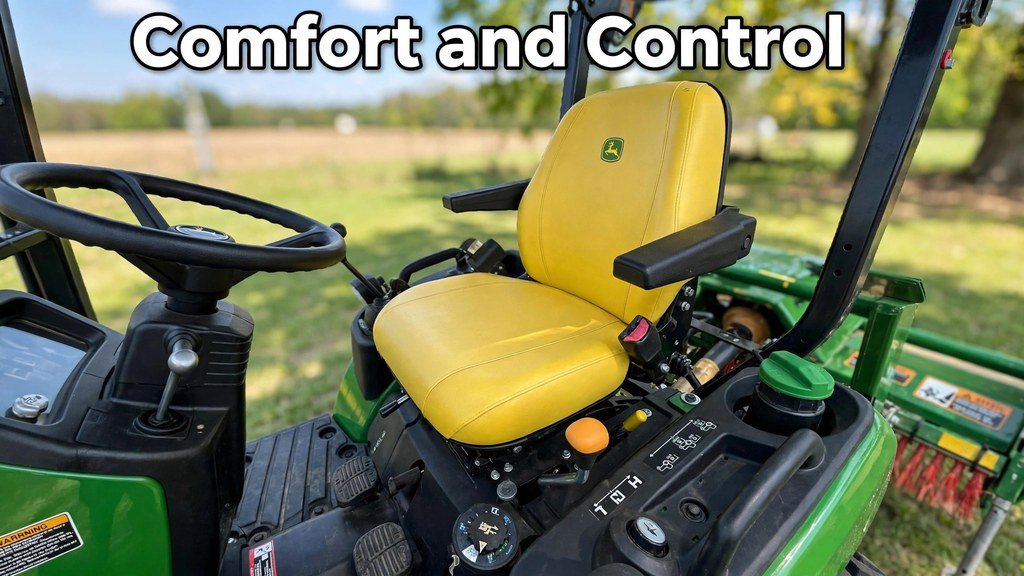
The two-range hydrostatic transmission with Twin-Touch pedals works like an automatic car: select a range, set the throttle, and press. No clutching, no gear hunting — owners say that makes loader work and tight mowing dramatically less tiring. Cruise control comes standard on the R, a genuine fatigue-fighter on long mowing passes, and the tilt steering wheel plus the deluxe suspension seat with armrests make all-day sessions something owners actually enjoy. It is the most complete comfort package in John Deere 1025R performance’s size class.
Maneuverability is a strong suit: power steering is standard, the turning radius is about 8.2 feet, and at 57.1 inches of wheelbase with a 47-inch overall width, the tractor threads gates and landscaping beds that would stop a bigger machine. New operators routinely report feeling confident within the first hour — approachable John Deere 1025R performance by design.
Traction, Stability, Terrain and Workload Limitations
Standard mechanical front-wheel drive plus the foot-operated differential lock claws through mud, snow, and loose slopes that would strand a two-wheel-drive garden tractor. Owners plow snow, climb damp hillsides, and pull implements in soft ground with confidence, especially on R4 industrial tires. The roughly 1,550-pound shipping weight is light enough to be gentle on lawns with turf tires yet heavy enough — with wheel weights or a ballast box on the hitch — to keep the rear end planted during loader work.
The limitations are the honest kind. The light weight that protects your lawn also lets the loader out-muscle the rear if you skip ballast — dealers insist on rear ballast for a reason. Ground clearance is modest at under 8 inches, so rocky ground and deep ruts need a careful line, and heavy brush hogging beats up the underside of any sub-compact. Side slopes demand respect: keep the loader low and avoid steep traverses. None of this is a flaw in John Deere 1025R performance; it is simply the physics of the size class, and owners who work within it report years of trouble-free service.
John Deere 1025R Real-World Owner Experience
Brochure numbers only go so far. What owners say after hundreds of hours is the real test, and the 1025R has more than a decade of owner history behind it. The pattern is clear: buyers who match the tractor to the workload love it, while buyers who expected a farm tractor in a sub-compact frame end up disappointed. Honest John Deere 1025R performance looks exactly like the machine Deere built.
Common Owner-Reported Benefits and Complaints
The benefits owners cite most often read like a comfort-feature checklist: the suspension seat, cruise control, and tilt steering get constant praise, as does the AutoConnect deck — owners who once spent half an hour wrestling mower decks now drive on and off in minutes. The 120R loader’s easy removal earns similar love. Reliability reports are generally strong for machines that get their scheduled service, with many owners describing years of trouble-free seasons as the core of their John Deere 1025R performance experience.
Complaints exist too, and a fair guide lists them. Some owners report the turning radius feels large when mowing tight, obstacle-filled lawns — the 60-inch deck is wider than the tractor and needs care near fixed objects. A few early-production owners documented factory quality-control issues, and the transmission filter service is awkward to reach compared with some rivals. Cold-weather starting draws the occasional grumble, and the backhoe’s modest hydraulic flow means digging is patient work. None of these are secrets; they show up consistently in owner forums, and they are worth weighing. This long-term owner review walks through the same pros and cons after extended use:
Choosing the Right Setup for Your Property
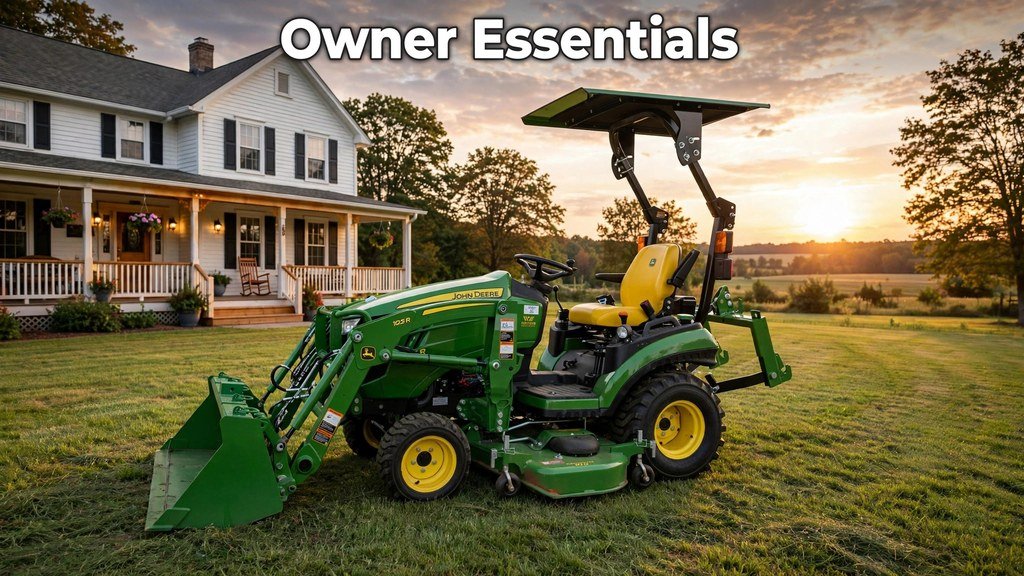
Match the tractor to the work, not the wishlist. For two to ten acres of mowing, driveway work, gardening, snow removal, and material handling, John Deere 1025R performance covers the list with margin — precisely the buyer Deere designed it for. Add the 120R loader and a 60D deck as the core package; a box blade or land plane for the driveway and a rotary tiller for the garden round out the most common owner setups.
If the 1025R’s premium features stretch the budget, the John Deere 1023E covers the same core workload for less money — compare the two in our 1023E performance and fuel usage guide before you decide. If your plans include regular brush hogging of rough acreage, constant heavy loader cycles, or running 5-foot-plus PTO implements at their limit, price out the 2025R or step up to the 2 Series before you buy — a dealer-side 1025R vs 2025R comparison lays out exactly where the bigger frame earns its money. Buy the tractor for the work you actually do, and John Deere 1025R performance will not disappoint.
Frequently Asked Questions About the John Deere 1025R Performance
These are the questions buyers ask once they move past the brochure numbers and want to know how the 1025R behaves in a working yard. The answers below draw on published specifications and the patterns that show up again and again in owner reports.
How much fuel does a John Deere 1025R use per hour?
Expect roughly 0.75 to 1.0 gallon per hour for typical mowing — the heart of John Deere 1025R performance for most owners. Owner reports cluster around a gallon per hour at 2,000–2,200 rpm with the deck engaged; comparison guides describe about 1 to 2 gallons per hour for moderate mixed tasks. Intense loader work or sustained heavy PTO loads can push consumption toward 1.5 gallons per hour, while idling uses only about 0.3 to 0.5 gallons per hour.
How long will a tank of diesel last on a 1025R?
The 6.3-gallon (24-litre) tank on current models delivers about five to six hours of typical mowing per fill at roughly a gallon per hour. Note that older model years carried a 5.6-gallon tank, so a used 1025R will run a little shorter between fill-ups. For mixed property work — some mowing, some loader time, some idling between tasks — most owners find a single tank covers a full working day, which is one of the most praised aspects of John Deere 1025R performance.
What is the difference between the 1025R and the 1023E?
The 1025R uses a larger Yanmar rated at 23.9 gross horsepower versus the 1023E’s 21.5, with PTO output around 17 hp against 14.9. In real work the seat-of-the-pants difference is smaller than the numbers suggest. Where the 1025R pulls ahead is convenience: cruise control, tilt steering, deluxe suspension seat with armrests, position-control rockshaft, and work lights — roughly $2,000 more at typical dealer pricing. For pure work output per dollar the 1023E is arguably the stronger value, which is why John Deere 1025R performance is best judged on comfort and features, not just horsepower.
Can the 1025R handle a 60-inch mower deck and a loader at the same time?
It can, but most owners prefer not to. The 60D AutoConnect deck is a factory option and the 17.2-hp PTO holds blade speed in normal conditions. In practice, owners report the tractor is more agile and the loader easier to see around with the deck removed — and the drive-over deck makes swapping a minutes-long job. For dedicated mowing days, take the loader off; for dirt-work days, take the deck off.
What is the top speed of the John Deere 1025R?
Deere lists about 9.1 mph forward in high range, with owners reporting similar real-world figures depending on tires and conditions. Low range is for working, high range is for transport between jobs on your own property.
Is the 1025R worth the extra money over the 1023E?
It depends on how much seat time you log. If you mow for hours at a stretch, the cruise control, suspension seat, and tilt steering genuinely reduce fatigue — owners who upgraded say they would not go back. If your usage is an hour here and there, the 1023E delivers nearly identical John Deere 1025R performance in terms of actual work done, for less money. Decide on comfort and features, because fuel use and capability per dollar are close between the two.