The short answer on John Deere 5075E performance: the 5075E is a 75-horsepower utility tractor built around John Deere’s 2.9-liter PowerTech 3029 diesel, rated at 60.3 PTO horsepower on the open station and paired with the 520M loader that lifts 3,523 pounds at the pivot pins to 132 inches. Owners report real-world fuel use of roughly 2.5 to 4 gallons per hour under load, with the 19-gallon tank (21 on cab models) covering a solid workday of fieldwork.
This John Deere 5075E performance guide breaks down fuel consumption task by task, what the tractor can actually pull and lift, how the two transmissions change the experience, honest handling limits, and what owners say after hundreds of hours — every figure drawn from Deere specifications, current dealer listings, or documented owner reports.
John Deere 5075E Fuel Consumption and Runtime
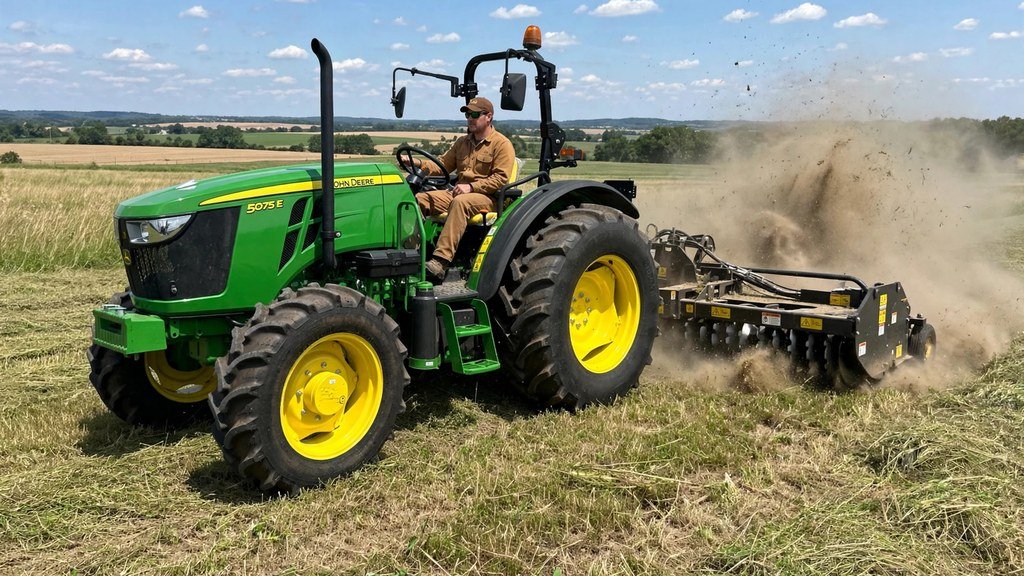
Fuel is the first thing working owners ask about, and John Deere 5075E performance on the fuel side is straightforward: a 2.9-liter three-cylinder working at a relaxed 2,100 rpm rated speed burns less than the horsepower figure might suggest. Owner-reported consumption clusters around 2.5 to 3 gallons per hour in steady PTO fieldwork once the engine is broken in, with lighter chores dipping toward 1.5 and heavy draft work pushing past 3.5.
Fuel Usage During Fieldwork, Loader Work and Idling
The most detailed owner log of John Deere 5075E performance fuel use comes from a TractorByNet 400-hour review of a 5075E: during the first 100 hours the tractor “really liked the fuel, nearing the 4 gallon per hour,” but once broken in it “calmed down to the 2.5-3 gallon per hour” at full PTO load (2,450-2,550 rpm), mostly pulling a heavy 10-foot twin-spindle bush hog and a John Deere 459E round baler. A separate comparison notes about 4 gallons per hour for the 5075E at PTO speed under hard load.
The table below collects owner-reported John Deere 5075E performance fuel figures by task — practical ranges from working owners, not laboratory data.
| Task | Typical Engine Speed | Reported Fuel Use (gal/hr) |
|---|---|---|
| Idling and light yard chores | 1,200-1,500 rpm | 1.0-1.8 |
| Loader work, material handling | 1,600-2,000 rpm | 1.8-2.8 |
| Mowing with 10-ft cutter | 2,100-2,500 rpm | 2.5-3.5 |
| Hay work, round baling | 2,100-2,500 rpm | 2.5-3.5 |
| Heavy tillage, plowing | 2,100-2,400 rpm | 3.0-4.0 |
| Blended real-world average | Mixed farm work | ~2.5-3.2 |
At those rates, the 19-gallon open-station tank covers roughly 6 to 8 hours of real fieldwork, and cab models stretch that with 21 gallons. Our 5075E ownership cost guide turns these John Deere 5075E performance fuel figures into annual operating budgets.
Factors Affecting Fuel Economy and Runtime per Tank
Engine speed dominates John Deere 5075E performance fuel economy. The PowerTech makes its rated 75 horsepower at just 2,100 rpm, and owners who match rpm to the load — rather than running flat-out for light chores — see the biggest savings. The optional 540E economy PTO (available with the 12F/12R PowrReverser) is the smartest fuel feature on the tractor: it delivers full 540-rpm PTO speed at just 1,588 engine rpm, cutting fuel use substantially in mowing and baling where full engine power is not needed.
Implement sizing matters for John Deere 5075E performance too. A 10-foot cutter matched to the 60-horsepower PTO lets the engine breathe at moderate rpm; an oversized implement forces constant full-throttle work. Break-in is real on this engine — the 400-hour reviewer watched consumption fall by roughly a gallon per hour after the first 100 hours. And ballast counts: a properly ballasted tractor pulls at lower rpm with less wheel slip, which is free fuel economy. Tire pressure, clean air filters, and avoiding long idling round out the habits that keep John Deere 5075E performance fuel numbers at the low end of the range.
John Deere 5075E Performance for Farm and Property Work
John Deere 5075E performance centers on a simple formula: 75 rated horsepower, 60.3 PTO horsepower, and 224 lb-ft of peak torque at 1,500 rpm from a turbocharged 2.9-liter PowerTech diesel with a 21-22% torque rise. That torque curve is what owners feel in the field — the heart of John Deere 5075E performance under load — the engine lugs through load increases without demanding constant downshifts, which is exactly what you want pulling a loaded baler up a grade or digging a 3-bottom plow into hard ground.
Tillage, Mowing, Hay Work and Material Handling
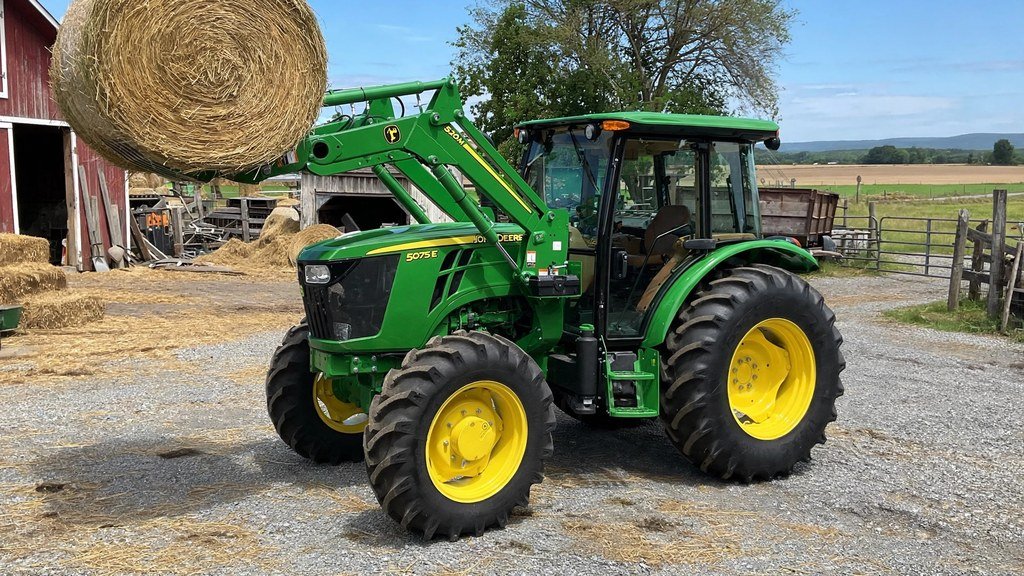
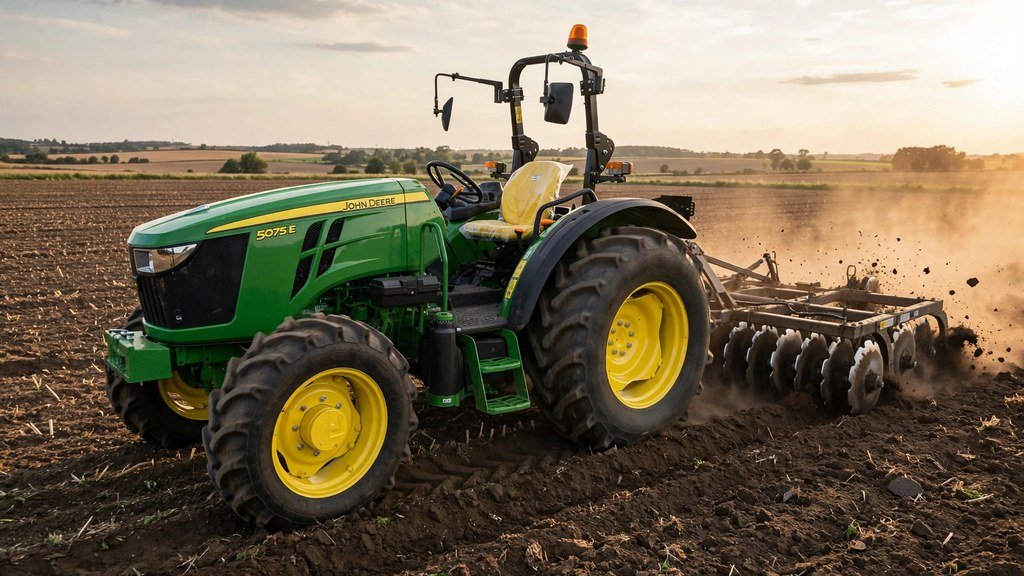
In tillage, John Deere 5075E performance covers the implements a 75-horsepower tractor should: 3-bottom plows, 8- to 10-foot disks, and field cultivators, with the Category 2 three-point hitch (convertible to Category 1) lifting 3,192 pounds at 24 inches behind the link arms. Owners report the 5075E pulling a heavy 10-foot twin-spindle bush hog all day and running a John Deere 459E round baler “no problem” — the two jobs that define this tractor’s working life on small and mid-size farms.
Mowing is the 5075E’s home turf: 10-foot rotary cutters, 7- to 9-foot disc mowers, and batwing mowers up to about 12 feet in light conditions. The 18.2-gpm open-center hydraulic system (11.4 gpm available at a single rear remote) runs grapples, augers, and hay tools without strain. The video below is a full dealer overview of the 5075E walking through the station, loader, and working features — a useful visual companion to this John Deere 5075E performance guide:
One emissions detail shapes daily John Deere 5075E performance more than most buyers expect: the 3-cylinder 5075E meets Final Tier 4 with a DOC and cooled EGR only — no diesel particulate filter, no DEF fluid, and no regeneration cycles, confirmed on John Deere’s 5E series page. That means no parked regens interrupting a baling day and no DEF to buy, a genuine simplicity advantage over larger Tier 4 machines that owners consistently praise.
Loader Work, Hauling and Demands Under Heavy Loads
The factory loader match for John Deere 5075E performance is the 520M: 132 inches of maximum lift height, 3,523 pounds of lift capacity at the pivot pins at full height (2,293 pounds measured 800 mm ahead of the pivot — the figure closer to real bucket-center loads), and 4,641 pounds of boom breakout force. Cycle times are quick for the class: 5.1 seconds to raise, 3.4 to lower, 4.3 to dump, and 2.6 to roll back.
For heavy material handling, that 520M rating puts the 5075E a full class above the compact line — full buckets of gravel, round bales, and pallet work are all-day jobs. The new 5E 3-cylinder models offer a factory third-function mid-SCV that operates while lifting and curling, so grapple work needs no diverter valve. Under sustained heavy loads, John Deere 5075E performance leans on the 5,919-pound MFWD operating weight (plus ballast) to keep the tractor planted, and the 22% torque rise means the engine holds rpm when the loader digs into a packed pile instead of falling on its face. Owners moving up from 40- to 50-horsepower compacts consistently call the loader the biggest single upgrade in John Deere 5075E performance.
John Deere 5075E Handling, Comfort and Operating Limitations
At 5,919 pounds in MFWD open-station trim (6,702 with the cab), John Deere 5075E performance starts from the planted, stable feel of a true utility tractor: stable, planted, and confidence-inspiring with a loaded bucket — but no longer nimble around trees and outbuildings the way a compact is. John Deere 5075E performance in tight quarters depends heavily on configuration: the 2WD model turns in 10.2 feet, while MFWD stretches that to 12.9 feet.
Cab, Open-Station Controls and Operator Comfort
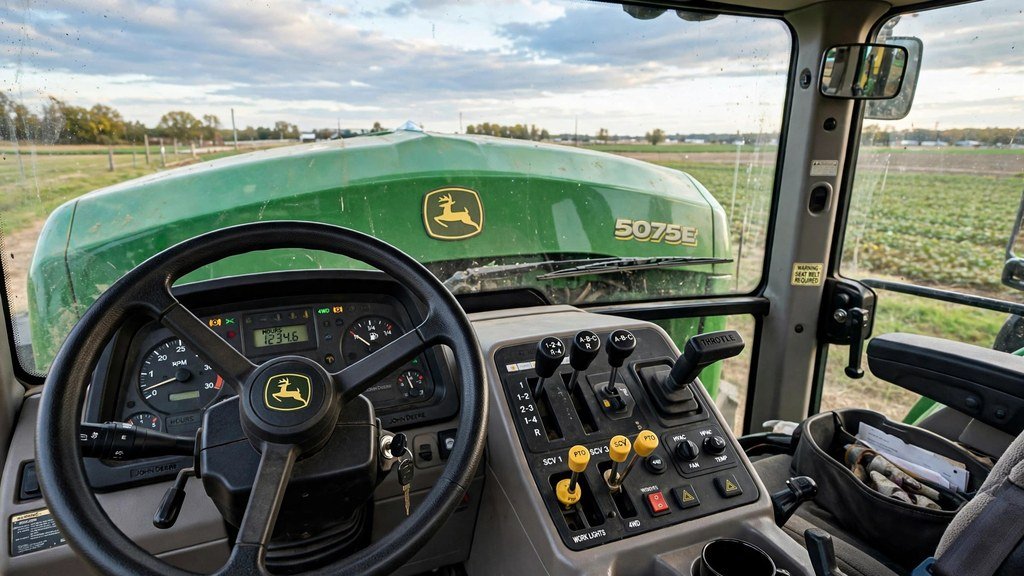
The 5075E comes three ways: open station, standard cab, and premium cab — and the cab choice changes daily life more than any other option. The premium cab adds an air-suspension seat, sunroof with sunshade, Bluetooth radio, LED work lights, rear wiper and washer, and an instructional buddy seat, per dealer walkarounds. Standard cabs get heat and air conditioning with halogen work lights. Open-station models keep it simple with a flat straddle platform, tilt steering, and a mechanical feel owners describe as honest and easy to learn.
Noise is rated at 81 dBA — fine for a utility tractor, though a long day still argues for the cab. Controls are mechanical and direct: floor-mounted gear levers on the side console, a mechanical PTO lever on the SyncShuttle (electrohydraulic on the PowrReverser), and a mechanical joystick for the loader. Owners praise the layout’s simplicity after years of running it, and the tilt-and-telescoping wheel plus adjustable seat fit a wide range of operators.
Traction, Stability, Terrain and Workload Limitations
The honest limits of John Deere 5075E performance start with the transmission. The standard 9F/3R SyncShuttle is a solid field gearbox, but owners report that shifting between ranges (A-B-C) while rolling grinds — only the four gears within each range are synchronized. The clutch on the dry-clutch SyncShuttle draws complaints for being jerky, and several owners say a hydrostatic or the 12F/12R PowrReverser would suit loader work better. If shuttle work dominates your day, the PowrReverser with its wet clutch and clutch-free direction changes is worth the premium.
Traction is rarely the limit — at nearly 6,000 pounds with MFWD and loaded rears, the 5075E hooks up well — but the flip side is soil compaction and a wide turning circle that make it clumsy for garden-scale work. The 18.2-gpm hydraulic system is adequate for loader and implement cylinders but is not high-flow; running big hydraulic motors (large snow blowers, mulchers) will feel slow compared to a 6-series. Cold starting draws owner complaints too: the 5075E cranks slowly even in warm weather per owner reports, and a block heater is the recommended fix for cold climates. And the 132-inch loader height, generous for the class, still will not stack bales three high — know your stack height before you buy.
John Deere 5075E Real-World Owner Experience
After the spec sheets, John Deere 5075E performance comes down to how owners feel after hundreds of hours. The consensus across owner forums is consistent: a simple, strong, honest tractor that does exactly what a 75-horsepower utility should do — pull, lift, mow, and bale — without the electronic complexity and aftertreatment headaches of bigger machines. The 400-hour reviewer summed it up as a “good tractor for the money,” glad he bought it.
Owner-Reported Benefits, Complaints and Trade-Offs
Benefits first, as owners report them: power with margin — the PowerTech pulls a 10-foot bush hog and a 459E baler without strain, and one owner’s tractor dyno’d at 78 horsepower after break-in, above its 75-hp rating. Simplicity is the most repeated praise: no DPF, no DEF, no regen, a mechanical character that DIY owners can maintain. Fuel economy in the 2.5-3 gph range under load draws repeated compliments for the horsepower. Value seals it — open-station 2026 models with loaders list around $75,000 at dealers like Horizon Ag & Turf, thousands under comparable premium-brand utility tractors.
Complaints, equally candid: the jerky SyncShuttle clutch tops the list, followed by slow cranking (worse in cold weather), grinding when shifting ranges on the move, no dash indicator for the intake preheater, and a hydraulic fluid dipstick owners find nearly impossible to read — “so clear I have a hard time seeing it.” Minor build niggles appear too: exhaust heat-shield screws vibrating loose, an rpm gauge sensor unreliable in cold weather. None are deal-breakers in owner telling, but all are worth knowing before you sign — and our 5075E maintenance and reliability guide covers the full problem list with fixes.
Choosing the Right Transmission and Tractor Setup
Getting the most from John Deere 5075E performance starts with the transmission decision. Choose the 9F/3R SyncShuttle if your work is mostly steady fieldwork — tillage, mowing, baling — where you set a gear and run; it is simpler, cheaper, and perfectly matched to draft work. Choose the 12F/12R PowrReverser if loader work, feeding, or any shuttle-heavy day dominates: clutch-free direction changes, a wet clutch, electrohydraulic PTO engagement, and the 540E economy mode transform productivity and comfort.
Drive and station follow the work: MFWD is the default right answer for loader work, hills, and wet ground — 2WD only makes sense for flat, dry row-crop-style duty. The cab decision is about hours: under 200 hours a year of fair-weather work, the open station saves roughly $20,000 and keeps things simple; over that, or for winter feeding, the cab pays for itself in comfort and resale. Tire choice shapes John Deere 5075E performance too — R1 ag tires for field work, R4 industrials for loader and yard duty — and rear ballast (fluid or wheel weights) is close to mandatory for serious loader work. For the full buying picture, our 5075E review and buying guide has the complete spec sheet and pricing for shoppers comparing John Deere 5075E performance against its siblings.
Frequently Asked Questions About John Deere 5075E Performance
These are the John Deere 5075E performance questions owners and shoppers ask most often, answered from Deere specifications and documented owner experience.
How much fuel does a John Deere 5075E use per hour?
These owner-reported John Deere 5075E performance fuel figures run roughly 1.0-1.8 gallons per hour for light chores, 1.8-2.8 for loader work, 2.5-3.5 for mowing and hay work, and 3.0-4.0 for heavy tillage (owner-reported ranges, not laboratory figures). One 400-hour owner measured 2.5-3 gph at full PTO load after break-in, down from nearly 4 gph in the first 100 hours. At a blended 2.5-3.2 gph, the 19-gallon tank covers 6-8 hours of real work.
How many horsepower does a John Deere 5075E have?
The 5075E is rated at 75 horsepower at 2,100 rpm from its turbocharged 2.9-liter PowerTech 3029 diesel, with 60.3 PTO horsepower on the open station (57.6 on cab models) and peak torque of 224 lb-ft at 1,500 rpm. One owner dyno test showed 78 horsepower after break-in — slightly above the rating.
What can the 520M loader lift on a 5075E?
The 520M loader lifts 3,523 pounds at the pivot pins at its 132-inch maximum height, or 2,293 pounds measured 800 mm ahead of the pivot — the figure closer to real bucket-center loads. Boom breakout force is 4,641 pounds at the pins. Those are pivot ratings; capacity falls as the load moves forward in the bucket, so proper rear ballast is required to use the full rating safely.
Does the John Deere 5075E need DEF or DPF regeneration?
No. The 3-cylinder 5075E meets Final Tier 4 with a diesel oxidation catalyst and cooled EGR only — no diesel particulate filter, no DEF fluid, and no regeneration cycles, confirmed on John Deere’s 5E series page. That is a genuine ownership advantage: no parked regens interrupting work and no DEF to buy. (The larger 4-cylinder 5090E and 5100E do use automatic regen.)
Which 5075E transmission should I choose: SyncShuttle or PowrReverser?
For mostly steady fieldwork — tillage, mowing, baling — the standard 9F/3R SyncShuttle is simpler and cheaper and does the job well. For loader work, feeding, or any day with constant direction changes, the 12F/12R PowrReverser’s clutch-free shuttling, wet clutch, and 540E economy PTO mode are worth the premium. Owners doing heavy shuttle work on the SyncShuttle consistently wish they had ordered the reverser.
How much does a new John Deere 5075E cost?
Current dealer listings put a 2026 open-station 5075E with MFWD and loader around $75,000, a standard cab with loader around $95,000, and a loaded premium cab with loader and grapple around $111,000. Used machines vary widely by hours and configuration. For what those numbers mean over years of ownership, see our 5075E ownership cost guide.