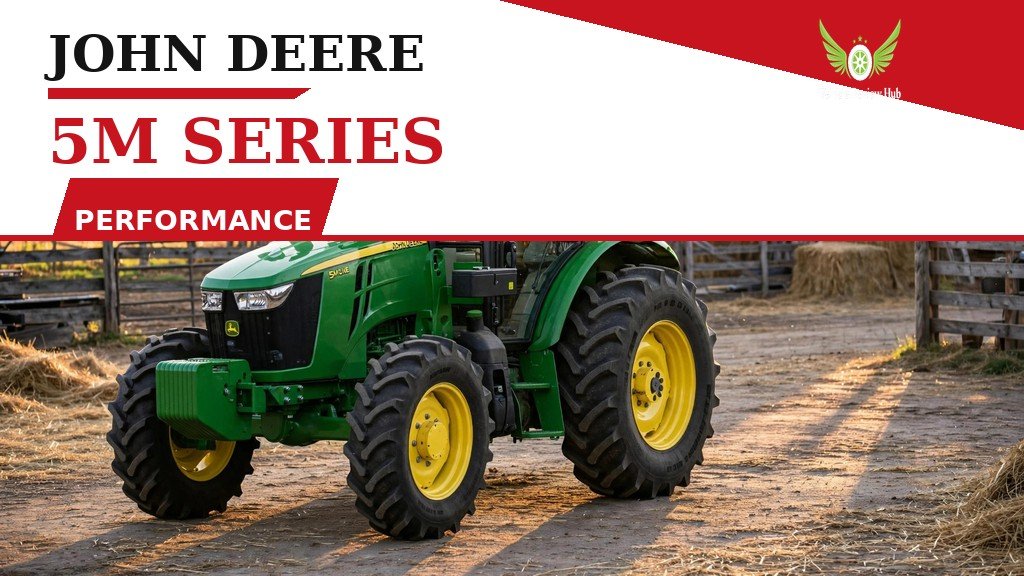
The short answer on John Deere 5M Series performance: John Deere’s premium mid-size utility tractors, rated 75 horsepower on the 5075M to 115 on the 5115M (current badges reach 130). PowerTech diesels, a heavier mid-frame chassis, up to three transmission choices, loader-ready hydraulics. Owner-reported fuel use runs roughly 2.5 to 4 gallons per hour in mixed farm work, toward 6 gph at full PTO load — and 35- to 52-gallon tanks make a full long day on one fill-up normal.
This guide breaks down John Deere 5M Series performance by model: fuel consumption by task, transmission effects on economy, tillage and hay capability, loader and hauling strength, handling and comfort, and owner reports after hundreds of hours. Every figure comes from Deere specs, dealer data, Nebraska test results, or documented owner reports — anything else is labeled an estimate.
John Deere 5M Series Fuel Consumption and Runtime
Fuel is the biggest running-cost line on any utility tractor, and the 5M family’s split personality shows here. The three-cylinder 5075M sips; the four-cylinder 5090M, 5100M, and 5115M drink more under load but return more work per gallon when the job genuinely needs horsepower. Oversized tanks — up to 51.9 gallons on a 5075M cab, per Koenig Equipment’s 5075M spec listing — mean most owners work a full day between fill-ups. That long-legged runtime is a quiet but real part of John Deere 5M Series performance.
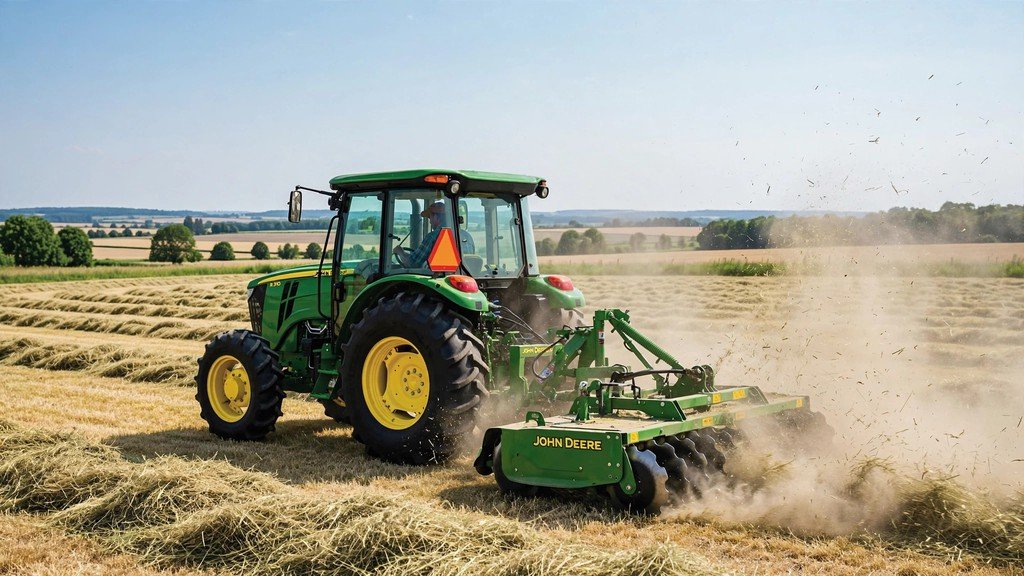
Fuel Use During Fieldwork, Loader Work and Idling
The only hard lab number comes from the Nebraska Tractor Test of the 5105M, a 105-horsepower sibling in the same 4.5L engine family: 5.8 gallons per hour at full PTO load. That is the ceiling — wide open, maximum power. Real owner-reported numbers sit well below it, and this is where John Deere 5M Series performance looks most attractive:
| Typical task | 5075M (75 hp) | 5090M / 5100M (90–100 hp) | 5115M (115 hp) |
|---|---|---|---|
| Light chores, idling, yard work | 1.2–2.0 gph | 1.5–2.5 gph | 1.8–2.8 gph |
| Loader work (feeding, material handling) | 2.5–4.0 gph | 3.0–4.5 gph | 3.5–5.0 gph |
| Mowing and hay (PTO engaged) | 3.5–5.0 gph | 4.0–5.5 gph | 4.5–6.0 gph |
| Heavy tillage / full PTO load | 4.5–5.5 gph | 5.0–6.0 gph | 5.5–6.5 gph |
| Typical blended workday | 2.5–3.5 gph | 3.0–4.0 gph | 3.5–4.5 gph |
That Nebraska figure anchors John Deere 5M Series performance at the top end: 5.8 gph at full PTO load while making about 81.5 PTO horsepower — roughly 14 horsepower-hours per gallon, respectable for a utility tractor. The 5115M column is estimated from its power class; treat it as a planning number, not lab data.
Runtime is where the big tanks pay off: the 5075M’s 47.1/51.9-gallon tanks deliver 15 to 17 hours at a 3-gph blended rate; the 5115M’s 41.7-gallon tank and the 5090M’s ~35-gallon tank still give honest 8- to 12-hour days. That endurance is a practical edge of John Deere 5M Series performance. Our 5M Series ownership cost guide turns these burn rates into dollars per hour and per year.
How Model, Workload and Transmission Affect Fuel Economy
The biggest lever on John Deere 5M Series performance economy is engine choice. The 5075M’s three-cylinder PowerTech 3029 wins every light-work comparison — owners moving feed at 1,500 rpm report it barely sipping. The four-cylinder PowerTech 4045 engines in the 5090M, 5100M, and 5115M use more fuel at idle, but under a 15-foot mower they convert fuel into finished acres faster, which is the efficiency that counts.
Transmission choice matters more than most buyers expect. The 540E economy PTO spins the shaft at 540 rpm with the engine near 1,645 rpm, cutting fuel and noise on light PTO jobs like tedding or running an auger. The Hi-Lo’s 32 forward speeds and the Powr8’s wide spread hold the engine in its sweet spot — owners report both burn noticeably less on transport and fieldwork than the base 16F/16R on the same job. Gear selection is one of the most underrated factors in John Deere 5M Series performance. The 5075E performance guide shows how the simpler 5E gearboxes compare on the same tasks.
Two smaller items complete the picture. DEF on the SCR-equipped 5090M, 5100M, and 5115M runs about 2 to 4 percent of diesel consumption, and the 3.2-gallon DEF tank on the 5115M stretches across several fill-ups. The 5075M avoids DEF but carries a diesel particulate filter needing occasional passive regeneration; steady moderate loading keeps that cycle invisible, while chronic light-load idling forces parked regens that burn extra fuel. Getting the emissions routine right keeps John Deere 5M Series performance consistent over the years — see our 5M Series maintenance guide covers the DPF and DEF routines in detail.
John Deere 5M Series Performance for Farm Work
The 5M’s mid-frame design is why buyers step up from the economy 5E: more iron, more hydraulic capacity, more hitch lift, and a chassis that stays planted with a 15-foot mower behind it or a round bale in the loader. From 75 to 115 engine hp and 57 to 100 PTO hp, one platform spans chore tractor and field tractor — that breadth is the heart of John Deere 5M Series performance.
Mowing, Hay Work, Tillage and Material Handling
Match the model to the implement and the 5M rarely feels underpowered. The 5075M (57.6 PTO hp) is at home on 8- to 10-foot rotary cutters, 4×5 round balers, and 6- to 8-foot discs. The 5090M and 5100M (75 and 85 PTO hp) open the envelope to 12- and 15-foot batwing mowers, 5×6 balers, 8- to 10-foot discs, and six-row planters. The 5115M’s 100 PTO horsepower pulls a 15-foot batwing through heavy grass and runs large square balers that would stall smaller tractors. This implement range is exactly where John Deere 5M Series performance earns its reputation.
Two engine traits make John Deere 5M Series performance feel stronger than the numbers suggest. Torque rise around 30 percent lets the engine dig in and hold rpm when the mower hits a thick patch instead of forcing a downshift, and the roughly 4 percent power bulge on the 4045 engines adds a cushion at the top end. The 540/540E/1,000-rpm PTO options match shaft speed to the implement: 540E for light mowing, full 540 for the baler, 1,000 for the big auger.
For a real-owner window into John Deere 5M Series performance after break-in, Steer Pointe Farms’ 150-hour 5100M review walks through mowing, loader chores, and general farm duty with honest impressions of power delivery and fuel use:
If your work centers on the 90-horsepower class, the 5090M performance deep-dive covers that model’s field behavior in finer detail, including its flex-wing mowing manners.
Loader Work, Hauling and Heavy-Load Performance
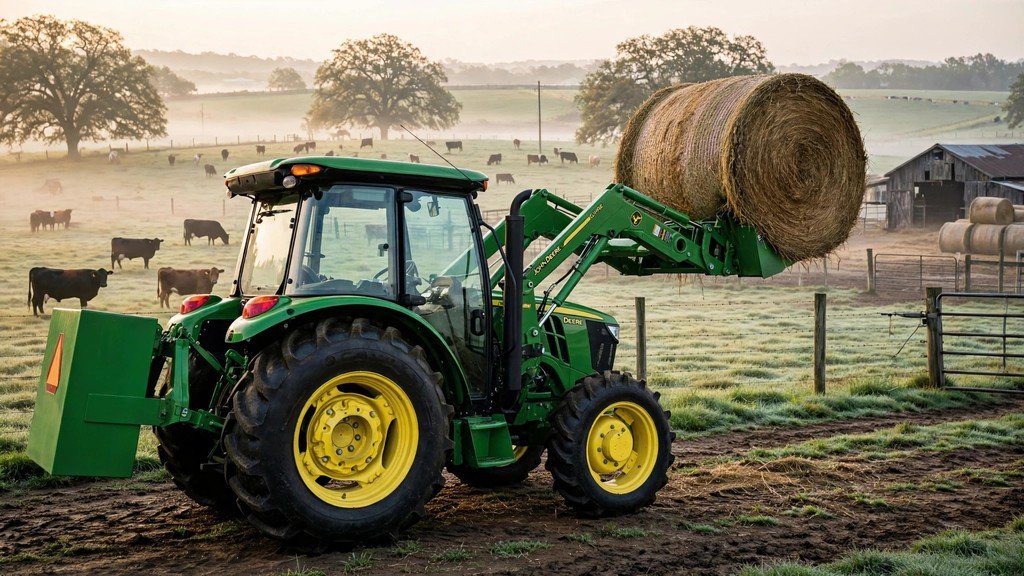
Front-loader work is arguably where John Deere 5M Series performance shines brightest. The factory H260 and H310 loaders were designed alongside the 5M chassis: mechanical self-leveling holds bucket angle through the lift arc, the single-point connection hooks up hydraulics in one motion, and the optional loader suspension smooths the ride with a full bucket — features MachineFinder’s loader guide highlights across the H Series line. Owners say the loader feels like part of the tractor, not an attachment.
In practical terms: confident handling of 1,200- to 1,500-pound round bales, full buckets of gravel or manure, and pallet-fork work. The 5M’s 7,800- to 8,900-pound shipping weight keeps it planted with a heavy load at full height, where lighter tractors get tippy. Proper rear ballast — wheel weights or a ballast box — is part of getting full John Deere 5M Series performance from the loader; see the maintenance guide.
Heavy-load hauling is the quiet half of John Deere 5M Series performance. The Hi-Lo’s 25-mph road speed makes the 5M a credible transport tractor; the base PowrReverser’s 19 mph covers shorter hops. Wet-disc brakes and the heavy-duty drawbar handle loaded grain carts and manure spreaders, and the Category 2 hitch — 5,150 lb standard on the 5075M (5,950 optional), up to 7,860 optional on the 5115M — lifts implements that would overwhelm a lighter hitch.
John Deere 5M Series Handling, Comfort and Limitations
Heavier iron brings stability and a calmer ride — the 5M’s mid-frame shows it on rough ground and side slopes. But size and weight have trade-offs, and honest John Deere 5M Series performance talk includes where this tractor is not the right tool.
Cab, Open-Station Controls and Operator Comfort
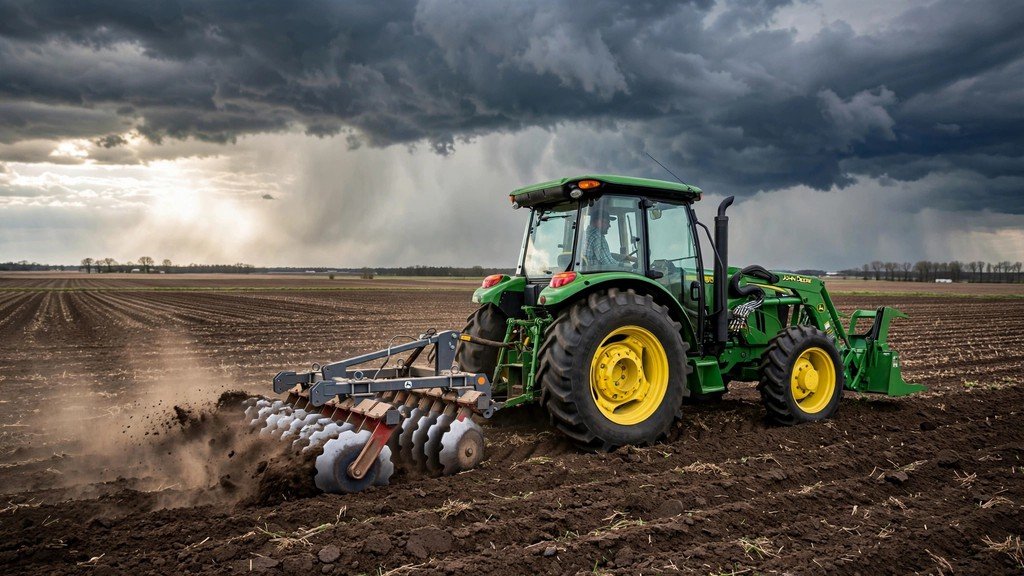
The 5M cab is a proper working office: effective climate control, a flat floor, good all-around glass with the cornerpost exhaust tucked out of sight lines, and an available air-ride seat for long hay days. The loader-view window plus sunroof make overhead loader placement genuinely visible — small details that protect John Deere 5M Series performance across 12-hour days. The open-station version keeps the foldable two-post ROPS and a comfortable suspension seat; the value pick where a cab is overkill.
Controls follow Deere’s utility logic: the reverser lever for clutch-free direction changes, range and gear levers in easy reach, color-coded hydraulics. Owners report a short learning curve — an afternoon, not a week — so new operators reach full John Deere 5M Series performance quickly. The full 5M Series review, which walks through cab and open-station versions side by side.
Traction, Stability, Terrain and Workload Limits
Traction is a 5M strength and a core part of John Deere 5M Series performance. Mechanical front-wheel drive, an electrohydraulic differential lock, and 7,800-plus pounds of iron put power down on hills, loose soil, and muddy feedlots where lighter tractors spin. The 12-foot turning radius with brakes handles headland turns without three-point shuffling.
The limits are the flip side of the same coin. That weight makes the 5M a poor choice for soft, wet ground — it will rut and bog where a lighter tractor walks through. It is not a row-crop tractor: no high-clearance option, no narrow-row configuration like the 5G specialty line. In cramped barnyards the smaller 5E is handier, and hundred-plus-acre primary tillage belongs to the 6M and 6R families. Knowing these limits matters as much as knowing the strengths when judging John Deere 5M Series performance for your farm — a step the 5M Series review frames against the bigger Deere lines.
John Deere 5M Series Real-World Owner Experience
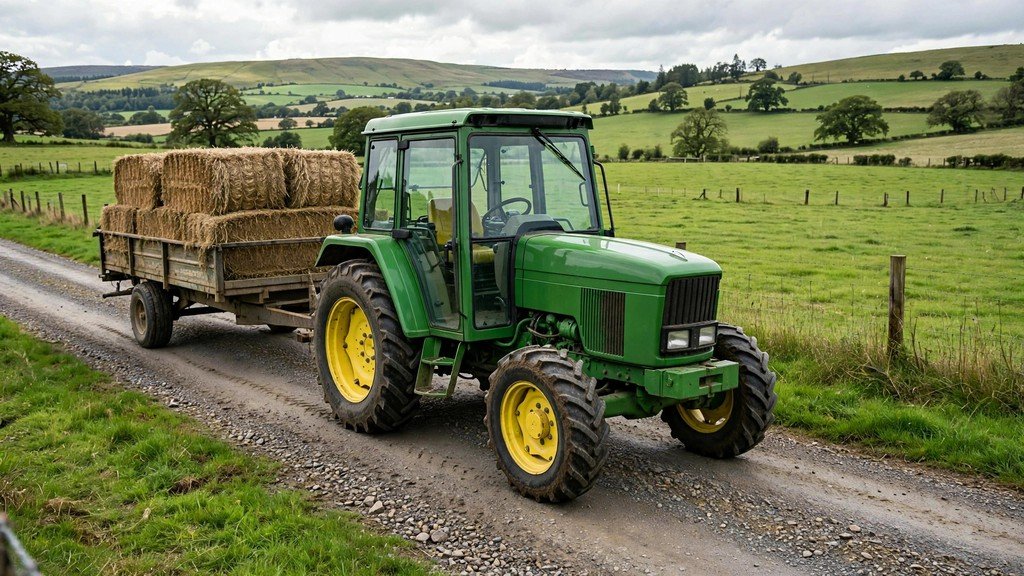
Owner consensus is consistent: the 5M costs more than a 5E and owners know it — they paid for the heavier frame, better transmissions, and the cab, and most say the premium earned its keep. In the real world, John Deere 5M Series performance is the absence of drama: it starts, it pulls, it lifts, and it does it again tomorrow.
Owner-Reported Benefits, Complaints and Trade-Offs
The benefits owners cite most are power delivery and reliability. The PowerTech 3029 and 4045 engines have long service histories, and owners describe them as “unstressed” — the 5M rarely works near its limits. The PowrReverser’s clutch-free shuttling transforms loader days, and Powr8 owners love having a gear for every speed. That unstressed, drama-free feel is the signature of John Deere 5M Series performance — and a 5M is never an orphan for parts or dealer support.
Complaints cluster around cost and emissions hardware. A well-optioned 5M cab tractor with loader runs deep into five figures beyond an equivalent 5E. On the four-cylinder models DEF handling is a minor chore; the 5075M’s DPF draws the occasional gripe from owners who idle extensively — usually fixed by working the tractor harder. These are the known price of John Deere 5M Series performance, not deal-breakers; detailed in the 5M maintenance and problems guide and the ownership cost breakdown.
Choosing the Right Model and Transmission for Your Work
Pick by workload, not by badge — matching model to work is how you buy the right John Deere 5M Series performance the first time. The 5075M is the smart money for livestock operations and daily loader chores, and the pick for buyers avoiding DEF. The 5090M and 5100M are the sweet spot for mixed farms — enough PTO for 15-foot mowers and 5×6 balers without the 5115M’s thirst. The 5115M suits hay operations where 100 PTO horsepower is a requirement.
| Transmission | Speeds | Best for |
|---|---|---|
| PowrReverser | 16F/16R | Loader work, livestock — clutch-free shuttling |
| PowrReverser Hi-Lo | 32F/16R | Mixed farms wanting 25-mph transport and field flexibility |
| PowrQuad PLUS | 16F/16R | Field work — shift ranges without the foot clutch |
| Powr8 | 32F/16R (+ creeper opt.) | Maximum flexibility — precise ground speeds |
One shopping note: current dealer lots carry 5095M, 5105M, 5120M, and 5130M (95 to 130 hp — see the current 5105M spec sheet) alongside used 5090M, 5100M, and 5115M tractors. Model, transmission, and emissions setup are the three decisions that define the John Deere 5M Series performance you will actually live with. The 5M Series review keeps the current model lineup straight.
Frequently Asked Questions About John Deere 5M Series Performance
Quick answers on John Deere 5M Series performance, drawn from Deere specs, dealer data, and documented owner experience.
How much fuel does a John Deere 5M use per hour?
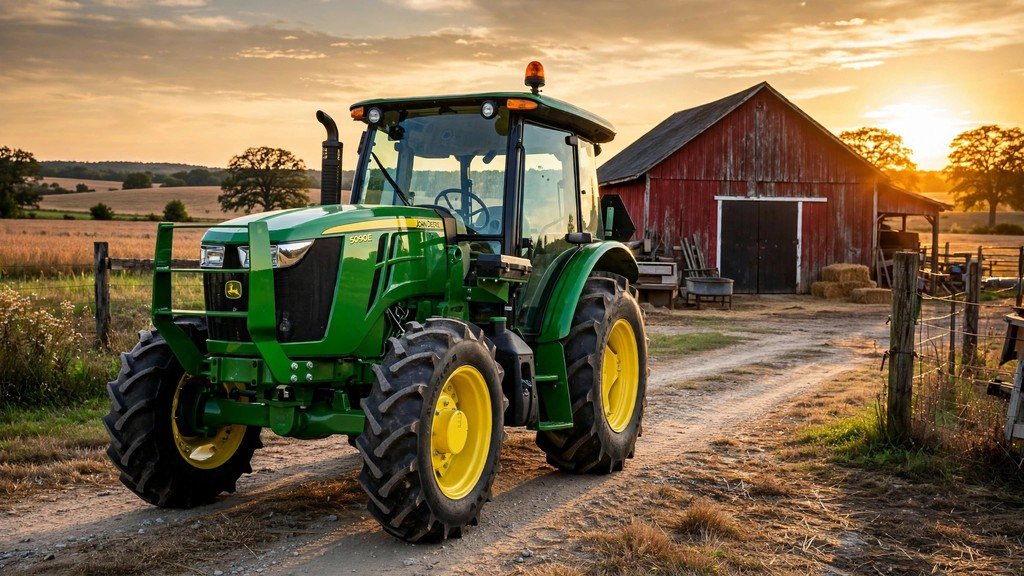
Plan on 2.5 to 4.5 gallons per hour for typical mixed farm work — the everyday reality of John Deere 5M Series performance at the fuel pump. Light chores run 1.2 to 2.8 gph, loader work 2.5 to 5 gph, PTO mowing 3.5 to 6 gph. The Nebraska Test of the 105-hp 5105M recorded 5.8 gph at full PTO load — the realistic ceiling. The 5075M is the thriftiest; the 5115M the thirstiest.
What is the difference between the 5075M and the 5115M?
The 5075M is the 75-horsepower entry point: three-cylinder 2.9L PowerTech 3029, 57.6 PTO horsepower, DOC/DPF emissions with no DEF, and the largest tank at up to 51.9 gallons. The 5115M is the 115-horsepower flagship: four-cylinder 4.5L PowerTech 4045, 100 PTO horsepower, DOC/SCR using DEF, and a 41.7-gallon tank. The 5115M handles 15-foot batwings and large balers; the 5075M suits 10-foot mowers and 4×5 balers.
Do John Deere 5M tractors use DEF?
It depends on the engine. The 5075M’s three-cylinder uses a diesel oxidation catalyst plus diesel particulate filter and needs no DEF. The four-cylinder 5090M, 5100M, and 5115M use DOC plus selective catalytic reduction, which requires DEF — about 2 to 4 percent of diesel use, from a 3.2-gallon tank on the 5115M. No four-cylinder 5M uses a DPF, so there are no parked regeneration cycles on those tractors.
Which transmission is best for John Deere 5M Series performance?
For loader-heavy work, the standard PowrReverser 16F/16R with clutch-free shuttling is the favorite. Mixed farms that road their tractor should step to the PowrReverser Hi-Lo 32F/16R for 25-mph transport and tighter gear splits. PowrQuad PLUS suits field operators who want to shift ranges without clutching; the Powr8 32F/16R with available creeper is for specialty work needing very precise ground speeds.
Can a John Deere 5M pull a 15-foot batwing mower?
The 5090M, 5100M, and 5115M handle 15-foot batwing mowers comfortably with 75 to 100 PTO horsepower. The 5075M, at 57.6 PTO horsepower, is better matched to 8- to 10-foot rotary cutters — a 15-foot batwing is asking too much of it. Match the mower to the PTO, not the engine badge.
Is the 5M worth the premium over the 5E?
For buyers who will use the extra capability, yes. The 5M brings a heavier mid-frame chassis, up to three transmission choices, more hydraulic flow, higher hitch lift, and a more refined cab — all visible in loader work, hay season, and long days. For basic chores on a budget, the 5075E does the same jobs for less money and burns less fuel doing them. The premium pays off in proportion to how hard you work the tractor — the final word on John Deere 5M Series performance value.