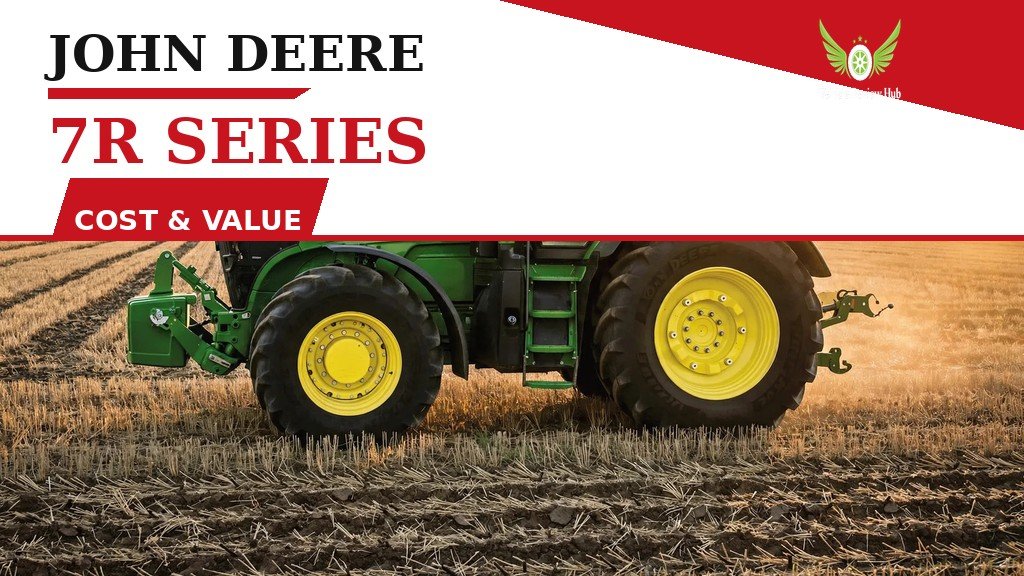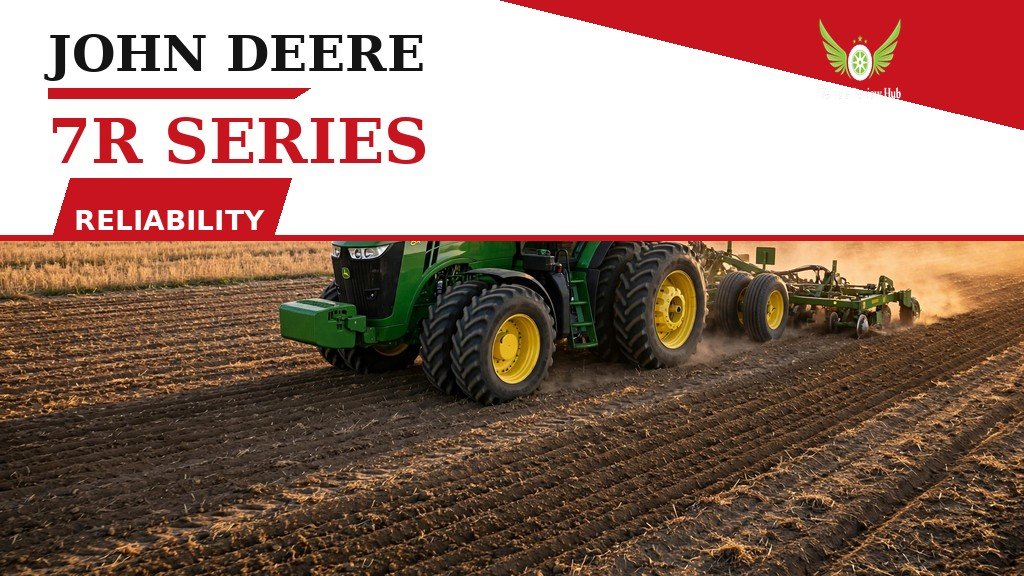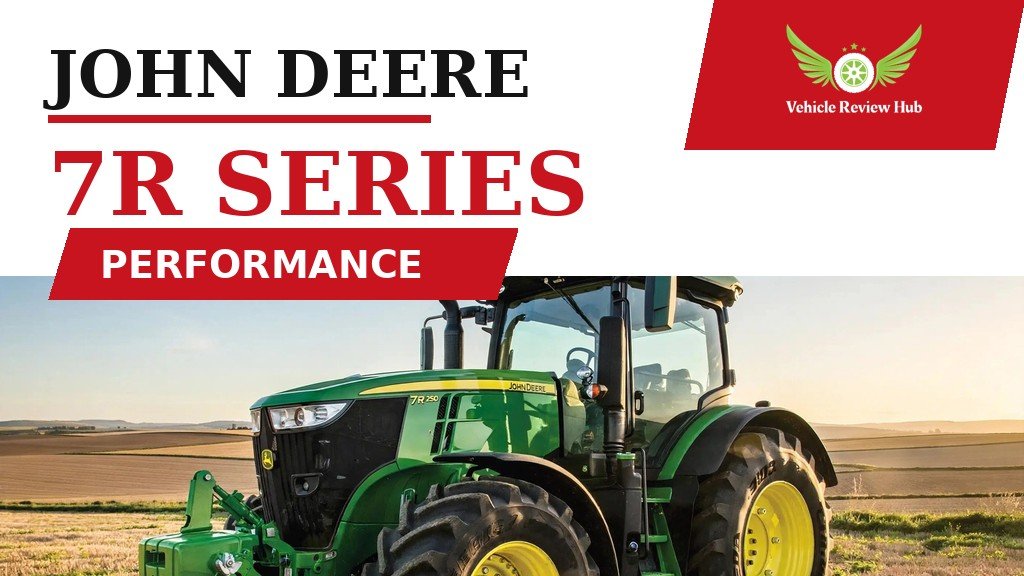
The John Deere 7R Series is the sweet spot of John Deere’s row-crop lineup: bigger and more capable than a 6R, more nimble and versatile than an 8R, with rated horsepower from 210 to 330 across seven models. This John Deere 7R Series review covers the full lineup, real new and used pricing, engine and transmission specs, and how the 7R stacks up against the 6R and 8R.
This John Deere 7R Series review focuses on facts you can verify: published specifications from John Deere and its dealers, current US pricing, and what owners and reviewers actually report. Every figure below comes from a checkable source — where a number is an estimate or dealer-reported, it’s labeled as such. This John Deere 7R Series review sources engine figures from Deere and dealer spec sheets, prices from current US listings, and field impressions from owner reports.
John Deere 7R Series Review, Models and Price
The 7R Series is John Deere’s mid-size row-crop tractor family, built in Waterloo, Iowa, for farms that need serious draft and PTO power without stepping up to the 8R’s footprint. Seven models cover the range: the 7R 210, 7R 230, 7R 250, 7R 270, 7R 290, 7R 310, and 7R 330. The 7R 210 through 7R 270 run a 6.8-liter PowerTech PSS six-cylinder; the 7R 290, 310, and 330 use a 9.0-liter PowerTech PVS six-cylinder. All are Final Tier 4 with DOC, DPF, and SCR/DEF aftertreatment.
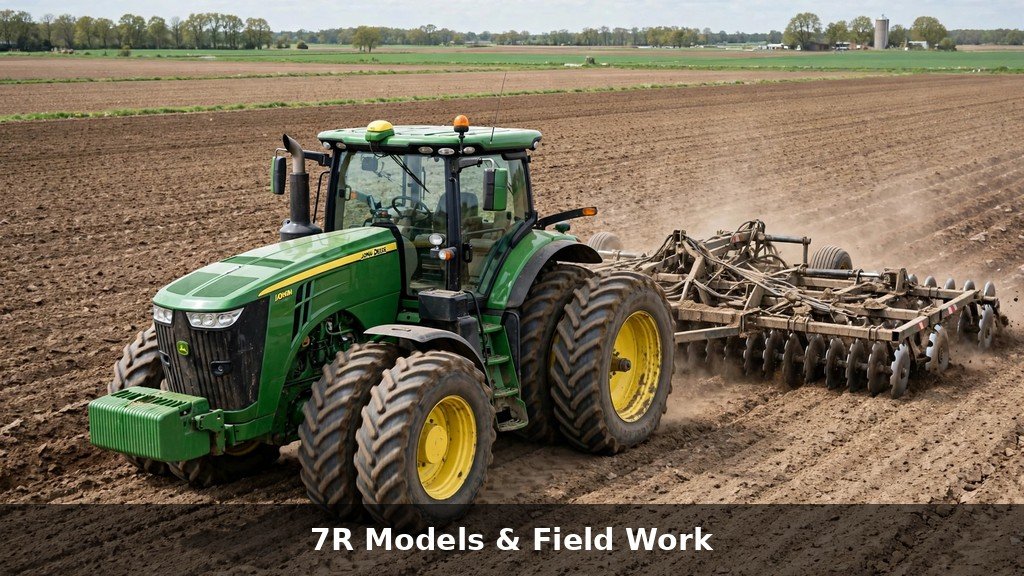
7R Tractor Models, Features and Intended Uses
Start by matching horsepower to implements. The 7R 210 and 7R 230 suit mixed row-crop and livestock operations running 12- to 16-row planters, mid-size grain carts, and PTO-driven hay tools. The 7R 250 and 7R 270 are the volume sellers for large row-crop farms — comfortable pulling a 24-row planter, a 40-foot field cultivator, or a high-capacity forage wagon. The 7R 290, 7R 310, and 7R 330 (290 to 330 rated hp) move into primary-tillage territory: big discs, rippers, and heavy grain-cart duty, with PTO output capped at 260 hp to protect the driveline — the range this John Deere 7R Series review examines most closely.
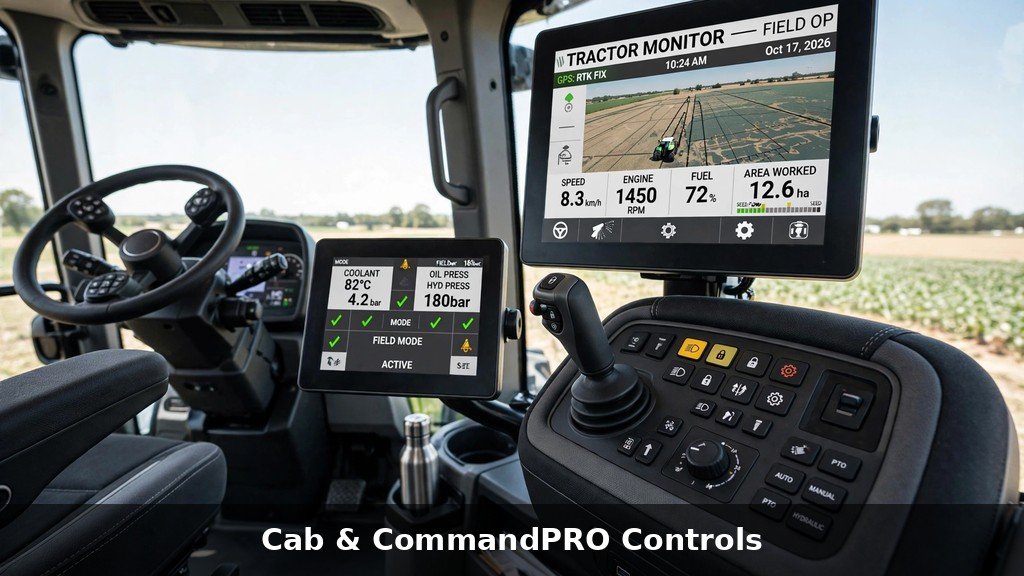
Standard equipment targets row-crop comfort and technology: the CommandView cab (114 cubic feet), Generation 4 CommandCenter displays (4200 or 4600), AutoTrac readiness, JDLink telematics, and optional TLS Plus front suspension. CommandPRO — the joystick driving control reviewers consistently praise for loader and transport work — is available on IVT models. Three visibility packages (Select, Premium, Ultimate) trade halogen lighting up to full LED. The video below walks through the 7R 250 in detail — key features, configurations, and where it fits on a working farm:
As this John Deere 7R Series review notes, the walkaround above explains the 7R's “do everything” reputation better than any brochure. Intended uses are broad by design — the machine that covers planting, tillage, grain-cart duty, and road transport. This John Deere 7R Series review keeps coming back to one theme in owner reports: the 7R is the “do everything” tractor on a row-crop farm — the machine that plants in spring, tills in fall, runs the grain cart, hauls on the road, and never feels out of place. Operators considering the step up from a 6R often land on a 7R 210 or 230 for the extra hydraulic capacity and drawbar muscle, while 8R shoppers who don’t need the 8R’s track options or maximum ballast save money by choosing a 7R 330. That is the verdict this John Deere 7R Series review heard repeatedly from row-crop operators.
New and Used Prices by Model, Year and Configuration
New 7R pricing sits firmly in large-row-crop territory. John Deere’s May 2026 government price page lists the 7R 250 base machine at $427,481 before options — the reference point this John Deere 7R Series review uses for new-machine pricing, and independent aggregator AllMachines prices the 7R 330 at $463,658. Configured machines commonly add $40,000–$80,000 in options. Dealers quote final prices on request.
Used values hold up well, which matters for the ownership-cost math in our John Deere 7R Series ownership cost guide. Recent US listings include 2024 7R 250 at $337,001 via Construction Equipment Guide — the kind of data points this John Deere 7R Series review relies on for the used market. A 2024 7R 250 with 643 hours at $304,999 at Papé Machinery in Four Lakes, Washington, shows the low-hour end of the range. Late-model low-hour 7R 290s and 330s trade higher still. Older 7R 210s and 230s from 2018–2021 with 2,000–4,000 hours typically land in the $150,000–$230,000 band depending on transmission, tire condition, and guidance equipment. New Zealand listings show similar depreciation patterns (2022 7R 250, 3,100 hours, NZ$360,000) — useful as a depreciation reference, though not a US market price.
Pricing takeaway from this John Deere 7R Series review: budget roughly $425,000–$475,000 new before options for the mid-range models, and expect well-kept late-model used machines to retain 60–70% of original value in the first five years.
John Deere 7R Series Engine, Horsepower and Specifications
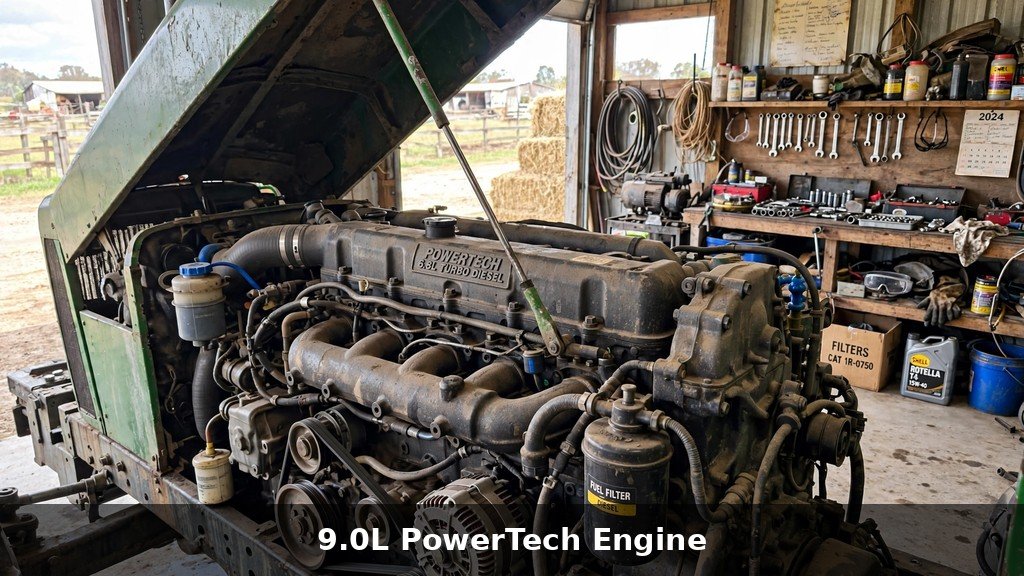
Every 7R runs a John Deere PowerTech six-cylinder — PSS 6.8 liters (415 cu in.) in the 210 through 270, PVS 9.0 liters (549 cu in.) in the 290 through 330. The 6.8L uses dual turbochargers in series (a variable-geometry turbo plus a fixed-geometry turbo); the 9.0L uses a single variable-geometry turbo. Rated speed is 2,100 rpm; peak torque arrives at 1,600 rpm. US Final Tier 4 aftertreatment is DOC + DPF + SCR with DEF, so the DPF regenerates automatically and DEF refills come from the 6.9-gallon tank.
Rated HP, Maximum HP, IPM and PTO Power
John Deere rates the 7R line from 210 hp (7R 210) to 330 hp (7R 330), with maximum power roughly 10% higher thanks to power bulge, plus up to 30 hp more from Intelligent Power Management (IPM) in transport and mobile PTO applications — a feature this John Deere 7R Series review considers essential for transport-heavy operations. Rated PTO power runs 170 hp on the 210 up to 260 hp on the 310 and 330 — note the PTO output is capped at 260 hp on the top three models to protect the driveline.
| Model | Rated hp | Max hp | PTO hp (rated) | Peak torque @ 1,600 rpm |
|---|---|---|---|---|
| 7R 210 | 210 | 231 | 170 | 725 lb-ft |
| 7R 230 | 230 | 253 | 182 | 794 lb-ft |
| 7R 250 | 250 | 275 | 205 | Not published |
| 7R 270 | 270 | 297 | 224 | Not published |
| 7R 290 | 290 | 319 | 242 | Not published |
| 7R 310 | 310 | 341 | 260 | 1,071 lb-ft |
| 7R 330 | 330 | 363 | 260 | 1,139 lb-ft |
The spec table below is this John Deere 7R Series review’s quick reference. PTO torque rise is 40% across the line, which is what lets the 7R hold implement speed when load spikes — reviewers consistently credit this torque reserve for the tractor’s “never lugs down” character. If PTO performance is your priority, our 7R Series performance and fuel usage guide breaks down fuel use by task.
Engine Displacement, Dimensions, Hydraulics and Hitch Capacity
The 7R’s chassis numbers explain why it bridges the 6R and 8R so well. Base machine weight is 22,000 lb with the e23 transmission and TLS front axle on 18.4R46 tires, on a 115.2-inch wheelbase — long enough for stability with heavy mounted implements, short enough to turn 23 feet with brakes. Overall length is about 217 inches and maximum height roughly 186 inches.
Fuel capacity is generous: 122 US gallons with the e23 transmission or 135 gallons with IVT, plus the 6.9-gallon DEF tank. That is a genuine full-day fuel load for most field work — see the Enns Brothers 7R 230 capacities sheet for the full table. The closed-center, pressure/flow-compensated hydraulic system delivers 43 gpm standard or 59 gpm optional, with up to six rear SCVs (35 gpm at a single rear SCV) and front SCVs with the optional front hitch.
Hitch muscle gets top billing in this John Deere 7R Series review: the Cat 3/3N rear hitch lifts 12,000 lb behind the lift points (15,200 lb with the optional Cat 3N setup), the optional front hitch lifts 11,464 lb, and the Cat 4 HD drawbar handles up to 4,050 lb of vertical load (10,000 lb with the heavy-duty drawbar support). Electrohydraulic hitch sensing, inboard planetary rear axles, and the 1300 Series MFWD front axle (TLS suspension optional) round out the running gear.
John Deere 7R Series Transmission and Implement Compatibility
Two transmissions cover the range. The e23 PowerShift is standard: 23 evenly spaced forward gears (15% steps) and 11 reverse gears, 26 mph standard or 31 mph optional, with Efficiency Manager that pairs mechanical efficiency with IVT-like ease. The AutoPowr IVT is optional in 26 or 31 mph and is the only transmission compatible with CommandPRO, the joystick driving control that makes loader work and road transport noticeably easier according to operator reviews.
e23 Powershift and IVT Transmission Options
Choose the e23 for maximum mechanical efficiency and lower purchase price — Efficiency Manager auto-selects gear and engine speed for the load, and owners report excellent draft-work fuel economy. Choose the IVT for stepless speed control, CommandPRO, and the smoothest road transport; its ActiveZero feature holds zero speed without touching the brakes regardless of load. In this John Deere 7R Series review, IVT + CommandPRO is the standout for mixed farm and road use. The 31 mph versions require the TLS Plus front suspension.
Both transmissions pair with the same rear-axle options: rack-and-pinion or flange axles, differential lock, and up to 24 front suitcase weights plus cast rear weights for ballasting. Creeper options are available for specialty low-speed work. Service intervals for both boxes are covered in our 7R Series maintenance guide — the companion piece to this John Deere 7R Series review.
PTO, Three-Point Hitch, Loader and Implement Compatibility
The independent rear PTO is 1,000 rpm on a 1.75-inch 20-spline shaft as standard, with 540/1,000, 540E/1,000E, and 1,000E gearcase options; a front PTO (1,000 rpm) comes with the optional front hitch. Engagement is via electric switch with adjustable modulation, and rated PTO speed arrives at 1,950 engine rpm (1,750 rpm in economy mode) — useful for trimming fuel on light PTO loads.
Implement compatibility is wide: the 7R handles planters up to 24 rows, field cultivators to 40+ feet, large square balers, grain carts to 1,000+ bushels, and heavy primary-tillage tools within its drawbar and hitch ratings. For loader work, the 643R loader is the factory pairing — the same loader family used on the 6R — and CommandPRO-equipped IVT models make loader cycling genuinely pleasant, per operator reports — a detail this John Deere 7R Series review confirmed against dealer configurators. Buyers comparing loader tractors should also read our John Deere 6R Series review, since the 6R is the most common cross-shopped alternative.
John Deere 7R Series vs. 6R and 8R Tractors
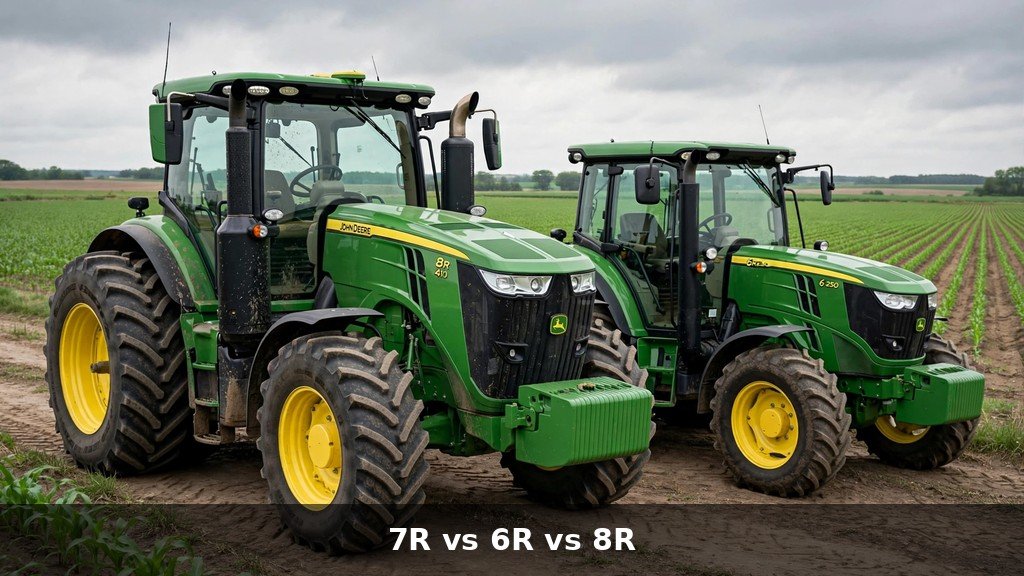
The 7R exists because the gap between the 6R (145–250 hp, 6.8L) and the 8R (230–410 hp) was too wide for many operations. Picking between the three comes down to power, size, weight, and price — and most farms find the 7R hits the overlap where their work actually lives.
Differences in Power, Features and Operating Capabilities
| Attribute | 6R Series | 7R Series | 8R Series |
|---|---|---|---|
| Rated hp range | 145–250 | 210–330 | 230–410 |
| Engine | 6.8L 6-cyl | 6.8L / 9.0L 6-cyl | 9.0L 6-cyl |
| Base weight | ~15,200–20,500 lb | 22,000 lb | ~24,500–29,000 lb |
| Hydraulics | 30–42 gpm | 43–59 gpm | 43–59 gpm |
| Hitch lift (std) | ~9,200–12,000 lb | 12,000 lb | ~13,500–15,200 lb |
| Assembly | Mannheim, Germany | Waterloo, Iowa | Waterloo, Iowa |
| New price band (base) | ~$315,000–$375,000+ | ~$400,000–$465,000 | ~$440,000–$560,000+ |
Against the 6R, the 7R brings roughly 25–80 more rated horsepower at the top end, the 9.0L engine on bigger models, higher hydraulic flow, and a heavier chassis that handles bigger implements without running out of traction. Against the 8R, the 7R gives up the 8R’s largest models (370 and 410 hp), maximum ballast levels, and track (8RT/8RX) options — but costs meaningfully less and fits in tighter field and road situations. Operators on TractorByNet and other owner forums frequently describe the 7R 250 as “the last tractor you’ll need” for 1,500–3,000-acre row-crop operations. That owner consensus is central to this John Deere 7R Series review.
Which Tractor Series Fits Your Farm and Budget?
Choose the 6R if your implements top out around 200 hp of demand, you want the lowest purchase price, or loader work dominates your hours. Choose the 7R if you run 16- to 24-row planters, pull grain carts, do primary tillage with 30–40-foot tools, or want one tractor that covers planting, tillage, and transport. Choose the 8R if you need more than 330 hp, run the heaviest implements, or want tracked variants for flotation and traction.
Budget reality check: a new 7R 250 base at $427,481 (Deere May 2026 price page) versus a late-model used 7R 250 at $305,000–$337,000 is a $90,000–$120,000 spread — which is why the used market for these tractors stays competitive. This John Deere 7R Series review treats that spread as the single most important number for buyers. Our 7R Series buying and ownership cost guide walks through the new-vs-used math in detail. This John Deere 7R Series review recommends running that math before choosing between series.
Frequently Asked Questions About the John Deere 7R Series
Quick answers to the questions buyers ask most about the 7R lineup, based on published specs and current market data.
How much does a new John Deere 7R Series tractor cost?
John Deere’s May 2026 price page lists the 7R 250 base machine at $427,481 before options, and the 7R 330 prices around $463,658 per independent aggregators — one more benchmark for readers of this John Deere 7R Series review. Typical options (IVT, visibility and comfort packages, front hitch, weights, guidance) add $40,000–$80,000 — most configured 7R tractors leave the dealership between $450,000 and $550,000. That is the honest pricing picture this John Deere 7R Series review can document today.
What engine does the John Deere 7R Series use?
The 7R 210 through 7R 270 use a John Deere PowerTech PSS 6.8-liter six-cylinder; the 7R 290 through 7R 330 use a PowerTech PVS 9.0-liter six-cylinder. Both are B20-biodiesel-compatible, Final Tier 4 engines with DOC, DPF, and SCR/DEF aftertreatment. The 6.8L runs dual turbochargers in series; the 9.0L uses a single variable-geometry turbo.
Does the John Deere 7R Series need DEF?
Yes. All 7R models use SCR aftertreatment with a 6.9-gallon DEF tank, and the cornerpost display includes a DEF level gauge with a low-fluid warning. The DPF regenerates automatically during normal operation. This John Deere 7R Series review treats DEF as a minor operating cost, not a drawback.
What transmissions are available on the 7R Series?
The e23 PowerShift (23 forward, 11 reverse gears; 26 or 31 mph) is standard, and the AutoPowr IVT (26 or 31 mph) is optional. CommandPRO joystick driving is available only with the IVT. The 31 mph versions require the TLS Plus front suspension. That detail shapes this John Deere 7R Series review’s transmission advice.
Where is the John Deere 7R Series built?
The 7R Series is built in Waterloo, Iowa, USA — the same factory that builds the 8R and 9R lines. (The smaller 6R Series is built in Mannheim, Germany.) For buyers who value domestic assembly, this John Deere 7R Series review notes Waterloo as a genuine plus.
What warranty does the John Deere 7R Series carry?
John Deere’s agricultural warranty statement covers tractors for 24 months or 2,000 hours, whichever comes first. with paid PowerGard extended plans (up to 60 months) available. That wraps the warranty picture in this John Deere 7R Series review.