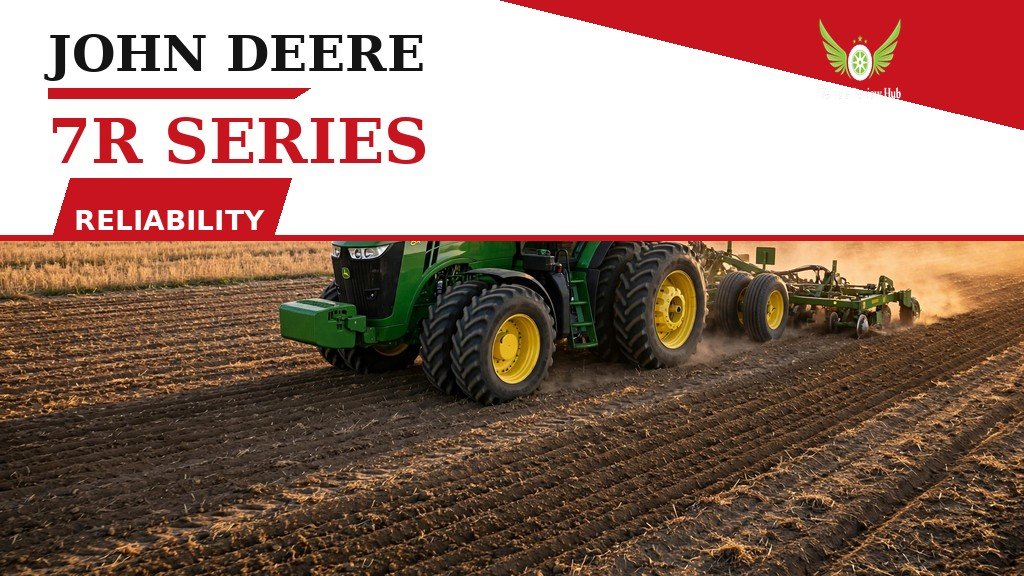
A 210-to-330-horsepower row-crop tractor only earns its keep when it stays in the field, and that comes down to disciplined John Deere 7R Series maintenance. The 7R’s factory intervals are generous — engine oil at 500 hours, transmission and hydraulic oil at 1,500 — but its size and technology punish deferred service hard. This John Deere 7R Series maintenance guide covers the service schedule and real costs, long-term reliability, the common problems owners report, and how to inspect a used 7R before you buy.
The 7R family spans the 7R 210 through the 7R 330: the 210, 230, 250, and 270 run the PowerTech PSS 6.8L six-cylinder, while the 290, 310, and 330 run the PowerTech 9.0L. If you’re still choosing a model, our John Deere 7R Series review breaks down the lineup and pricing — then come back here for the John Deere 7R Series maintenance details that keep your tractor running.
John Deere 7R Series Maintenance Schedule and Service Costs
John Deere 7R Series maintenance follows a simple rhythm: daily checks, 500-hour engine services, 750-hour hydraulic filter changes, and the big 1,500-hour transmission service. The table below combines Deere’s published intervals — engine oil at 500 hours, hydraulic/transmission oil at 1,500, coolant at 6,000 — with the daily checks that catch small problems early.
| Interval | John Deere 7R Series maintenance items | Typical cost |
|---|---|---|
| Daily / 10 hours | Check oil, coolant, and DEF levels; drain fuel water separator; check air-filter restriction indicator; walk around for leaks | — |
| Every 50 hours | Check front-axle oil; grease chassis points; clean cab air filters in dusty conditions | $30–$60 |
| Every 500 hours | Change engine oil and filter; change fuel filters; service air cleaner; inspect drive belt | $400–$700 DIY / $800–$1,400 dealer |
| Every 750 hours | Replace transmission/hydraulic oil filters; change front-axle final-drive oil | $250–$500 |
| Every 1,500 hours / 2 years | Change transmission/hydraulic oil and filters (42+ gal); change axle oils; change cab air filters and engine air cleaner | $1,200–$2,500 |
| Every 4,500 hours | Change secondary element of engine air cleaner | $80–$150 |
| Every 6,000 hours / 6 years | Change engine coolant (COOL-GARD II); inspect hoses and radiator | $300–$600 |
| Annual routine total | ~500–800 engine hours of typical row-crop use | $1,000–$2,000 DIY / $2,000–$4,000 dealer (estimates) |
Engine Oil, Fuel Filters, Cooling System and Routine Service
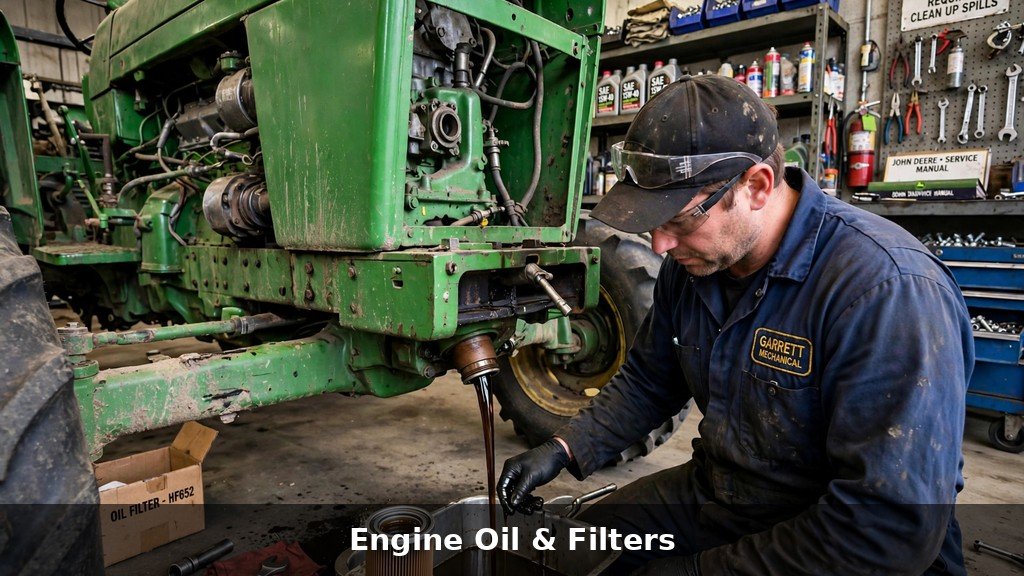
The crankcase holds about 6.9 gallons (26 L), so even a DIY oil change is a two-bucket job. John Deere 7R Series maintenance calls for 500-hour oil changes with Plus-50 II oil and genuine filters; cut the interval back in severe dust, and change it annually even on low-hour machines since oil degrades in the sump.
The 7R runs a high-pressure common-rail system with an electric self-priming transfer pump, and Deere specs a two-stage setup: a 10-micron primary cartridge with a water-in-fuel sensor and drain, plus a 2-micron secondary spin-on element. Change both filters at every 500-hour John Deere 7R Series maintenance service — a surprising share of owner-reported “engine problems” trace back to restricted fuel flow from gelled diesel, algae in farm storage tanks, or a water-logged primary filter, and fuel starvation can even prevent a DPF regeneration from starting. The cooling system holds about 10.4 gallons of COOL-GARD II with a 6,000-hour change interval; check it annually with Deere’s coolant test strips, and blow out the radiator screens in chaff-heavy work. The video below walks through a full service on a big-frame John Deere and pairs well with the John Deere 7R Series maintenance items above:
Transmission, Hydraulic Oil, Axles and Lubrication
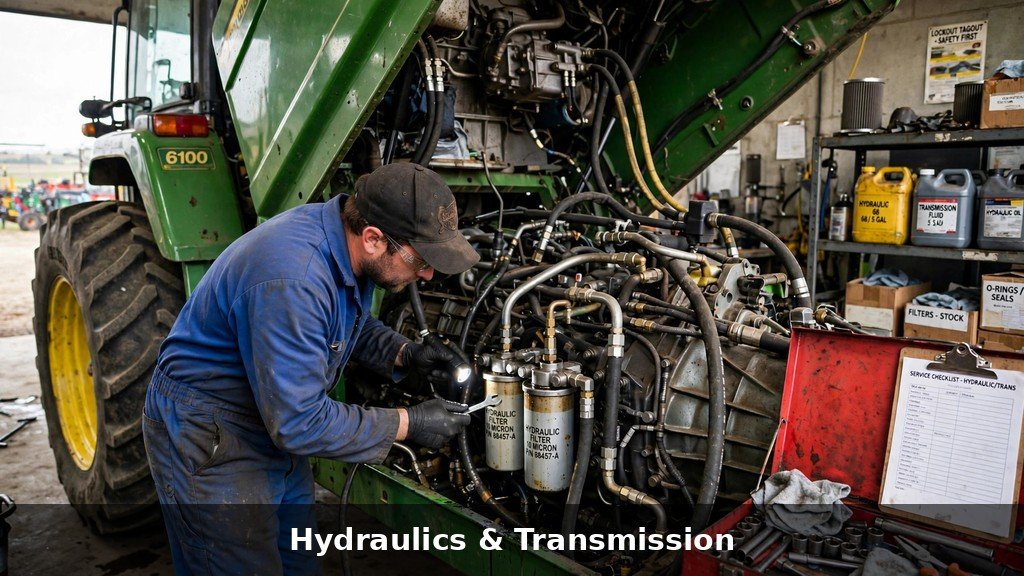
The transmission/hydraulic system is the biggest fluid job: about 42.3 gallons of Hy-Gard serving the transmission, steering, brakes, hitch, and SCVs. The John Deere 7R Series maintenance interval is 1,500 hours for the full change with filter-only changes at 750 hours — and those 750-hour filters matter, because a clogged hydraulic filter shows up as slow hitch response or weak steering long before it causes damage. Budget $1,200–$2,500 at a dealer (the oil is most of it), or roughly half that DIY with bulk Hy-Gard.
Check front-axle oil at 50 hours and change it with the 1,500-hour service, including final drives. On tractors with TLS Plus — the hydro-pneumatic front suspension required with the 31-mph (50K) options — have the dealer inspect the accumulators and ride-height calibration at the same John Deere 7R Series maintenance interval; a tired accumulator shows up as a harsh, porpoising ride. Grease every chassis, hitch, and drawbar fitting at the 50-hour lube round.
John Deere 7R Series Reliability and Long-Term Durability
The 7R has a well-earned reputation as a high-hour, low-drama tractor — Deere’s Waterloo, Iowa-built row-crop flagship. John Deere 7R Series maintenance done on schedule is what separates 10,000-hour tractors from 5,000-hour money pits: wet-sleeve 6.8L and 9.0L six-cylinders with a long ag track record, an e23 PowerShift with decades of lineage, and IVTs regarded as reliable with clean fluid and filters.
Engine, Transmission and Hydraulic System Reliability
The 6.8L uses dual turbochargers and the 9.0L a single variable-geometry turbo. Both run cooled EGR plus a full US Final Tier 4 aftertreatment stack — DOC, DPF, and SCR with DEF — and peak torque arrives at just 1,600 rpm (725 lb-ft on the 7R 210, up to 1,139 lb-ft on the 7R 330), so the engines work at low rpm and low stress. Owner reports describe the engines as the least troublesome part of the tractor; complaints cluster around sensors, wiring, and emissions peripherals rather than hard parts.
The e23 is a mechanical powershift with a strong service record — 23 forward gears in even 15-percent steps, 11 reverse, and an Efficiency Manager that holds ground speed at reduced rpm — and Deere’s recalibration procedure often cures harsh shifting without parts. The IVT pairs with CommandPRO for seamless speed control, but its reliability hinges on clean oil, making the 750-hour John Deere 7R Series maintenance filter changes non-negotiable on IVT machines. The closed-center hydraulic system (43 gpm standard, 59 gpm optional) is equally robust, and the MY2024 SCV stack redesign made coupler-size changes a simple slice swap.Factors Affecting Service Life, Downtime and Repair Costs
Three things separate long-lived 7Rs from problem children: duty cycle, fluid discipline, and software. These engines and their aftertreatment are happiest at sustained working load — a 7R that idles or works lightly will regen its DPF far more often than one pulling a ripper at 80 percent load. Fluid discipline is the cheapest insurance in agriculture: genuine filters, the right oil, no stretched intervals. And software matters more every year — Deere’s updates fix shift calibrations, display glitches, and emissions logic.
Connectivity is a genuine reliability asset. Five years of JDLink is included on recent machines, and Connected Support lets your dealer see codes and view the in-cab display remotely — Deere says this cuts downtime by an average of 20 percent. For long-term keepers, the PowerGard plan extends coverage up to four additional years or 3,000 hours in Limited (engine and powertrain) or Comprehensive (full machine) form. Our 7R Series ownership cost guide runs the full five-year John Deere 7R Series maintenance and repair numbers including resale.
John Deere 7R Series Common Problems and Warning Signs
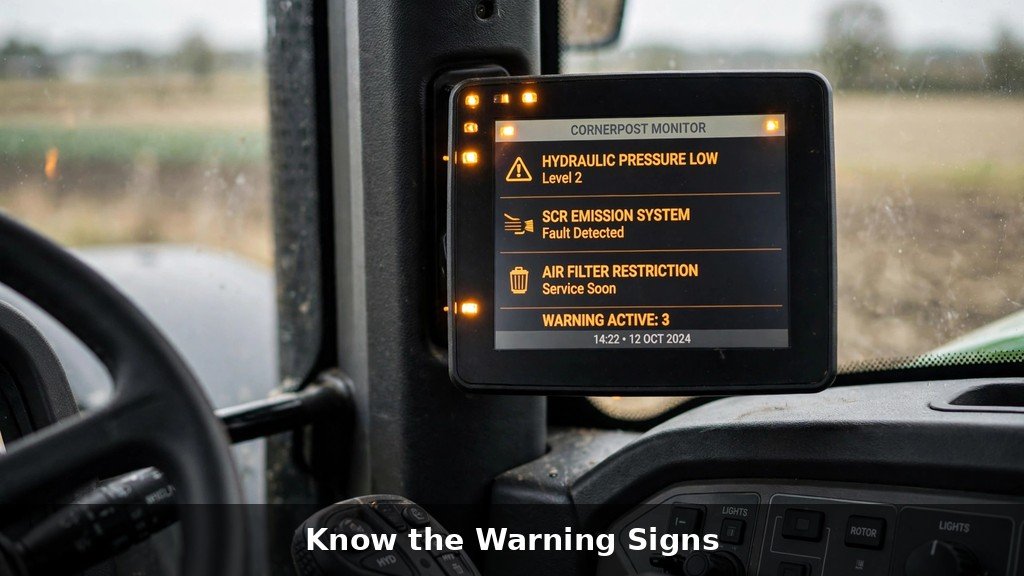
No tractor line is perfect, and John Deere 7R Series maintenance records show issues clustering in three places: the emissions system, the electronics, and the hydraulics. The pattern below comes from owner forums, technician write-ups, and dealer bulletins — and most 7R problems announce themselves early through the cornerpost display and CommandCenter.
Engine, Electrical, Hydraulic and Transmission Symptoms
Emissions and derate faults top the list of John Deere 7R Series maintenance headaches. The most common owner-reported issue is a DEF-related derate: a DEF quality sensor fault or contaminated DEF in the 6.9-gallon tank can put the engine into a power derate — sometimes a hard 1,500-rpm lock — until resolved. The fix is usually simple (fresh DEF, a dried or replaced sensor connector), but the downtime stings at planting or harvest. DPF complaints follow the same pattern: lightly worked tractors regen constantly, and ignoring the cleaning cycle loads the filter until a parked regen or dealer visit is needed.
Electrical and sensor faults are the second cluster: a failed DOC inlet temperature sensor, a flaky wheel-speed sensor, or a corroded DEF-tank connector can throw a cascade of codes that look catastrophic but trace to one part. Pull the full code list through Service ADVISOR before replacing anything — the first code is usually the culprit, and making this your standard John Deere 7R Series maintenance habit saves real money. Hydraulic symptoms — slow hitch, drifting SCVs, noisy steering — almost always mean filters, low oil, or a suction leak rather than a failed pump. Transmission complaints are comparatively rare: harsh e23 shifts are usually fixed with a dealer recalibration, and IVT complaints tend to be about feel rather than failures. TLS Plus issues show up as degraded ride quality — an accumulator or calibration matter for the dealer.
Diagnosing Faults and Evaluating Repair Needs
Good John Deere 7R Series maintenance starts every diagnosis the same way: read the codes before touching a wrench. The cornerpost display and Generation 4 CommandCenter show active faults, and with JDLink your dealer can pull the same list remotely through Service ADVISOR Remote. Deere’s code structure is genuinely helpful — each code’s Suspect Parameter Number and Failure Mode Identifier pinpoints the circuit, so a DEF quality sensor fault has a documented test procedure rather than being a mystery. A useful independent reference is the John Deere ECU fault-code guide at linux-os.net, which walks through common codes with causes and test steps.
Wear items (filters, belts, batteries, tires) are John Deere 7R Series maintenance, not problems — budget for them. Calibrations (e23 shift recalibration, TLS ride-height, SCV flow tuning) are dealer procedures that restore performance without parts. Hard failures (a cracked manifold, a failed turbo actuator, a scored pump) are uncommon before high hours if the schedule was kept. Keep a simple log — date, hours, code, action — because documented service history adds real money at resale. For the smaller-frame comparison, 6M Series maintenance and 5090M maintenance cover the same diagnostic habits at lower horsepower.
John Deere 7R Series Safety Checks and Used-Tractor Inspection
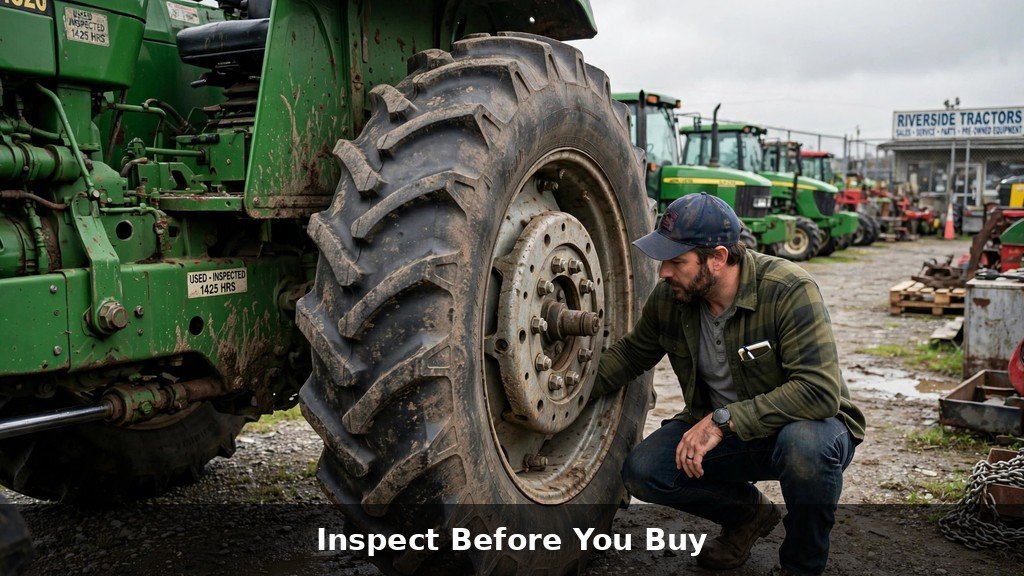
A used 7R is one of the smartest buys in big ag — Waterloo-built, strong resale, deep parts support — but it’s a six-figure machine where a missed problem is a five-figure mistake. Run the same checks whether buying from a dealer or at auction: budget an hour, bring a flashlight, and ask for the digital service history. Documented John Deere 7R Series maintenance is the most valuable thing a used listing can show.
Checking Service History, Software Updates and Applicable Recalls
Ask for the complete John Deere 7R Series maintenance history first: receipts, dealer work orders, or the Operations Center machine record. Look for proof of the 500-hour engine services, the 1,500-hour transmission/hydraulic service, and coolant service at 6,000 hours. A 6,000-hour tractor with no record of a transmission oil change is a negotiation point — price it accordingly. Confirm the software level too: have the dealer verify the tractor is current on engine, transmission, and display software.
On recalls: we could not verify any 7R-specific CPSC recall in current CPSC records — the widely reported September 2024 brake recall covered 1023E/1025R/2025R compact utility tractors only. Treat any “7R recall” claim as reported rather than confirmed unless matched to an official CPSC release or a Deere bulletin for your serial number. Any authorized dealer can run the serial for open campaigns, or call Deere at 800-537-8233. Also confirm emissions warranty status — federal emissions warranties outlast the base machine warranty and can cover expensive aftertreatment components.
Inspecting Brakes, Tires, Hydraulics and Transmission Operation
Work through the machine methodically. Brakes: the 7R uses hydraulic wet-disk brakes (plus optional wet-disk front brakes with TLS Plus) — test both pedals independently at low speed for even engagement, and confirm the park brake holds on a slope. Tires: measure tread, look for stubble damage and sidewall cuts; a set of row-crop rubber runs into five figures. Hydraulics: cycle every SCV, watch for drift in the hitch or cylinders, and listen for pump cavitation; milky oil means water and burnt-smelling oil means heat. Transmission: run the e23 through the gears under light load, or drive the IVT through its full range confirming smooth stepless response. Engage the 1,000-rpm PTO under load and lift the three-point through its full range. Finally, cold-start the engine: brief haze is normal, but persistent blue or white smoke after warmup warrants a deeper look. Once the inspection is done, our 7R Series ownership cost guide and 7R Series performance and fuel usage guide complete the buying picture.
Frequently Asked Questions About John Deere 7R Series Maintenance
The questions 7R owners and buyers ask most about John Deere 7R Series maintenance — answered with the factory intervals and real-world practice.
How often does a John Deere 7R need an oil change?
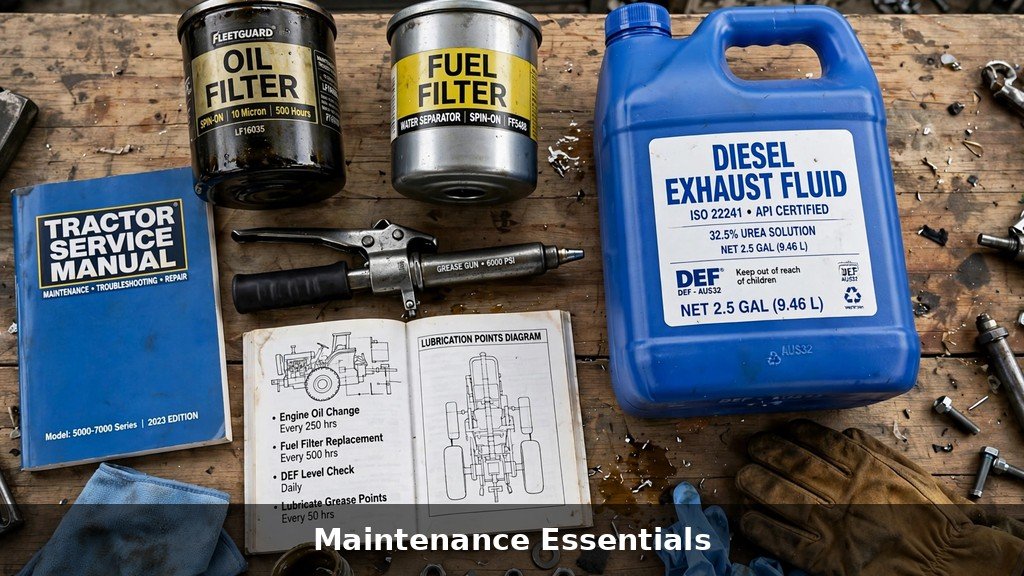
John Deere 7R Series maintenance calls for an oil change every 500 hours or annually, whichever comes first, with Plus-50 II oil and a genuine filter. The crankcase holds about 6.9 gallons — budget $400–$700 in parts DIY or $800–$1,400 at a dealer. Change the fuel filters at the same interval, and don’t skip the annual change on low-hour tractors.
What emissions system does the 7R use, and does it need DEF?
Yes. US Final Tier 4 7R tractors use cooled EGR plus DOC, DPF, and SCR with DEF; the tank holds 6.9 gallons with a gauge on the cornerpost display. Keep it filled with fresh, ISO-compliant DEF — stale DEF is the most common cause of derate faults owners report — and work the tractor hard enough that the DPF regenerates passively. This is the aftertreatment item most John Deere 7R Series maintenance questions are really about.
What is the 1,500-hour service, and what does it cost?
The centerpiece of John Deere 7R Series maintenance: transmission/hydraulic oil and filters (about 42 gallons of Hy-Gard), front-axle and final-drive oil, cab air filters, engine air cleaner, and the crankcase-vent oil separator. Dealer cost typically runs $1,200–$2,500; DIY with bulk oil cuts that roughly in half. The 750-hour filter-only changes between full services keep the hydraulics, steering, and transmission happy.
Are there any recalls on the John Deere 7R Series?
We could not verify a 7R-specific recall in current CPSC records; the September 2024 brake recall covered 1023E/1025R/2025R compacts only. If a seller mentions a 7R recall, ask for the campaign number and verify it — any John Deere dealer can check your serial number, or call Deere at 800-537-8233. Never skip this step on a used purchase.
e23 PowerShift or IVT — which is more reliable?
Both have strong records with different personalities. The e23 is a mechanical powershift — simpler, and shift issues are usually fixed with a dealer recalibration rather than parts. The IVT is seamless with CommandPRO but more sensitive to fluid condition, making the 750-hour filter changes non-negotiable. Choose by operating style and maintain whichever you buy on schedule.
What should I check first when a 7R throws a fault code?
Read the full code list before replacing anything — the first code is usually the root cause and the rest are symptoms. DEF quality and sensor-connector faults are the most common culprits behind derates; check DEF level and quality, inspect connectors for corrosion, and clear codes only after the repair. With JDLink, your dealer can pull codes remotely through Service ADVISOR Remote, which often turns a John Deere 7R Series maintenance mystery into a phone call.