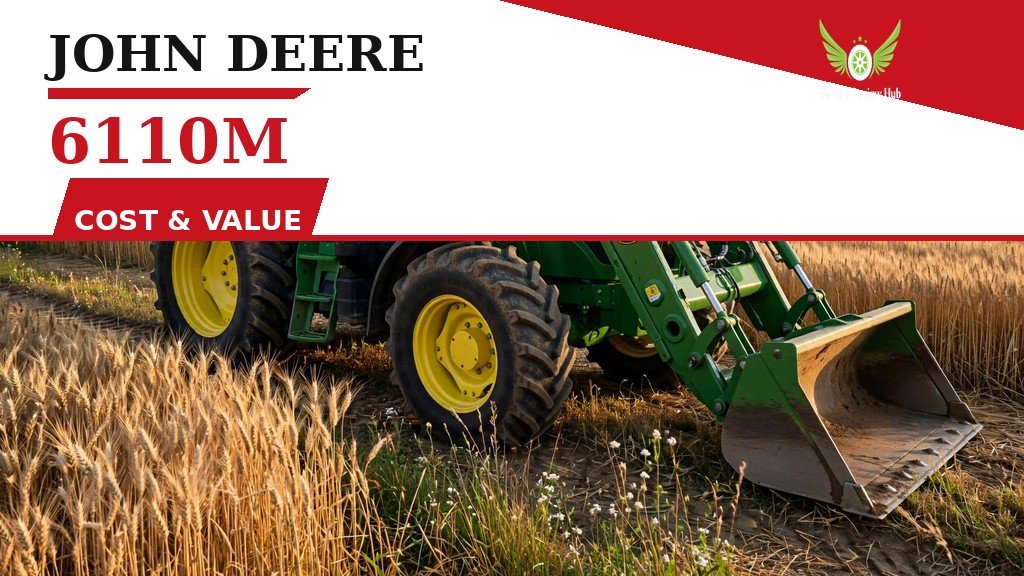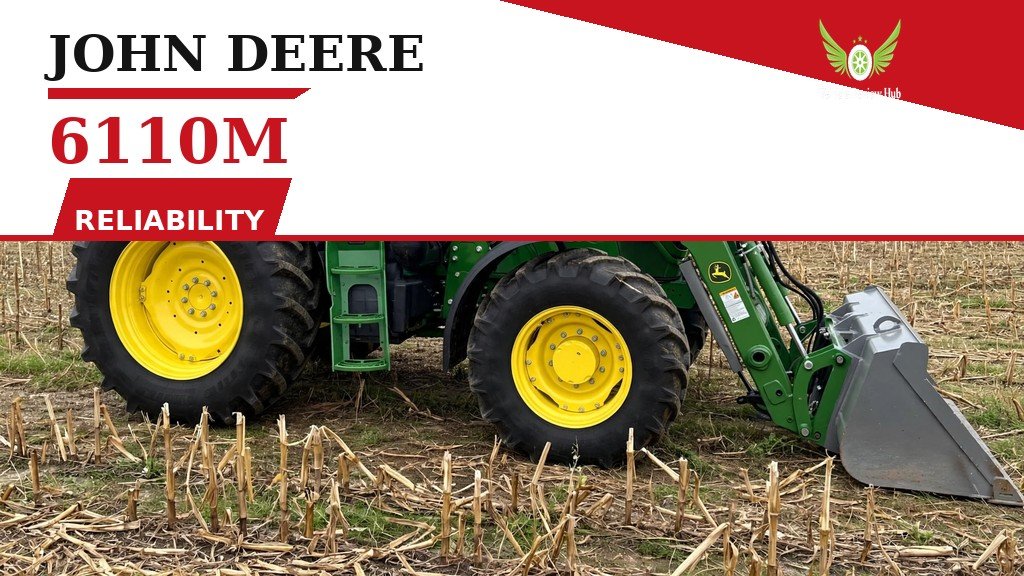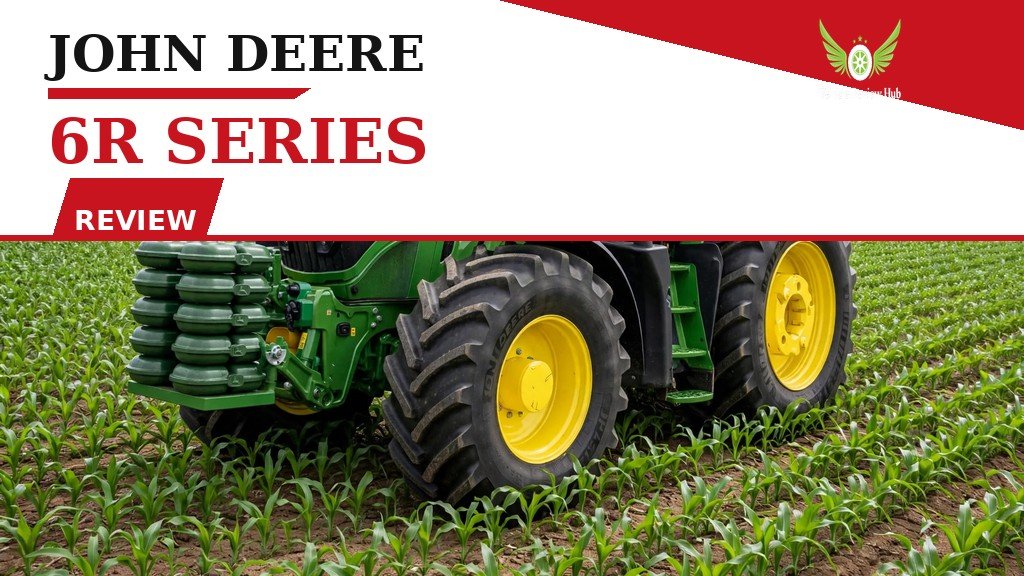
This John Deere 6R Series review covers Deere’s mid-size row-crop tractor line: seven models from the 145-hp 6145R to the 250-hp 6250R, all built in Mannheim, Germany, around the 6.8-liter PowerTech six-cylinder with Final Tier 4 DOC+DPF+SCR emissions. Expect used prices from roughly $85,000 for older high-hour machines to $280,000 for late-model low-hour tractors, with new machines typically quoted by dealers in the mid-$200,000s to well past $300,000 depending on model and options.
In this John Deere 6R Series review you’ll find the full 6R model lineup with rated, maximum and PTO horsepower, the engine and emissions details that matter for US buyers, transmission choices from AutoQuad to the AutoPowr IVT, loader and implement compatibility, realistic used pricing by hours and condition, and honest comparisons with the 6M Series and the 7R above it — every figure drawn from Deere specs, current dealer listings, or documented owner experience.
John Deere 6R Series Review, Models and Price
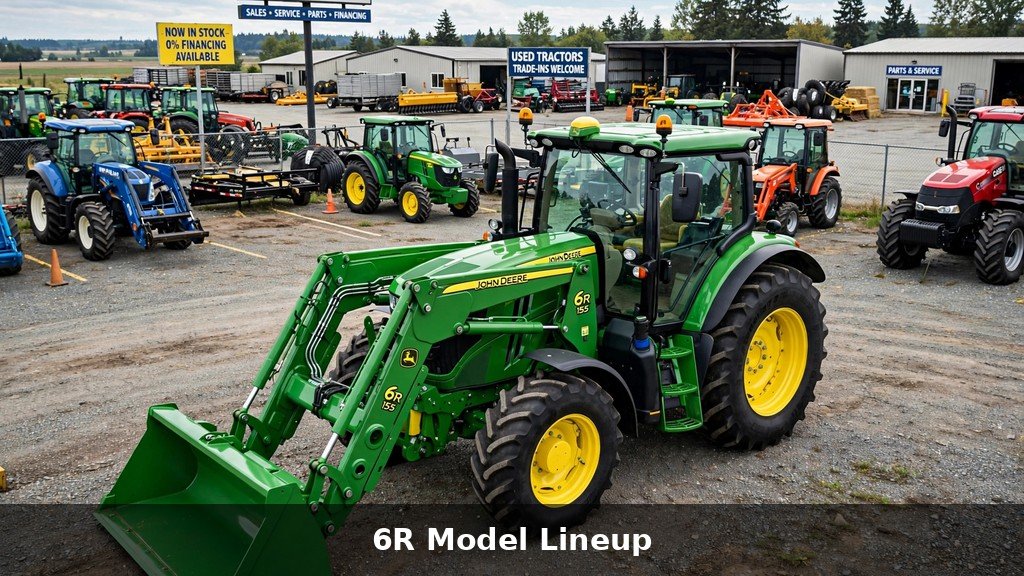
The 6R sits in the heart of John Deere’s row-crop range: bigger and more capable than the 6M utility line, more maneuverable and affordable than the 7R. The current lineup runs 6145R, 6155R, 6175R, 6195R, 6215R, 6230R and 6250R — and if you’re shopping new, you’ll also see the simplified 2022-and-newer naming (6R 155, 6R 175, 6R 195, 6R 215, 6R 230, 6R 250) on dealer lots. Same tractors, shorter badges.
6R Tractor Models, Features and Intended Uses
Every 6R in this John Deere 6R Series review shares the same formula: a 6.8-liter six-cylinder PowerTech diesel, a full-frame steel chassis that carries implement loads instead of the engine block, and the ComfortView cab. Mid-frame models (6145R, 6155R) target mixed farms and dairies; large-frame models (6175R through 6250R) are aimed at row-crop operations, contractors, and heavy transport and loader work. Intelligent Power Management adds up to 40 hp in transport and mobile PTO applications on the smaller models, and up to 50 hp on the 6230R/6250R — the 6250R can touch 300 hp with bulge and IPM combined, according to Deere’s launch materials.
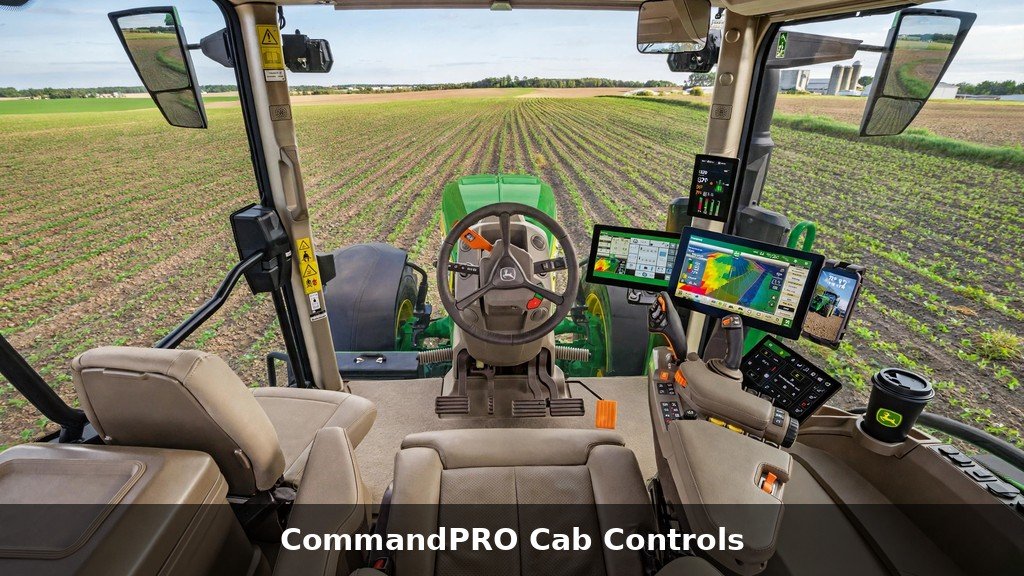
Standout features across the range in this John Deere 6R Series review include the optional CommandPRO joystick armrest that puts drive, hydraulic and guidance functions under your right hand, Triple-Link Suspension (TLS) front axle options, the Gen 4 CommandCenter display with integrated AutoTrac guidance readiness, and a closed-center pressure-and-flow-compensated hydraulic system. The independent front reviews agree on the cab: one long-term 6175R test called the layout, armrest controls and visibility class-leading, awarding the tractor top marks for cabin layout and transmission usability. The first-drive video below covers the latest 6R updates — ride comfort, handling and the revised cab — from an independent UK test team:
Intended uses in this John Deere 6R Series review: row-crop tillage and planting, hay and forage (mower-conditioners, large square balers, self-loading wagons), dairy and livestock feeding and manure handling, daily loader work, and road transport. The 195-hp 6195R is the volume seller in the US — this John Deere 6R Series review rates it as enough power for a 6-bottom plow or a big baler without stepping into 7R money. Fuel and workload capability are broken down model by model in our 6R Series performance and fuel usage guide.
New and Used Prices by Model, Year and Configuration
Deere doesn’t publish fixed list prices for the 6R — new machines are quoted by dealers, and the number moves with transmission, hydraulics, guidance and tire choices. As a rule of thumb for this John Deere 6R Series review: late-model low-hour tractors (2022–2024, under 1,500 hours) ask $200,000–$280,000; mid-life machines (2018–2021, 2,000–5,000 hours) sit around $130,000–$220,000; older high-hour tractors (2014–2017, 6,000+ hours) trade from about $85,000 to $150,000. Documented US data points: a 2023 6R 155 with 1,688 hours listed at $199,500 at LandMark Implement in Kansas, and a 6R 195 advertised at $263,520.
IVT/AutoPowr machines command a premium over AutoQuad examples, guidance-ready tractors with StarFire receivers hold value better, and loader-ready 6Rs with the 663R-class loader add roughly $15,000–$25,000 over bare tractors. Price the DEF/DPF service history into your offer — a neglected aftertreatment system is the most expensive surprise on a used FT4 tractor — as detailed in our 6R Series maintenance and reliability guide. For what those purchase prices mean over years of ownership, see our 6R Series ownership cost guide.
John Deere 6R Series Engine, Horsepower and Specifications
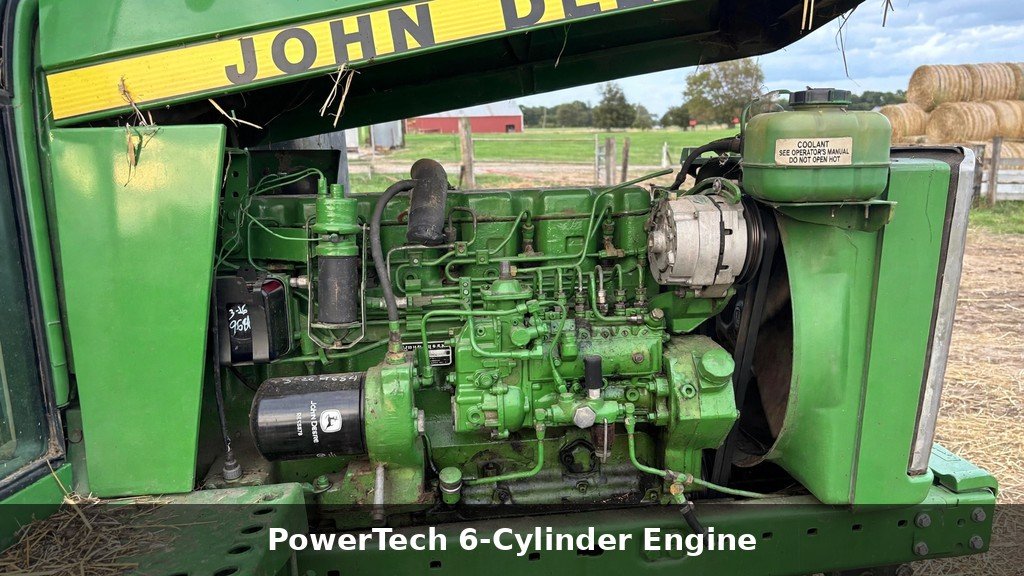
One engine does everything in this John Deere 6R Series review: the John Deere PowerTech 6.8-liter six-cylinder (415 cu in), wet-sleeved, with a fixed-geometry first-stage turbo feeding a variable-geometry second stage, air-to-air aftercooling and cooled exhaust gas recirculation. It is the same 6068 architecture Deere has refined for decades — owners and dealers consistently call it the most proven part of the tractor. Rated speed is 2,100 rpm across the range, with a 40 percent PTO torque rise that keeps pull-type implements working when the load spikes.
Engine Power, PTO HP and Differences Across Models
The headline numbers in this John Deere 6R Series review: 145 to 250 rated horsepower, with Intelligent Power Management adding up to 40 hp (50 hp on the 6230R/6250R) in transport and mobile PTO work. Emissions are US Final Tier 4 with DOC, DPF and SCR using DEF — the full three-stage aftertreatment, verified on US dealer spec sheets for the 6155R and 6215R (engine family NJDXL06.8324). Budget for DEF at roughly 2–4 percent of diesel use and let parked regenerations finish when requested.
| Model | Rated hp | Max hp | PTO hp (SAE) | Peak torque @ 1,600 rpm |
|---|---|---|---|---|
| 6145R | 145 | 160 (+40 IPM) | 113 | 499 lb-ft |
| 6155R | 155 | 168 (+40 IPM) | 121 | 533 lb-ft |
| 6175R | 175 | 193 (215 w/ IPM) | ~140* | ~610 lb-ft |
| 6195R | 195 | 212 | 158 | 672 lb-ft |
| 6215R | 215 | 233 | 174 | 740 lb-ft |
| 6230R | 230 | — (+50 IPM) | ~190* | — |
| 6250R | 250 | 300 w/ bulge + IPM | ~205* | — |
| Key takeaway | 145–250 rated hp from one proven 6.8L six-cylinder; the 6195R’s 158 PTO hp is the US volume sweet spot | |||
*PTO figures marked with an asterisk follow the documented pattern (roughly 30–40 hp below rated) where Deere doesn’t publish a model-specific SAE number. All other figures are from Deere or dealer spec sheets. Note the model-year naming: tractors built from 2022 on wear the short badges — 6R 155, 6R 175, 6R 195, 6R 215, 6R 230, 6R 250 — for the same machines.
Dimensions, Hydraulics, Hitch Capacity and Fuel Capacity
The 6R in this John Deere 6R Series review runs a closed-center, pressure-and-flow-compensated hydraulic system: 30 gpm standard (45cc pump) or 41 gpm optional (60cc pump) at 2,900 psi, with up to five rear SCVs and three mid SCVs for loader and front-mounted work. Rear hitch is Category 3/3N — roughly 9,200–9,500 lb on the mid-frame models and up to 11,990 lb on the 6215R. The 6195R carries an 87.1-gallon fuel tank with a 5.3-gallon DEF tank; the 6145R runs 71.3 gallons of diesel and 4.2 gallons of DEF. Base weights run from about 15,200 lb (6145R) to 18,700 lb (6215R), with maximum permissible weights up to 29,650 lb on the 6195R — heavy, stable platforms for draft work, as this John Deere 6R Series review’s spec comparison confirms.
John Deere 6R Series Transmission, Cab and Implement Compatibility
Transmission choice is the biggest decision on a 6R order sheet, and it moves both the new price and the used value. This John Deere 6R Series review walks through the three families Deere actually offers on the 6R — and clears up one common point of confusion first: the e19 full PowerShift is the 6M’s transmission, not the 6R’s. On the 6R, the stepped powershift role belongs to the 24-speed DirectDrive dual-clutch box.
AutoQuad, AutoPowr/IVT and e19 PowerShift Options
The three 6R transmissions: AutoQuad PLUS ECO (20 or 24 speeds, the value choice — simple, proven, and the easiest to service), DirectDrive (24-speed dual-clutch that pre-selects the next gear for near-seamless shifts, with an AutoClutch function so you can stop without touching the clutch pedal), and AutoPowr/IVT (infinitely variable, 0.03 mph to 26 or 31 mph, the standard fit on most new 6Rs and the favorite for loader and PTO work). Older 6Rs may carry the 16-speed PowrQuad PLUS. Across the tests consulted for this John Deere 6R Series review, reviewers consistently praise the DirectDrive as smooth and economical on the road, while noting it’s an expensive option biased toward transport duty; the IVT wins for operators who live in the loader or run PTO implements at exact ground speeds.
The cab is the ComfortView — reviewers call it quiet (under 70 dBA on the 6195R) with excellent visibility and intuitive driving functions that flatten the learning curve for operators new to the tractor. CommandPRO puts drive, hydraulics and guidance on one configurable joystick; TLS Plus front suspension and cab suspension are the options that transform road work. Guidance-ready machines with StarFire receivers and the Gen 4 CommandCenter hold their value best at resale.
Loader, Three-Point Hitch, PTO and Rear Implement Compatibility
The 6R is loader-ready from the factory, pairing with the 663R-class front loader for daily feeding, material handling and bale work. The Category 3/3N rear hitch with electronic lower-link sensing handles mounted plows, heavy cultivators and large planters; the drawbar is Category 3. Rear PTO is 540/1,000 rpm standard with 540E and 1,000E economy options on many configurations, electrohydraulically engaged. Front hitch and front PTO are available for mower and snowblower combinations. With up to five rear SCVs — a core section of this John Deere 6R Series review — the 6R runs planters, air seeders and large square balers without hydraulic compromise — a step change from the 6M’s three-SCV ceiling that matters for row-crop buyers comparing the two lines in this John Deere 6R Series review.
John Deere 6R Series vs. 6M and Other Utility Tractors
Buyers cross-shop the 6R against three things: the 6M below it, the 7R above it, and the red and blue competition. Here’s how this John Deere 6R Series review frames those decisions.
Differences in Power, Features and Operating Capabilities
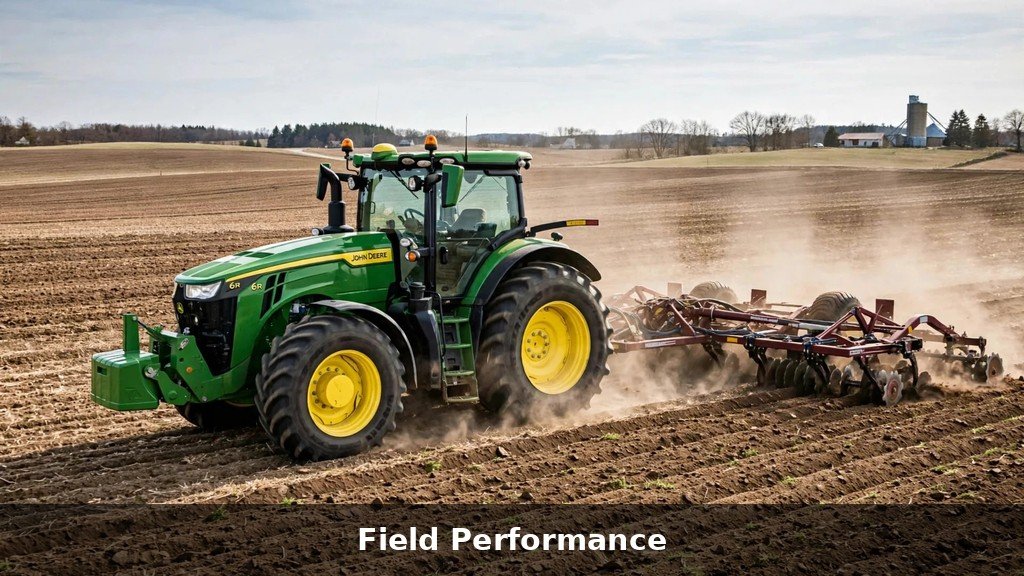
Against the John Deere 6M Series, this John Deere 6R Series review finds the 6R brings a six-cylinder engine at every step (the 6M tops out at a 4.5L four), roughly 30–100 more horsepower depending on the pairing, a heavier full-frame chassis, closed-center PFC hydraulics with up to 41 gpm, and the CommandPRO/Gen 4 technology stack. A 6145R weighs over 15,200 lb against a 6145M’s roughly 13,600 lb — and the 6R’s price premium is typically $30,000–$60,000 over a comparable 6M. Against the 7R, the 6R gives up the top-end horsepower (the 7R runs to 350 hp), the larger cab and the heaviest draft capability — but keeps the same factory, the same control philosophy and most of the precision-ag integration at a meaningfully lower price and a more maneuverable footprint.
Against competitors like the Case IH Puma series and New Holland T7 range, the 6R’s advantages per owner reports are dealer network density, resale value, and the AutoPowr IVT’s refinement; the trade-off is typically a higher purchase price. Our John Deere 5090M review covers the top of the smaller 5M range for buyers deciding how much tractor they really need.
Which Utility Tractor Offers Better Value?
Value in this John Deere 6R Series review depends on the work. For mixed farms, dairies and hay operations under ~500 acres, this John Deere 6R Series review finds the 6M usually wins on purchase price and maneuverability. For row-crop tillage, planting, heavy PTO work and serious transport, the 6R’s six-cylinder torque, hydraulic capacity and cab technology earn the premium — and the 6195R sits in the sweet spot where capability per dollar peaks. If your implements are growing (bigger planters, wider tillage), this John Deere 6R Series review’s advice is to buy the 6R once rather than trading a 6M up in three years. If the work is mostly loader, feeding and mowing, the 6M keeps more money in the operation.
Frequently Asked Questions About the John Deere 6R Series
These are the questions buyers ask most often after reading a John Deere 6R Series review — answered from Deere’s published specs, current dealer listings, and documented owner experience.
What do the new 6R 155, 6R 195 and 6R 250 badges mean?
They’re the same tractors. From the 2022 model year, Deere shortened the badges: 6R 155 is the 6155R, 6R 195 is the 6195R, 6R 250 is the 6250R, and so on. When you’re shopping used listings in this John Deere 6R Series review’s price bands, search both naming conventions — a “2023 6R 195” and a “2021 6195R” are the same machine underneath.
Does the John Deere 6R use DEF, and does it have a DPF?
Yes to both. The US Final Tier 4 6R runs the full three-stage aftertreatment — DOC, DPF and SCR — with DEF consumption around 2–4 percent of diesel use. One documented owner reports roughly 400 liters of AdBlue per 1,000 engine hours on a 6195R. Let parked regenerations finish when requested, keep DEF fresh, and never ignore a derate warning — aftertreatment neglect is the most expensive used-buyer surprise on FT4 tractors.
Which 6R transmission should I choose: AutoQuad, DirectDrive or IVT?
For simplicity and lowest long-term service cost, the AutoQuad PLUS. For the best all-around operator experience — loader work, PTO implements, road transport — the AutoPowr IVT, which is also the most common fit on new machines and holds value best at resale. The DirectDrive dual-clutch suits transport-heavy operations but costs more up front. That is this John Deere 6R Series review’s transmission advice in one line: match the transmission to the work, not the brochure.
6R vs 6M: which one do I actually need?
If your implements are implements — mounted plows, big planters, large balers — and your days are long, the 6R’s six-cylinder torque, 41-gpm hydraulics and heavier frame are worth the premium. If the work is feeding, mowing, loader chores and light tillage, the 6M does it for tens of thousands less. The 6145R/6155R overlap the top of the 6M range, which is exactly where most buyers should compare them head to head.
How many hours is too many on a used 6R?
There’s no magic number in this John Deere 6R Series review’s used-buying guidance — condition and records beat the hour meter. A 5,000-hour 6R with full dealer service history, fresh fluids and a clean aftertreatment record is a better buy than a 2,500-hour machine with no records. That said, budget for bigger-ticket items past 6,000–8,000 hours: clutch packs on stepped transmissions, IVT service, front-axle work, and injector or turbo attention. Always run the serial number through Deere’s recall lookup or call 800-537-8233 before money changes hands.
What warranty does the John Deere 6R carry?
Deere’s standard agricultural warranty, as verified for this John Deere 6R Series review: 24 months or 2,000 hours base coverage, whichever comes first — the same base terms as the 5M and 6M lines. Extended warranty is commonly offered on used machines through dealers (one current LandMark listing shows extended coverage to October 2026), and it’s worth pricing on any late-model purchase in this John Deere 6R Series review’s upper price bands.