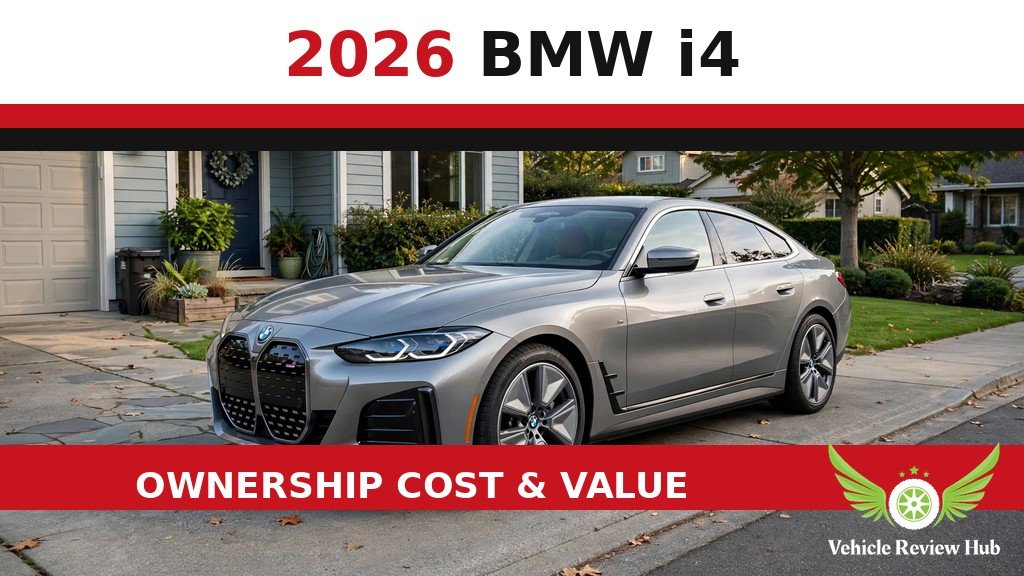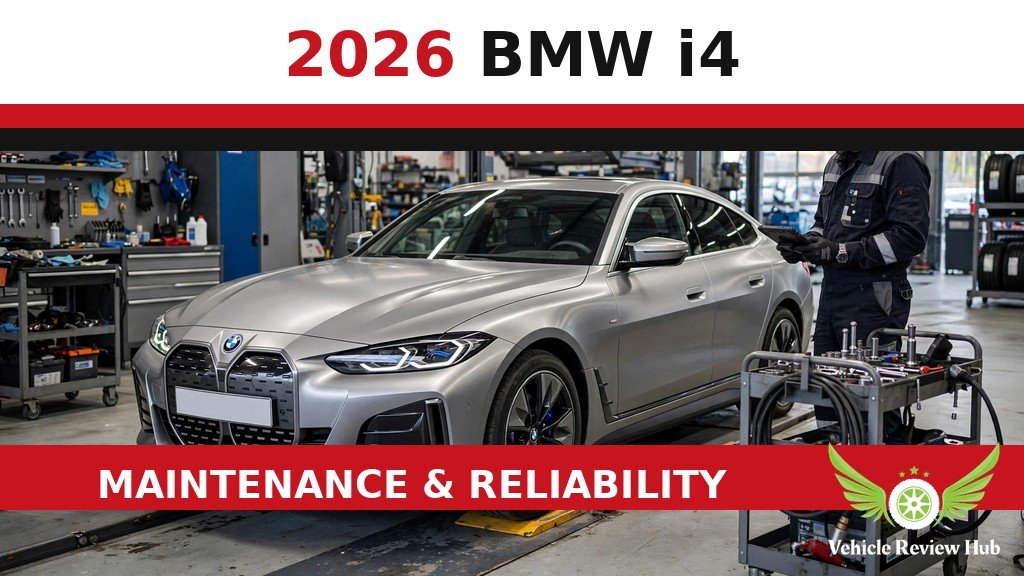
The 2026 BMW 4 Series combines sporty performance with premium technology, but maintenance and long-term reliability remain important factors for U.S. buyers. BMW includes scheduled maintenance for 3 years or 36,000 miles under its Ultimate Care program, while the new-vehicle limited warranty lasts 4 years or 50,000 miles.
The BMW 4 Series Maintenance Cost can increase after the included maintenance period, especially as tires, brakes, and other wear items become due. For a 2026 430i Coupe, Edmunds estimates about $7,297 in maintenance and $2,839 in repairs over five years, based on its ownership-cost model.
This guide also examines BMW 4 Series Reliability, reported BMW 4 Series Common Problems, current recalls, and the factors that can affect ownership costs as mileage increases. Consumer Reports currently predicts above-average reliability for the 2026 model, although long-term 2026-specific data is still limited because it is a new model year.
According to our experience analyzing BMW ownership costs and reliability information, separating scheduled maintenance from unexpected repairs gives buyers a clearer picture of what they may actually spend over time. This guide focuses on the current U.S. data that matters most when deciding whether the 2026 BMW 4 Series is a practical long-term choice.
BMW 4 Series Maintenance Schedule & Service Coverage
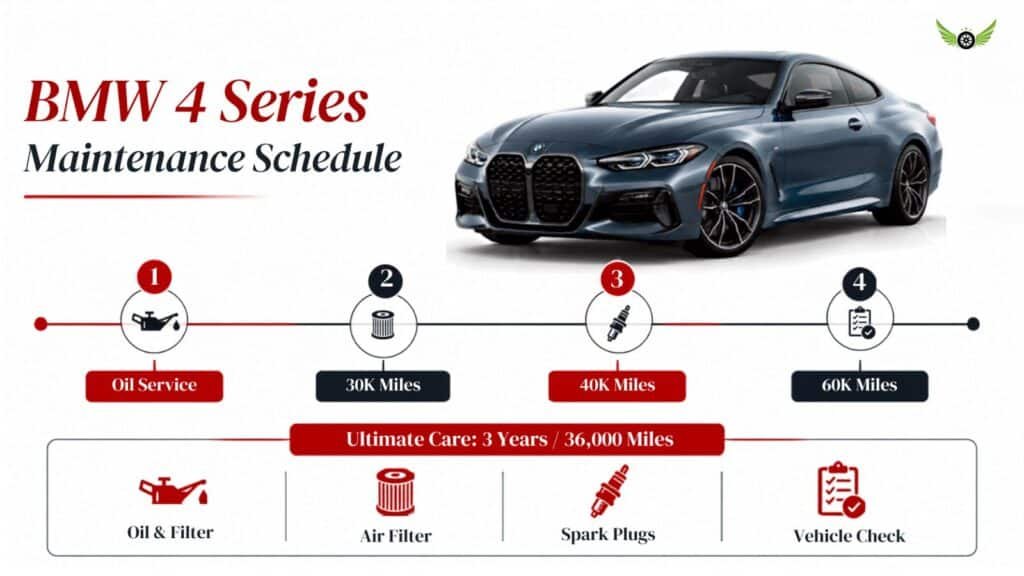
The 2026 BMW 4 Series uses BMW’s Condition Based Service (CBS) system rather than a single fixed service interval for every maintenance item. Sensors, driving conditions, mileage, and elapsed time are used to calculate when specific services are due. The driver can view upcoming maintenance through the vehicle’s service display.
For U.S. models, the system tracks items such as engine oil, vehicle checks, front and rear brake pads, and brake fluid. Other maintenance tasks are scheduled to coincide with specific oil services.
Routine Service Intervals and Major Maintenance Requirements
The maintenance schedule for the BMW 4 Series is primarily controlled by the CBS system, so the exact timing can vary with driving conditions. BMW states that short trips, frequent cold starts, extended idling, stop-and-go driving, and high engine speeds can affect maintenance requirements.
For the 2026 4 Series, important scheduled work includes engine oil and filter replacement, cabin microfilter replacement, engine air-filter service, spark plugs, brake-fluid replacement, brake inspections, and the vehicle check. BMW’s maintenance summary places some items at recurring oil-service intervals rather than using one universal mileage figure.
Maintenance item | How BMW determines service |
Engine oil & filter | CBS service interval |
Cabin microfilter | Combined with specified oil service |
Engine air filter | Scheduled oil-service occurrence |
Spark plugs | Scheduled oil-service occurrence |
Brake pads & discs | CBS / condition |
Brake fluid | Time-based CBS interval |
Vehicle check | CBS interval |
BMW also specifies that the 2026 maintenance program covers the required factory maintenance when it is performed according to the vehicle’s maintenance schedule. Extra services requested earlier than the indicated interval are not covered by the maintenance program.
Factory Warranty and Complimentary Maintenance Coverage
BMW provides the 2026 BMW 4 Series with a 4-year/50,000-mile New Vehicle Limited Warranty, whichever comes first. This covers eligible defects in materials or workmanship and is separate from scheduled maintenance coverage.
The BMW Ultimate Care Scheduled Maintenance Program covers eligible factory-scheduled maintenance for 36 months or 36,000 miles, whichever occurs first, for qualifying 2026 vehicles purchased from an authorized BMW Center in the United States. The 2026 maintenance booklet states that the remaining maintenance-program coverage is transferable to subsequent owners.
Covered maintenance includes engine oil and filter, brake fluid, cabin microfilters, engine air filters, spark plugs, the remote-control key battery, and the vehicle check when required under BMW’s schedule. Tires, wheels, alignment, balancing, rotation, and several other non-scheduled or wear-related items are excluded.
According to our experience, the biggest point for buyers is the difference between warranty protection and maintenance coverage. The warranty protects against eligible defects, while Ultimate Care handles qualifying scheduled maintenance during the first 36 months or 36,000 miles. Once that maintenance period ends, routine service becomes a direct ownership expense.
BMW 4 Series Maintenance & Repair Costs
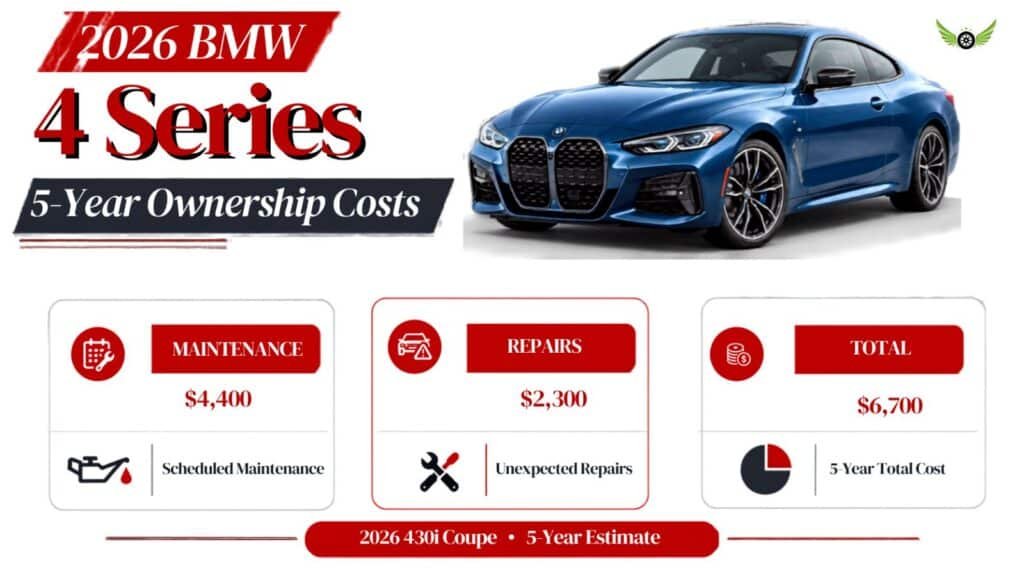
The BMW 4 Series Maintenance Cost is relatively predictable during the first three years because qualifying scheduled maintenance is covered by BMW Ultimate Care for 36 months or 36,000 miles. After that period, owners are responsible for routine servicing and any repairs that are not covered by warranty or another protection plan.
Current ownership estimates show a meaningful difference between maintenance and repair expenses. For a 2026 430i Coupe, Edmunds estimates $7,297 in maintenance and $2,839 in repairs over five years, while KBB estimates $3,547 and $2,012, respectively. These are estimates rather than fixed BMW service prices, so actual costs can vary by mileage, driving conditions, location, and service provider.
Routine Service, Tires, Brakes & Common Wear Items
BMW’s scheduled maintenance program covers eligible services such as engine oil and filter, brake fluid, cabin microfilters, engine air filters, spark plugs, the remote-control battery, and the vehicle check when required by the maintenance schedule.
However, several normal ownership expenses are excluded, including tires and wheels, alignment, tire balancing and rotation. Brake-related coverage depends on the applicable maintenance-program terms and wear limits, so owners should check the vehicle’s specific coverage rather than assume every brake replacement is included.
Cost category | Current 5-year estimate / coverage |
430i Coupe maintenance — Edmunds | $7,297 |
430i Coupe repairs — Edmunds | $2,839 |
430i Coupe maintenance — KBB | $3,547 |
430i Coupe repairs — KBB | $2,012 |
BMW Ultimate Care | 36 months / 36,000 miles |
These figures show why routine servicing and unexpected repairs should be budgeted separately. Tire and brake expenses can also vary substantially depending on tire specification, traffic, driving style, and annual mileage.
Short-Term vs Long-Term Maintenance Cost Expectations
Short-term ownership is easier to budget because qualifying scheduled maintenance is included during the first 36 months or 36,000 miles. Edmunds’ current 2026 430i Coupe estimate shows $0 maintenance in years 1 and 2, followed by $673 in year 3, $3,260 in year 4, and $3,364 in year 5.
Ownership year | Maintenance | Repairs |
Year 1 | $0 | $0 |
Year 2 | $0 | $0 |
Year 3 | $673 | $0 |
Year 4 | $3,260 | $1,118 |
Year 5 | $3,364 | $1,721 |
5-year total | $7,297 | $2,839 |
For the 2026 4 Series Gran Coupe, Edmunds estimates lower five-year costs of $6,320 for maintenance and $2,432 for repairs, showing that body style can affect projected ownership expenses.
According to our experience, the most important cost difference comes after complimentary maintenance ends. The first few years are relatively predictable, while longer ownership requires more attention to routine service, tires, brakes, and potential repairs. These estimates should therefore be used for budgeting, not as guaranteed bills.
BMW 4 Series Reliability & Common Problems
The BMW 4 Series Reliability outlook for 2026 is currently favorable, but long-term 2026-specific evidence is still limited. Consumer Reports predicts the 2026 model to be more reliable than the average new car, based on reliability data from the 2023–2025 model years.
There is currently one NHTSA recall for the 2026 4 Series. It affects certain 430i and M4 vehicles because positive battery cables may not be properly connected to the power distribution box. The defect can cause an engine stall and, in some circumstances, a fire. The recall covers only 4 vehicles, and BMW’s remedy is inspection and replacement of the affected components where necessary at no charge.
Beyond this recall, there is not enough evidence to describe any engine, transmission, or infotainment issue as a widespread 2026 defect. Earlier 4 Series data can provide useful context, but those problems should not automatically be labeled as 2026 BMW 4 Series Common Problems.
Engine, Transmission and Mild-Hybrid System Reliability
The 2026 lineup uses BMW’s turbocharged four-cylinder and inline-six engines with an eight-speed automatic transmission. Both powertrains incorporate a 48-volt mild-hybrid system. BMW describes its mild-hybrid system as a combustion engine supported by a 48V electric motor that assists with starting, acceleration and efficiency.
At this stage, there is no strong model-year-specific evidence of widespread engine or transmission failures in the 2026 4 Series. Consumer Reports’ above-average reliability prediction is encouraging, but it should be viewed as a forecast rather than several years of proven 2026 ownership data.
The mild-hybrid system adds additional electrical hardware, so battery, starter-generator and related electrical connections are relevant reliability points. A 2025 recall involving certain 4 Series models concerned a loose starter-generator connection, but that was a separate campaign and should not be treated as evidence of a widespread 2026 failure.
According to our experience, the sensible approach with a new 4 Series is to focus on documented model-year issues and proper scheduled maintenance rather than assuming that every problem reported on an older BMW applies to the current generation.
Electrical, Infotainment & Other Reported Issues
The 2026 4 Series uses BMW’s iDrive 8.5 infotainment system with a 12.3-inch instrument display and 14.9-inch central display. Its extensive electronic equipment means software, sensors, connectivity and electrical components are important areas to monitor during ownership.
Current owner feedback is still limited. Edmunds reports generally positive early owner sentiment, while some owners have mentioned issues such as phone connectivity bugs and convertible-top problems. These reports are too limited to establish a widespread reliability defect.
Older 4 Series reliability data has recorded electrical and engine-electrical concerns, including battery cables and hybrid-system components. However, these reports cover earlier model years and should be treated as historical context rather than confirmed 2026 problems.
The clearest current concern remains the battery-cable recall on certain 2026 vehicles. Buyers should check the VIN through NHTSA because recall status is vehicle-specific and an unrepaired recall can be repaired by the manufacturer at no charge.
According to our experience, the current evidence points to a generally positive reliability picture, with electrical and software-related functions worth monitoring as the 2026 model accumulates more owner history. It is still too early to claim a definitive long-term failure pattern.
BMW 4 Series Recalls & Technical Service Updates
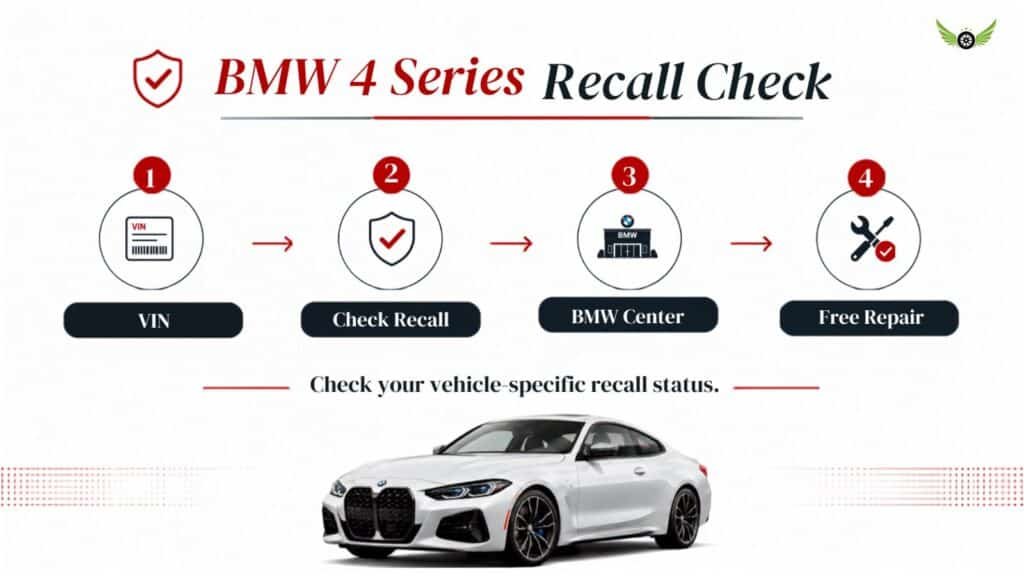
For the 2026 BMW 4 Series, recall information should be checked by VIN because not every vehicle with the same model and year is necessarily affected. NHTSA distinguishes safety recalls from manufacturer communications, while BMW separately provides recall and software-update tools for owners.
BMW’s current U.S. information confirms that recall repairs are performed free of charge at an authorized BMW Center. This makes recall status an important part of ownership, particularly for a new vehicle where some campaigns may be introduced after production.
Current Safety Recalls and How to Check Your Vehicle
A documented 2026 4 Series service campaign, SIB 34 02 26, concerns the dynamic stability control (DSC) hydro unit on certain G22 4 Series Coupes and G23 Convertibles produced during specific June–July 2026 periods. BMW identified a potential issue with protective film around the DSC hydro-unit threaded connections that could lead to gradual brake-fluid loss. The campaign was issued as a delivery stop, so affected vehicles should be addressed before delivery.
Owners should not rely only on general internet recall lists. NHTSA recommends entering the vehicle’s 17-character VIN into its recall search because the VIN result identifies unrepaired safety recalls associated with that specific vehicle. BMW also allows owners to check recalls through its official recall page or the My BMW App under Service and Maintenance → Recalls & Campaigns.
NHTSA also notes that recently announced recalls may not immediately show for every VIN because affected VINs can be added progressively. Checking periodically is therefore more reliable than relying on a single search performed when the vehicle is purchased.
Technical Service Bulletins and Software Updates
Technical Service Bulletins (TSBs) and BMW Service Information Bulletins are different from safety recalls. They provide technicians with repair procedures, diagnostic information, or instructions for addressing known conditions. NHTSA makes manufacturer communications searchable by vehicle year, make, and model.
For the 2026 BMW 4 Series, software updates are also relevant because BMW can address certain vehicle-system, navigation, infotainment, and functional issues through Remote Software Upgrade when the vehicle has the required hardware. BMW states that eligible vehicles can receive updates through the My BMW App or directly through the vehicle.
BMW’s current 26-03 Remote Software Upgrade can include functional improvements and updates to systems such as BMW Operating System, navigation, and infotainment. Availability varies by vehicle and equipment, so owners should check their VIN and vehicle software menu rather than assume every update applies to every 4 Series.
According to our experience, the practical distinction is simple: a recall requires a safety-related remedy, while a TSB or software update can address a technical or software condition without meaning the vehicle has a safety defect. Checking both the VIN recall status and available BMW software updates is the most reliable way to keep a 2026 4 Series current.
BMW 4 Series Long-Term Reliability
The BMW 4 Series Reliability outlook for 2026 is positive, but there is not yet enough high-mileage data to confirm how the current model will perform over 10 or 15 years. Consumer Reports currently predicts the 2026 4 Series to be more reliable than the average new car, based on reliability data from the 2023–2025 model years.
Historical 4 Series data provides useful context. iSeeCars estimates an average lifespan of 116,962 miles, or about 10.4 years, for the 4 Series sedan, while the coupe averages about 120,186 miles or 12.1 years. However, iSeeCars specifically reports insufficient data to calculate a separate reliability rating for the 2022–2026 generation, so these figures should be treated as historical reference rather than a 2026 lifespan guarantee.
Expected Lifespan with Proper Maintenance
BMW does not publish a guaranteed mileage or service life for the 2026 4 Series. Instead, BMW recommends following the vehicle’s Maintenance Service Display and the maintenance tasks in its Maintenance Booklet. BMW states that proper maintenance helps protect the vehicle’s operational performance, safety, and reliability.
The 2026 maintenance schedule includes recurring engine-oil service, brake inspections, brake-fluid service, air-filter replacement, spark-plug replacement, and vehicle checks. BMW’s maintenance document places some major services at approximately 30,000, 40,000, 50,000, and 60,000 miles, depending on the specific item and model configuration.
According to our experience, maintenance history is more useful than mileage alone when judging long-term BMW ownership. A vehicle with consistent scheduled service and prompt repairs has a stronger basis for long-term ownership than one with the same mileage but incomplete maintenance records.
How to Reduce Long-Term Repair Costs
The most effective way to control long-term repair costs is to maintain the car according to BMW’s schedule and deal with developing problems early. BMW’s factory maintenance program covers scheduled maintenance for the first 3 years or 36,000 miles, but owners must continue servicing the vehicle after that period.
For long-term ownership, focus on:
- Completing oil, filter, brake-fluid, spark-plug, and inspection services when required.
- Monitoring brake pads, discs, tires, and other wear items.
- Responding quickly to warning messages or unusual mechanical and electrical symptoms.
- Keeping applicable software updates installed.
- Checking the VIN for open safety recalls and completing recall repairs.
- Keeping complete service records after the complimentary maintenance period ends.
The 2026 BMW 4 Series currently has a favorable predicted reliability outlook, but its true high-mileage durability will become clearer only after more vehicles accumulate years of real-world use. For buyers planning to keep the car long term, consistent maintenance is a more dependable strategy than relying on a predicted lifespan figure.
BMW 4 Series Maintenance, Reliability & Common Problems FAQs
The 2026 BMW 4 Series combines premium performance with relatively predictable scheduled maintenance during its first 36 months or 36,000 miles. Long-term ownership costs, reliability, recalls, and potential repair expenses become more important after the complimentary maintenance period ends.
Is the 2026 BMW 4 Series reliable?
Yes, the current reliability outlook is positive. Consumer Reports predicts the 2026 BMW 4 Series to be more reliable than the average new car, although this prediction is based on 2023–2025 model-year data rather than several years of 2026-specific ownership history.
How much does it cost to maintain a 2026 BMW 4 Series?
For a 2026 430i Coupe, Edmunds currently estimates $7,297 in maintenance and $2,839 in repairs over five years. These are ownership estimates, not fixed BMW service prices, and actual costs can vary by mileage, driving conditions, location, trim, and repair facility.
Does BMW cover maintenance on the 2026 4 Series?
Yes. BMW Ultimate Care covers eligible factory-scheduled maintenance for 36 months or 36,000 miles, whichever comes first, for qualifying 2026 vehicles purchased from an authorized BMW Center in the United States.
What maintenance does the BMW 4 Series need?
Scheduled maintenance can include engine oil and filter, brake fluid, cabin microfilters, engine air filters, spark plugs, the remote-control battery, and the vehicle check, depending on when each service becomes due. BMW uses its maintenance system to determine the applicable service requirements.
What are the common problems with the 2026 BMW 4 Series?
There is not yet enough long-term evidence to establish a definitive list of widespread 2026-specific problems. The model currently has a favorable predicted reliability rating, while one confirmed recall affects certain 2026 430i and M4 vehicles because of improperly connected positive battery cables.
Does the 2026 BMW 4 Series have any recalls?
Yes. NHTSA campaign 25V643000 affects certain 2026 430i and M4 vehicles. The positive battery cables may not be properly connected to the power distribution box, potentially causing an engine stall and fire risk. The recall population is 4 vehicles, and BMW’s remedy is inspection and replacement of affected components when necessary at no charge.
How do I check for a BMW 4 Series recall?
Use the vehicle’s 17-character VIN on NHTSA’s recall search. A VIN search identifies unrepaired safety recalls associated with that specific vehicle. NHTSA also notes that newly announced recalls may be added progressively, so checking again later can be useful.
How long can a BMW 4 Series last?
Historical iSeeCars data estimates the 4 Series at approximately 116,962 miles or 10.4 years on average, with a 2.3% probability of reaching at least 200,000 miles. These figures cover historical 4 Series vehicles and should not be treated as a guaranteed lifespan for the 2026 model.
Is the BMW 4 Series expensive to own after the warranty and maintenance coverage end?
Ownership costs can rise after complimentary maintenance ends because routine service and repairs become the owner’s responsibility. Edmunds estimates that maintenance for a 2026 430i Coupe rises from $673 in year three to $3,260 in year four and $3,364 in year five in its current ownership model.
How can I reduce long-term BMW 4 Series repair costs?
Follow BMW’s scheduled maintenance, address warning messages promptly, maintain tires and brakes, keep applicable software updated, and complete open recall repairs. Keeping detailed service records is also valuable once the 3-year/36,000-mile complimentary maintenance period ends.