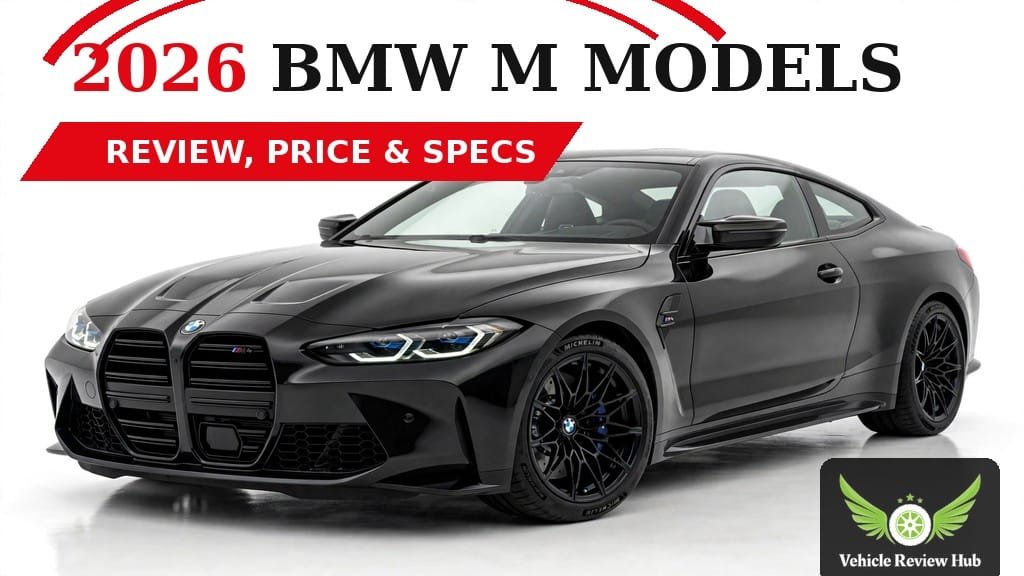
Which BMW M car deserves your money in 2026 — and what actually separates a real M from the M-badged models around it? The short answer: BMW M models span from the $68,200 M2 to the $136,100 X6 M Competition, all built by BMW’s motorsport division with track-ready engineering that M Performance models like the M340i only imitate. Whether you want a manual-transmission coupe, a 717-hp hybrid super-sedan, or a 617-hp SUV, there is a BMW M model for it. In this guide, we review the full 2026 BMW M models lineup for US buyers: pricing, specs, model comparisons, M vs M Performance differences, engines, interiors, and a buying guide to pick the right one.
Running costs matter too — see our BMW M models mileage and MPG guide for fuel economy across the range.
BMW M Models Lineup, Pricing & Model Comparison
BMW M models for 2026 cover every performance niche: compact coupe, sports sedan, grand coupe, super-sedan, wagon, and two super-SUVs. Every one is developed by BMW M GmbH with bespoke engines, reinforced chassis, and track-capable cooling — none are mere appearance packages.
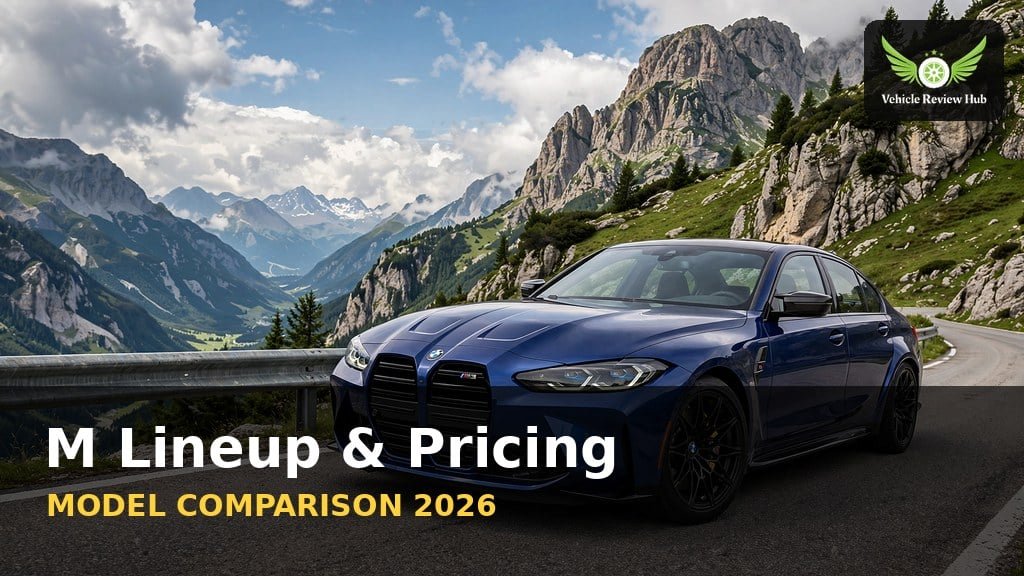
BMW M2, M3, M4, M5, M5 Touring, X5 M & X6 M
Here is the complete 2026 BMW M models range with US pricing and key specs:
| Model | Starting MSRP | Engine / Power | 0–60 mph |
|---|---|---|---|
| M2 Coupe | $68,200 | 3.0L twin-turbo I6, 473 hp | 4.1 sec (manual) |
| M3 Sedan | $79,300 | 3.0L twin-turbo I6, 473–523 hp | 4.1–3.4 sec |
| M4 Coupe | $82,200 | 3.0L twin-turbo I6, 473–523 hp | 4.1–3.4 sec |
| M5 Sedan | $123,300 | 4.4L twin-turbo V8 hybrid, 717 hp | 3.4 sec |
| M5 Touring | $125,300 | 4.4L twin-turbo V8 hybrid, 717 hp | 3.5 sec |
| X5 M Competition | $131,000 | 4.4L twin-turbo V8 mild-hybrid, 617 hp | 3.7 sec |
| X6 M Competition | $134,600 | 4.4L twin-turbo V8 mild-hybrid, 617 hp | 3.7 sec |
The M2 is the purist’s choice — rear-drive, available 6-speed manual, and the lightest BMW M model. The M3 adds four-door practicality with the same S58 engine in three states of tune up to 523 hp. The M4 is the M3’s coupe twin with identical mechanicals. The M5 goes hybrid for 717 hp and supercar pace with sedan comfort, and the M5 Touring brings that powertrain to a wagon — the first M5 wagon ever sold in America. The X5 M and X6 M are 617-hp super-SUVs that outrun most sports cars while seating five. Full 2026 BMW M3 pricing and specifications are detailed on Autoblog.
Which BMW M Model Fits Your Budget and Lifestyle?
Under $80,000, the M2 is the answer — the most engaging BMW M model per dollar, with a manual gearbox no rival offers at this price. From $80,000–$95,000, the M3 and M4 split the vote: choose the M3 for daily usability and rear-seat space, the M4 for coupe style. Both offer the 523-hp Competition xDrive for all-weather pace.
Above $120,000, the M5 Sedan is the ultimate all-rounder — 717 hp, 3.4-second pace, and genuine luxury. The M5 Touring adds wagon versatility for $2,000 more, a must for enthusiasts who need cargo space. The X5 M and X6 M suit buyers who want M pace with SUV ride height and towing capability; pick the X5 M for practicality or the X6 M for its coupe-SUV drama. For a deeper dive on running costs, see our BMW M models maintenance cost guide.
BMW M vs M Performance Models: What’s the Difference?
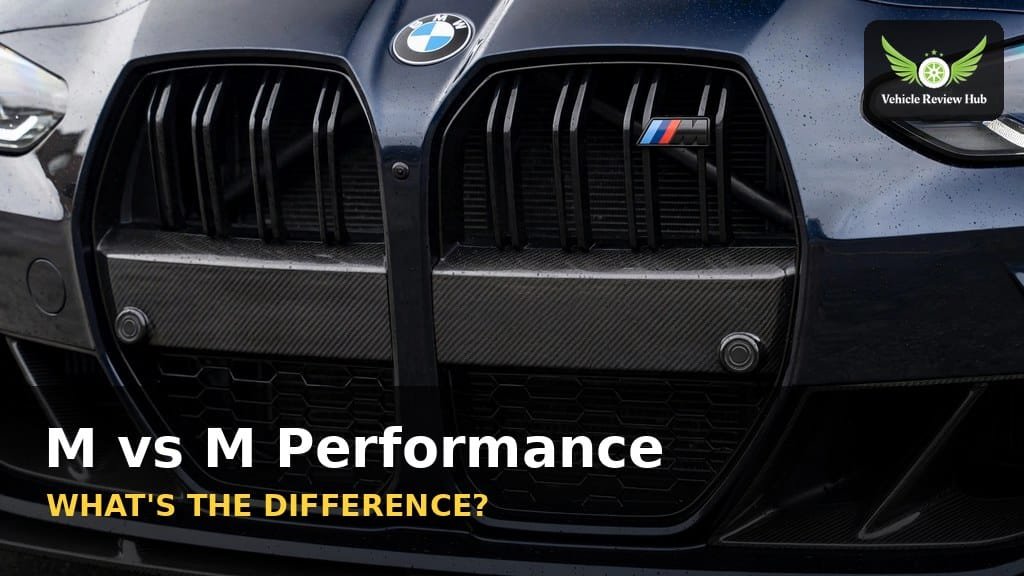
This is the most misunderstood distinction in BMW’s lineup. BMW M models are standalone performance machines from BMW’s motorsport division; M Performance models are faster versions of regular BMWs. Both wear M badges — but they are engineered to very different standards.
Full BMW M Engineering, Performance & Track Capability
Full BMW M models get bespoke M-specific engines (the S58 inline-six, the S68 V8) built to motorsport tolerances with forged internals, upgraded cooling systems designed for sustained track use, reinforced chassis components, M-tuned transmissions, adaptive M suspension, and massive M compound brakes. They are developed as separate models, not optioned-up regular BMWs — which is why an M3 shares so little with a 330i beyond the badge shape.
Identification is easy: full BMW M models wear simplified badging — just “M” plus the series number (M2, M3, M4, M5). They are the only BMWs with quad exhausts, M-specific mirrors, and M Drive Professional with track telemetry and drift analysis. If the badge reads “M340i” or “X5 M60i” with letters after the M, it is not a full M car. This BMW M vs M Sport vs M Performance explainer breaks down all three tiers clearly.
M340i, M440i and Other M Performance Alternatives
M Performance models — M340i, M440i, M240i, X5 M60i, and the electric i4 M50/iX M60 — bridge the gap between standard BMWs and full BMW M models. They get higher-output engines (the M340i’s B58 makes 386 hp), M Sport brakes, sport exhausts, and tuned suspension, delivering thrilling everyday pace at a much lower price: an M340i starts around $62,000 versus $79,300 for the M3.
For most drivers on public roads, an M Performance model delivers 80% of the experience for 70% of the money — plus better fuel economy, lower insurance, and a more comfortable ride. Choose M Performance if you want fast daily transport; choose a full BMW M model if you want track capability, the ultimate chassis, and the real M engine. The M340i is arguably the smart-money performance BMW in the entire lineup.
BMW M Engines, Powertrains & Performance
BMW M models are defined by their engines — and 2026 offers three distinct flavors: the screaming S58 inline-six, the thunderous S68 twin-turbo V8, and a new plug-in hybrid system that makes the M5 the most powerful M car ever.
Turbocharged Inline-Six vs Twin-Turbo V8 Performance
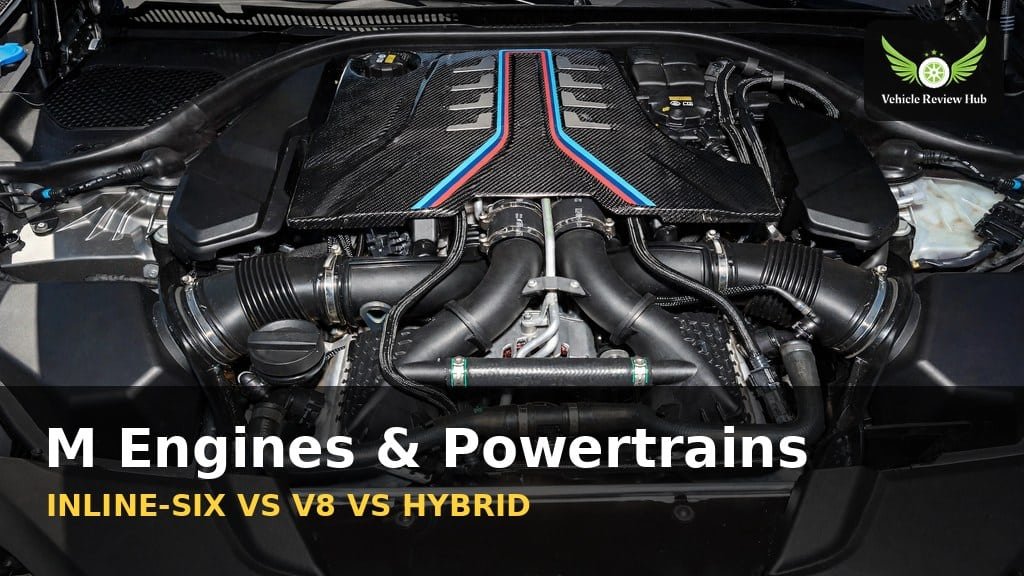
The S58 3.0-liter twin-turbo inline-six powers the M2, M3, and M4 with 473 hp in base form, 503 hp in Competition trim, and 523 hp in Competition xDrive guise. It revs to 7,200 rpm with a motorsport-bred character — forged crank, closed-deck block, and cooling that survives track sessions. In the M3 Competition xDrive, it delivers 3.4-second 0–60 runs that embarrass supercars costing twice as much.
The S68 4.4-liter twin-turbo V8 serves the M5 (577 hp from the engine alone) and the X5 M/X6 M (617 hp with 48-volt mild-hybrid assistance, 553 lb-ft). The V8 brings effortless torque and a soundtrack the six cannot match, at the cost of weight and thirst — expect mid-teens mpg in spirited driving. Both engines pair with 8-speed M Steptronic transmissions (the M2 and base M3/M4 also offer a 6-speed manual) and M xDrive all-wheel drive with a rear-drive mode for purists.
M Hybrid and Electrified BMW M Models
The 2026 M5 Sedan and M5 Touring are plug-in hybrids: the S68 V8 plus a 194-hp electric motor integrated into the transmission, fed by a 14.8 kWh battery, for 717 hp and 738 lb-ft combined. The result is a 3.4-second 0–60 run with 25–29 miles of electric-only range and 47–54 MPGe when charged — full 2026 BMW M5 hybrid specifications are on Autoblog.
Electrification also reaches BMW M models through the XM (a standalone M hybrid SUV) and M Performance EVs like the i4 M50 and iX M60. Purists grumbled about hybrid weight — the M5 is a 5,400-lb car — but the performance is undeniable, and the electric motor’s instant torque fills every gap in the V8’s delivery. The M division’s future is electrified; the M5 is simply first.
BMW M Interior, Technology & Everyday Practicality
Modern BMW M models are dual-purpose machines: track weapons with heated seats. The cabins blend motorsport focus with genuine luxury, and the technology is shared with BMW’s flagship models.
Performance-Focused Cabin, M Controls & Driver Technology
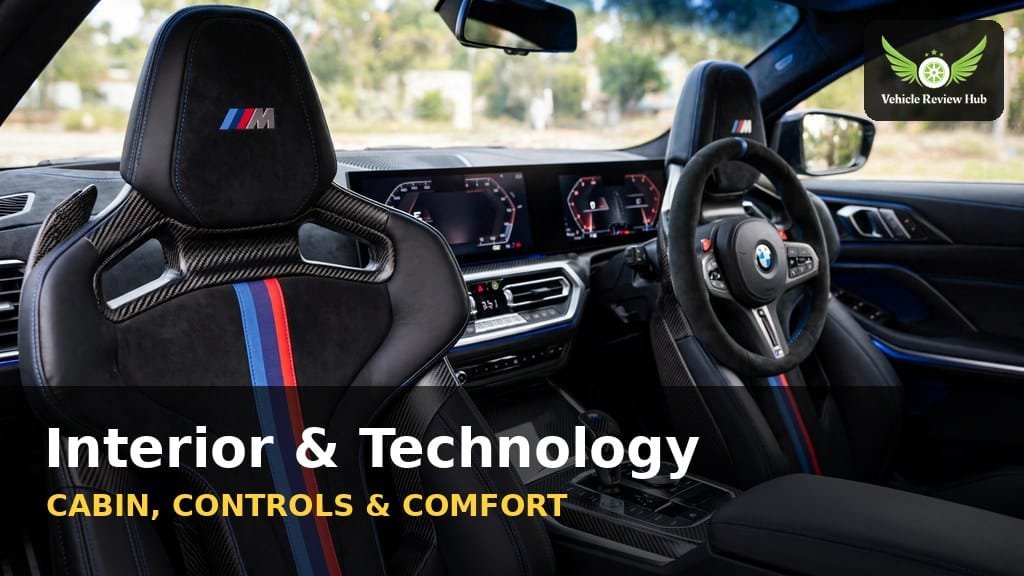
Every BMW M model gets M sport seats (optional M Carbon buckets save weight and add drama), an M-specific steering wheel with programmable M1/M2 buttons for instant access to your favorite drive settings, and M graphics in the BMW Curved Display (12.3-inch cluster + 14.9-inch touchscreen running iDrive 8.5). M Drive Professional adds track telemetry, lap timing, and drift analysis for circuit days.
Standard tech includes wireless Apple CarPlay and Android Auto, a head-up display with M-specific readouts, Harman Kardon audio (Bowers & Wilkins optional on larger models), and the full Driving Assistance suite. The cabins are genuinely luxurious — Extended Merino leather, carbon fiber trim, and ambient lighting come standard on most BMW M models. It is a long way from the stripped-out M cars of the 1980s.
Sports Car vs Sedan vs SUV Practicality
Practicality varies enormously across BMW M models. The M2 is a 2+2 coupe with a 13.8 cu-ft trunk and tight rear seats — a weekend car that can commute. The M3 sedan adds proper rear doors and adult-usable rear space with a 16.9 cu-ft trunk. The M5 Touring is the practicality king: 27.2 cu-ft behind the seats, 57.6 cu-ft folded — wagon versatility with 717 hp.
The X5 M offers 33.9 cu-ft expanding to 72.3 cu-ft, plus a commanding driving position and towing capability the cars cannot match. The X6 M trades some cargo for style. Fuel economy ranges from ~19 mpg combined (M2) to ~14 mpg gas-only (M5) — see our BMW M models mileage guide for details. For the complete financial picture, our BMW M models ownership cost guide covers insurance, depreciation, and long-term costs.
BMW M Models Buying Guide
With seven BMW M models spanning $68,000 to $136,000, choosing comes down to honest answers about how you will actually use the car. According to our experience evaluating owner feedback across the M range, buyers who match the car to their real life — not their fantasy track calendar — end up happiest.
Best BMW M Model for Track Driving, Daily Use & Family Needs
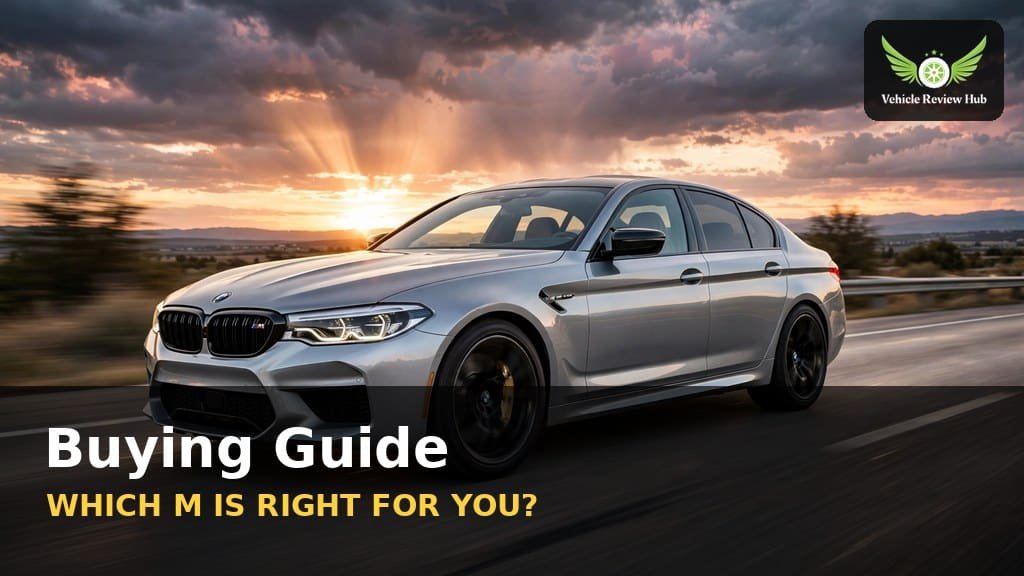
For track driving, the M2 is the sweet spot: lightest, most balanced, cheapest to run hard, and available with a manual. The M4 CSL-style variants and M3 Competition are faster, but the M2’s purity wins on circuit. For daily use, the M3 Competition xDrive is the consensus pick — four doors, all-weather traction, 523 hp, and a ride civilized enough for commuting.
For family needs, the M5 Touring is unmatched: supercar pace with wagon practicality, or the X5 M if you need SUV ground clearance and towing. The X6 M is for those who prioritize presence over practicality. One rule holds across the range: buy the Competition xDrive if you face winter weather, and the manual if you do not — you will only get so many chances.
Watch this POV test drive and review of the 2026 BMW M5 Touring — the 717-hp hybrid wagon:
Pros, Cons & Is a BMW M Worth the Price?
Pros: motorsport-bred engineering, class-leading performance per dollar, daily usability, strong resale (M cars depreciate slower than standard BMWs), and — for now — manual transmissions. A $79,300 M3 outruns $150,000 supercars from a decade ago while seating four in comfort.
Cons: steep running costs (tires, brakes, premium fuel, insurance), firm rides that punish bad roads, and weight — modern BMW M models are heavy, with the M5 over 5,400 lbs. M Performance alternatives deliver much of the thrill for less money and hassle.
Is a BMW M worth it? If driving matters to you, yes — few purchases deliver this much engineering per dollar. But buy with eyes open: budget 15–20% of the purchase price per year for running costs on hard-driven examples, get the M Driver’s Package if you will track it, and never skip the pre-purchase inspection on a used M car.
FAQs About BMW M Models
Quick answers to the most common questions about BMW M models, pricing, and the M vs M Performance difference.
What is the cheapest BMW M model in 2026?
The BMW M2 Coupe is the cheapest full BMW M model, starting at $68,200 before destination. It offers 473 hp, rear-wheel drive, and an available 6-speed manual — the most engaging M car per dollar in the lineup.
What is the difference between BMW M and M Performance?
Full BMW M models (M2, M3, M4, M5) are standalone motorsport-division machines with bespoke engines, reinforced chassis, and track-ready cooling. M Performance models (M340i, M440i, X5 M60i) are faster versions of regular BMWs with upgraded engines and suspension but standard chassis architecture — thrilling daily drivers, not track cars.
Which BMW M model is the fastest?
The 2026 BMW M5 Sedan is the quickest, with 717 hybrid horsepower and a 3.4-second 0–60 mph time. The M3/M4 Competition xDrive (523 hp, 3.4 seconds) match it to 60 mph but cannot match its top-end pull. The X5 M and X6 M hit 60 mph in 3.7 seconds despite weighing over 5,400 lbs.
Are BMW M models reliable?
Modern BMW M models are reasonably reliable when maintained, but running costs are high: performance tires every 15,000–20,000 miles, big brake jobs, and premium fuel. The S58 engine has a strong reliability record; the hybrid M5 is too new for long-term data. Budget generously for maintenance.
Do BMW M models hold their value?
Yes — full BMW M models typically depreciate slower than standard BMWs, and manual-transmission versions (M2, base M3/M4) hold value best due to enthusiast demand. Limited variants like the M2 CS and M5 Touring are expected to retain value particularly well.
Is the BMW XM a real M model?
Yes — the XM is a standalone BMW M model (no regular-BMW equivalent), with a plug-in hybrid V8 powertrain. However, its heavy weight and polarizing styling have made it a slow seller, and strong discounts are common — making it a potential used bargain rather than a collector piece.
BMW M models remain the benchmark for usable performance: motorsport engineering you can daily-drive, priced from $68,200 to $136,100. Whether you choose the purist M2, the all-rounder M3, the 717-hp M5, or a 617-hp super-SUV, you are buying into five decades of M division expertise. Just remember the badge rule — if it says M340i, it is fast; if it says M3, it is the real thing.