The 2026 BMW X1 is a premium compact SUV, but its real cost goes well beyond the purchase price. For a U.S. buyer, the total ownership picture includes depreciation, insurance, fuel, maintenance, repairs, financing, and state fees. Kelley Blue Book currently estimates a 5-year cost to own of $63,254 for the 2026 model, including $25,056 in depreciation and $38,198 in out-of-pocket expenses.
Insurance is another major expense to consider. KBB estimates $15,870 in insurance costs over five years, while scheduled maintenance is estimated at $5,633 and repairs at $1,742 during the same period. These are ownership estimates rather than fixed prices, so an individual driver’s costs can be different.
Resale value also has a direct effect on the overall ownership equation. KBB estimates that the 2026 model will lose about $25,056 in value over five years, leaving an estimated $19,494 residual value. Actual resale prices will depend on mileage, condition, accident history, service records, equipment, and local market demand.
This guide looks at the BMW X1 Ownership Cost from the perspective of a U.S. buyer who wants to understand the full financial commitment. It covers BMW X1 Insurance, depreciation and resale value, fuel and maintenance expenses, repair costs, and what owners should expect when keeping the vehicle for several years. The goal is to show where the money goes and which ownership expenses are most important before buying.
BMW X1 Ownership Cost Breakdown
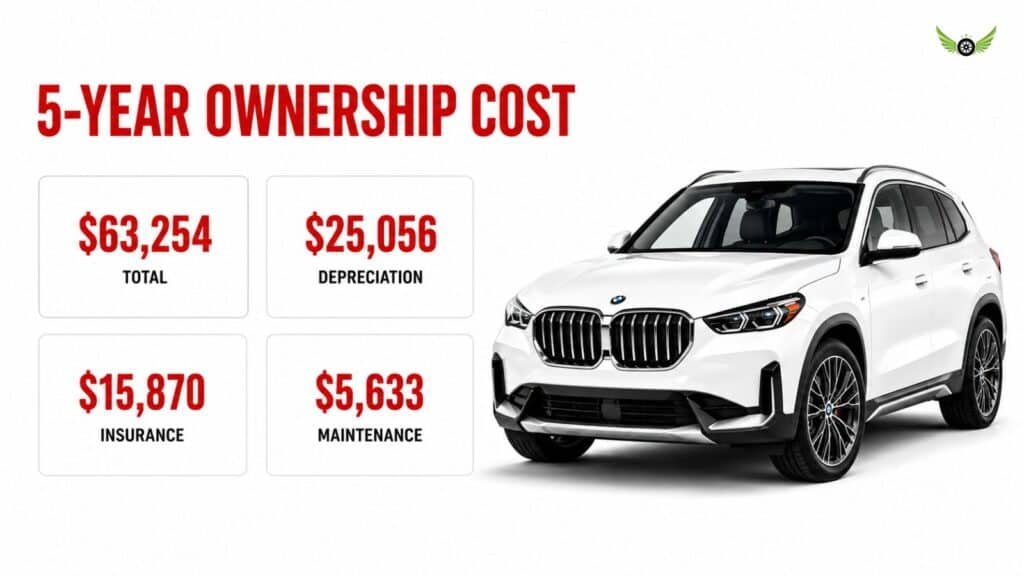
For the 2026 model, Kelley Blue Book estimates a 5-year cost to own of $63,254. That figure combines $38,198 in out-of-pocket expenses with $25,056 in depreciation. Among the recurring expenses, insurance is the largest at $15,870, followed by maintenance at $5,633 and financing at $5,784.
CarEdge provides a useful second benchmark, although its figures use different assumptions. Its general X1 ownership model estimates $57,868 over five years, including depreciation, insurance, fuel, interest and maintenance. Because the methodologies differ, these numbers should not be combined into one average; KBB’s 2026-specific estimate is more appropriate for the 2026 model.
Fuel, Maintenance & Financing Costs
KBB estimates $4,219 for fuel, $5,633 for maintenance, $1,742 for repairs, and $5,784 for financing over five years. The fuel estimate is relatively modest compared with insurance because KBB’s ownership model uses its own assumptions for annual driving and fuel costs.
Expense | 5-Year Estimate |
Fuel | $4,219 |
Maintenance | $5,633 |
Repairs | $1,742 |
Financing | $5,784 |
Insurance | $15,870 |
State fees | $4,950 |
Maintenance is not evenly distributed across the five years in KBB’s model. It estimates no maintenance expense in years 1 and 2, followed by $188 in year 3 and $5,445 in year 4. This pattern reflects the timing of scheduled maintenance rather than a typical annual bill.
Total 5-Year Ownership Cost
The estimated $63,254 five-year cost includes both money spent during ownership and the vehicle’s projected loss in value. KBB estimates $25,056 of depreciation, leaving a projected $19,494 residual value after five years.
Cost Component | 5-Year Estimate |
Out-of-pocket expenses | $38,198 |
Depreciation | $25,056 |
Total cost to own | $63,254 |
Estimated residual value | $19,494 |
This means depreciation accounts for roughly 40% of the total five-year ownership cost, while insurance alone accounts for about 25%. For a buyer comparing luxury compact SUVs, those two categories deserve as much attention as fuel economy and routine service costs.
BMW X1 Insurance Cost
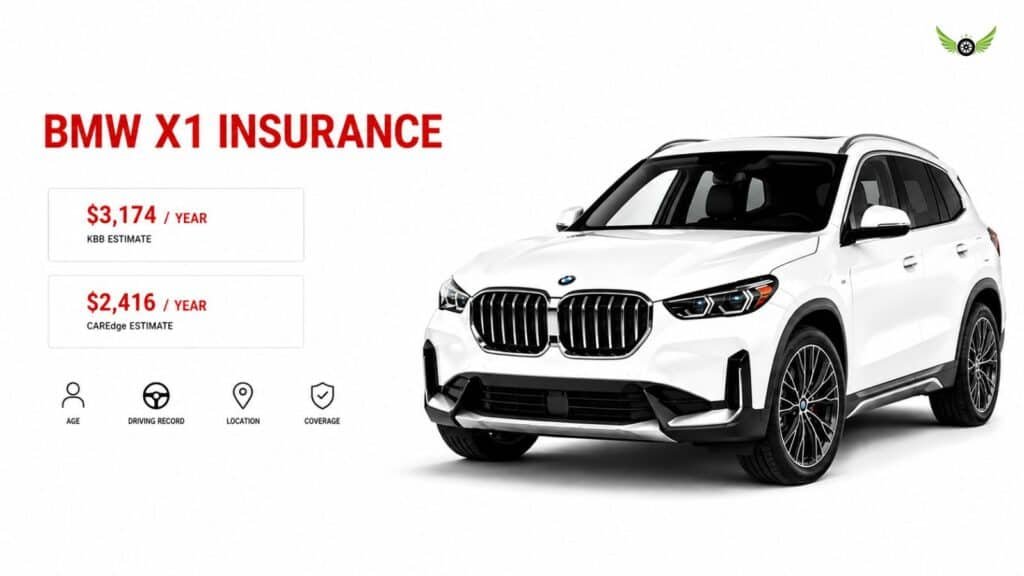
Insurance is one of the largest recurring expenses in the 2026 model’s ownership budget. Kelley Blue Book estimates $15,870 over five years, equal to $3,174 per year or about $265 per month in its 2026 ownership model. CarEdge gives a lower estimate of $2,416 per year for a 40-year-old driver with good credit, a clean record, full coverage and about 13,000 miles annually. The difference comes from different assumptions and methodologies, so neither figure should be treated as a personalized quote.
Average Insurance Premium
For a realistic national benchmark, the two sources provide a useful range rather than one fixed premium.
Source | Annual Estimate | Five-Year Estimate |
Kelley Blue Book | $3,174 | $15,870 |
CarEdge | $2,416 | $12,080 |
KBB’s figure is specifically included in its 2026 cost-to-own calculation. Its model assumes the same $3,174 insurance expense in each of the five ownership years. CarEdge’s estimate uses a 40-year-old driver, good credit, a clean driving record, full coverage, a single-car policy and approximately 13,000 miles per year.
CarEdge’s driver-profile data shows how quickly the premium can change. At age 40, its estimated annual full-coverage premium is $2,416 for a good driver with good credit, $3,547 after a recent at-fault accident and $4,150 with poor credit. At age 25, the corresponding estimates rise to $3,443, $5,055 and $5,914. These are modeled estimates, not actual insurer quotes.
Factors That Affect Insurance Rates
The biggest differences in BMW X1 Insurance costs come from the driver’s risk profile, location, coverage and insurer. CarEdge’s current data demonstrates this clearly: its age-40 estimate changes from $2,416 to $3,547 after an at-fault accident and to $4,150 with poor credit.
Location can make an equally large difference. For a good driver, CarEdge estimates annual premiums ranging from $1,118 in Hawaii to $3,483 in Connecticut. Its estimates are $3,433 in Florida, $2,922 in California, and $2,033 in Illinois. These figures illustrate geographic variation rather than guaranteed state premiums.
Other important rating factors include:
- Age and driving experience
- Accidents and traffic violations
- Credit-based insurance factors, where permitted by state law
- ZIP code and local claim patterns
- Coverage limits and deductible
- Annual mileage
- Insurance company and available discounts
- Vehicle repair and claim-loss history
The 2026 model also earned an IIHS Top Safety Pick+ designation. It received Good ratings in the small-overlap front, updated moderate-overlap front and side tests, along with Good headlights and pedestrian front-crash prevention. However, a strong safety rating does not guarantee a lower insurance premium because insurers use their own claims and risk models.
For a buyer, the most accurate way to calculate insurance before purchase is to obtain several quotes using the exact ZIP code, driver profile, trim, annual mileage, coverage limits and deductible. National estimates are useful for budgeting, but the actual premium can differ substantially from these published averages.
BMW X1 Resale Value & Depreciation
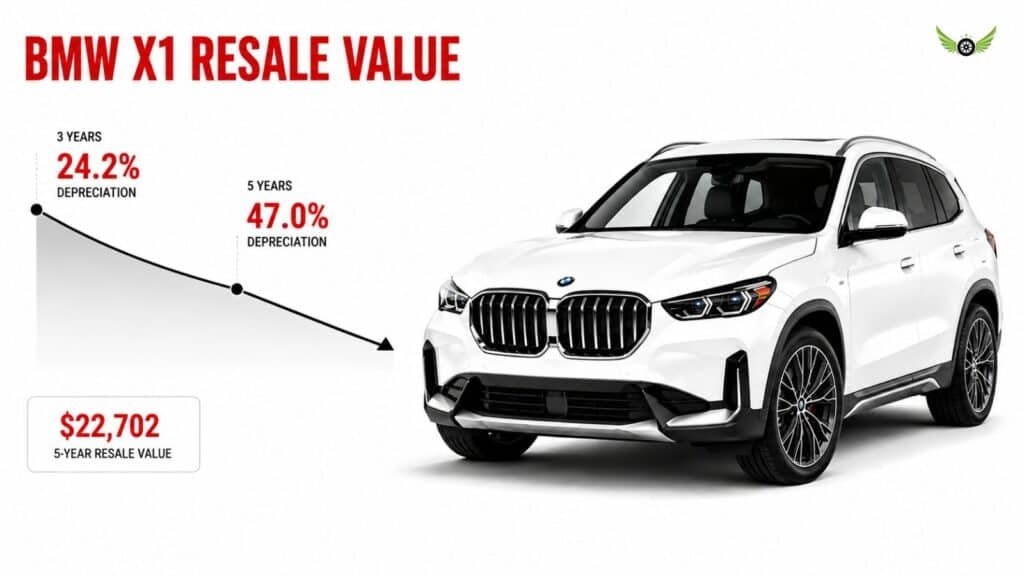
The BMW X1 has moderate resale performance for its class. iSeeCars’ latest analysis, based on more than 15 million vehicles, estimates 24.2% depreciation after three years and 47.0% after five years, leaving estimated resale values of $32,447 and $22,702, respectively. The five-year depreciation rate is close to the luxury subcompact SUV average of 46.1%.
For the specific 2026 xDrive28i, Edmunds projects a value of $32,306 after three years and $24,876 after five years, with total five-year depreciation of $26,142. Because Edmunds and iSeeCars use different valuation methods, these figures should be viewed as separate estimates rather than combined.
3-Year & 5-Year Depreciation
Period | iSeeCars historical/model data | Edmunds 2026 xDrive28i |
3 years | 24.2% depreciation / $32,447 value | $32,306 value |
5 years | 47.0% depreciation / $22,702 value | $26,142 depreciation / $24,876 value |
Edmunds’ projection shows the largest dollar drop during the first year, with depreciation of $10,845, followed by $4,330 in year two and $3,537 in year three.
For an actual resale transaction, mileage, condition, accident history, service records, trim, options and local demand can move the price considerably. The published figures are useful for ownership planning, not guaranteed future selling prices.
BMW X1 vs Competitors Resale Value
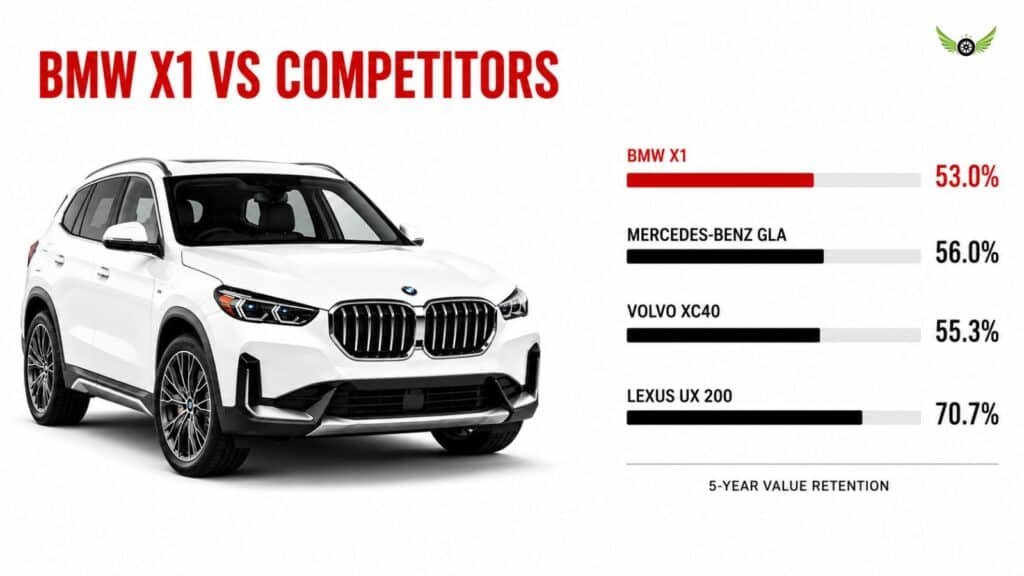
The X1 is not the strongest value-retaining vehicle in this segment. iSeeCars ranks the Lexus UX 200 first, with 70.7% five-year value retention, followed by the Mercedes-Benz GLA at 56.0% and Volvo XC40 at 55.3%. The X1 retains 53.0% in the same comparison.
Model | 5-Year Value Retention | 5-Year Depreciation |
Lexus UX 200 | 70.7% | 29.3% |
Mercedes-Benz GLA | 56.0% | 44.0% |
Volvo XC40 | 55.3% | 44.7% |
BMW X1 | 53.0% | 47.0% |
The direct model comparisons tell the same story. iSeeCars estimates the XC40 loses 48.3% over five years versus 50.4% for the X1, while the Lexus UX 250h loses 36.9% versus 50.4% for the X1.
For buyers focused on BMW X1 Ownership Cost, this matters because depreciation can become one of the largest expenses over a three- to five-year ownership period. The data suggests that the X1 offers average-to-moderate value retention, but competitors such as the Lexus UX have a clear advantage when resale value is the primary priority.
BMW X1 Long-Term Ownership Experience
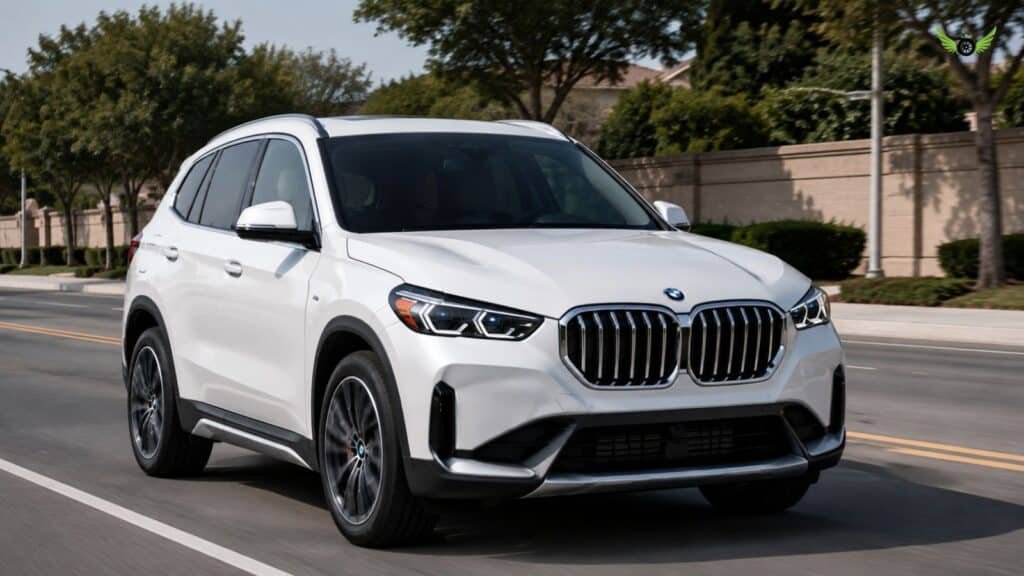
The 2026 BMW X1 is still too new for a reliable 10-year or 150,000-mile track record. The current generation started in 2023, so the best evidence comes from recent model-year data and long-term repair-cost projections. J.D. Power gives the 2026 model a 76/100 Quality & Reliability score, rated Average. RepairPal rates the X1 line 3.5/5, with average annual repair and maintenance costs of $915.
High-Mileage Ownership Expectations
CarEdge estimates $18,808 in maintenance and repairs over 10 years. Its model projects annual costs from $727 in year 1 to $2,854 in year 10, while the estimated probability of a major repair rises from 5.58% in year 1 to 56.41% in year 10. These are model-based probabilities, not a guarantee for an individual vehicle.
The data suggests that long-term ownership becomes more expensive as the vehicle ages, particularly after the factory maintenance and warranty periods. For a high-mileage owner, keeping service records and addressing drivetrain or electronic faults early is more important than relying on a fixed mileage lifespan.
Pros & Cons After Years of Ownership
Pros | Cons |
Strong driving experience | Repair exposure increases with age |
Premium interior and technology | Electronics can require attention |
Practical compact-SUV size | Long-term 2026 data is limited |
Standard AWD on U.S. xDrive28i | Out-of-warranty repairs can be expensive |
J.D. Power rates the 2026 model 84/100 for Driving Experience, while its reliability score remains 76/100. This supports a clear ownership trade-off: the vehicle scores strongly for driving appeal, but its long-term financial risk is less predictable than its driving performance.
For buyers planning to keep the vehicle beyond five years, the available evidence supports a reasonable but not proven high-mileage ownership outlook. The X1 should not be marketed as a guaranteed 150,000- or 200,000-mile vehicle; maintenance history and repair costs will become increasingly important as mileage rises.
Is the BMW X1 Worth Buying in 2026?
The 2026 BMW X1 is worth buying for shoppers who want a small luxury SUV with strong driving performance, useful space and standard all-wheel drive, but it is not the best choice for buyers focused primarily on low ownership costs. Edmunds rates the 2026 X1 7.4/10, while J.D. Power gives it 84/100 for Driving Experience and 76/100 for Quality & Reliability.
The financial side needs more attention. Kelley Blue Book estimates $63,254 in five-year ownership costs, including $25,056 in depreciation, $15,870 in insurance and $5,633 in maintenance. That makes the X1 a stronger choice for someone who values the BMW driving experience enough to accept higher ownership expenses.
Who Should Buy the BMW X1?
The X1 fits buyers who want compact dimensions without giving up premium features, performance or practicality. The xDrive28i produces 241 hp, returns 25 mpg city and 34 mpg highway, and provides 25.7 cubic feet of cargo space behind the rear seats.
It is particularly suitable for:
- Drivers who value responsive handling and acceleration.
- Buyers who want standard AWD in a compact luxury SUV.
- Small families needing useful rear-seat and cargo space.
- Owners comfortable with premium maintenance and insurance costs.
- Buyers planning to use the vehicle primarily for daily driving rather than maximizing resale value.
The X1 is less attractive for buyers whose priority is the lowest possible ownership expense. KBB’s five-year cost model shows that depreciation and insurance alone account for more than $40,000 of the projected ownership cost.
Final Ownership Verdict
The 2026 X1 makes a strong case as a premium compact SUV for buyers who prioritize driving experience and everyday usability. It has a responsive turbocharged four-cylinder, good cargo capacity, standard AWD and strong safety performance. The IIHS gives the 2026 model a Top Safety Pick+ designation, with Good ratings in the small-overlap front, updated moderate-overlap front and updated side tests.
Its main compromise is ownership expense. J.D. Power’s 76/100 reliability score is average rather than class-leading, and KBB’s five-year estimate puts total ownership at $63,254.
Best choice for: buyers who want premium driving dynamics, compact SUV practicality and standard AWD.
Think twice if: your main goal is minimum insurance, maintenance, depreciation and long-term ownership expense.
2026 BMW X1 Ownership, Cost & Buying FAQs
The key buying questions for the 2026 BMW X1 are not limited to price. Long-term buyers should consider its five-year ownership expense, warranty coverage, depreciation, insurance, reliability, practicality and the cost of keeping the vehicle after the included maintenance period. Current U.S. data from KBB, BMW, J.D. Power, Edmunds and IIHS provides a useful basis for answering these questions.
Is the 2026 BMW X1 worth buying?
Yes, if driving experience, premium features and compact-SUV practicality are more important than having the lowest possible ownership cost. Edmunds rates the 2026 model 7.4/10, while J.D. Power gives it 84/100 for Driving Experience and 76/100 for Quality & Reliability.
How much does the 2026 BMW X1 cost to own for five years?
Kelley Blue Book estimates $63,254 in five-year total ownership costs. This includes $38,198 in out-of-pocket expenses and $25,056 in depreciation.
How much is BMW X1 insurance in the USA?
KBB estimates $15,870 over five years, or about $3,174 per year, within its 2026 cost-to-own model. Actual premiums depend on the driver’s age, location, driving history, coverage, mileage and insurer.
How much maintenance does the 2026 BMW X1 need?
KBB estimates $5,633 in maintenance over five years, while BMW provides scheduled maintenance coverage through BMW Ultimate Care for 3 years or 36,000 miles, whichever comes first.
How long is the BMW X1 factory warranty?
The U.S. New Vehicle Limited Warranty covers the vehicle for 4 years or 50,000 miles, whichever comes first. BMW states that this warranty is transferable to subsequent owners.
Does BMW Ultimate Care cover maintenance after 36,000 miles?
No. BMW Ultimate Care for a 2026 vehicle ends at 36 months or 36,000 miles. After that point, scheduled maintenance becomes the owner’s responsibility unless additional coverage has been purchased.
Does the BMW X1 have good resale value?
Its resale performance is average rather than class-leading. J.D. Power gives the 2026 model a 78/100 Resale score, which it classifies as Average. KBB estimates $25,056 in five-year depreciation and a $19,494 five-year residual value.
Is the 2026 BMW X1 reliable for long-term ownership?
Current evidence suggests average reliability, but there is not yet enough high-mileage data to make a strong 10-year or 150,000-mile prediction. J.D. Power’s Quality & Reliability score is 76/100, while the current generation only dates back to 2023.
Is the BMW X1 expensive to repair after the warranty ends?
It can be. KBB estimates $1,742 in repairs during the first five years, while RepairPal’s model-line data puts average annual repair and maintenance costs at about $915. Actual out-of-warranty costs depend heavily on mileage, failure type, repair facility and vehicle condition.
Is the BMW X1 safe?
Yes. The 2026 BMW X1 is an IIHS Top Safety Pick+. IIHS gives it Good ratings in the small-overlap front, updated moderate-overlap front and updated side crash tests, although the rear-passenger rating in the updated moderate-overlap test includes an Acceptable result for chest injury measures.
What is the biggest ownership concern?
For a long-term buyer, total ownership expense is the bigger concern than the purchase price alone. KBB’s five-year estimate shows that depreciation and insurance together account for $40,926, before adding fuel, maintenance, repairs, financing and state fees.