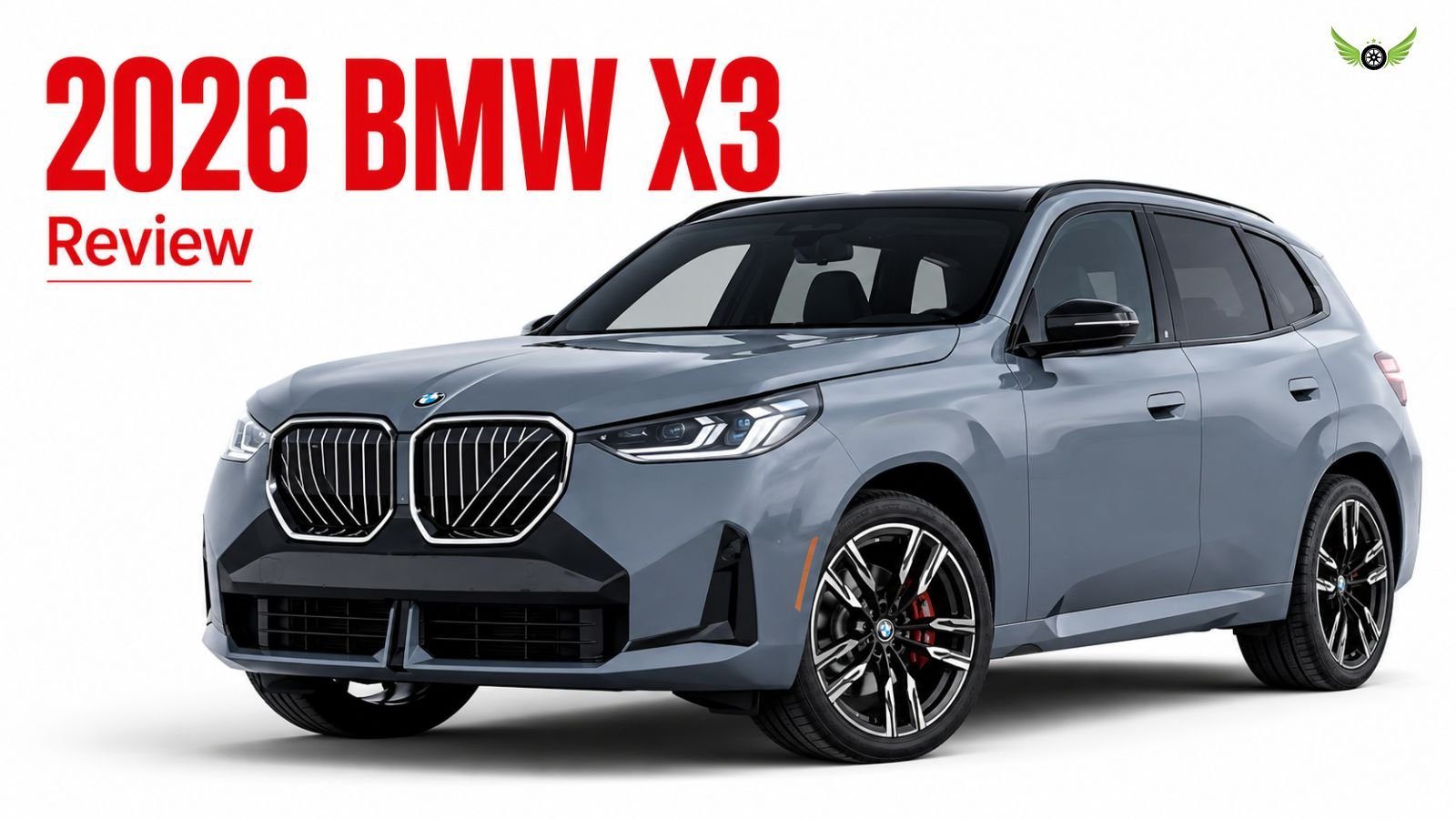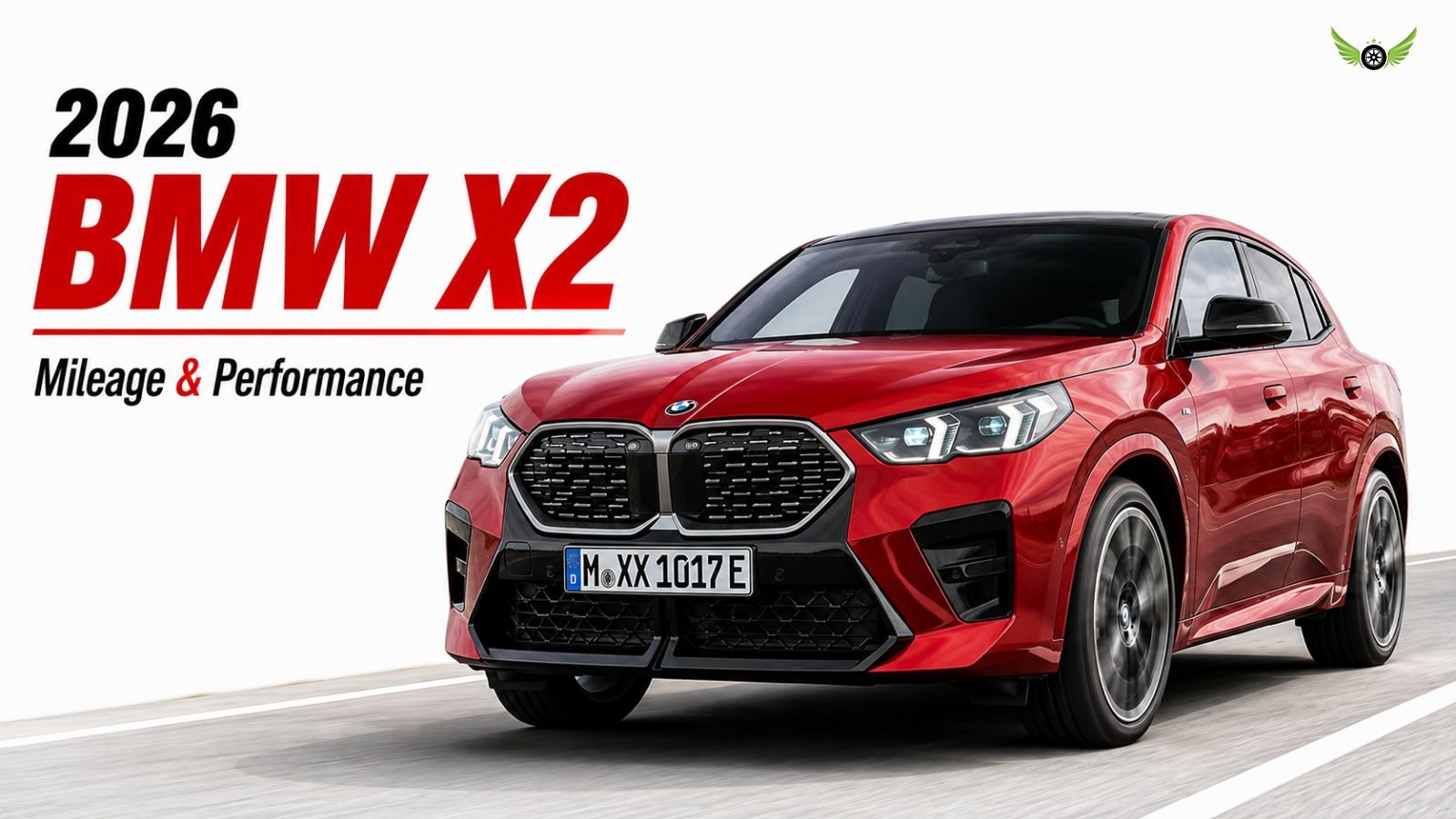
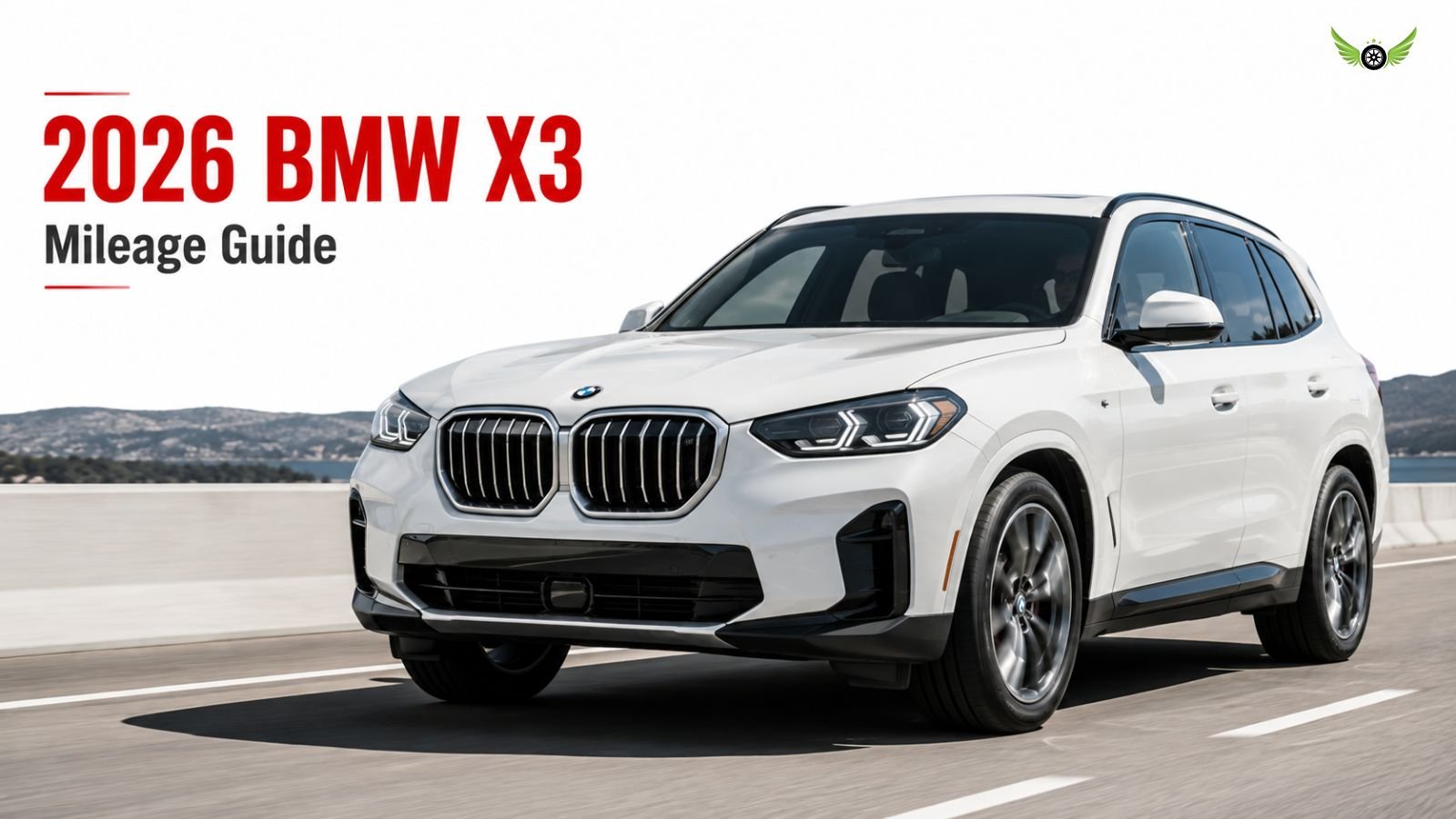
The 2026 BMW X3 is a compact luxury SUV that balances fuel economy, everyday comfort, and strong road performance. In the USA, the X3 30 xDrive uses a 255-hp turbocharged 2.0-liter four-cylinder with a 48-volt mild-hybrid system, while the X3 M50 xDrive uses a 393-hp turbocharged 3.0-liter inline-six with the same hybrid assistance. Both use an eight-speed automatic transmission and standard all-wheel drive.
For fuel economy, the X3 30 xDrive is EPA-rated at 27 mpg city and 33 mpg highway, or 29 mpg combined. The more powerful X3 M50 xDrive is rated at 25 mpg city and 30 mpg highway, with 27 mpg combined. Independent testing also shows that the M50 can return close to its EPA highway figure in real-world 75-mph driving, with Car and Driver recording 29 mpg.
Performance is another major strength. Car and Driver recorded 6.2 seconds from 0–60 mph for the X3 30 xDrive and 4.0 seconds for the M50. The base model is better suited to relaxed daily driving, while the M50 delivers substantially stronger acceleration without giving up the X3’s everyday usability.
This guide looks at the BMW X3 Mileage, BMW X3 MPG, and BMW X3 Performance in the context that matters most to U.S. buyers: fuel efficiency, acceleration, ride quality, city driving, highway behavior, AWD capability, driving modes, and everyday practicality.
BMW X3 MPG & Fuel Economy
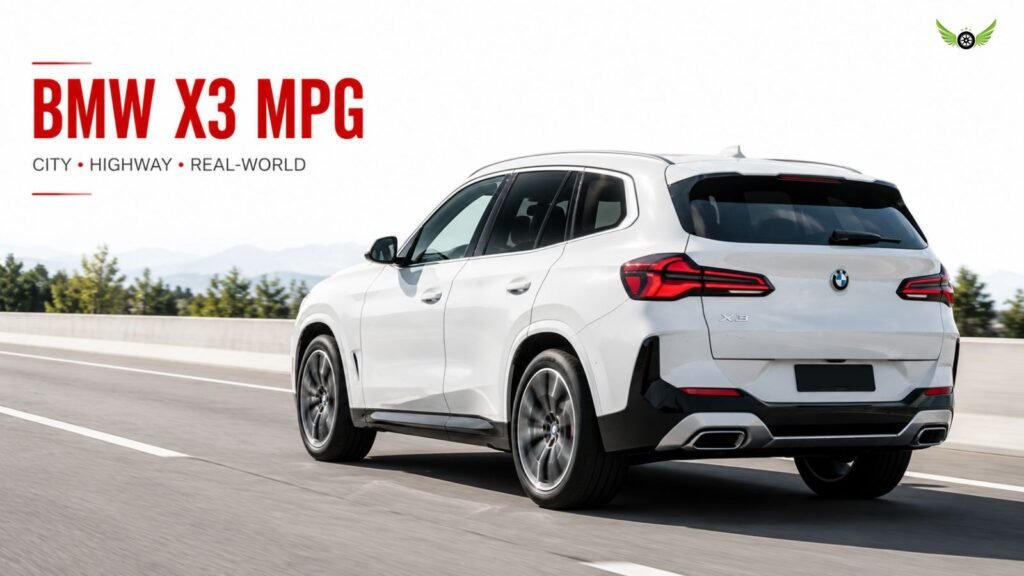
For the 2026 U.S. lineup, fuel economy depends on which version you choose. The X3 30 xDrive is rated at 27 mpg city and 33 mpg highway, while the more powerful X3 M50 xDrive is rated at 25 mpg city and 30 mpg highway. That makes the four-cylinder version the more efficient choice for buyers who want lower fuel consumption without moving to a fully electric or plug-in model.
Official EPA Fuel Economy Ratings
The X3 30 xDrive uses a 2.0-liter turbocharged four-cylinder with 48-volt mild-hybrid assistance, producing 255 horsepower. The M50 uses a 3.0-liter turbocharged inline-six with the same 48-volt system and produces 393 horsepower. Both versions use an eight-speed automatic transmission and all-wheel drive.
2026 Model | City | Highway |
X3 30 xDrive | 27 mpg | 33 mpg |
X3 M50 xDrive | 25 mpg | 30 mpg |
The difference is small on paper but meaningful over regular driving. The X3 30 xDrive has a 3-mpg highway advantage and a 2-mpg city advantage over the M50. For a driver covering a lot of highway miles, the 30 xDrive is the better fit for fuel efficiency.
Real-World BMW X3 Fuel Economy
EPA numbers provide a standardized comparison, but actual consumption changes with traffic, speed, weather, tire setup, driving style, and trip length. Independent testing gives a more practical reference point.
Car and Driver recorded 29 mpg at a steady 75 mph with the X3 M50 on its highway fuel-economy test. That is close to its 30-mpg highway rating, despite the M50’s 393-hp six-cylinder engine. The same test recorded 21 mpg overall during its broader evaluation, showing why highway results should not be treated as an everyday average.
For buyers comparing the two versions, the pattern is straightforward: the X3 30 xDrive prioritizes efficiency, while the M50 accepts a modest fuel-economy penalty for substantially stronger performance. The choice mainly comes down to whether lower running costs or faster acceleration matters more.
BMW X3 Performance & Driving Experience
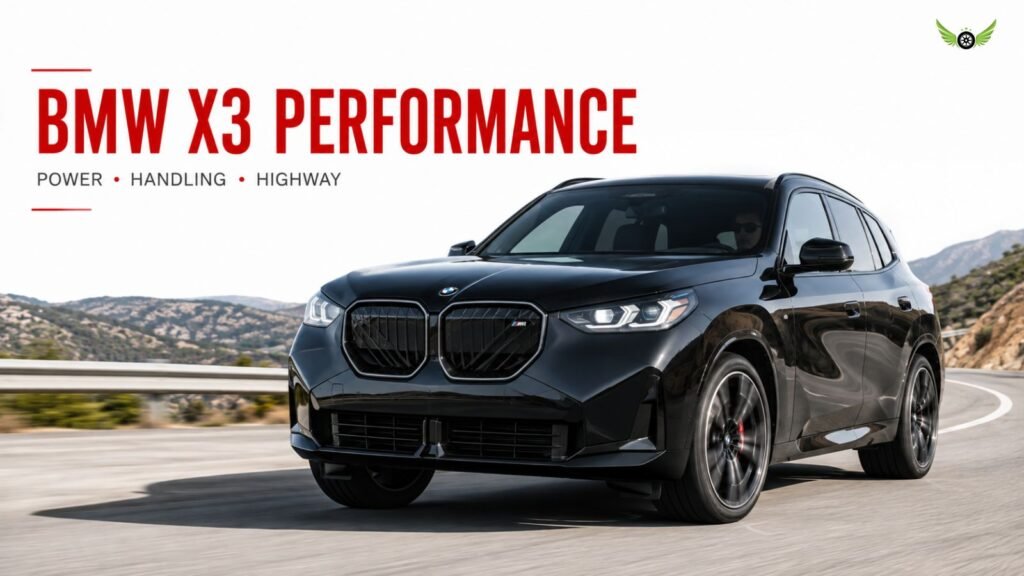
The 2026 BMW X3 gives U.S. buyers two distinct performance choices. The X3 30 xDrive uses a 255-hp 2.0-liter turbocharged four-cylinder, while the X3 M50 xDrive gets a 393-hp 3.0-liter turbocharged inline-six. Both use 48-volt mild-hybrid technology, an eight-speed automatic transmission and all-wheel drive.
Acceleration, Mild Hybrid Power & Transmission
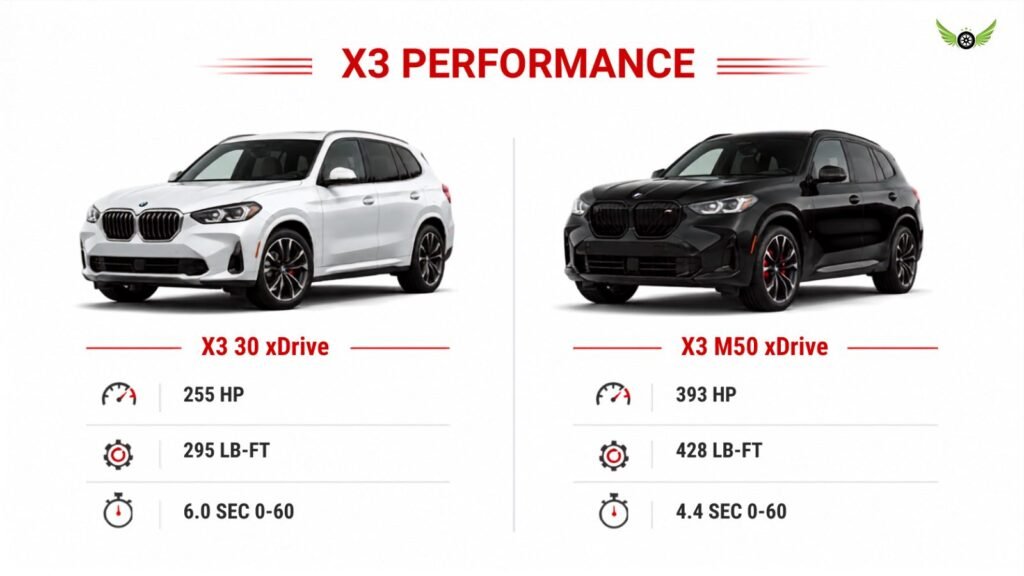
The X3 30 xDrive reaches 60 mph in 6.0 seconds according to BMW’s preliminary testing. The M50 is substantially quicker at 4.4 seconds. Independent testing by Car and Driver produced 6.2 seconds for the 30 xDrive and 4.0 seconds for the M50, showing how results can vary with testing conditions and methods.
2026 Version | Engine | Power | Torque | BMW 0–60 mph |
X3 30 xDrive | 2.0L turbo 4-cylinder + 48V mild hybrid | 255 hp | 295 lb-ft | 6.0 sec |
X3 M50 xDrive | 3.0L turbo inline-6 + 48V mild hybrid | 393 hp | 428 lb-ft | 4.4 sec |
The four-cylinder model has enough performance for commuting, merging and normal highway passing. The M50’s inline-six delivers a much stronger response when accelerating at higher speeds. The eight-speed automatic transmission is shared by both versions, keeping shifts smooth during relaxed driving and more responsive when acceleration is needed.
Ride Comfort, Handling & Highway Performance
The standard model focuses on a balance between comfort and road control. BMW says the latest X3 benefits from increased body rigidity, revised suspension geometry and improved straight-line stability. Car and Driver also describes the X3 as having a well-developed ride-and-handling balance rather than prioritizing outright sportiness.
The M50 moves further toward performance. Edmunds’ real-road and track testing found it sharp and agile, with well-weighted steering and confident braking. The suspension remains reasonably comfortable over normal bumps, although rear passengers may find it firm even in Comfort mode.
For everyday driving, the 30 xDrive is the more balanced choice. The M50 makes more sense for buyers who specifically want quicker acceleration and sharper handling while keeping the practicality of a compact SUV.
BMW X3 Daily Driving Experience
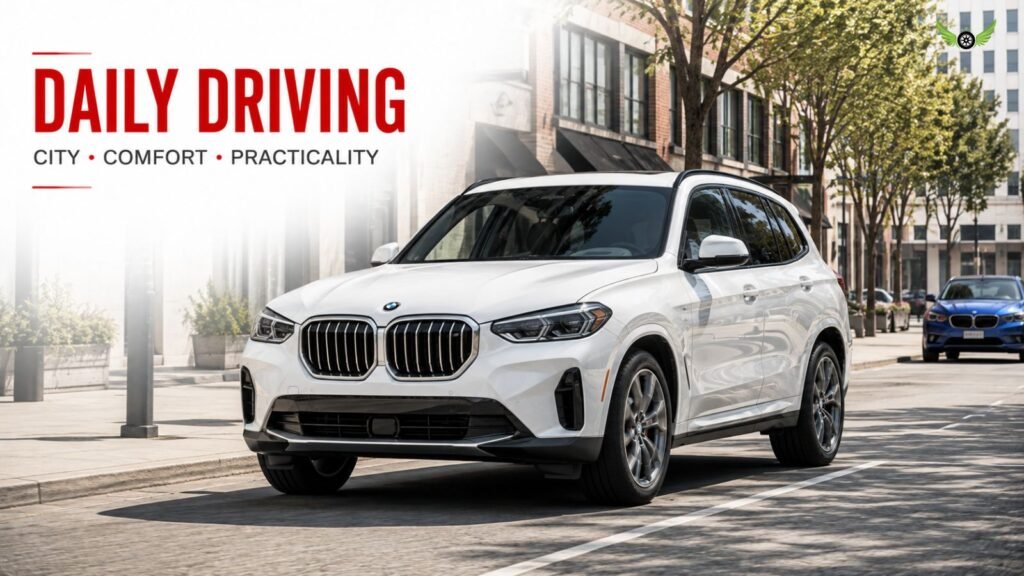
The 2026 BMW X3 is well suited to daily use because it combines a manageable size with good visibility, comfortable front seating and useful cargo space. Edmunds rates its visibility highly and found the ride comfortable, while the cargo area is larger than several direct luxury-SUV competitors.
City Driving, Parking & Visibility
At 187.2 inches long and 75.6 inches wide, the X3 has a fairly substantial footprint for a compact luxury SUV, but its 40.0-foot turning circle helps when maneuvering through tighter streets and parking areas. Edmunds found outward visibility excellent, and the available surround-view camera adds useful visibility around the vehicle when parking in confined spaces.
The driving position also makes it relatively easy to judge the vehicle’s surroundings. For city use, the combination of good visibility and available parking-camera technology is more useful than simply having a smaller exterior footprint.
Passenger Comfort & Cargo Practicality
The front seats use firm cushioning with a wide range of adjustments, including lumbar support and a thigh extender. The second row provides 38.2 inches of headroom and 36.3 inches of legroom, which is adequate for adults, although the rear seat does not offer the reclining function found in some competitors. Wide door openings also make getting in and out straightforward.
Cargo space is one of the X3’s stronger practical points. There are 31.5 cubic feet behind the second row, increasing to 67.1 cubic feet with the rear seats folded. The standard 40/20/40 split-folding arrangement also makes it easier to carry longer or bulky items without giving up all rear seating. Edmunds notes that this cargo capacity is ahead of several competitors in the segment.
Practicality | 2026 BMW X3 |
Seating capacity | 5 |
Rear headroom | 38.2 in |
Rear legroom | 36.3 in |
Cargo behind rear seats | 31.5 cu. ft. |
Maximum cargo volume | 67.1 cu. ft. |
Turning circle | 40.0 ft. |
Overall, the X3 works particularly well for buyers who want a compact luxury SUV that remains easy to use in everyday traffic while offering more cargo flexibility than many rivals.
BMW X3 xDrive AWD & Driving Modes
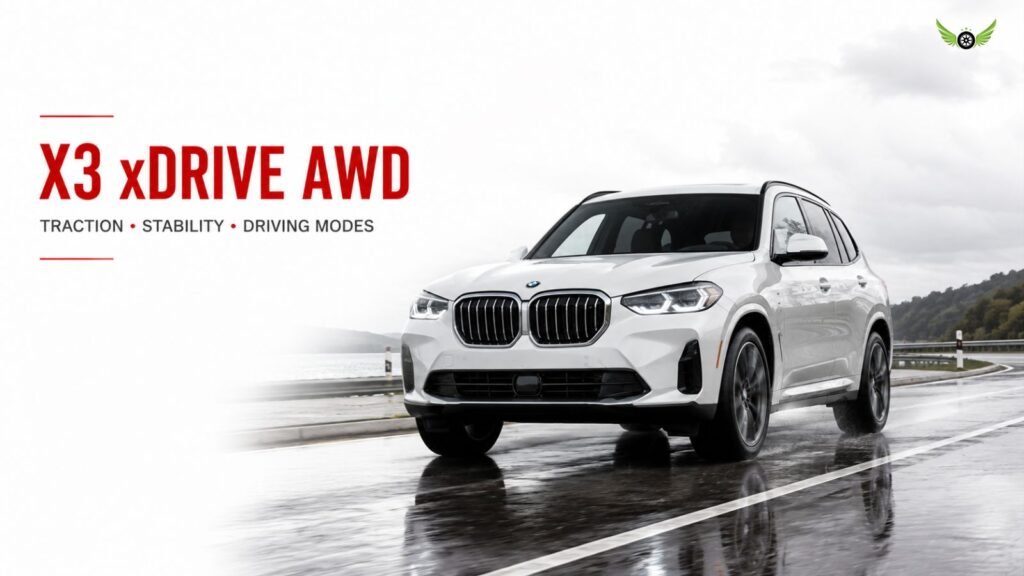
The 2026 BMW X3 comes with xDrive all-wheel drive in the U.S. lineup. The system works with BMW’s stability and traction-control systems to manage available grip, while the My Modes system lets the driver change how the vehicle responds to different driving situations.
xDrive AWD, Traction & All-Weather Capability
BMW’s xDrive system continuously manages power distribution between the front and rear axles according to available traction and driving conditions. In everyday use, this helps the X3 maintain grip on wet roads and during low-traction conditions. The system works together with the vehicle’s stability and traction controls rather than relying on AWD alone.
That makes xDrive useful for rain, slippery pavement and light winter conditions, but it does not remove the limitations of tires, road surface or weather. For snow and ice, appropriate winter-capable tires remain important. The X3 should therefore be viewed as a road-focused luxury SUV with added traction capability, not as a dedicated off-road vehicle.
Eco, Personal & Sport Driving Modes
BMW officially calls these Efficient, Personal and Sport My Modes. Efficient mode is designed to reduce energy consumption by adjusting the powertrain and other vehicle functions, while its Efficiency Coach provides feedback intended to encourage smoother and more anticipatory driving.
Personal mode provides the more relaxed everyday setting, while Sport changes the vehicle’s character for more responsive driving. BMW says Sport mode can adjust areas such as the drive system, steering and damping, depending on equipment. On models equipped with Dynamic Damper Control, BMW specifically notes that Sport provides tighter tuning.
For normal commuting, Efficient or Personal makes the most sense. Sport is more useful when quicker throttle response, sharper steering and firmer chassis behavior are wanted. On the M50, the sportier hardware makes this difference more noticeable, although independent testing has found the ride can become firm depending on suspension and wheel configuration.
BMW X3 vs Audi Q5 & Mercedes-Benz GLC
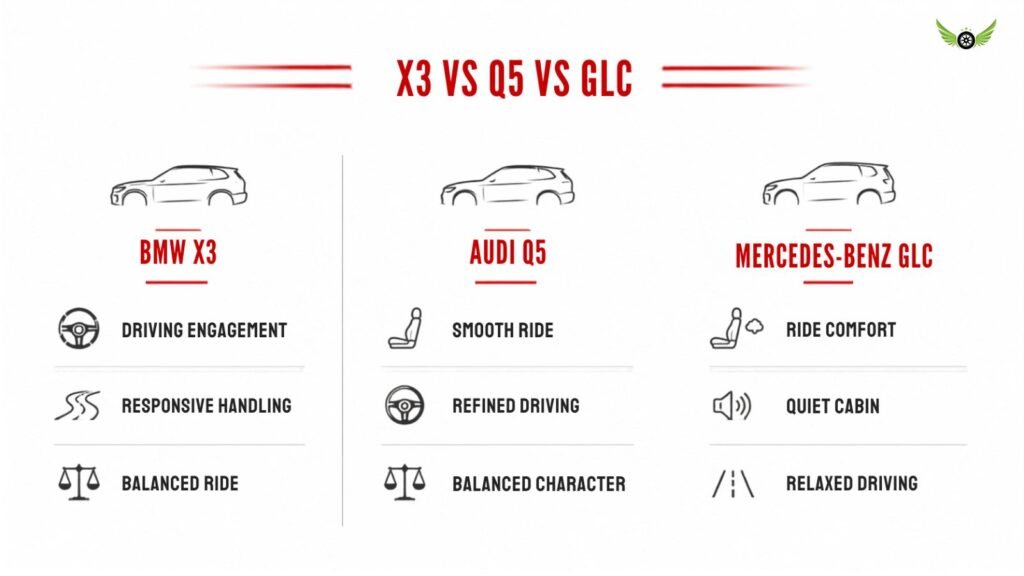
The 2026 BMW X3, Audi Q5 and Mercedes-Benz GLC 300 are closely matched compact luxury SUVs, but their driving characteristics are different. The X3 emphasizes responsive handling, the Q5 combines performance with a composed ride, and the GLC puts more emphasis on relaxed comfort. For everyday driving, the best choice depends on whether handling, refinement or ride comfort matters most.
Driving Performance Comparison
The standard X3 30 xDrive uses a 255-hp turbocharged four-cylinder with 295 lb-ft of torque. The Audi Q5 produces 268 hp and 295 lb-ft, while the GLC 300 4MATIC produces 255 hp and 295 lb-ft. All three use turbocharged four-cylinder engines with some form of electrification and all-wheel drive.
2026 Model | Power | Torque | Transmission | 0–60 mph |
BMW X3 30 xDrive | 255 hp | 295 lb-ft | 8-speed automatic | 6.0 sec* |
Audi Q5 | 268 hp | 295 lb-ft | 7-speed S tronic | 5.8 sec |
Mercedes-Benz GLC 300 4MATIC | 255 hp | 295 lb-ft | 9-speed automatic | 6.0 sec |
*BMW’s figure is a preliminary manufacturer test result. Actual acceleration varies with specification, conditions and testing method.
The numbers are close, so the difference is not large enough to define the driving experience by itself. The X3’s eight-speed automatic and rear-biased xDrive setup contribute to its more driver-focused character, while the Q5’s seven-speed S tronic and quattro system deliver quick, controlled responses. The GLC 300 uses a nine-speed automatic and 4MATIC, with its 48-volt integrated starter-generator providing additional electric assistance.
Ride Comfort & Everyday Usability
The X3 offers a strong middle ground between handling and comfort. It feels more responsive when cornering than a purely comfort-oriented SUV, while still providing the space and road manners expected from a daily luxury vehicle.
The Q5 is similarly balanced but places more emphasis on a composed, refined driving experience. Its standard quattro all-wheel drive and 268-hp engine give it enough performance for commuting and highway travel without making the ride feel overly sporty.
The GLC 300 is the better fit for buyers who prioritize a relaxed driving character. Its selective-damping suspension and multilink rear suspension are designed around comfort while maintaining controlled handling. It also offers 37.4 inches of rear legroom and 21.9 cubic feet of cargo space behind the rear seats.
Overall, the X3 is the stronger choice for drivers who want more involvement behind the wheel, while the GLC 300 suits comfort-focused buyers. The Q5 sits between them, combining responsive performance with a refined everyday character.
BMW X3 Mileage, MPG, Performance & Driving Experience FAQs
The 2026 BMW X3 combines fuel efficiency, responsive performance, practical cargo space and standard all-wheel drive. The answers below cover the key ownership and driving questions that matter most when comparing the X3 with other compact luxury SUVs.
What is the 2026 BMW X3 MPG?
The X3 30 xDrive is EPA-rated at 27 mpg city, 33 mpg highway and 29 mpg combined. The M50 xDrive is rated at 25 mpg city, 30 mpg highway and 27 mpg combined. The 30 xDrive is therefore the better choice for fuel efficiency.
What can you expect from the BMW X3 in real-world driving?
Real-world fuel consumption depends on speed, traffic, weather and driving style. Edmunds’ current testing gives the 30 xDrive an EPA combined rating of 29 mpg, while an owner report on Edmunds described an average of 25 mpg with a highway high of 37 mpg. Owner results are individual experiences, not a standardized test result.
How fast is the 2026 BMW X3 30 xDrive?
BMW lists a 6.0-second 0–60 mph time for the X3 30 xDrive. Edmunds independently recorded 6.1 seconds, showing that actual acceleration can vary slightly with testing conditions.
Is the X3 M50 much faster than the X3 30 xDrive?
Yes. The M50 produces 393 hp and 428 lb-ft of torque, compared with 255 hp and 295 lb-ft in the 30 xDrive. Edmunds recorded 4.4 seconds to 60 mph for the M50, making it substantially quicker than the standard version.
Is the 2026 BMW X3 comfortable for daily driving?
Yes. The 30 xDrive combines a comfortable ride with predictable cornering, strong braking and good outward visibility. Edmunds rated its driving experience 7.3/10 and describes the X3 as a well-rounded SUV for everyday use.
Is the BMW X3 easy to drive and park in the city?
It is relatively easy to manage for its class. The X3 has a 40.0-foot turning circle, and Edmunds found its visibility excellent. An available surround-view camera can provide additional help in tight parking spaces.
How much cargo space does the 2026 BMW X3 have?
The X3 offers 31.5 cubic feet behind the rear seats and 67.1 cubic feet with the rear seats folded. That gives it more cargo capacity than the 2026 Audi Q5, which Edmunds lists at 27.6 and 56.9 cubic feet respectively.
Does the 2026 BMW X3 have all-wheel drive?
Yes. The U.S. X3 30 xDrive and X3 M50 xDrive use all-wheel drive. The system is designed to help manage available traction, which is useful on wet or slippery roads, although tires remain important in severe winter conditions.
Which driving mode is best for everyday use?
Efficient is the logical choice when lower energy consumption is the priority, while Personal is better suited to a customized everyday setup. Sport changes the vehicle toward a more responsive driving character and is more useful when sharper reactions are wanted.
Is the BMW X3 better to drive than the Audi Q5 and Mercedes-Benz GLC?
For buyers who prioritize handling and driver involvement, the X3 has a clear advantage. Edmunds’ comparison testing rated the X3 ahead of the Q5 and GLC overall, describing it as the most exciting to drive while still maintaining a comfortable ride.
Is the BMW X3 more practical than the Audi Q5 and Mercedes-Benz GLC?
The X3 has a strong practicality advantage in cargo capacity. Edmunds lists 31.5 cubic feet behind its rear seats, compared with 27.6 cubic feet for the Q5 and 21.9 cubic feet for the GLC 300.
Which 2026 BMW X3 is better for most buyers?
The X3 30 xDrive is the better fit for most buyers because it combines adequate acceleration, better fuel economy and strong everyday practicality. The M50 xDrive makes more sense for drivers who place much greater importance on acceleration and sportier handling. Edmunds also recommends the X3 overall and describes the 30 xDrive as a well-rounded choice.