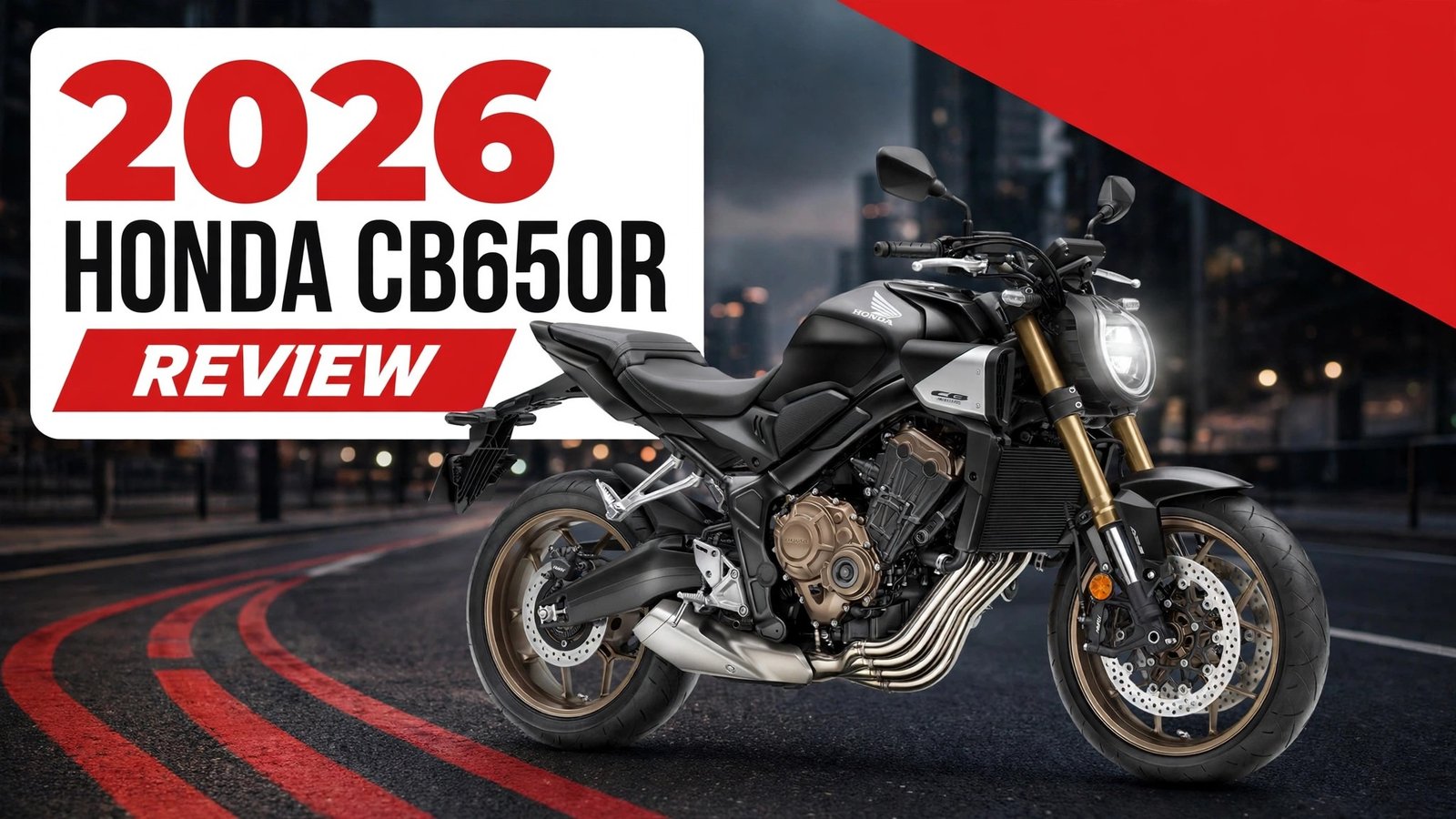
Short answer: this Honda CB650R review covers a naked middleweight that got better by getting simpler to ride — a 649cc inline-four with Neo Sports Café styling, a 2026 price cut to $8,699, and an E-Clutch system that works the clutch for you without turning the bike into an automatic. The CB650R launched in the United States in 2019, replacing the older CB650F, and it has run continuously since, with its biggest updates landing in 2021 (a better fork) and 2024 (E-Clutch plus a TFT dash). This Honda CB650R review follows the bike year by year, reports only figures that belong to the naked bike, and keeps the faired CBR650R’s numbers out of it.
One warning up front, because it shapes this whole Honda CB650R review: the CB650R and the CBR650R share a platform, but they are different motorcycles. Prices, ergonomics, recalls, and reviews for the faired bike do not transfer to the naked bike. Where a figure below looks familiar from CBR650R coverage, this Honda CB650R review says so plainly and keeps it out of the CB650R’s own story. For the faired sibling’s own story, see our Honda CBR650R review.
Honda CB650R Overview and Model-Year Updates
The overview of this Honda CB650R review starts with longevity: eight US model years, no gap year, and a bike that Honda kept refining rather than replacing. The CB650R arrived as the middleweight of Honda’s Neo Sports Café range — a retro-modern naked with a round-ish headlight, an upright riding position, and a high-revving four-cylinder engine. This Honda CB650R review treats that steady evolution as the bike’s main credential.
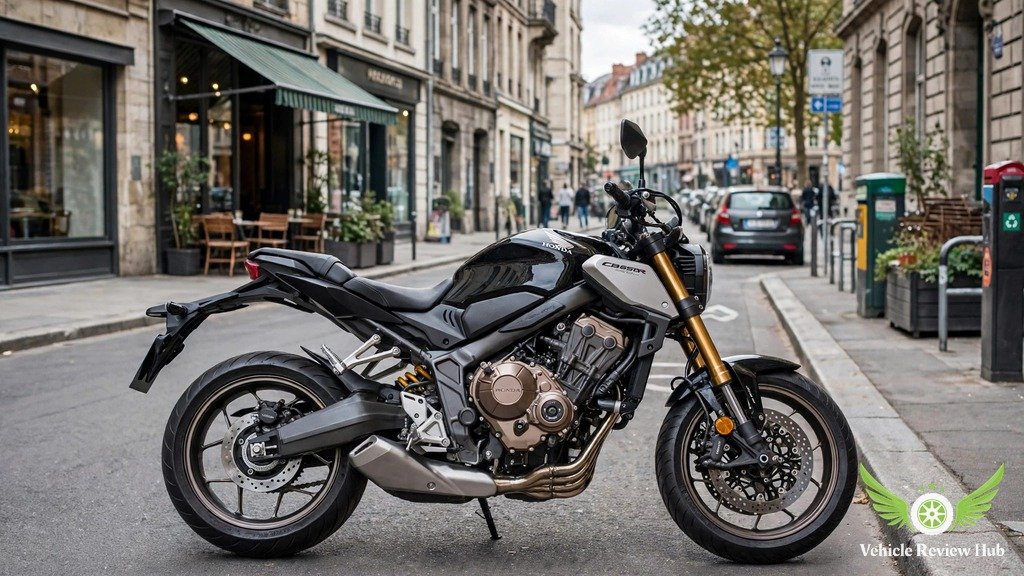
US Launch in 2019 Replacing the CB650F at $8,899
The United States launch in this Honda CB650R review dates to 2019, when the CB650R replaced the CB650F at $8,899 — $9,199 with ABS, which was optional in that first year only. The CB650F (2014–2018) was a different, older motorcycle, and none of its specs, prices, or reviews belong here. The 2019 CB650R brought the Neo Sports Café look, a 649cc inline-four, and Honda Selectable Torque Control on ABS models, and it set the template every later year followed. The 2021 update then swapped the fork for a Showa Separate Function Big Piston unit and revised the engine for emissions without losing performance, which testers confirmed on the dyno. This Honda CB650R review follows those steps rather than treating every year as a different bike.
E-Clutch Only From 2024 and a $700 Price Cut for 2026
The E-Clutch era in this Honda CB650R review begins in 2024: every US CB650R from 2024 on is an E-Clutch bike, and the manual version ended with the 2023 model year. The 2024 bike cost $9,399 — the same as 2023 despite adding E-Clutch and a TFT dash — and the 2025 bike held that price plus $600 destination. For 2026, Honda cut the price by $700 to $8,699 plus $600 destination, with no mechanical changes, in Matte Black Metallic. That cut is the headline of this Honda CB650R review for new-bike buyers: the current bike is the cheapest CB650R Honda has sold in years, and it carries the full 2024-on equipment set. For the performance story behind those years, see our Honda CB650R performance guide.
Honda CB650R Engine and Specifications
The engine section of this Honda CB650R review is the heart of the bike’s appeal: a 649cc inline-four in a class full of twins and triples, tuned for a high-revving character rather than low-end grunt. Honda USA publishes no horsepower figure for this motorcycle, a fact this Honda CB650R review states plainly — every power number below is a labelled dyno test, never a factory claim. The chassis numbers are stable and well documented, with year splits attached wherever a number changed.
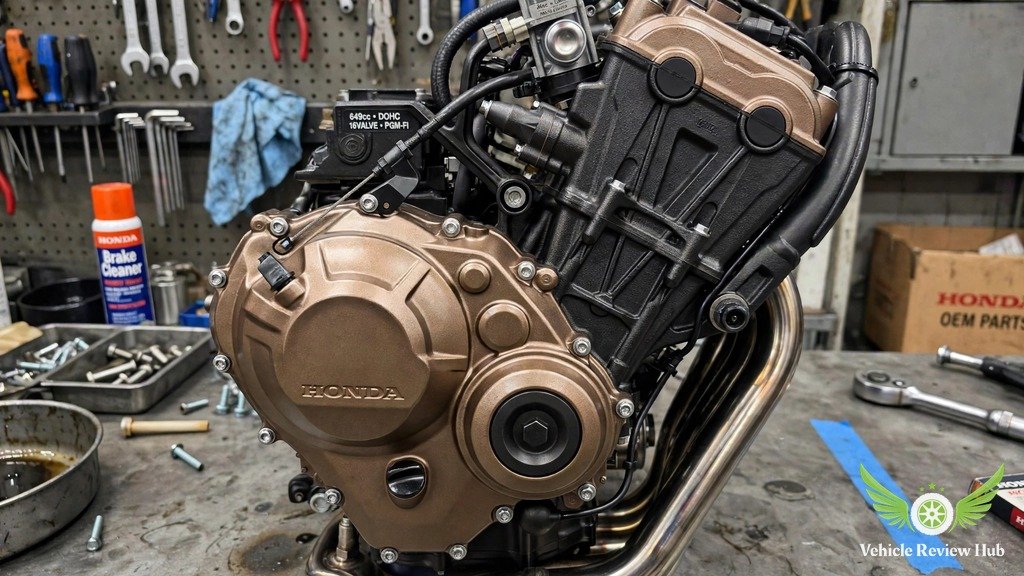
649cc DOHC Inline-Four at 11.6:1 With 32mm Throttle Bodies
At the heart of this Honda CB650R review is the 649cc liquid-cooled DOHC inline-four: 67.0 x 46.0mm bore and stroke, 11.6:1 compression, PGM-FI fuel injection through 32mm throttle bodies, a six-speed gearbox, and a #525 chain running 15T/42T sprockets. The engine revs to 12,000 rpm on the European claim, and American dyno tests put rear-wheel output in the low eighties: Cycle World measured 81.90 horsepower at 10,870 rpm and 42.97 lb-ft of torque at 7,960 rpm on a 2021 bike, while Motorcyclist’s separate dyno recorded 81.9 horsepower at 10,900 rpm and 43.0 lb-ft at 8,000 rpm. This Honda CB650R review reports both tests separately and never averages them — they corroborate each other, but they are different bikes on different dynos on different days. The European 95-horsepower figure is a crank claim, not an American measurement, and it never appears in this Honda CB650R review as a US number. The 2019 bikes measured slightly lower, around 80.6 horsepower, so the 2021 engine update was a genuine, if modest, improvement.
Weight 445 lb Before E-Clutch and 456 lb After, Not 466
The weight story in this Honda CB650R review needs care, because a wrong figure circulates online. Claimed curb weight was 445 lb before E-Clutch (2023) and 456 lb from 2024 on, per Honda USA’s 2026 page — never 466 lb, a figure this Honda CB650R review explicitly rejects. The E-Clutch hardware itself accounts for roughly 4.5 lb of that step, per SlashGear’s reporting; the remaining few pounds belong to the wider 2024 package, and this Honda CB650R review does not merge those two facts into a single explanation. The rest of the chassis is consistent: 31.9-inch seat height, 57.0-inch wheelbase, 4.1-gallon tank (with a 0.8-gallon reserve noted on 2019 sheets), and a steel twin-spar frame. A 240mm rear disc and, from 2021, a 41mm Showa SFF-BP fork complete a chassis that feels light and neutral for a four-cylinder middleweight.
| Specification | Honda CB650R figure | Note |
|---|---|---|
| Engine | 649cc liquid-cooled DOHC inline-four | 67.0 x 46.0mm, 11.6:1 compression |
| Gearbox / final drive | 6-speed, #525 chain 15T/42T | E-Clutch from 2024, manual before |
| Tank / seat | 4.1 gal, 31.9-inch seat | 57.0-inch wheelbase |
| Weight | 445 lb (2023) → 456 lb (2024-on) | Never 466 lb |
| Summary | High-revving four, light chassis | Honda USA publishes no hp figure |
Honda CB650R Price and Market Availability
Price is where this Honda CB650R review gets interesting, because the bike’s sticker climbed steadily for five years and then fell by $700. Understanding that arc is the key to judging both new-bike value and used prices. This Honda CB650R review lays out the verified price history with destination charges stated per year rather than blended, and it omits the 2020 and 2021 MSRPs, which could not be re-verified from a Honda or dealer source at writing time.
Honda CB650R Price in the USA: $8,699 Plus $600 for 2026
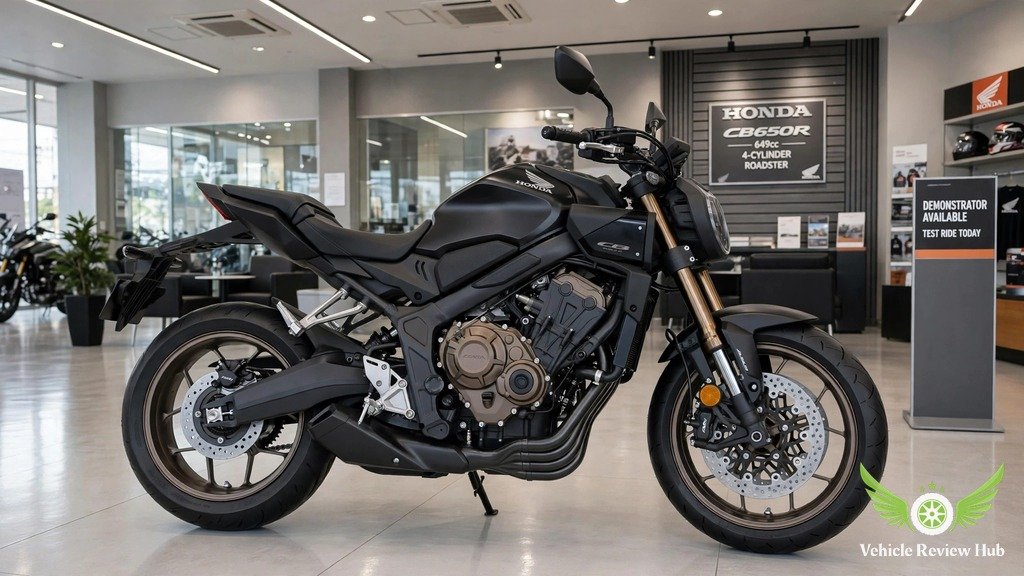
The current price in this Honda CB650R review is $8,699 plus $600 destination for the 2026 CB650R E-Clutch, in Matte Black Metallic — a $700 cut from the $9,399 the bike carried in 2024 and 2025, with no mechanical changes. Honda USA’s own 2026 CB650R page describes it as a reduced MSRP with no corners cut, and the spec sheet confirms the same 649cc engine, 456-lb curb weight, and 4.1-gallon tank. The earlier arc runs: $8,899 base ($9,199 ABS) in 2019, $9,299 in 2022, and $9,399 in 2023 — the last manual year — before E-Clutch arrived at the same $9,399 in 2024. Destination was $400 on older dealer sheets versus $600 now, so this Honda CB650R review quotes destination per year, never as a single blended figure. Against its rivals, the 2026 price undercuts the faired CBR650R E-Clutch at $9,199 plus $600, and it sits almost exactly on the Yamaha MT-07’s $8,599 plus $675 — a comparison this Honda CB650R review carries into the verdict.
ABS Optional in 2019 Only and Standard From 2020 in the US
The ABS story in this Honda CB650R review is short and exact: ABS was optional in 2019 only, and standard from 2020 onward in the United States. A 2019 non-ABS bike is therefore the only CB650R a US buyer will meet without ABS, and it should cost less than an equivalent ABS bike — check for the ABS ring and the self-test light rather than trusting a listing. From 2020 onward every American CB650R carries ABS as standard, and Honda Selectable Torque Control, which was ABS-model-only in 2019, became standard across the range with the 2024 update. There is no gap year in the CB650R’s US run: model years run 2019 through 2026 continuously, and both 2020 and 2021 appear in the bike’s recall record. For servicing and wear items, see our Honda CB650R reliability guide.
Honda CB650R Design, Features and Technology
Design is where the CB650R earns its keep in this Honda CB650R review: Neo Sports Café styling that has aged well, an upright riding position, and technology that arrived in sensible steps rather than gimmicks. The 2024 update brought the two technology milestones that matter most to buyers — the TFT dash and E-Clutch — while keeping the bike’s clean naked look. This Honda CB650R review covers both, plus one connectivity claim it refuses to make.
Neo Sports Café Styling, Five-Inch TFT and All-LED Lighting
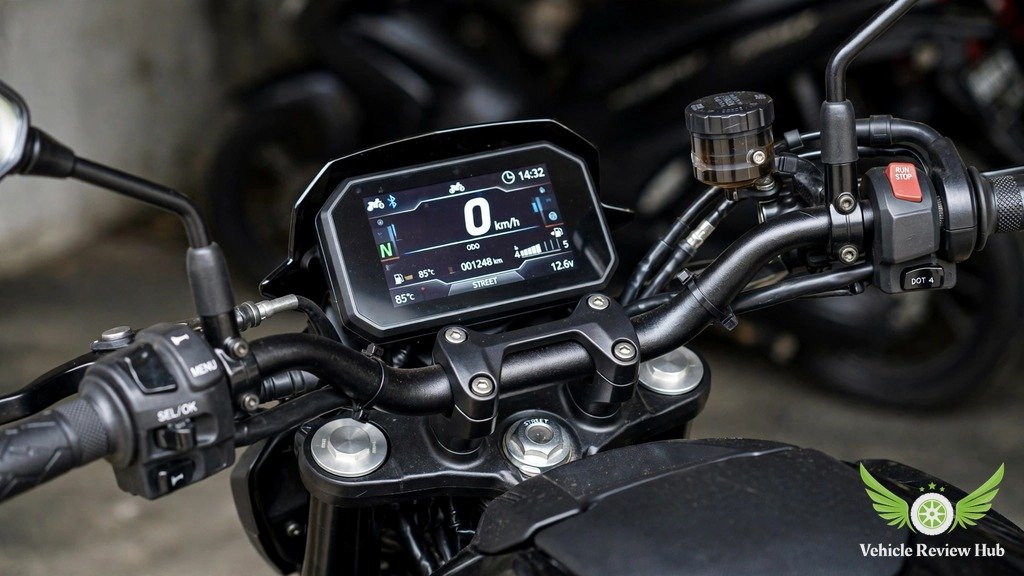
The styling in this Honda CB650R review is Honda’s Neo Sports Café language: a round-ish LED headlight, a sculpted tank, a short tail, and an exposed frame, all in a package that looks modern without chasing streetfighter fashion. The 2024 update sharpened the details and replaced the older LCD dash with a 5-inch TFT display, alongside all-LED lighting and standard HSTC. The TFT is clear in sunlight and easy to read at a glance, and it is a useful year tell when checking a used bike’s claimed age: LCD means pre-2024, TFT means 2024-on. One caution from this Honda CB650R review: the 2024-on bikes also brought the expanded right-side engine cover that houses the E-Clutch hardware, a visible difference worth knowing when comparing a 2023 manual bike with a 2024 E-Clutch bike side by side.
RoadSync Not Confirmed for US Bikes: Honda USA Never Mentions It
The RoadSync heading in this Honda CB650R review is literal, and it deserves emphasis: Honda USA never mentions RoadSync for the US CB650R. European coverage of the same motorcycle lists RoadSync connectivity on the TFT, but no American Honda page, press release, or spec sheet confirms it for US bikes, so this Honda CB650R review does not claim it. Buyers who want phone connectivity should verify it on the actual bike’s dash menus rather than trusting a European review. The same discipline applies to the rest of the electronics: the US bike has a cable throttle, no ride modes, and no IMU-based aids — HSTC is straightforward traction control, and this Honda CB650R review presents it that way rather than dressing it up as a full electronics suite.
Honda CB650R Riding Experience and Comfort
Comfort is the CB650R’s quiet strength in this Honda CB650R review, and the reason testers kept recommending it to riders stepping up from smaller bikes. The upright bars, the 31.9-inch seat, and the light steering make the bike feel smaller than its four-cylinder engine suggests, while the inline-four’s flexibility keeps it calm in traffic and eager on a back road. This Honda CB650R review separates city manners from highway manners, because the bike’s one real weakness shows up only at sustained speed — and because E-Clutch changes the city part of the story entirely.
Riding Position, Handling and Low-Speed Maneuverability
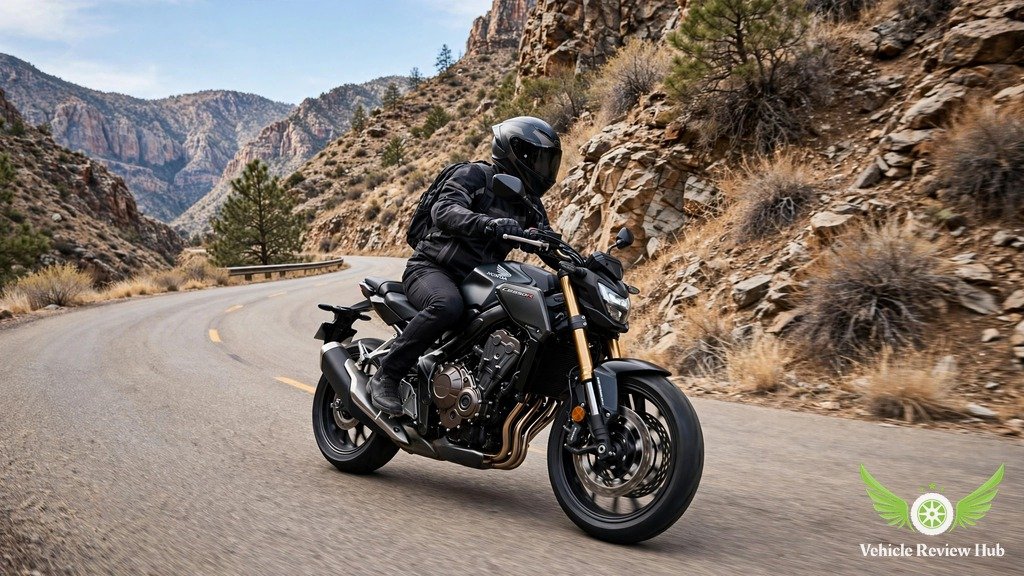
The riding position in this Honda CB650R review is the bike’s signature: upright bars, a natural reach, feet easily flat on the ground for most riders, and a narrow waist that helps shorter riders most. Low-speed maneuverability is a genuine strength — U-turns, parking-lot work, and filtering through traffic all feel easy — and E-Clutch makes it easier still, because the system works the clutch at walking pace and at stops, so a newer rider never stalls in traffic. The chassis stays neutral and forgiving, and the 2021-on Showa SFF-BP fork sharpened front-end feel over the earlier SFF unit. One honest note from American testers, carried in this Honda CB650R review: vibration around 6,000 to 7,000 rpm is noticeable, but it fades past 8,000 rpm as the engine surges forward — a character trait, not a defect, and one that matters less once a rider learns to keep the four spinning.
Highway Comfort, Wind Exposure and Everyday Practicality
Highway comfort in this Honda CB650R review is good with one honest caveat: wind exposure. The naked bike has no fairing, so sustained 70-mph running puts wind on the rider’s chest, and longer highway days tire you sooner than the faired CBR650R would. Around town and on back roads, though, the CB650R is the more practical bike — easier to ride slowly, easier to park, and, with E-Clutch, easier to live with in stop-and-go traffic than any manual middleweight. Fuel economy helps the everyday case too: American tests averaged 47 mpg, and a 4.1-gallon tank gives roughly 193 miles of theoretical range. The video below is CanyonChasers’ 2026 review of the real E-Clutch bike, honestly named as such, and it captures the system’s everyday character well.
For the full performance picture behind this Honda CB650R review — dyno figures, acceleration, and fuel economy in depth — see our Honda CB650R performance guide.
Honda CB650R Review: Pros, Cons and Verdict
The verdict in this Honda CB650R review is simple, and it has survived a decade of rivals in spirit: the CB650R is one of the most complete, easiest-to-live-with middleweight nakeds available, new or used. Its limitations are real but narrow, and they matter less to the riders the bike is built for. This Honda CB650R review weighs both sides before the final call.
Main Advantages and Limitations of the Honda CB650R
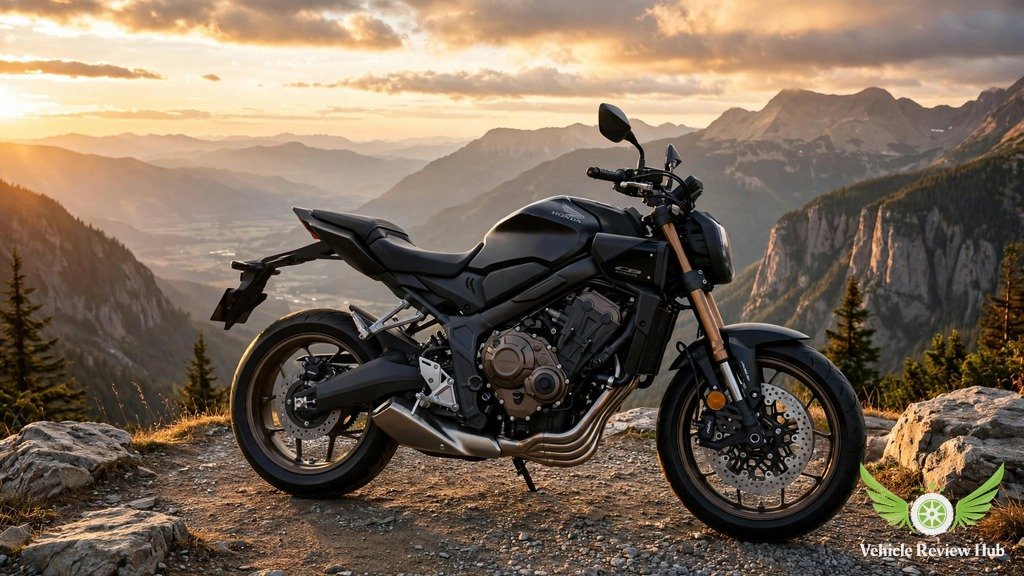
The advantages in this Honda CB650R review start with the engine: a high-revving inline-four with a character no twin in the class can match, backed by Honda reliability and a decade of 650-family parts support. Cycle World’s dyno test of the 2021 bike covers the measured output in depth, and CanyonChasers’ 2026 E-Clutch review covers the current bike’s everyday strengths. Running costs stay modest — 47-mpg test economy, affordable tyres in sensible sizes, and a simple service schedule covered in our Honda CB650R reliability guide. The limitations are equally plain: highway wind blast with no fairing, a 4.1-gallon tank that caps range near 193 miles, vibration in the midrange, and a thin used market — this is a rare bike in the United States, so used buyers have fewer examples to choose from. None of those is a flaw for the bike’s intended rider; all of them are reasons to test-ride the MT-07 as well before deciding. For the buying decision in full, see our Honda CB650R buying guide.
E-Clutch Is an Automatic Clutch, Never an Automatic Gearbox
The final heading in this Honda CB650R review is literal, and it deserves emphasis: E-Clutch is an automatic clutch, never an automatic gearbox. The rider still shifts every gear with their left foot; the system only works the clutch — at starts, at stops, and between gears — and it can be switched off or overridden with the lever at any time. It also acts as a quickshifter for clutchless full-throttle shifts, but it does not make the CB650R an automatic motorcycle, and this Honda CB650R review never describes it that way. The verdict stands: a new 2026 CB650R at $8,699 plus $600 is one of the smartest buys in the middleweight class, and a used example in good condition, priced with the bike’s rarity in mind, remains a strong second choice.
Honda CB650R Review FAQs
Direct answers to the Honda CB650R review questions buyers ask most, covering the bike’s run, its E-Clutch system, its prices, and its everyday character.
What is the Honda CB650R?
A naked middleweight with a 649cc inline-four and Neo Sports Café styling, says this Honda CB650R review, sold in the United States from 2019 onward.
How much does the 2026 Honda CB650R cost?
$8,699 plus $600 destination, says this Honda CB650R review — a $700 cut from the 2024–2025 price, with no mechanical changes.
What is Honda E-Clutch?
An automatic clutch system, says this Honda CB650R review. The rider still shifts every gear with their foot; the system works the clutch at starts, stops, and between gears, and it can be switched off or overridden with the lever.
Is the CB650R an automatic motorcycle?
No, says this Honda CB650R review. E-Clutch automates the clutch only — it is never an automatic gearbox or a DCT.
How much horsepower does the Honda CB650R make?
Honda USA publishes no figure, says this Honda CB650R review. Cycle World measured 81.90 horsepower at 10,870 rpm at the rear wheel on a 2021 bike; the European 95-horsepower figure is a crank claim, not a US number.
When did the CB650R get a TFT dash?
With the 2024 update in the United States, says this Honda CB650R review, alongside E-Clutch, all-LED lighting, and standard HSTC.
Does the US CB650R have RoadSync?
Not confirmed, says this Honda CB650R review. Honda USA never mentions RoadSync for US bikes, so buyers should verify connectivity on the actual bike.
What is the CB650R’s fuel economy?
American tests averaged 47 mpg, says this Honda CB650R review, giving roughly 193 miles of theoretical range from the 4.1-gallon tank.
Is the CB650R good for intermediate riders?
Yes, says this Honda CB650R review — a 31.9-inch seat, neutral handling, and, on 2024-on bikes, E-Clutch make it one of the easiest four-cylinder middleweights to live with.
Should I buy a CB650R or an MT-07?
Buy the CB650R for its four-cylinder character and Honda refinement, says this Honda CB650R review; buy the MT-07 for its torquier twin and slightly lower out-the-door price — and ride both before deciding.