Buying a used Honda CBR1000RR is one of the smartest ways into literbike ownership, but only if you buy the right year, verify the right recalls, and refuse to pay for equipment the bike never had. This Honda CBR1000RR buying guide gives the direct verdict: a 2017-on SC77 bike with a clean VIN check, documented service history, and a price inside the November 2026 asking band is a strong buy. A bike with an open fuel-pump recall, an unverified 2008 oil history, or an asking price built on RR-R Fireblade SP figures is not.
Honda CBR1000RR Price and Market Availability
New and used prices sit close enough that the new-versus-used decision is a real calculation in this Honda CBR1000RR buying guide. A leftover new bike can cost less than a nearly new used example, while a well-bought 2017 or 2018 bike saves thousands for the same SC77 generation.

What Does a Used Honda CBR1000RR Cost in the USA by Generation?
New prices anchor every used negotiation in this Honda CBR1000RR buying guide. For 2026, the base bike costs $16,999 plus a $775 destination charge, and the ABS version, the CBR1000RA, costs $17,299, both in Pearl White only, according to Honda’s own 2026 model page. For 2027, the base price rises to $17,099 plus $775 destination, with ABS at $17,399, with July availability. One dealer listing used “final year” wording for 2027, but that is a dealer claim, not a Honda statement, and this Honda CBR1000RR buying guide does not repeat it as fact. Dealer discounts are real: a new 2026 ABS was advertised at $15,587 by Ken’s Sports in Kaukauna, Wisconsin, and a new 2026 base at $14,199 after offers by J&J Motors in Ohio, in this Honda CBR1000RR buying guide.
The used market splits by generation: the SC59 covers 2008 to 2016, and the SC77 covers 2017 onward, with no 2020 model year sold in the United States. A fresh November 2026 dealer sample for this Honda CBR1000RR buying guide found a 2017 base at $13,499 from Full Throttle Houston, Texas, with 17,758 miles, listed November 3, 2026; a 2018 ABS at $13,950 from RPM Powersports, Sarasota, Florida, with 6,305 miles; and a 2017 ABS at $11,999 from National Powersports, Pembroke, New Hampshire, with 8,599 miles, though its price was set March 21, 2026. The sampled 2017-19 band is about $11,999 to $13,950 in this Honda CBR1000RR buying guide.
2017-19 Bikes Ask $10,500 to $13,900 and 2023 Used at $14,699
The 2023 market is tighter: a 2023 ABS at $14,699 from National Powersports in Pembroke, New Hampshire, with only 249 miles, cut September 21, 2026 from $15,999; a 2023 ABS at $13,498 from Ozarks Powersports, Springfield, Missouri, on October 30, 2026; a 2023 at $14,995 from Prime Motorcycles, Melbourne, Florida, with 4,304 miles; a 2023 at $14,999 from Timbrook Honda, Winchester, Virginia; and a 2023 ABS at $14,900 from Lucky-U-Cycles, Wildwood, Florida, with 3,853 miles. California buyers should note the Pembroke listing’s warning: a non-California-emissions used bike under 7,500 miles cannot be titled in California. Finally, the Pembroke listing’s 175 hp and 85 lb-ft are dealer figures, not a dyno test in this Honda CBR1000RR buying guide.
| Year and trim | Asking price | Dealer | Mileage and date |
|---|---|---|---|
| 2017 base, Matte Black | $13,499 | Full Throttle Houston, TX | 17,758 miles, Nov 3, 2026 |
| 2018 ABS | $13,950 | RPM Powersports, Sarasota FL | 6,305 miles, Nov 2026 |
| 2017 ABS | $11,999 | National Powersports, NH | 8,599 miles, price set Mar 21, 2026 |
| 2023 ABS, 249 miles | $14,699 | National Powersports, NH | Cut Sep 21, 2026 from $15,999 |
| 2023 ABS | $13,498 | Ozarks Powersports, MO | Oct 30, 2026 |
| 2023 | $14,995 | Prime Motorcycles, FL | 4,304 miles, Oct 30, 2026 |
| 2023 | $14,999 | Timbrook Honda, VA | Nov 2, 2026 |
| 2023 ABS | $14,900 | Lucky-U-Cycles, FL | 3,853 miles, Nov 2, 2026 |
Honda CBR1000RR Insurance and Ownership Costs
Insurance surprises first-time literbike buyers, because no published CBR1000RR-specific insurance quote exists. Every figure in this section of the Honda CBR1000RR buying guide is therefore a labelled class benchmark, never a quote for this exact motorcycle.

No US Model-Specific Insurance Data Found and Literbike Loading
No US model-specific insurance figure for the CBR1000RR was found in published rate data, and this Honda CBR1000RR buying guide states that plainly rather than inventing one. MoneyGeek’s October 2026 data puts full coverage for a 2021 Honda 1,000cc sport model at about $3,948 per year for a 40-year-old clean-record rider, against about $364 per year for full coverage on a Rebel 500. The same rider profile therefore pays roughly eleven times more for full coverage on a literbike-class Honda than on a 500cc cruiser. General motorcycle full coverage typically runs about $500 to $1,500 per year, while a young rider on a 1,000cc supersport can face $2,500 to $5,000 or more per year for full coverage. Those are benchmark bands in this Honda CBR1000RR buying guide, not quotes.
How to Estimate Fuel, Maintenance, Parts and Other Ownership Expenses
Fuel is the easiest cost to estimate honestly in this Honda CBR1000RR buying guide. Motorcycle.com’s 2017 shootout observed 38.2 mpg on the base bike, the best figure in its group, but that was test riding including flogging and photo passes, so treat it as a realistic mixed-use planning number. With a 4.2 to 4.3-gallon tank, the working range is about 160 to 165 miles at 38.2 mpg. Maintenance is simple: first service at 600 miles, then oil and filter every 8,000 miles or 12 months, and valve inspection every 16,000 miles. The spark-plug interval was not verified against the owner’s manual for this Honda CBR1000RR buying guide, so check the manual for your model year. Parts are Honda-fair for a superbike, but SC77-specific fairing panels and the 5-axis IMU are expensive if damaged in this Honda CBR1000RR buying guide.
How to Inspect a Used Honda CBR1000RR
An inspection has two jobs: catch the known problems, and catch the bike that is not what its listing claims. This section of the Honda CBR1000RR buying guide gives you the checks that catch both.
Checking Oil History on 2008-11 Bikes and Crash or Track Damage
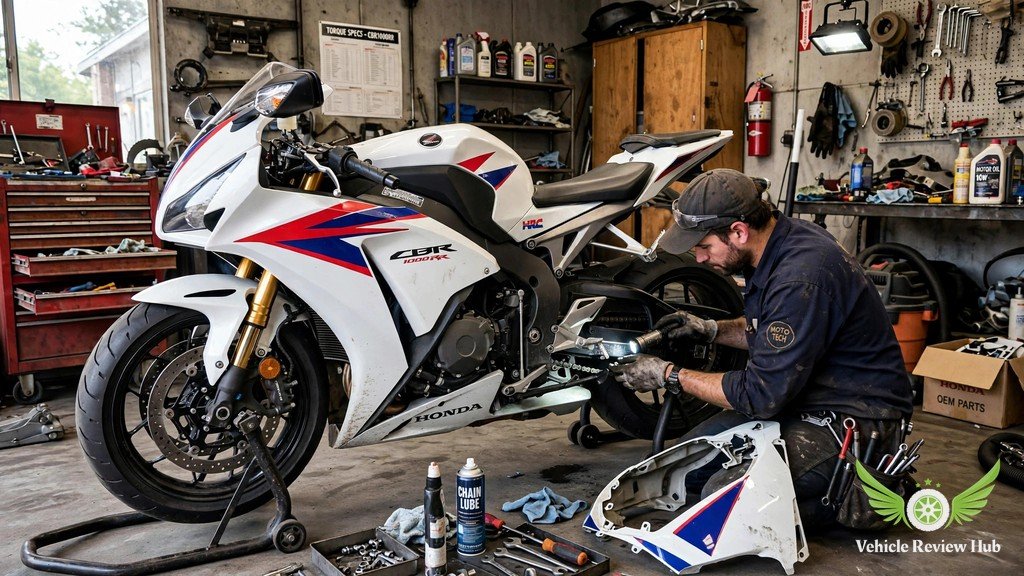
On any 2008 to 2011 bike, and especially any 2008, demand the oil history in this Honda CBR1000RR buying guide’s first inspection rule. Multiple 2008 owners reported heavy oil consumption to NHTSA, including a quart every 300 to 400 miles, while dealers quoted “1 quart per 1,000 miles is normal” as the in-spec framing. No safety recall was ever issued for 2008 oil consumption, so this is an owner-documented watch item, not a recall you can look up and clear. Check the oil level cold, look for blue smoke above 7,000 rpm, and ask for oil-change receipts. Owner reports say 2009 bikes received revised internals, but that is owner-reported, not Honda-confirmed. For crash damage, look past shiny fairings: check fork stops for paint cracking, bar ends for grinding, and the lower fairing for rash in this Honda CBR1000RR buying guide.
Inspecting the Frame, Tires, Brakes, Chain and Electronics Health
Work through the bike in a fixed order, as this Honda CBR1000RR buying guide recommends. Frame: sight down the frame spars, check steering-head bearings for notching, and confirm the VIN plate matches the title. Tires: check date codes and look for flat-spotting. Brakes: the base SC77 runs dual 320mm front discs with radial 4-piston Tokico calipers and a single 220mm rear disc, so check for pulsing and scoring, and confirm whether the bike is the ABS model. Chain: check slack, tight spots, and sprocket hooking. Electronics: cycle through the power modes and the 9-level HSTC torque control, and confirm the 5-axis IMU shows no fault codes. Remember that the quickshifter is a paid Honda accessory on the standard bike, not standard equipment in this Honda CBR1000RR buying guide.
Honda CBR1000RR Model Years and Features to Compare
Three generations shape the buying decision in this Honda CBR1000RR buying guide. SC59 bikes are cheaper and simpler, SC77 bikes bring modern electronics, and the SP and SP2 are collector variants.
Comparing SC59 Bikes With the 2017-On SC77 Generation
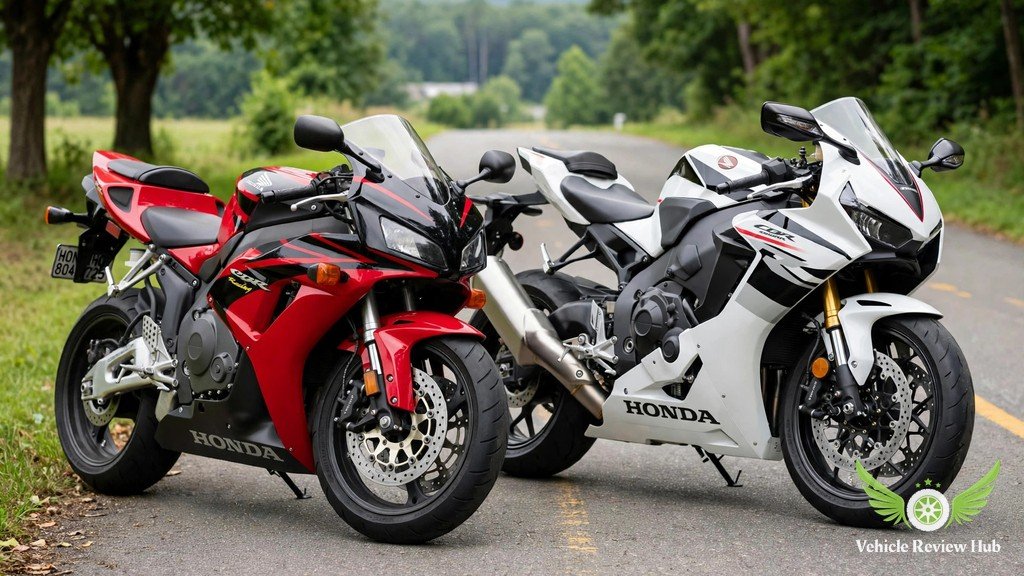
The US bike became the SC59 for 2008 to 2016 and the SC77 from 2017 onward. The SC77 brought throttle-by-wire, a 5-axis IMU, 9-level HSTC, power modes, and the HESD steering damper. Its engine is a 999cc inline-four with a manufacturer-claimed 189 hp at 13,000 rpm. Those are claimed crank figures, not dyno results: Cycle World measured 149.63 hp at the rear wheel on a 2017 US base bike, and Motorcycle.com’s 2017 shootout measured 153.2 hp on a different dyno. This Honda CBR1000RR buying guide also corrects a common error: some coverage describes a titanium tank and muffler as standard SC77 equipment, but Cycle News’s 2017 track test and Honda’s own SP and SP2 brochure confirm the titanium muffler and thin-wall titanium tank are SP and SP2 only. There is also no verified US top speed for the SC77; the 186 mph MCN figure is European only in this Honda CBR1000RR buying guide.
SP Premium Around $2,500 to $4,000 and the Rare SP2 at $21,999
Contemporary Cycle News pricing for 2017 was $16,499 base, $16,799 ABS, $19,999 SP, and $25,000 SP2, of which only 500 units were built. The SP premium of $3,500 fits the quoted $2,500 to $4,000 band, and the SP buys Ohlins suspension, Brembo monoblocs, a lithium-ion battery, titanium exhaust and tank, and a quickshifter. The SP2 price conflicts across sources: some guides quote $21,999, but Cycle News’s contemporary $25,000 is corroborated by a dealer brochure listing a 2017 SP2 at $24,999, so this Honda CBR1000RR buying guide reports both and treats $25,000 as the contemporary verified price. TopSpeed’s January 2025 used-SP analysis put a 2019 SP at $17,445 retail, with $13,325 trade. The SP trim ended after 2019 in the United States, with the SP2 limited to 2017 only in this Honda CBR1000RR buying guide.
Honda CBR1000RR vs Kawasaki ZX-10R: Which One to Buy in the USA
The ZX-10R is the natural cross-shop because it matches the Honda on price. This section of the Honda CBR1000RR buying guide puts the rivals on one table with trim-labelled prices.
CBR1000RR at $16,999 Matches the ZX-10R Base Price for 2026
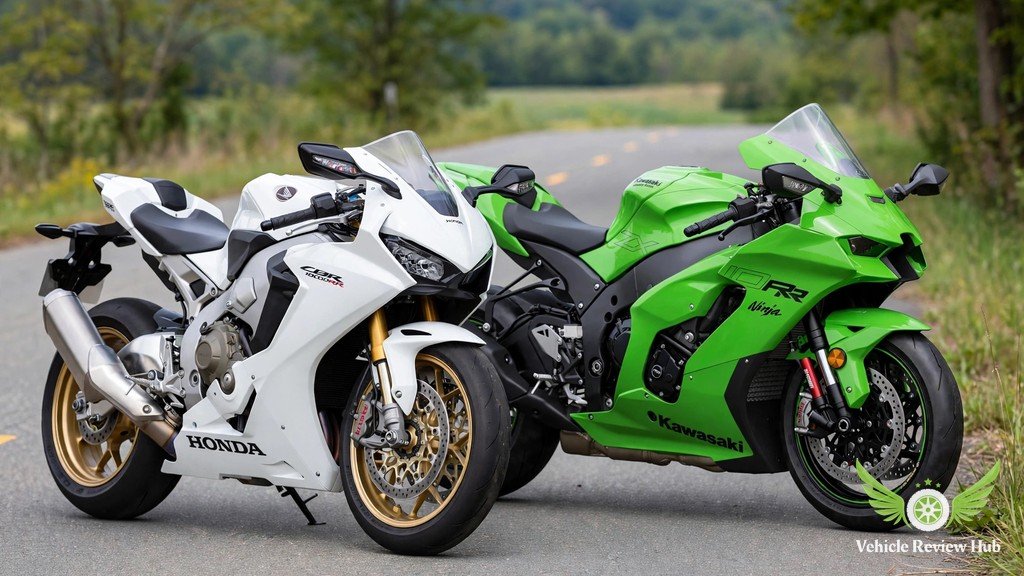
For 2026, the CBR1000RR base price of $16,999 exactly matches the Kawasaki ZX-10R base price of $16,999, but destination charges differ: $775 for the Honda against $840 for the Kawasaki, so the Honda is $65 cheaper before any dealer discount. The Honda’s case in this Honda CBR1000RR buying guide rests on its 5-axis IMU and 9-level HSTC, while the Kawasaki’s case rests on its own electronics suite. In the used market, a used SC77 Honda at $12,000 to $14,000 competes against used ZX-10Rs in the same band; condition and service history should decide. If you want a smaller supersport, the CBR600RR review covers the 600cc alternative, and the CBR1000RR review covers the base bike’s riding experience. For the numbers behind this Honda CBR1000RR buying guide, the CBR1000RR performance figures and the reliability and maintenance coverage give the dyno, service, and recall detail in this Honda CBR1000RR buying guide.
When an RR-R SP at $28,999 or a GSX-R1000 Makes More Sense
The RR-R Fireblade SP only makes sense when you genuinely want a track-focused superbike. The 2027 RR-R SP costs $28,999 with August availability, and a used 2023 RR-R SP was listed at $28,499 in Centerville, Utah, with 3,410 miles and a JH2SC82 VIN prefix confirming it as an RR-R. Never let a seller price a base RR against RR-R figures: the RR-R’s 214 hp claim, 6-axis IMU, and titanium con-rods belong to the SC82, not the SC77. The Suzuki GSX-R1000 undercuts both at $16,399 base for 2026, with the GSX-R1000R at $18,649. The Yamaha YZF-R1 costs $19,199 plus $775 destination for 2026. The BMW S 1000 RR is quoted at $19,975 by TopSpeed, against a low-authority site claiming $17,995, a conflict this Honda CBR1000RR buying guide reports rather than resolves. The Ducati Panigale V4 shows the same problem: $24,995 from one dealer source against $27,795 from TopSpeed, so treat “around $25,000” as a secondary-sourced approximation in this Honda CBR1000RR buying guide.
| 2026 rival | Base price | Destination | Why it matters |
|---|---|---|---|
| Honda CBR1000RR base | $16,999 | $775 | Matches ZX-10R base |
| Honda CBR1000RR ABS | $17,299 | $775 | Cornering ABS |
| Kawasaki ZX-10R base / ABS | $16,999 / $17,999 | $840 | Direct price match |
| Kawasaki ZX-10RR | $29,999 | $840 | Track special |
| Suzuki GSX-R1000 base / R | $16,399 / $18,649 | Check current page | Undercuts Honda, Kawasaki |
| Yamaha YZF-R1 base | $19,199 | $775 | 70th Anniversary $19,699 |
| BMW S 1000 RR | $19,975 (TopSpeed) | Check current page | Conflicts with $17,995 claim |
| Ducati Panigale V4 | About $25,000 | Check current page | $24,995 vs $27,795 conflict |
| Honda RR-R Fireblade SP (2027) | $28,999 | Check current page | SC82, August availability |
Is Buying a Used Honda CBR1000RR Worth It?
Yes, with three conditions: a clean VIN check, a price inside the sampled band, and the generation you think it is. The deal breaks when any condition fails: an open fuel-pump recall, an undocumented 2008 oil history, or an RR-R price on a base bike should each end the negotiation.

Benefits and Risks: No 2020 Model Exists, Verify the Year by VIN
The most useful free check in this Honda CBR1000RR buying guide is the 10th VIN digit. Honda sold no base CBR1000RR in the United States for 2020, so any bike presented as a 2020 base RR is mislabelled. The codes are 2017 H, 2018 J, 2019 K, 2021 M, 2022 N, 2023 P, 2026 T, and 2027 V, with no L code because no 2020 bike exists. The recall check is equally year-exact and must never be merged into one line. Recall 17V706 covers all 2017 bikes for a fuel-cap seal, 2,443 units. Recall 24V-113, campaigns KP8 and KP9, covers certain 2018-19 bikes only, with a stop sale from February 9, 2024. Recall 24V-864, campaigns KR2 to KR5, is the expansion covering certain 2008-17 and 2021 bikes, 40,481 units multi-model. Note: one published summary of the 24V-864 list also names 2019, so run every 2018 to 2021 VIN through Honda’s recall lookup. A separate November 2024 parts stop sale covers replacement pumps numbered 16700-MFL-013 for 2008 to 2016 models; that is a parts stop sale, not a fourth bike recall. Never import 25V-891, which is CBR600RR-only, or 22V-061 and 20V289, which are RR-R-only. One NHTSA complaint from July 22, 2025, shows the stakes: a 2008 bike with 50,000 miles stalled from fuel-pump failure, unrepaired, as Motorcycle.com’s recall alert covered in this Honda CBR1000RR buying guide.
The video below is a general Fireblade buying guide from Aspire HQ covering research, history checks, and viewing preparation — not an SC77-specific walkaround, and its title names no model year, so judge the bike itself against this guide’s year-by-year checks.
US-Market Alternatives: YZF-R1, S 1000 RR and Panigale V4
The YZF-R1 at $19,199 plus $775 destination is the crossplane-crank alternative. For most buyers, the verdict in this Honda CBR1000RR buying guide stands: buy a clean, VIN-verified SC77 inside the sampled band and keep the recall check current in this Honda CBR1000RR buying guide.
Honda CBR1000RR Buying Guide: Frequently Asked Questions
Direct answers from the research in this Honda CBR1000RR buying guide.
How much does a used Honda CBR1000RR cost in the USA?
In this Honda CBR1000RR buying guide’s November 2026 sample, 2017-19 bikes asked $11,999 to $13,950, and 2023 bikes asked $13,498 to $14,999.
Is there a 2020 Honda CBR1000RR?
No, and this Honda CBR1000RR buying guide stresses the point: Honda sold no base RR in the United States for 2020, so any “2020” base bike is mislabelled.
What is the difference between the CBR1000RR and the CBR1000RR-R Fireblade SP?
The base RR is the SC77: 999cc, claimed 189 hp, 5-axis IMU, $16,999 for 2026. The RR-R SP is the SC82: 214 hp European claim, 6-axis IMU, $28,999 for 2027 in this Honda CBR1000RR buying guide.
Which fuel-pump recalls affect the base CBR1000RR?
Three, kept separate in this Honda CBR1000RR buying guide: 17V706 for all 2017 bikes, 24V-113 for certain 2018-19 bikes, and 24V-864 for certain 2008-17 and 2021 bikes.
Does the CBR1000RR have a quickshifter as standard?
No. On the standard base bike, the quickshifter is a paid Honda accessory, not standard equipment, while the SP includes one in this Honda CBR1000RR buying guide.
Does the base CBR1000RR have a titanium fuel tank?
No. The titanium muffler and thin-wall titanium fuel tank are SP and SP2 features only, confirmed by Cycle News’s 2017 track test and Honda’s own brochure in this Honda CBR1000RR buying guide.
What is the real horsepower of a US CBR1000RR?
Honda claims 189 hp at the crank. Cycle World measured 149.63 hp at the rear wheel on a 2017 US base bike, and Motorcycle.com’s shootout measured 153.2 hp on a different dyno in this Honda CBR1000RR buying guide.
What is the top speed of the CBR1000RR?
There is no verified US top speed for the SC77 generation. The 186 mph MCN figure is European only, never a US test result.
How much does insurance cost for a CBR1000RR?
No US model-specific figure was found. MoneyGeek’s October 2026 data puts full coverage for a 2021 Honda 1,000cc sport model at about $3,948 per year for a 40-year-old clean-record rider in this Honda CBR1000RR buying guide.
What should I check on a 2008 CBR1000RR before buying?
Oil history first: multiple 2008 owners reported heavy oil consumption, and dealers quoted “1 quart per 1,000 miles is normal.” No recall was ever issued for it in this Honda CBR1000RR buying guide.
Is the SP worth the premium over the base bike?
The SP premium of about $3,500 fits the quoted $2,500 to $4,000 band and buys Ohlins suspension, Brembo monoblocs, a lithium-ion battery, titanium exhaust and tank, and a quickshifter in this Honda CBR1000RR buying guide.
How much is a new CBR1000RR in 2026 and 2027?
For 2026, the base costs $16,999 plus $775 destination, and ABS costs $17,299. For 2027, the base costs $17,099 plus $775, and ABS costs $17,399.