Short answer: Honda CRF250R reliability is the reliability of a proven, current-generation race bike with a strict, hours-based service life — and this Honda CRF250R reliability guide says so plainly. The 2022-on platform, updated for 2025 and carried into 2027 with targeted changes only, has no chronic engine failure on its record — but it is a closed-course competition motorcycle with no warranty, no street legality, and a piston the 2026 manual replaces every six races, about every 15 hours. Buy on hours and paperwork, not on looks.
One framing fact belongs up front in this Honda CRF250R reliability guide: the current bike is not a new design. The 2027 CRF250R carries targeted updates only — a smaller airbox-cover opening, a slightly longer muffler, updated ECU mapping for the AMA’s lower sound limits, updated fork fluid, and the new tricolor livery — while the 450 got the full redesign. That matters for Honda CRF250R reliability because the 2025–2026 test evidence is the honest basis for 2027 buying advice: no 2027 first test exists yet, and the 2026 bike is identical to the 2025 bike. For the full model story, see our CRF250R review.
Honda CRF250R Reliability Overview
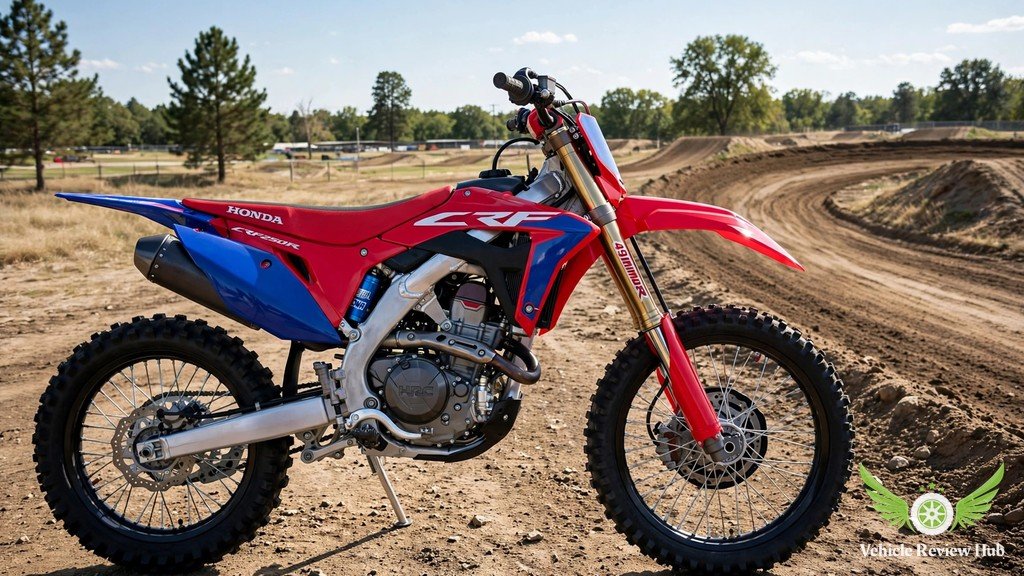
The headline for Honda CRF250R reliability is simple: you are buying a proven platform, and the proof is in the service record. The 2022 redesign brought a low-end-focused engine 8 lb lighter than the 2021 bike, and Honda called the 2025 bike — stiffer frame, new shock mount, redesigned airbox, new bodywork — 70 percent new.
Proven 2022-On Platform With a Thin Long-Term Record
Proven 2022-on platform with a thin long-term record is the honest summary of Honda CRF250R reliability. Proven, because the 249cc liquid-cooled DOHC single — 79.0 by 50.9mm, 13.9:1, PGM-FI with a 44mm throttle body — has been raced hard since 2022 across the standard R, the RX, and the Works Edition, and its failure modes are well understood. Thin, because the 2025 platform is still young: the oldest 2025 bikes are barely two seasons old, and the 2027 bike’s targeted changes have no long-term record at all. Australasian Dirt Bike Magazine’s long-term 2025 CRF250R test is the kind of evidence this Honda CRF250R reliability guide leans on: across its test period the bike’s valve clearances never drifted out of specification, the oil and filter came out clean after run-in, and nothing broke beyond normal wear. That is one test bike, not a fleet study.
How Hours, Storage and Previous Care Affect Reliability
How hours, storage, and previous care affect reliability matters more on a 250R than on almost any other Honda, because this Honda CRF250R reliability guide is written for used-bike buyers. Hours are the only honest currency: no odometer, so “low miles” means nothing without an hour-meter reading and a service log showing the 15-hour piston work. Storage is the quiet risk: a bike parked wet, a dead battery, or stale fuel punishes a race engine faster than track time does. Previous care shows in ten-minute checks: tires, brake discs, fork seals, chain, airbox, and spokes — the long-term test bike needed its spokes tensioned after the first ride, then never again. For Honda CRF250R reliability, the service book and the hour log are the bike’s CV, and a seller who cannot produce them is selling you a question mark.
Honda CRF250R Common Problems and Wear Items
Common problems on the 250R are refreshingly ordinary for Honda CRF250R reliability: no chronic engine failure, no gearbox scandal, and a wear list any inspection catches. The platform has been raced hard since 2022, so teething troubles have had years to surface — and what has surfaced is a short wear list, two recall items that must never be confused, and a third claim that does not survive checking.
Recall 26-458: Handlebar Clamp on 2025 and 2026 Bikes
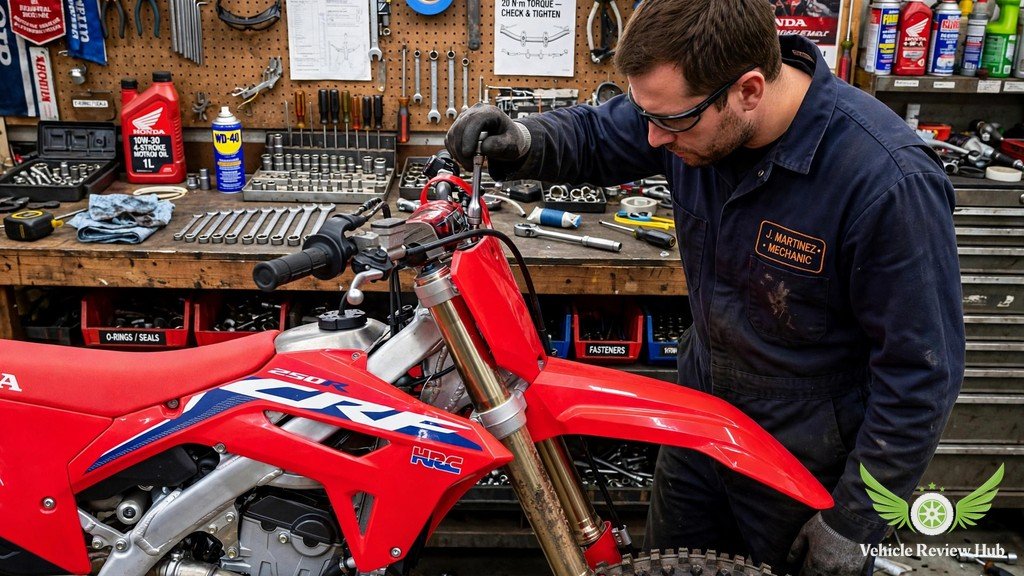
Recall 26-458: handlebar clamp on 2025 and 2026 bikes is the doc heading, kept verbatim, and this Honda CRF250R reliability guide carries it with a labelling warning. The handlebar item is real, but it is a separate item from the drive-gear recall covered later in this Honda CRF250R reliability guide, and the two must never be merged. What is verified: Australia’s ACCC notice of April 2026 covers CRF250R/RW/RX manufactured July 2024 to April 2026 for handlebars not secured tightly enough, and Transport Canada’s 2026115 notice names the 2025 CRF250R for replacement handlebar under-holders fitted in dealer service, later replaced by 2026-488. What is not verified: the “26-458” identifier itself, which is doc-sourced only and was not re-verified as a confirmed recall number — so this Honda CRF250R reliability guide uses it only as the doc’s identifier, never as a confirmed CPSC number. Practical advice is the same either way: check the clamp and under-holder on any 2025–2026 bike, and run the VIN through Honda’s recall lookup rather than assuming coverage from a headline.
The 2018 Clutch Basket Recall Covered All 3,200 Bikes
The 2018 clutch basket recall covered all 3,200 bikes is the doc heading, kept verbatim — and this Honda CRF250R reliability guide must correct it, because the claim does not survive checking. The verified recall found in research is NHTSA 19V-412, Honda campaign KK3, of June 2019: a transmission-main-shaft circlip recall covering 3,898 units — not 3,200 — across the 2019 CB300R, 2018 CBR300R, 2018 CRF250L, 2018 CRF250L Rally, and 2018–2019 CMX300. It does not name the CRF250R motocrosser at all. No CRF250R clutch-basket recall was found, and the “3,200” figure is unverified. So for Honda CRF250R reliability, the correct advice for any 2018 R buyer is the opposite of the heading’s implication: do not assume your bike was covered, do not transfer the L-family circlip recall to the R, and VIN-check the individual bike instead. A seller who cites a “clutch basket recall” on a CRF250R is confused about the model or selling a story — either way, the VIN result decides.
Honda CRF250R Maintenance Schedule and Servicing
The maintenance schedule is the backbone of Honda CRF250R reliability, written in races and hours, not miles and months, following the 2026 owner’s manual ladder. Every race counts as about 2.5 hours: 3 races is about 7.5 hours, 6 races about 15.0, 9 races about 22.5, and 12 races about 30.0. Learn that ladder and Honda CRF250R reliability becomes predictable; ignore it and the same bike becomes a rebuild bill.
Oil, Filter, Valves and Piston All at Six Races or 15 Hours
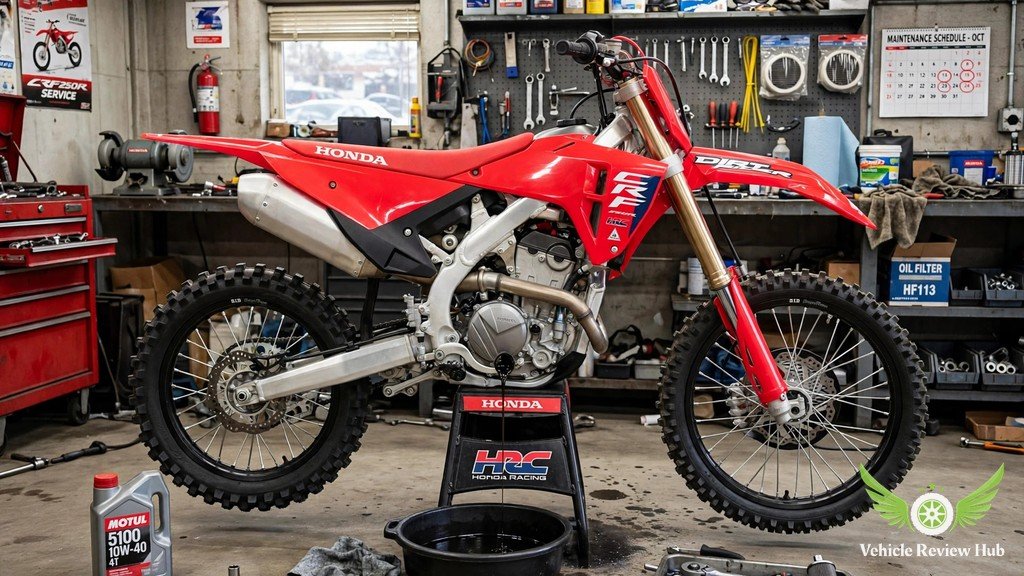
Oil, filter, valves, and piston all at six races or 15 hours is the sentence that defines Honda CRF250R reliability costs, and it is verified from the 2026 owner’s manual ladder. Engine oil and filter are replaced every 6 races, about every 15.0 hours, and the same mark brings the valve-clearance and decompressor inspection and the replacement of the piston, piston rings, and piston pin. The first oil change and a valve inspection both come after the break-in ride, because valves seat in during run-in. MotoMind’s manual-derived oil-interval table confirms the same 6-race, 15-hour oil-and-filter line for the CRF250R. One figure this Honda CRF250R reliability guide deliberately does not print is the oil capacity: it was not verified against the R manual, and the RX-manual figure does not transfer — check your year’s manual instead. For the power figures behind these intervals, see our CRF250R performance guide.
Older Manuals Differ: 2014 Piston Interval Was 30 Hours
Older manuals differ, and the 2014 piston interval was 30 hours — verified, and a trap for anyone buying an older bike or reading an older manual. The 2014 manual puts piston and ring replacement at every 12 races, about every 30 hours, double the current 6-race, 15-hour interval. That is not a mistake in either book: Honda tightened the interval as the bikes got faster and revvier. For Honda CRF250R reliability, always state the manual year with the interval — a seller quoting the 30-hour interval for a 2025 bike is quoting the wrong book. The same discipline applies to the rest of the ladder: fork oil every 9 races, about 22.5 hours, and coolant every 2 years, regardless of hours, on the current manual.
| Service item | Interval (2026 manual) | Note |
|---|---|---|
| Engine oil + filter | Every 6 races / ~15.0 hours | Also after break-in ride |
| Valve clearance + decompressor | Inspect every 6 races / ~15.0 hours | Also after break-in ride |
| Piston, rings, pin | Replace every 6 races / ~15.0 hours | Replace |
| Air filter | Cleaned every race / ~2.5 hours | After every heat in dust |
| Drive chain | Replaced every 3 races / ~7.5 hours | Replace |
| Fork oil | Every 9 races / ~22.5 hours | — |
| Coolant | Every 2 years | Regardless of hours |
| Summary | Races and hours, not miles | 2014 piston: 30 hours |
Honda CRF250R Tires, Brakes and Suspension Maintenance
Tires, brakes, and suspension are where Honda CRF250R reliability meets the track, and the wear items here are the ones a pre-purchase inspection catches first. The standard bike’s hardware — cable clutch, Pirelli rubber, Showa suspension — is serviceable with ordinary tools, which is itself an advantage.

Air Filter Cleaned Every Race and Chain Replaced at 7.5 Hours
Air filter cleaned every race and chain replaced at 7.5 hours are the two shortest, strictest jobs in Honda CRF250R reliability, and the two most commonly skipped. The air filter is cleaned every race, about every 2.5 hours, and after every heat in dust — a dirty filter costs power first, then an engine. The drive chain is not merely adjusted: the 2026 manual replaces it every 3 races, about every 7.5 hours, on the #520 chain with its 13-tooth front and 50-tooth rear sprockets. A stretched chain wears sprockets, then the countershaft seal. Check any used bike’s chain the way the manual intends — slack, kinks, tight spots, sprocket hooking — and treat an original-looking chain at 20 hours as evidence the whole ladder was skipped.
Brake Pads, Suspension Linkage and Bearing Checks
Brake pads, suspension linkage, and bearing checks complete the Honda CRF250R reliability chassis list. Brakes are a single 260mm front disc with a twin-piston caliper and a 240mm rear disc; check pad thickness and disc condition at every service. Tires are Pirelli Scorpion MX32 rubber on the standard bike — 80/100-21 front, 100/90-19 rear — and the wider Dunlop MX33 110 rear tire belongs to the Works Edition only, so a standard bike wearing MX33s has been modified, not upgraded by Honda. Suspension is a 49mm inverted Showa fork with 12.2 inches of travel — Honda’s figure, against a 12.0-inch secondary listing noted as a conflict, never the spec — and a Pro-Link Showa shock with 12.1 inches. Fork oil every 9 races, about 22.5 hours, belongs here too. Linkage, wheel, steering-head, and swingarm-pivot bearings deserve a hands-on check at every major service, since race-bike bearings age in hours, not years.
Honda CRF250R Maintenance and Ownership Costs
Ownership costs are where Honda CRF250R reliability pays off in predictability. Fuel is minor, servicing is frequent but straightforward, and the only large bills come from a skipped piston interval or a bike without an hour log. No US servicing-cost dollar figure exists for the 250R, so none is invented here.
Fuel, Routine Servicing, Tires and Replacement Parts
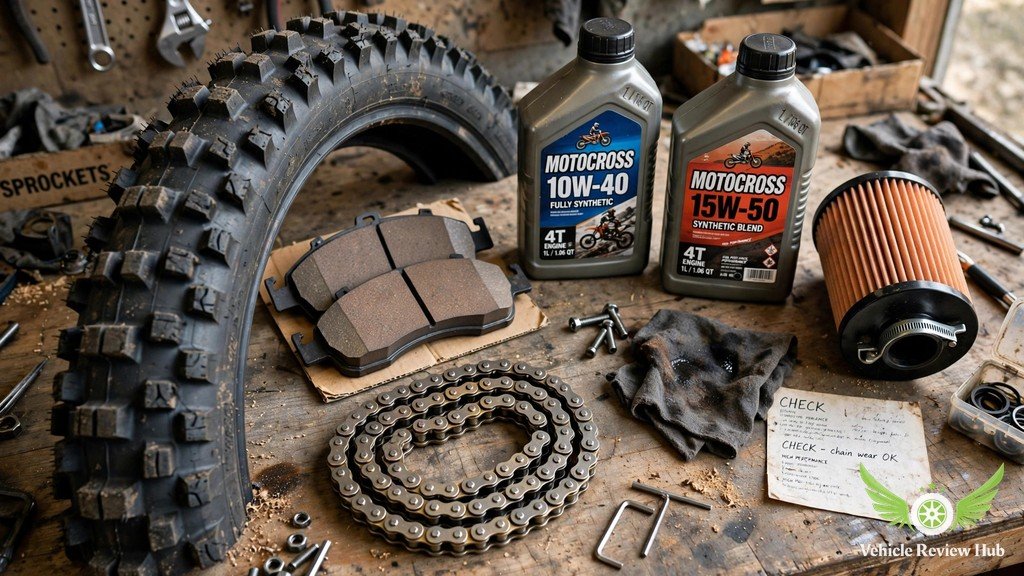
Fuel first for Honda CRF250R reliability budgeting: no EPA rating or MPG figure exists for a closed-course bike. Fuel economy is measured in motos per tank: the 250R carries a 1.7-gallon tank — not the RX’s 2.1 gallons and not the 450’s 1.9 — and a full tank covers a practice session and a moto. Routine servicing follows the race-based ladder, and a home mechanic can do most of it. Tires are the big consumable — knobby rears wear fast on hardpack — and the chain’s 7.5-hour rhythm makes drivetrain parts a recurring line. Parts are a strength: common Honda consumables and deep aftermarket support for the 2022-on platform. For the full buying decision, see our CRF250R buying guide.
No Warranty at All: Sold As Is for Competition Use
No warranty at all: sold as is for competition use is the doc heading, kept verbatim, and this Honda CRF250R reliability guide quotes no street bike’s warranty for it. Honda’s own manual says the bike is sold for closed-course competition use only and does not conform to Federal Motor Vehicle Safety Standards or US EPA standards. Do not let a seller quote the road-legal CRF450RL’s warranty for this machine — that warranty never applied to any R. The consequence for Honda CRF250R reliability is that every repair is on the owner’s wallet from hour zero. A bike with a complete hour log, piston and valve receipts, and a clean VIN check is worth real money. Leftover new stock is no exception: zero hours start the ladder at zero.
| Cost item | Figure | Label |
|---|---|---|
| New bike (2027) | $8,599 + $600 destination | Verified; available July 2026 |
| New bike (2025 / 2026) | $8,299 / $8,399 + $600 | 2026 is a 2025 carryover |
| Race-based service rhythm | Oil/valves/piston 6 races; chain 3 races | Hours, not miles |
| Fuel | 1.7 gal tank | No MPG rating exists |
| Factory warranty framing | None — competition bike | Never quote the RL warranty |
| US servicing cost | No published figure found | No invented quote given |
| Summary | Frequent, predictable, owner-funded | Skipped piston service = big bills |
How to Keep a Honda CRF250R Reliable
Keeping a 250R reliable means doing the simple things on races and hours. Nothing in Honda CRF250R reliability needs exotic tools: an hour meter, an every-race air-filter habit, a logbook, a chain habit, and the VIN check first.

Preventive Maintenance, Hour Meter and Regular Inspections
Preventive maintenance, hour meter, and regular inspections are the three habits that define Honda CRF250R reliability: every-race air filter, 3-race chain replacement, 6-race oil, filter, valve, and piston work, 9-race fork oil, and two-year coolant. The hour meter is literal: log every ride’s hours, keep every receipt, and never buy or sell on “low miles”. Regular inspections mean a pre-ride check plus seasonal seals, bearings, pads, and frame cracks. Verify the generation too: the Works Edition’s hydraulic clutch, MX33 tires, and Yoshimura titanium exhaust never came on the standard bike. For the standard bike’s own story against its rivals, see our CRF450R reliability guide for how Honda’s bigger race bike handles the same hours-based life.
The Primary-Drive-Gear Story Is Unverified: VIN Check Decides
The primary-drive-gear story is unverified: VIN check decides is the doc heading, kept verbatim — and this Honda CRF250R reliability guide must correct its first half, because the recall itself is verified. The CPSC notice of April 30, 2026 is real and it does name the CRF250R: model years 2025–2026, models CRF250R/RX/RWE and CRF450R/RX/RWE, for a drive gear that can lock the rear wheel. Justia’s record of the April 30, 2026 CPSC notice confirms the model list. What is unverified is only whether a given VIN is included: not every 2025–2026 bike is affected, and the recall does not cover 2022–2024 or 2027 bikes at all. So the correct Honda CRF250R reliability rule is VIN-first: run the VIN through Honda’s recall lookup and get a dealer campaign-history printout before paying. Keep this item separate from the handlebar item above — different defect, different notice, different years.
The video below in this Honda CRF250R reliability guide is Motocross Hideout’s guide to the signs that a four-stroke dirt bike engine needs a rebuild — generic four-stroke guidance, not CRF250R-specific, and no substitute for the manual’s 15-hour piston interval.
Honda CRF250R Reliability FAQs
Direct answers to the Honda CRF250R reliability questions buyers ask most: intervals, recalls, and generations labelled by source and manual year.
Is the Honda CRF250R reliable?
Yes, by race-bike standards. For Honda CRF250R reliability, the proven 2022-on platform holds up — but only on the race-based schedule, and only with a real hour log.
How often does the CRF250R need an oil change?
For Honda CRF250R reliability, oil and filter are replaced every 6 races, about every 15.0 hours, per the 2026 manual.
When does the CRF250R need its valves checked?
For Honda CRF250R reliability, valves and the decompressor are inspected every 6 races, about every 15.0 hours.
How often does the CRF250R need a new piston?
For Honda CRF250R reliability, piston, rings, and pin are replaced every 6 races, about every 15.0 hours — on a 250 motocrosser the piston is a consumable.
Why was the 2014 piston interval 30 hours?
For Honda CRF250R reliability readers: the 2014 manual set piston and ring replacement at every 12 races, about 30 hours. Never apply the 2014 interval to a 2025 bike.
How often should I replace the CRF250R drive chain?
For Honda CRF250R reliability, the #520 drive chain is replaced every 3 races, about every 7.5 hours — not merely adjusted.
Does the CPSC drive-gear recall cover the CRF250R?
Yes, says this Honda CRF250R reliability guide — the verified April 30, 2026 CPSC notice names 2025–2026 CRF250R/RX/RWE. Only individual VIN inclusion is unverified, so VIN-check every bike.
What is the CRF250R handlebar recall?
For Honda CRF250R reliability checks, the handlebar item is separate from the drive-gear recall: ACCC April 2026 and Transport Canada 2026115 naming the 2025 CRF250R. The “26-458” identifier is doc-only, unverified.
Was there a 2018 CRF250R clutch basket recall?
No, says this Honda CRF250R reliability guide. The verified 2019 circlip recall (19V-412, 3,898 units) names the CRF250L family, not the R, and no R clutch-basket recall was found.
Does the CRF250R have a warranty?
No warranty framing applies, says this Honda CRF250R reliability guide: the R is a closed-course competition motorcycle, sold as is, and no street bike’s warranty should be quoted for it.
Is the CRF250R street legal?
No. For Honda CRF250R reliability buyers, the R is closed-course only, not street legal in any US state, and cannot be plated. Honda’s manual states public-road operation is illegal.
Is buying a used CRF250R worth it?
Yes, says this Honda CRF250R reliability guide, when the hour log shows every-race filters, 3-race chains, and 6-race piston work, and the VIN clears both checks.