The short answer on Honda Fury performance is simple: this is a cruiser built for torque and presence, not stopwatch numbers. Cycle World found the computer cuts in at 100 mph, no verified instrumented 0-60 or quarter-mile test exists, period dyno runs put rear-wheel output in the mid-50s, and real-world economy lands between 37 and 50 mpg from a small 3.4-gallon tank. This Honda Fury performance guide separates tested figures from claimed ones and gives an honest verdict on where Honda Fury performance is quick and where it runs out of breath.
Honda Fury Engine Performance and Power Delivery
The Fury’s engine is the whole point of the motorcycle, and the Honda Fury review explains how Honda wrapped that engine in a factory-chopper body. It is a 1312cc liquid-cooled 52-degree V-twin with a single-pin crankshaft, dual counter-balancers, three valves per cylinder, and fuel injection through a 38mm throttle body — and for Honda Fury performance, the question is not peak power but torque just off idle.
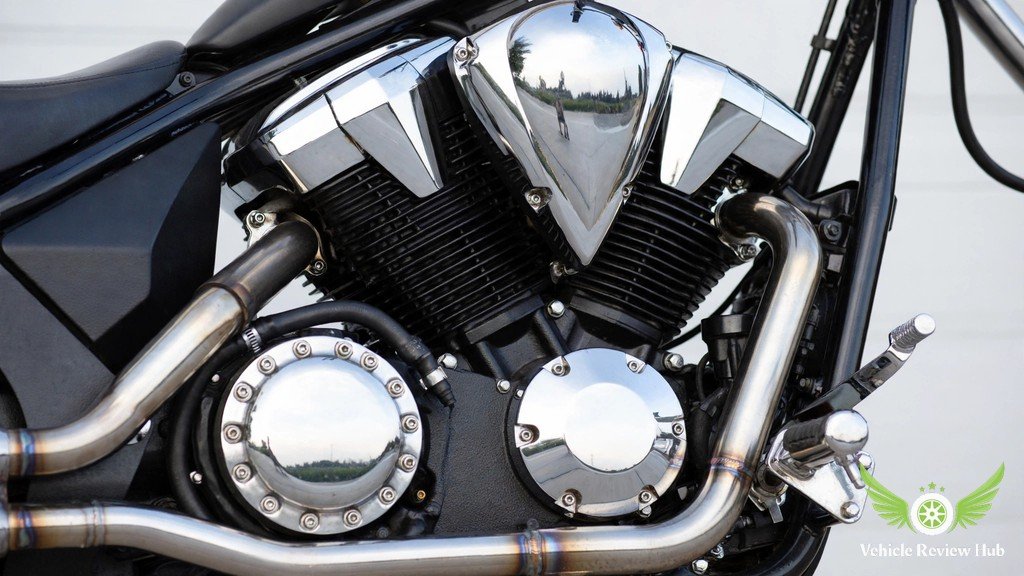
Period Dyno 56.0 HP at 4,300 RPM and 71.2 lb-ft at 3,600 RPM
No single period source I could verify confirms exactly 56.0 horsepower at 4,300 rpm and 71.2 lb-ft at 3,600 rpm as one dyno run, so treat this heading as a rounded summary of period Honda Fury performance testing. Motorcycle.com’s comparison test recorded 57.3 horsepower at 4,300 rpm at the rear wheel with 72.9 lb-ft at 3,700 rpm, while YouMotorcycle’s 2010 test recorded 53.7 horsepower at 4,300 rpm. The 79 lb-ft at 2,250 rpm often quoted for this engine is a claimed crankshaft figure from Honda’s European press information, never a rear-wheel measurement — and mixing the two is the most common Honda Fury performance error online.
Single-Pin Crank Character, Low-End Torque and Throttle Response
The single-pin crankshaft gives the Fury its character: both connecting rods share one crankpin, so firing pulses arrive unevenly, producing the loping idle and pulsing exhaust note that are central to Honda Fury performance. Dual counter-balancers take the harsh edge off, testers reported minimal vibration, and Cycle World put it plainly — the engine “makes 70 foot-pounds of torque just off-idle, and continues to make that much until it signs off.” That flat, early torque curve makes throttle response immediate at city speeds — a small twist moves the bike without a downshift — and that is the heart of Honda Fury performance, even though acceleration flattens as speed climbs.
| Figure | Verified value |
|---|---|
| Engine | 1312cc liquid-cooled 52-degree V-twin, SOHC, 3 valves per cylinder |
| Rear-wheel horsepower | 53.7–57.3 hp at about 4,300 rpm (period tests vary) |
| Rear-wheel torque | 72.9 lb-ft at 3,700 rpm |
| Claimed crank torque | 79 lb-ft at 2,250 rpm |
| Transmission / final drive | 5-speed manual, shaft drive |
| Curb weight | 675 lb (full tank, all fluids) |
Honda Fury Top Speed and Acceleration
Top speed is the one place where the Fury has a hard, verified answer — and it is lower than many buyers expect. The bike is electronically limited, and for Honda Fury performance, this section kills two myths: that a 1300cc chopper must be fast, and the aggregator claims of 103 or 110 mph that circulate without any test behind them.
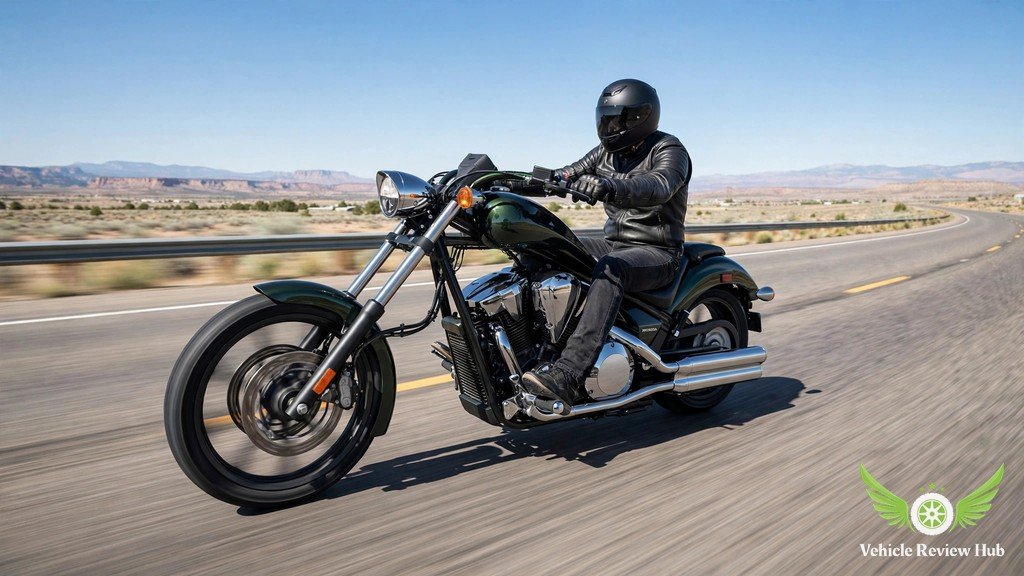
Cycle World Found the ECU Enforces a Strict Limit at 100 MPH
Cycle World’s June 2009 test is unambiguous: “the Fury’s computer enforces a strict lights-out policy at 100 mph.” That is the tested top speed — 100 mph, set by the ECU, not by aerodynamics or power — while aggregator tables listing 103 or 110 mph cite no instrumented test and should be treated as unverified Honda Fury performance claims. Owners reporting indicated speeds above 100 mph are generally reading an optimistic speedometer or a modified bike, which changes nothing about Honda Fury performance as tested.
Why No Verified Instrumented 0-60 or Quarter Mile Test Exists
No verified instrumented 0-60 mph or quarter-mile time exists for the Honda Fury: period spec tables leave the quarter-mile field blank, and neither Cycle World nor Motorcycle.com published a timed acceleration run. Every 0-60 number quoted for Honda Fury performance online is therefore a guess, an owner estimate, or a figure borrowed from another motorcycle, and this guide will not invent one. What the evidence does support is qualitative: roughly 70 lb-ft just off idle makes the Fury launch strongly through the first two gears, then Honda Fury performance tapers as the low-rev tuning runs out of breath — quick in traffic, beaten in a roll-on contest by modern 100-plus-horsepower cruisers.
Honda Fury Mileage and Fuel Economy
Fuel economy is where the Fury quietly over-delivers — and where its small tank takes the gift back. The understressed twin sips fuel at a cruise, but the teardrop tank holds only 3.4 gallons, so for Honda Fury performance in the real world, miles between fuel stops matter more than miles per gallon.
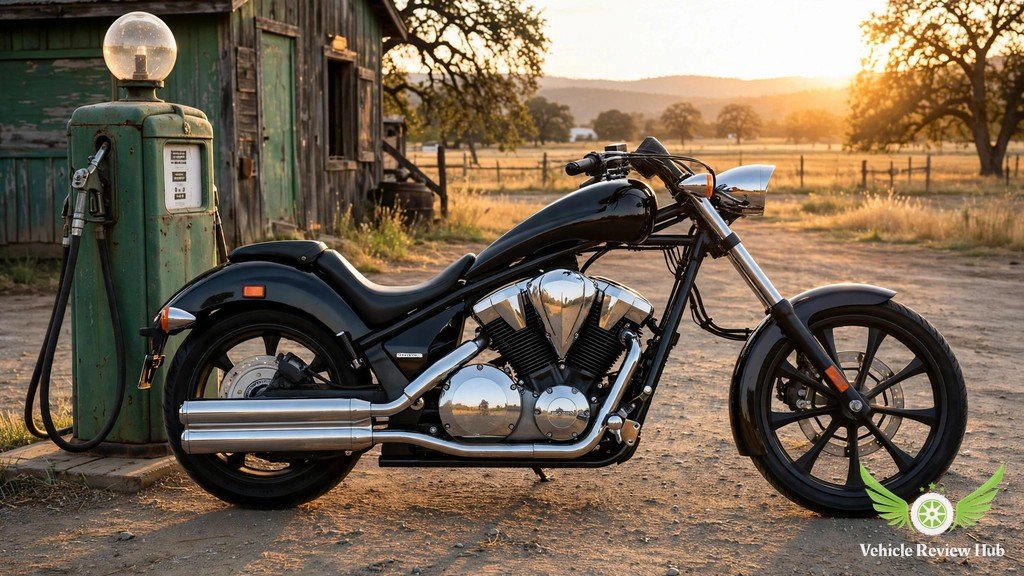
Period EPA Estimate 45 MPG and the Small 3.4-Gallon Tank
The period EPA-era estimate for the Fury is 45 mpg, consistent across period sources: Motorcycle.com’s spec pages list 46 mpg combined, and period spec roundups record 44.98 mpg. Treat 45 mpg as a period estimate, not a current EPA label value, since Honda’s current spec page lists fuel capacity (3.4 gallons) but no Honda Fury performance economy figure. The arithmetic is simple — 3.4 gallons times 45 mpg gives about 153 miles of theoretical range — but with no fuel gauge, only a low-fuel warning light, the tank is the real constraint on Honda Fury performance.
Owner Reports 37 to 50 MPG, Reserve Near 100 Miles and Range
Owner reports put real-world Honda Fury performance economy between 37 and 50 mpg, and the spread comes down to riding style more than the bike. One long-term owner reporting 50,000 miles put it exactly: as good as 50 mpg and as little as 37 mpg depending on the right hand, “generally you are on reserve after 100 miles.” Forums agree — about 115 miles per tank typically, 134 to 137 stretched, one report of 140 miles at 46 mpg — and Motorcycle.com’s comparison test found the same upper-30s to low-to-mid-40s spread, so plan Honda Fury performance fuel stops every 100 to 115 miles and never trust the theoretical 153-mile figure.
| Riding condition | Economy | Theoretical range (3.4 gal) | Planning range |
|---|---|---|---|
| Gentle cruising (best reported) | 50 mpg | 170 miles | About 140 miles |
| Period estimate / mixed riding | 45 mpg | 153 miles | About 115–130 miles |
| Hard throttle / city (worst reported) | 37 mpg | 126 miles | About 100 miles (reserve) |
| Typical owner average | Low-to-mid 40s mpg | 136–153 miles | About 115 miles |
Honda Fury Real-World Riding Performance
On paper, a 71-inch wheelbase and 675 pounds sound like hard work. On the road, period testers found the opposite at normal speeds, and this is where Honda Fury performance stops being a spec sheet and becomes a riding experience.
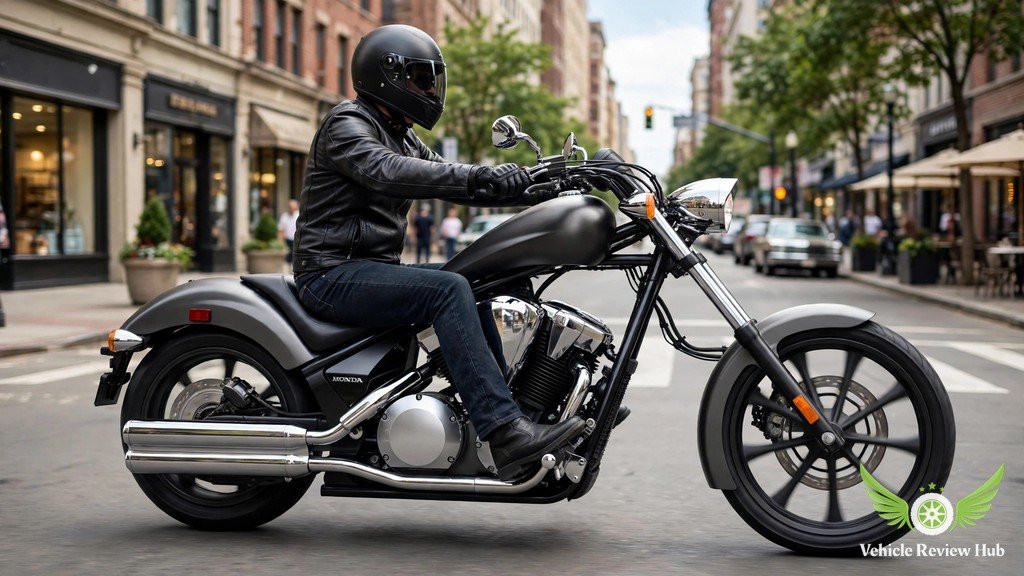
City Riding, Boulevard Cruising and Everyday Acceleration
Around town, the Fury is easier than it looks: the 26.7-inch seat height (some dealer sheets list 26.9 inches) puts most riders’ feet flat on the ground, and the low center of gravity makes the weight manageable at parking-lot speeds. Motorcycle.com’s comparison test found the steering neutral with no noticeable fork flop and U-turns on a two-lane road doable — high praise for Honda Fury performance in a chopper with this much wheelbase — while torque from just off idle pulls cleanly away from lights without downshifting. The annoyances are standard chopper fare — a wide turning circle and a long shape needing a full parking space — but everyday acceleration is where Honda Fury performance feels most at home.
Highway Riding, Passing Ability and Long-Distance Limits
On the highway, the Fury settles into a relaxed cruise: the long wheelbase and low center of gravity give the straight-line stability testers praised for Honda Fury performance, and the engine’s lazy torque means 60 to 70 mph cruising asks little. Passing needs planning — with no sixth gear and an engine that signs off early, an 80 mph pass takes a downshift and a longer clear stretch than on a modern performance cruiser, and the 100 mph limiter caps any rush. With no windshield as standard, sustained highway speed is a wind-blast endurance test for the rider, and with fuel stops every 100 to 115 miles, Honda Fury performance on long trips is measured in stops, not miles.
Honda Fury Handling, Braking and Stability
Handling is where the Fury’s spec sheet has caused the most confusion, because two different rake angles and two different trail figures circulate for the same motorcycle. Both are real, they measure different things, and for Honda Fury performance in corners, the chassis is stable and neutral at the speeds it was built for.
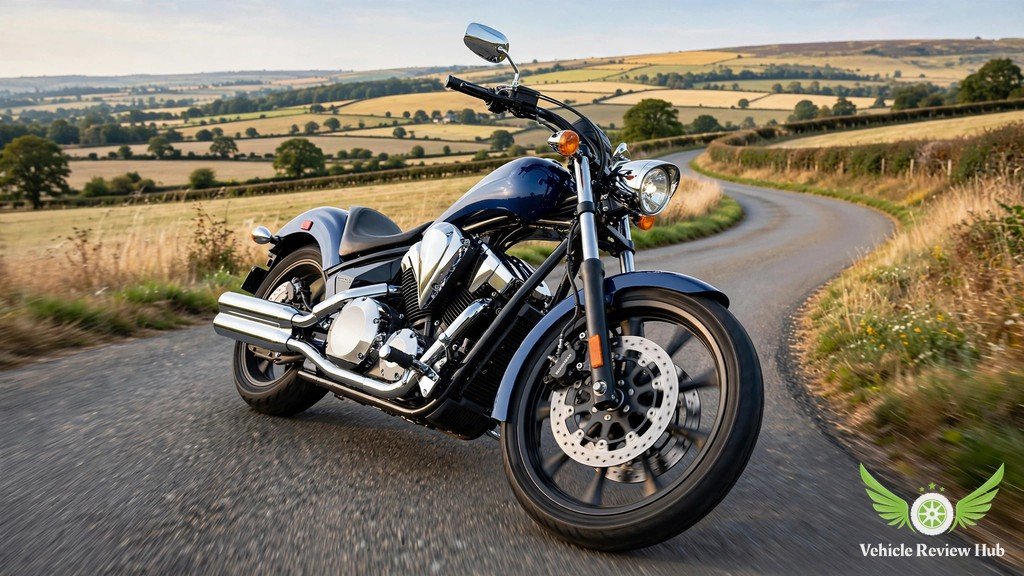
Rake Figures Conflict: 38 Degrees at Launch, 32 Degrees in Current Sheets
The rake conflict is real, and it has a documented explanation rather than a winner: preliminary Honda specifications around the 2010 launch listed 38 degrees, later corrected to 32 degrees, and Honda USA’s 2025 page lists rake at 32.0 degrees with 3.6 inches of trail. The 38-degree figure did not come from nowhere — Cycle World’s 2009 test described the fork tubes as raked at 38 degrees — because Honda raked the fork tubes out farther than the steering head itself, giving the chopper look while keeping the steering head at 32 degrees. So 38 degrees is the fork-tube angle and 32 degrees is the steering-head angle; trail shows the same drift, 3.5 inches at Cycle World against 3.6 on current sheets. Front fork travel drifted the same way, 5.1 inches on current pages against 4.0 in period guides — and for Honda Fury performance, the takeaway is simple: trust the 32-degree steering-head figure.
Single 336mm Front Disc, Front Brake Effort and Ground Clearance
Braking hardware is simple: a single 336mm front disc with a twin-piston caliper, a single 296mm rear disc with a single-piston caliper, and ABS standard on the current bike, as Honda USA’s 2025 spec page lists ABS on both brakes. Early buyers did not get that as standard — ABS was a $1,000 option in fall 2010, paired with a Combined Braking System linking the brakes through the rear pedal only — and on a 675-pound motorcycle, one front disc means a firm pull. Period testing supports using both brakes together, and with only 4.9 inches of ground clearance, hard cornering finds the pegs before the tires find their edge, which is where Honda Fury performance braking reaches its limit.
Honda Fury Performance Compared With Other Factory Choppers
Put the Fury next to its two most natural rivals and the value proposition snaps into focus. The Harley-Davidson Breakout is the bike the Fury most resembles, while the Indian Scout Bobber is the lighter, faster-revving alternative at a closer price — and for Honda Fury performance, the comparison flatters on price and sobers on power.
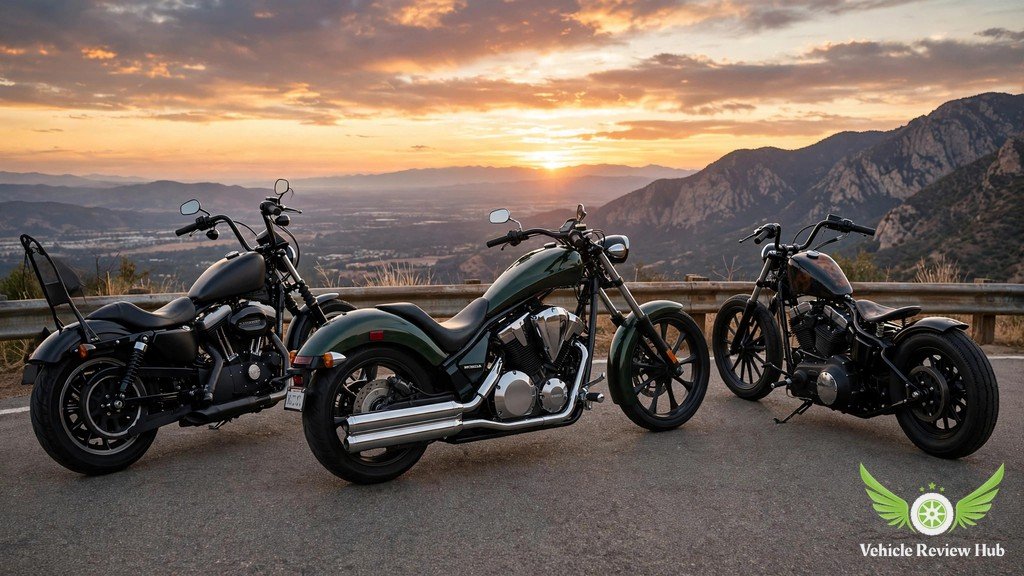
Honda Fury vs Harley-Davidson Breakout and Indian Scout Bobber
On Honda Fury performance comparisons, the Breakout costs roughly twice the Fury and gives roughly twice the power: Harley-Davidson’s 2026 Breakout lists at $22,999 plus $895 freight, with a 1923cc Milwaukee-Eight 117 making 103 horsepower and 126 lb-ft, a 5-gallon tank, 49 mpg combined, and a 681-pound running weight against the Fury’s 675. The Scout Bobber attacks from the other direction: the 2026 Indian Scout Bobber starts at $12,999, only $1,500 above the Fury’s $11,499, yet its liquid-cooled 1250cc SpeedPlus V-twin makes 105 horsepower and 82 lb-ft, it weighs just 542 pounds running, and it has a six-speed belt drive. What the Fury keeps is its own case: the longest wheelbase at 71 inches, shaft drive, and a price $11,500 under the Breakout. A buyer choosing on speed alone buys the Scout; a buyer choosing on Honda Fury performance per dollar still has a reason to pick the Fury.
| Figure | Honda Fury (2025) | Harley Breakout (2026) | Indian Scout Bobber (2026) |
|---|---|---|---|
| Price (MSRP) | $11,499 + $775 destination | $22,999 + $895 freight | $12,999 |
| Engine | 1312cc V-twin, liquid-cooled | 1923cc Milwaukee-Eight 117 | 1250cc SpeedPlus V-twin |
| Power | ~53.7–57.3 hp (rear wheel, period tests) | 103 hp at 4,800 rpm | 105 hp |
| Torque | ~72.9 lb-ft (rear wheel) | 126 lb-ft at 3,000 rpm | 82 lb-ft at 6,300 rpm |
| Weight (running) | 675 lb | 681 lb | 542 lb |
| Fuel tank | 3.4 gal | 5.0 gal | 3.4 gal |
| Transmission / drive | 5-speed, shaft | 6-speed, belt | 6-speed, belt |
| Wheelbase | 71.0 in | 66.7 in | 61.5 in |
Is the Honda Fury Suitable for Daily Riding and Weekend Cruises?
Yes, with the right expectations: as a weekend cruiser, the Fury is close to ideal — it looks like a custom bike, sounds like a big twin, and handles boulevards and sweeping back roads with neutral manners. As a daily rider, Honda Fury performance is workable rather than ideal: the low seat and flat torque make traffic easy and shaft drive removes chain chores, but the costs are the small tank, tight parking, no weather protection, and no luggage. Beginners should think twice, since 675 pounds and 71 inches punish slow-speed mistakes, but the buyer who already wants a chopper will find the Honda Fury performance envelope — strong off idle, relaxed at 70 mph, done at 100 mph — is no compromise most weekends. The Honda Fury buying guide covers what to pay for each.
Honda Fury Performance FAQs
These are the questions buyers actually ask about Honda Fury performance, answered from the tested record — including the questions where the honest answer is that no test exists.
What is the top speed of the Honda Fury?
100 mph. Cycle World’s 2009 test found the computer enforces a strict limit at 100 mph, and aggregator claims of 103 or 110 mph cite no instrumented test — that 100 mph figure is the tested ceiling for Honda Fury performance.
How fast is the Honda Fury 0-60?
There is no verified instrumented 0-60 time for the Fury. Neither Cycle World nor Motorcycle.com published a timed run, so any precise 0-60 figure quoted for Honda Fury performance online is a guess, an owner estimate, or borrowed from another motorcycle.
How much horsepower does the Honda Fury make?
Period rear-wheel dyno tests recorded 53.7 to 57.3 horsepower at about 4,300 rpm, with rear-wheel torque of 72.9 lb-ft at 3,700 rpm. Honda USA publishes no horsepower figure, and the often-quoted 79 lb-ft number is a claimed crankshaft figure, not a rear-wheel measurement — those are the only honest numbers behind Honda Fury performance claims.
What is the Honda Fury’s MPG?
The period estimate is 45 mpg, and owners report 37 to 50 mpg depending on throttle use. For Honda Fury performance, economy depends more on your right hand than on the bike.
How far can a Honda Fury go on a tank?
Plan on 100 to 115 miles between fuel stops. The 3.4-gallon tank gives about 153 miles in theory at 45 mpg, but owners typically see the warning light around 100 miles in hard use and 115 miles on average — that planning rule is the most useful Honda Fury performance habit on longer rides.
Does the Honda Fury have ABS?
Current bikes have ABS standard — Honda USA’s 2025 spec page lists it on both brakes. Early bikes did not: ABS was a $1,000 option in fall 2010 with a Combined Braking System, and the Honda Fury buying guide covers the year-by-year split, since for Honda Fury performance the ABS question matters most when buying used.
What is the Honda Fury’s rake?
32 degrees at the steering head, the figure on Honda’s current spec sheets, with 3.6 inches of trail. The 38-degree figure from launch-era coverage is the fork-tube angle — and knowing which is which clears up most Honda Fury performance confusion about steering.
Is the Honda Fury good for highway riding?
Yes for relaxed cruising, with limits. The long wheelbase gives excellent straight-line stability and the engine is unstressed at 60 to 70 mph, but passing at 80 mph needs a downshift and a long clear stretch, with no windshield — that is the honest highway picture for Honda Fury performance.
Is the Honda Fury good for daily riding?
It works as a daily rider with trade-offs. The low 26.7-inch seat, flat torque, and shaft drive make traffic easy, but fuel stops every 100 to 115 miles, a long wheelbase in tight parking, no weather protection, and no luggage mean that as a daily rider, Honda Fury performance is workable rather than ideal.
How does the Honda Fury compare to the Harley Breakout?
The Breakout costs about twice as much ($22,999 plus freight) and makes about twice the power: $22,999 plus $895 freight for 103 horsepower and 126 lb-ft, against the Fury’s $11,499 for mid-50s rear-wheel horsepower. Running weights are nearly identical at 681 versus 675 pounds, but the Breakout adds a sixth gear and a 5-gallon tank — on that math, Honda Fury performance buys presence, not speed.
Is the Honda Fury fast?
Quick off the line, not fast by modern standards. Around 70 lb-ft just off idle makes it feel strong through the first two gears, but acceleration flattens as speed climbs and the ECU stops the fun at 100 mph — that split, quick but not fast, defines Honda Fury performance.
What year Honda Fury is best for performance?
There is no performance-relevant best year, because the bike is mechanically near-unchanged from 2010 through the latest confirmed 2025 model. Since nothing mechanical changed, Honda Fury performance does not depend on model year — buy on condition, mileage, and ABS, and use the Honda Fury buying guide to compare used prices.
Does the Honda Fury’s shaft drive need much maintenance?
Far less than a chain. Shaft drive removes chain adjustment, lubrication, and replacement from the ownership routine, and the Honda Fury reliability article covers final-drive oil and the rest of the schedule — that absence of chain chores is a quiet part of Honda Fury performance ownership.