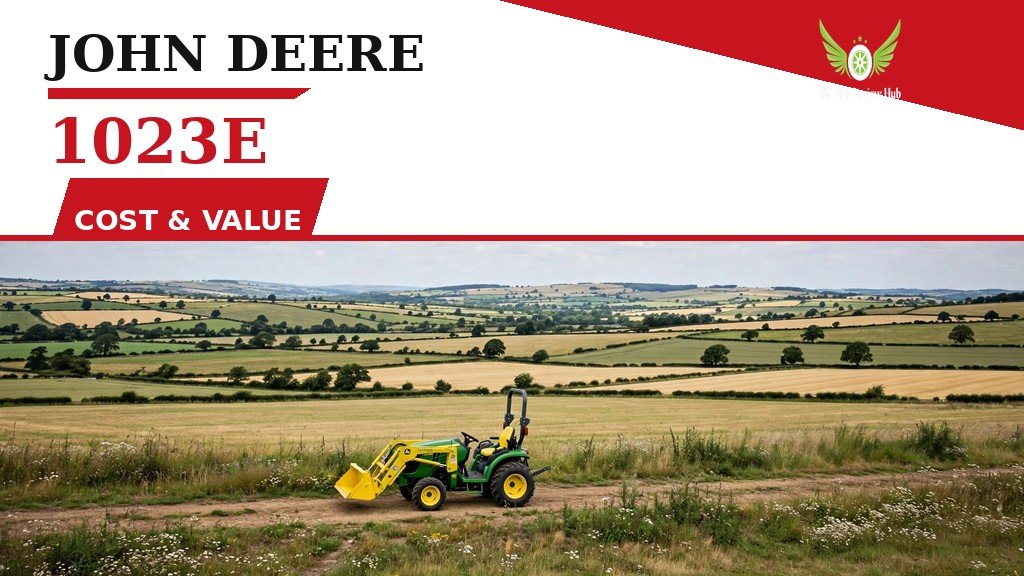
The John Deere 1023E ownership cost is one of the friendliest numbers in the sub-compact tractor world, but the sticker price only tells part of the story. Between diesel, filters, insurance, and the occasional repair, a 1023E typically costs a homeowner roughly $1,300 to $1,800 per year before resale. Because these machines hold their value so well, the true John Deere 1023E ownership cost over five years often lands well under what the purchase price suggests.
In this guide, we break down every piece of the budget: fuel and maintenance, insurance and storage, depreciation and resale, and the repair-or-replace decision. We also compare the John Deere 1023E ownership cost against the pricier 1025R.
John Deere 1023E Total Ownership Cost
When buyers talk about John Deere 1023E ownership cost, they usually start with the purchase price and stop there. That is a mistake. The real number is the purchase price plus five years of running expenses, minus what the tractor is still worth when you sell it. On that basis, the 1023E is one of the cheapest tractors per hour of work in the United States.
Fuel, Maintenance and Routine Operating Expenses
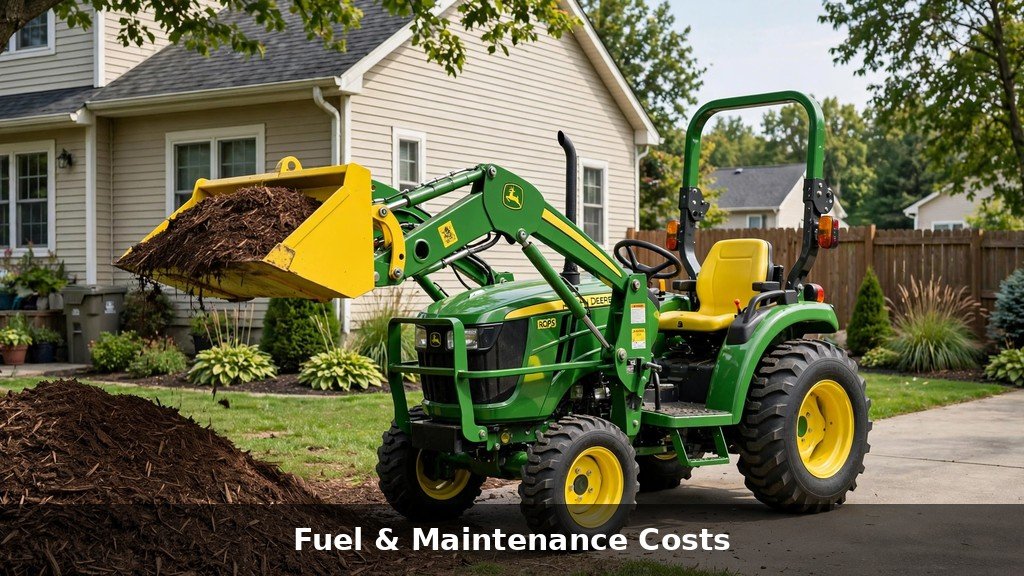
Fuel is the largest recurring line item in John Deere 1023E ownership cost. The 21.5-horsepower Yanmar diesel sips fuel compared to gas-powered yard equipment, burning roughly 0.5 to 0.7 gallons per hour under typical mowing and loader work. With a 5.7-gallon tank, most owners refuel every 8 to 10 hours of work. Owner reports consistently describe the 1023E as a tractor that can work all weekend on a single tank when the work is light.
At 100 to 200 hours per year, annual fuel use lands around 60 to 130 gallons. Diesel prices move a lot: the EIA’s weekly diesel price update showed the U.S. average near $6.20 per gallon in early October 2026, down from a record spike above $6.50 in September. For planning we use a rounded $5.00 per gallon in the budget table below, between the EIA’s 2026 average forecast of $5.19 and its 2027 projection of $4.49. At 150 hours a year, fuel runs about $450 to $780 annually depending on the pump price.
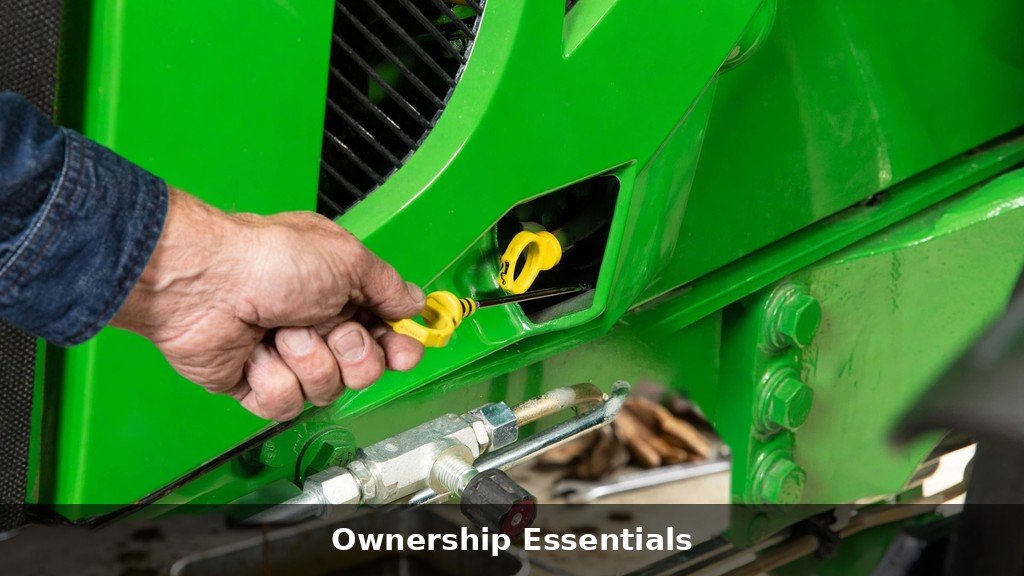
Routine maintenance is the second recurring expense, and it is modest. An annual oil and filter service costs most owners $60 to $120 in parts DIY, or $200 to $300 at a dealer. Greasing the loader pins and mower spindles, cleaning the air filter, and checking fluids cost almost nothing but protect everything else. Our John Deere 1023E performance and fuel usage guide has detailed consumption numbers by task type. That math is why fuel often decides whether the John Deere 1023E ownership cost fits your budget.
Repairs, Unexpected Costs and Five-Year Budget
A realistic John Deere 1023E ownership cost projection reserves money for repairs, even though the machine is famously reliable. The 6-year/2,000-hour powertrain warranty covers the expensive internals early on, but wear items still cost money: mower blades every year or two ($80 to $150), a battery every 4 to 6 years ($120 to $180), and hydraulic hoses or belts as they age ($50 to $200 each). A full set of turf or R4 tires eventually runs $400 to $700. Our 1023E maintenance and reliability guide covers the service schedule and the warning signs that turn a small fix into a big bill.
The table below rolls everything into a five-year budget for a typical homeowner running about 150 hours per year. Every figure is an estimate based on owner reports and current parts pricing, not a quote.
| Cost Item | Estimated 5-Year Total | Notes |
|---|---|---|
| Diesel fuel (150 hrs/yr) | $2,250 | ~90 gal/yr at an estimated $5.00/gal |
| Routine maintenance (oil, filters, grease) | $1,200 | Annual service, mostly DIY |
| Scheduled service intervals | $600 | 200/400-hour transmission and hydraulic service |
| Insurance | $1,000 | Estimated $200/yr inland marine or scheduled policy |
| Repairs and parts reserve | $1,500 | Belts, hoses, blades, electrical items |
| Tires, battery, miscellaneous | $700 | One battery and tire wear over five years |
| Total estimated 5-year operating cost | $7,250 | Excludes purchase price; before resale recovery |
That $7,250 estimate works out to roughly $1,450 per year, or under $10 per operating hour. Set against a machine that replaces hundreds of dollars in landscaping, rental, and handyman bills each year, most owners find the John Deere 1023E ownership cost easy to justify.
John Deere 1023E Insurance and Financial Risks
Insurance is the part of John Deere 1023E ownership cost that buyers forget to budget for, and it is one of the cheapest lines to get right. A $15,000-plus machine deserves real coverage, and the right policy usually costs less than a single tank of diesel per month.
Equipment Insurance and Liability Considerations
A standard homeowners policy may cover a tractor stored at home, but coverage is often limited and usually excludes use away from the property. Many 1023E owners carry a separate inland marine policy or schedule the tractor as a personal article, covering theft, fire, rollover, and damage while trailering. Owner reports describe inland marine quotes for compact tractors in the range of roughly $115 to $300 per year for a machine in the 1023E’s price class, though rates vary by value, deductible, and state.
Liability is the other half. If the tractor damages a neighbor’s property or you do paid work with it, a homeowners policy may not respond, so owners who use their 1023E for side jobs or snow removal should ask an agent about a farm or business liability endorsement. Insuring the machine costs a small share of the John Deere 1023E ownership cost, so going without is a poor gamble. If you financed the tractor, the lender may require proof of insurance until the loan is paid off.
Financing also belongs in any John Deere 1023E ownership cost discussion. John Deere Financial regularly advertises promotional rates that change with the season, so confirm the current offer with your dealer rather than budgeting around an old number. A low rate can save hundreds of dollars, while cash buyers avoid interest entirely and keep the John Deere 1023E ownership cost predictable.
Storage, Theft and Damage Protection
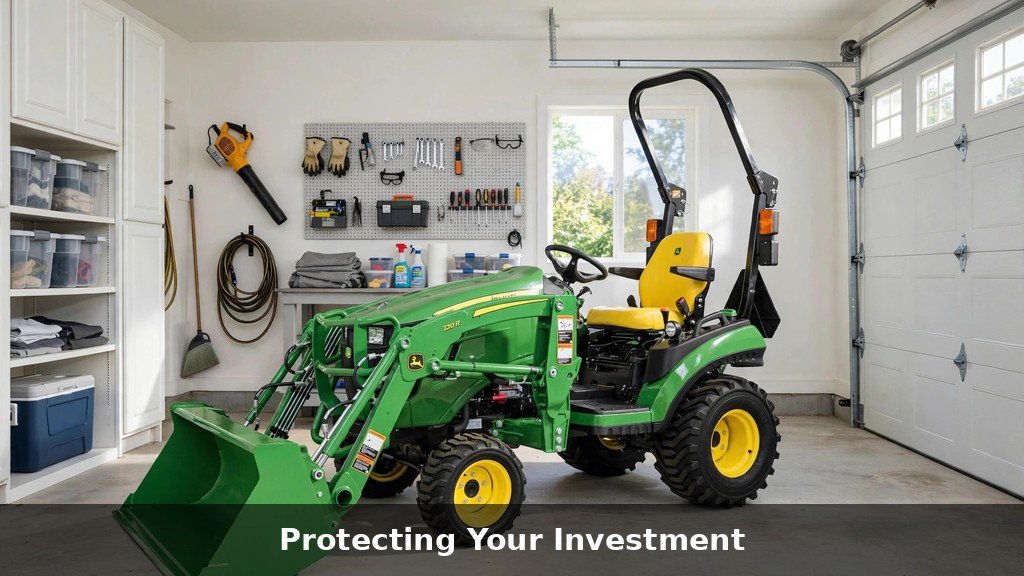
Proper storage protects both the machine and your John Deere 1023E ownership cost. A tractor kept in a garage or barn holds its paint, seat, and plastics far better than one left outside, and that condition difference shows up directly in resale value. Indoor storage also cuts the theft risk behind many insurance claims. If indoor space is not available, a breathable cover and a locked, level parking spot are the minimum.
Theft is a real financial risk with sub-compact tractors. They are light enough to winch onto a trailer, valuable enough to resell quickly, and often parked where they are visible from the road. Beyond insurance, owners reduce the risk by removing the key, locking the fuel cap, chaining the tractor when storing it outside, and fitting a GPS tracker, which costs less than $100 plus a small subscription. ROPS structures should stay up whenever the tractor is working, since a rollover is both a safety event and a repair bill that can reach several thousand dollars. A few hundred dollars in prevention protects a five-figure asset and keeps the John Deere 1023E ownership cost from spiking on a single bad day.
John Deere 1023E Depreciation and Resale Value
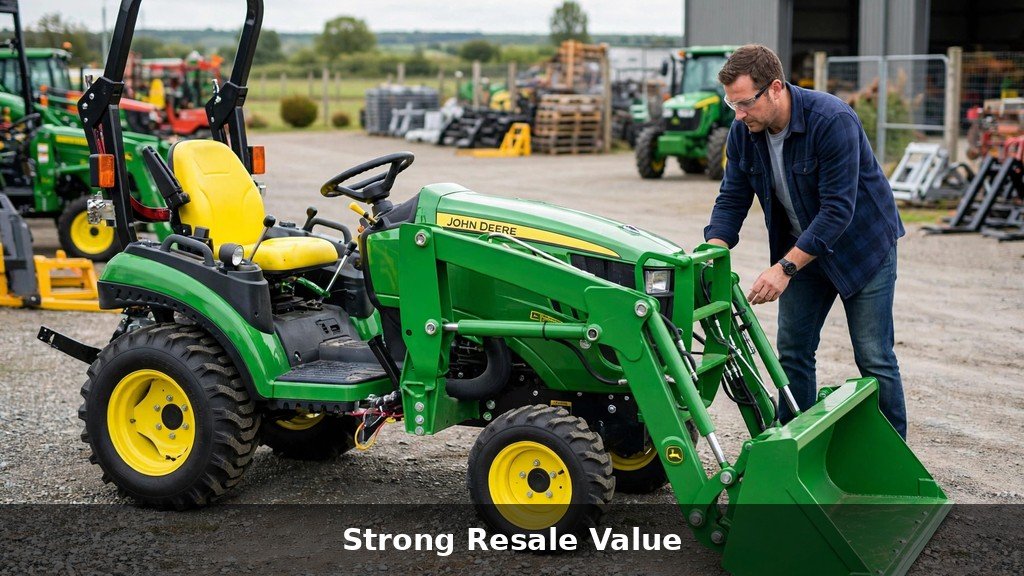
Depreciation shapes the John Deere 1023E ownership cost more than almost any other factor, because it determines how much of your purchase price comes back to you. John Deere sub-compacts are among the slowest-depreciating machines in the equipment world, and strong dealer networks, easy parts availability, and brand reputation keep used demand high year after year.
How Model Year, Hours and Condition Affect Price
Used 1023E pricing follows a clear pattern: low hours and good condition command prices surprisingly close to new. A 2018 model with just 230 hours, a 120R loader, and a 60-inch mower deck was recently listed at $16,500, within a few thousand dollars of new. Well-kept machines with 200 to 400 hours typically sell from $12,000 to $16,000, while higher-hour tractors with 500 to 1,000 hours trade closer to $9,000 to $12,000. Rougher examples with cosmetic damage or unknown service history fall below that band.
Hours matter more than model year. A 2016 with 300 garage-kept hours will outsell a 2021 with 900 hard hours, because buyers know the Yanmar diesel is barely broken in at a few hundred hours. Faded plastic, a torn seat, or a rusty mower deck can knock $1,000 off the asking price, while service records add confidence and dollars. This resale strength directly lowers the John Deere 1023E ownership cost, since every dollar of retained value is a dollar you do not really spend. Our full review and specs breakdown of the 1023E covers the features that make used buyers pay a premium.
One factor to watch: John Deere has introduced the 1E 23 as the new entry-level 1 Series model with the same 21.5 horsepower, and dealers are discounting remaining 1023E inventory. TriGreen Equipment’s 1023E vs. 1E 23 comparison notes that discounted 1023E stock can be the value play for budget buyers. The 1023E’s huge installed base and parts support should keep long-term resale solid.
Attachments, Dealer Trade-In and Private Sale
Attachments are a hidden lever in the John Deere 1023E ownership cost equation at resale time. A tractor sold with a 120R loader and a 60D AutoConnect mower deck sells faster and for meaningfully more than a bare tractor, because the buyer avoids shopping for those attachments separately. Loaders and decks hold value well on their own, so a well-equipped package recovers thousands more at sale time. When you buy, think of attachments as prepaid resale value; when you sell, list them individually if a package price does not move the machine.
For the sale itself, a private sale almost always beats a dealer trade-in, often by $1,500 to $3,000 on a clean 1023E. Dealers need margin to recondition and warranty the machine, so their offer reflects wholesale reality. A private listing with clear photos, the hour-meter reading, service records, and a cold-start video tends to sell within days in most markets. If you trade toward a bigger tractor, get the trade number in writing first, and remember some states let you pay sales tax only on the price difference.
John Deere 1023E Long-Term Ownership Value
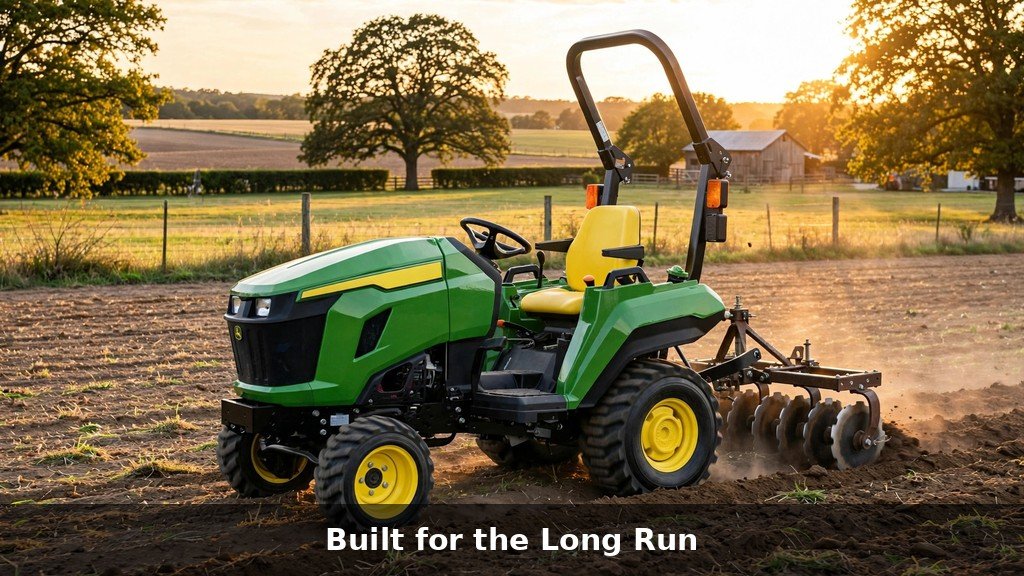
The real test of John Deere 1023E ownership cost comes after year five, when the warranty is gone and the machine has a few hundred hours on the meter. Owner reports describe tractors with 800, 1,000, even 1,500 hours still doing daily work with nothing more than routine service.
Repair or Replace an Older Tractor
Every owner eventually faces the repair-or-replace question, and the math favors keeping the 1023E longer than expected. A good rule from experienced owners: if a single repair costs less than about half of one year’s depreciation on a new machine, fix it and keep working. A $900 hydraulic pump or a $600 set of tires is cheap compared to the $2,000-plus a new 1023E can lose in its first year off the lot.
The decision changes when problems stack up. Multiple simultaneous failures, an engine that burns oil, or a slipping transmission can push a repair bill past $3,000 to $4,000, at which point a low-hour used 1023E or a discounted new one starts to look sensible. Age alone is not the trigger; neglected maintenance is what kills these tractors. When you price the options, compare the repair quote against the annual John Deere 1023E ownership cost of a replacement, not just the sticker price. For most owners, keeping a well-maintained tractor remains the lower John Deere 1023E ownership cost path deep into the second decade, and MachineFinder’s 1023E feature breakdown shows why these machines stay capable for so long.
John Deere 1023E vs. 1025R Ownership Costs
Comparing the John Deere 1023E ownership cost with the 1025R is the question every 1 Series shopper asks, because the two tractors look nearly identical in the showroom. The 1025R costs roughly $4,000 to $5,000 more new, with dealers reporting average selling prices around $20,200 for the 1025R versus about $15,600 for the 1023E over recent years. That gap never fully closes.
Day to day, running costs are nearly identical: the same fuel appetite, the same service intervals, similar insurance. Where the John Deere 1025R costs more is the extras, the premium seat, tilt steering, cruise control, and lighting that make it nicer to operate but add little to resale. The 1025R holds its value well too, so the gap in John Deere 1023E ownership cost narrows slightly at trade-in, but the 1025R holds its value well too. The video below from Good Works Tractors walks through whether the 1025R’s upgrades are worth the money, which is really an ownership-cost question in disguise.
The bottom line: the 1023E wins on purchase price, ties on running costs, and loses only a little at resale, giving it the lowest John Deere 1023E ownership cost in the 1 Series lineup. The 1025R is the better buy only if you value its comfort features enough to pay for them twice, at purchase and in slightly higher depreciation.
Frequently Asked Questions About John Deere 1023E Ownership
These answers cover the most common John Deere 1023E ownership cost questions buyers ask.
How much does a John Deere 1023E cost per year to own?
For a typical homeowner running 100 to 200 hours per year, the total John Deere 1023E ownership cost lands around $1,300 to $1,800 annually, covering fuel, maintenance, insurance, and a repair reserve. That excludes the purchase price and does not credit resale value, which can return a large share of what you paid.
Is the John Deere 1023E expensive to maintain?
No. Annual oil and filter service costs $60 to $120 in parts DIY, or $200 to $300 at a dealer, and the 200- and 400-hour transmission and hydraulic services add a few hundred dollars every few years. Sticking to the schedule keeps the John Deere 1023E ownership cost low and prevents the neglected-maintenance failures that generate big bills.
How well does the John Deere 1023E hold its resale value?
Very well. Low-hour examples with a loader and mower deck routinely list within a few thousand dollars of new pricing, and clean machines with 200 to 400 hours typically sell between $12,000 and $16,000. Strong resale helps the John Deere 1023E ownership cost case more than any other factor.
What does tractor insurance cost for a 1023E?
Most owners report paying roughly $115 to $300 per year for an inland marine policy or a scheduled personal-articles endorsement. Rates vary by state, deductible, and insured value, so get a quote from your own agent. It is a small slice of the John Deere 1023E ownership cost and worth every penny.
When should I repair my 1023E instead of replacing it?
Repair it when the fix costs less than about half of one year’s depreciation on a new machine and the rest of the tractor is sound. Consider replacing when multiple major systems fail at once or a repair quote passes $3,000 to $4,000. Service history matters more than age in this decision.
Is the 1023E cheaper to own than the 1025R?
Yes. The 1023E costs about $4,000 to $5,000 less to buy, runs on the same fuel and service schedule, and holds its value nearly as well. The 1025R’s comfort upgrades are nice but do not pay for themselves, so the John Deere 1023E ownership cost edge stays with the simpler machine for most buyers.