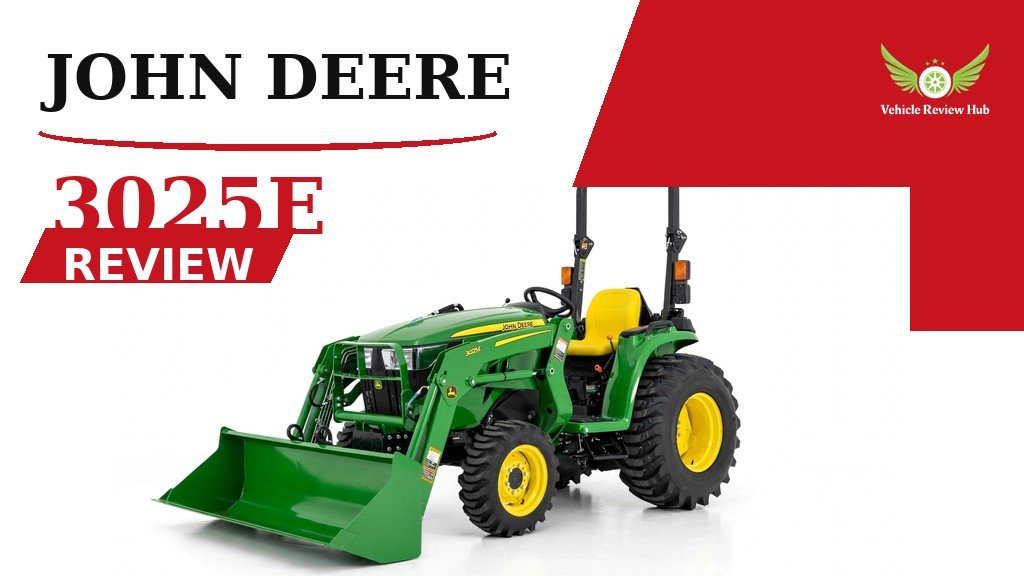
The short answer in this John Deere 3025E review: it is John Deere’s most affordable 3-series compact tractor, built for owners who need a real step up from a sub-compact without paying for premium features. A 24.4-horsepower Yanmar diesel, a two-range hydrostatic transmission, and standard four-wheel drive give the 3025E the muscle for 5 to 20 acres of mowing, loader work, and property maintenance, while its under-25-hp rating keeps it free of DPF and DEF. New 2026 machines with the 300E loader are advertised around $20,000 to $22,500 cash, and used examples with a loader trade from roughly $15,500 with high hours to the mid-$20,000s with low hours — a price spread this John Deere 3025E review maps out in detail below.
John Deere 3025E Review, Features and Price
This John Deere 3025E review starts with what the tractor is: Deere’s economy 3-series compact, positioned between the smaller 2-series machines and the pricier 3R line. It keeps the capability buyers actually use — hydrostatic drive, MFWD, a strong Category 1 hitch, and a full-size loader — while skipping premium extras like a mid PTO, deluxe seating, and electronic conveniences. That formula is exactly why it became one of the best-selling compact tractors in the United States — and why this John Deere 3025E review treats it as the value benchmark of the 3E line.
Key Features, Configurations and Intended Uses
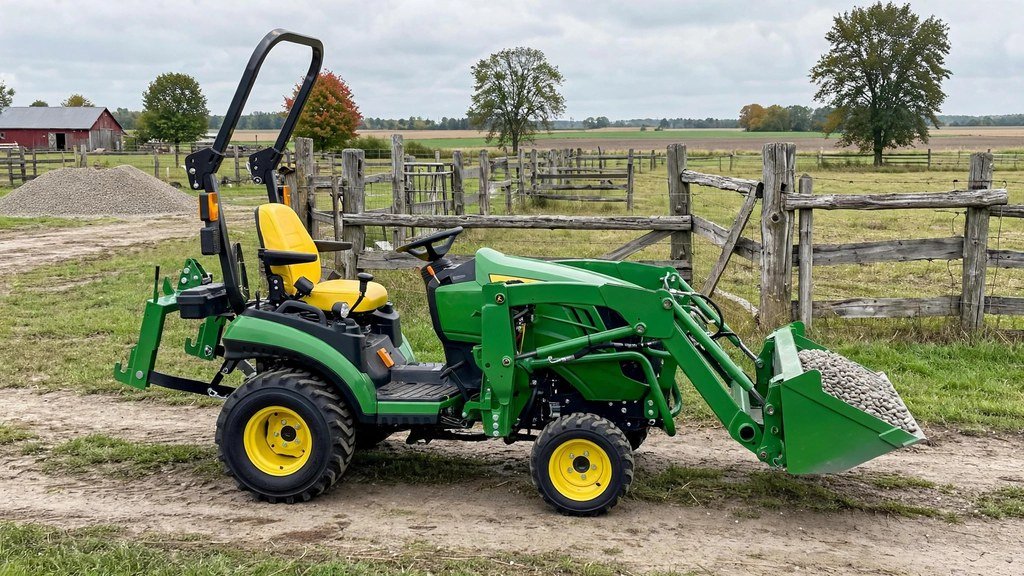
Every John Deere 3025E review has to start with the drivetrain, because it defines how the tractor feels. The two-range hydrostatic transmission with Twin Touch foot pedals gives clutch-free speed and direction control, and standard mechanical front-wheel drive keeps it pulling in mud, snow, and loose soil. A differential lock and wet disk brakes come standard, and the turning radius of 9.4 feet without brakes is the tightest in its horsepower class according to Deere — a real advantage when maneuvering around barns, trees, and fence lines.
The operator station is deliberately simple: a straddle platform, a left-hand range lever, a foldable ROPS, and basic analog gauges with an LCD hour display. There is no mid PTO on the 3025E, which means no belly mower — mowing is handled by rear three-point grooming or finish mowers, covered in the attachments section below. Owners on tractor forums consistently describe the 3025E as easy to service, with excellent parts availability and a reputation for starting reliably in cold weather — feedback gathered for this John Deere 3025E review from multiple owner communities — and our 3025E performance and fuel usage guide covers how it behaves across real tasks in more detail.
The 3025E suits hobby farms, horse properties, large rural lots, landscaping businesses, and light commercial work — anywhere a 25-horsepower-class machine with a real loader earns its keep. It is assembled in Augusta, Georgia, and carries Deere’s 6-year/2,000-hour powertrain limited warranty, which dealers like Greenway Equipment advertise prominently. The video below, selected for this John Deere 3025E review, is a full review and walkaround of a 2023 model showing the features buyers should check:
New and Used Prices by Model Year, Hours and Condition
John Deere’s May 2026 government price page lists the 3025E base machine at $21,449, with the factory-installed 300E loader and bucket adding $6,024 — a $27,473 list total before dealer discounts. Actual transaction prices run well below list: TriGreen Equipment advertised new 2026 3025E tractors with loaders at $22,500 cash, and Greenway Equipment ran a $19,999 cash promotion on the 3025E-plus-loader package, both valid through late 2026. Expect real-world new prices in the $20,000 to $24,000 range depending on region, tires, and current programs.
On the used market, hours and condition drive everything. A 2021 3025E with just over 1,000 hours and a loader was recently listed at $15,500 by LandMark Implement in Nebraska, while a nearly new 2024 with 3 hours asked $26,399 at Ag-Pro in Georgia. As a rule of thumb in this John Deere 3025E review: low-hour machines (under 300 hours) with a loader trade in the low-to-mid $20,000s, mid-hour tractors (300–800 hours) land in the high teens to low $20,000s, and 1,000-hour-plus examples fall into the $14,000 to $17,000 band. Machines sold with the loader, a box blade, and a rotary cutter command the top of each band. Our 3025E ownership cost guide breaks down what those purchase prices mean over five years of ownership.
John Deere 3025E Engine, Horsepower and Specifications
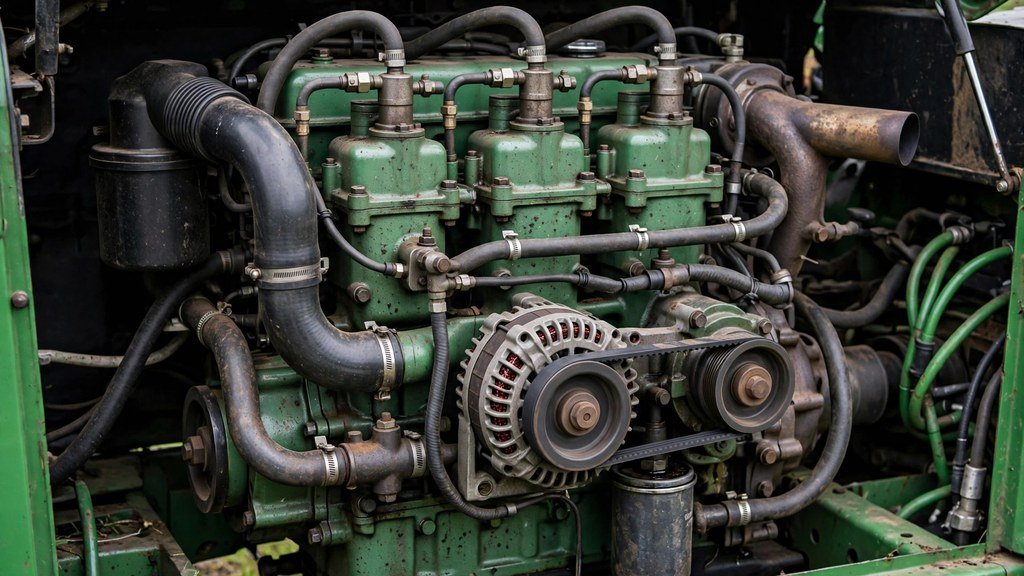
The heart of any John Deere 3025E review is the Yanmar diesel — a proven 1.642-liter three-cylinder that Deere also uses in detuned and uprated forms across the 3E line. It is a simple, naturally aspirated, direct-injection engine with no turbocharger, no DPF, and no DEF, which is exactly what buyers shopping this class want to hear.
Diesel Engine, Rated HP, PTO Power and Hydrostatic Transmission
Deere’s spec sheet — the primary source for this John Deere 3025E review — identifies the engine as the Yanmar 3TNV88F-EPJT2: three cylinders, 1.642 liters (100.2 cubic inches), bore and stroke of 88 by 90 mm, 19.1:1 compression, and 53.4 lb-ft of torque at rated speed. Gross output is 24.4 horsepower (18.2 kW, 24.7 PS) at 2,400 rpm, with 17.4 horsepower available at the rear PTO. Some dealers round the numbers up in advertising, but the 24.4/17.4 figures are Deere’s official spec-sheet ratings and the ones to plan implement sizing around.
Because the 3025E stays under 25 horsepower — the detail this review keeps coming back to — it meets Final Tier 4 emissions without a diesel particulate filter or DEF fluid: there are no regeneration cycles to interrupt and no aftertreatment maintenance beyond normal service. The two-range hydrostatic transmission pairs with the engine through Twin Touch pedals, and the independent rear PTO spins a standard 540 rpm through a wet disk clutch. Our 3025E maintenance and reliability guide covers service intervals and the emissions setup in depth.
Dimensions, Weight, Fuel Capacity, Hydraulics and Lift Capacity
The 3025E measures up as a true compact, not a sub-compact: roughly 2,603 pounds shipping weight, a 62.7-inch wheelbase, and a 7.5-gallon fuel tank that supports a full working day between refuels. The hydraulic system uses dual gear pumps delivering 9.3 gpm total — 5.3 gpm to implements and 4.0 gpm to steering — at 2,495 psi, and the Category 1 three-point hitch with position control lifts 1,356 pounds 24 inches behind the link arms.
| Specification | John Deere 3025E |
|---|---|
| Engine | Yanmar 3TNV88F-EPJT2, 3-cyl, 1.642 L, naturally aspirated |
| Gross horsepower | 24.4 hp (18.2 kW) @ 2,400 rpm |
| PTO horsepower | 17.4 hp, rear 540 rpm, independent |
| Transmission | 2-range hydrostatic, Twin Touch pedals, MFWD |
| Emissions | Final Tier 4 — no DPF, no DEF |
| Shipping weight | ~2,603 lb |
| Fuel tank | 7.5 gal (28.5 L) |
| Hydraulics | 9.3 gpm total (5.3 implement / 4.0 steering), 2,495 psi |
| 3-point hitch | Category 1, 1,356 lb lift 24 in. behind link arms |
| Turning radius | 9.4 ft without brakes |
John Deere 3025E Attachments and Implement Compatibility
A compact tractor is only as useful as its attachments, and this John Deere 3025E review finds the 3025E well covered: the 300E front loader, the 370B backhoe, and a deep catalog of Category 1 three-point implements. The one notable gap is the missing mid PTO, which rules out a belly mower.
Front Loader, Backhoe and Compatible Mower Decks
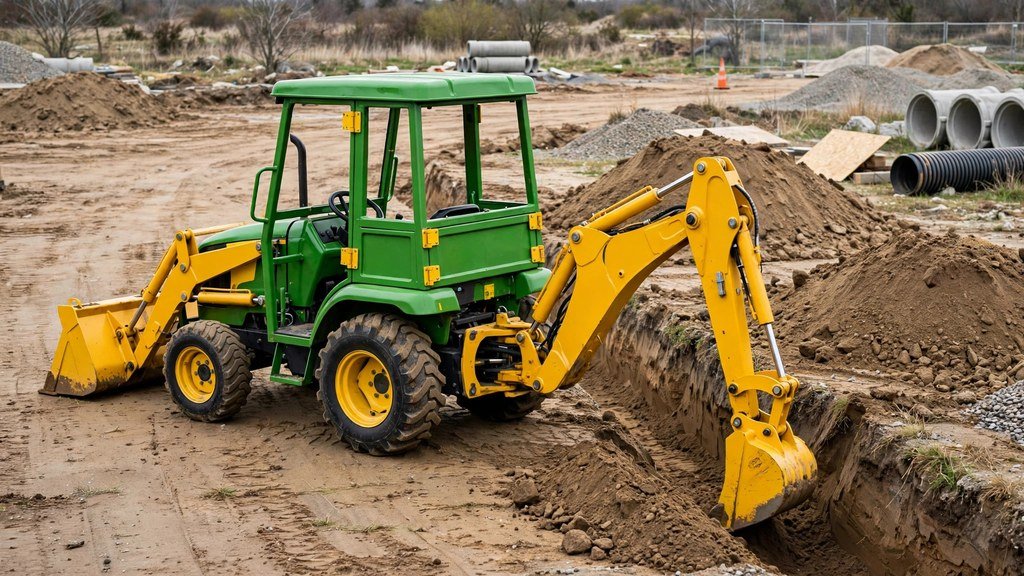
The 300E is the factory loader for the 3025E, and its numbers are strong for the class — strong enough that this John Deere 3025E review rates it ahead of most rivals’ standard loaders: 84 inches of maximum lift height, 1,186 pounds of lift capacity at the pivot pin at full height (845 pounds measured 500 mm ahead of the pivot), and 1,704 pounds of boom breakout force at the pivot. Dump clearance is 63 inches with the bucket fully dumped, and the standard 61-inch materials bucket detaches quickly for pallet forks or a grapple with an added third function. Deere also offers a mechanical self-leveling 300E that raises rated lift capacity to 1,283 pounds. The loader lists at $6,024 with installation on the May 2026 price page, and Deere requires proper three-point ballast for safe loader work.
For digging, this John Deere 3025E review confirms the 370B backhoe fits the 3025E with Deere’s BLV11015 subframe mounting kit and the BLV11068 Power Beyond hydraulic kit — it is not a three-point bolt-on, and the subframe is what keeps the digging loads off the transmission case. The 370B digs to 6 feet 10 inches with a 148-degree swing arc, 2,692 pounds of bucket digging force, and 8, 12, or 16-inch buckets. Because the 3025E has no mid PTO, mowing means a rear-mounted grooming or finish mower driven by the rear 540 PTO rather than an AutoConnect belly deck; a 60-inch rear finish mower is the sweet spot for the 17.4 PTO horsepower.
Implement Compatibility and Work Limitations
The Category 1 hitch with iMatch Quick-Hitch compatibility makes implement swaps a one-person job, and the 17.4 PTO horsepower comfortably runs 4 to 5-foot rotary cutters, 48 to 60-inch tillers, box blades, landscape rakes, post-hole diggers, and overseeders — which is why implement flexibility scores well in this John Deere 3025E review. Stay within the 1,356-pound hitch rating and size implements to the PTO power — a 6-foot brush hog is too much cutter for this tractor, and owners who try it report the classic symptoms of an overloaded compact: lugging, slow PTO recovery, and premature clutch wear.
Know the limits before you buy — the honest-limits section of any John Deere 3025E review: the 3025E is an open-station tractor with economy-spec hydraulics, so it is not the pick for running a hydraulic grapple all day without added remotes, for constant heavy ground-engaging work, or for buyers who need a factory cab. Rear ballast is mandatory with the loader — a ballast box or filled rear tires — because the light rear end gets tippy with a raised bucket, a setup issue owners mention often. Anyone regularly maxing out the loader or the PTO should price the 3038E step-up, covered in the comparison below.
John Deere 3025E vs. 3025D and Other Compact Tractors
No John Deere 3025E review is complete without the cross-shop, because Deere sells the same basic tractor with a gear transmission as the 3025D, and Kubota’s L2501 fights it head-on in every rural county. The right pick depends on how you work, not on the badge.
Differences in Power, Features and Capabilities
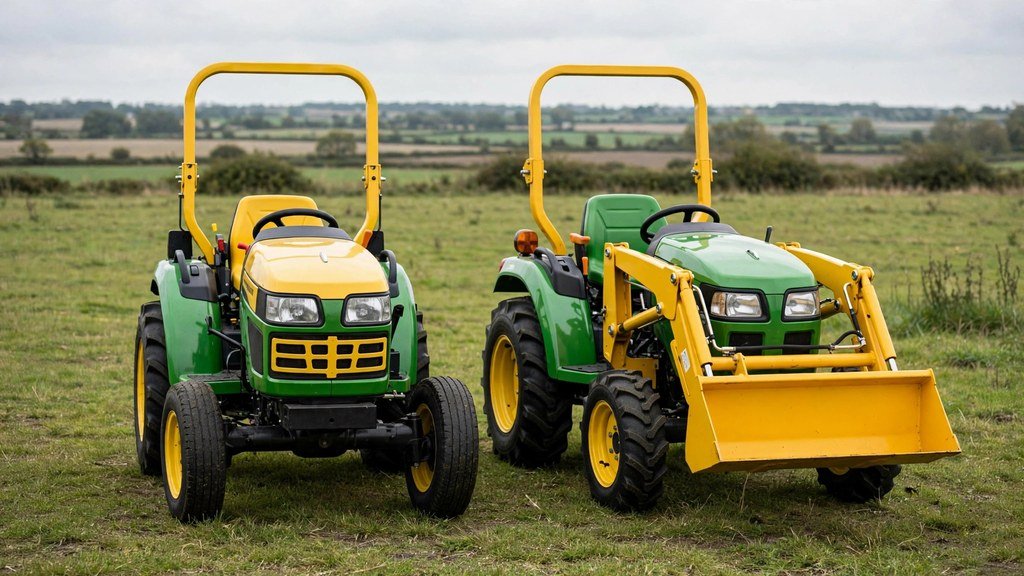
The 3025D is the 3025E’s gear-drive twin: the same 24.4-horsepower Yanmar and Final Tier 4 emissions, but an 8-forward/8-reverse synchromesh shuttle transmission instead of hydrostatic drive. Papé Machinery’s comparison notes the 3025D puts 20.7 horsepower to the PTO versus the 3025E’s 17.4 (gear drives lose less power than hydrostatics), lifts 2,081 pounds on the three-point versus 1,356, and turns tighter with its brakes at 5.3 feet. The tradeoff is convenience: the 3025D uses a right-hand gear lever and clutch work, while the 3025E’s Twin Touch pedals make loader work and mowing far less tiring. The 3025D listed at $20,055 in 2023, typically a few hundred to about a thousand dollars less than a comparable 3025E.
Against the Kubota L2501 (24.8 hp), the fight is close. The Kubota offers a three-range hydrostatic or a gear option, a larger 10-gallon fuel tank, and a steel hood versus the Deere’s plastic, and dealer comparisons generally put the Kubota slightly cheaper upfront. The Deere counters with Twin Touch pedals, tighter dealer network coverage in most US regions, and historically stronger resale value — Koenig Equipment’s comparison notes both brands are durable but Deere holds value better at trade-in time.
| Model | Engine HP | PTO HP | Transmission | 3-Pt Lift (lb) | Fuel Tank |
|---|---|---|---|---|---|
| John Deere 3025E | 24.4 | 17.4 | 2-range hydro | 1,356 | 7.5 gal |
| John Deere 3025D | 24.4 | 20.7 | 8F/8R gear shuttle | 2,081 | 7.5 gal |
| John Deere 3038E | 36.7 | 30 | 2-range hydro | 1,356 | 7.5 gal |
| Kubota L2501 | 24.8 | — | 3-range hydro or gear | — | 10 gal |
Which Compact Tractor Offers Better Value?
For most buyers, the 3025E is the value sweet spot: hydrostatic ease, enough power for real implements, and the lowest price of entry into Deere’s 3-series. Our verdict in this John Deere 3025E review: choose the 3025D only if you prefer gear drive, run PTO implements for long hours where the extra PTO horsepower and efficiency pay off, or want the stronger three-point lift for heavy rear implements — and accept the clutch work that comes with it.
Step up to the 3038E — 36.7 gross horsepower and 30 PTO horsepower per Deere’s spec sheet, advertised around $28,692 with a loader at Greenway — if you regularly run a 6-foot cutter, a 72-inch tiller, or heavy material handling. Our 3038E review covers that machine in full. And if you are deciding between the 2-series and 3-series, our 2032R review shows what the smaller-frame alternative offers. For everyone else doing 5 to 20 acres of mixed work, the 3025E remains the rational buy in the John Deere 3025E review class.
Frequently Asked Questions About the John Deere 3025E
These are the questions buyers ask most often after reading a John Deere 3025E review, answered from Deere’s spec sheets and current dealer listings.
How much horsepower does the John Deere 3025E have?
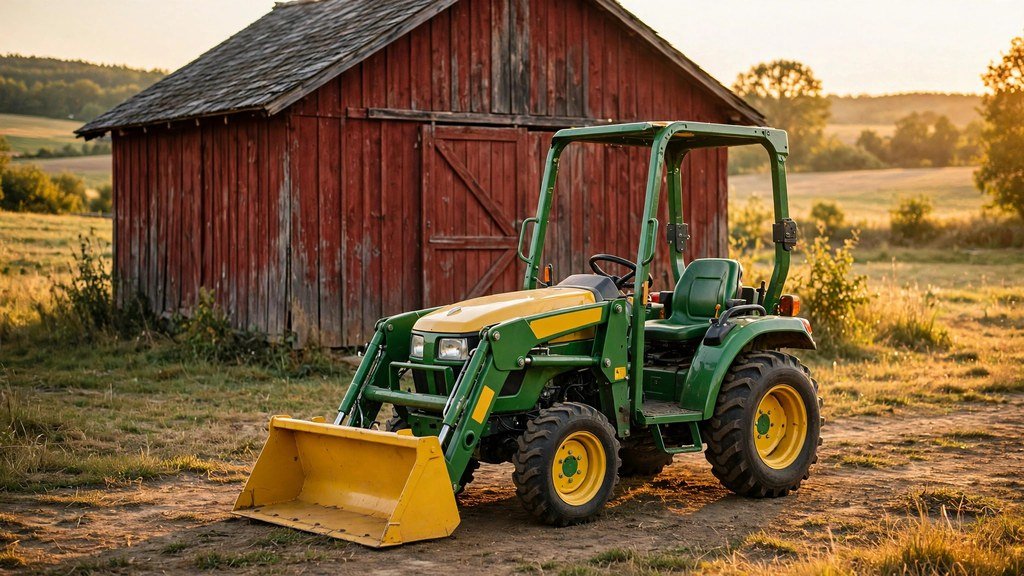
The John Deere 3025E is rated at 24.4 gross horsepower (18.2 kW, 24.7 PS) at 2,400 rpm from its 1.642-liter three-cylinder Yanmar diesel, with 17.4 horsepower available at the rear PTO. That under-25-hp rating, central to this John Deere 3025E review, is deliberate: it keeps the tractor in the Final Tier 4 bracket that requires no DPF or DEF.
How much does a new John Deere 3025E cost with a loader?
Deere’s May 2026 price page — linked in this John Deere 3025E review — lists the combination at $27,473 ($21,449 tractor plus $6,024 for the 300E loader with installation), but dealers discount heavily: advertised cash prices for new 2026 machines with loaders ran $19,999 to $22,500 in late 2026. Most buyers should expect to pay in the low $20,000s after shopping two or three dealers.
Does the John Deere 3025E have a DPF or need DEF?
No — and this is one of the most-read answers in any John Deere 3025E review. The 3025E’s 24.4-horsepower Yanmar meets Final Tier 4 emissions without a diesel particulate filter and uses no DEF fluid. There are no regeneration cycles to manage, which simplifies ownership compared with larger Tier 4 tractors that carry DPF and DEF systems.
Can you put a backhoe on a John Deere 3025E?
Yes — a popular question this John Deere 3025E review answers often. The 370B backhoe fits the 3025E with Deere’s BLV11015 subframe mounting kit and the BLV11068 Power Beyond hydraulic kit. It digs to 6 feet 10 inches with a 148-degree swing. Budget for the subframe and hydraulics on top of the backhoe itself, and have the dealer install it.
Can the 3025E run a mid-mount mower deck?
No. As noted in this John Deere 3025E review, the 3025E has no mid PTO, so a belly mower is not an option. Mowing is done with rear three-point grooming or finish mowers driven by the rear 540 PTO — a 60-inch rear finish mower matches the 17.4 PTO horsepower well.
What is the difference between the 3025E and the 3025D?
The 3025D is the gear-drive version of the same tractor this John Deere 3025E review covers: same 24.4-hp Yanmar, but an 8F/8R synchromesh shuttle transmission, 20.7 PTO horsepower, and a 2,081-pound three-point lift versus the 3025E’s hydrostatic drive, 17.4 PTO horsepower, and 1,356-pound lift. The 3025D typically costs slightly less but demands clutch work; the 3025E is easier for loader work and mowing.