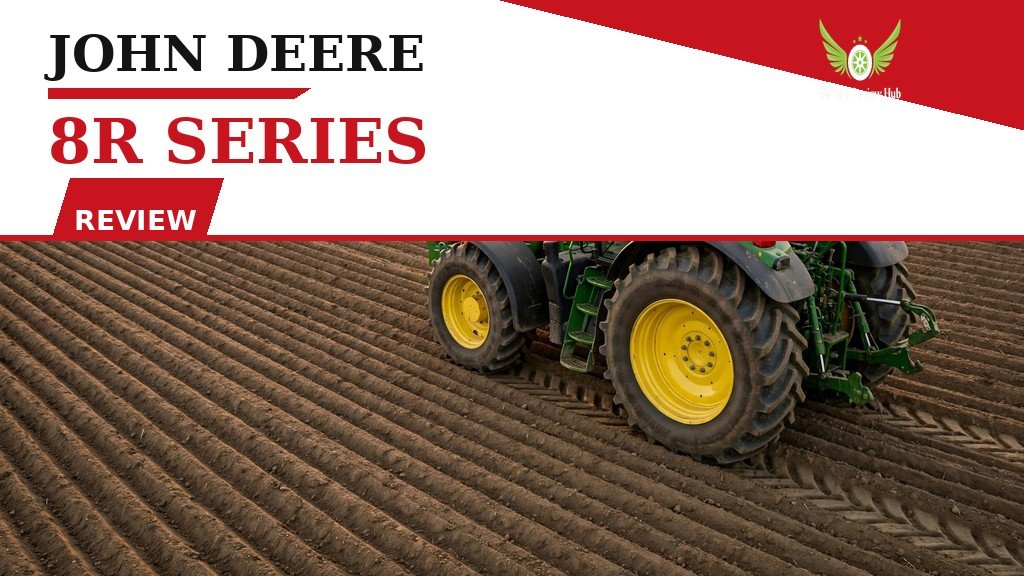
The John Deere 8R Series review starts with a simple fact: this is the row-crop tractor that defines what “big frame” means in American agriculture. The 8R family spans 230 to 410 rated horsepower from a single PowerTech 9.0L six-cylinder, with three transmission families, up to 84 gallons per minute of hydraulic flow, and a chassis that tops 44,000 pounds when fully ballasted. If the 7R is the versatile middleweight, the 8R is the machine that handles primary tillage, 24-row planters, and the biggest grain carts without breaking a sweat. This John Deere 8R Series review is the complete USA buying guide for the line.
This John Deere 8R Series review covers all seven models — the 8R 230, 8R 250, 8R 280, 8R 310, 8R 340, 8R 370, and 8R 410 — with verified engine specs, transmission options, implement compatibility, new and used pricing, and comparisons against the 7R and 8RX. Figures come from John Deere spec sheets, current dealer listings, and owner reports — the sourcing standard behind every John Deere 8R Series review on this site; estimates are labeled where they are estimates.
John Deere 8R Series Review, Models and Price
The 8R is John Deere’s large-frame wheeled row-crop tractor, built in Waterloo, Iowa, for operations where the implement sets the horsepower requirement — big discs and rippers, 24-row planters, large air seeders, and high-capacity grain carts. Seven models cover the range, all sharing the PowerTech 9.0L six-cylinder, the CommandView III cab, and closed-center pressure-flow-compensated hydraulics. The latest 2026 update consolidated the line around the 280–410 hp models with the JD9 engine and updated transmissions including eAutoPowr; earlier model years also carried the 8R 230 and 8R 250 badges on the same 9.0L platform — the full range this John Deere 8R Series review covers in depth.
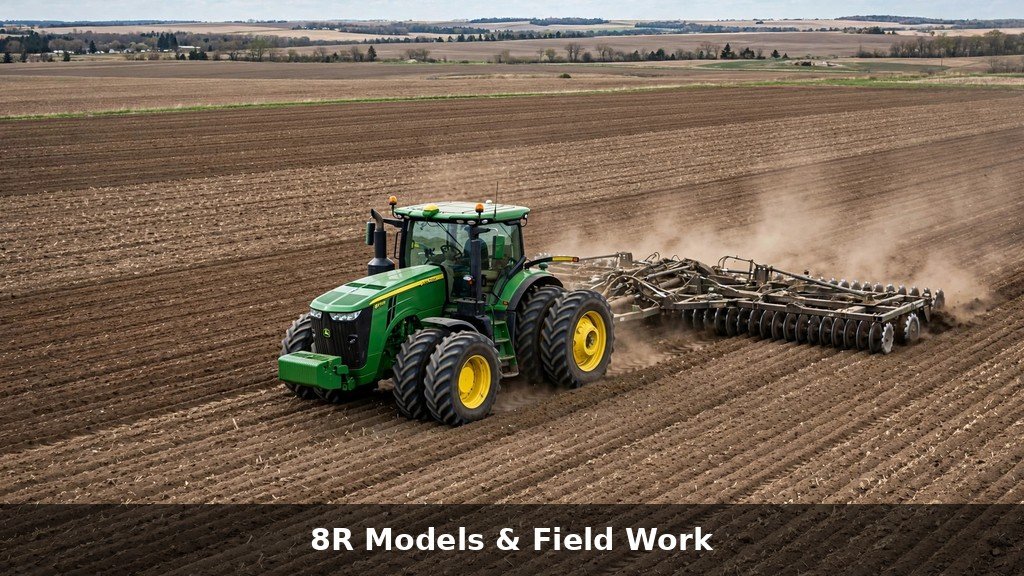
8R Tractor Models, Features and Intended Uses
The lineup runs 8R 230 (230 hp), 8R 250 (250 hp), 8R 280 (280 hp), 8R 310 (310 hp), 8R 340 (340 hp), 8R 370 (370 hp), and 8R 410 (410 hp), each rated at 2,100 rpm with Intelligent Power Management adding roughly 10 percent in transport and PTO work. Standard equipment targets row-crop productivity: the e23 PowerShift with Efficiency Manager, 60 gpm of hydraulic flow, a Category 3/3N rear hitch rated at 14,000 pounds, and precision-ag readiness with GreenStar, AutoTrac components, and JDLink telematics baked in. The 8R 230 and 8R 250 suit large mixed operations stepping up from a 7R; the 280–340 models are the volume sellers for serious row-crop work; and the 370 and 410 are primary-tillage machines built for the heaviest draft loads on the farm.
The video below from Farmers Guide shows an 8R 370 at a NORMAC demo day — a good look at the machine in real working conditions:
New and Used Prices by Model, Year and Configuration
New 8R pricing sits at the top of the wheeled row-crop market. John Deere’s May 2026 government price page lists the 8R 370 base machine at $642,367 before options — the reference point this John Deere 8R Series review uses for new-machine pricing, and most configured tractors leave the dealership well above $700,000 once IVT, visibility and comfort packages, front hitch, weights, and guidance equipment are added. That is the honest pricing picture this John Deere 8R Series review can document today; dealers quote final prices on request. That is the new-machine picture; this John Deere 8R Series review turns to the used market next.
Used values hold up well, which matters for the ownership-cost math in our John Deere 8R Series ownership cost guide. Recent US dealer listings include a 2025 8R 370 with 392 hours at $465,000 at Van Wall in Knoxville, Iowa; a 2024 8R 370 with 1,525 hours at $369,900 at Van Wall in Nevada, Iowa; another 2024 8R 370 at $419,900; and a 2024 8R 370 with 2,878 hours at $329,900 at Van Wall in Hampton, Iowa. Independent aggregator AllMachines prices used 8R 310s between $329,610 and $398,800 and 8R 370s between $293,000 and $435,000 depending on year, hours, and condition — the kind of data points this John Deere 8R Series review relies on for the used market.
John Deere 8R Series Engine, Horsepower and Specifications
Every 8R runs a John Deere PowerTech 9.0L six-cylinder — 549 cubic inches, B20-biodiesel-compatible, Final Tier 4 with DOC, DPF, and SCR/DEF aftertreatment. Dealer spec sheets confirm engine family MJDXL09.0333 on the 8R 280, with a single variable-geometry turbo, air-to-air aftercooling, and cooled exhaust gas recirculation. Rated speed is 2,100 rpm; peak torque arrives at 1,600 rpm (1,311 Nm / 966 lb-ft on the 8R 280); and PTO torque rise is 40 percent, which is what keeps the engine digging instead of stalling when the load spikes. These are the verified figures this John Deere 8R Series review uses for implement matching.
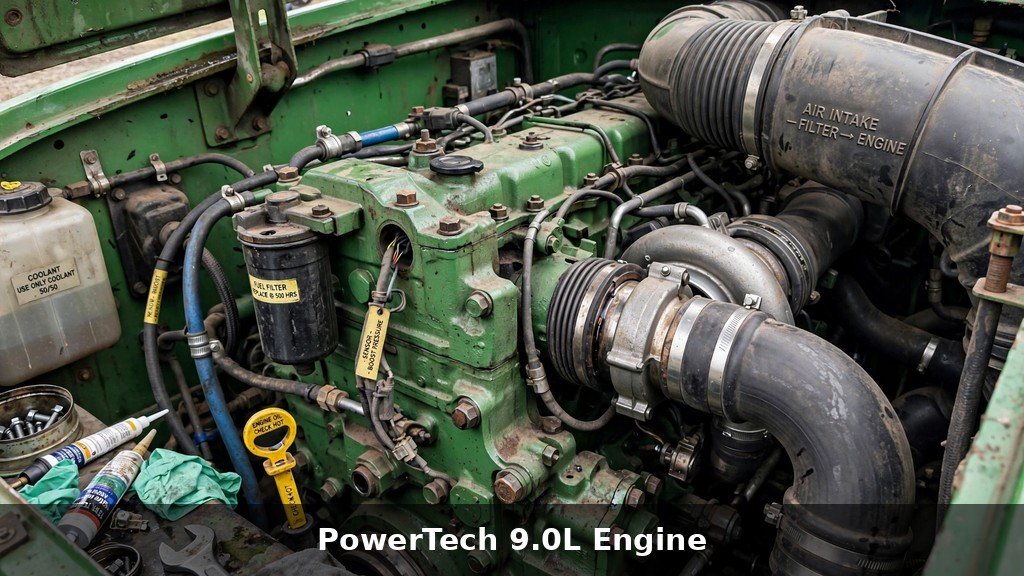
Rated HP, Maximum HP, IPM and PTO Power
The three power figures Deere publishes — rated, maximum without IPM, and maximum with IPM — tell the real story, and this John Deere 8R Series review treats them as the single most important numbers on the spec sheet. Rated power is the ECE-R120 figure at 2,100 rpm; maximum power without IPM is what the engine makes at its torque peak; and Intelligent Power Management adds roughly 10 percent in transport and mobile PTO applications.
| Model | Rated hp | Max hp (no IPM) | Max hp (with IPM) |
|---|---|---|---|
| 8R 230 | 230 | — | — |
| 8R 250 | 250 | — | — |
| 8R 280 | 280 | 308 | 326 |
| 8R 310 | 310 | 341 | 357 |
| 8R 340 | 340 | 374 | 388 |
| 8R 370 | 370 | 407 | 420 |
| 8R 410 | 410 | 443 | 458 |
Maximum-power figures for the 8R 230 and 8R 250 are not published in the current-line materials (both were dropped from the 2026 update), so this John Deere 8R Series review lists rated power only for those two — treat older-brochure maximums for early model years as year-specific rather than current. Rated PTO power runs 228 hp on the 8R 280, 257 hp on the 8R 310, and 310 hp on the 8R 370 (dealer spec sheets), putting the top of the line firmly in the territory where PTO-driven implements like big manure tankers and heavy forage harvesters live.
Engine Displacement, Dimensions, Hydraulics and Hitch Capacity
The 9.0L six is just the start. Hydraulics come from an 85-cc pump delivering 60 gpm standard, with an optional 85-cc plus 35-cc dual pump pushing 84 gpm for operations running big air seeders or multiple hydraulic motors. The rear hitch is Category 3/3N with 14,000 pounds of standard lift at 24 inches behind the hitch point, 18,500 pounds with the optional higher-capacity cylinders, and up to 20,000 pounds with the Category 4N/3 option. A Category 3N ground-engaging front hitch adds 11,464 pounds up front. Base machine weight runs 25,800 pounds (MFWD/PowerShift) to 28,000 pounds (ILS/e23), with maximum permissible weight at 44,100 pounds — and a 120.1-inch wheelbase (3,050 mm) that keeps that weight planted. The fuel tank holds 192 US gallons (727 liters), or 172 gallons (651 liters) with the optional central tire inflation system plumbing. Those capacities are the baseline this John Deere 8R Series review uses when sizing the 8R against the 7R and 8RX.
John Deere 8R Series Transmission and Implement Compatibility
Three transmission families cover the 8R line, and choosing among them is one of the biggest decisions a buyer makes — so this John Deere 8R Series review breaks down each one below. The e23 PowerShift (23 forward, 11 reverse) is standard on most models with Efficiency Manager and 40 km/h or 50 km/h top speeds; the 16-speed PowerShift is the traditionalist’s choice on the 280 through 370; and AutoPowr IVT — the latest eAutoPowr on the updated 370 and 410 — gives stepless speed control with CommandPRO, the joystick driving control reviewers consistently praise for loader and transport work. The 8R 410 is e23 or eAutoPowr only; the 16-speed box drops off at the top of the range.
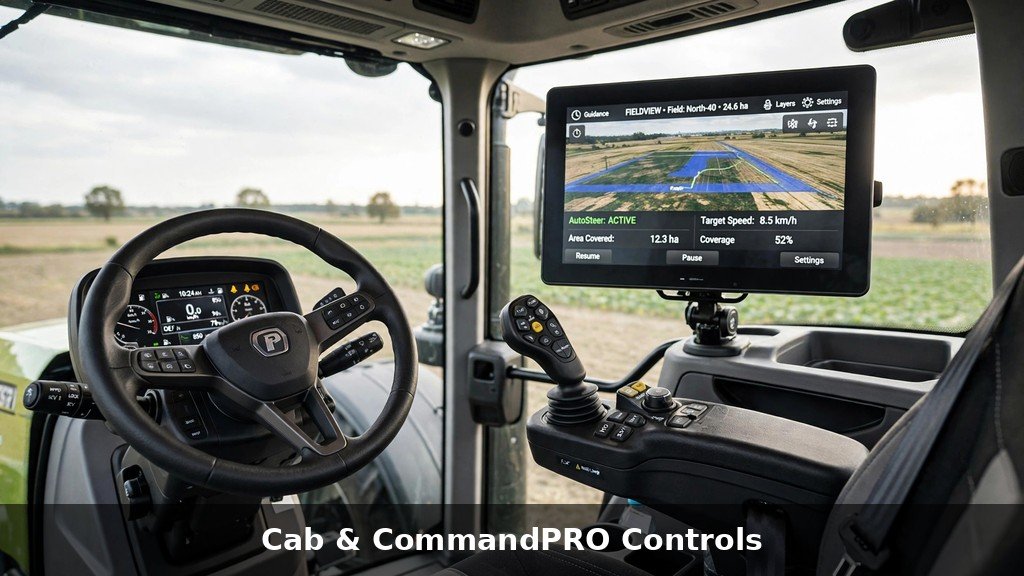
e23 PowerShift, 16-Speed PowerShift and IVT Options
The e23 is the default for a reason: full powershift with automatic and custom-programmed shift modes, 15-percent gear spacing, and top speeds of 26 mph (40K) or 31 mph (50K), with ILS or Triple-Link Suspension Plus calming the ride at road speed. The 16-speed PowerShift is a simpler full-powershift box that appeals to buyers who want proven mechanical simplicity and lower service complexity. This John Deere 8R Series review treats the e23 as the transmission most buyers should default to. AutoPowr IVT shines in PTO and draft work where ground speed needs to stay constant while engine load varies — hay, forage, and manure work — though it carries a purchase premium and its own service profile. All three pair with electrohydraulic front and rear differential locks, and all support the active suspension options that make 31 mph road transport civilized. For buyers torn between boxes, this John Deere 8R Series review recommends the e23 for mixed work and IVT for PTO-heavy duty.
PTO, Three-Point Hitch, Hydraulic Flow and Implement Compatibility
The independent rear PTO is 1,000 rpm standard on a 1.75-inch 20-spline shaft, with 540/1,000, 540E/1,000E, and 1,000E gearcase options for matching implement demand to engine load; a front PTO comes with the optional front hitch. Engagement is via electric switch with adjustable modulation. With up to 84 gpm of hydraulic flow, up to six rear SCVs, and front SCVs available, the 8R handles implements that are as much hydraulic systems as steel — which is why this John Deere 8R Series review rates the 8R as the large-frame sweet spot for air-seeder operations — large air seeders with fan and meter drives, big planters with bulk-fill blowers, and heavy tillage tools with hydraulic depth control. Independent Link Suspension (ILS) is the signature 8R feature for drawbar pull: the front axle carries its own suspension travel, which is why owners consistently report the 8R out-pulls fixed-axle competitors of similar weight.
John Deere 8R Series vs. 7R and 8RX Tractors
The 8R sits between two very different machines, and the comparison below — central to this John Deere 8R Series review — clarifies what you’re paying for. Against the 7R, the 8R brings more displacement (9.0L vs. 6.8L on the smaller 7Rs), 60/84 gpm hydraulics vs. 43/59 gpm, a 20,000-pound hitch option, and a chassis that starts where the 7R maxes out. Those deltas are the heart of this John Deere 8R Series review’s buying advice. Against the 8RX — the four-track version on the same power platform — the wheeled 8R trades ultimate traction and flotation for road speed, lower purchase price, simpler transport, and easier tire/track maintenance.
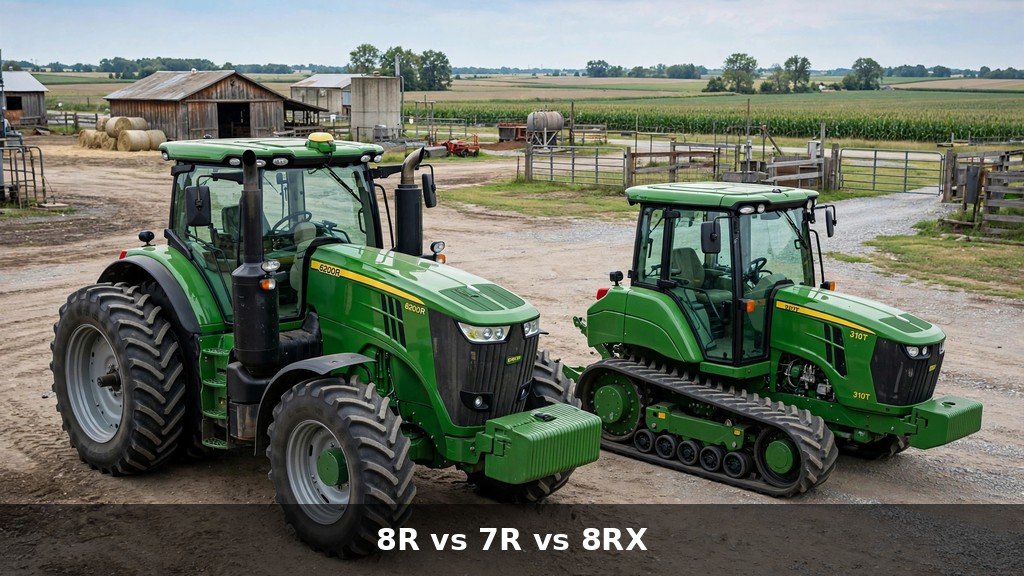
Differences in Power, Traction and Operating Capabilities
| Attribute | 7R Series | 8R Series | 8RX Series |
|---|---|---|---|
| Rated hp range | 210–330 | 230–410 | 280–410 |
| Engine | 6.8L / 9.0L 6-cyl | 9.0L 6-cyl | 9.0L 6-cyl |
| Drive | Wheeled MFWD | Wheeled MFWD/ILS | 4-track |
| Hydraulics | 43–59 gpm | 60–84 gpm | 60–84 gpm |
| Rear hitch max | 15,200 lb | 20,000 lb | 20,000 lb |
| Base weight | ~22,000 lb | ~25,800–28,000 lb | ~34,400 lb |
The 8R and 8RX share engines, cabs, and most options — the decision is traction versus mobility. If your soils are soft, your slopes steep, or your compaction budget tight, the tracks earn their premium. If you road between fields, value transport speed, or want to keep the purchase price and undercarriage maintenance down, the wheeled 8R is the rational pick — the conclusion this John Deere 8R Series review reached after weighing both machines. Our 8RX Series review walks through the track-machine side of that decision in detail.
Which Tractor Series Fits Your Farm and Budget?
Start with the implement, not the tractor — the first rule of this John Deere 8R Series review. If your biggest tool is a 24-row planter or a mid-size grain cart, an 8R 280 or 310 — or even a top-end 7R Series machine — will do the job for less money and less fuel. If you’re pulling big discs, rippers, or heavy air seeders, the 8R 340 through 410 with ILS is the right neighborhood. The 6R Series covers the step below the 7R for mixed farms, and the full 8R Series performance and fuel usage guide breaks down what each model drinks per hour of real work. After comparing all seven models, this John Deere 8R Series review treats the 8R 310 as the sweet spot for most large row-crop buyers: enough power for serious tillage, three transmission choices, and the strongest used-market support in the line.
Frequently Asked Questions About the John Deere 8R Series
Straight answers to the questions buyers ask most about the 8R line, drawn from this John Deere 8R Series review’s research.

What engine does the John Deere 8R Series use?
Every 8R uses a John Deere PowerTech 9.0L six-cylinder (549 cu in), B20-biodiesel-compatible, with a single variable-geometry turbo, air-to-air aftercooling, and cooled EGR — verified for this John Deere 8R Series review across dealer spec sheets. US Final Tier 4 aftertreatment is DOC + DPF + SCR with DEF — the DPF regenerates automatically and DEF refills come from a dedicated tank. The 280 through 340 models run the PVS 9.0L; the 370 and 410 run the PSS 9.0L (dealer brochure data).
How much horsepower does the John Deere 8R 410 have?
The 8R 410 is rated at 410 hp at 2,100 rpm, with 443 hp maximum without IPM and 458 hp with Intelligent Power Management engaged (transport and PTO work). It’s the top of the wheeled 8R line; the 8RX 410 matches it on tracks.
What transmissions are available on the 8R?
Three families: the e23 PowerShift (23 forward, 11 reverse, standard on most models), the 16-speed PowerShift (a simpler full-powershift option on the 280 through 370), and AutoPowr IVT (stepless, with CommandPRO joystick driving; the latest eAutoPowr on the 370 and 410). Top speeds are 26 mph (40K) or 31 mph (50K) depending on configuration — all three confirmed available on current-year machines in this John Deere 8R Series review’s research.
How much does a new John Deere 8R cost?
John Deere’s May 2026 price page lists the 8R 370 base machine at $642,367 before options; configured tractors commonly run $700,000-plus. Used prices from current dealer listings run roughly $330,000 for a 2024 8R 370 with 2,878 hours to $465,000 for a 2025 with 392 hours — and that spread is why this John Deere 8R Series review emphasizes used values in the buying decision. See our 8R Series ownership cost guide for the full new-vs-used math this John Deere 8R Series review recommends running before you shop.
Where is the John Deere 8R made?
The 8R Series is built in Waterloo, Iowa — confirmed on Deere’s May 2026 price page and dealer spec sheets. The warranty is Deere’s agricultural standard: 24 months / 2,000 hours base coverage (whichever comes first), with paid PowerGard extended plans available. This John Deere 8R Series review never treats the compact-tractor 6-year/2,000-hour warranty as applying to the 8R line.
Are there any recalls on the John Deere 8R Series?
No 8R-specific CPSC recall was verifiable in this John Deere 8R Series review’s research (the September 2024 brake recall covered 1023E/1025R/2025R compacts only). Some sources report various service campaigns over the years, but we could not verify an original CPSC release for the 8R line — treat those as reported rather than confirmed, and check any used machine’s serial number through your Deere dealer or 800-537-8233. Our 8R Series maintenance guide covers the full used-inspection checklist.