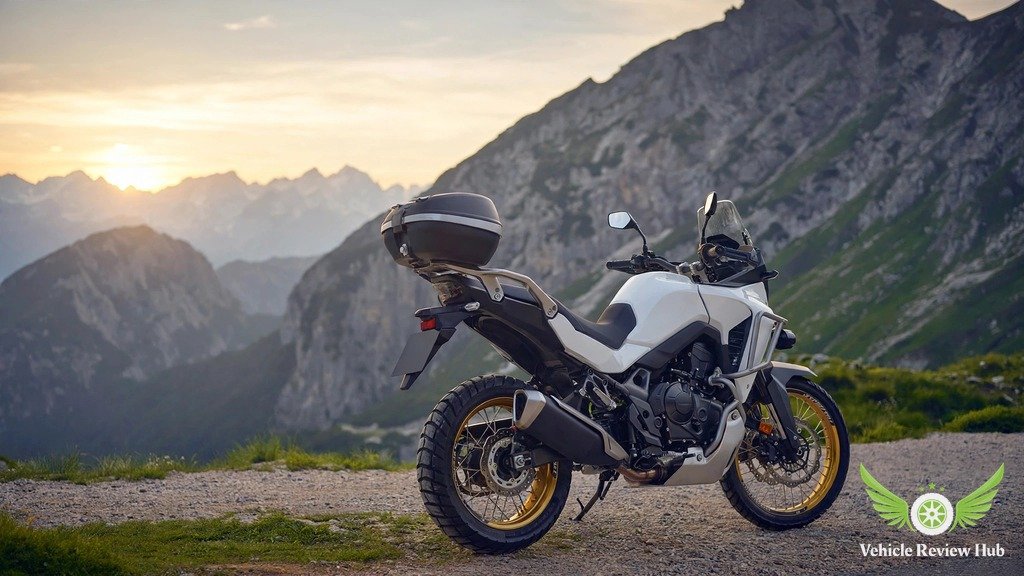
The Honda Transalp XL750 is the middleweight adventure bike that makes the most sense for riders who want one motorcycle for commuting, weekend gravel and long highway days, and for 2026 it costs $10,199 plus $600 destination. This Honda Transalp XL750 review gives you the direct answers first: it runs a 755cc parallel twin, weighs 468 pounds in current form, carries a 4.4-gallon tank, and now comes only with Honda’s E-Clutch system. This Honda Transalp XL750 review covers history, engine, prices, technology, comfort and verdict.
The short version of this Honda Transalp XL750 review is simple. If you want a light, affordable adventure bike with genuine off-road wheels and modern electronics, the Transalp is hard to beat at its price. If you want hardcore dirt performance or long-distance touring luxury, the Yamaha Tenere 700 or a bigger adventure bike fits better. Either way, this Honda Transalp XL750 review insists you judge the bike by its US model years, because the American lineup started in 2024, a year after Europe’s launch.
Honda Transalp XL750 Overview and Model-Year Updates
The Transalp name returns after a long absence, and the modern XL750 is a clean-sheet middleweight: a 755cc twin in a steel frame, with a 21-inch front wheel, a 5-inch TFT display and five ride modes. This Honda Transalp XL750 review treats it as a road-biased adventure bike with real gravel ability, not a dirt bike with plates.
What Is the Honda Transalp XL750 and Who Is It Designed For?
The Transalp sits between Honda’s smaller dual-sports and the big Africa Twin: a 755cc adventure bike built for riders who split their time between pavement and unpaved roads. This Honda Transalp XL750 review describes it as the right bike for commuters who ride gravel on weekends, newer adventure riders moving up from a small dual-sport, and experienced riders who want a lighter second bike. It is not a lightweight trail bike, and this Honda Transalp XL750 review does not pretend otherwise: at 468 pounds, it is a substantial machine that rewards smooth inputs over aggressive off-road riding, a balance this Honda Transalp XL750 review returns to in the verdict.
US Launch 2024, 2025 Facelift and 2026 E-Clutch Update Explained
Europe got the rebooted Transalp as a 2023 model, but American buyers waited until 2024, when Honda confirmed the XL750 for the US market at $9,999 in Matte Black Metallic only, as RevZilla’s US confirmation reported. The 2025 model kept the $9,999 price and brought the facelift: a central aero duct, a Durabio windscreen, a dual-projector LED headlight, an optically bonded TFT display with Honda RoadSync, and retuned suspension, arriving at dealers in June 2025, as Rider’s 2025 preview reported. This Honda Transalp XL750 review notes the 2025 suspension retune softened the fork and firmed the shock for better control on uneven ground, while travel stayed at 7.9 inches front and 7.5 inches rear. The 2026 model is the bigger change: E-Clutch as standard, fully adjustable suspension and an aluminum skid plate, at $10,199 plus $600 destination, with dealers receiving bikes from July 2026. This Honda Transalp XL750 review keeps that three-year split straight because each year rides slightly differently, and used buyers will meet all three.
Honda Transalp XL750 Engine and Specifications
The Transalp uses a liquid-cooled 755cc Unicam parallel twin with a 270-degree crankshaft, shared in concept with Honda’s CB750 Hornet street bike but tuned for adventure use. This Honda Transalp XL750 review notes the engine is the bike’s strongest asset: flexible, smooth and happy to rev.

755cc Parallel-Twin Engine, Six-Speed Gearbox and Assist Clutch
The engine displaces 755cc from an 87.0mm bore and 63.5mm stroke, runs an 11.0:1 compression ratio, and breathes through a 46mm throttle body with programmed fuel injection and throttle-by-wire. Honda’s European claim is 90.5 horsepower at 9,500 rpm and 55 lb-ft at 7,250 rpm; Honda USA publishes no horsepower figure, so this Honda Transalp XL750 review quotes the European claim as exactly that, never as a US rating. The six-speed gearbox uses an assist-and-slipper clutch on 2024 and 2025 bikes, and Honda’s E-Clutch system on the 2026 model, which lets the rider shift up and down and pull away or stop without using the clutch lever, while the lever still works conventionally whenever the rider wants it. The performance figures explain how that power reaches the road.
Weight 459 to 468 lb by Year, Seat Height 33.7 Inches and Specifications
Honda lists the Transalp at 459 pounds for 2024, 463 pounds for 2025 and 468 pounds for 2026, measured with fluids and a full tank, and the seat sits at 33.7 inches with an optional 32.6-inch accessory seat. The weight crept up as Honda added equipment, but the bike stays one of the lighter middleweight adventure bikes, and this Honda Transalp XL750 review notes the seat height is accessible by adventure standards. The table below gathers the current specification, confirmed for 2026 on the Honda USA specification page.
| Specification | 2026 Transalp E-Clutch |
|---|---|
| Engine | 755cc Unicam parallel twin |
| Compression ratio | 11.0:1 |
| Claimed output (EU) | 90.5 hp @ 9,500 rpm; 55 lb-ft @ 7,250 rpm |
| Gearbox | Six-speed manual with Honda E-Clutch; #520 chain |
| Curb weight | 468 lb |
| Seat height | 33.7 inches (optional 32.6-inch seat) |
| Tires | 90/90-21 front; 150/70-18 rear, tube-type spoked |
| Brakes | Dual 310mm front; single 256mm rear; ABS |
| Suspension travel | 7.9 in front; 7.5 in rear, fully adjustable for 2026 |
| Fuel capacity | 4.4 gallons |
| Warranty | Transferable one-year limited warranty; HondaCare available |
Honda Transalp XL750 Price and Market Availability
The Transalp has always been priced as a value bike, and that is central to its appeal. This Honda Transalp XL750 review puts the current bike at $800 below the Yamaha Tenere 700, before destination charges, while offering more electronics and a more comfortable road ride.

Honda Transalp XL750 Price by Year in the USA: 2024 to 2026
The Transalp listed at $9,999 for both 2024 and 2025, then rose $200 to $10,199 for 2026, with destination charges of $600 on the current bike. The table below shows the run, and this Honda Transalp XL750 review notes the 2026 increase buys real hardware — E-Clutch, fully adjustable suspension and an aluminum skid plate — rather than a color change. The bike is sold through any authorized Honda Powersports dealer, and the 2026 model reached dealers from July 2026.
| Model year | MSRP | Key change |
|---|---|---|
| 2024 | $9,999 | US launch, Matte Black Metallic only |
| 2025 | $9,999 | Facelift, new TFT, retuned suspension |
| 2026 | $10,199 + $600 dest | E-Clutch standard, adjustable suspension, skid plate |
Colours by Year: Matte Black, Then White and Deep Pearl Gray
For 2024, American buyers got one color: Matte Black Metallic, a deliberately plain launch choice that disappointed riders hoping for the traditional red-white-and-blue Transalp scheme sold in Europe. From 2025 onward the US bike comes in White and Deep Pearl Gray, and the 2026 E-Clutch model keeps those two colors. This Honda Transalp XL750 review notes the color history matters for used buyers: a 2024 bike in any color other than matte black should prompt questions about repainting, and the white 2025-on bikes are the easiest to spot at a glance. Honda’s accessory catalog also matters to this Honda Transalp XL750 review: heated grips, a taller windscreen, a lower seat, knuckle guards, a centerstand, an aluminum skid plate and hard luggage are all offered, so a used bike’s farkle list can add real value or hide crash damage, and buyers should check whether accessories were dealer-fitted or improvised.
Honda Transalp XL750 Design, Features and Technology
The Transalp looks like a smaller Africa Twin, with a tall windscreen, a slim tank and a high front fender over its 21-inch wheel. This Honda Transalp XL750 review finds the 2025 redesign matters most, because it fixed the two weakest parts of the launch bike: the headlight and the display.

21-Inch Tubed Spoked Wheels, TFT Display and Dual Projector Headlight
The single most important design fact in this Honda Transalp XL750 review is the wheel setup: a 21-inch front and 18-inch rear, wire-spoked and tube-type on every US year, so a puncture means a tube change rather than a roadside plug. The 5-inch full-color TFT display shows speed, fuel, trip, gear position and ride mode, and from 2025 it uses optical bonding for readability in bright sunlight plus Honda RoadSync smartphone connectivity. The 2025 facelift also replaced the launch bike’s single headlight with a compact dual-projector LED unit borrowed in spirit from the Africa Twin, a change reviewers praised. The reliability record covers what to check on those wheels and the display.
Ride Modes, HSTC Levels and Why There Is No IMU, Cornering ABS or Cruise
The Transalp offers five ride modes — Sport, Standard, Rain, Gravel and a customizable User mode — adjusting power delivery, engine braking and ABS intervention, with Honda Selectable Torque Control managing rear-wheel slip and the User mode allowing rear ABS to be switched off for dirt. What it does not offer is equally important to this Honda Transalp XL750 review: there is no inertial measurement unit, so there is no lean-sensitive cornering ABS or cornering traction control, only conventional two-channel ABS. Cruise control is also absent on every US model year, a noted omission in 2025 coverage that Honda’s 2026 feature list does not change. Buyers who want those systems must step up to a bigger, more expensive adventure bike, and this Honda Transalp XL750 review counts that as a fair trade at this price, not a hidden flaw.
Honda Transalp XL750 Riding Experience and Comfort
On the road, the Transalp feels light, narrow and easy, closer to a tall street bike than to a heavy adventure machine. This Honda Transalp XL750 review bases its riding impressions on published road tests and owner feedback rather than a personal test ride.

Riding Position, Handling and Low-Speed Maneuverability
In this Honda Transalp XL750 review, the riding position is upright and roomy, with a wide handlebar, a narrow waist at the tank-seat junction, and footpegs placed for long days rather than aggressive standing. At 468 pounds with a 33.7-inch seat, the bike is manageable at parking-lot speeds for most adult riders, and reviewers consistently call it instantly confidence-inspiring, as RevZilla’s 2024 first ride found. The 21-inch front wheel slows steering slightly compared with a 19-inch setup, but the payoff is stability on gravel. Shorter riders should also try the optional 32.6-inch accessory seat, which drops the saddle by just over an inch and makes flat-footing at stops noticeably easier without changing the suspension. The video below shows the 2026 E-Clutch model tested on tar and dirt, useful for the riding position and the way the clutch system works in real riding.
Highway Comfort, Gravel Roads and Everyday Practicality
Highway comfort is good rather than great: the windscreen and fairing keep wind off the chest, the seat supports long days, and the engine cruises relaxed, but the 4.4-gallon tank limits range and the absence of cruise control shows on long highway stretches. On gravel, this Honda Transalp XL750 review rates the bike genuinely capable for its class — the 21-inch wheel, long-travel suspension and Gravel mode make fire roads easy, though soft stock suspension on 2024–2025 bikes and the exposed sump before 2026 reward careful line choice. For everyday use the Transalp is comfortable and practical, with Honda’s dealer network behind it, but its size makes tight city filtering less easy than on a small dual-sport. This Honda Transalp XL750 review agrees with ADV Pulse’s 2025 first ride that the missing cruise control is the one omission riders keep hoping Honda will fix, since the bike is otherwise so well suited to long highway days. The used prices picture is covered in the companion guide.
Honda Transalp XL750 Review: Pros, Cons and Verdict
After weighing the specification, price history and published road tests, this Honda Transalp XL750 review lands in a clear place: the Transalp is the best-value middleweight adventure bike for the rider it was designed for, and a compromised one for riders who want either hardcore dirt ability or touring luxury.

Main Advantages and Limitations of the Honda Transalp XL750
In this Honda Transalp XL750 review, the advantages start with value: a 755cc twin, five ride modes, a TFT display with connectivity, a 21-inch front wheel and Honda build quality for $10,199 in 2026. The limitations are equally real: tube-type tires, no cruise control, no IMU-based electronics, a 4.4-gallon tank that caps range, and soft suspension on 2024–2025 bikes that heavier riders will want to upgrade. The 2026 model answers two of those complaints directly with fully adjustable suspension and a skid plate, which is why this Honda Transalp XL750 review rates it the pick of the range for new buyers. Ownership backup is another quiet strength in this Honda Transalp XL750 review: a transferable one-year limited warranty with optional HondaCare coverage, plus a dealer network that stocks common wear parts. The E-Clutch system itself needs a short learning period, since stopping in gear without touching the lever feels strange at first, but testers report it becomes second nature within a day of riding.
Who Should Consider the Honda Transalp XL750 Over the Tenere 700?
This Honda Transalp XL750 review says: choose the Transalp if your riding is mostly pavement with gravel weekends, you value ride modes, a TFT display and a lower price, and the $800 saving over the Tenere 700 matters. Choose the Yamaha Tenere 700 if hardcore dirt riding matters more than touring comfort, or if you want the simpler, lighter bike — Yamaha lists the Tenere at 452 pounds wet against the Transalp’s 468, with a deliberately minimal electronics package. The verdict of this Honda Transalp XL750 review is that the 2026 Transalp is a genuinely good all-roads adventure bike, provided you buy it for the mixed job Honda designed it to do.
Honda Transalp XL750 Review: Frequently Asked Questions
These direct answers cover the questions buyers ask most often after reading this Honda Transalp XL750 review.
How much does a 2026 Honda Transalp XL750 cost?
The 2026 Transalp E-Clutch lists at $10,199 plus $600 destination, in White or Deep Pearl Gray; this Honda Transalp XL750 review notes it is the only Transalp version for 2026, with E-Clutch standard.
What engine does the Transalp XL750 use?
This Honda Transalp XL750 review confirms the engine: a liquid-cooled 755cc Unicam parallel twin with a 270-degree crankshaft, 11.0:1 compression and a six-speed gearbox. Honda’s European claim is 90.5 horsepower at 9,500 rpm; Honda USA publishes no horsepower figure.
When did the Transalp XL750 come to the USA?
As a 2024 model, at $9,999 in Matte Black Metallic only. Europe got the rebooted Transalp a year earlier, so this Honda Transalp XL750 review treats any claimed 2023 US model as a European bike or a mislabel.
What changed for 2025 and 2026?
The 2025 bike kept the $9,999 price and added the facelift: aero duct, Durabio windscreen, dual-projector headlight, optically bonded TFT with RoadSync and retuned suspension. The 2026 bike added E-Clutch as standard, fully adjustable suspension and an aluminum skid plate, at $10,199. This Honda Transalp XL750 review rates the 2026 model the pick for new buyers.
How heavy is the Transalp XL750 and how tall is the seat?
This Honda Transalp XL750 review lists the bike at 459 pounds for 2024, 463 for 2025 and 468 for 2026, with the seat at 33.7 inches and an optional 32.6-inch accessory seat available.
Does the Transalp XL750 have tubeless tires?
No. The 21-inch front and 18-inch rear wheels are wire-spoked and tube-type on every US year, so this Honda Transalp XL750 review advises carrying tubes and tools on remote rides, since a puncture cannot be plugged at the roadside.
Does the Transalp XL750 have cruise control?
No, cruise control is absent on every US model year, including the 2026 E-Clutch model. This Honda Transalp XL750 review counts it as the bike’s most commonly cited omission for highway touring.
What is Honda E-Clutch on the 2026 Transalp?
E-Clutch lets the rider shift up and down and pull away or stop without using the clutch lever, while the lever still works conventionally. This Honda Transalp XL750 review stresses it is not an automatic gearbox: the rider still chooses every gear with the foot lever.
Is the Transalp XL750 good off-road?
It handles gravel roads, fire roads and light trails well for its class, thanks to the 21-inch wheel and long-travel suspension. For hard single-track or aggressive dirt riding, this Honda Transalp XL750 review recommends the lighter, simpler Tenere 700 instead.
Should I buy the Transalp XL750 or the Tenere 700?
Buy the Transalp for mixed road and gravel riding, ride modes, a TFT display and an $800 price advantage. Buy the Tenere 700 for dirt-first riding and simplicity, at 452 pounds wet with minimal electronics. This Honda Transalp XL750 review finds both honest bikes, aimed at different riders.