Short answer: the Honda Fury is the only factory-built chopper a major manufacturer still sells, and it has barely changed since its 2010 debut — the same 1312cc V-twin, the same 71-inch wheelbase, the same raked-out stance. For $11,499 plus $775 destination, this Honda Fury review finds a motorcycle that trades practicality for presence: a 26.7-inch seat, shaft drive, standard ABS, and head-turning style, against a 3.4-gallon tank, a 100 mph computer limit, and no modern electronics at all. This Honda Fury review covers prices by year, the specs Honda’s own pages disagree about, and who should buy the Fury over a modern bobber.
Honda Fury Overview and Model-Year Updates
The Fury occupies a segment of one in Honda’s lineup, and this Honda Fury review starts with what that means: no other current Honda looks like this, and no other major brand sells a production chopper at this price.
What Is the Honda Fury and Who Is It Designed For?
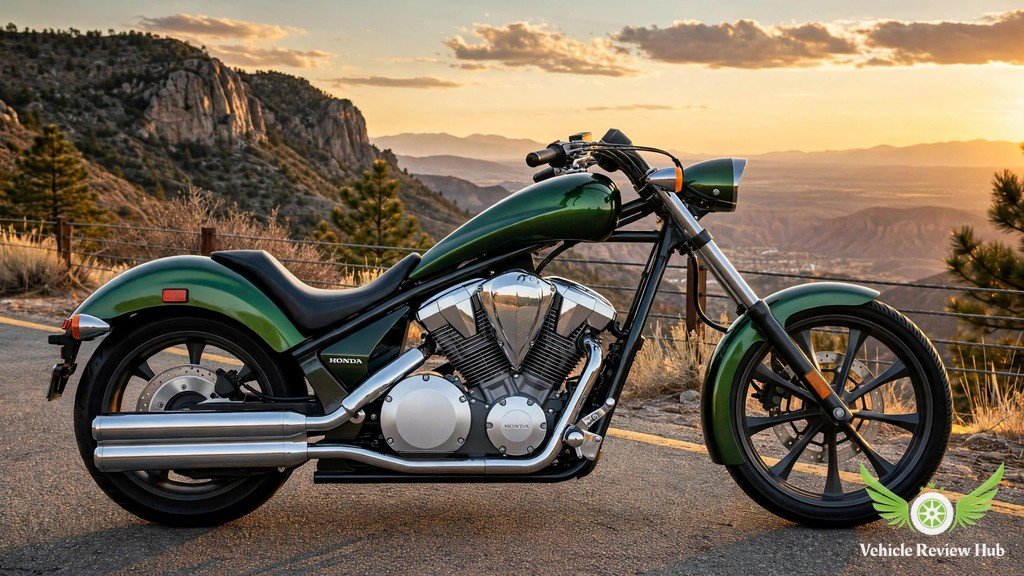
In this Honda Fury review, the Honda Fury (model code VT1300CX) is a factory chopper: a production motorcycle built to look like a custom-shop creation, with a stretched frame, a high steering head, long fork tubes, a teardrop tank, and a hardtail-style rear end hiding a single shock. This Honda Fury review describes a bike designed for riders who want chopper styling without chopper compromises — no welding, no fabrication, no sketchy handling, and a Honda dealer network behind it. The target buyer values presence over practicality: boulevards, bike nights, and weekend cruises, accepting a small tank and a solo-style seat as the price of the look. It is not a touring bike, not a commuter, and not a beginner’s first motorcycle despite the low seat — 675 pounds and a 71-inch wheelbase demand respect at parking-lot speeds. Cycle World’s Fury overview calls it one of the last factory choppers available from any manufacturer — and that scarcity is now part of the appeal.
US History 2010 to 2025: Mechanically Unchanged, No 2026 Model
The Fury debuted on January 16, 2009, at the New York International Motorcycle Show as a 2010 model, and this Honda Fury review stresses how little has changed since: engine, frame, suspension, and brakes are fundamentally the same in 2025 as in 2010, with paint colours and minor finishes doing the work of model-year updates. Launch pricing was $12,999 for the 2010 bike, per period reports; by 2020 the Fury sold for $10,599, and the 2025 bike costs $11,499 — cheaper new today than at launch, before inflation. As of November 2026, Honda has announced no 2026 Fury, and the 2025 remains the current model on Honda’s site; one third-party 2026 lineup compilation lists a 2026 Fury as an expected carryover — a prediction, not a Honda announcement — so this Honda Fury review treats 2025 as the latest model year. Buyers should also note the Fury’s quiet history, which this Honda Fury review verified: it was never a big seller, dealers often stock one at a time, and leftover 2025 bikes were still advertised into November 2026, sometimes discounted.
Honda Fury Engine and Specifications
The Fury’s numbers are modest by modern standards and honest about it, as this Honda Fury review notes: this is a torque-first cruiser engine, not a performance motor.

1312cc Liquid-Cooled 52-Degree V-Twin, 5-Speed Gearbox and Shaft Drive
The engine in this Honda Fury review is a liquid-cooled 1312cc 52-degree V-twin with single overhead cams, three valves per cylinder, programmed fuel injection through a 38mm throttle body, and a 9.2:1 compression ratio, derived from Honda’s VTX1300 family and retuned for the Fury. A single-pin crankshaft and dual counter-balancers give it the loping V-twin pulse chopper buyers want, with less vibration than a rigid-mounted custom. Honda USA publishes no horsepower figure, so this Honda Fury review quotes period tests instead: rear-wheel dyno runs cluster around 56–57 horsepower at about 4,300 rpm, with claimed torque of 79 lb-ft at 2,250 rpm and rear-wheel torque in the low 70s. Power reaches the rear wheel through a five-speed manual gearbox and a shaft final drive — the Fury is the only mass-produced chopper with shaft drive, which means no chain to lube or adjust, only final-drive oil on a long interval. The gearbox is a plain five-speed with a light, smooth clutch action period testers praised against Harley rivals.
Chopper Geometry, 71-Inch Wheelbase, Seat Height and 675 lb Curb Weight
Wheelbase, the figure this Honda Fury review leads with, is 71.0 inches on Honda’s current spec page (period tests measured 71.2 inches, the longest Honda ever built at the time), and curb weight is 675 pounds including a full tank. Seat height is where this Honda Fury review has to show its working: Honda’s current Fury page lists 26.7 inches, while dealer specification sheets list 26.9 inches — a small discrepancy, likely rounding or measuring differences, and either way the seat is among the lowest on any full-size motorcycle. Ground clearance is 4.9 inches, which matters for the peg-scraping discussion later in this Honda Fury review, and a one-year transferable limited warranty is included, with HondaCare extended coverage as an option.
| Specification | 2025 Honda Fury | Source |
|---|---|---|
| Engine | 1312cc liquid-cooled 52-degree V-twin, SOHC, 3 valves per cylinder | Honda USA |
| Transmission / final drive | 5-speed manual / shaft | Honda USA |
| Wheelbase | 71.0 inches | Honda USA |
| Seat height | 26.7 inches (dealer sheets: 26.9 inches) | Honda USA / dealer sheets |
| Curb weight | 675 pounds | Honda USA |
| Fuel capacity | 3.4 gallons | Honda USA |
| Front / rear tire | 90/90-21 / 200/50-18 | Honda USA |
Honda Fury Price and Market Availability
New Fury pricing has barely moved in fifteen years, and this Honda Fury review anchors used-bike judgments to the figures below rather than to asking-price folklore.

Honda Fury Price in the USA: $11,499 for 2025 Plus $775 Destination
The 2025 Fury costs $11,499 plus a $775 destination charge, for $12,274 before taxes, title, and dealer fees, in a single trim and a single colour. That is the whole new-bike story in this Honda Fury review: one model, one price, no options to decode. Compared with the 2010 launch price of $12,999, the Fury has actually fallen in nominal dollars, and against its rivals it remains the cheapest way into a new full-size chopper-style cruiser — thousands below Harley’s Breakout, which the companion buying guide prices in detail. Availability is the catch this Honda Fury review found: the Fury is a slow seller, many dealers do not floor one, and buyers may need to search regionally or order. Leftover 2025 bikes were still advertised in November 2026, including discounted examples, so this Honda Fury review advises checking for leftovers before paying full MSRP. See the companion Fury buying guide for the used market by era.
Colours by Year From 2010 Dark Red to Adventure Green and Dealer Availability
Colour is, in this Honda Fury review, the Fury’s real model-year history. The 2010 launch palette was Dark Red Metallic, Metallic Silver, Ultra Blue Metallic, Black, and a limited Matte Silver Metallic; 2011 added Bordeaux Red Metallic, Mat Axis Orange, Matte Orange Metallic, and Pearl White. Later years cycled through single colours, including Pearl Hawkseye Blue for 2020, before Adventure Green arrived fresh for 2024 and carried over as the only 2025 colour. That arc matters for used buyers: early bikes offer the widest colour choice, while the newest bikes offer exactly one. Paint condition matters more than usual on a Fury because the tank and fenders are the styling statement — a faded or mismatched panel hurts value disproportionately, and this Honda Fury review notes that original paint is a selling point on an otherwise unchanged motorcycle. Dealer availability follows the same pattern: new supply is thin and concentrated, while the used market holds bikes from every year of the run.
Honda Fury Design, Features and Technology
Design is the entire reason the Fury exists, and this Honda Fury review judges it on those terms: rolling sculpture that also has to work as a motorcycle.

Factory Chopper Styling, 21-Inch Front Wheel and 200mm Rear Tire
The styling brief was radical for Honda: a high steering head, fork tubes raked far out, a teardrop tank, a single-shock rear end styled to look like a hardtail, an aluminum swingarm, and almost nothing extra — no windshield, no bags, no chrome excess . The 21-inch front wheel wears a skinny 90/90 tire that lightens steering and sells the chopper stance, while the 200/50-18 rear tire gives the fat back-end look. Cycle World’s 2009 launch test called the result a chopper that steers like a normal streetbike — still the Fury’s signature achievement. Storage is nil, and passenger accommodation is an afterthought on a solo-style seat. Buyers who need luggage or two-up comfort should look elsewhere; buyers who want the look will find nothing else like it at this price, as this Honda Fury review concludes.
ABS Standard on Current Bikes and Why There Is No TFT or Ride Modes
The technology story in this Honda Fury review is short because there is almost no technology. The current Fury carries a single 336mm front disc with a twin-piston caliper and a single 296mm rear disc, both with standard ABS, plus a combined braking system. ABS was a $1,000 option at launch — early ABS bikes were even restricted to black paint at first — so early used Furys may be non-ABS, and buyers should check rather than assume. Beyond ABS, there is nothing electronic to discuss: no TFT display, no ride modes, no traction control, no cruise control, no IMU, and no smartphone connectivity. The instruments are a simple analogue-digital cluster with a speedometer and indicator lights, and no tachometer. This Honda Fury review counts that simplicity as both a virtue and a limit: there is nothing to go wrong and nothing to update, but riders coming from modern cruisers will miss cruise control on the highway and a fuel gauge — the Fury uses a low-fuel light, not a gauge, on its small tank.
Honda Fury Riding Experience and Comfort
On the road, this Honda Fury review finds the Fury does exactly what its geometry promises: it cruises beautifully in a straight line and asks for patience everywhere else.

Neutral Steering, Full-Lock U-Turns and Low-Speed Manners
Steering is the pleasant surprise of this Honda Fury review. Despite the raked-out front end, the bike does not flop into turns or stand up mid-corner; Cycle World’s launch test praised its perfectly neutral steering, and a later comparison found two-lane U-turns entirely doable. The secret is geometry: the fork tubes are raked to 38 degrees, farther than the 32-degree steering head, which keeps trail at a sensible 3.5–3.6 inches — the measurement that actually governs steering effort. That distinction also resolves the rake conflict buyers meet in spec sheets: 38 degrees describes the fork tubes at launch, 32 degrees the steering-head figure on Honda’s current spec page, and both are correct about different things. At parking-lot speeds the 675 pounds and 71-inch wheelbase still demand attention, and the long wheelbase feels uneasy over mid-turn bumps, but the low seat and low center of gravity keep the bike manageable. The video below, a real-world Fury review, covers the same ground: everyday rideability, the shaft drive, and city manners.
One low-speed note from this Honda Fury review: the clutch is light and the throttle gentle, so slow traffic is far less stressful than the chopper silhouette suggests — the bike’s manners, not its looks, surprise new riders.
4.9-Inch Ground Clearance, Early Peg Touch-Down and Everyday Comfort
Ground clearance of 4.9 inches is the everyday limit this Honda Fury review flags first. Footpegs touch down early in corners, which is normal for the breed and a useful warning system rather than a flaw, but it means the Fury is not a canyon bike and never pretends to be. The riding position is pure cruiser: feet forward, wide bars, and a low seat that lets most riders flat-foot easily — though taller riders may find legroom tight, and the solo-style seat offers limited support after a couple of hours. Wind protection is essentially absent without an aftermarket screen, so highway speeds bring full wind blast, and the 100 mph computer limit — confirmed by Cycle World’s launch test — caps the top end well below what aggregator pages claim; unverified 110 mph figures have no instrumented test behind them. Fuel range shapes every ride: the 3.4-gallon tank and period EPA estimate of 45 mpg give about 153 miles in theory, while owner reports span 37 to 50 mpg, or roughly 126 to 170 miles, with the low-fuel light around 100 miles. Plan stops early — the Fury has no fuel gauge.
Honda Fury Review: Pros, Cons and Verdict
The verdict of this Honda Fury review is simple: buy the Fury for the way it looks and the way it makes you feel, not for the spec sheet.

Main Advantages and Limitations of the Honda Fury
The advantages stack up quickly in this Honda Fury review. The Fury is the only factory chopper at this price, with Honda reliability, shaft drive, standard ABS, a 26.7-inch seat, and styling no bolt-on kit can replicate. It holds its value better than most cruisers precisely because nothing replaces it, and its mechanical sameness means parts and knowledge are plentiful. The limitations this Honda Fury review lists are equally concrete: a 3.4-gallon tank, no wind protection, no luggage, no passenger comfort, early peg touch-down, a 100 mph limit, and technology that stopped evolving a decade ago. One caution belongs in any 2026 verdict: buyers of 2023–2025 Furys should check the fuel-pump recall 26V633 by VIN — 820 Fury units sit inside a 4,206-unit campaign with free pump replacement and owner letters from November 27, 2026, per TopSpeed’s recall report. That check costs nothing and belongs on every late-model purchase.
Who Should Consider the Honda Fury Over Modern Bobbers?
Buy the Fury if you want a chopper and nothing else will do: the stance, the rake, the teardrop tank, and the knowledge that Honda built it this way. Buy a modern bobber instead if you want performance, technology, or practicality — the Rebel 1100 is lighter, quicker, cheaper, and far more capable, and Indian’s Scout Bobber offers similar attitude with more power, though neither matches the Fury’s extreme silhouette. This Honda Fury review also notes the middle path: a Fury for weekends and a practical bike for everything else, which is how many owners actually live with one. For most buyers, the Fury makes sense as a second bike or a style-first purchase — and as that, it has no real rival at $11,499.
Honda Fury Review FAQs
Direct answers to the most common questions in this Honda Fury review, covering prices, specs, colours, ABS, range, and rivals.
What is the Honda Fury?
The Honda Fury is Honda’s factory chopper: a production motorcycle styled like a custom chopper, with a raked front end, a 71-inch wheelbase, and a 1312cc V-twin. This Honda Fury review treats it as a segment of one.
How much does a 2025 Honda Fury cost?
The 2025 Fury costs $11,499 plus a $775 destination charge, for $12,274 before taxes and fees, in one trim and one colour, Adventure Green. This Honda Fury review notes leftover 2025 bikes were still advertised into November 2026.
Is there a 2026 Honda Fury?
As of November 2026, Honda has announced no 2026 Fury, and the 2025 remains the current model on Honda’s site. This Honda Fury review treats third-party 2026 listings as predictions, not announcements.
What engine does the Honda Fury have?
A liquid-cooled 1312cc 52-degree V-twin with a five-speed manual gearbox and shaft final drive. This Honda Fury review notes Honda publishes no horsepower figure; period dyno tests measured roughly 56–57 rear-wheel horsepower.
How tall is the Honda Fury seat?
Honda’s current page lists 26.7 inches, while dealer specification sheets list 26.9 inches. This Honda Fury review headlines Honda’s figure and flags the small discrepancy rather than hiding it.
How much does the Honda Fury weigh?
675 pounds curb weight including a full tank, per Honda’s current spec page. This Honda Fury review notes the 71-inch wheelbase matters more than the weight at riding speeds.
Does the Honda Fury have ABS?
Current bikes do, as standard equipment with a combined braking system. This Honda Fury review notes ABS was a $1,000 option at launch, so early used bikes may be non-ABS — check before buying.
How far can a Honda Fury go on a tank?
The 3.4-gallon tank and period 45 mpg estimate give about 153 miles in theory; owner reports of 37 to 50 mpg imply roughly 126 to 170 miles, with the low-fuel light around 100 miles. This Honda Fury review advises planning stops early.
What is the Honda Fury top speed?
About 100 mph, enforced by the computer — Cycle World’s launch test described a strict limit at that speed. This Honda Fury review notes unverified 110 mph aggregator claims have no instrumented test behind them.
What colours did the Honda Fury come in?
This Honda Fury review traces colours from the 2010 launch, which offered Dark Red Metallic, Metallic Silver, Ultra Blue Metallic, Black, and limited Matte Silver Metallic; later years added colours including Pearl Hawkseye Blue for 2020, before Adventure Green arrived for 2024 and carried over as the only 2025 colour.
Is the Honda Fury good for tall riders?
Only with a test ride first. The low seat and forward controls suit shorter riders best, and taller riders may find legroom tight; this Honda Fury review recommends sitting on one before buying.
Should I buy a Honda Fury or a Rebel 1100?
Buy the Fury for chopper styling nothing else matches; buy the Rebel 1100 for a lighter, quicker, more practical cruiser. This Honda Fury review rates the Fury as a style-first purchase with no real rival at its price.