Short answer: Honda NT1100 DCT reliability looks strong for a first-year-in-America motorcycle, because the bike underneath is not new — the NT1100 has sold in Europe since 2022, its 1,084cc Unicam twin is a retuned Africa Twin engine, and the US model has a simple, conventional specification. But Honda NT1100 DCT reliability is not a settled record yet: the American bike only reached dealers in May 2025, owner samples are tiny, and the one recall number that circulates does not actually name this bike. This Honda NT1100 DCT reliability guide separates verified facts from doc figures and gives you the service schedule, the wear items, and the VIN check that matter before you buy.
One framing fact belongs up front in this Honda NT1100 DCT reliability guide: do not judge the American NT1100 by European reviews alone. Europe got the NT1100 in 2022 with manual and DCT versions and an Electronic Suspension option; the United States gets one version only — the base NT1100 DCT, no manual gearbox, no electronic suspension, Gray Metallic for 2026 after Pearl Hawkeye Blue for 2025. When this Honda NT1100 DCT reliability guide quotes a European figure, it says so.
Honda NT1100 DCT Reliability Overview
The headline for Honda NT1100 DCT reliability is encouraging but young: three European riding seasons behind the platform, a US launch in May 2025, and long-term American data still accumulating.

MCN Owners: 2025-On Bikes 4.2 Out of 5 From Four Reviews
MCN owners give 2025-on bikes 4.2 out of 5 from four reviews — a sentence that needs its warning label, because it is the thinnest figure in Honda NT1100 DCT reliability coverage. Four owners cannot prove a reliability record, and this Honda NT1100 DCT reliability guide refuses to let a 4.2 from four people outweigh wider evidence — and note that this figure is a doc figure, not re-verified against a current MCN page in this pass. What the small sample suggests is direction: owners praise the engine, comfort, and all-round competence, while complaints concentrate on details rather than breakdowns. Stronger evidence for Honda NT1100 DCT reliability is the platform record: more than 12,000 NT1100s sold in Europe before the US launch, a retuned Africa Twin engine family with years of service history, and no pattern of engine or gearbox failure in the European press. Rider Magazine’s 2025 review likewise found it a favourable all-rounder at $11,899.
How Mileage, Storage and Previous Care Affect Reliability
How mileage, storage, and previous care affect reliability matters on an NT1100 because this is a bike bought for big distances that sometimes then sits for months. High mileage alone is not a red flag for Honda NT1100 DCT reliability — a 20,000-mile bike with a stamped service book beats a 3,000-mile bike with no records, and the twin is built for touring miles. Storage is the quiet risk: a winter without a battery tender can mean a weak battery and flat-spotted tyres, and DCT electronics punish neglect. Previous care shows in ten-minute checks: tyre date codes, brake discs, fork-seal weeping, chain slack and lubrication, and TFT condition. For Honda NT1100 DCT reliability, the service book is the bike’s CV — gaps in it are a negotiation, not a footnote.
Honda NT1100 DCT Common Problems and Wear Items
Common problems on the NT1100 are, so far, refreshingly ordinary for Honda NT1100 DCT reliability: no chronic engine failure, no gearbox scandal, a short list of detail complaints, and ordinary wear items any inspection catches. The platform has run in Europe since 2022, so teething troubles have had years to surface.

TFT Touchscreen Failures and Thin Frame Paint Reports
TFT touchscreen failures and thin frame paint reports are the two detail complaints that follow the NT1100, and this Honda NT1100 DCT reliability guide labels them honestly: both are doc figures, not re-verified against a named source, and neither is described as a widespread failure. The TFT is the bike’s 6.5-inch touchscreen with Apple CarPlay and Android Auto; reports describe occasional glitches rather than dead units, and the check is to pair a phone and cycle the riding modes before you buy. Thin frame paint is cosmetic — early stone chips — and the check is a visual walk-around. Neither item should scare a buyer off, but both belong on the inspection list. For Honda NT1100 DCT reliability, the honest summary is that the complaint list is short and cosmetic-leaning, a good sign for a three-year-old platform.
Chain, Sprockets, Tires, Fork Seals, Brakes and Electrical Checks
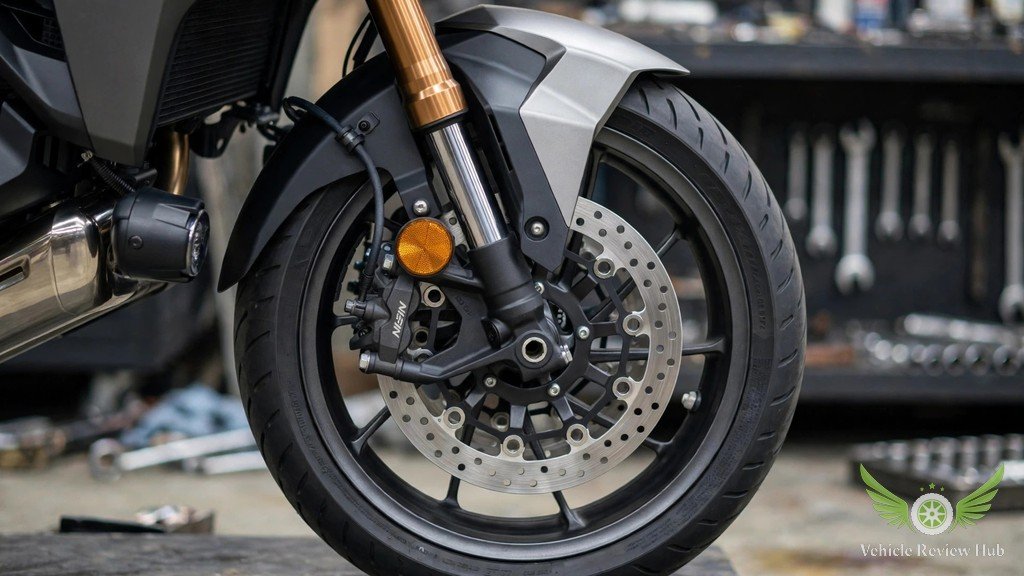
Chain, sprockets, tyres, fork seals, brakes, and electrics make up the rest of the Honda NT1100 DCT reliability watch list — and note the first item, because the NT1100 is chain-driven, not shaft-driven. The final drive is a #525 chain with 16-tooth front and 40-tooth rear sprockets, so chain slack, lubrication, and sprocket wear are real maintenance. Tyres are 120/70-17 front and 180/55-17 rear, the rear the big consumable; check date codes, not just tread. Brakes are dual 310mm front discs and a single 256mm rear disc under ABS; check pad thickness and disc condition. The 43mm Showa fork has preload adjustment only — no electronic suspension on the US bike — so fork-seal weeping is a straightforward check. On electrics, test the TFT, riding modes, paddle shifters, and CarPlay pairing — small Honda NT1100 DCT reliability checks that take minutes. Cycle News’ 2025 NT1100 DCT review confirms the US specification this guide works from: DCT only, conventional suspension, no electronic suspension.
Honda NT1100 DCT Maintenance Schedule and Servicing
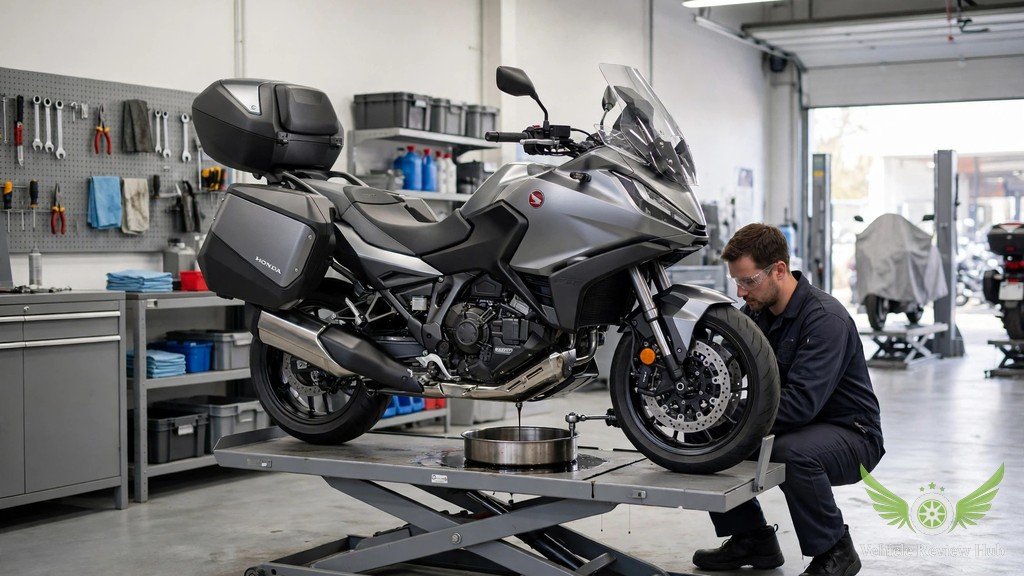
The maintenance schedule is the backbone of Honda NT1100 DCT reliability: a first service at 600 miles, then an 8,000-mile oil rhythm, with valve, air-filter, and DCT-filter work falling together at 16,000 miles. The DCT filters are the item new owners most often miss, and missing them is the easiest Honda NT1100 DCT reliability mistake to make.
First Service at 600 Miles, Oil Every 8,000 Miles
First service at 600 miles, oil every 8,000 miles — and that sentence corrects the single most common Honda NT1100 DCT reliability error, because generic Honda advice online often quotes an oil change every 4,000 miles. That generic figure is not NT1100-specific, and this guide does not use it. The doc’s schedule sets the first service at 600 miles and oil every 8,000 miles after that; a used bike whose first stamp is missing deserves a discount, and one whose oil changes run long deserves suspicion. The twin is tolerant but not immortal, and the DCT shares the engine’s oil supply, so neglected oil punishes the gearbox as well as the engine. For the riding numbers behind those miles, see our Honda NT1100 DCT performance guide.
At 16,000 Miles: Valves, Air Filter and Both DCT Filters
At 16,000 miles the Honda NT1100 DCT reliability schedule brings its biggest visit: valves, air filter, and both DCT filters together. The Unicam valve train uses screw-and-nut exhaust adjusters with shimmed intakes, and owner-forum discussion corroborates the doc’s 16,000-mile valve interval — with the warning that intake shimming, when needed, is the expensive part of the job. The air filter falls at the same visit, and the two DCT filters are the NT1100-specific items a general shop may not know to change. A used bike nearing 16,000 miles without proof of the DCT filters deserves a price chip: skipped DCT filtration is a long-term gearbox risk, not a cosmetic gap. This Honda NT1100 DCT reliability guide never presents the Africa Twin’s intervals as the NT1100’s: same engine family, different service book. Honda’s 2026 NT1100 DCT page confirms the core specification this schedule serves, including the 46mm throttle body and the #525 chain final drive.
| Service item | Interval (NT1100 DCT) | Note |
|---|---|---|
| First service | 600 miles | Break-in service — do not skip |
| Engine oil + filter | Every 8,000 miles | Not the generic 4,000-mile figure |
| Valve-clearance inspection | Every 16,000 miles | Screw-and-nut exhaust, shimmed intakes |
| Air filter | Every 16,000 miles | Same visit |
| Both DCT filters | Every 16,000 miles | Both DCT filters — NT1100-specific |
| Summary | 600 / 8,000 / 16,000 miles | Chain drive — chain care is separate work |
Honda NT1100 DCT Tires, Brakes and Suspension Maintenance
Tyres, brakes, and suspension are where Honda NT1100 DCT reliability meets the road. A 547 lb motorcycle (curb weight, full tank) on road-biased tyres is gentle on nothing except its own brakes, and the conventional Showa suspension keeps suspension jobs cheaper than an electronically suspended rival’s. That simplicity is a quiet Honda NT1100 DCT reliability advantage.
DCT Low-Speed Judder Checks and Clutch Filter Service
DCT low-speed judder checks and clutch filter service are the gearbox-specific items in Honda NT1100 DCT reliability, and a test ride must cover them. DCT judder — a shudder or grab when pulling away slowly — is the symptom to feel for at walking speed, in traffic, and on a slow U-turn, where the clutches work hardest. A healthy DCT pulls away smoothly in automatic and manual paddle modes; judder or harsh engagement deserves a dealer diagnosis before you pay. The clutch filter service at 16,000 miles is the preventive side: fresh filtration keeps engagement clean, and the doc’s schedule pairs it with the DCT oil filter. For Honda NT1100 DCT reliability, the rule is simple — ride it slowly, feel the clutches, and check the filter history.
Brake Pads, Fork Seals, Shock Checks and Fluid Intervals
Brake pads, fork seals, shock checks, and fluid intervals complete the Honda NT1100 DCT reliability chassis list. Pads first: check thickness at every service on the dual 310mm front and single 256mm rear discs. Fork seals second: the 43mm Showa SFF-BP fork is a conventional unit with preload adjustment only, so a seal job is a standard shop task — but weeping seals still need fixing, not ignoring. Shock third: the Pro-Link Showa single shock, also 5.9 inches of travel, deserves a bounce test and an oil-misting check. Fluids fourth: brake fluid and coolant run on time intervals as well as mileage, so a two-year-old bike with 2,000 miles on original fluids is overdue, not pampered. For Honda NT1100 DCT reliability, the chassis story is reassuring: nothing exotic, nothing dealer-only, just ordinary checks done on time.
Honda NT1100 DCT Maintenance and Ownership Costs
Ownership costs are where Honda NT1100 DCT reliability pays off in cash — and where it stops being cheap. Fuel is reasonable, routine servicing is modest for the class, and the only large bills are the ones a skipped 16,000-mile service creates. No US servicing-cost figure has been published, so this Honda NT1100 DCT reliability guide gives no invented American quote.

Fuel, Routine Servicing, Tires and Replacement Parts
Fuel first for Honda NT1100 DCT reliability budgeting: no EPA rating exists for motorcycles in this class, so this guide gives no invented official figure. The doc’s WMTC estimate is about 47 mpg in US terms, and owner Fuelly data sits near 47.2 mpg over roughly 55,000 miles — both labelled here as estimates, not test figures, implying roughly 250 miles from the 5.4-gallon tank by arithmetic. Routine servicing follows the 8,000-mile rhythm, with the 16,000-mile visit the expensive one; tyres are the big consumable, the 180/55-17 rear wearing faster than the front two-up. Parts are a qualified strength in Honda NT1100 DCT reliability: consumables are common Honda parts through a nationwide dealer network, chain and sprockets are standard sizes, and model-specific bodywork takes longer to source. For the buying decision in full, including used prices, see our Honda NT1100 DCT buying guide.
Warranty Conflict: One Year in 2025 Papers, Two in 2026
Warranty conflict: one year in 2025 papers, two in 2026 — and this Honda NT1100 DCT reliability guide states the conflict plainly instead of picking a side without evidence. Honda’s own 2026 NT1100 DCT page lists a transferable, two-year included, limited warranty, with HondaCare extended coverage available. The doc’s claim of one year in 2025 papers could not be confirmed against a current Honda source in this pass, so this guide does not assert the 2025 term as fact — it flags it as a doc claim for the buyer to confirm against the bike’s own papers. For an American buyer, the translation is simple: the 2026 warranty is decent and transferable, the 2025 term is a paperwork question, and neither follows a bike whose service book is empty. The engine underneath, shared in architecture with the Africa Twin, is the long-term argument.
| Cost item | Figure | Label |
|---|---|---|
| Fuel economy (estimated) | ~47 mpg (WMTC-derived estimate / Fuelly owners) | ~250 miles per 5.4-gal tank by arithmetic; no EPA rating |
| Routine service rhythm | Every 8,000 miles | First service at 600 miles |
| Big service visit | 16,000 miles: valves, air filter, both DCT filters | Intake shimming, if needed, costs most |
| Tyres | 120/70-17 front, 180/55-17 rear | Rear is the big consumable |
| Factory warranty (2026) | 2 years, transferable, limited | 2025 one-year claim unverified |
| US servicing cost | No published figure found | No invented quote given |
| Summary | Modest routine costs, pricey 16,000-mile visit | Skipped DCT filters create the big bills |
How to Keep a Honda NT1100 DCT Reliable
Keeping an NT1100 DCT reliable means doing the simple things on time. Nothing in Honda NT1100 DCT reliability requires exotic tools — just a calendar, an 8,000-mile oil habit, a service book, a chain habit, and the VIN check before money changes hands.

Preventive Maintenance, Service Records and Regular Inspections
Preventive maintenance, service records, and regular inspections are the three habits that define Honda NT1100 DCT reliability. Preventive maintenance means the 8,000-mile oil habit, the 16,000-mile valve, air-filter, and DCT-filter visit, chain cleaning and lubrication, and fluids on time. Keep every receipt: a complete service book is worth real money at resale, and a gap in it is a negotiation. Regular inspections mean a two-minute pre-ride check — tyres, brakes, lights, oil level, chain slack — plus seasonal fork seals, pads, battery, and TFT checks.
No NHTSA List Names the NT1100, Yet Dealer Papers Do: Check VIN
No NHTSA list names the NT1100, yet dealer papers do — and that heading needs its label first, because it is the single most important Honda NT1100 DCT reliability fact here. Verified via the NHTSA API in November 2026, NT1100 recalls return zero results for both 2025 and 2026. The recall number that circulates in NT1100 discussion, 25V-358, does not name the NT1100 at all: the same NHTSA data confirms it on the 2025 CMX1100 and other models, not this bike. Any “dealer papers” claim naming the NT1100 stays labelled doc-only and unverified. The remedy is the NHTSA recall lookup against the actual VIN — the first rule of Honda NT1100 DCT reliability buying — plus a dealer campaign-history printout for that bike. Never accept a recall claim, for or against this bike, without the VIN result.
The video below in this Honda NT1100 DCT reliability guide is a month-long test review from Cruiseman’s Garage, asking whether the NT1100 DCT is as good as a Gold Wing — an ownership perspective.
Honda NT1100 DCT Reliability FAQs
Direct answers to the Honda NT1100 DCT reliability questions buyers ask most, with every recall, interval, and warranty claim labelled by source.
Is the Honda NT1100 DCT reliable?
Early evidence says yes. For Honda NT1100 DCT reliability, the platform has three European seasons behind it, a retuned Africa Twin engine family, and no pattern of engine or gearbox failure — but the American bike launched only in May 2025, so US data is still accumulating.
What are the common problems on an NT1100 DCT?
For Honda NT1100 DCT reliability shoppers, the watch items are doc-reported TFT screen glitches and thin frame paint (both labelled unverified in this pass), plus ordinary wear: chain, sprockets, tyres, pads, fork seals, and batteries on stored bikes.
Is there an NT1100 DCT recall?
For Honda NT1100 DCT reliability checks, no NHTSA list names the NT1100 for 2025 or 2026 — verified via the NHTSA API in November 2026. The circulating 25V-358 number names the 2025 CMX1100 and other models, not the NT1100 — always check the actual VIN.
What is the NT1100 DCT service schedule?
For Honda NT1100 DCT reliability: first service at 600 miles, oil and filter every 8,000 miles, and valves, air filter, and both DCT filters at 16,000 miles. Chain care is separate, ongoing work.
When does the NT1100 DCT need its valves checked?
For Honda NT1100 DCT reliability, every 16,000 miles. The Unicam train uses screw-and-nut exhaust adjusters and shimmed intakes; intake shimming, when needed, is the expensive part.
How often should the NT1100 DCT oil be changed?
For Honda NT1100 DCT reliability, every 8,000 miles — not the generic 4,000-mile figure that circulates in general Honda advice online. Fresh oil matters doubly, because the DCT shares the engine’s oil supply.
Does the NT1100 DCT have a chain or a shaft drive?
A chain. For Honda NT1100 DCT reliability readers, the final drive is a #525 chain with 16-tooth front and 40-tooth rear sprockets — chain care is real, ongoing maintenance.
Is the NT1100 DCT expensive to maintain?
For Honda NT1100 DCT reliability budgeting, routine costs are modest for the class on the 8,000-mile rhythm, but no published US servicing-cost figure exists, so no American quote is given. The 16,000-mile visit is the expensive one.
What warranty does the NT1100 DCT have?
For Honda NT1100 DCT reliability buyers, Honda’s 2026 page lists a transferable two-year limited warranty, with HondaCare available. The doc’s one-year 2025 claim is unverified — check the bike’s papers.
Does the US NT1100 DCT have a manual gearbox option?
No. For Honda NT1100 DCT reliability buyers, the US bike is DCT-only; Honda has said it has no plan to offer a manual NT1100 at retail in America.
Is buying a used NT1100 DCT worth it?
Yes, says this Honda NT1100 DCT reliability guide, when the bike is clean, VIN-checked (with the 25V-358 trap understood), and backed by a complete service book showing the 600-, 8,000-, and 16,000-mile work. Buy on paperwork, not shine.