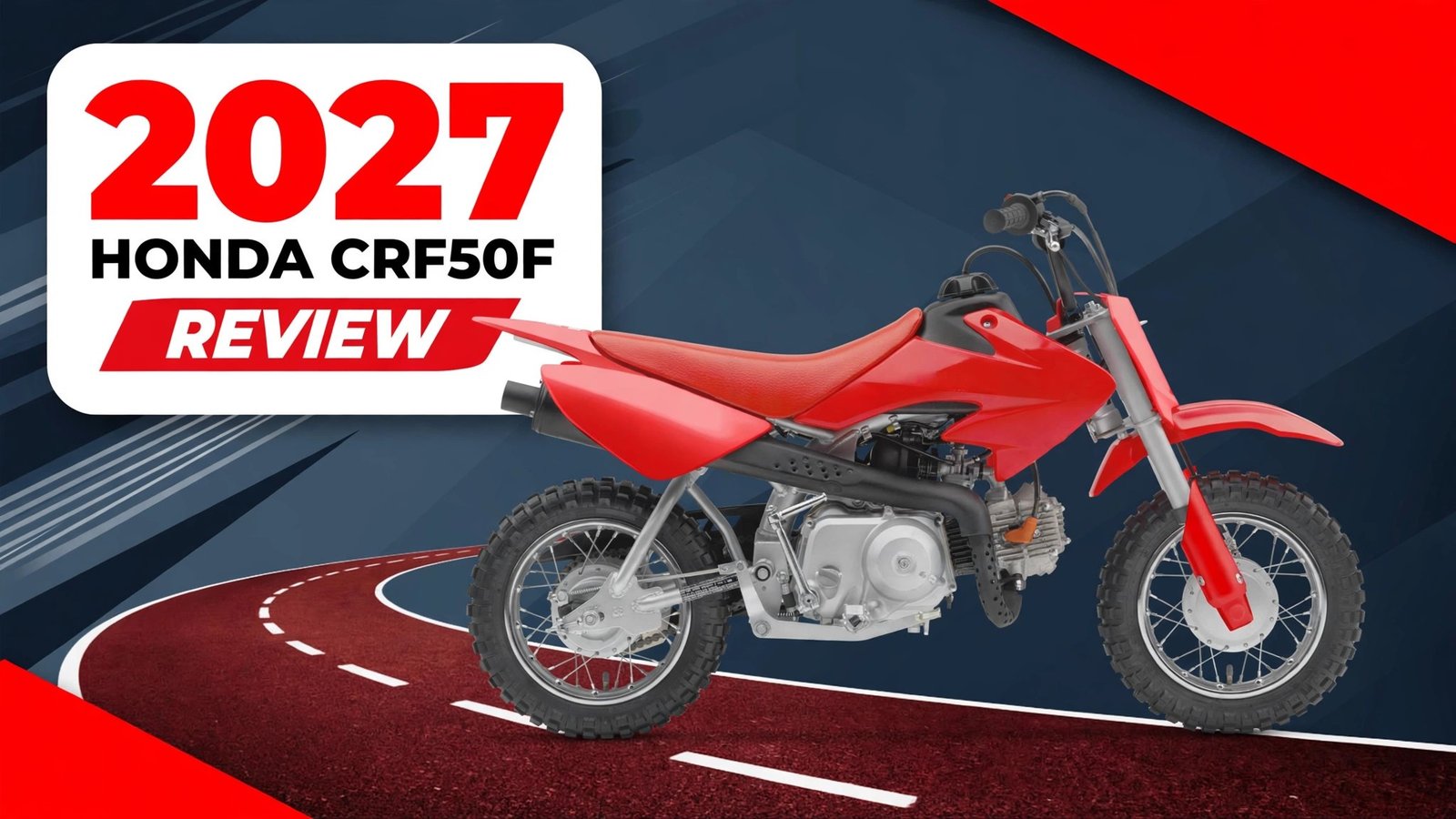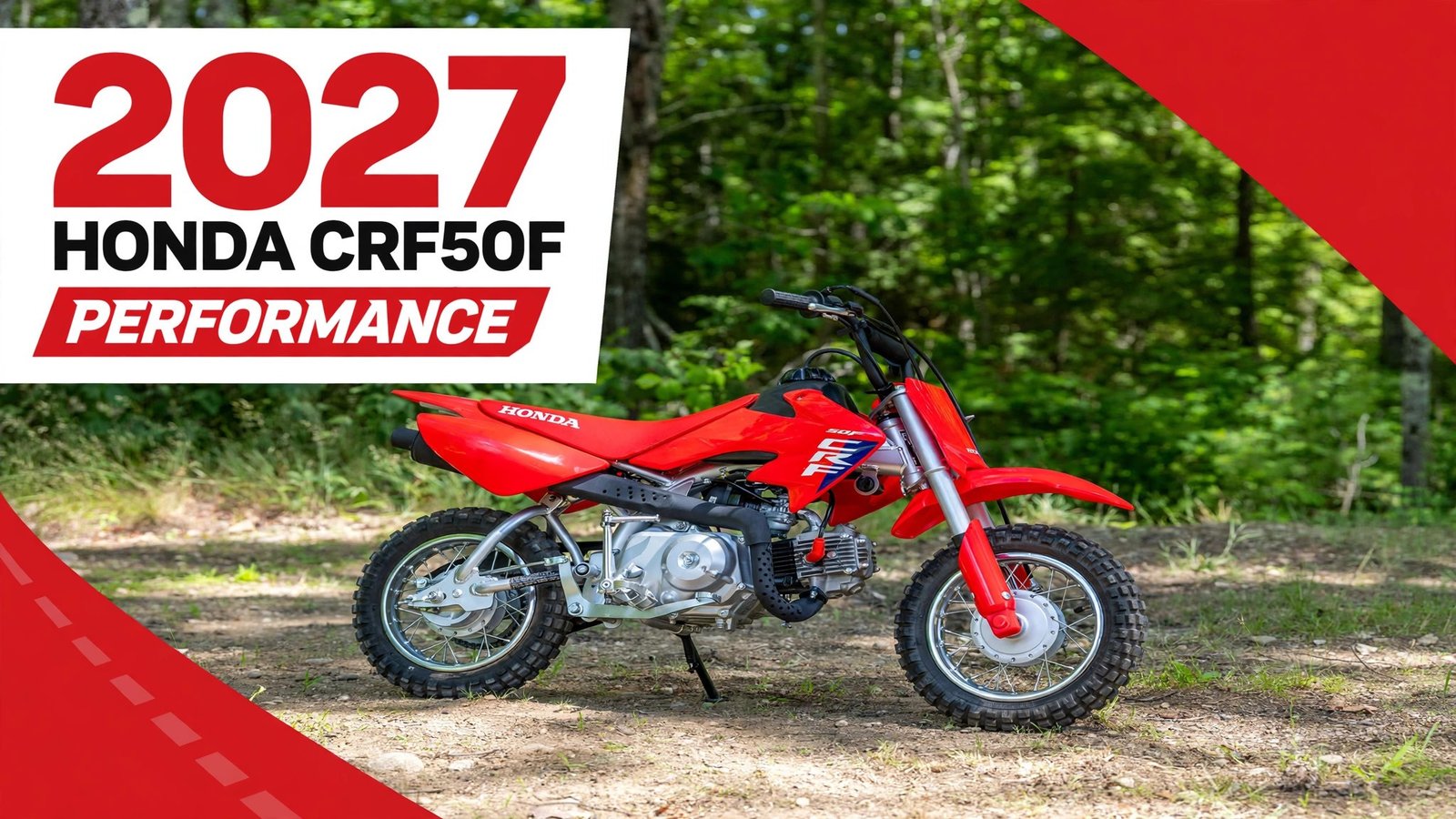
Short answer: Honda CRF50F performance is smallest-kids-bike performance, and that is a compliment, not a complaint. This Honda CRF50F performance guide starts with the honest headline: a 49cc air-cooled four-stroke single with a three-speed automatic clutch, gentle bottom-end power, no tested horsepower, torque, or MPG figure from Honda or any reputable outlet, and a top speed nobody has ever measured properly. The 2027 bike costs $1,899 plus $300 destination, and this Honda CRF50F performance guide measures it the only fair way: by how easily a first-time rider learns to ride, shifts through three gears without stalling, and comes home grinning without drama.
One framing fact belongs up front in this Honda CRF50F performance guide: do not shop this bike on numbers it does not publish. Honda lists no horsepower, no torque, and no MPG for the CRF50F, and any page that prints those figures as tested facts is dressing up estimates. What it does offer is verified: a carbureted 49cc engine that has barely changed since 2004, an automatic clutch with no lever to learn, kick start only, 111 pounds, a 21.6-inch seat, and a throttle limiter screw that lets a parent set the pace. For the full model story, see our Honda CRF50F review.
Honda CRF50F Engine Performance and Power Delivery
Engine performance on the CRF50F is about delivery, not output. The little single makes its modest power low in the rev range, where a learner needs it, and deliberately gives up at the top, where a learner does not. This Honda CRF50F performance guide treats that trade as the design, not a flaw.
Honda Publishes No Horsepower or MPG Figure at All
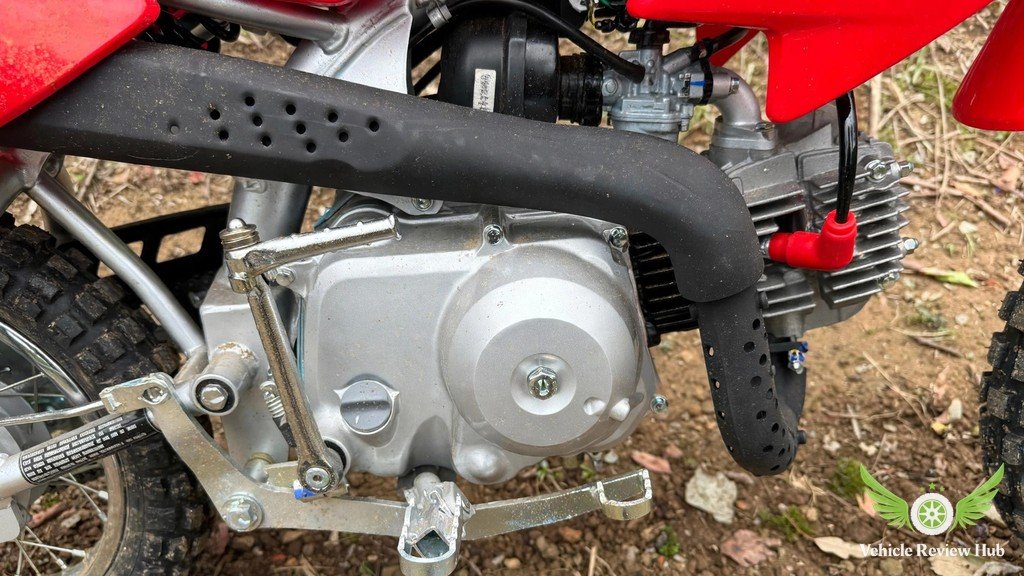
Honda publishes no horsepower or MPG figure at all for the CRF50F, and this Honda CRF50F performance guide states that plainly because it shapes every other claim in the article. Honda’s CRF50F page confirms the spec list and its gaps: the engine is a 49cc air-cooled single-cylinder four-stroke, and the page simply does not publish power figures. So this Honda CRF50F performance guide never prints a horsepower number as a Honda figure, never prints a dyno result, and never converts yard-riding range into an MPG rating. One aggregator-style claim does circulate, putting the little single at just over 3 hp, and this Honda CRF50F performance guide mentions it only as a non-Honda estimate, never as a tested number and never as a Honda figure.
Three-Speed Automatic Clutch Tuned for First Rides
Three-speed automatic clutch tuned for first rides is the whole engine philosophy of Honda CRF50F performance. There is no clutch lever to master and no stalling when a new rider stops: the centrifugal clutch engages as revs rise, and the rider shifts with the foot lever only. The engine itself is a 49cc air-cooled SOHC two-valve single, 39.0 by 41.4 mm, 10.0:1 compression, fed by an 11 mm piston-valve carburetor on current bikes. The carburetor matters more than any horsepower guess: it is simple, it is the reason the bike is famously cold-blooded on a winter morning, and it is why the CRF50F is the one CRF-F bike Honda never gave fuel injection. Ultimate Motorcycling’s 2018 CRF50F review describes the engine as the same basic design since the Mini Trail days, and that continuity is the fairest summary of Honda CRF50F performance available anywhere.
| Engine item (Honda spec pages) | CRF50F | Honda CRF50F performance note |
|---|---|---|
| Engine | 49cc air-cooled SOHC two-valve single | Same displacement every year, 2004–2027 |
| Bore and stroke / compression | 39.0 x 41.4 mm / 10.0:1 | Long-stroke layout favours bottom-end pull |
| Fuel system / gearbox | 11 mm carburetor / three-speed automatic clutch | No clutch lever to learn — the whole point |
| Final drive | Chain, #420 14T/37T | Short trail gearing, geared for learning |
| Summary | Honda CRF50F performance: delivery over output | Honda publishes no hp, torque, or MPG |
Honda CRF50F Top Speed and Acceleration
Top speed and acceleration are the two questions every parent asks first about Honda CRF50F performance, and both have the same honest answer: no instrumented test exists.

No Reputable Outlet Has Ever Published a Tested Speed
No reputable outlet has ever published a tested speed for the CRF50F, and this Honda CRF50F performance guide refuses to invent one. No magazine runs a timed acceleration test or a GPS-verified top-speed run on a smallest-kids trail bike, and Honda publishes no top speed. What riders do describe, consistently, is brisk low-speed pull for a small child’s weight: the bike gets off the line cleanly, putters up a yard hill without drama, and feels quicker than its size suggests at learner speeds. Acceleration here means first-gear pull from a standstill with the limiter fitted, not a quarter-mile time — and on that measure, Honda CRF50F performance is exactly right for its rider.
Blog Figures of 25 to 34 MPH Are Unsourced Estimates
Blog figures of 25 to 34 mph are unsourced estimates, and this Honda CRF50F performance guide reports them only that way. Various blogs and owner posts print top speeds anywhere from about 25 mph to about 34 mph for the CRF50F, with no test, no rider weight, no terrain, and no GPS log behind any of them. The gearing itself argues for the low end of the online range: a three-speed gearbox with short trail ratios and a 14T/37T final drive runs out of gear early, and a 49cc air-cooled single tuned for bottom-end torque has neither the rev ceiling nor the power to push a knobby-tired kids bike to road speed. With the limiter screw turned in for a beginner, the real-world top speed is far lower still — which is the point of the screw.
Honda CRF50F Mileage and Fuel Economy
Mileage on a CRF50F is measured in yard afternoons, not miles per gallon. The tank is tiny, the engine sips fuel, and the honest range answer comes from the tank size, never from a converted MPG claim.

No MPG Figure Exists: Do Not Print One
No MPG figure exists for the CRF50F, and this Honda CRF50F performance guide says so plainly rather than repeating a made-up number as economy. The EPA does not rate off-road motorcycles, Honda publishes no economy figure, and no magazine runs a measured fuel loop on a bike with no odometer and no road use. Any page printing an MPG rating for this bike has no test behind it, and this Honda CRF50F performance guide will not manufacture one from anecdotes. What Honda CRF50F performance does offer on fuel is genuinely good news for parents: a small, efficient, carbureted single that runs on regular gas and stretches a tank a long way at learner speeds. For the service habits that keep that economy honest, see our Honda CRF50F reliability guide.
The 0.7 Gallon Tank and a Day of Yard Riding
The 0.7 gallon tank and a day of yard riding is the whole fuel story, and this Honda CRF50F performance guide frames range around it honestly. The tank holds 0.7 gallons including a 0.2-gallon reserve, switched by the petcock when the main supply runs dry — a real improvement over guessing, and a useful lesson for a young rider learning fuel management.
Honda CRF50F Real-World Riding Performance
Real-world riding is where Honda CRF50F performance earns its reputation. The bike is not fast, and it does not pretend to be — it is easy, forgiving, and confidence-building, exactly what a first bike must be.

Honda’s Own Limiter Guide: 12, 19 and 31 MPH by Age
Honda’s own limiter guide: 12, 19 and 31 mph by age is the doc heading, kept verbatim — and this Honda CRF50F performance guide labels it honestly: the 12/19/31 mph-by-age figures are doc-sourced guidance in this research, not verified from a Honda manual or Honda page, so they are printed as doc-sourced figures, not as Honda’s own published table. The idea behind them is sound and matches how parents actually use the bike: the youngest, least experienced rider gets the slowest setting, and the screw comes out in stages as skill grows. But until a Honda source for those exact speeds is produced, this Honda CRF50F performance guide will not call them Honda’s own numbers.
Set the Top Speed by Turning a Screw: Manual Wording
Set the top speed by turning a screw: manual wording is Honda’s own guidance, and it is verified. Honda’s feature wording says it plainly: set the top speed by turning a screw, which helps keep new riders from going too fast, too soon, and lets you match the CRF50F’s power output to the rider’s skill level. The manual’s mechanism: the throttle limiter screw in the lower throttle housing limits throttle-grip movement, measured at 13/16 inch (21 mm) when the throttle is fully open and less when restricted — turn clockwise to reduce, counterclockwise to increase. The manual warns never to remove the limiter screw, because moisture and debris can enter, and to use the limiter with the transmission in first gear until the youngster is familiar with operating the motorcycle. Before each ride, check the limiter screw measurement and the restriction of throttle-grip movement. That two-stage character is why the 50F lasts longer in a family than a fixed-speed kids bike — the bike grows with the rider, one screw turn at a time.
Honda CRF50F Handling, Braking and Stability
Handling on the CRF50F is light, low, and forgiving. The bike weighs 111 pounds, sits at 21.6 inches, and steers easily, which is why new riders trust it quickly.
81mm Drum Brakes at Both Ends: No Discs, No ABS
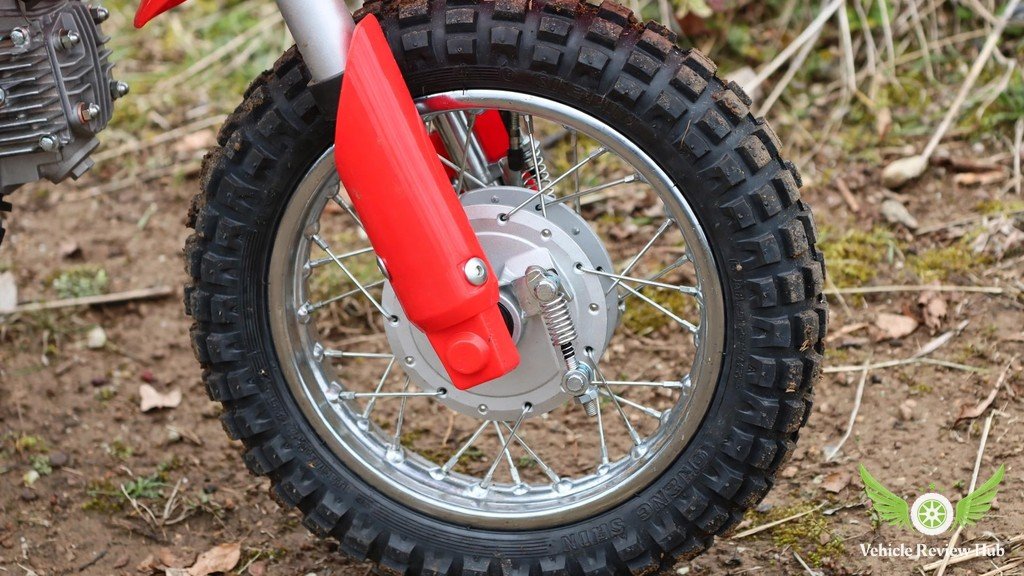
81 mm drum brakes at both ends, no discs, no ABS, are the verified braking facts for Honda CRF50F performance, and they suit the bike’s weight and speed. Both brakes are drums on the 2027 page — simple, sealed against mud, and easy for small hands and feet to operate — and there is no ABS on any year. Older Honda pages list 80 mm drums, so this Honda CRF50F performance guide year-labels the figure: 81 mm for 2027, 80 mm on the 2026 and older listings. Chassis numbers: 22 mm inverted fork with 3.8 inches of travel, single rear shock with 2.8 inches, 10-inch wheels front and rear, 36.0-inch wheelbase, 21.6-inch seat, 6.0 inches of ground clearance. The steering geometry favours stability over quickness, which is exactly right for a first bike — a nervous, quick-steering kids bike would be a worse teacher, not a better one.
Weight Is the Real Limit: 111 lb for the Smallest Kids
Weight is the real limit: 111 lb for the smallest kids is the heading, and this Honda CRF50F performance guide reads it the way Honda’s manuals demand — the limit that matters is the rider, not the bike. The CRF50F itself weighs 111 pounds ready to ride, but Honda rates it to a maximum load of just 88 pounds including rider and accessories. The striking consequence must be stated plainly: the bike weighs more than its maximum rider. An adult riding it exceeds Honda’s rated limit by a wide margin, and even a bigger child with gear on can push past 88 pounds. A child who has outgrown either number has outgrown the bike, whatever their age, and the honest step-up is the CRF110F, covered in our Honda CRF110F performance guide.
Honda CRF50F Performance Compared With Other Kids Bikes
Comparison is where Honda CRF50F performance becomes a buying decision.
Honda CRF50F vs Yamaha PW50 and TT-R50E
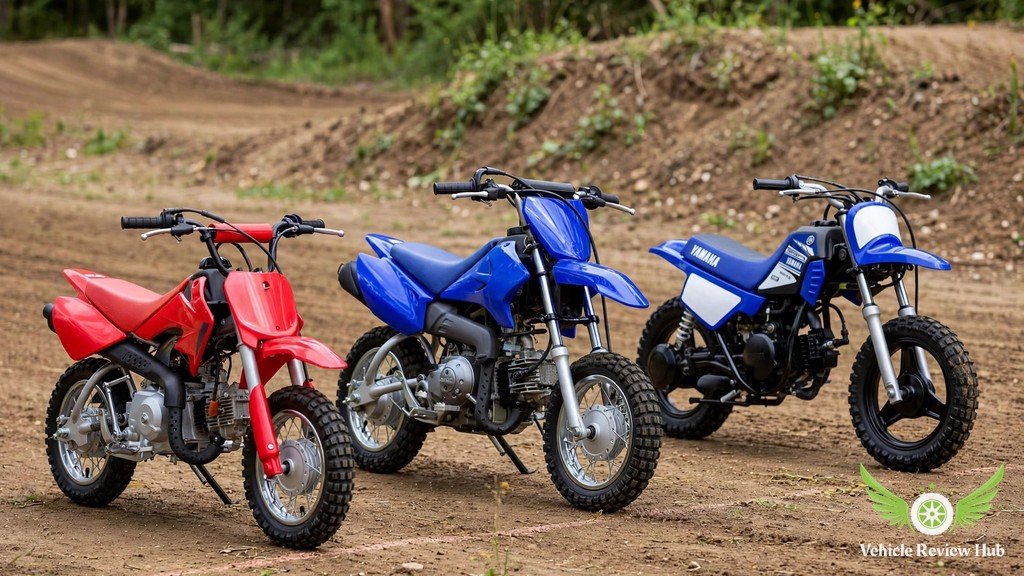
Honda CRF50F versus the Yamaha PW50 and TT-R50E is a close fight on paper and a clearer one in the showroom, once prices are year-labelled. The 2027 Yamaha TT-R50E costs $1,899 plus $250 destination, the same sticker as the Honda’s $1,899 plus $300 — but the Yamaha adds the feature the Honda lacks: electric push-button start, against the Honda’s kick start only. The Yamaha is a 49cc four-stroke with a 3-speed automatic transmission, a Mikuni VM11 carburetor, a 21.9-inch seat, and a 0.8-gallon tank. The 2027 Yamaha PW50 also costs $1,899 plus $215 destination, but it is a different animal: a 49cc two-stroke with a fully automatic single-speed transmission and shaft drive, a 0.5-gallon tank, and an 18.7-inch seat — lighter than the Honda at 90 pounds and lower, which makes it the better pick for the very smallest riders who cannot yet flat-foot the Honda. Yamaha’s TT-R50E features page confirms the electric-start advantage, and Motocross Hideout’s CRF50 vs PW50 comparison reaches the same verdict this Honda CRF50F performance guide does: the PW50 wins for the smallest kids, while the Honda wins once the child is tall enough to reach the ground and ready to learn gears. The Honda answers both Yamahas with four-stroke simplicity with no premix, a three-speed gearbox that teaches shifting, a keyed ignition, a six-month transferable warranty, and a dealer network. The video below in this Honda CRF50F performance guide is Motocross Hideout’s PW50 vs CRF50 comparison — honestly labelled as a comparison video, not a Honda-only test, and the clearest head-to-head look at what this Honda CRF50F performance guide covers.
| Kids bike (2027, year-labelled) | Price + destination | Honda CRF50F performance verdict |
|---|---|---|
| 2027 Honda CRF50F | $1,899 + $300 = $2,199 | 4-stroke, 3-speed auto, kick only, 111 lb, 21.6-in seat |
| 2027 Yamaha TT-R50E | $1,899 + $250 = $2,149 | Electric start the Honda lacks; 21.9-in seat; 0.8 gal |
| 2027 Yamaha PW50 | $1,899 + $215 = $2,114 | 2-stroke single-speed, shaft, 90 lb, 18.7-in seat — smallest |
| 2027 Honda CRF110F (step-up) | $2,799 + $300 = $3,099 | 109cc, 4-speed auto, electric start, 169 lb, 25.9-in seat |
| Summary | Honda CRF50F performance: gears and simplicity over gadgets | No maker here publishes power to rank |
Is the Honda CRF50F Suitable for Beginner Riders? Yes
Is the Honda CRF50F suitable for beginner riders? Yes — with the smallest-kids qualifications this Honda CRF50F performance guide has carried throughout. The case is strong: an automatic clutch with no lever to learn, 111 pounds, a 21.6-inch seat, gentle bottom-end power, a throttle limiter screw for first rides, a keyed ignition so a parent controls when the bike runs, and a carbureted engine a home mechanic can understand. Total Motorcycle’s 2027 CRF50F coverage confirms the current bike’s price and positioning as the smallest Honda youth bike. Qualifications apply: age six and up, never under six per Honda’s own label; both feet flat on the ground or the bike does not fit; rider plus gear under Honda’s 88-pound limit; adult supervision for youth riders, proper gear, and off-road-only riding. For the buying decision behind this verdict, see our Honda CRF50F buying guide. The last word on Honda CRF50F performance is simple: it is the easiest geared trail bike to learn on, at a fair price, with Honda reliability behind it.
Honda CRF50F Performance FAQs
Direct answers to the Honda CRF50F performance questions parents and new riders ask most, with every figure labelled by source and model year.
How much horsepower does the Honda CRF50F make?
Honda publishes no horsepower figure, says this Honda CRF50F performance guide. Any circulating figure is a non-Honda estimate, not a Honda figure and not a dyno result.
What is the Honda CRF50F top speed?
There is no instrumented or GPS test, says this Honda CRF50F performance guide. Online figures from about 25 to about 34 mph are unsourced blog and owner claims with no test behind them, never a tested top speed.
What MPG does the Honda CRF50F get?
No tested MPG exists from any reputable outlet, says this Honda CRF50F performance guide. Range is framed from the 0.7-gallon tank in yard-riding time, never as an MPG rating.
What engine does the CRF50F have?
Honda CRF50F performance starts with a 49cc air-cooled SOHC two-valve single, 39.0 by 41.4 mm, 10.0:1 compression, an 11 mm carburetor on current bikes, and a three-speed automatic clutch.
Is the CRF50F fuel-injected?
No, says this Honda CRF50F performance guide. The CRF50F is carbureted in every year and is the one CRF-F bike Honda never gave fuel injection.
Does the CRF50F have a clutch lever?
No, says this Honda CRF50F performance guide. The CRF50F has a three-speed automatic clutch with no lever; shifting needs no clutch work, which is the whole point for first riders.
Does the CRF50F have electric start?
No, says this Honda CRF50F performance guide. The CRF50F is kick start only on every year — the Yamaha TT-R50E’s electric start is the rival feature the Honda lacks.
What does the throttle limiter do?
It restricts throttle-grip movement by a screw, says this Honda CRF50F performance guide. Honda’s manual measures 21 mm at full throttle, warns never to remove the screw, and says to use first gear until the youngster is familiar with the bike.
What is the difference between the CRF50F and the CRF110F?
Size, gears, and starting, says this Honda CRF50F performance guide. The 50F is a 49cc three-speed auto-clutch kick-start bike at $1,899 plus $300; the 110F is a 109cc four-speed auto-clutch bike with electric start at $2,799 plus $300.
Does the CRF50F have ABS?
No, says this Honda CRF50F performance guide. Braking is drum brakes at both ends — 81 mm for 2027 — with no discs and no ABS on any year.
Is the CRF50F good for beginners?
Yes, says this Honda CRF50F performance guide, with qualifications: automatic clutch, low seat, gentle power, throttle limiter, and keyed ignition make it a genuine first bike for the smallest kids — but age six and up, both feet flat, under the 88-pound limit, and off-road only.
Is the CRF50F street legal?
No, says this Honda CRF50F performance guide. The CRF50F is off-road only and never street legal in any US state, and it cannot be plated.
How much does the 2027 CRF50F cost?
Honda CRF50F performance value starts at $1,899 plus $300 destination for the 2027 bike — $2,199 total, unchanged from 2026, in Red only, and not sold in California.