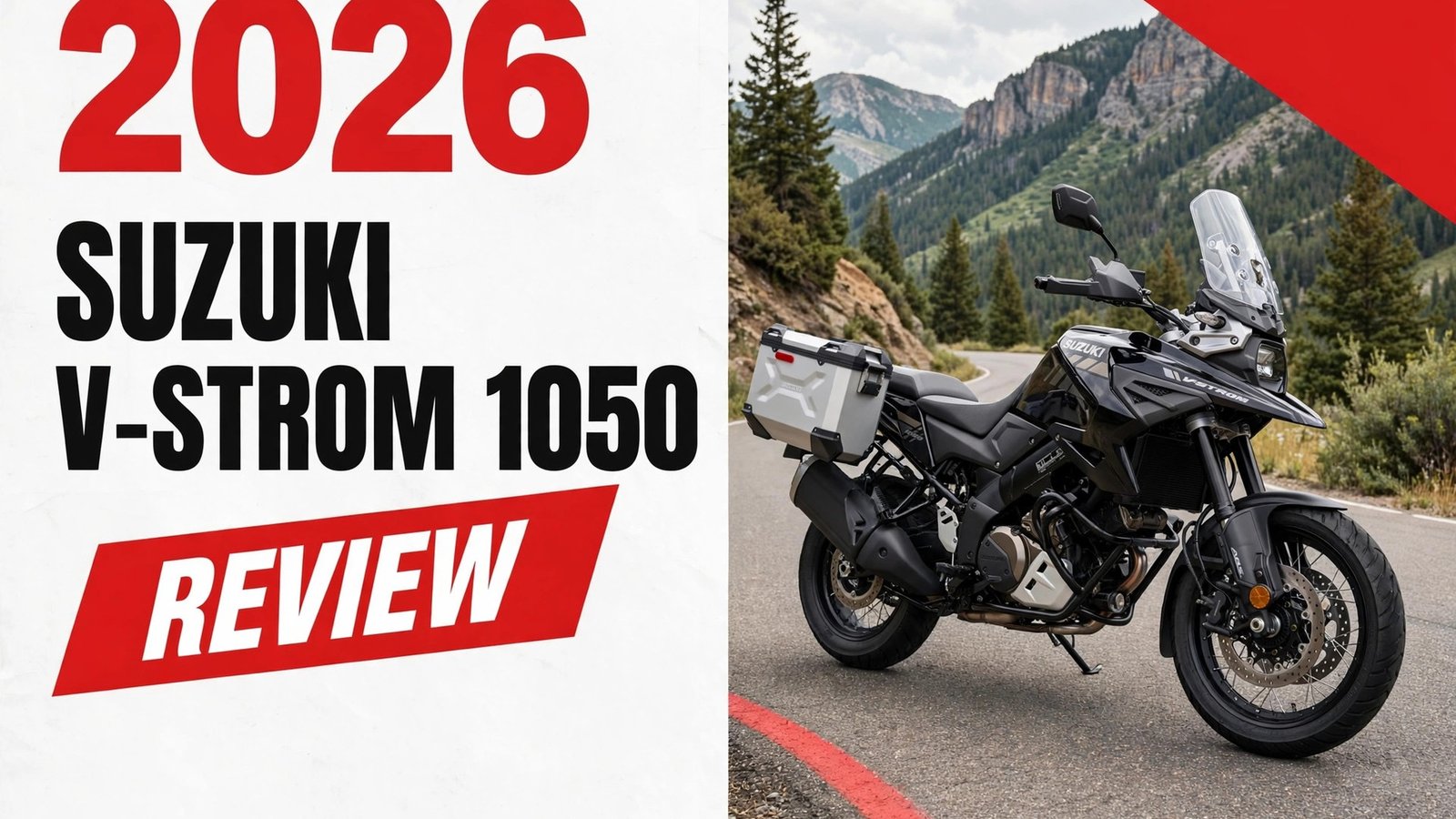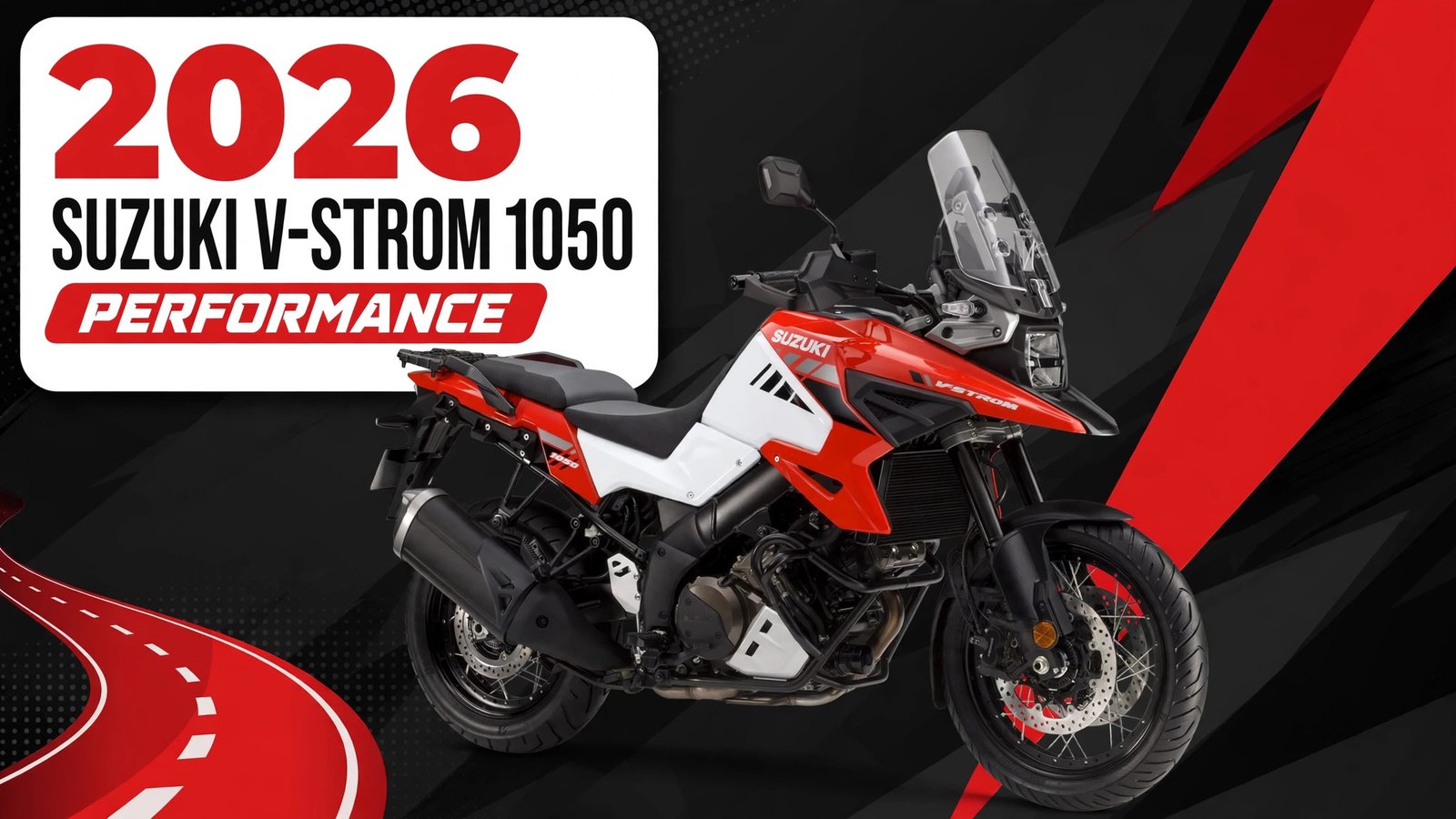
The Suzuki V-Strom 1050 performance story starts with a split between what Suzuki claims and what independent tests actually measure. Suzuki claims 107 horsepower and 74 lb-ft for the 1,037cc V-twin, yet Suzuki USA publishes no horsepower, torque, or MPG figure of its own. The Suzuki V-Strom 1050 performance numbers come from three different dynos, and they do not agree: Cycle World measured 93.4 horsepower at the rear wheel, Rider 96.3, and MCN 99 bhp.
The short version of Suzuki V-Strom 1050 performance is this: a strong, flexible road-biased adventure bike with a fat midrange and a tested real-world fuel economy of about 50 mpg. It is not a fast bike by the standards of its class, and no named American outlet has ever published instrumented test figures for top speed, 0-60, or braking distance. What follows is every tested Suzuki V-Strom 1050 performance figure, with gaps stated openly. For prices and trims, see the full 1050 review.
Suzuki V-Strom 1050 Engine Performance and Power Delivery
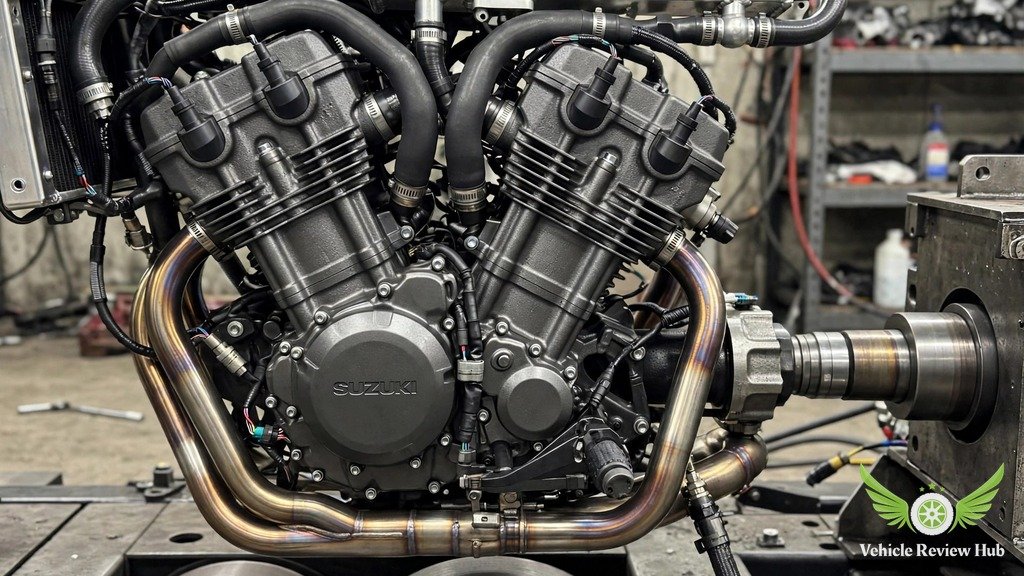
At the heart of Suzuki V-Strom 1050 performance is a 1,037cc liquid-cooled 90-degree V-twin, 100.0 by 66.0 mm, 11.5:1 compression, ride-by-wire, six-speed, with dual spark plugs and a slipper-assist clutch. It is built for midrange pull rather than peak numbers, and Rider Magazine’s first ride noted clean pull from as low as 1,800 rpm in top gear.
Cycle World Dyno: 93.4 HP on the 2020 XT
Cycle World ran a 2020 XT on its in-house Dynojet 250i and recorded 93.4 horsepower at 8,650 rpm and 64.5 lb-ft of torque at 4,630 rpm, the headline Suzuki V-Strom 1050 performance numbers. That torque peak arrives early: the engine holds more than 60 lb-ft at the rear wheel from 3,000 rpm to the redline. The Cycle World dyno test is the most widely quoted Suzuki V-Strom 1050 performance figure, and it is in the video below.
The 93.4-horsepower wheel figure is roughly a 12 percent loss from the 107-horsepower claim, which is normal for a chain-drive twin on a Dynojet. Watch the Suzuki V-Strom 1050 performance run itself here:
Rider Dyno Found 96.3 HP on the Same Bike
Rider Magazine tested the same 2020 XT on a Jett Tuning dyno and recorded 96.3 horsepower at 8,500 rpm and 66.1 lb-ft at 6,300 rpm for Suzuki V-Strom 1050 performance: 2.9 horsepower more than Cycle World’s figure, because it is a different dyno on a different day with a different bike. The Rider dyno test also gives the honest generation comparison: the old DL1000 made 91.8 horsepower on the same Jett dyno, so the 1050 gains 4.5 horsepower.
MCN adds a third Suzuki V-Strom 1050 performance figure: 99 bhp at the rear wheel on its own dyno, with no rpm stated. The three numbers together are the full set of named-outlet Suzuki V-Strom 1050 performance dyno results, and ranking across different dynos is meaningless.
| Bike and test | Dyno | Rear-wheel hp | Rear-wheel torque | Claimed |
|---|---|---|---|---|
| 2020 V-Strom 1050XT, Cycle World | Dynojet 250i | 93.4 hp @ 8,650 rpm | 64.5 lb-ft @ 4,630 rpm | 107 hp / 74 lb-ft |
| 2020 V-Strom 1050XT, Rider | Jett Tuning | 96.3 hp @ 8,500 rpm | 66.1 lb-ft @ 6,300 rpm | 107 hp / 74 lb-ft |
| 2020 V-Strom 1050XT, MCN | MCN’s own dyno | 99 bhp (rpm not stated) | Not stated | 106 bhp / 73.7 lb-ft |
No dyno result exists for the DE trim from any named outlet. The DE uses the same engine with the same claimed output, but an XT dyno figure is an XT figure, and Suzuki V-Strom 1050 performance claims must say so.
Suzuki V-Strom 1050 Top Speed and Acceleration
Here is the honest answer on Suzuki V-Strom 1050 performance first: no instrumented top speed, 0-60 time, or quarter-mile figure exists from any named American outlet. Cycle World, Rider, and MCN all list no top speed. That gap matters for Suzuki V-Strom 1050 performance because the internet is full of numbers that look like tests and are not. This guide prints only what was actually measured.
No Instrumented US Test Exists for the 1050
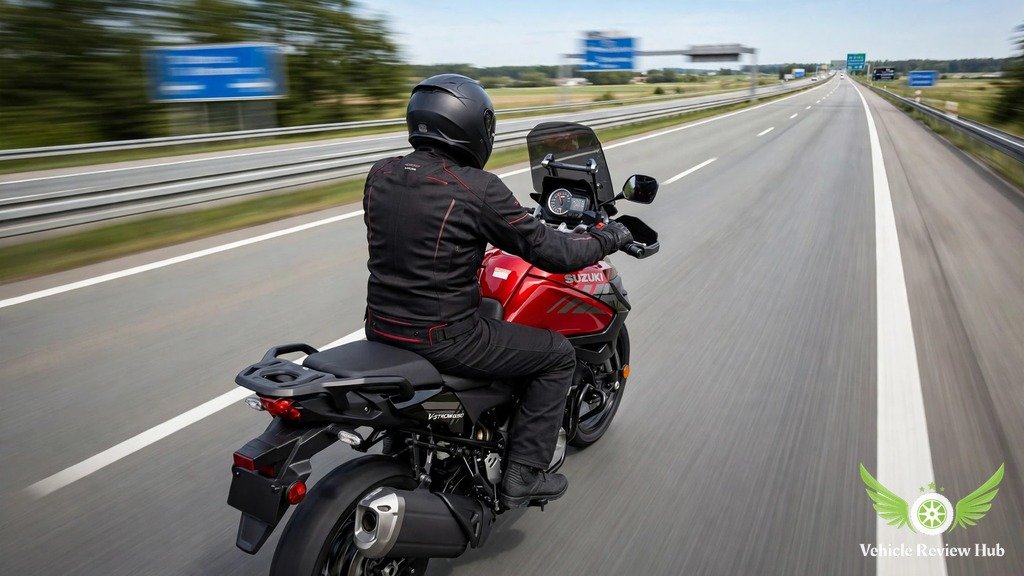
The only measured Suzuki V-Strom 1050 performance top-speed run anywhere is an owner run: a MotoTop video shows a 2023 DE reaching a GPS-verified 194 km/h, or 120.5 mph, on the Autobahn. It is a real reading, but one owner’s bike on one day, not an instrumented test. Treat it as the floor of what the bike can do, not a published top speed.
Aggregator estimates fill the Suzuki V-Strom 1050 performance gap instead: sbkmotor lists 220 km/h (137 mph), BikeBD about 210 km/h, and another site about 201 km/h. None names a rider or a method. A forum post claiming 244 km/h from a dyno day is meaningless, because a dyno measures wheel speed with no load.
Aggregator 0-60 Figures Must Not Be Used
The Suzuki V-Strom 1050 performance 0-60 picture is the same: no named outlet has published a 0-60 or quarter-mile time, and the numbers online are unsourced. One site prints 0-60 in about 3.1 to 3.4 seconds with no test behind it, and that figure should not be repeated as fact. The 4.99-second 0-100 km/h figure from ZigWheels belongs to the third-generation V-Strom 650 XT, a different motorcycle.
What can be said honestly about Suzuki V-Strom 1050 performance and acceleration is this: the engine makes 64.5 lb-ft at the rear wheel at just 4,630 rpm on Cycle World’s dyno and holds more than 60 lb-ft from 3,000 rpm to the redline, so the bike pulls strongly from low revs without needing a downshift to pass. The 2023 update raised the first and sixth gear ratios, with sixth now an overdrive; individual ratios are unpublished.
Suzuki V-Strom 1050 Mileage and Fuel Economy
Fuel economy is the one area of Suzuki V-Strom 1050 performance with a proper tested figure, from Rider Magazine’s 2020 XT test: 44.2 mpg at the low end, 49.8 on average, and 54.0 at the high end. With the 5.3-gallon tank, that average works out to about 264 miles of Suzuki V-Strom 1050 performance range. Those are the only tested fuel numbers for this bike.

Rider Tested 44.2 Low, 49.8 Average, 54.0 High
Rider’s three-figure set is valuable for Suzuki V-Strom 1050 performance because it is a set: 44.2 mpg covers hard riding, 49.8 mixed use, and 54.0 gentle cruising. Expect close to 50 mpg in normal use and mid-40s when ridden hard. The bike needs premium fuel, 91 AKI minimum, and cruises at 3,500 rpm at 60 mph in top gear.
MCN’s launch ride averaged 42 mpg in UK gallons, which are larger than US gallons, so it cannot sit beside Rider’s figures without converting. MCN’s testers expected 50 mpg or more in normal riding, which lines up with Rider’s average. No DE-specific tested MPG exists in Suzuki V-Strom 1050 performance, so the XT’s figures are the platform figures.
Suzuki USA Publishes No MPG Figure at All
Suzuki USA publishes no fuel-economy figure for the 1050. The only manufacturer number is the WMTC claim of 20.4 km/L, about 48 mpg in US gallons: a laboratory claim, not a test. Two unsourced estimates, 45.2 mpg and about 45 mpg, should never be repeated as fact.
| Source | Figure | What it is |
|---|---|---|
| Rider 2020 XT, tested | 44.2 low / 49.8 avg / 54.0 high mpg | Tested; estimated range about 264 miles |
| MCN launch ride, tested | 42 mpg average | Tested, in UK gallons, not US gallons |
| MCN expectation | 50+ mpg in normal riding | Expectation, not a test |
| WMTC manufacturer claim | 20.4 km/L, about 48 mpg US | Claim, never present as tested |
| Suzuki USA | No figure published | Suzuki USA publishes no MPG figure at all |
Suzuki V-Strom 1050 Real-World Riding Experience
On the road, Suzuki V-Strom 1050 performance feels like what it is: a big, comfortable, road-biased adventure tourer with a flexible engine. Rider Magazine’s first ride called it the most technologically advanced V-Strom to date, yet welcoming in disposition. It pulls from 1,800 rpm in top gear without complaint, which is Suzuki V-Strom 1050 performance at its best.
Cycle News on the DE: It Feels Its 554 Pounds
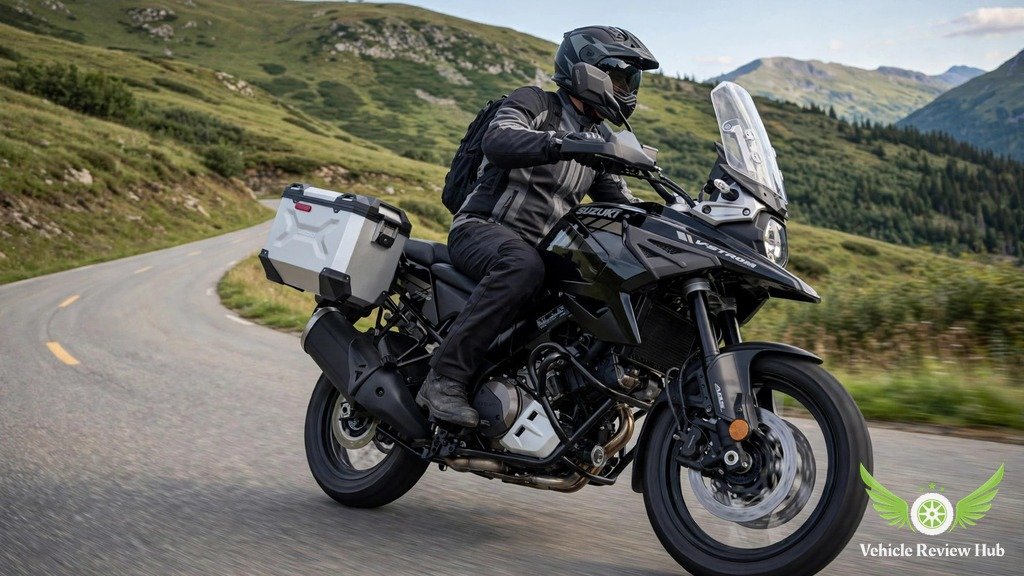
The DE is the heavier bike in the family at 554 pounds with a full tank, and Cycle News said it plainly: the bike feels every bit of that weight when lifted off its side stand or onto its center stand. The same review notes the DE sits tall and feels top-heavy with the tank full, calls the roughly 100 horsepower sufficient, and the DE a better motorcycle in the dirt than the previous XT.
MCN’s Greece launch ride tells the same story from the trail: with traction control off, the bike lifts its 21-inch front wheel, but as the pace picked up the suspension bottomed out, and stopping 554 pounds downhill felt challenging rather than fun. The base bike is 20 pounds lighter.
No RevZilla Review of the 1050 Was Found
One gap is worth stating plainly: no RevZilla first ride or review of the V-Strom 1050 exists, so this guide quotes none. Bennetts BikeSocial fills part of that Suzuki V-Strom 1050 performance gap, rating the DE and standard bike 3 out of 5 overall and calling the 1050 Japan’s last big V-twin. The Bennetts review notes the standard bike has lost none of its stable, sure-footed cornering ability, which matches what Rider and MCN found.
Suzuki V-Strom 1050 Handling, Braking and Stability
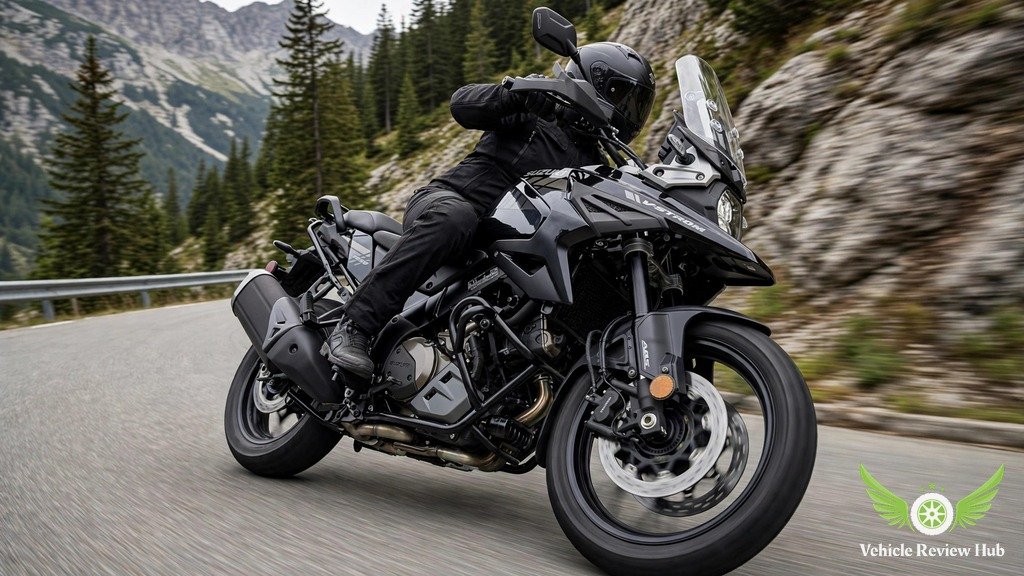
Handling is where the 2023 update changed Suzuki V-Strom 1050 performance most. From 2023 onward, every 1050 carries a six-axis IMU with the Suzuki Intelligent Ride System: cornering ABS, multimode traction control, cruise control, hill hold, and slope and load dependent braking. The quickshifter works both up and down, the TFT dash is a five-inch color unit, and the windscreen adjusts by hand. Before 2023, the base bike had none of that: no cornering ABS, no cruise control, and an LCD dash instead of the TFT. The XT alone had the full package in 2020 to 2022.
Cornering ABS and Cruise Arrived for All in 2023
The 2023 electronics update is the single most important handling fact about this motorcycle, and it defines modern Suzuki V-Strom 1050 performance: a 2023 or newer 1050, in any trim, has cornering ABS and cruise control as standard. A 2020 to 2022 base bike has neither. The DE adds switchable rear ABS for Suzuki V-Strom 1050 performance off-road, so the rear wheel can lock in the dirt, plus a Gravel mode. The base and XT cannot switch the rear ABS off, which one European comparison lists as a genuine con.
One thing the TFT does not do is connect to a phone: no Bluetooth, no navigation, and no MySPIN, despite one outlet claiming in November 2026 that the 2023 update brought Bluetooth and navigation through an app. That claim is wrong, and the same outlet’s own article says the opposite.
Brake Pads, Suspension Linkage and Bearing Checks
No tested 60-0 braking figure exists for Suzuki V-Strom 1050 performance from any named outlet, so this guide gives no stopping distance. The base bike stops with dual 310 mm front discs and Tokico four-piston calipers, a 260 mm rear disc, and a fully adjustable 43 mm KYB inverted fork. The DE runs the same brake sizes with longer travel, 6.7 inches front and 6.6 rear.
The owner’s manual checklist for Suzuki V-Strom 1050 performance covers steering checks at 600, 7,500, and 14,500 miles, and fork and rear-suspension leak inspections at 7,500 and 14,500 miles. The honest maintenance rule is the owner’s manual schedule, which also sets the valve check and spark plug change at 14,500 miles. The 800DE performance guide shows the family contrast: the smaller bike has a tested 45 to 46 mpg and a 72.2-horsepower dyno figure, while Suzuki V-Strom 1050 performance answers with more torque everywhere.
Suzuki V-Strom 1050 Performance Compared With Other Adventure Bikes
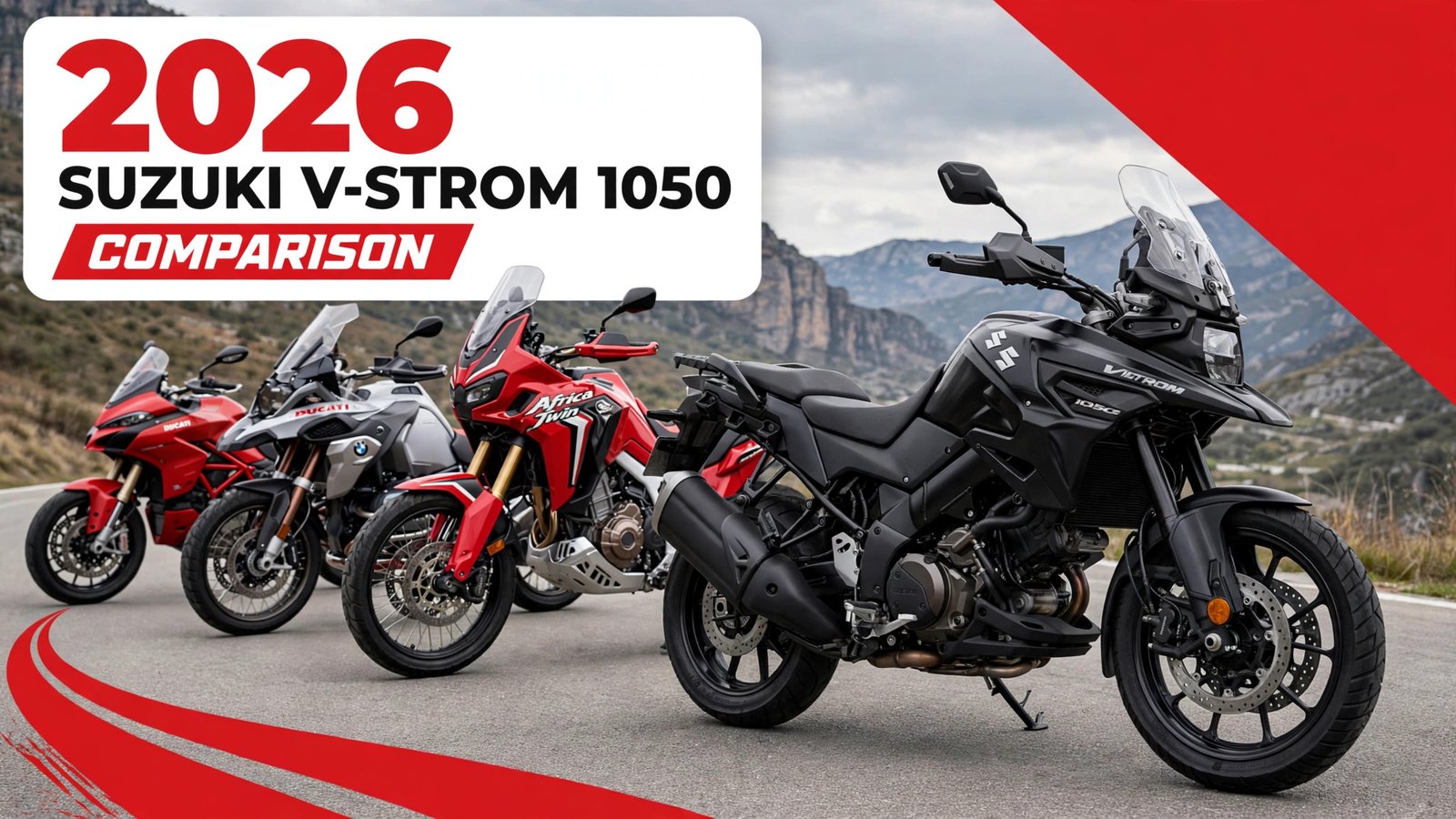
Against its rivals, Suzuki V-Strom 1050 performance is the value buy in a class where money buys power. The full comparison lives in the 1050 comparison. The Africa Twin, the BMW R 1300 GS, and the Ducati Multistrada V4 all cost more, and all three make more claimed power except the Africa Twin.
Suzuki V-Strom 1050 vs Honda Africa Twin
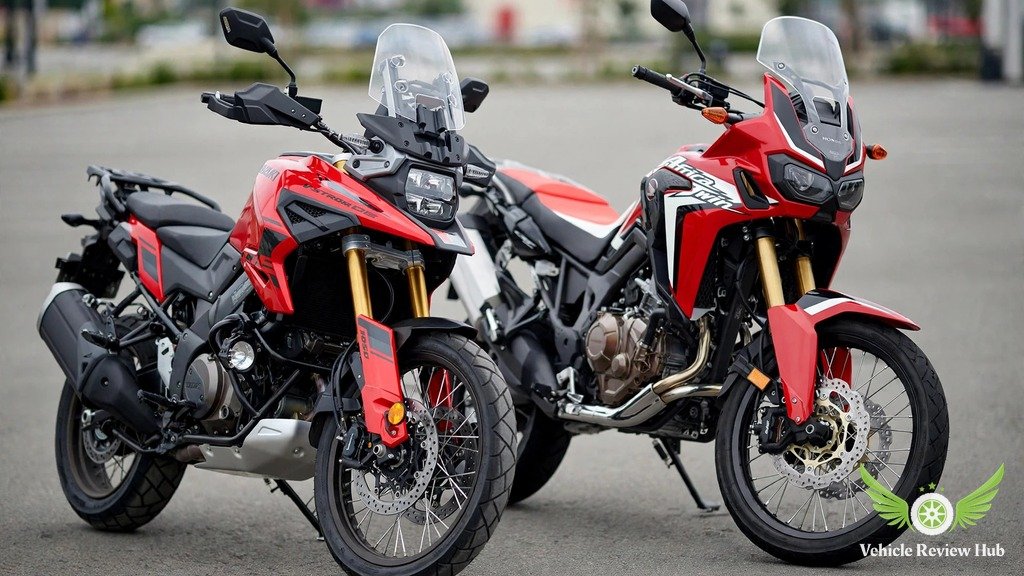
The Africa Twin is the closest Suzuki V-Strom 1050 performance rival on paper. Honda claims about 101 horsepower and 82.6 lb-ft for the Twin’s 1,083cc parallel twin, against the 1050’s 107 and 74. Honda USA publishes no US power figure for the Twin. On claimed power-to-weight the two are tied at 0.200 against 0.198 horsepower per pound. The Twin is 24 pounds lighter at 510 pounds against 534, and costs 300 dollars less for 2026. The 1050 answers with a V-twin character, a lower 33.7-inch seat against the Twin’s 34.3, and standard cruise control and a quickshifter on every 2023 and newer bike.
The other two rivals are in a different price world. The BMW R 1300 GS claims 145 horsepower and 110 lb-ft, weighs 523 pounds wet, and costs 20,395 dollars before destination, while the Ducati Multistrada V4 S claims 170 horsepower and 91 lb-ft, weighs about 511 pounds, and starts at 28,995 dollars. Even MCN’s 99 bhp, the highest of the three 1050 dyno tests, sits well below the German and Italian claims.
Is the Suzuki V-Strom 1050 Suitable for Beginner Riders? No
No, and the reasons are weight, height, and power together. The base bike weighs 534 pounds, the seat sits at 33.7 inches at its lowest setting, and the engine makes 107 claimed horsepower with 74 lb-ft of torque. All three at once make slow-speed work and a first drop much harder than they need to be. The 650 performance figures show the honest starting point in this family: a lighter, shorter, cheaper bike with the same Suzuki dealer network behind it. Buy the 1050 as a second or third bike, after the slow-speed skills are already learned.
Suzuki V-Strom 1050 Performance: Frequently Asked Questions
These are the direct answers to the questions riders actually ask about Suzuki V-Strom 1050 performance. Where no test exists, the answer says so plainly.
How much horsepower does the V-Strom 1050 make on a dyno?
Three named outlets dyno-tested the 2020 XT: Cycle World measured 93.4 horsepower at the rear wheel, Rider 96.3, and MCN 99 bhp. The fair range is 93 to 99 rear-wheel horsepower.
What is the V-Strom 1050’s top speed?
No instrumented top speed exists for Suzuki V-Strom 1050 performance from any named outlet. The only measured run anywhere is an owner GPS run of 194 km/h, or 120.5 mph, on a 2023 DE on the Autobahn.
What is the V-Strom 1050’s 0-60 mph time?
No instrumented 0-60 or quarter-mile time exists from any named outlet, and the figures online, including an unsourced 3.1 to 3.4 seconds, have no test behind them. The honest Suzuki V-Strom 1050 performance proxy is the torque curve: 64.5 lb-ft at the rear wheel at 4,630 rpm, with more than 60 lb-ft from 3,000 rpm to the redline.
What MPG does the V-Strom 1050 get?
Rider Magazine tested 44.2 mpg at the low end, 49.8 on average, and 54.0 at the high end on the 2020 XT. Expect about 50 mpg in normal mixed riding for Suzuki V-Strom 1050 performance, mid-40s when ridden hard, and mid-50s on a gentle cruise. The WMTC claim of about 48 mpg is a laboratory figure, not a test.
How far can the V-Strom 1050 go on a tank?
About 264 miles in mixed riding on the 5.3-gallon tank at Rider’s tested 49.8-mpg average for Suzuki V-Strom 1050 performance, or roughly 234 at the low figure and 286 at the high one. Plan fuel stops around 240 miles.
Does the V-Strom 1050 have enough power?
Yes for its job, and Suzuki V-Strom 1050 performance proves it. The 107-horsepower claim and the 93 to 99 rear-wheel dyno figures cover two-up touring, highway passing, and loaded luggage, because the torque arrives early. The bike is not fast by the standards of the 145-horsepower GS or the 170-horsepower Multistrada V4, but it was built as a value tourer.
How does the V-Strom 1050 compare to the Africa Twin on performance?
Almost exactly level on paper for Suzuki V-Strom 1050 performance. The Twin claims about 101 horsepower and 82.6 lb-ft against the 1050’s 107 and 74, and their claimed power-to-weight figures are 0.198 and 0.200, effectively tied.
What is the V-Strom 1050’s power-to-weight ratio?
On claimed figures, Suzuki V-Strom 1050 performance works out to 0.200 horsepower per pound: 107 claimed horsepower divided by 534 pounds of curb weight for the base bike. On Cycle World’s tested 93.4 rear-wheel horsepower, it is about 0.175. The Africa Twin sits at 0.198, so the two are tied on paper.
Is the V-Strom 1050’s engine buzzy at highway speed?
No named test reports a buzz problem in Suzuki V-Strom 1050 performance. The engine cruises at 3,500 rpm at 60 mph in top gear, well below its 8,500-rpm power peak, and the 90-degree V-twin layout is naturally smooth. Highway complaints are about weight and wind, not vibration.
What is the V-Strom 1050’s redline?
Suzuki publishes no redline figure for the 1050, so this Suzuki V-Strom 1050 performance guide prints no number. Peak power arrives at 8,500 rpm on the global claim, and Cycle World’s dyno recorded 8,650 rpm.
Does the V-Strom 1050 have riding modes?
Yes, on 2023 and newer bikes, Suzuki V-Strom 1050 performance comes through the Suzuki Intelligent Ride System: ride modes, multimode traction control, cornering ABS, cruise control, and hill hold, all managed by the six-axis IMU.
Is the V-Strom 1050 faster than the V-Strom 800DE?
Yes, clearly, and this is one Suzuki V-Strom 1050 performance comparison that can be made on the same dyno. Cycle World measured Suzuki V-Strom 1050 performance at 93.4 rear-wheel horsepower and the 800DE at 72.2 on its Dynojet, a gap of 21 horsepower. The 800DE is lighter at 507 pounds, but Suzuki V-Strom 1050 performance is faster.