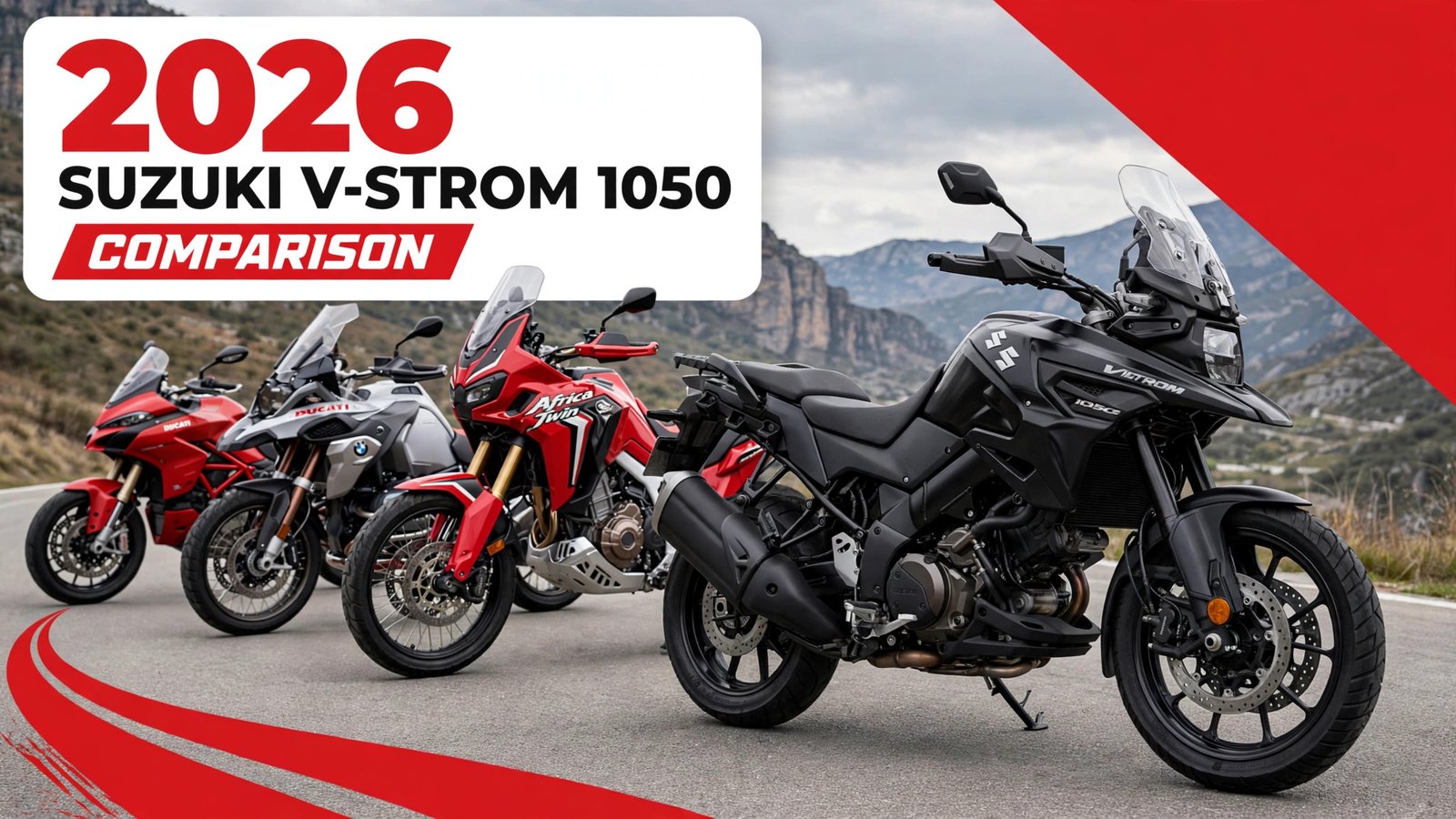
The short answer in this Suzuki V-Strom 1050 comparison is that the 1050 is the cheapest way into the full-size adventure class with a big twin and full electronics — and it is close enough to the Honda Africa Twin on price that the choice comes down to character. The 2026 base 1050 costs $15,499, just $300 more than the Africa Twin’s $15,199, while the BMW R 1300 GS starts at $20,395 and the Ducati Multistrada V4 S at $28,995. This Suzuki V-Strom 1050 comparison puts all four side by side on price, specs, electronics, weight and value.
Two things to know before the details. First, Suzuki USA publishes no horsepower, torque or MPG figure for the 1050 — the 107 hp and 74 lb-ft figures are global claims, and the only measured power numbers come from independent dyno tests, covered in the 1050 performance guide. Second, this Suzuki V-Strom 1050 comparison uses 2026 US prices with destination and totals wherever they are verified, and says so plainly where a destination figure is not verified. For prices, trims and model years, see the full 1050 review.
Suzuki V-Strom 1050 Overview and Its Closest Rivals
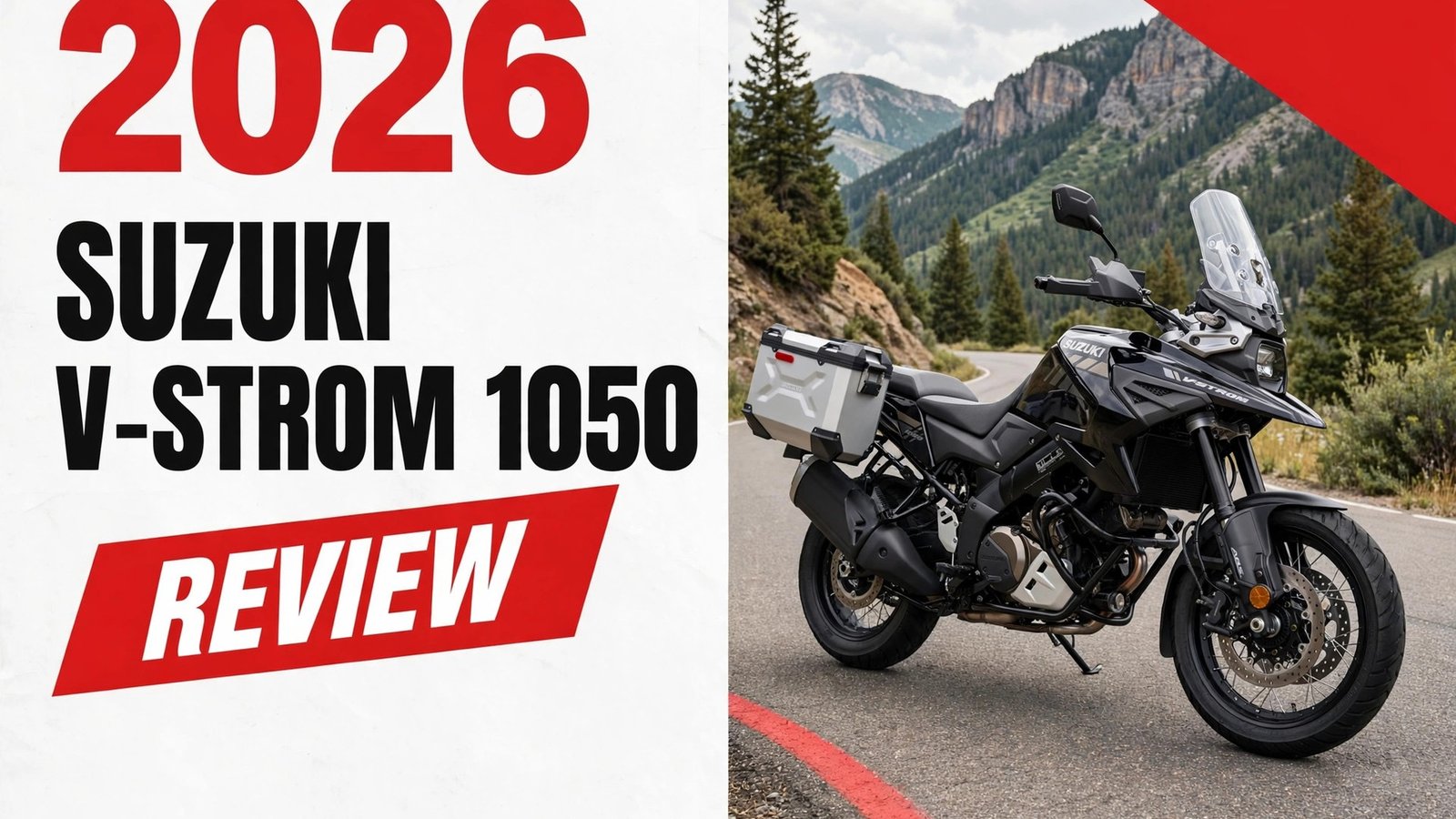
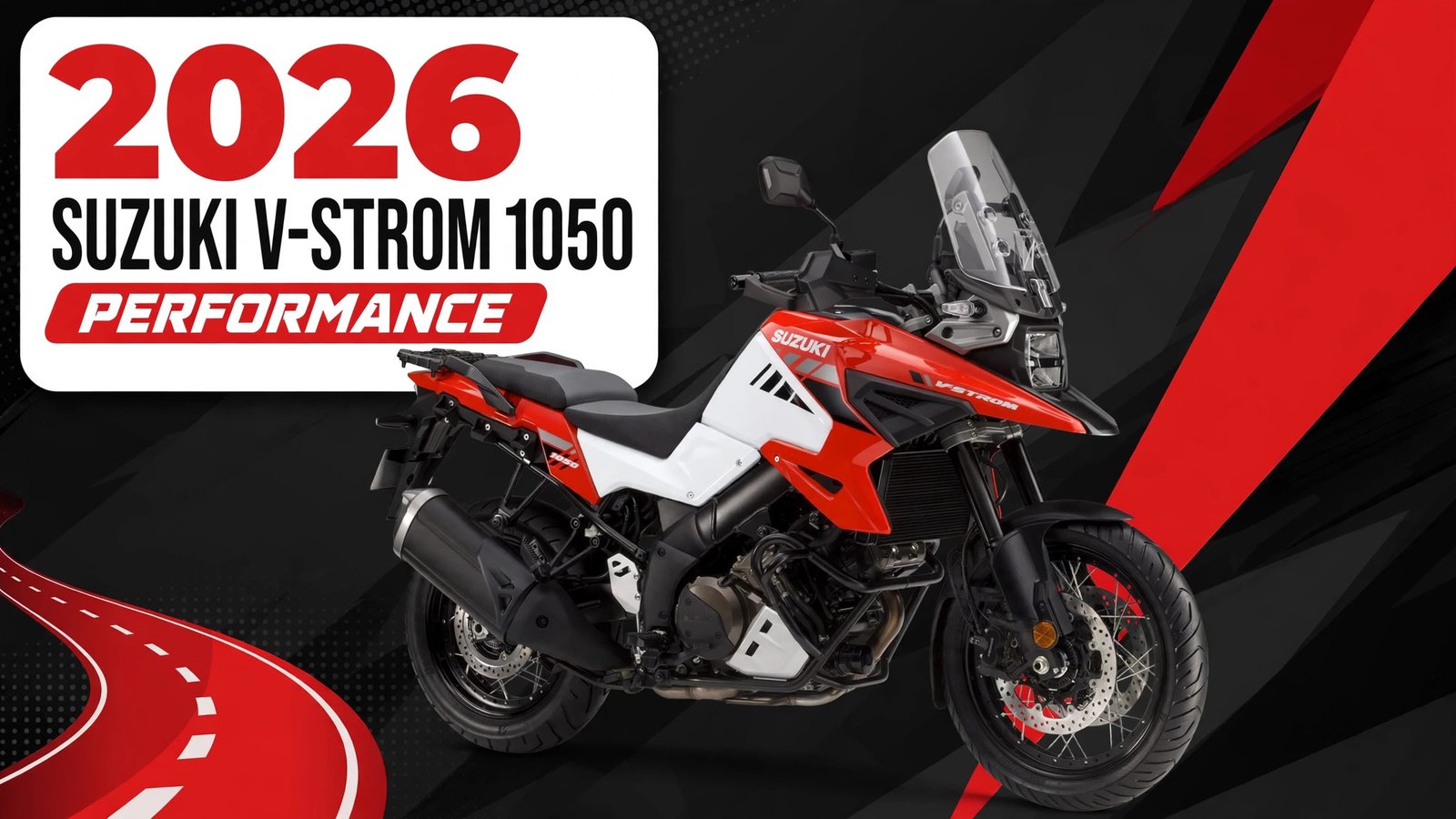
In this Suzuki V-Strom 1050 comparison, the 1050 is a 1,037cc liquid-cooled 90-degree V-twin adventure tourer with a 5.3-gallon tank, 534-pound curb weight and 33.7-inch seat, and since the 2023 update every trim carries a six-axis IMU, cornering ABS, traction control, cruise and a quickshifter. The Suzuki USA 1050 page lists the 2026 base at $15,499.

Why These Three Rivals: Same Class, Same Job
All four bikes in this Suzuki V-Strom 1050 comparison are full-size adventure bikes with a genuine long-distance touring brief — same class, same job. The Africa Twin is the Japanese value rival at nearly the same price, with a bigger dealer network and a DCT option the Suzuki does not offer. The R 1300 GS is the class benchmark, with shaft drive, radar and adaptive ride height, for $4,896 more. The Multistrada V4 is the power and technology flagship, with 170 hp and radar, for $13,496 more. What the 1050 brings is a proven V-twin and a price that leaves thousands in the buyer’s pocket.
How the Four Bikes Differ at a Glance
The headline differences are money, weight and power. The Multistrada makes 63 hp more than the 1050 and the GS 38 hp more, yet the 1050 ties the Africa Twin on claimed power-to-weight. The table below is the whole Suzuki V-Strom 1050 comparison at a glance — no same-dyno table exists, because only the 1050 has a named-outlet dyno test.
| Bike | Engine / claimed power | Weight | Tank | Seat height |
|---|---|---|---|---|
| Suzuki V-Strom 1050 | 1,037cc V-twin, 107 hp / 74 lb-ft (global claim) | 534 lb curb | 5.3 gal | 33.7 in (34.5 in high) |
| Honda Africa Twin | 1,083cc parallel twin, ~101 hp / 82.6 lb-ft (global claim) | 510 lb curb (manual) | 5.0 gal (6.55 gal ES) | 34.3 in (33.5 in low) |
| BMW R 1300 GS | 1,300cc boxer twin, 145 hp / 110 lb-ft | 523 lb wet | 5.0 gal | 33.4 in standard |
| Ducati Multistrada V4 S | 1,158cc V4, 170 hp / 91 lb-ft | ~511 lb (wet, no fuel) | 5.8 gal (7.9 gal Rally) | Not verified from Ducati USA |
Suzuki V-Strom 1050 vs Honda Africa Twin
The Africa Twin is the closest rival in this Suzuki V-Strom 1050 comparison: the 2026 Twin starts at $15,199, only $300 below the 1050’s $15,499. The Twin is the dirt-first machine with a 21-inch front wheel and a DCT option, the 1050 the road-touring machine with V-twin character and standard cruise and quickshifter. The Africa Twin review covers the Honda in full.
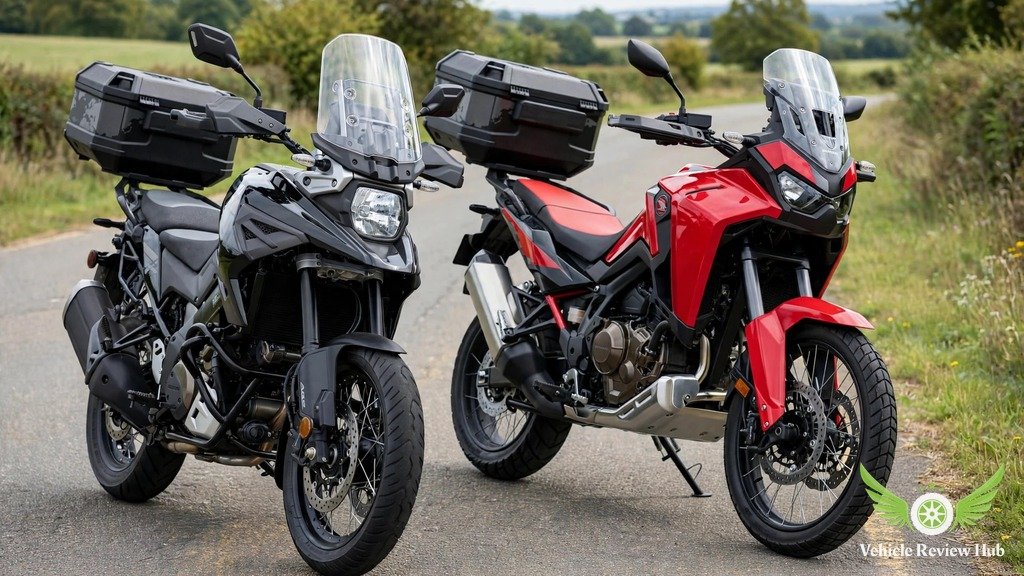
One video covers two of the three rivals in this Suzuki V-Strom 1050 comparison after 80,000 km of long-term use, on weight, comfort, reliability, maintenance and costs. Three honest caveats before you watch: the narration is in Spanish, the GS in the video is the older R 1250 GS rather than the R 1300 GS in this Suzuki V-Strom 1050 comparison, and no Multistrada appears in it.
Engine, Specs and Performance Side by Side
On claimed power the two are near-identical: the 1050’s global claim is 107 hp at 8,500 rpm and 74 lb-ft at 6,000 rpm, against the Twin’s of about 101 hp at 7,500 rpm and 82.6 lb-ft at 5,500 rpm — and neither is a US figure, because neither Suzuki USA nor Honda USA publishes one. What is measured is the 1050’s dyno record: Cycle World 93.4 hp, Rider 96.3 hp, MCN 99 bhp — three different dynos that must never be ranked against each other. No same-dyno comparison exists for the Twin, so the honest Suzuki V-Strom 1050 comparison on performance is a tie on paper — 0.200 hp per pound for the 1050 against 0.198 for the Twin — and the riding experience decides. On weight the Twin wins by 24 pounds (510 lb against 534 lb, both manual, curb), and the Twin’s 5.0-gallon tank is smaller than the 1050’s 5.3, though the Adventure Sports ES carries 6.55 gallons. The Twin makes more torque lower down; the 1050’s V-twin answers with 64.5 lb-ft at just 4,630 rpm on Cycle World’s dyno.
Price, Equipment and Which Suits Which Rider
For 2026 the Twin’s base manual is $15,199 and the DCT is $15,999, against the 1050’s $15,499 — and the Twin’s 2026 destination charge is not separately verified, so this Suzuki V-Strom 1050 comparison gives 2026 MSRP only for the Honda. The Twin’s equipment list is longer: a 6.5-inch TFT with Apple CarPlay and Android Auto, traction and wheelie control, four ride modes plus two custom, cornering ABS and the DCT option, while the Adventure Sports ES adds Showa electronic suspension, heated grips and a 19-inch front wheel. The 1050 answers with standard cruise and a quickshifter on every 2023 and newer bike, a lower 33.7-inch seat against the Twin’s 34.3, and a 12-month unlimited-mileage warranty against the Twin’s one-year transferable unlimited-mileage warranty. Choose the Twin if dirt matters more than road, if the DCT appeals, or if the 21-inch front wheel and 9.8 inches of clearance fit your riding.
Suzuki V-Strom 1050 vs BMW R 1300 GS
The GS is the benchmark in this Suzuki V-Strom 1050 comparison, and the price gap is the story: the 2026 R 1300 GS costs $20,395 plus $1,095 destination, $21,490 in total, which is $4,896 more than the 1050 on MSRP alone. For that money the GS gives 38 hp more, shaft drive, radar and adaptive ride height. The question this Suzuki V-Strom 1050 comparison has to answer is whether those advantages are worth nearly $5,000.

Engine, Specs and Performance Side by Side
The GS’s 1,300cc ShiftCam boxer twin makes 145 hp at 7,750 rpm and 110 lb-ft at 6,500 rpm, against the 1050’s global claim of 107 hp and 74 lb-ft — a 38-hp gap, 0.277 hp per pound against 0.200. Yet the GS is barely lighter at 523 pounds wet against the 1050’s 534-pound curb — only 11 pounds heavier despite the chain. Both carry 5.0-gallon tanks and 6.5-inch TFTs, but the GS’s electronics go further: Dynamic ESA suspension, riding modes Pro, hill-start control, optional radar and adaptive ride height. The 1050’s electronics are simpler: IMU, cornering ABS, traction control, cruise and quickshifter, with no radar or adaptive suspension. The GS’s real ownership advantage in this Suzuki V-Strom 1050 comparison is the shaft drive — no chain to clean, lube and replace — against the 1050’s chain. The motorcycle.com GS comparison confirms the $20,395 price, $1,095 destination and 36-month warranty.
Price, Equipment and Which Suits Which Rider
The GS costs $21,490 with destination against the 1050’s $16,199 — and the GS price climbs fast, the optional ASA gearbox pushing it over $25,000 and packages toward $30,000. Its warranty is longer at 36 months or 36,000 miles against the 1050’s 12 months, and its resale values are the strongest in the class. Choose the GS if shaft drive, radar, adaptive ride height and the best resale matter, or if you ride two-up loaded. Choose the 1050 if the $4,896 saving matters more than radar and shaft — the Suzuki does the same long-distance touring job with the same cruise control, is simpler to own, and its dealers charge less. Do not confuse the base GS with the GS Adventure, a separate $28,165 model with a 7.9-gallon tank and 593 pounds wet.
Suzuki V-Strom 1050 vs Ducati Multistrada V4
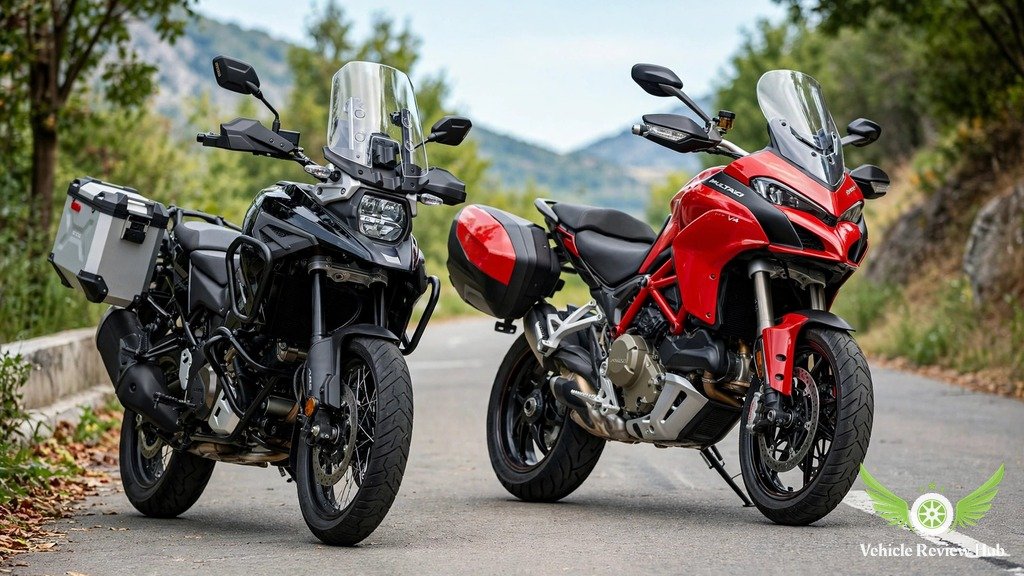
The Multistrada V4 is the power and technology flagship of this Suzuki V-Strom 1050 comparison, and the gap is the widest of the three: the V4 S starts at $28,995, $13,496 more than the 1050 — nearly double the Suzuki’s money. For that the Ducati gives 170 hp, radar, Skyhook suspension and the longest valve-check interval in the class. The honest question is not whether the Multistrada is the better motorcycle — on paper it is — but whether a 1050 buyer needs 170 hp and radar at twice the price.
Engine, Specs and Performance Side by Side
The V4 S’s 1,158cc Granturismo V4 makes 170 hp at 10,750 rpm and 91 lb-ft at 9,000 rpm, against the 1050’s global claim of 107 hp and 74 lb-ft — a 63-hp gap, the widest claimed power-to-weight spread in this Suzuki V-Strom 1050 comparison at 0.333 against 0.200. The Ducati is also lighter at about 511 pounds wet without fuel, 23 pounds under the 1050, and carries a bigger 5.8-gallon tank against the 1050’s 5.3. Its electronics are the class standard: radar, Skyhook suspension, a 6.5-inch TFT, a six-axis IMU, cornering ABS, quickshifter and four ride modes. Where the Ducati quietly wins the ownership argument is the valve-check interval: 37,000 miles, the longest in this set, against the 1050’s 14,500. The TotalMotorcycle V4 S page confirms the $28,995 price and the 60,000-km valve interval.
Price, Equipment and Which Suits Which Rider
The V4 S starts at $28,995 with its destination not verified for 2026, while the Rally costs $31,995 plus $1,295 destination, $33,290 in total, and the V4 RS is a separate $39,995 model. The plain non-S Multistrada V4’s 2026 US status and price were not verified, so this Suzuki V-Strom 1050 comparison uses the V4 S as the entry point. The Ducati’s warranty is 24 months with unlimited mileage, against the 1050’s 12 months. Choose the Multistrada if 170 hp, radar and Skyhook matter, or if the 37,000-mile valve interval fits a high-mileage life. Choose the 1050 if the $13,496 saving matters more — the Suzuki covers the same touring and two-up luggage job, with a simpler engine and dealers that charge far less. The Cycle News Rally first look confirms the Rally’s $31,995 price and 7.9-gallon tank.
Suzuki V-Strom 1050 Price and Value Compared
Price is where this Suzuki V-Strom 1050 comparison is decided: the four bikes span $13,496 from cheapest to dearest. The 1050 sits at the bottom of the class on price and in the middle on equipment, which is why it wins the value argument. The Suzuki USA 1050DE page lists the DE at $16,449.

New Prices Across the Four Bikes in the USA
The 2026 table below is the whole Suzuki V-Strom 1050 comparison in dollars, with destination shown only where it is verified. The 1050DE sits one row above the base as the off-road pick inside the family, at $16,449 plus $700.
| Bike | MSRP 2026 | Destination | Total |
|---|---|---|---|
| Suzuki V-Strom 1050 | $15,499 | $700 | $16,199 |
| Suzuki V-Strom 1050DE | $16,449 | $700 | $17,149 |
| Honda Africa Twin | $15,199 | Not verified for 2026 | MSRP only (2025 total was $15,574) |
| BMW R 1300 GS | $20,395 | $1,095 | $21,490 |
| Ducati Multistrada V4 S | $28,995 | Not verified | MSRP only |
The gaps tell the story of this Suzuki V-Strom 1050 comparison. The 1050 is $300 more than the Africa Twin on MSRP, the GS is $4,896 more than the 1050, the Multistrada V4 S is $13,496 more than the 1050 and $8,600 more than the GS, and the DE is $950 over the base 1050.
Running Costs and Resale Value Compared
Running costs split the four bikes in this Suzuki V-Strom 1050 comparison in the 1050’s favour on routine work and against it on two counts. The 1050’s valve inspection falls at 14,500 miles with plugs replaced at the same service, and its chain needs slack checked before every ride and a clean and lube every 600 miles. The Multistrada’s 37,000-mile valve interval is the longest in the set, while the GS’s shaft drive removes the chain. The Africa Twin’s and the GS’s valve intervals were not verified, so no figure is printed for either. On warranties the GS leads at 36 months or 36,000 miles, the Multistrada follows at 24 months unlimited-mileage, and the 1050 and the Africa Twin give 12 months unlimited-mileage. On fuel, the only tested figures in this Suzuki V-Strom 1050 comparison belong to the 1050: Rider tested 44.2 mpg low, 49.8 average and 54.0 high on the 2020 XT, about 264 miles from the 5.3-gallon tank, per the Rider first ride. On resale the GS is strongest, while the 1050’s lower price means less money to lose.
Suzuki V-Strom 1050 Comparison Verdict and US Alternatives
The verdict of this Suzuki V-Strom 1050 comparison: the 1050 wins on value, the Africa Twin wins on dirt, the GS wins on everything except price, and the Multistrada wins on power and technology. The right buy depends on which win matters most, and on how much money is left for the riding itself. The 800DE comparison covers the same value question one class down, against the Transalp, the Ténéré 700 and the Tuareg 660.

The Africa Twin Matches Its Money Almost Exactly
The Africa Twin matches its money almost exactly because the $300 gap buys a real difference rather than a rounding error. For $300 less, the Twin gives a 21-inch front wheel, 9.8 inches of clearance, a DCT option and a bigger dealer network. For $300 more, the 1050 gives a V-twin character, a lower 33.7-inch seat, standard cruise and a quickshifter, and a 5.3-gallon tank against the Twin’s 5.0. Neither bike wins on paper in this Suzuki V-Strom 1050 comparison — 0.200 against 0.198 on claimed power-to-weight, effectively tied — so the choice is a test ride, not a spreadsheet. Riders who tour mostly on pavement and want the lower seat should buy the 1050; riders who ride dirt, want the DCT, or want the taller bike should buy the Twin. Either way, the Suzuki V-Strom 1050 comparison ends in a tie that the rider breaks — the honest verdict for the two cheapest bikes in the class.
Super Ténéré Is Gone: Last US Year Was 2024
The Yamaha Super Ténéré was the natural fourth Japanese rival in this Suzuki V-Strom 1050 comparison until Yamaha quietly removed it from the US website in December 2024. Its last US year was 2024 at $16,299, with a 1,199cc parallel twin making 112 hp, shaft drive and 584 pounds. It is gone from the US market, so it is listed here only as a used-bike alternative, never as a current rival. The live alternatives inside the family are the 1050DE at $16,449 plus $700 destination, $950 over the base for the 21-inch front wheel, switchable rear ABS, Gravel mode and longer travel, and the V-Strom 650XT Adventure at $10,999 plus $530 destination for 2025, $11,529 in total — $4,670 less than the 2026 base 1050 with destination. The Kawasaki Versys 650 LT gets one line of context only, at $10,399 plus $685 ($11,084 total): a road-biased tourer on 17-inch cast wheels with no 21-inch front. For the full maintenance picture behind this verdict, see the 1050 reliability guide.
Suzuki V-Strom 1050 Comparison: Frequently Asked Questions
Direct answers to the questions riders ask in a Suzuki V-Strom 1050 comparison. Every price is a 2026 US figure unless the answer says otherwise.
Is the V-Strom 1050 better than the Honda Africa Twin?
Neither wins outright. The 1050 is better on the road — V-twin character, lower 33.7-inch seat, standard cruise and quickshifter; the Twin is better off-road — 21-inch front wheel, 9.8 inches of clearance, DCT option. On claimed power-to-weight they tie at 0.200 against 0.198 hp per pound, so a Suzuki V-Strom 1050 comparison against the Twin ends in a test ride.
Which is cheaper — the V-Strom 1050 or the Africa Twin?
The Africa Twin is cheaper on MSRP by $300 in this Suzuki V-Strom 1050 comparison: $15,199 against the 1050’s $15,499 for 2026. The Twin’s 2026 destination is not verified, while the 1050’s $700 destination gives a verified total of $16,199.
Is the V-Strom 1050 better than the BMW R 1300 GS?
Not on capability, but better on value. The GS makes 145 hp against the 1050’s 107 hp claim, has shaft drive, radar and adaptive ride height, and holds value better. The 1050 costs $4,896 less on MSRP and does the same touring job. A Suzuki V-Strom 1050 comparison against the GS is a question of budget.
How does the V-Strom 1050 compare to the Ducati Multistrada V4?
In this Suzuki V-Strom 1050 comparison, the Multistrada V4 S is faster and more advanced — 170 hp, radar and Skyhook suspension against the 1050’s 107 hp claim and simpler electronics. It costs $13,496 more. The Ducati’s 37,000-mile valve interval beats the 1050’s 14,500 miles, but the Suzuki covers the same touring job for nearly half.
Which bike has the most horsepower — V-Strom 1050, Africa Twin, R 1300 GS, or Multistrada V4?
The Multistrada V4, by a wide margin: 170 hp, against the GS’s 145 hp, the 1050’s 107 hp global claim and the Africa Twin’s roughly 101 hp global claim. The 1050’s only measured power numbers are its dyno tests — Cycle World 93.4 hp, Rider 96.3 hp, MCN 99 bhp — and no same-dyno comparison exists across the four bikes in this Suzuki V-Strom 1050 comparison.
Which bike is the lightest — V-Strom 1050, Africa Twin, R 1300 GS, or Multistrada V4?
The Africa Twin, at 510 pounds curb for the base manual, against the Multistrada V4 S at about 511 pounds wet without fuel, the GS at 523 wet and the 1050 at 534 curb. The 1050 is the heaviest bike in this Suzuki V-Strom 1050 comparison, 24 pounds over the Twin and 11 over the GS.
Which bike is best for long-distance touring?
All four tour well in this Suzuki V-Strom 1050 comparison, for different money. The GS is the most complete tourer, with shaft drive, radar and the best wind protection. The 1050 is the best value tourer, with cruise control, a 5.3-gallon tank and about 264 miles of range. The Multistrada is the fastest. The Africa Twin is the most versatile, with the biggest tank at 6.55 gallons on the ES.
Which bike is best for off-road riding?
The Africa Twin takes the off-road win in this Suzuki V-Strom 1050 comparison, on its 21-inch front wheel, 9.8 inches of clearance and dirt-first design. The 1050DE is the off-road pick inside the Suzuki family, with its own 21-inch front wheel, switchable rear ABS and Gravel mode, but the base 1050 on 19-inch cast wheels is a road bike. The GS and the Multistrada are road-biased.
Which bike has the longest valve-check interval?
The Multistrada V4, at 37,000 miles — the longest in this set. The 1050’s valve inspection falls at 14,500 miles with plugs replaced at the same service. The Africa Twin’s and the R 1300 GS’s valve intervals were not verified, so no figure is printed for either in this Suzuki V-Strom 1050 comparison.
Which bike has the best warranty?
The BMW R 1300 GS takes the warranty win in this Suzuki V-Strom 1050 comparison, at 36 months or 36,000 miles. The Multistrada V4 follows at 24 months with unlimited mileage. The 1050 and the Africa Twin both give 12 months with unlimited mileage — the 1050’s a 12-month unlimited-mileage limited warranty, the Twin’s a one-year transferable unlimited-mileage warranty.
Is the V-Strom 1050 good value compared to the R 1300 GS and Multistrada V4?
Yes — in this Suzuki V-Strom 1050 comparison, the 1050 costs $4,896 less than the GS and $13,496 less than the Multistrada V4 S on MSRP, yet it carries the same core touring equipment: cruise control, quickshifter, cornering ABS and IMU. It gives up radar, adaptive suspension and shaft drive, and 38 to 63 hp, but it keeps thousands for luggage, tires and trips.
Should I buy the V-Strom 1050 or the V-Strom 1050DE?
Buy the base 1050 if you tour mostly on pavement: $950 cheaper, 20 pounds lighter, lower seat, cast wheels with tubeless tires. Buy the DE if you ride dirt: 21-inch front wheel, switchable rear ABS, Gravel mode and longer travel are worth the $950. Both bikes in this Suzuki V-Strom 1050 comparison share the same engine, 107 hp claim and 14,500-mile valve interval.