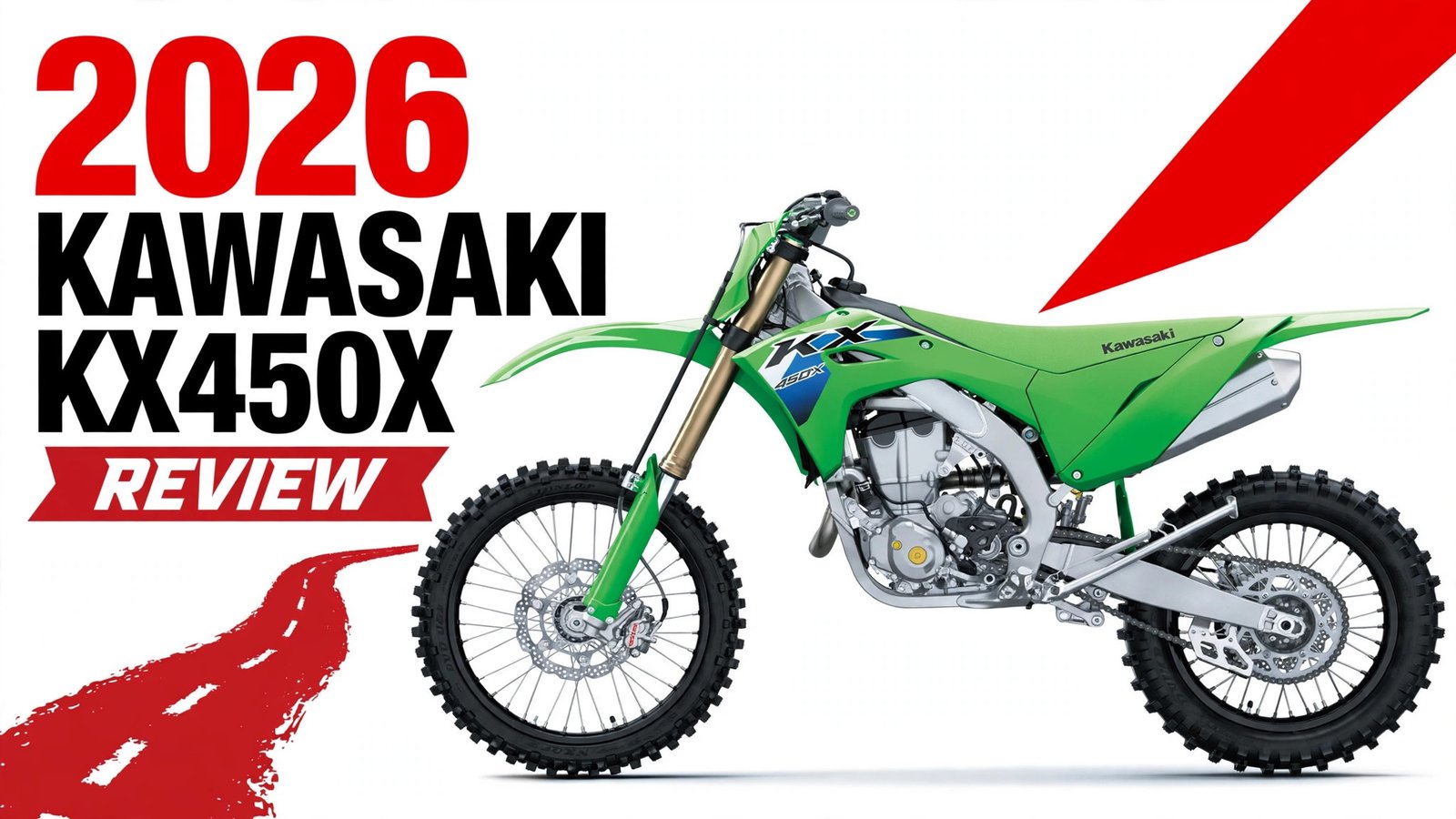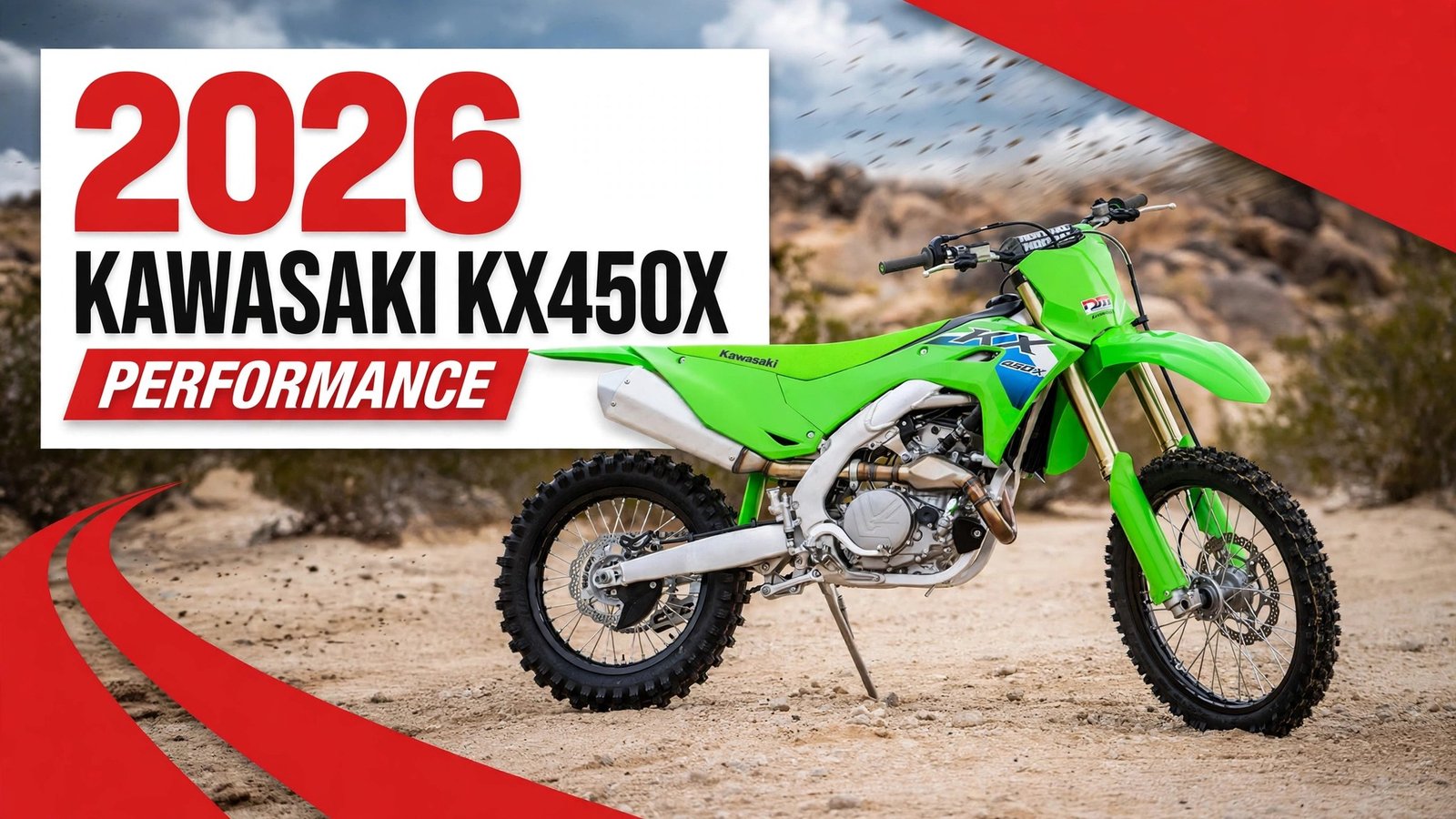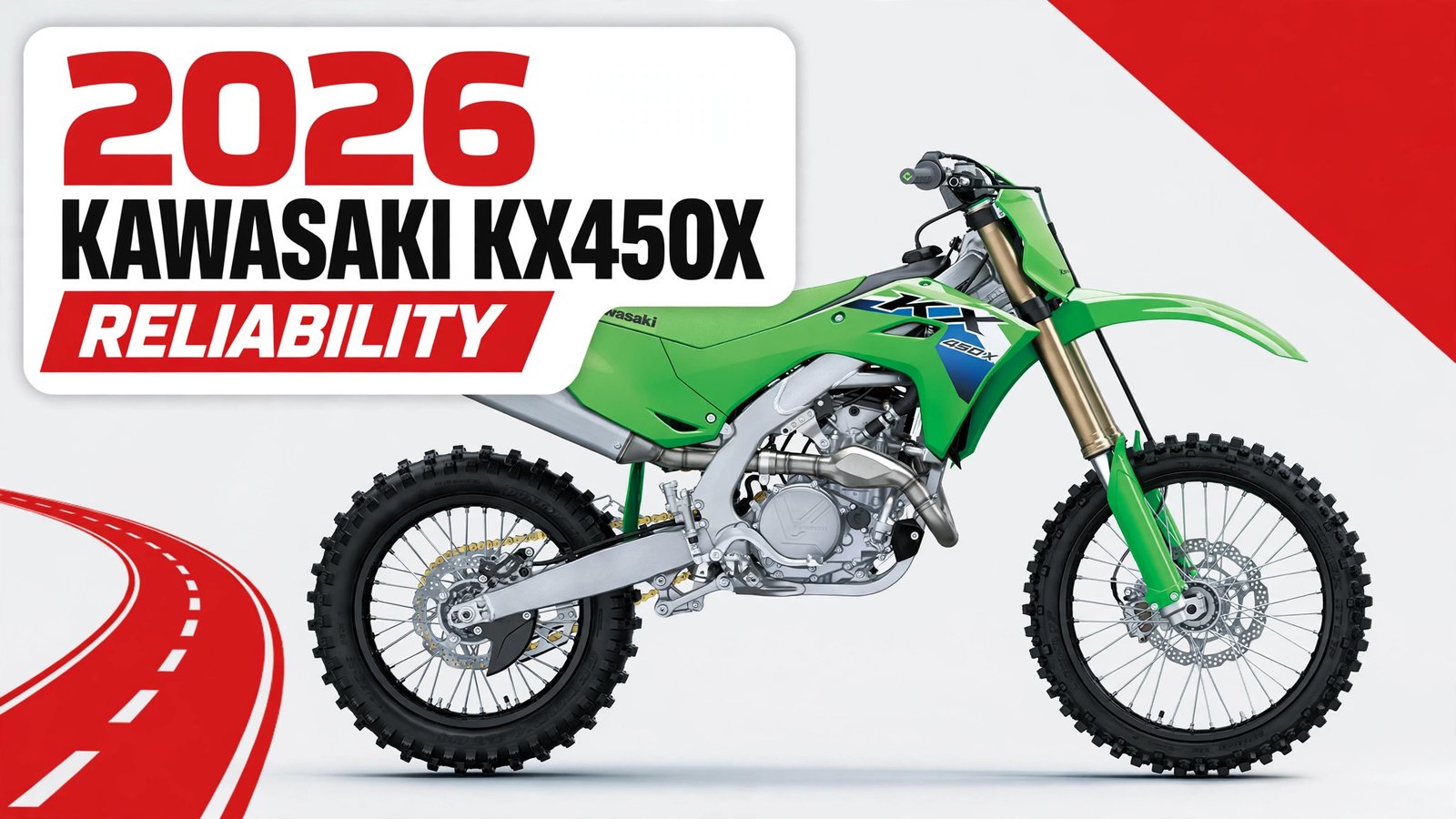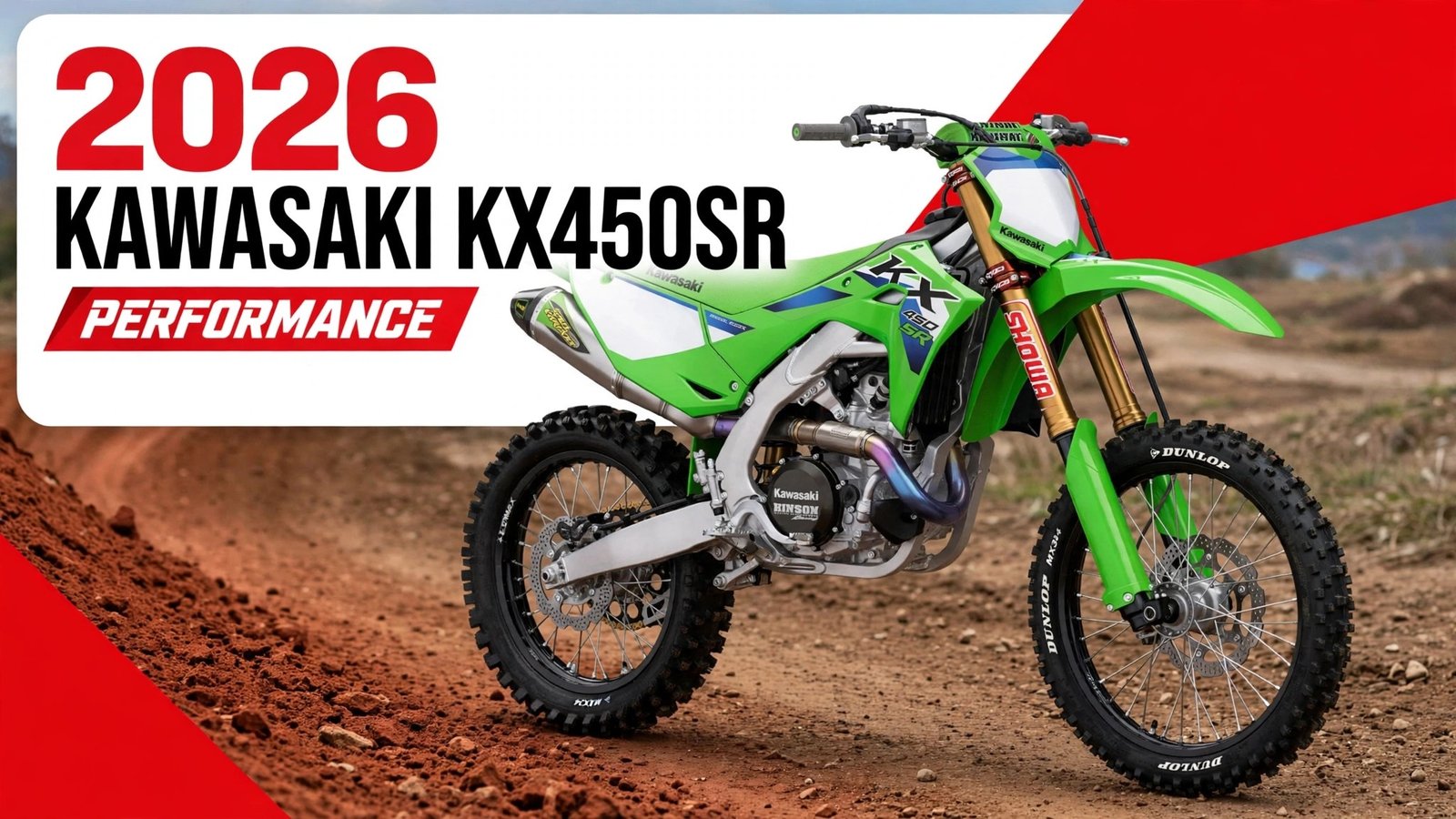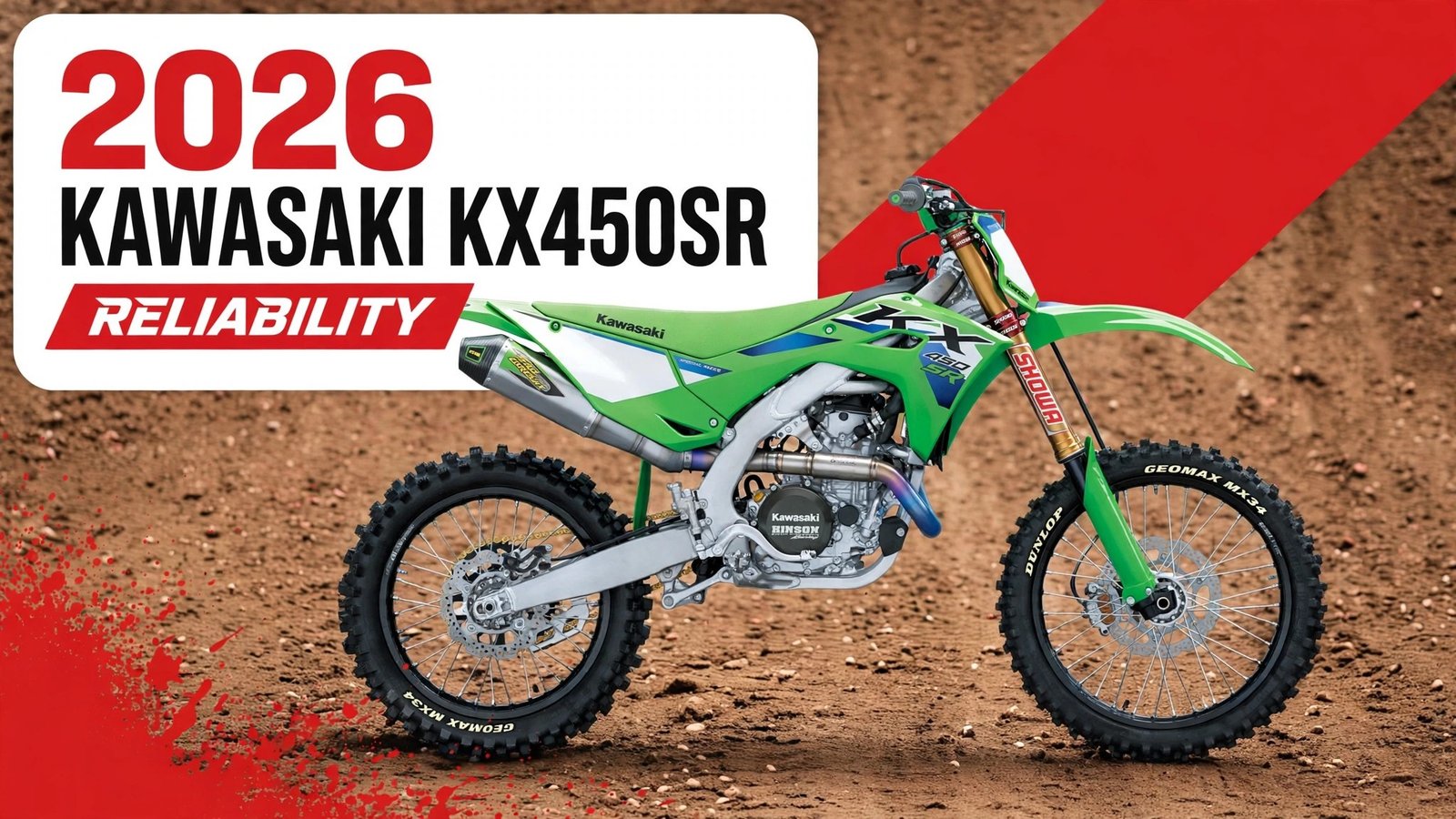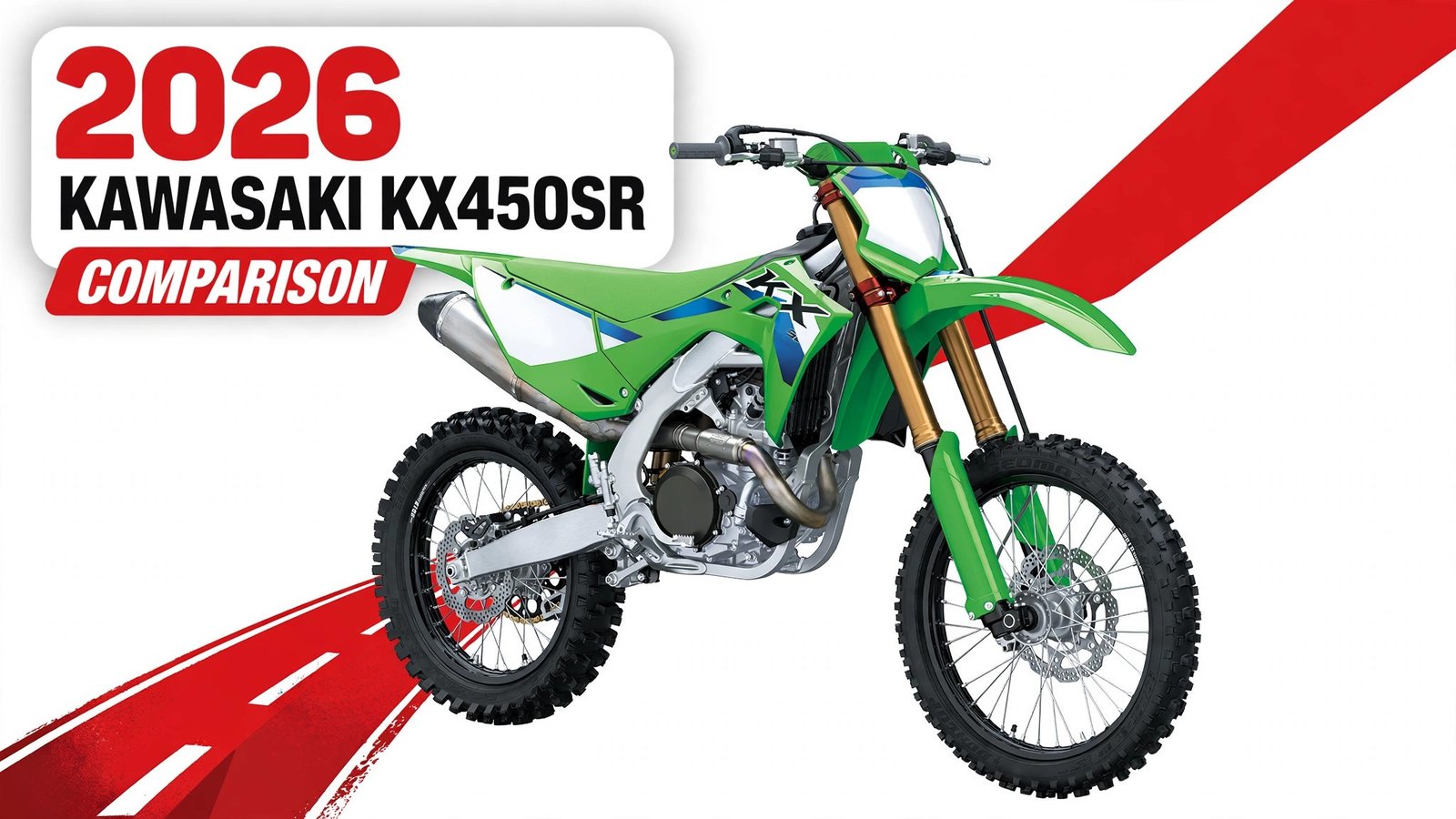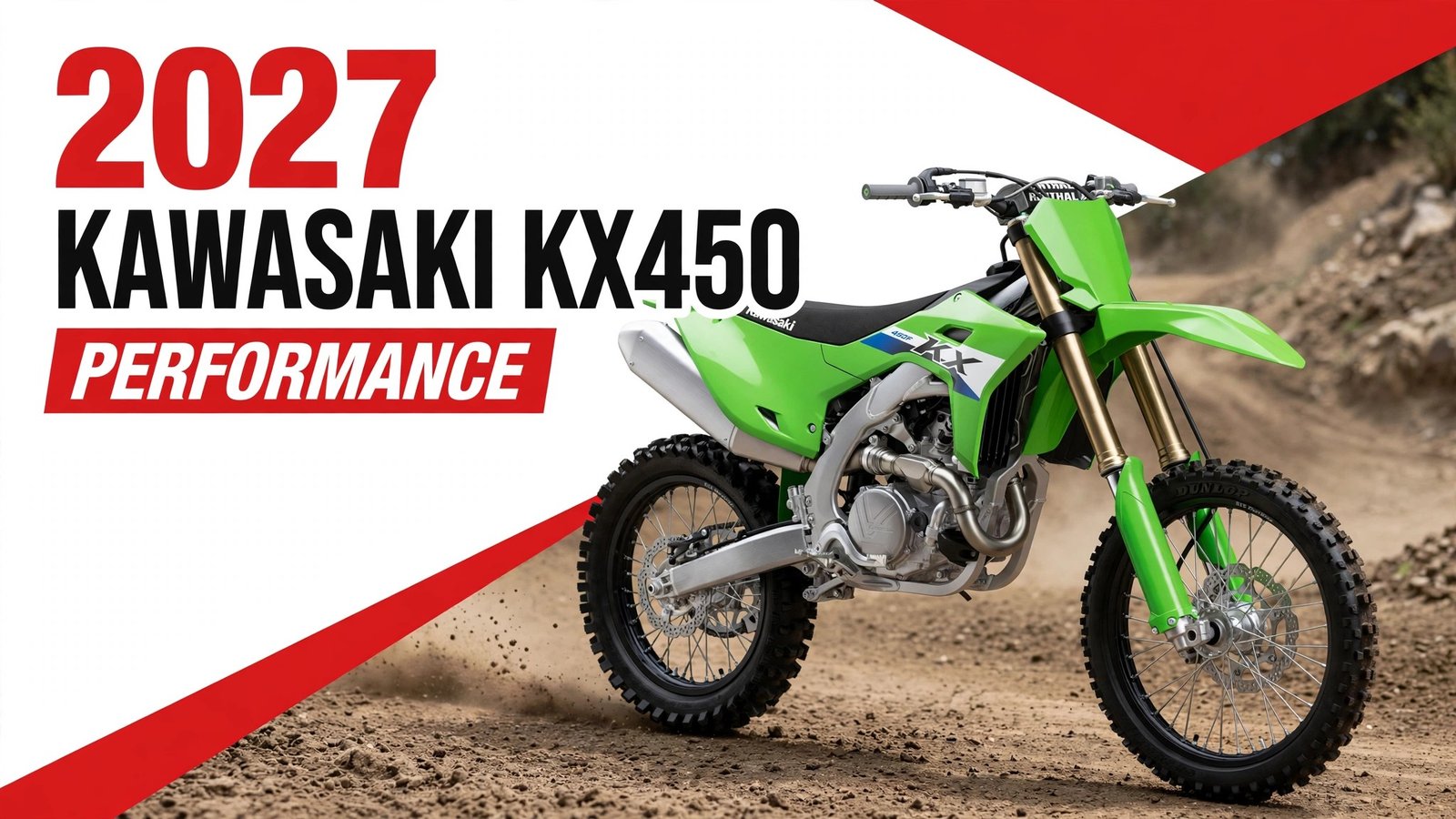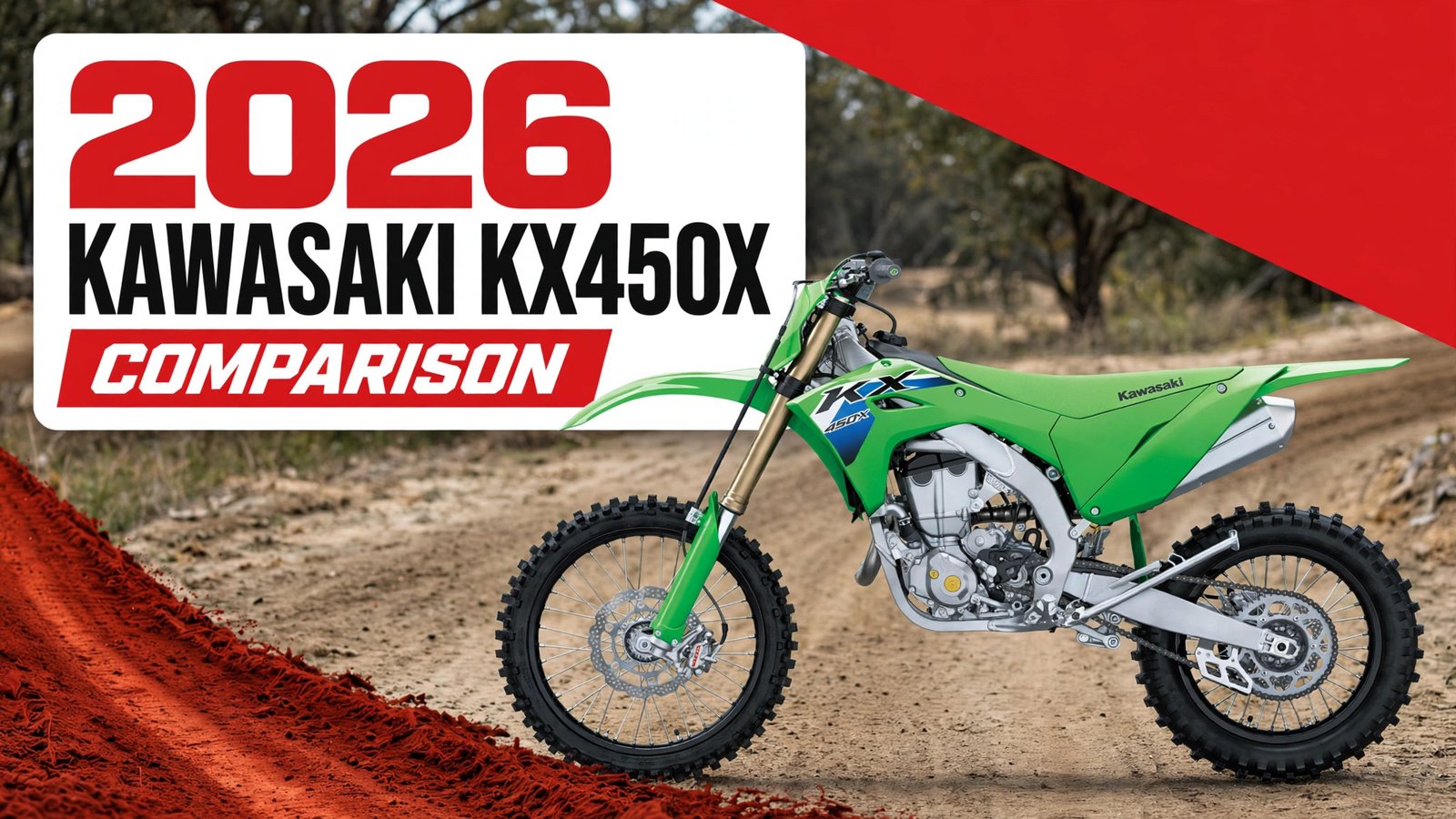
Four 450cc cross-country bikes, one question: which one is worth your money in 2026? The Kawasaki KX450X arrives as the defending champion — winner of both Dirt Bike Test off-road shootouts — yet it is not the cheapest bike here, and it carries the smallest fuel tank in the class. This Kawasaki KX450X comparison puts the 2026 X against the Yamaha YZ450FX, the Honda CRF450RX and the KTM 450 XC-F on the four things that decide a purchase: delivered price, gearbox, tank size and shootout wins.
In short, the Kawasaki wins the shootout and loses on range. It costs $850 more delivered than the Honda and $600 more than the Yamaha, while the KTM costs $1,790 more than the Kawasaki. The rest of this Kawasaki KX450X comparison works through the rivals one by one, then settles the value question.
Kawasaki KX450X Overview and Its Closest Rivals
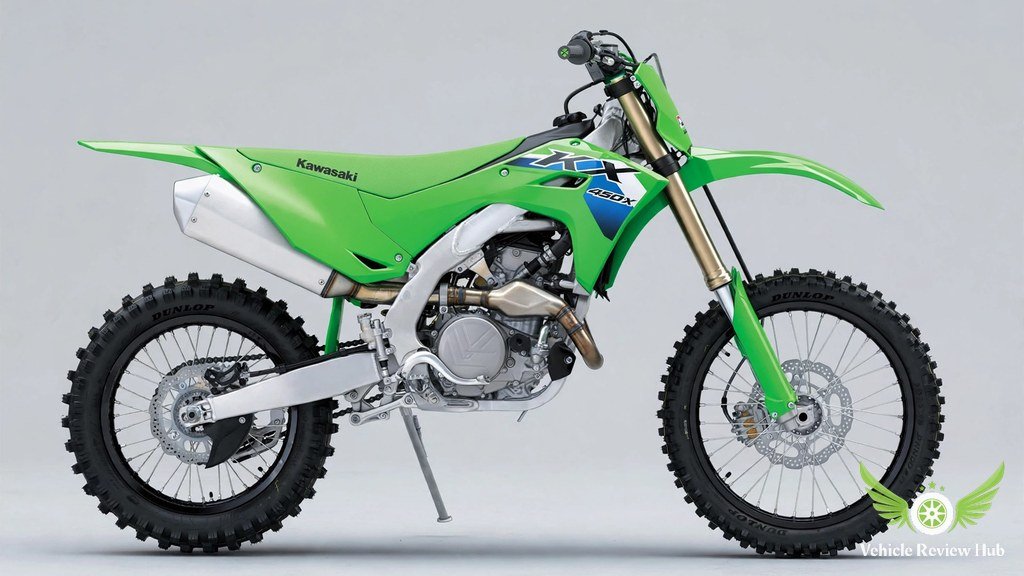
The four bikes are the 2026 versions of the same idea: a 450cc motocross engine retuned for off-road racing, with an 18-inch rear wheel, softer suspension and a kickstand. The Kawasaki is the only one of the four that has won both Dirt Bike Test off-road shootouts, and it is also the only one with a 1.64-gallon tank. This Kawasaki KX450X comparison starts with that tension, because it explains almost everything that follows: the KX wins on rideability, and it pays for it in range.
Wins Shootouts, Loses on Range
Dirt Bike Test’s 2026 450 off-road shootout put the Kawasaki first on 11 points, one point ahead of the Honda on 12, with the KTM third on 17, the Yamaha fourth on 21 and the Triumph fifth on 29. Two wins, two different fields, the same winner — and in both tests the Kawasaki won on rideability rather than peak power. Dirt Bike Test’s own verdict on the 2026 winner says the KX motor is “one of the softest of the bunch, but that’s not a bad thing for the masses riding off-road,” and that the bike “puts the power to the ground very effectively” even though it “doesn’t feel the fastest.” The price of that character is range. Dirt Bike Test got 45 to 60 minutes per tank from the stock 1.64-gallon tank in its 2025 review, and the tank sizes below show why — the Yamaha and Honda both carry 2.1 gallons and the KTM carries 2.24, so the Kawasaki runs dry first on any long loop.
How the Four Bikes Differ at a Glance
The KTM is the only six-speed and the only one with a quickshifter; the Kawasaki, Yamaha and Honda all run five speeds, and only the Yamaha’s is wide-ratio. This Kawasaki KX450X comparison uses the tables below as its reference — every figure is a 2026 figure, year-labelled, and anything not verified in this session is left out rather than guessed.
| Bike | MSRP | Destination or freight | Delivered price |
|---|---|---|---|
| Honda CRF450RX | $9,999 | $600 | $10,599 |
| Yamaha YZ450FX | $10,199 | $650 | $10,849 |
| Kawasaki KX450X | $10,799 | $650 | $11,449 |
| KTM 450 XC-F | $12,549 | $690 freight | $13,239 |
Note: Delivered prices are MSRP plus the verified destination or freight charge for 2026. The Kawasaki sits $850 above the Honda and $600 above the Yamaha, and $1,790 below the KTM — the gaps this Kawasaki KX450X comparison returns to in the value section.
| Item | Kawasaki KX450X | Yamaha YZ450FX | Honda CRF450RX | KTM 450 XC-F |
|---|---|---|---|---|
| Engine | 449cc DOHC single, 96.0×62.1 mm, 12.5:1 | 450cc DOHC single, 97.0×60.9 mm, 13.0:1 | 450cc Unicam SOHC single, 96.0×62.1 mm, 13.5:1 | 449.9cc SOHC single, 95×63.4 mm, 13.1:1 |
| Gearbox | 5-speed close-ratio | 5-speed wide-ratio | 5-speed close-ratio | 6-speed Pankl |
| Fuel tank | 1.64 gal | 2.1 gal | 2.1 gal | 2.24 gal |
| Front fork | 49 mm Showa coil | KYB SSS coil-spring | Showa, off-road valved | 48 mm WP XACT closed-cartridge |
| Seat height | 37.4 in | 37.6 in | 37.7 in | Not verified |
| Wet/curb weight | 249.9 lb curb | 251 lb wet | 256 lb curb | 231 lb dry |
| Wheelbase | 58.3 in | 57.9 in | 58.2 in | 58.8 in |
| Warranty | None (closed-course) | 1-year limited | None (sold as is) | 1-year limited |
| Spark arrestor | No | No | No | No |
Note: All figures are 2026 and year-labelled. The KTM’s brakes, tyres and seat height were not verified in this session, so this Kawasaki KX450X comparison prints none of them rather than guessing.
Kawasaki KX450X vs Yamaha YZ450FX
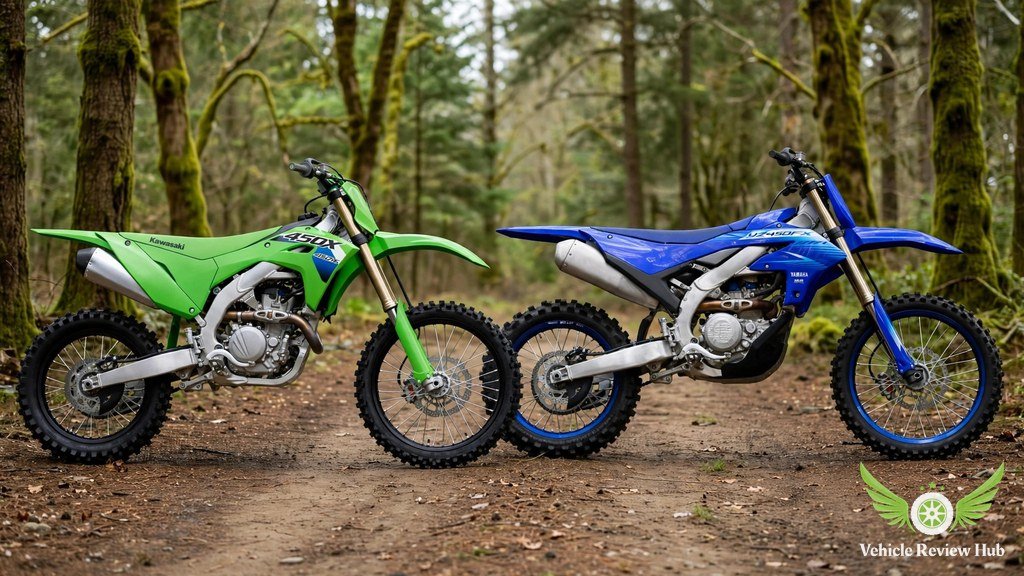
The Yamaha YZ450FX is the Kawasaki’s oldest rival in this class and the cheapest way into the comparison after the Honda. The question this Kawasaki KX450X comparison asks of the Yamaha is simple: does the cheaper bike with the bigger tank and the wider gearbox beat the shootout winner?
Engine, Specs and Performance Side by Side
The two engines are near-identical on paper. The Yamaha’s 450cc DOHC single runs a 97.0×60.9 mm bore and stroke at 13.0:1 compression, against the Kawasaki’s 449cc unit at 96.0×62.1 mm and 12.5:1. The Yamaha runs the KYB SSS coil-spring fork, while the Kawasaki’s 49 mm Showa coil fork is softer and, in Dirt Bike Test’s words, “some of the best overall for the entire group” in the 2026 shootout, with front-end comfort and hand feel as the standout traits. The Yamaha’s wide-ratio five-speed is the practical advantage: it spans desert straights and tight singletrack without the re-gearing the Kawasaki’s close-ratio box demands. On the dyno there is no common test for the two cross-country bikes, so the nearest labelled figures are the 2026 motocross bikes on Dirt Bike Magazine’s Pro Circuit dyno: the YZ450F made 56.7 hp at 9,600 rpm and the KX450 made 57.7 hp at 9,400 rpm, fifth of twelve. Those are the MX bikes, not the XC bikes, and this Kawasaki KX450X comparison prints them only as the nearest labelled figures — never as the rivals’ cross-country figures. In the shootout that actually counts, the Yamaha finished fourth of five on 21 points while the Kawasaki won on 11, despite the Yamaha’s stronger motocross dyno in 2023. The shootout rewards the Kawasaki’s rideability over the Yamaha’s peak power, and that is the result this Kawasaki KX450X comparison weighs most heavily.
Price, Equipment and Which Suits Which Rider
Delivered, the Yamaha is $600 cheaper than the Kawasaki — $10,849 against $11,449. The Yamaha carries a 2.1-gallon tank against the Kawasaki’s 1.64, a 1-year limited warranty against the Kawasaki’s none, and Yamaha’s Power Tuner App with four-level traction control and a lap timer against the Kawasaki’s KTRC, launch control and power modes with the Rideology app. Neither bike has a spark arrestor, and neither has hand guards as standard — the Kawasaki waits until the 2027 FX for those. The Yamaha suits the rider who covers varied ground and wants the wide-ratio gearbox and the bigger tank without re-gearing or an aftermarket tank. The Kawasaki suits the rider who values the smoothest power delivery and the best shootout record, and who accepts the 45-to-60-minute fuel range as the price. This Kawasaki KX450X comparison gives the Yamaha the value edge on paper and the Kawasaki the win on the stopwatch — and the stopwatch is what the shootout measures.
Kawasaki KX450X vs Honda CRF450RX
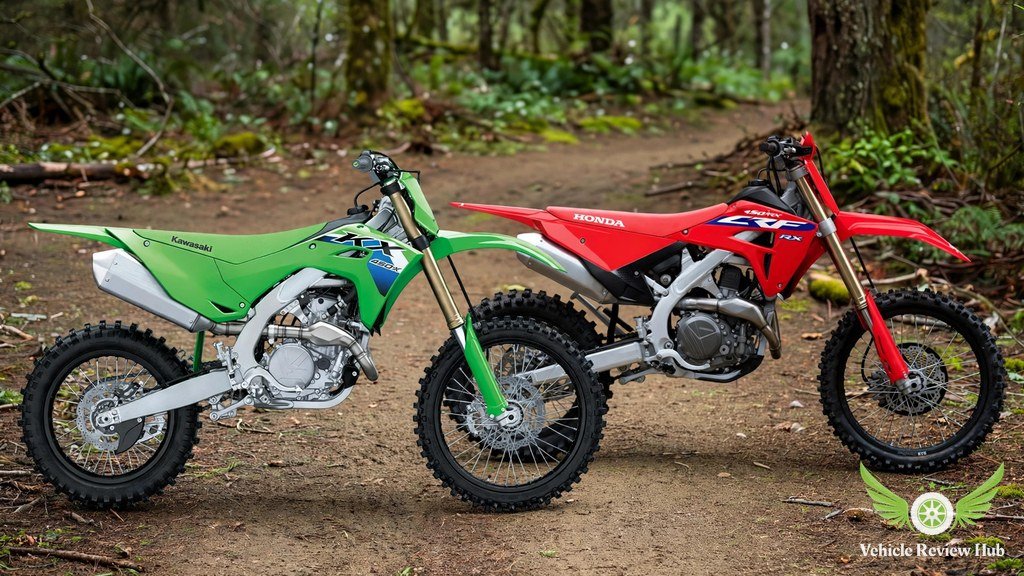
The Honda CRF450RX is the cheapest bike in this comparison at $10,599 delivered — $850 less than the Kawasaki — and it came within one point of beating the Kawasaki in the 2026 shootout. This Kawasaki KX450X comparison treats the Honda as the value benchmark: everything the Kawasaki costs extra must be justified against a bike that is cheaper, nearly as fast on the stopwatch, and better equipped in two places.
Engine, Specs and Performance Side by Side
The Honda’s 450cc Unicam SOHC single runs the same 96.0×62.1 mm bore and stroke as the Kawasaki but at a higher 13.5:1 compression, against the Kawasaki’s 12.5:1. The Honda’s Showa fork is off-road valved, and its 260 mm front disc is the smallest of the Japanese three. The Honda’s five-speed is close-ratio like the Kawasaki’s, so neither bike escapes the gearing compromise; the KTM’s six-speed is the only escape in this class. On the nearest labelled dyno — the 2026 motocross bikes on Dirt Bike Magazine’s Pro Circuit dyno — the CRF450R made 55.3 hp at 8,700 rpm with the highest torque of the group tied at 36.5 lb-ft, against the KX450’s 57.7 hp at 9,400 rpm. Those are the MX bikes, not the XC bikes, and this Kawasaki KX450X comparison prints them only as the nearest labelled figures. In the shootout that counts, the Honda finished second on 12 points, one point behind the Kawasaki’s 11 — the closest margin in the test, and the tightest result in this Kawasaki KX450X comparison.
Price, Equipment and Which Suits Which Rider
At $10,599 delivered the Honda undercuts the Kawasaki by $850 — the biggest saving in this comparison — and it brings two pieces of equipment the Kawasaki lacks: factory hand guards and Honda’s HSTC traction control with HRC launch control and a handlebar map switch. The Honda’s 2.1-gallon tank matches the Yamaha and beats the Kawasaki’s 1.64 by 0.46 gallons, and its 37.7-inch seat is the tallest of the Japanese three. The Honda suits the rider who wants the lowest price in the class without giving up shootout pace, and who values the factory hand guards the Kawasaki does not offer until the 2027 FX. The Kawasaki’s answer is its win, its smoother power delivery, and its 49 mm Showa fork against the Honda’s off-road-valved Showa. This Kawasaki KX450X comparison calls the Honda the value pick and the Kawasaki the shootout pick, and the $850 gap is the price of choosing the winner over the value pick.
Kawasaki KX450X vs KTM 450 XC-F
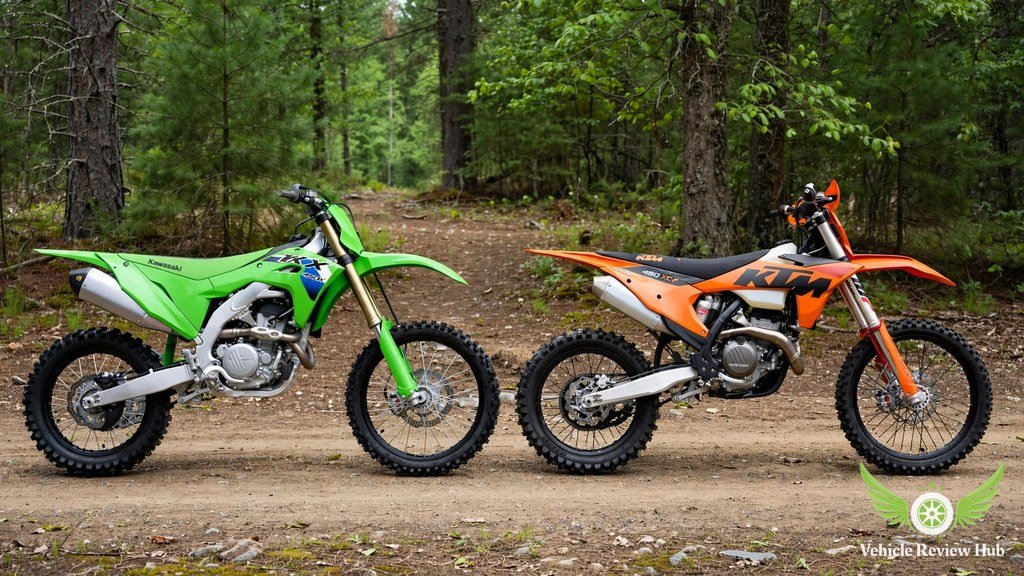
The KTM 450 XC-F is the outlier in this comparison: the most expensive bike here by a wide margin, the only six-speed, the only quickshifter, and the only bike with the biggest tank. This Kawasaki KX450X comparison asks whether the Austrian bike’s specification advantage is worth thousands more than the Japanese three — and the shootout answer, for once, is no.
Engine, Specs and Performance Side by Side
The KTM’s 449.9cc SOHC single runs a 95×63.4 mm bore and stroke at 13.1:1, and its six-speed Pankl gearbox is the only six-speed in this class — the gearbox Dirt Bike Test wishes the Kawasaki had. On the nearest labelled dyno — the 2026 motocross bikes on Dirt Bike Magazine’s Pro Circuit dyno — the KTM 450SX-F made 59.5 hp at 9,300 rpm, the highest of the four motocross bikes, against the KX450’s 57.7 hp at 9,400 rpm. Those are the MX bikes, not the XC bikes, and this Kawasaki KX450X comparison prints them only as the nearest labelled figures. In the shootout that counts, the KTM finished third on 17 points, six behind the Kawasaki’s winning 11 and five behind the Honda’s 12 — despite the six-speed, the quickshifter, the biggest tank and the strongest motocross dyno.
Price, Equipment and Which Suits Which Rider
The price gap is the story. The KTM’s $12,549 MSRP plus $690 freight is $13,239 delivered — $1,790 more than the Kawasaki, $2,390 more than the Yamaha and $2,640 more than the Honda. The KTM does bring a 1-year limited warranty against the Kawasaki’s none, plus launch control and the quickshifter, but its brakes, tyres and seat height were not verified in this session and this Kawasaki KX450X comparison prints none of them. For everyone else, the Kawasaki wins the shootout for $1,790 less — and that is the value case this Kawasaki KX450X comparison makes in one sentence.
Kawasaki KX450X Price and Value Compared
The delivered ladder runs from $10,599 to $13,239 — a $2,640 spread — and the shootout winner sits in the middle of it. This Kawasaki KX450X comparison works through the gaps one by one, then looks at what the bikes cost to keep running.
Europeans Cost Thousands More
The KTM is the only European bike in this test, and it is the only one that costs thousands more than the Japanese three. Delivered, the KTM is $1,790 over the Kawasaki, $2,390 over the Yamaha and $2,640 over the Honda — and those gaps are after the freight charge, not before it. The KTM’s own model page lists the $12,549 base MSRP with freight of $690, and the $13,239 delivered total is computed from those two verified figures. The Kawasaki’s premium over the Honda is $850 and over the Yamaha is $600 — real money, but a different order of magnitude from the KTM’s gap. This Kawasaki KX450X comparison does not call the KTM a bad bike; it calls it a bike whose advantages cost thousands and whose shootout result was third.
| Bike | Delivered price | Gap vs the Kawasaki | Gap vs the Honda |
|---|---|---|---|
| Honda CRF450RX | $10,599 | $850 less | — |
| Yamaha YZ450FX | $10,849 | $600 less | $250 more |
| Kawasaki KX450X | $11,449 | — | $850 more |
| KTM 450 XC-F | $13,239 | $1,790 more | $2,640 more |
Note: Gaps are computed from the verified 2026 delivered prices. The 2027 KX450FX, at $11,249 delivered, is the only forward-look figure in this Kawasaki KX450X comparison — it costs $200 less than the 2026 X while adding the bigger tank, the skid plate and the hand guards.
Running Costs and Resale Value Compared
All four are closed-course race machines with short service intervals, and the Kawasaki’s are the best documented: Dirt Bike Test’s 2025 review recommends replacing the stock clutch plates and fibres every 10 to 20 hours after breaking a fibre at 27 hours, and the KX450 family chart replaces the piston, ring and pin every 6 races or 15 hours. The verified parts figures are small — the Kawasaki skid-plate kit is $36.72 and the Pro X piston kit for 2024–2026 is $199.76 — but they recur often, and the full maintenance picture is in the Kawasaki KX450X reliability guide. No resale-value figure was verified for any of the four bikes in this session, so this Kawasaki KX450X comparison prints none — a resale claim without a source would be a guess, and the comparison does not guess.
Kawasaki KX450X Comparison Verdict and US Alternatives
The verdict is the shootout result, and the shootout result is the Kawasaki. The Kawasaki KX450X is the benchmark for woods and cross-country racing in 2026. The rest of this Kawasaki KX450X comparison weighs what that benchmark costs against what it gives up.
The video below is Trevor Hunter’s personal ranking of the five 2026 off-road 450s — Yamaha first, the Kawasaki second, then the KTM, Honda and Triumph. That is one rider’s opinion, not the shootout result: the combined Dirt Bike Test result puts the Kawasaki first on 11 points, ahead of the Honda on 12, the KTM on 17, the Yamaha on 21 and the Triumph on 29. This Kawasaki KX450X comparison keeps the two separate, because confusing one rider’s ranking with the combined result is how the wrong winner gets printed.
Verdict: The Woods Benchmark
The Kawasaki wins this comparison because it wins the test that matters most. The 2026 Dirt Bike Test off-road shootout is the only head-to-head test of these four bikes as cross-country machines, and the Kawasaki won it by a point from the Honda and by six from the KTM — with the smallest tank, the only close-ratio five-speed without a wide-ratio option, and the second-highest delivered price of the four. The Honda is the value pick at $850 less delivered, with factory hand guards and the second-place finish. The Yamaha is the practical pick, with the wide-ratio gearbox, the 2.1-gallon tank and the $600 saving. The KTM is the specification pick, with the six-speed, the quickshifter and the biggest tank — at $1,790 more than the Kawasaki and a third-place finish. None of the three beats the Kawasaki where it counts, and this Kawasaki KX450X comparison names the Kawasaki the woods benchmark on that basis. The honest caveat is the tank: a 1.64-gallon tank that lasts 45 to 60 minutes is the Kawasaki’s real weakness, and the rider who races two-hour events must plan fuel or buy the aftermarket tank. The 2027 KX450FX answers that weakness directly — a ~1.98-gallon tank, a standard skid plate with a linkage guard and standard hand guards, at $11,249 delivered. A buyer who can wait gets the better bike for less money, and that forward look is worth weighing before buying.
| Place | Bike | Points |
|---|---|---|
| 1 | Kawasaki KX450X | 11 |
| 2 | Honda CRF450RX | 12 |
| 3 | KTM 450 XC-F | 17 |
| 4 | Yamaha YZ450FX | 21 |
| 5 | Triumph TF450-C | 29 |
Note: Dirt Bike Test 2026 450 off-road shootout, stock bikes, combined points — lowest wins. The Kawasaki also won the 2023 stock shootout on 13 points, ahead of the Yamaha and Honda tied on 20 and the GasGas on 27. This Kawasaki KX450X comparison prints the combined results only; individual riders’ personal rankings are opinions, not results.
WR450F Is the Trail Option
Not every buyer wants a closed-course race bike, and for those buyers the Yamaha WR450F is the trail option. The 2026 WR450F costs $10,299 on MSRP — about $10,974 delivered, with the $675 destination dealer-listed — which puts it $475 under the Kawasaki delivered. It runs the same 450cc Yamaha engine family at 97.0×60.8 mm and 13.0:1, with a wide-ratio five-speed, a KYB SSS fork with 11.8 inches of travel, and a 2.0-gallon tank. What sets it apart is the equipment the race bikes lack: a spark arrestor as standard, a headlight and taillight, a radiator fan, a multi-function meter and a folding kickstand. It is not street-legal from the factory, and this Kawasaki KX450X comparison does not claim it is.
Kawasaki KX450X Comparison FAQs
The answers below use the verified 2026 figures from this Kawasaki KX450X comparison. For the riding experience, the full performance figures and the maintenance picture, see the Kawasaki KX450X review, the Kawasaki KX450X performance guide and the Kawasaki KX450X reliability guide.
Which 450 cross-country bike is cheapest delivered in 2026?
The Honda CRF450RX is the cheapest at $10,599 delivered ($9,999 + $600). The Yamaha YZ450FX is next at $10,849, the Kawasaki KX450X is $11,449, and the KTM 450 XC-F is the most expensive at $13,239 — and this Kawasaki KX450X comparison puts the Kawasaki $850 above the Honda and $1,790 below the KTM.
Which bike has a six-speed gearbox?
Only the KTM 450 XC-F, with a six-speed Pankl gearbox. The Kawasaki, Yamaha and Honda are all five-speeds — the Yamaha’s is wide-ratio, while the Kawasaki’s and Honda’s are close-ratio — and this Kawasaki KX450X comparison notes that Dirt Bike Test wishes the Kawasaki had a six-speed.
Which bike has the biggest fuel tank?
The KTM 450 XC-F, at 2.24 gallons. The Yamaha YZ450FX and Honda CRF450RX both carry 2.1 gallons, and the Kawasaki KX450X carries the smallest tank in the class at 1.64 gallons — the reason this Kawasaki KX450X comparison records a 45-to-60-minute fuel range for the Kawasaki.
Who won the 2026 Dirt Bike Test off-road shootout?
The Kawasaki KX450X, first on 11 points, ahead of the Honda on 12, the KTM on 17, the Yamaha on 21 and the Triumph on 29. This Kawasaki KX450X comparison prints the combined result — not any single rider’s personal ranking, which is a different thing.
Is there a dyno test comparing the four 2026 cross-country bikes?
No — there is no common dyno test for the four 2026 XC bikes. The nearest figures are the 2026 motocross bikes on Dirt Bike Magazine’s Pro Circuit dyno, where the KX450 made 57.7 hp at 9,400 rpm, and this Kawasaki KX450X comparison prints those only as labelled motocross figures, never as the cross-country bikes’ figures.
How much more does the KTM cost than the Kawasaki?
The KTM 450 XC-F costs $1,790 more delivered than the Kawasaki KX450X — $13,239 against $11,449 — and $2,640 more than the Honda. This Kawasaki KX450X comparison calls that the “Europeans cost thousands more” gap, and the KTM finished third in the shootout despite it.
What is the trail alternative to the KX450X?
The Yamaha WR450F. Its 2026 MSRP is $10,299 — about $10,974 delivered, destination dealer-listed — and it brings a wide-ratio five-speed, a 2.0-gallon tank, a spark arrestor, a headlight and taillight and a radiator fan as standard. This Kawasaki KX450X comparison names it the trail option for riders who need lights and a spark arrestor rather than a closed-course race bike.