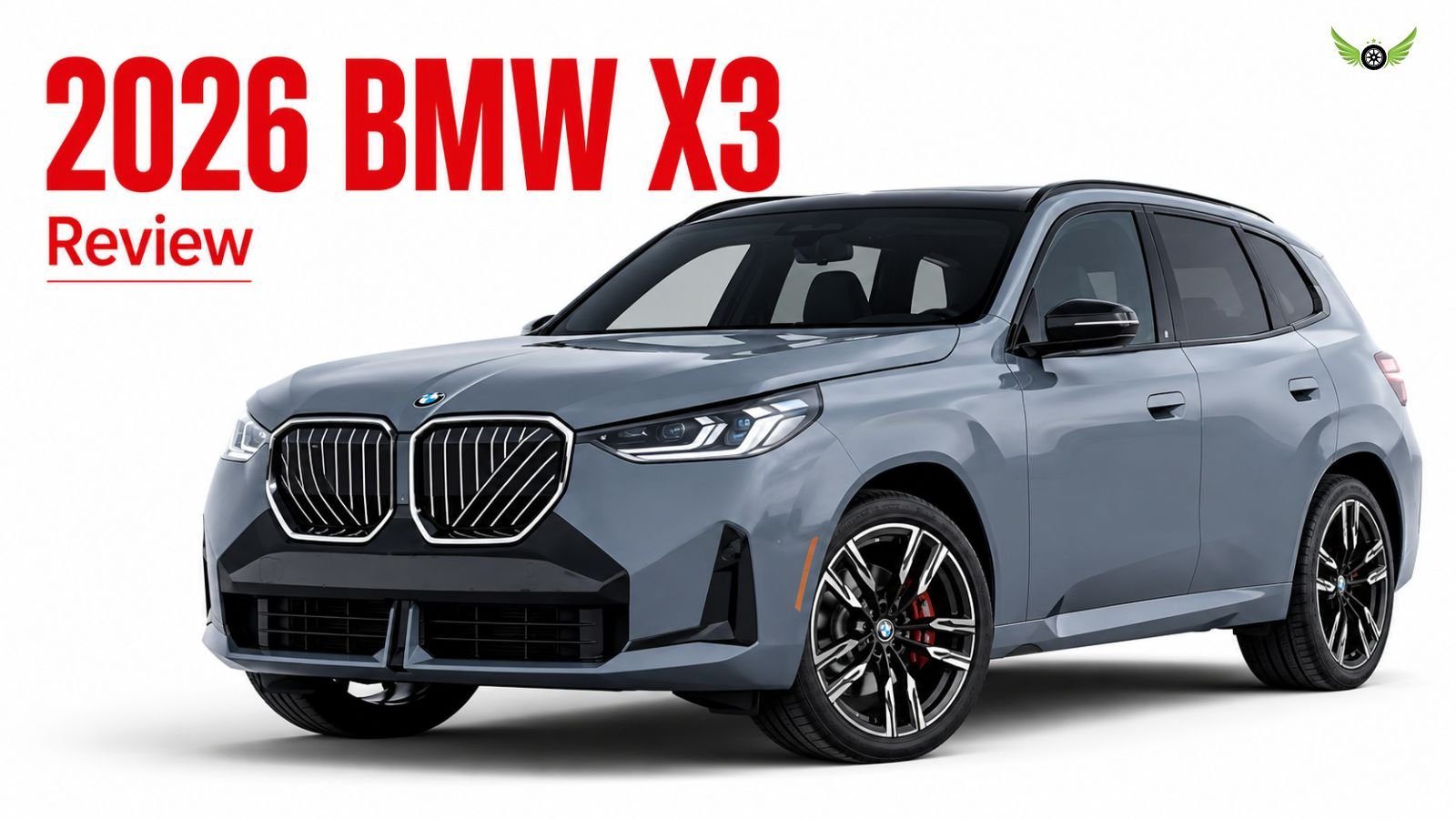
The 2026 BMW X3 remains one of BMW’s most important luxury compact SUVs in the USA, combining a comfortable five-seat cabin, strong road manners, modern technology, and two distinct powertrain choices. For 2026, the X3 continues with the current-generation design introduced for 2025, so buyers are getting a relatively fresh model rather than a major redesign.
The BMW X3 Price starts at $51,300 MSRP for the X3 30 xDrive, according to BMW USA, before taxes, registration, and other applicable fees. The performance-focused X3 M50 xDrive starts at $68,350 MSRP on BMW’s current model page.
Under the hood, the X3 30 xDrive uses a turbocharged 2.0-liter four-cylinder with mild-hybrid assistance, producing 255 horsepower and 295 lb-ft of torque. The M50 xDrive steps up to a turbocharged 3.0-liter inline-six mild-hybrid powertrain rated at 393 horsepower and 428 lb-ft of torque. Both use an eight-speed automatic transmission and all-wheel drive.
This BMW X3 Review looks beyond the headline specifications to explain how the SUV fits everyday driving, family use, technology needs, and performance expectations. Based on current expert reviews and available specifications, the X3 stands out for its balance of driving ability, cabin quality, cargo usefulness, and powertrain choices.
If you are comparing trims, estimating ownership value, or deciding whether this SUV deserves a place on your shortlist, this BMW X3 Buying Guide covers the key areas you should consider before making a purchase.
BMW X3 Trims, Pricing & What's New
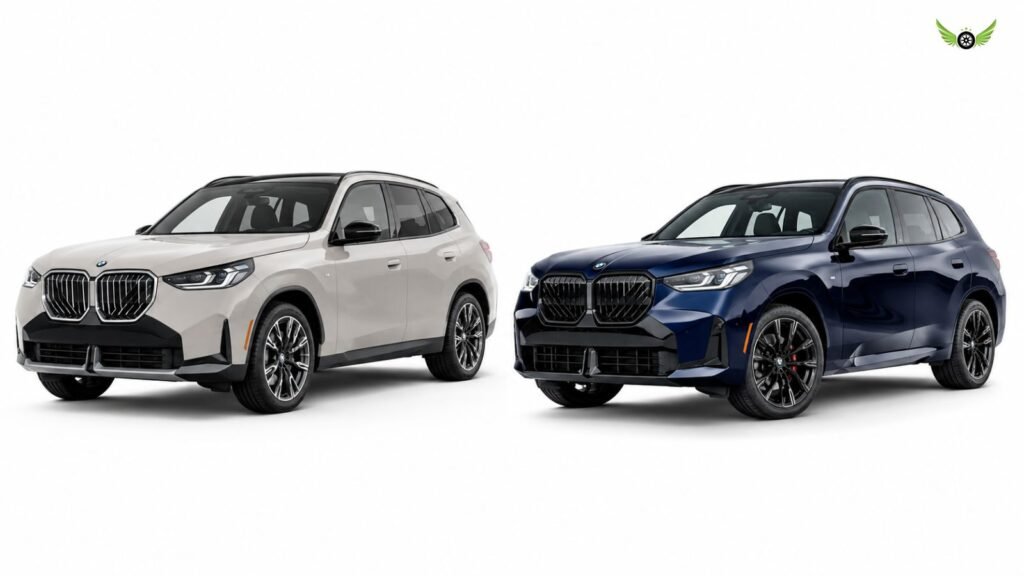
The 2026 BMW X3 lineup in the U.S. remains simple: the 30 xDrive and M50 xDrive. BMW lists starting MSRPs of $51,300 for the 30 xDrive and $66,500 for the M50, before taxes, registration and dealer adjustments. Edmunds and Cars.com list higher figures of $52,650 and $67,850 because their prices include the current destination charge.
There is no major redesign for 2026. The fourth-generation X3 was introduced for 2025, so the 2026 model largely carries over that design, cabin and powertrain lineup. Minor model-year changes include YouTube app integration in the infotainment system and availability changes involving the tire-sealant kit.
BMW X3 30 xDrive vs BMW X3 M50 xDrive
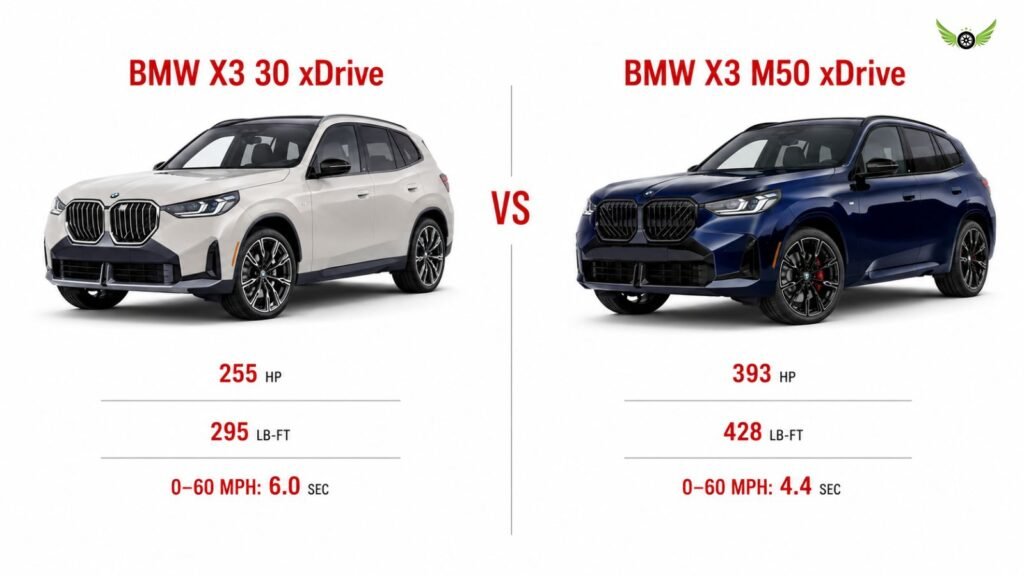
The X3 30 xDrive uses a 2.0-liter turbocharged four-cylinder with 48-volt mild-hybrid assistance. It produces 255 hp and 295 lb-ft of torque and reaches 60 mph in 6.0 seconds according to BMW’s preliminary test figure. The M50 uses a 3.0-liter turbocharged inline-six with 48-volt assistance, producing 393 hp and 428 lb-ft, with a claimed 4.4-second 0–60 mph time. Both use an eight-speed automatic transmission and standard xDrive all-wheel drive.
Specification | X3 30 xDrive | X3 M50 xDrive |
Starting MSRP* | $51,300 | $66,500 |
Engine | 2.0L turbo I4 | 3.0L turbo I6 |
Horsepower | 255 hp | 393 hp |
Torque | 295 lb-ft | 428 lb-ft |
0–60 mph | 6.0 sec | 4.4 sec |
Drivetrain | xDrive AWD | xDrive AWD |
*BMW starting MSRP; destination and other charges can increase the transaction price.
For a typical daily driver, the 30 xDrive offers the better balance of performance, efficiency and purchase price. The M50 is the more appropriate choice when acceleration and sharper chassis tuning are priorities. Edmunds reaches a similar conclusion, recommending the less expensive 30 xDrive for most buyers.
Packages, Options & Best Value Trim
The 30 xDrive can be equipped with options such as the Premium Package, M Sport Package and Driving Assistance Professional Package. The Premium Package adds features including a head-up display and surround-view camera, while the Driving Assistance Professional Package provides hands-free driving capability in compatible conditions at speeds up to 40 mph.
For buyers building a practical luxury SUV, the 30 xDrive is the best-value trim. Edmunds notes that even with selected options, it can remain below a $60,000 price target. The M50 is easier to justify only when its six-cylinder engine and performance hardware are central to the buying decision.
BMW X3 Engine, Performance & Specifications
The 2026 BMW X3 offers two gasoline mild-hybrid powertrains. The X3 30 xDrive uses a 2.0-liter turbocharged four-cylinder, while the X3 M50 xDrive uses a 3.0-liter turbocharged inline-six. Both pair their 48-volt systems with an eight-speed automatic transmission and standard all-wheel drive. The difference is significant: the 30 xDrive is tuned for balanced daily performance, while the M50 is designed around stronger acceleration and sharper driving dynamics.
2.0L Turbo Mild Hybrid vs 3.0L Inline-6 Mild Hybrid
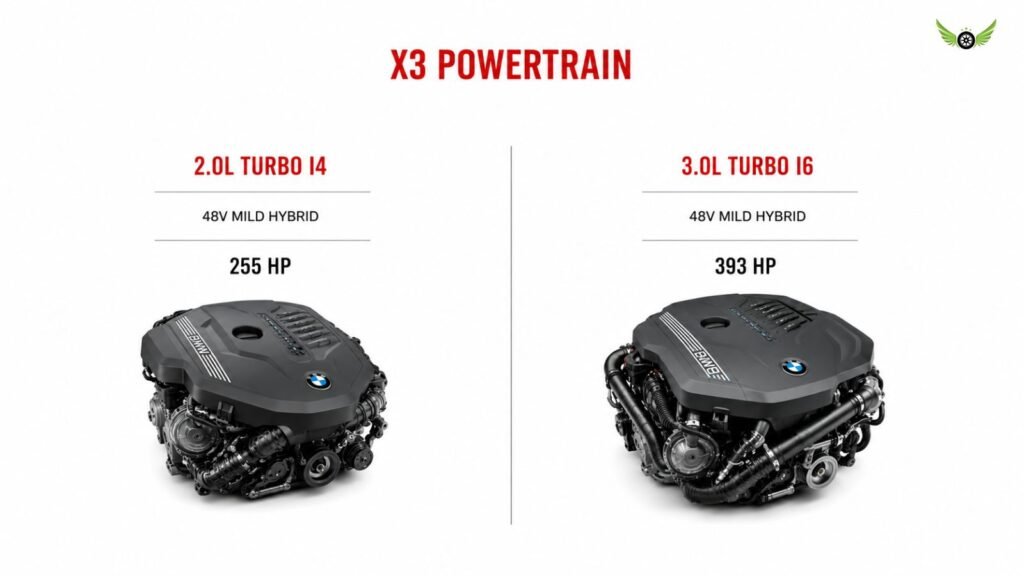
The 2.0-liter engine in the X3 30 xDrive produces 255 hp and 295 lb-ft of torque. The 48-volt mild-hybrid system supports the gasoline engine during acceleration and helps improve efficiency. BMW rates the 30 xDrive at 29 mpg combined, with 27 mpg city and 33 mpg highway.
The 3.0-liter inline-six in the X3 M50 produces 393 hp and 428 lb-ft of torque. It delivers 138 more horsepower and 133 more lb-ft than the four-cylinder. The M50 is also rated at 27 mpg combined, or 25 mpg city and 30 mpg highway.
For normal commuting, the four-cylinder provides enough output without sacrificing much fuel economy. The inline-six is the better choice for buyers who want noticeably quicker acceleration and stronger performance.
Horsepower, Torque, 0–60 MPH & Towing Capacity
BMW estimates the X3 30 xDrive at 6.0 seconds from 0–60 mph, while the M50 is rated at 4.4 seconds. Independent Car and Driver testing produced 6.2 seconds for the 30 xDrive and 4.0 seconds for the M50, showing that real-world acceleration can differ from manufacturer estimates depending on testing conditions and methodology.
Towing is another meaningful difference. The 30 xDrive can tow up to 4,001 pounds when properly equipped, while the M50 reaches 4,850 pounds with the appropriate trailer equipment.
Specification | X3 30 xDrive | X3 M50 xDrive |
Engine | 2.0L turbo I4 | 3.0L turbo I6 |
Mild-hybrid system | 48V | 48V |
Horsepower | 255 hp | 393 hp |
Torque | 295 lb-ft | 428 lb-ft |
BMW 0–60 mph | 6.0 sec | 4.4 sec |
EPA combined | 29 mpg | 27 mpg |
Maximum towing | 4,001 lb | 4,850 lb |
The numbers make the choice straightforward. The X3 30 xDrive is better suited to everyday driving and fuel-conscious buyers, while the M50 xDrive is the stronger option for drivers who value acceleration, performance hardware, and higher towing capacity.
BMW X3 Interior, Technology & Safety
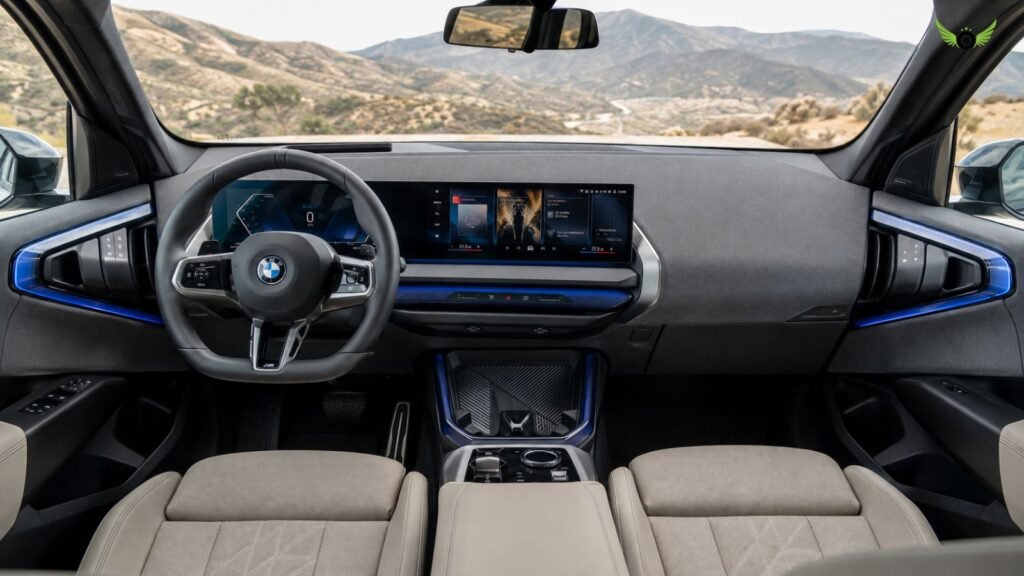
The 2026 BMW X3 combines a five-seat cabin, 31.5 cubic feet of cargo space, and BMW’s digital cockpit with a strong set of available driver-assistance technologies. BMW’s official specifications show the same 31.5-cu-ft cargo capacity for both the X3 30 xDrive and X3 M50 xDrive.
Cabin Comfort, Cargo Space & Passenger Room
The X3 seats five people, with BMW describing the rear seating area as spacious enough for up to three passengers. Standard front sport seats provide adjustable support, while available equipment can add further comfort features.
Cargo capacity is 31.5 cubic feet with the rear seats in place. BMW also lists the X3 at 67.1 cubic feet with the rear seats folded, giving it useful flexibility for luggage, groceries, and larger cargo.
Interior specification | 2026 BMW X3 |
Seating capacity | 5 |
Cargo space, rear seats up | 31.5 cu. ft. |
Maximum cargo space | 67.1 cu. ft. |
Wheelbase | 112.8 in. |
BMW Curved Display, iDrive 9 & Driver Assistance Features
The dashboard uses BMW’s Curved Display, combining a 12.3-inch digital instrument cluster with a 14.9-inch touchscreen. BMW Operating System 9 provides the main interface, with touch and voice controls through the BMW Intelligent Personal Assistant.
For driver assistance, BMW offers systems designed to help with functions such as lane keeping, distance control, collision avoidance, and parking. The exact equipment depends on the selected configuration and optional packages, so buyers should check the build sheet rather than assume every feature is standard.
The 2026 X3 also carries a strong independent safety record: IIHS lists the 2025–26 BMW X3 as a Top Safety Pick+, applying to vehicles built after April 2025.
BMW X3 vs Audi Q5, Mercedes-Benz GLC & Lexus NX
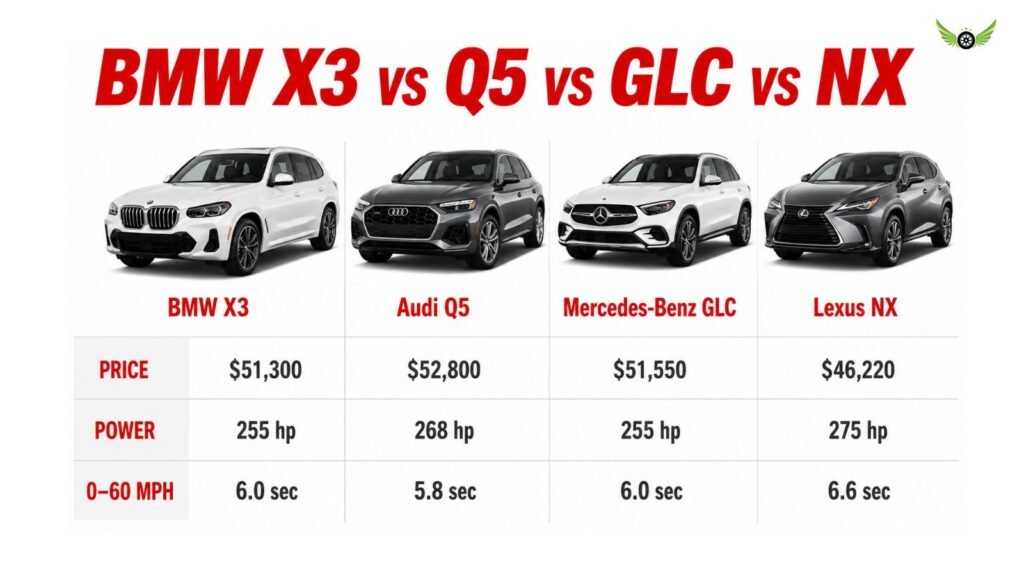
The 2026 BMW X3 competes directly with the Audi Q5, Mercedes-Benz GLC, and Lexus NX. Using current U.S. manufacturer data, the X3 30 xDrive starts at $51,300 and produces 255 hp. The Audi Q5 starts at $52,800 with 268 hp, the Mercedes-Benz GLC 300 4MATIC starts at $51,550 with 255 hp, and the Lexus NX 350 AWD starts at $46,220 including DPH with 275 hp.
Performance, Features & Value Comparison
The standard powertrains are fairly close, but each SUV has a different advantage. The Q5 has the quickest manufacturer-listed 0–60 mph time among the base models at 5.8 seconds, followed by the GLC at 6.0 seconds, while the X3 30 xDrive is also rated at 6.0 seconds. The NX 350 is rated at 6.6 seconds.
2026 model | Starting price* | Horsepower | 0–60 mph | AWD |
BMW X3 30 xDrive | $51,300 | 255 hp | 6.0 sec | Standard |
Audi Q5 | $52,800 | 268 hp | 5.8 sec | Standard |
Mercedes-Benz GLC 300 4MATIC | $51,550 | 255 hp | 6.0 sec | Standard |
Lexus NX 350 AWD | $46,220 | 275 hp | 6.6 sec | Standard |
*Manufacturer pricing is not structured identically. Lexus’s published NX 350 price includes its $1,395 Delivery, Processing and Handling fee.
The technology approach also differs. The X3 uses BMW’s digital cockpit and Operating System 9, the Q5 uses an 11.9-inch virtual cockpit with a 14.5-inch MMI display, while the GLC uses a 12.3-inch instrument cluster and 11.9-inch MBUX touchscreen. The NX focuses more heavily on standard safety technology, with Lexus Safety System+ 3.0 standard across the lineup.
Which Luxury SUV Is the Better Buy?
For a buyer who values driving dynamics and performance choice, the X3 has a strong advantage because the lineup extends from the 255-hp 30 xDrive to the 393-hp X3 M50 xDrive. That gives BMW shoppers a much wider performance range within the same model family.
The Audi Q5 is a strong alternative if its digital interior and 268-hp powertrain appeal more to you. The Mercedes-Benz GLC 300 4MATIC offers similar output to the X3 with a comparable starting price. The Lexus NX 350 has the lowest published entry price among these four and also offers hybrid and plug-in-hybrid versions for buyers prioritizing efficiency.
Best overall for a balance of performance and choice: BMW X3
Best lower-price option: Lexus NX 350
Strongest alternative for digital-focused buyers: Audi Q5
Strong alternative for Mercedes-Benz buyers: GLC 300 4MATIC
BMW X3 Buying Guide
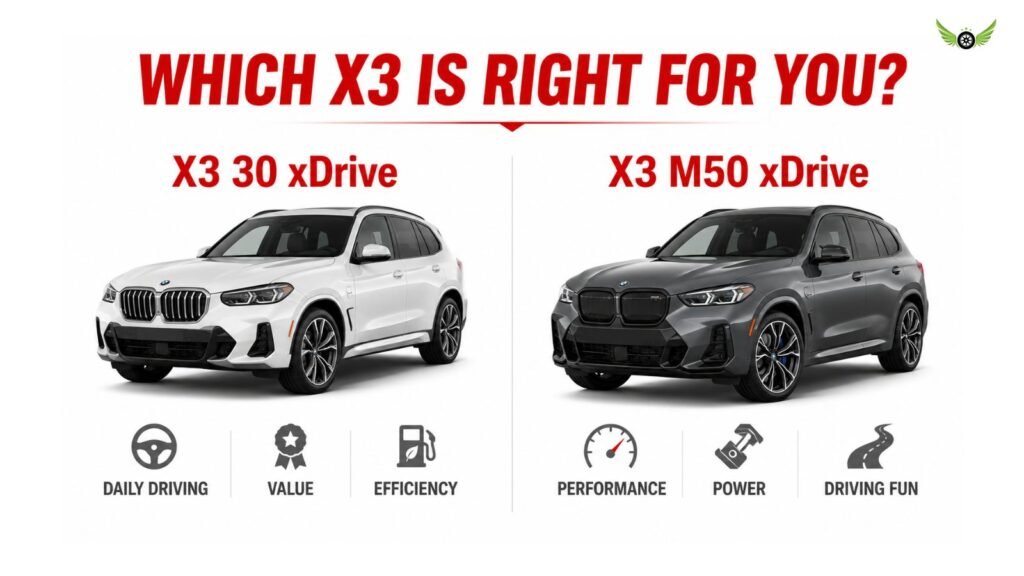
The 2026 BMW X3 is easiest to choose by deciding whether you value balanced daily driving or stronger performance. The 30 xDrive produces 255 hp, while the M50 xDrive delivers 393 hp and a BMW-estimated 4.4-second 0–60 mph time. Both use xDrive all-wheel drive and an eight-speed automatic transmission.
Best BMW X3 Trim for Different Buyers
For most shoppers, the X3 30 xDrive is the sensible choice. Its 2.0-liter turbocharged four-cylinder produces 255 hp and returns an EPA-rated 27 mpg city and 33 mpg highway. It also offers 31.5 cubic feet of cargo space, so choosing the lower-output engine does not reduce basic practicality.
The X3 M50 xDrive is better suited to drivers who want performance. Its 3.0-liter inline-six produces 393 hp and 428 lb-ft of torque, with M-specific performance equipment and a 4.4-second BMW-estimated 0–60 mph time.
Buyer | Recommended trim | Main reason |
Daily driver | 30 xDrive | Balanced power and fuel economy |
Family use | 30 xDrive | Same 31.5-cu-ft cargo capacity |
Performance-focused buyer | M50 xDrive | 393-hp inline-six |
Value-focused buyer | 30 xDrive | Lower starting MSRP |
Pros, Cons & Final Verdict
Pros
- Two powertrains provide a clear choice between efficiency and performance.
- Standard xDrive all-wheel drive on both versions.
- 31.5 cubic feet of cargo capacity behind the rear seats.
- The M50 offers substantially stronger performance without changing the basic SUV layout.
Cons
- The M50 costs considerably more than the 30 xDrive.
- The 30 xDrive is not aimed at buyers seeking high-performance acceleration.
- Optional equipment can increase the final purchase price significantly; BMW currently lists the 30 xDrive from $51,300 and the M50 from $66,500.
Final verdict:
The 30 xDrive is the better choice for most buyers because it combines adequate performance, better fuel economy, practical cargo space, and a lower entry price. The M50 is worth choosing when its six-cylinder performance and M-specific chassis upgrades are a genuine priority.
2026 BMW X3 Review FAQs: Price, Specs & Buying Questions
The 2026 BMW X3 covers the main areas buyers usually consider before purchasing a luxury compact SUV: pricing, powertrains, acceleration, fuel economy, towing, cargo space, technology, and safety. The U.S. range includes the X3 30 xDrive and X3 M50 xDrive, giving buyers a choice between balanced everyday performance and stronger six-cylinder performance.
How much does the 2026 BMW X3 cost in the USA?
The 2026 X3 30 xDrive starts at $51,300, while the X3 M50 xDrive starts at $66,500. These are BMW’s starting MSRPs and do not include taxes, title, license, registration, or dealer-adjusted pricing.
What are the 2026 BMW X3 trims?
The U.S. lineup has two main versions: X3 30 xDrive and X3 M50 xDrive. The 30 xDrive uses a 2.0-liter turbocharged four-cylinder, while the M50 uses a 3.0-liter turbocharged inline-six. Both use xDrive all-wheel drive.
How much horsepower does the 2026 BMW X3 have?
The X3 30 xDrive produces 255 horsepower. The M50 xDrive produces 393 horsepower, making it the performance-focused version of the lineup
How fast is the 2026 BMW X3 from 0 to 60 mph?
BMW estimates the X3 30 xDrive at 6.0 seconds from 0 to 60 mph. The M50 xDrive is quicker at 4.4 seconds. BMW identifies these as preliminary test results, so actual acceleration can vary with vehicle specification and testing conditions.
What is the fuel economy of the 2026 BMW X3?
The X3 30 xDrive is rated at 27 mpg city and 33 mpg highway. The M50 xDrive is rated at 25 mpg city and 30 mpg highway. The four-cylinder version therefore has the stronger EPA fuel-economy figures.
How much can the 2026 BMW X3 tow?
The X3 30 xDrive can tow up to 4,001 pounds when properly equipped with the factory-installed trailer hitch. BMW advises checking the owner’s manual for complete towing requirements and equipment specifications.
How much cargo space does the 2026 BMW X3 have?
The X3 provides 31.5 cubic feet of cargo capacity with the rear seats in use. BMW’s published X3 cargo information gives up to 67.1 cubic feet when the rear seats are folded.
What technology does the 2026 BMW X3 use?
The cabin uses BMW’s Curved Display with a 12.3-inch digital instrument cluster and 14.9-inch control display. BMW Operating System 9 supports touch operation, voice control through the BMW Intelligent Personal Assistant, Apple CarPlay, and Android Auto.
Is all-wheel drive standard on the 2026 BMW X3?
Yes. Both the X3 30 xDrive and X3 M50 xDrive come with BMW xDrive all-wheel drive.
Is the 2026 BMW X3 safe?
The 2026 X3 has strong IIHS crash-test results. IIHS lists the X3 among its 2026 Top Safety Pick+ models, with the award applying to vehicles meeting the organization’s current criteria.
Which 2026 BMW X3 is better for most buyers?
The X3 30 xDrive is the more logical choice for most buyers who prioritize everyday usability, fuel economy, and a lower purchase price. The M50 is the better fit for drivers who specifically want its 393-hp inline-six and substantially quicker acceleration.
Is the 2026 BMW X3 worth buying?
Yes, if its combination of performance, technology, cargo capacity, and premium features matches your priorities. The key decision is whether the standard 30 xDrive provides enough performance or whether the additional capability of the M50 justifies its higher price.