The 2026 BMW 3 Series is a premium sports sedan that offers strong performance, modern technology, and everyday practicality, but buyers should also understand its maintenance and long-term ownership costs. In the USA, BMW provides scheduled maintenance coverage for 3 years or 36,000 miles, while the new-vehicle limited warranty covers 4 years or 50,000 miles.
This guide examines the key ownership factors that matter when buying a BMW 3 Series in the USA, including its maintenance schedule, BMW 3 Series Maintenance Cost, factory service coverage, routine repair and wear-item expenses, reliability, and commonly reported issues. It also looks at warranty coverage, recalls, technical updates, expected long-term durability, and ways owners can reduce repair costs.
Current cost data gives buyers a useful baseline. Kelley Blue Book estimates approximately $3,520 in maintenance costs over five years for the 2026 BMW 3 Series, although actual expenses can vary by mileage, trim, location, driving conditions, and repair facility.
Reliability should be considered with some caution because long-term 2026-specific ownership data is still limited. J.D. Power currently gives the 2026 BMW 3 Series an 81/100 Quality & Reliability score, while Consumer Reports predicts about-average reliability based largely on previous model-year data.
According to our experience, the biggest ownership-cost difference comes from how well the car is maintained and how quickly developing issues are addressed. For a new 2026 model, it is also important to distinguish confirmed recalls and manufacturer service information from common problems associated with older BMW 3 Series generations.
BMW 3 Series Maintenance Schedule & Service Coverage
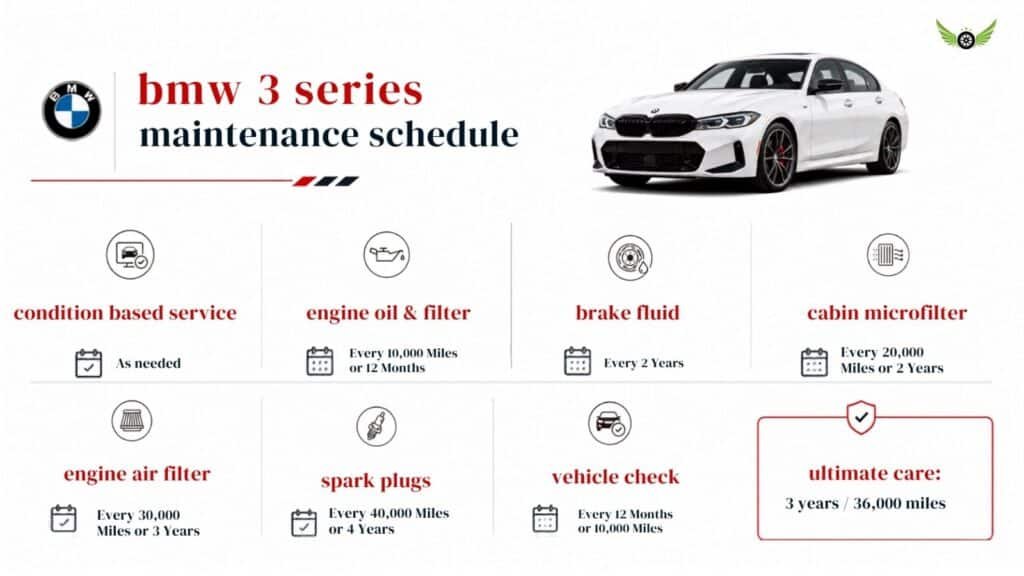
The 2026 BMW 3 Series follows BMW’s Condition Based Service (CBS) system, which determines when scheduled maintenance is required based on the vehicle’s operating conditions and displays the service requirement to the driver. BMW recommends following the vehicle’s Maintenance Service Display together with the maintenance information provided for the specific vehicle.
For U.S. vehicles, BMW also includes Ultimate Care Scheduled Maintenance for 36 months or 36,000 miles, whichever comes first. This coverage applies to eligible factory-recommended scheduled maintenance performed at an authorized BMW Center and is transferable to subsequent owners.
Routine Service Intervals and Major Maintenance Requirements
Routine service is not based on one identical mileage interval for every owner. The CBS system determines when maintenance becomes due. BMW’s 2026 maintenance documentation identifies engine oil and filter, brake fluid, cabin microfilters, engine air filters, spark plugs, remote-control/key batteries, and the vehicle check among the scheduled maintenance items covered by Ultimate Care.
Maintenance item | How service is determined |
Engine oil and filter | CBS / vehicle service display |
Brake fluid | Scheduled service requirement |
Cabin microfilter | Scheduled maintenance |
Engine air filter | Scheduled maintenance |
Spark plugs | Scheduled maintenance |
Vehicle check | CBS / scheduled maintenance |
Remote-control/key battery | When replacement is required |
The important point for owners is that a generic mileage chart should not replace the vehicle’s own service display. BMW specifically directs owners to follow the Maintenance Service Display and the applicable Maintenance Booklet for service requirements.
BMW Complimentary Maintenance and Factory Service Coverage
BMW Ultimate Care provides scheduled maintenance at no additional charge when the service is eligible under the program and performed by an authorized BMW Center. For a 2026 vehicle, the coverage period is 3 years or 36,000 miles from the applicable in-service date.
The program covers listed scheduled items including engine oil and filter, brake fluid, cabin microfilters, engine air filters, spark plugs, remote-control/key batteries, and vehicle checks. It does not cover every ownership expense. Tires and wheels, wheel alignment, tire balancing and rotation, for example, are excluded from the standard maintenance program.
According to our experience, the complimentary maintenance period is an important advantage for early ownership because many routine factory services are covered. The key is to follow the CBS reminders rather than paying for services earlier than BMW’s specified requirements, since BMW’s maintenance terms exclude covered services performed more frequently than indicated.
BMW 3 Series Maintenance & Repair Costs
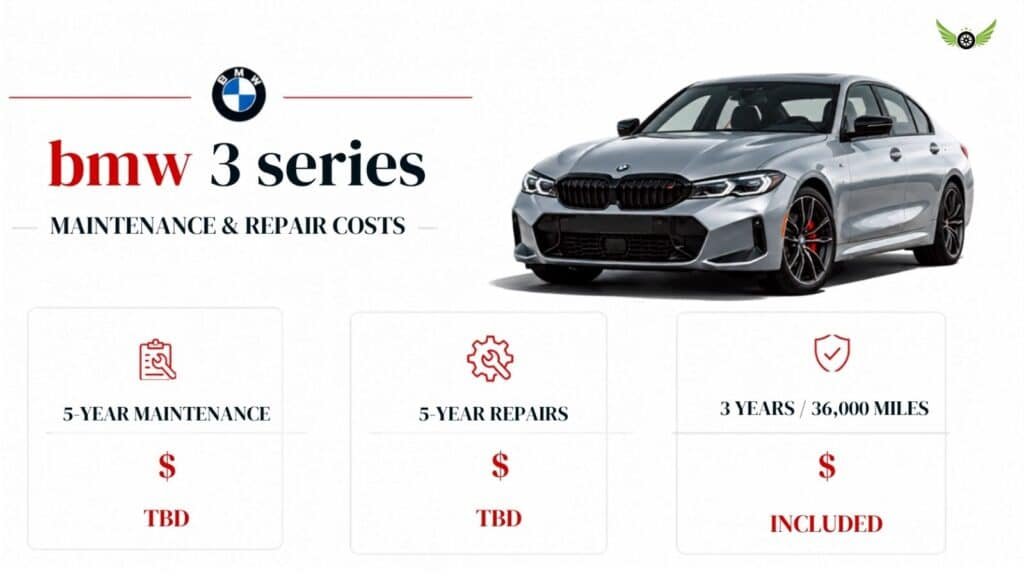
Maintenance costs for a 2026 BMW 3 Series vary by trim, mileage, driving conditions and where the vehicle is serviced. BMW Ultimate Care covers eligible scheduled maintenance for the first 3 years or 36,000 miles, which helps keep early ownership costs lower.
Current estimates show a noticeable difference between providers. KBB estimates about $3,520 in maintenance over five years, while Edmunds estimates $7,719 for a 2026 330i. CarEdge currently estimates about $4,501 in combined maintenance and repairs over the first five years. These figures use different methodologies, so they should be treated as planning estimates rather than fixed BMW prices.
Routine Service, Tires, Brakes & Common Wear Item Costs
During the complimentary maintenance period, BMW covers eligible factory-recommended services including engine oil and filter, brake fluid, cabin microfilters, engine air filters, spark plugs, remote-control/key batteries and vehicle checks.
The 2026 BMW maintenance documentation uses the vehicle’s Condition Based Service (CBS) system rather than one universal mileage schedule. BMW’s example service display shows engine oil due at 10,000 miles and a vehicle check at 40,000 miles, demonstrating how the car itself tracks upcoming maintenance.
Cost measure | Current estimate |
KBB 5-year maintenance | $3,520 |
KBB average annual maintenance | $704/year |
Edmunds 5-year 330i maintenance | $7,719 |
CarEdge 5-year maintenance & repairs | $4,501 |
CarEdge 10-year maintenance & repairs | $14,345 |
KBB’s figure is an average estimate, while Edmunds’ 330i calculation assumes 15,000 miles per year. CarEdge uses its own long-term cost model.
Tires, wheels, alignment, balancing and rotation are outside BMW Ultimate Care’s standard scheduled-maintenance coverage, so these should be budgeted separately.
According to our experience, these non-covered wear items are important when calculating the real cost of ownership because complimentary scheduled maintenance does not eliminate every expense associated with keeping the car on the road.
Short-Term vs Long-Term Maintenance Cost Expectations
The first three years are easier to budget because eligible scheduled maintenance is covered through BMW Ultimate Care. After 36 months or 36,000 miles, the owner becomes responsible for covered maintenance that falls outside the program, along with normal wear and repair costs.
Edmunds’ current 2026 330i estimate shows how costs can change after the complimentary period:
Year | Maintenance | Repairs |
1 | $0 | $0 |
2 | $0 | $0 |
3 | $646 | $0 |
4 | $3,972 | $1,012 |
5 | $3,101 | $1,549 |
That gives Edmunds’ 2026 330i a five-year estimate of $7,719 for maintenance and $2,561 for repairs. These are projections, not guaranteed expenses for every owner.
For long-term ownership, CarEdge estimates $14,345 in maintenance and repairs over 10 years, with the annual estimated cost increasing from $581 in year one to $2,154 in year ten.
The practical takeaway is that a new owner should expect relatively predictable scheduled-service costs during the covered period, but keep a larger maintenance reserve as the vehicle ages and accumulates mileage.
BMW 3 Series Reliability & Common Problems
The 2026 BMW 3 Series currently has an 81/100 Quality & Reliability score from J.D. Power. Recent owner feedback also points to strong driving performance, technology, handling and fuel efficiency, while brakes, run-flat tires and the firm ride appear among the more common criticisms in 2026 owner reviews.
For a new owner, the main reliability areas to watch are the powertrain, electrical systems and infotainment. BMW’s current 3 Series uses a 2.0-liter turbocharged engine in the 330i, while the M340i gets a 3.0-liter turbocharged inline-six with 48V mild-hybrid technology.
Engine, Mild-Hybrid System & Transmission Reliability
The 330i produces 255 hp and 295 lb-ft of torque from its 2.0-liter turbocharged four-cylinder. The M340i uses a 3.0-liter turbocharged inline-six with 48V mild-hybrid assistance and produces 386 hp. Both versions use an eight-speed automatic transmission.
Current reliability information does not identify the engine or transmission as a dominant problem area. Owner feedback is generally positive about acceleration, smoothness and driving response. One 2026 owner described the car as smooth, quiet, sporty and efficient, while another praised the handling and power delivery.
The 48V system does add electrical components to the M340i’s powertrain. BMW has also issued campaigns affecting certain recent vehicles, including a 2026 emissions campaign covering specific 2023–2026 BMW vehicles produced within a defined production period. This campaign concerns control-unit programming and is not an engine or transmission failure.
Electrical, Infotainment & Other Reported Issues
The current model relies heavily on digital controls, infotainment and electronic driver-assistance systems. Recent owner feedback is largely positive about the technology, although some owners mention a learning curve with the infotainment controls.
Electrical issues have appeared in owner reports from recent 3 Series models. Consumer Reports, for example, records reports of blank display screens and electrical-accessory problems on the 2025 3 Series. These reports are useful when assessing the current generation, but they should not be presented as a universal 2026 fault.
Brake feel is a more visible concern in current owner feedback. One 2026 330i xDrive owner described the brakes as jerky, while another owner said the brakes required some adjustment to achieve smooth stops. Other owners report being very satisfied with the car overall.
Reliability point | Current data |
J.D. Power score | 81/100 |
330i power | 255 hp |
M340i power | 386 hp |
330i/M340i transmission | 8-speed automatic |
According to our experience, the 2026 BMW 3 Series gives the strongest ownership impression through its engine response, handling, technology and everyday efficiency. The areas worth paying closer attention to are brake feel, electronic functions and recall status. For any specific vehicle, checking the VIN is the most reliable way to identify applicable recall campaigns. NHTSA provides VIN-based recall checking for U.S. vehicles.
BMW 3 Series Warranty, Recalls & Technical Updates
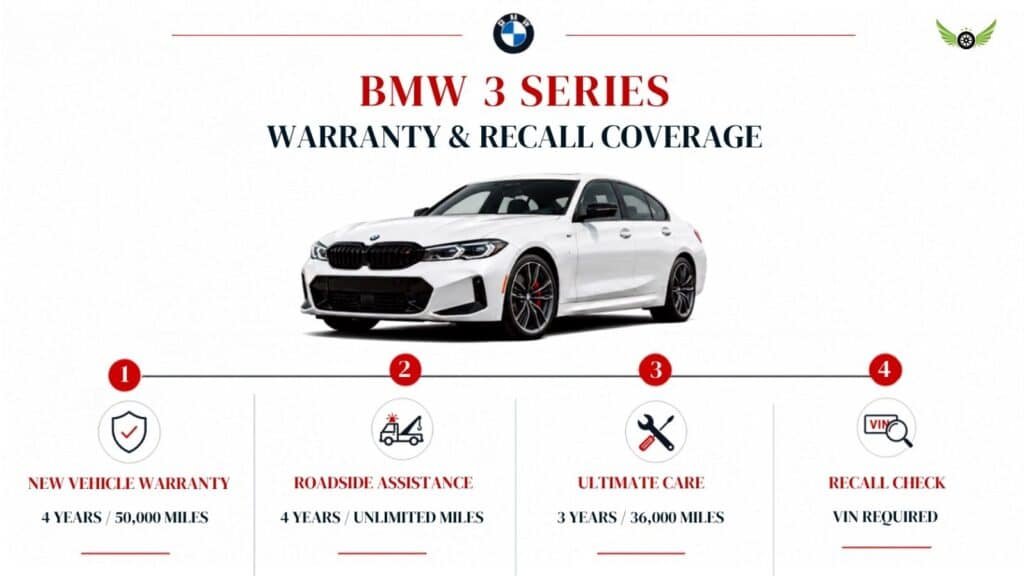
For the 2026 BMW 3 Series in the USA, BMW provides a 4-year/50,000-mile New Vehicle Limited Warranty. Roadside Assistance is provided for 4 years with unlimited miles. Separately, BMW Ultimate Care covers eligible scheduled maintenance for 3 years/36,000 miles.
These programs cover different aspects of ownership: the warranty addresses eligible defects in materials and workmanship, while Ultimate Care covers specified factory-recommended maintenance.
Factory Warranty and Extended Protection Options
The main factory protections are straightforward:
Coverage | 2026 BMW 3 Series |
New Vehicle Limited Warranty | 4 years / 50,000 miles |
Roadside Assistance | 4 years / unlimited miles |
Ultimate Care maintenance | 3 years / 36,000 miles |
BMW also offers Vehicle Service Contracts (VSCs) for additional protection. Coverage can extend to 7 years or 100,000 miles, with Platinum and Powertrain options. Platinum covers a broader range of vehicle systems, including electronics and drivetrain components, while Powertrain focuses on major engine, transmission and drivetrain components.
According to our experience, extended protection is worth considering for owners who plan to keep their BMW 3 Series beyond the 50,000-mile factory warranty, particularly when predictable repair costs are a priority.
How to Check Recalls and Service Bulletins
The most accurate way to check a specific vehicle is by its 17-digit VIN. BMW’s recall system shows applicable safety and emission campaigns, and the same information can be accessed through the My BMW App under Service and Maintenance → Recalls & Campaigns. BMW states that eligible recall repairs are performed free of charge at an authorized BMW Center.
NHTSA provides another useful source for U.S. owners. Its recall database supports searches by VIN, vehicle year, make and model. NHTSA also maintains a Manufacturer Communications database containing manufacturer notices, bulletins and other technical communications submitted by automakers.
For software-related updates, BMW provides a VIN-based software update tool that lets owners check for available vehicle and paired-device software updates.
According to our experience, checking the VIN before buying a used 3 Series—and periodically during ownership—is one of the simplest ways to stay current on recall campaigns, technical updates and available software improvements.
BMW 3 Series Long-Term Reliability
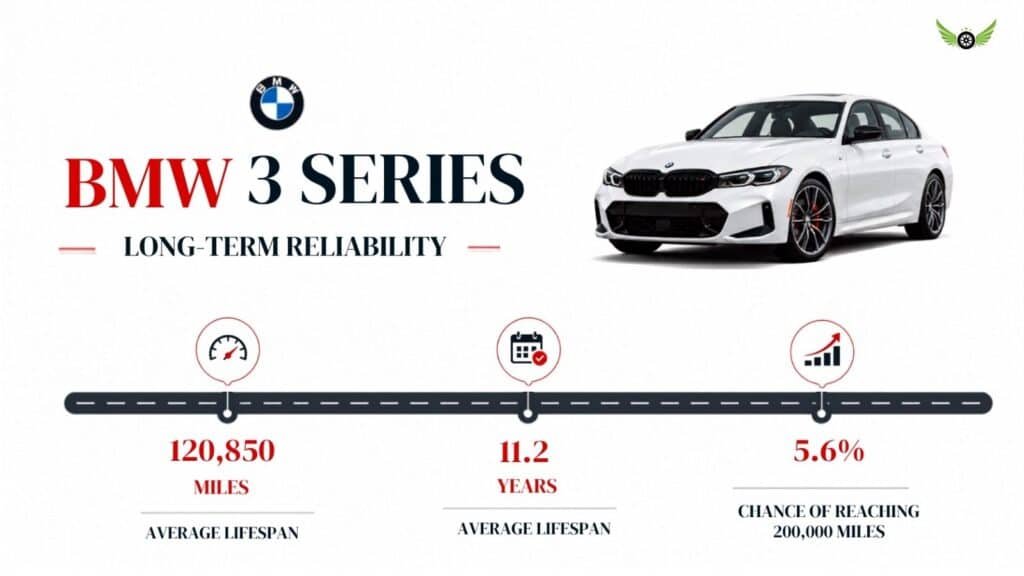
Long-term ownership data shows that the BMW 3 Series can remain on the road well beyond the initial warranty period when maintenance is kept up. iSeeCars’ analysis of more than 300 million vehicles puts the average 3 Series lifespan at 120,850 miles or about 11.2 years, with a 5.6% chance of reaching 200,000 miles. Its current reliability rating is 7.0/10.
Maintenance costs generally rise as mileage and vehicle age increase. CarEdge estimates about $14,345 in maintenance and repairs over 10 years, compared with $4,501 during the first five years. Its estimated annual cost rises from $581 in year one to $2,154 in year ten.
According to our experience, keeping the service history complete and dealing with maintenance as it becomes due makes a major difference to long-term ownership. The 2026 model also benefits from BMW Ultimate Care, which covers eligible scheduled maintenance for 3 years or 36,000 miles.
Expected Lifespan with Proper Maintenance
A useful real-world benchmark is around 120,850 miles, based on iSeeCars’ large-scale longevity analysis. The same analysis shows an average lifespan of approximately 11.2 years. Reaching 200,000 miles is possible, but it represents a much smaller share of vehicles in the dataset.
Longevity measure | BMW 3 Series |
Average lifespan | 120,850 miles |
Average age | 11.2 years |
Chance of reaching 200,000 miles | 5.6% |
Reliability rating | 7.0/10 |
For a 2026 owner, the best approach is to follow BMW’s Condition Based Service recommendations, maintain the vehicle at the required intervals and keep records of completed work. BMW’s maintenance program covers eligible factory-recommended services during the first 36 months or 36,000 miles.
How to Reduce Long-Term Repair Costs
The simplest way to control repair costs is to maintain the car before small issues become larger repairs. Following the CBS reminders, using the correct service parts and fluids, monitoring warning messages and keeping tires and brakes in good condition all contribute to better long-term ownership.
CarEdge’s current estimates show why maintenance planning becomes more important with age:
Year | Estimated annual maintenance & repairs |
1 | $581 |
3 | $850 |
5 | $1,311 |
10 | $2,154 |
CarEdge also estimates a 41.71% probability of a major repair by year 10, using its definition of a major repair as one costing more than $500. These are statistical ownership estimates rather than guaranteed expenses for an individual vehicle.
For the 2026 BMW 3 Series, maintaining the vehicle according to BMW’s service requirements, keeping complete records and addressing warning messages promptly are the most practical ways to control long-term repair spending. BMW also lets owners view their current warranty and maintenance coverage through the My BMW App or My BMW portal.
FAQs About 2026 BMW 3 Series Maintenance, Reliability & Ownership
This FAQ covers the main ownership questions around the 2026 BMW 3 Series, including maintenance cost, service requirements, reliability, common problems, warranty coverage, recalls, and long-term ownership. The answers are kept short and focused on the information buyers and owners are most likely to need.
Is the 2026 BMW 3 Series expensive to maintain?
Yes. Edmunds estimates about $7,980 in maintenance and $2,887 in repairs over five years for the 2026 330i.
How often does the 2026 BMW 3 Series need maintenance?
It depends on the CBS system. BMW uses sensors, algorithms, time, mileage and driving conditions to determine when individual maintenance services are due.
Is scheduled maintenance included with a new BMW 3 Series?
Yes. BMW Ultimate Care covers factory-recommended scheduled maintenance for 3 years or 36,000 miles, whichever comes first.
Is the 2026 BMW 3 Series reliable?
Yes. J.D. Power gives it an 81/100 Quality & Reliability score, while Consumer Reports predicts about-average reliability.
What are the common BMW 3 Series problems?
Electrical and electronic systems are key areas to monitor. Recent 3 Series reliability information includes reported issues involving electrical accessories, infotainment and other vehicle systems.
How long can a BMW 3 Series last?
Around 120,850 miles on average. iSeeCars estimates an average lifespan of about 11.2 years for the 3 Series.
Does the 2026 BMW 3 Series have a mild-hybrid system?
Yes. The 330i and M340i use gas/electric mild-hybrid powertrains, with the M340i using a 48V system.
What warranty comes with the 2026 BMW 3 Series?
4 years/50,000 miles. BMW also provides Roadside Assistance for 4 years with unlimited mileage.
Does BMW offer extended protection for the 3 Series?
Yes. BMW offers Vehicle Service Contracts with protection that can extend to 7 years or 100,000 miles, depending on the selected plan.
How do I check BMW 3 Series recalls?
Use the VIN. BMW’s recall system lets owners check vehicle-specific campaigns, and NHTSA provides a U.S. recall database.
How do I check my BMW warranty and maintenance coverage?
Use My BMW. The My BMW App and My BMW portal show the vehicle’s warranty and maintenance expiration dates and mileage.
How can I reduce long-term repair costs?
Follow BMW’s maintenance schedule. Using the CBS reminders, keeping service records and addressing maintenance requirements on time can help control repair costs.
Is the 2026 BMW 3 Series good for long-term ownership?
Yes. It offers strong driving performance and a factory maintenance program, while long-term ownership requires budgeting for maintenance and repairs after the complimentary coverage period. Edmunds estimates $10,867 combined maintenance and repairs over five years for the 330i.
Is the 2026 BMW 3 Series worth buying?
Yes, for buyers who value performance and premium driving quality. J.D. Power gives the 2026 model an 84/100 Driving Experience score, while its ownership costs should be considered alongside the purchase price.