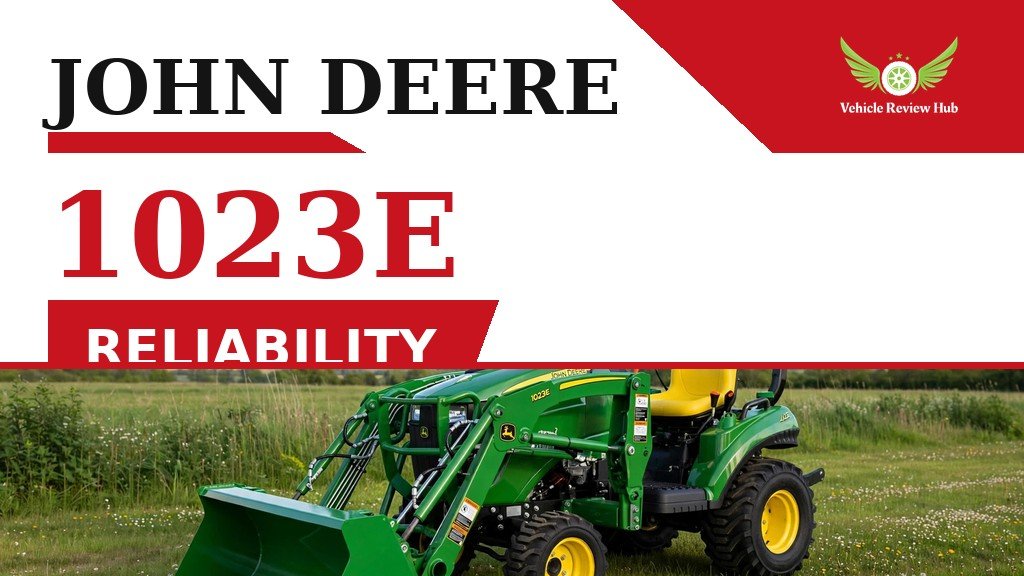
The short answer: John Deere 1023E maintenance is straightforward, and the tractor rewards owners who stick to the factory schedule. The 1023E runs a 21.5-gross-hp three-cylinder Yanmar diesel at 3,200 rpm with about 14.9 PTO horsepower, Tier 4 Final emissions without a DPF, and a two-range hydrostatic transmission with MFWD. Deere’s guidance calls for an engine oil and filter change every 200 hours or annually, a hydraulic filter replacement after the first 50 hours and then every 200 hours, fuel filters roughly every 400 hours, and a coolant flush every two years. Most of the small jobs in John Deere 1023E maintenance are easy enough for a careful owner, and parts are widely available through any dealer. Owners report long, trouble-free lives from tractors serviced on time.
This guide walks through the full John Deere 1023E maintenance schedule, realistic service costs, the most commonly reported reliability issues, the September 2024 brake-linkage recall, and a used-tractor inspection checklist. Every interval below comes from Deere service guidance; owner-reported problems are attributed to the forums and repair guides that documented them.
John Deere 1023E Maintenance Schedule
The John Deere 1023E maintenance schedule follows Deere’s standard 1 Series rhythm: daily checks before use, a break-in service early on, then repeating 200-hour, 400-hour, and two-year cycles. A 5.7-gallon fuel tank, a ~12.3-liter transmission/hydraulic sump, ~2.7 liters of crankcase oil with the filter, and ~3.7 liters of coolant are the capacities Deere’s quick-reference guide lists, so most fluid jobs need only a few quarts or gallons. Deere backs the tractor with a 6-year/2,000-hour powertrain warranty, so keeping dated service records helps resale as well as coverage.
Engine Oil, Filters and Cooling System
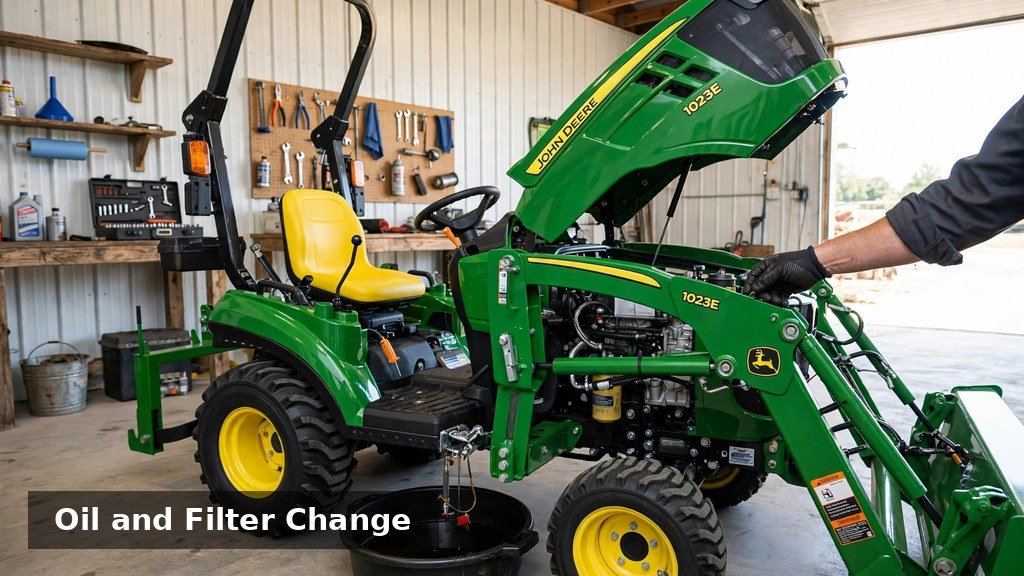
In the John Deere 1023E maintenance schedule, engine oil and the oil filter are due every 200 hours or annually, whichever comes first. Deere lists the engine oil filter as part number M806418 in its 1023E guide, and the crankcase holds about 2.7 liters with the filter installed. Change the oil with the engine warm, refill to the dipstick mark, and check for leaks after a short run. Skipping this interval is the fastest way to shorten the life of any diesel, and it is the one piece of John Deere 1023E maintenance owners should never stretch.
Air and fuel filters matter more than many owners expect. The primary air filter (M113621) and secondary element (M123378) should be checked and cleaned as needed, with replacement roughly every 400 hours. The inline fuel filter (AM116304) and main fuel filter (MIU804763) are also on the 400-hour/annual cycle. In dusty mowing conditions, inspect air filters more often. John Deere 1023E maintenance calls for a cooling-system flush and refill with John Deere COOL-GARD coolant every two years or about 2,000 hours; in between, keep the grille screens and radiator fins clear of grass and chaff, since a clogged radiator is the most common cause of overheating reports on these tractors.
| Service Interval | What to Do |
|---|---|
| Break-in, first 50–100 hours | Replace hydraulic filter (LVA16054), change engine oil and filter, retorque wheel hardware |
| Every 200 hours or annually | Change engine oil and filter; replace hydraulic filter; clean grille screens and radiator fins; check battery, belts, hoses |
| Every 400 hours or annually | Replace inline and main fuel filters; replace primary and secondary air filters |
| Every 1,200 hours | Check engine valve clearance (dealer job) |
| Every 2 years or 2,000 hours | Flush cooling system and refill with COOL-GARD coolant; service fuel injection nozzles |
Hydraulic Fluid, Greasing and Routine Inspections
The shared transmission/hydraulic system is the heart of the 1023E, and John Deere 1023E maintenance gives it special attention early. The hydraulic filter gets its first replacement after 50 hours, then every 200 hours, with the full transmission oil change on the longer manual interval. As part of John Deere 1023E maintenance, check the transmission oil level with the engine warm using Deere’s procedure, and always use the fluid type the manual specifies for your serial range. Low fluid or an overdue filter is the usual suspect behind weak loader lift, slow hydrostatic response, or a jerky pedal.
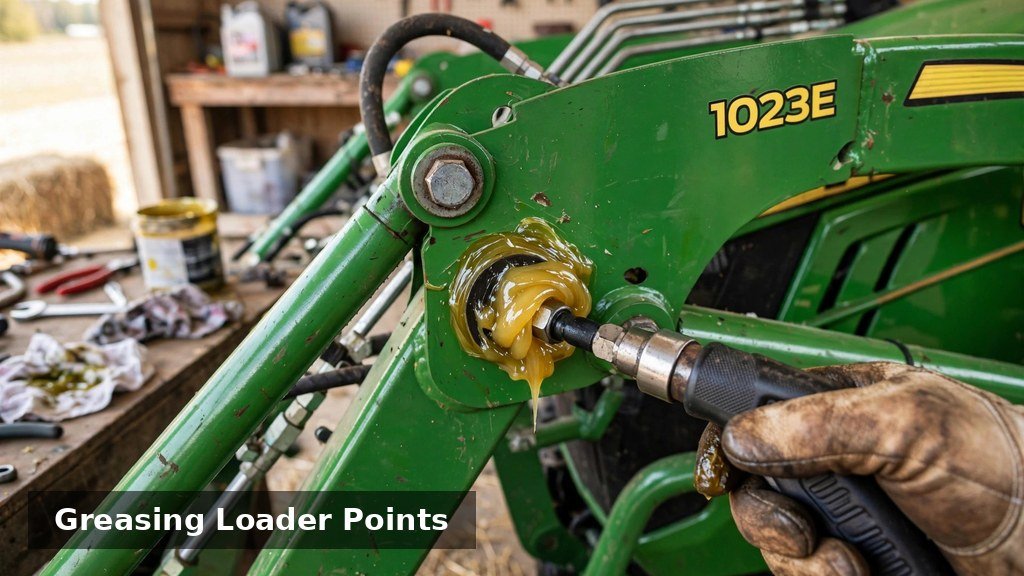
John Deere 1023E maintenance includes regular grease at every fitting on the loader arms, bucket linkage, steering spindles, MFWD driveshaft, and mower-deck spindles — a job owners describe as the single best anti-wear habit on this tractor. Regular greasing keeps the loader operating smoothly and extends the life of its pins and bushings. For a visual walkthrough of the scheduled jobs, this service video on the 1023E covers the maintenance points owners usually ask about:
These daily checks are the simplest part of John Deere 1023E maintenance, taking about five minutes while preventing most surprise breakdowns: engine oil level, coolant level, tire pressure, a look for fresh leaks under the tractor, and a quick test of the safety interlock switches. Cleaning debris from around the muffler, engine cover, and mower deck after each use keeps fire risk and overheating down.
John Deere 1023E Maintenance and Repair Costs
Routine John Deere 1023E maintenance is affordable by tractor standards, but parts carry the green-paint premium, so budgeting a few hundred dollars a year for consumables is realistic. A DIY oil and filter change runs roughly $30–$60 in parts (estimate), while a dealer 200-hour service typically lands in the $200–$400 range depending on the region and what else the tech finds (estimate). Keeping the tractor on schedule protects that 6-year/2,000-hour powertrain warranty and supports strong resale, which is part of the long-term math covered in our 1023E ownership cost guide.
Routine Service and Replacement Parts
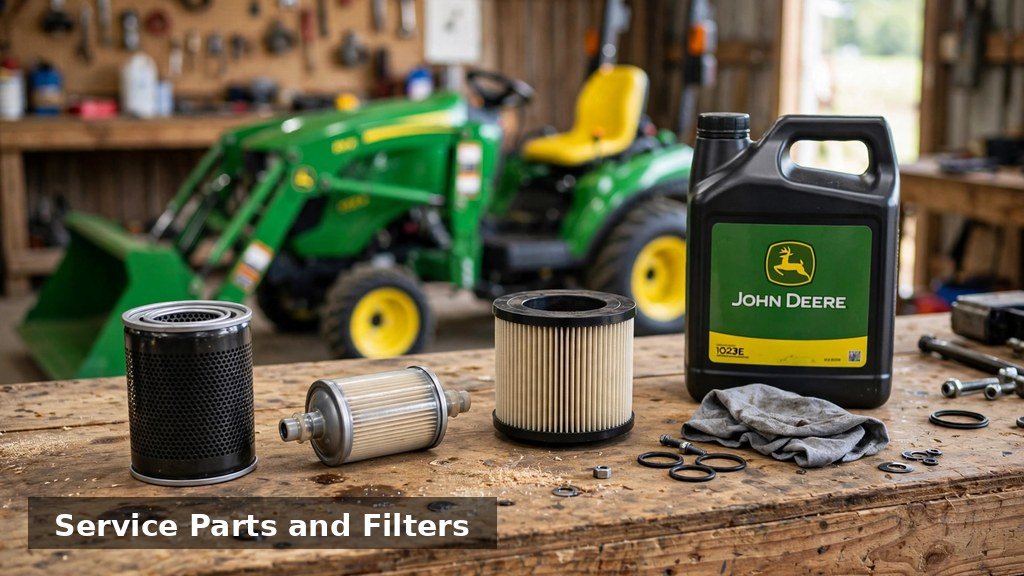
Filter part numbers save a trip to the parts counter. Deere’s 1023E guide lists the engine oil filter as M806418, the inline fuel filter as AM116304, the main fuel filter as MIU804763, the primary air filter as M113621, the secondary element as M123378, and the hydraulic filter as LVA16054 — and there is a one-kit filter pack (LVA21035) that bundles the main maintenance filters together. A dedicated 1023E repair guide with diagrams and OEM part numbers is handy when you want to confirm a part against your serial range before ordering.
Beyond filters, John Deere 1023E maintenance plans for mower blades, deck belts, and grease as the recurring wear items. Blades are inexpensive and worth sharpening or replacing as a matched set when they dull; a worn deck belt shows up as slipping or squealing under load. Battery replacement (Deere lists TA15224) usually comes every three to five years, and hydraulic hoses that bulge or weep should be replaced immediately rather than tightened and ignored. None of these are big jobs, but together they make up most of the annual John Deere 1023E maintenance spend.
DIY Maintenance vs. Professional Repairs
Homeowners can safely handle the DIY side of John Deere 1023E maintenance: oil and filter changes, air and fuel filter swaps, greasing, blade and belt service, and basic cleaning and inspection — these are the bread-and-butter tasks. The operator manual spells out procedures step by step, and the tractor’s layout keeps common filters and fittings reachable. Owners who do these jobs themselves often report spending under $150 a year on consumables (estimate).
Leave fuel injection, hydrostatic transmission internals, and electrical diagnostics to the dealer. Where owners get into trouble, according to dealer techs and experienced forum members, is trying to diagnose hydrostatic faults, injection-pump issues, or complex safety-switch wiring without the right tools. A good middle ground is doing the routine service yourself and booking the dealer for the 1,200-hour valve clearance check and an annual inspection.
John Deere 1023E Reliability and Common Problems
Overall, the 1023E has a strong reliability record across nearly fifteen years of production in Augusta, Georgia. The Yanmar diesel is a simple, proven unit, and most owner complaints are minor annoyances rather than failures. Still, patterns do emerge in owner reports, and knowing them helps your John Deere 1023E maintenance routine distinguish a five-minute fix from a dealer visit. The sections below summarize the problems owners report most often — not a claim that every tractor develops them.
Engine, Transmission and Hydraulic Warning Signs
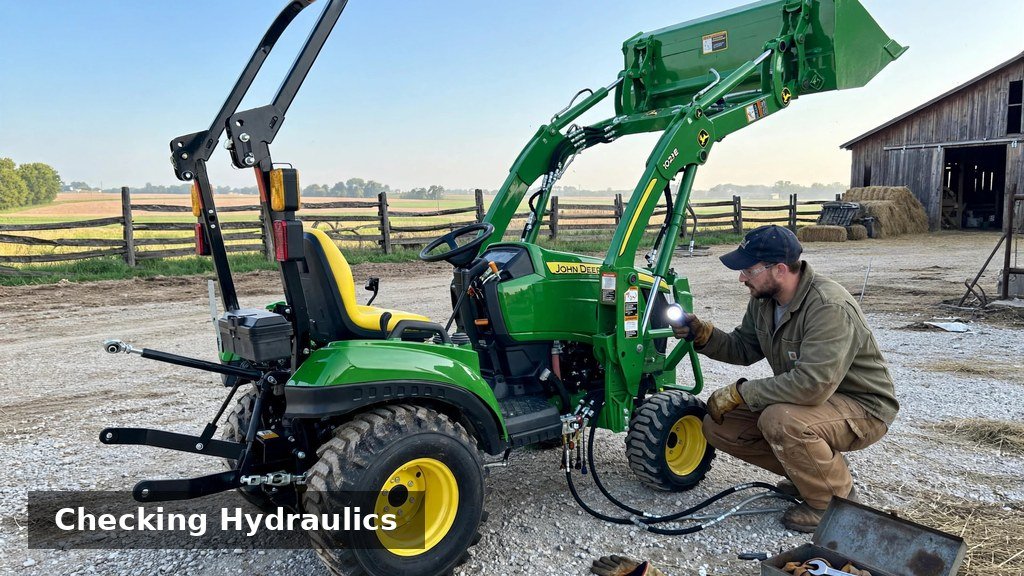
In John Deere 1023E maintenance discussions among owners, hard starting is the most talked-about engine complaint. Causes owners report include clogged fuel filters, air in the fuel system, tired glow-plug warm-up in extreme cold, and dirty injection nozzles. If the tractor cranks but will not catch, check the fuel shut-off valve, drain any water from the separator, and replace the fuel filters before suspecting anything expensive. Owners also note that a sudden increase in fuel consumption or loss of power under load usually traces back to a plugged air filter or restricted fuel filter. If a tractor feels weaker than it used to while doing the same work, our 1023E performance and fuel usage guide explains what normal fuel consumption looks like so you can tell a real problem from a heavy workload.
On the drivetrain side, the classic complaints are transmission fluid leaks around the range selector area, slow or sluggish hydraulic response, and occasional loss of pull on hills. Owner reports most often blame low transmission oil, an overdue hydraulic filter, or the front-axle oil being neglected — all routine John Deere 1023E maintenance items. Clean the suction screen, keep the filter on schedule, and check the front hub seals for weeping. If drive problems persist after fluid and filter service, dealer diagnosis is the right call, since internal hydrostatic wear is not a home repair.
Brake, Electrical and Starting Issues
John Deere 1023E maintenance should include attention to the brakes because of the safety recall discussed in the next section, but routine brake issues are simpler: brakes that feel weak usually just need adjustment, and a park brake left engaged will make the tractor feel sluggish. Check brake adjustment during annual service, and keep an eye on the brake linkage bell crank for cracks or looseness.
The electrical side of John Deere 1023E maintenance most often comes down to safety switches and the battery. Owners report no-crank situations caused by the seat switch, the neutral safety switch on the transmission, or corroded battery terminals — all cheap fixes once found. If the tractor will not crank, confirm it is fully in neutral, wiggle the seat switch connection, clean the terminals, and check the fuses before replacing the starter. In cold weather, a battery on a maintainer and a proper glow-plug warm-up cycle solve most starting complaints.
John Deere 1023E Recalls and Used-Tractor Inspection
A tractor’s safety record is part of its reliability story, and the 1023E has one significant recall on the books. Before buying used — or if you already own a 2017–2024 machine — verifying recall status is a ten-minute job that matters.
How to Check Recall Status and Safety Repairs
In September 2024 the U.S. Consumer Product Safety Commission announced a recall of about 147,900 John Deere compact utility tractors sold between November 2017 and July 2024, covering the 1023E, the John Deere 1025R, and the 2025R. The front bell crank in the brake linkage can fail and cause the tractor to lose braking, creating a crash hazard. The recall followed four reported brake-linkage failures, including one hospitalization and two impact injuries. Coverage of the September 2024 CPSC recall of John Deere compact utility tractors notes that Deere arranged free repairs through authorized dealers, including on-site service for owners who could not transport their machines.
To check your tractor, find the serial number on the frame on the front right side near the engine, then enter it in the recall lookup on Deere’s website or call Deere & Company at 800-537-8233. If your machine is covered and the repair was never done, stop using it and schedule the free fix with an authorized dealer. When buying used, make the recall fix part of your John Deere 1023E maintenance checklist: ask the seller for the repair paperwork; a completed recall repair is documented and should come with the tractor.
What to Inspect Before Buying a Used Tractor
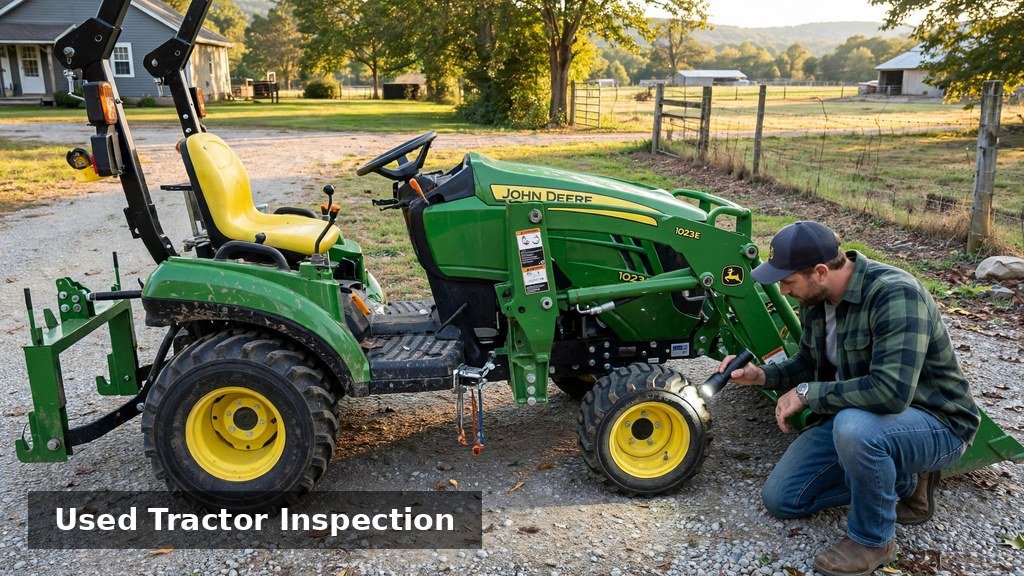
John Deere 1023E maintenance history starts with the hour meter and service records. A 1023E with 400 well-documented hours is a better buy than a 200-hour machine with no records. Ask for receipts for oil changes, filter replacements, and any dealer service. Our John Deere 1023E review and buying guide covers realistic new and used price bands so you can judge whether the asking price matches the hours and condition.
Walk the tractor with a checklist: cold-start it and listen for knocking or hard cranking; run the loader through full lift, curl, and dump looking for cylinder drift or weeping seals; engage the PTO and listen for bearing noise; check the range selector area and front hubs for oil weeping; inspect loader pins and bushings for play; look at tire wear and sidewall cracks; and test every safety switch, light, and gauge. Note that the new 1E 23 has replaced the 1023E as Deere’s entry-level 1 Series model, so late-model used 1023E prices reflect that transition — leverage it in negotiation, but do not let a bargain price excuse skipped inspection.
Frequently Asked Questions About John Deere 1023E Maintenance
These are the maintenance questions 1023E owners and shoppers ask most often, answered from Deere service guidance and documented owner experience.
How often should I change the oil in my John Deere 1023E?
Change the engine oil and filter every 200 hours or once a year, whichever comes first. Deere lists the oil filter as M806418 and the crankcase capacity at about 2.7 liters with the filter. This is the single most important item in John Deere 1023E maintenance, so do not stretch the interval even if the tractor sits unused for months.
When is the hydraulic filter due on a 1023E?
The hydraulic filter (LVA16054) gets its first replacement after 50 hours, then every 200 hours. Because the transmission and hydraulics share one system, an overdue filter can show up as weak loader lift, slow hydrostatic response, or jerky pedal feel — symptoms owners sometimes mistake for serious transmission trouble.
Is the 1023E brake recall still open, and how do I check?
The September 2024 CPSC recall covering 1023E tractors sold from November 2017 through July 2024 remains the key safety item to verify. Find your serial number on the front-right frame near the engine, enter it in Deere’s recall lookup, or call 800-537-8233. The dealer repair is free.
What causes hard starting in cold weather?
Most cold-start complaints in John Deere 1023E maintenance trace to a weak battery, corroded terminals, a clogged fuel filter, or air in the fuel system rather than engine failure. Keep the battery on a maintainer in winter, replace the fuel filters on schedule, drain water from the separator, and give the glow plugs their full warm-up cycle before cranking. Persistent no-start problems with a good battery usually point to a safety switch or starter solenoid.
Can I do my own maintenance, or does it void the warranty?
Doing your own John Deere 1023E maintenance — oil changes, filter swaps, greasing, and inspections — does not void coverage as long as you use proper parts and fluids and keep dated records, which is exactly what the 6-year/2,000-hour powertrain warranty expects to see. Save receipts and log hours. For injection, hydrostatic, and electrical work, most owners are better off with the dealer’s tools and training.
What should a dealer 200-hour service cost?
Expect roughly $200–$400 at a dealer for the 200-hour service, depending on region and what else they find (estimate). Either way, disciplined John Deere 1023E maintenance is cheaper than the repair the skipped service was meant to prevent.