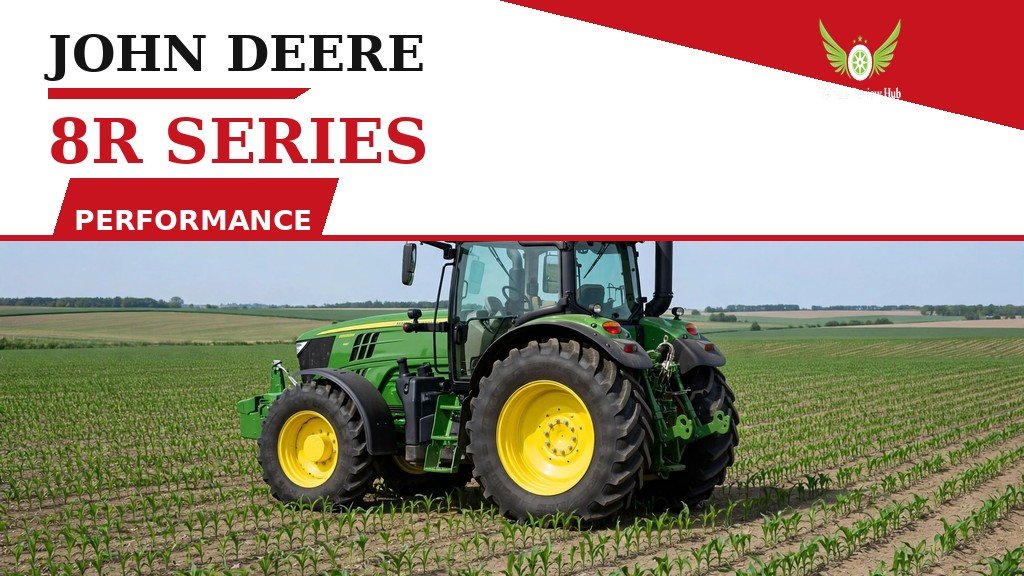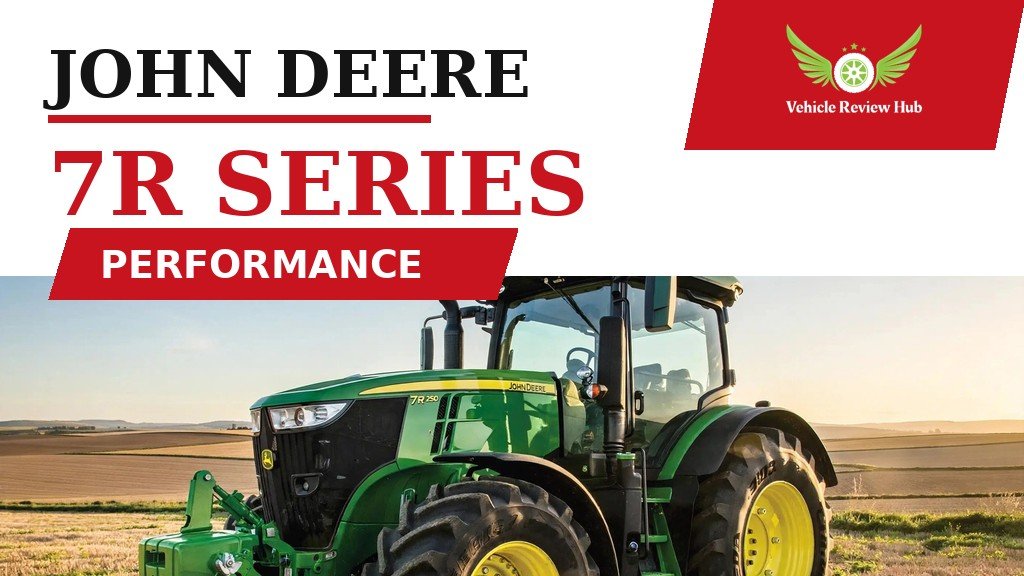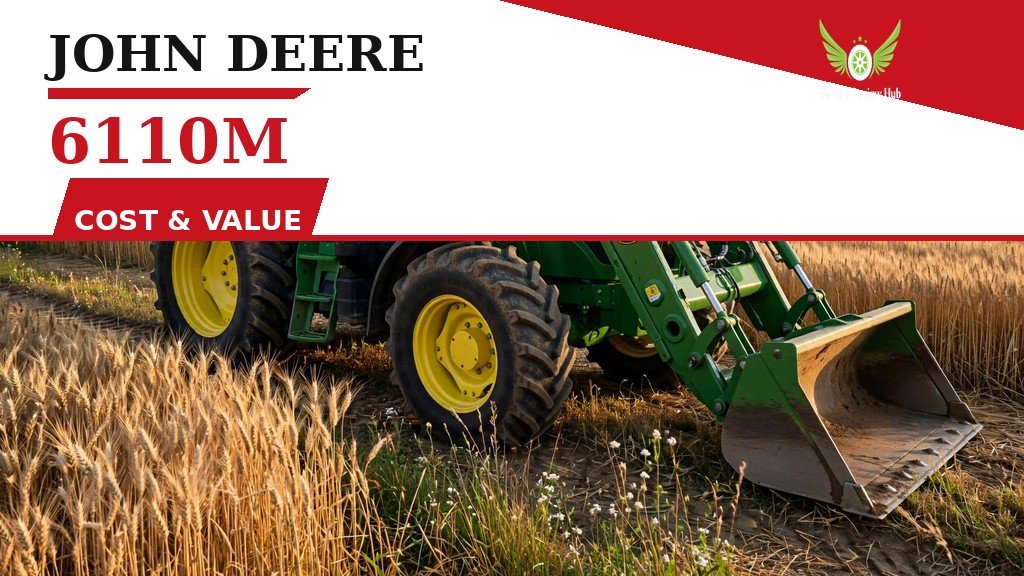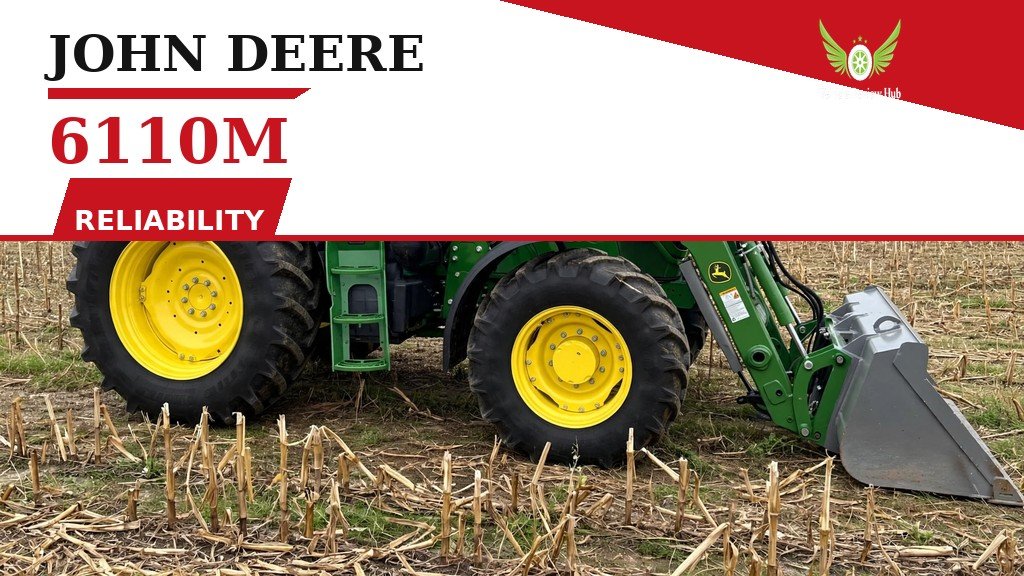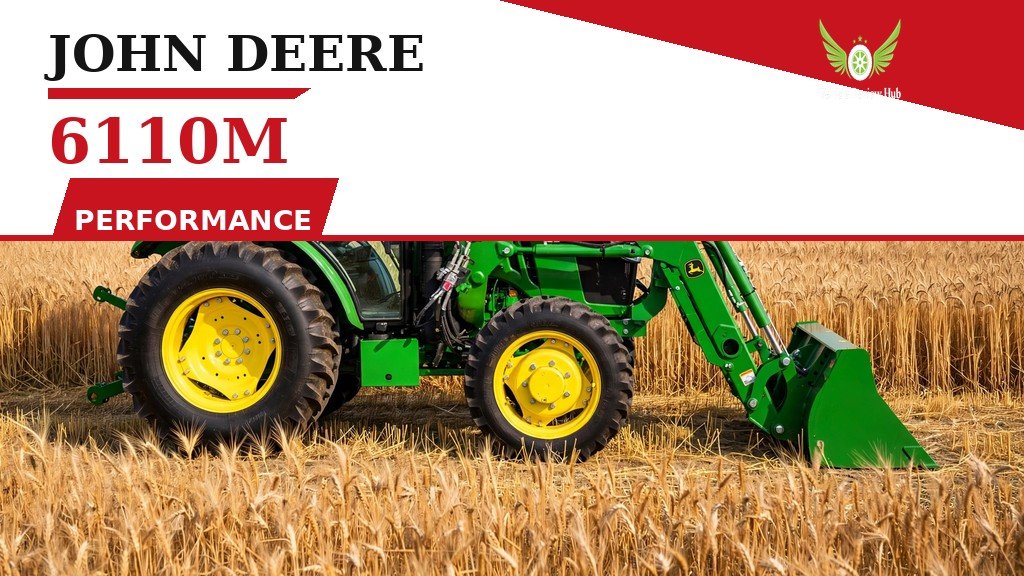
The John Deere 6110M performance story starts with a simple fact: this 110-horsepower utility tractor from Deere’s 6M line burns roughly 2.5 to 5 gallons of diesel per hour depending on the job, runs a 51-gallon tank for a full working day, and puts 84 PTO horsepower to the ground through a 4.5L PowerTech engine with no DPF to regenerate. For mixed farms running tillage, hay work, and daily loader chores, that combination of mid-size power and straightforward DOC-plus-SCR emissions is the heart of John Deere 6110M performance.
This guide breaks down John Deere 6110M performance by task — fuel use during fieldwork, loader work, and PTO operation — plus handling, comfort, real owner experience, and how to pick the right transmission for your work. Every figure comes from Deere’s published specs, OECD test data, or documented owner reports; anything that is an estimate is labeled as one.
John Deere 6110M Fuel Consumption and Runtime
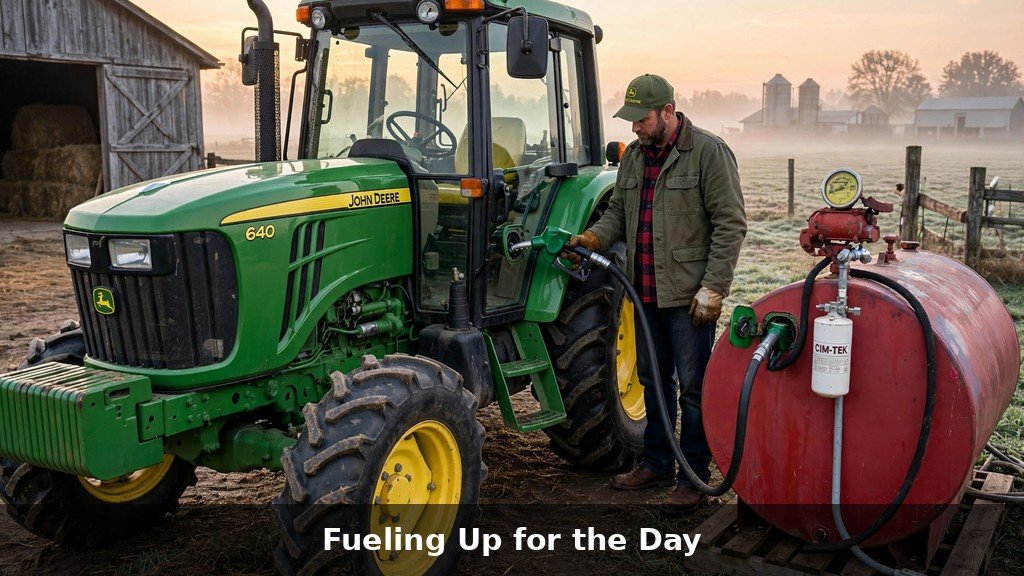
Fuel is the largest running cost on any utility tractor, so John Deere 6110M performance starts at the fuel tank. The 6110M carries 51 gallons of diesel and 3.4 gallons of DEF, and the Final Tier 4 PowerTech EWL engine doses DEF at roughly 2 to 4 percent of diesel use. There is no DPF and no parked regeneration on the US model, which removes one maintenance variable that older Tier IV machines carried.
Fuel Use During Fieldwork, Loader Work and PTO Operation
Documented test data gives John Deere 6110M performance a solid ceiling and a realistic floor. The OECD test on the closely related 6120M — the same EWL 4.5L engine family — recorded 6.3 gallons per hour at maximum power, which is the absolute top end you will see. At the other end, a documented long-term test logged roughly 2.8 gallons per hour over 18 hours of mixed mowing, tedding, raking, and road work (190 liters total). Owner-reported figures fall between those poles:
| Task | Typical fuel use (gph) | Source |
|---|---|---|
| Light work, idling, yard chores | 2.0–3.0 | Owner-reported |
| Loader work, feeding, material handling | 3.0–4.5 | Owner-reported |
| Mowing, tedding, baling | 3.5–5.0 | Owner-reported |
| Heavy draft or full PTO load | 4.5–6.0 | Owner-reported |
| Documented mixed farm work | ~2.8 | Published long-term test (6120M, same engine) |
| Maximum-power ceiling | 6.3 | OECD test (6120M, same engine) |
| Planning figure, mixed farm day | 3.0–4.0 | Estimate from the ranges above |
Those numbers put the John Deere 6110M performance envelope in clear territory: at a blended 3.5 gallons per hour, the 51-gallon tank delivers roughly 14 hours of mixed work — comfortably a full day and then some before refueling. Our John Deere 6110M review covers the full spec sheet behind these figures.
Factors Affecting Fuel Economy and Runtime per Tank
Transmission choice moves the needle most on John Deere 6110M performance at the pump. The AutoPowr IVT holds engine rpm inside the peak torque band under acceleration instead of revving through fixed gears, which is why Deere markets it as the fuel-efficient option — reviewers consistently note lower rpm and less noise under load. The PowrQuad Plus and AutoQuad Plus boxes are efficient when operators use the right range, but they reward an experienced hand; short-shifting and running one range too high are the classic fuel wasters.
Other factors that shape John Deere 6110M performance per tank: Intelligent Power Management adds up to 20 horsepower in transport and mobile PTO applications, which costs fuel when active; correct ballast and tire pressure cut rolling resistance; selecting 540E for light PTO work drops engine rpm; and long idle periods burn roughly 1 to 1.5 gallons per hour for zero work. DEF costs are negligible — the 3.4-gallon tank needs topping every few fuel fills. For the full cost picture, see our John Deere 6110M ownership cost guide.
John Deere 6110M Performance for Farm and Property Work
The 6110M sits in the sweet spot of the 6M line: 110 rated horsepower, 122 maximum, 130 with IPM, and 84 PTO horsepower from a 4.5L single-turbo PowerTech EWL turning 2,100 rpm — figures confirmed in the published 6110M specifications. Peak torque of 515 Nm (379.8 lb-ft) arrives at 1,600 rpm with a 40 percent torque rise, which is what gives John Deere 6110M performance its forgiving, lug-through-it character when the implement loads up.
Tillage, Mowing, Hay Work and Material Handling
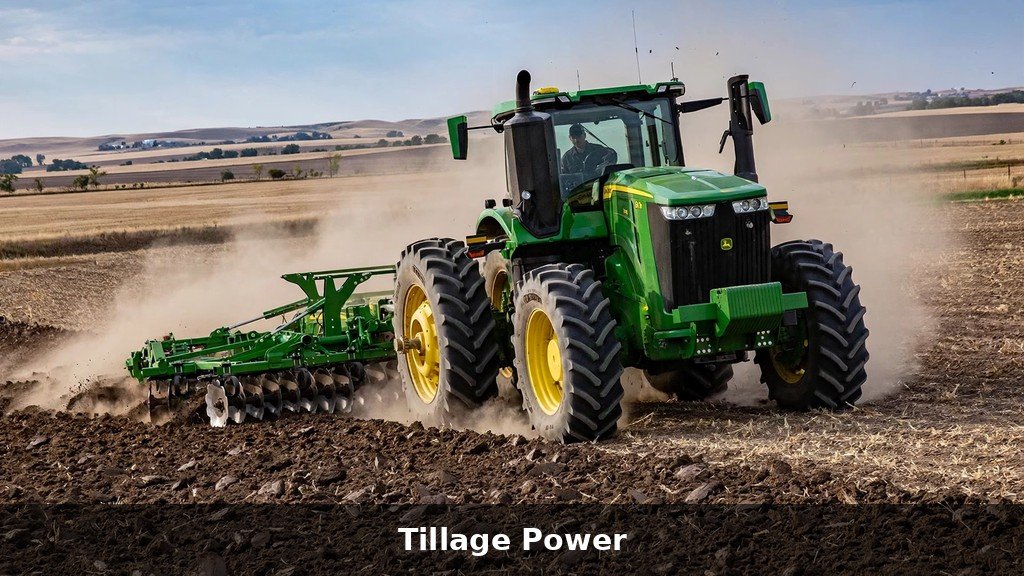
In primary tillage, John Deere 6110M performance is defined by torque more than horsepower. The 40 percent torque rise means the engine pulls down to 1,600 rpm and keeps digging instead of forcing a downshift. The Category 2/3N rear hitch lifts 5,582 pounds sustained at 610 mm behind the coupling points (7,431 pounds with the optional higher-capacity cylinders, per Deere’s operator manual), so mounted plows, heavy discs, and combination seedbed tools are all within reach.
For hay work — where John Deere 6110M performance arguably shines brightest — 84 PTO horsepower handles a 10-foot disc mower-conditioner, a tedder, and a 4×5 round baler without strain — the classic mid-size hay package. The 540/540E/1000 PTO options let operators match implement demand to engine load, and electrohydraulic engagement with in-cab switch plus fender remote makes hookup practical. The video below shows a 6110M running a Berti mulcher in the field — exactly the kind of sustained PTO work this section covers:
Material handling rounds out the John Deere 6110M performance resume. The open-center hydraulic system delivers 21 gpm standard and 30 gpm with the optional PFC pump at 2,900 psi, feeding up to four rear and three mid-mount SCVs — enough flow to run a grapple, a bale squeeze, or a front-mounted mower. Compared with the smaller 5M machines, the 6M’s heavier 12,522-pound base weight and 101.6-inch wheelbase give it noticeably more stability with a loaded bucket, as our 6M Series performance guide details across the model range.
Loader Work, Hauling and Heavy-Load Performance
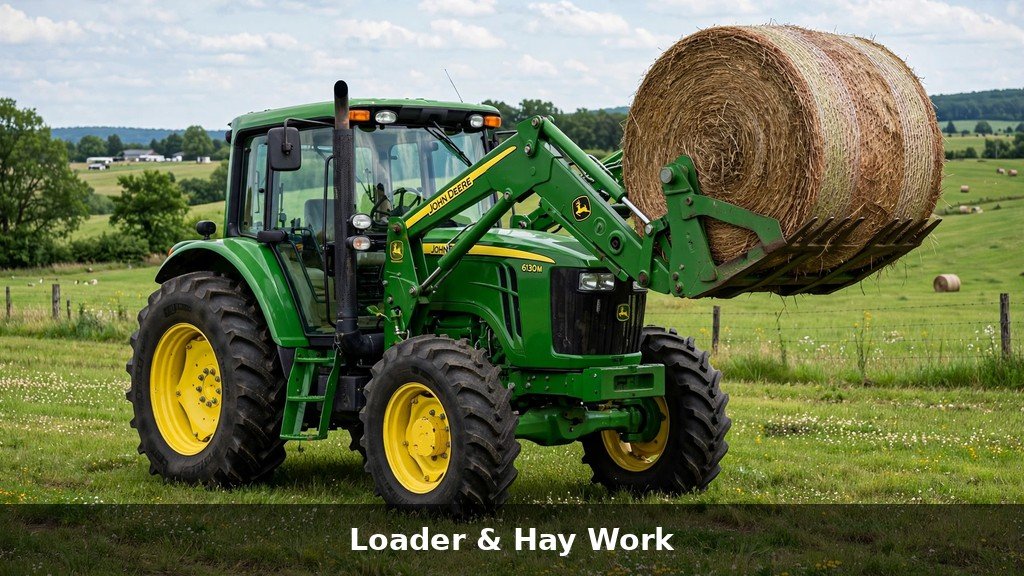
Paired with the 643R loader, John Deere 6110M performance in the yard is strong: roughly 3,832 to 3,874 pounds of lift at the pivot with the non-self-leveling linkage (4,736 to 4,826 pounds with mechanical self-leveling), 163 to 169 inches of maximum lift height, and about 6,200 pounds of breakout force. That is genuine commercial loader territory — loading mixer wagons, stacking big square bales, and handling palletized feed are all comfortable work.
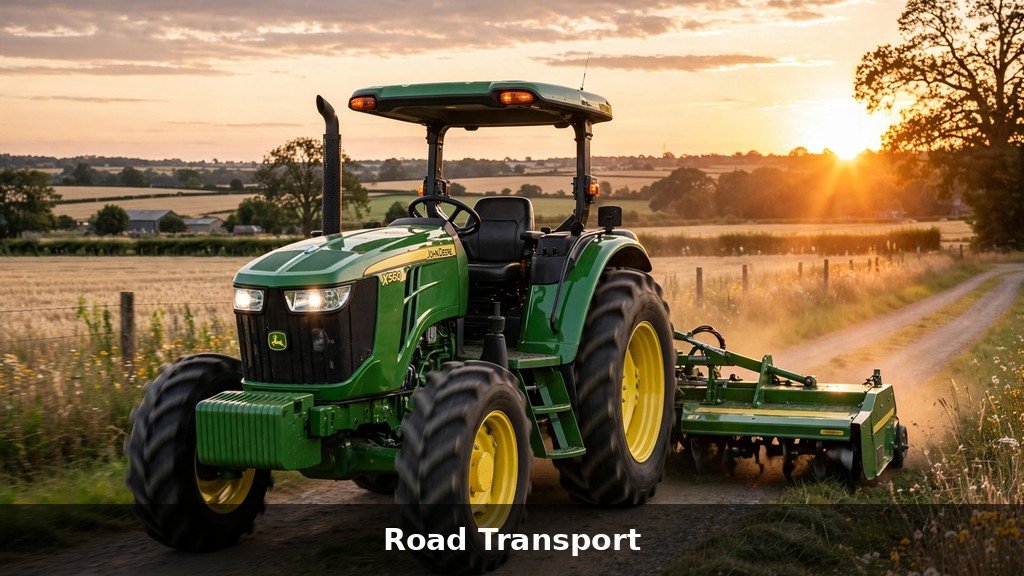
For hauling, the 40 km/h (25 mph) top speed on the PowrQuad Plus and AutoQuad Plus boxes, or the stepless AutoPowr IVT, makes road transport between fields efficient, and IPM’s extra 20 horsepower in transport applications helps on grades with a loaded trailer. The 12,522-pound base weight plus ballast gives the 6110M the traction that defines John Deere 6110M performance under load — loaded grain carts and manure spreaders that would push a lighter utility tractor around are comfortable work here. One limitation to note for John Deere 6110M performance: sustained draft work at the very top of the power band is where the 6120M and 6130M earn their premium — if your tillage is consistently heavy clay at depth, the extra displacement-per-dollar of the bigger 6Ms is worth pricing, as covered in our 5M Series performance comparison for the step-down perspective.
John Deere 6110M Handling, Comfort and Operating Limitations
Handling is where the 6M platform separates itself from lighter utility tractors. The steel bridge-frame chassis, 101.6-inch wheelbase, and 12,522-pound base weight give the 6110M a planted feel that owners consistently praise, and the optional Triple-Link Suspension (TLS) front axle adds ride comfort and traction on rough ground. John Deere 6110M performance in real farm conditions is as much about this stability as it is about horsepower.
Cab Comfort, Controls and Ease of Operation
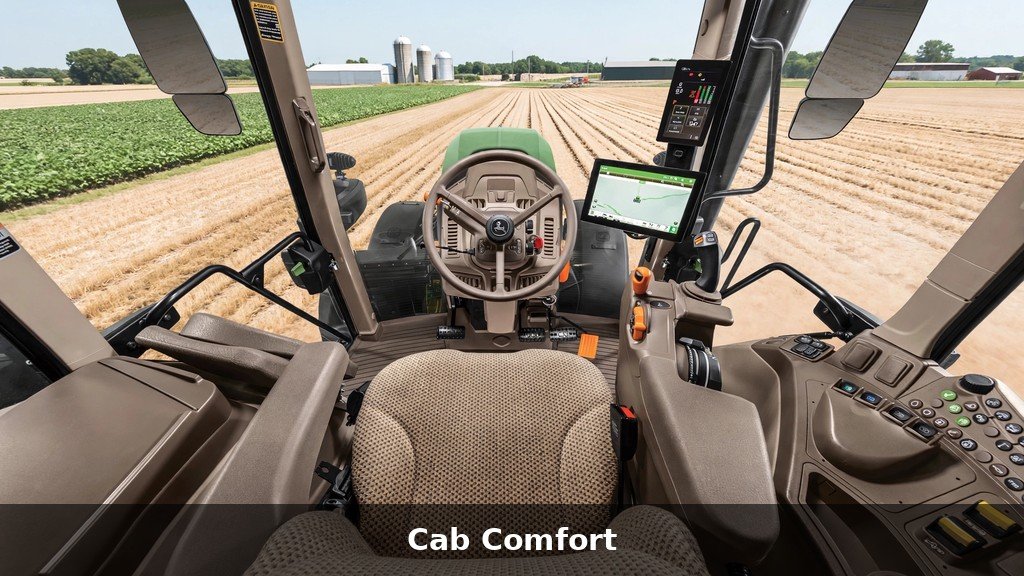
The ComfortView cab is a genuine strong point of John Deere 6110M performance from the operator’s seat, as this detailed 6110M overview also concludes. Three cab packages — Select, Select+, and Premium — scale from a well-equipped working cab to a 70-dBA premium environment with mechanical cab suspension, an air-ride seat, and the panoramic roof option that loader operators love for stacking bales high. The compact CommandARM console puts the key controls at the right hand, and the electronic left-hand reverser makes shuttle work between forward and reverse nearly effortless — a feature loader operators single out in nearly every review.
Controls are straightforward enough that new operators get productive quickly — an underrated part of John Deere 6110M performance on farms where the 6110M is the shared machine. The Gen 4 CommandCenter display (with AutoTrac guidance readiness and StarFire receiver options) brings precision-ag capability that used to require a row-crop tractor, and JDLink telematics lets owners watch hours, fuel, and diagnostic codes from a phone. For buyers comparing comfort across the class, our 5090M performance guide shows what the step down to the 5M gives up.
Traction, Stability, Terrain and Workload Limitations
Traction is a John Deere 6110M performance strength: MFWD with an electrohydraulic differential lock, 12,522 pounds of base weight before ballast, and up to 23,040 pounds of permissible gross weight mean the tractor can be ballasted to the job. On steep or soft ground, that weight is both asset and limitation. In very soft or wet conditions, a 12,500-pound tractor will leave its mark, and several owners note the 6110M is more machine than muddy spring fields want. Tire selection (row-crop versus flotation) matters more here than on lighter tractors.
Workload limitations are honest ones. The 84 PTO horsepower ceiling means a 15-foot batwing mower or a big square baler is asking too much — those belong to the 6130M and up. Continuous heavy draft at maximum power will push fuel use toward the 6 gph OECD ceiling, and the standard 21 gpm hydraulic pump can feel slow running large hydraulic motors; the 30 gpm PFC option exists for exactly that reason. None of this diminishes John Deere 6110M performance in its intended class — it simply defines the class, which is 100- to 300-acre mixed farms, serious hay operations, and daily loader work rather than broadacre tillage.
John Deere 6110M Real-World Owner Experience
Owner sentiment on the 6110M is consistently positive, with the tractor earning a reputation as the “do-everything” machine on mid-size operations. Reviewers and owners describe John Deere 6110M performance as dependable and predictable: it starts, it pulls, and the electronics stay out of the way. The no-DPF emissions setup draws specific praise from owners burned by regen issues on other brands — one less system to think about is a real ownership benefit.
Owner-Reported Benefits, Complaints and Trade-Offs
The John Deere 6110M performance benefits owners cite most: strong low-end torque that lugs through tough spots, excellent visibility from the cab, the easy left-hand reverser for loader work, and fuel economy that beats expectations for the weight class — a figure that surprises owners coming from older, thirstier machines. The CommandARM layout and the quiet 70-dBA cab get regular compliments from operators putting in 10-hour days. Reliability reports are strong, with many owners describing the EWL engine and Quad transmissions as proven combinations.
Complaints about John Deere 6110M performance are modest but real. The most common owner-reported gripes: slow hydraulic response with the standard 21 gpm pump on loader-intensive days (the 30 gpm option fixes it), occasional electrical niggles — sensor faults, display codes, and cluster calibration issues that usually trace to connectors or batteries rather than hard failures — and the price of admission, since a well-optioned 6110M competes with larger used tractors. A few owners note the sloping hood limits cooling-pack access compared with older Deeres, so radiator cleaning takes more patience. None of these are deal-breakers in owner forums; they read as the normal trade-offs of a modern, electronics-rich tractor. Our 6110M maintenance and reliability guide covers each of these in depth.
Choosing the Right Transmission and Tractor Setup
Transmission choice is the biggest setup decision affecting John Deere 6110M performance, and owners are vocal about matching the box to the work. The PowrQuad Plus (16/16 or 24/24) is the proven value pick — simple, proven, and efficient in experienced hands — and it suits farms where one operator runs the tractor daily. The AutoQuad Plus adds automatic shifting within ranges, which owners doing lots of PTO work appreciate. The CommandQuad Plus brings full automatic shifting with AutoClutch, a favorite for loader work where clutchless braking saves legs. The AutoPowr IVT is the premium choice: stepless speed control, the best fuel economy under varying loads, and the easiest learning curve for multiple operators — at the highest purchase price and with the most complexity underneath.
Beyond the gearbox, the setup advice for the best John Deere 6110M performance is consistent: order the 30 gpm PFC hydraulics if you run a loader daily, add the TLS front axle for ride and traction on rough ground, spec the panoramic roof if you stack bales, and ballast to the job rather than running maximum weight everywhere. For the purchase side of these decisions — new versus used (with current used listings ranging roughly $62,500 to $135,500), and what to inspect — see our 6110M ownership cost and buying guide.
Frequently Asked Questions About John Deere 6110M Performance
These are the questions buyers ask most about John Deere 6110M performance once they move past the brochure numbers — answered from Deere specs, test data, and documented owner experience.
How much fuel does the John Deere 6110M use per hour?
For John Deere 6110M performance planning, plan on 3.0 to 4.0 gallons per hour for a mixed farm day. Owner-reported ranges run 2.0–3.0 gph for light work, 3.0–4.5 for loader work, 3.5–5.0 for mowing and hay, and 4.5–6.0 for heavy draft or full PTO load. A documented long-term test logged about 2.8 gph over mixed work; the 6.3 gph OECD ceiling only applies at sustained full power.
Does the John Deere 6110M have a DPF?
No. The US Final Tier 4 6110M uses DOC and SCR aftertreatment with DEF and has no diesel particulate filter and no parked regeneration. (The EU Stage V version adds a DPF, and older Tier IV 6Ms used EGR-plus-DPF — so do not mix overseas specs or old forum advice with a current US machine.)
What is the PTO horsepower of the John Deere 6110M?
84 PTO horsepower at rated engine speed, with up to 109 PTO horsepower at 1,000 PTO rpm when Intelligent Power Management is active. That puts the 6110M squarely in 10-foot mower-conditioner and 4×5 round baler territory.
Which transmission is best on the John Deere 6110M?
For John Deere 6110M performance, it depends on the work. PowrQuad Plus is the proven value choice for experienced operators; AutoQuad Plus adds convenience for PTO work; CommandQuad Plus with AutoClutch suits loader-intensive days; and AutoPowr IVT delivers the best fuel economy and easiest operation at the highest price. For a shared farm tractor with multiple operators, owners most often recommend the IVT or CommandQuad.
How much can the John Deere 6110M lift with a loader?
With the 643R loader, roughly 3,832 to 3,874 pounds at the pivot with the standard linkage (4,736 to 4,826 pounds with mechanical self-leveling), to 163–169 inches of lift height, with about 6,200 pounds of breakout force. The rear hitch lifts 5,582 pounds sustained at 610 mm behind the pins — 7,431 pounds with the optional high-capacity cylinders.
Is the John Deere 6110M good for hay work?
Yes — hay is arguably the 6110M’s best application. The 84 PTO horsepower, 40 percent torque rise, and 51-gallon tank suit long days mowing, tedding, and baling; the cab options keep operators comfortable; and owners report some of the best fuel figures in this class during hay season. For operations running big square balers or 15-foot batwings, step up to the 6130M or larger.