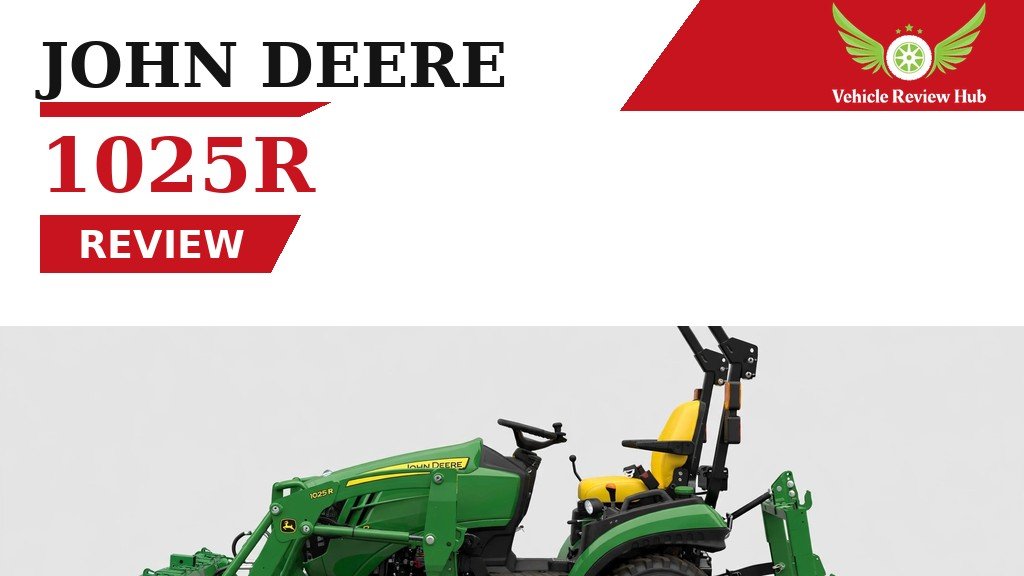
The John Deere 1025R review story starts with a simple fact: this is the best-selling sub-compact in Deere’s 1 Series — a 23.9-horsepower Yanmar diesel, a smooth two-range hydrostatic transmission, and a comfort package with cruise control, tilt steering, and a suspension seat the cheaper 1023E does not get. New 2026 models with a 120R front loader are advertised around $19,000 to $19,250, while used low-hour examples typically trade between about $14,000 and $19,000 depending on year, hours, and attachments.
This John Deere 1025R review covers everything a USA buyer needs: engine and PTO specifications, the 120R loader and 260B backhoe, AutoConnect mower decks, new and used pricing, and honest comparisons with the 1023E and Kubota’s BX series — all drawn from specs, dealer listings, and owner reports.
John Deere 1025R Review, Features and Price
The 1025R is the premium 1 Series model — the same sub-compact footprint as the 1023E, with more muscle and a longer standard-features list. This part of our John Deere 1025R review covers the features that justify the price jump and what buyers actually pay.
Key Features, Configurations and Intended Uses
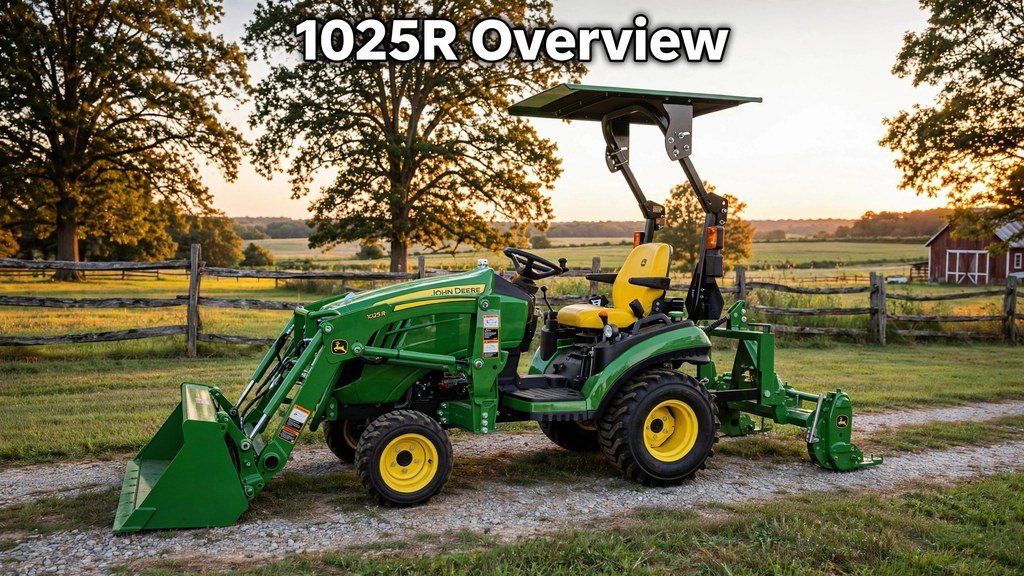
What separates the 1025R from its cheaper sibling is comfort and control. Standard equipment includes cruise control, a tilt steering wheel, a deluxe suspension seat with armrests, fender-mounted work lights, a toolbox, a floor mat, and position control on the three-point hitch — the features owners name as the reason they stepped up. The Twin Touch hydrostatic pedals, power steering, and tight turning radius make it approachable for first-time tractor owners, which is exactly who this John Deere 1025R review is written for.
Deere sells the 1025R as an open-station tractor, and cab-equipped examples also trade used for buyers needing year-round weather protection. The intended uses in this John Deere 1025R review are the classic one-to-five-acre list: mowing with a 54- or 60-inch AutoConnect deck, loader work, snow removal, driveway grading, and — with the 260B backhoe — trenching and stump removal. Owners on TractorByNet describe it as a machine that replaced both a lawn tractor and a shed full of rental equipment.
The video below gives an honest owner-style walkthrough of the 1025R — the good and the bad:
New and Used Prices by Model Year, Hours and Condition
New pricing in this John Deere 1025R review is straightforward. Deere’s standard list for the bare 1025R tractor sits around $17,800, and 2026 dealer inventory with the 120R loader is advertised at $19,013 to $19,250 at stores like TriGreen Equipment and Northland in this John Deere 1025R review’s pricing survey. Add a 60-inch deck or the 260B backhoe and the ticket climbs quickly — backhoe packages can push past $25,000. One Florida dealer listed a 1025R with loader at $24,941 MSRP with a $19,990 cash price — dealer discounting creates real room.
Used 1025R prices hold remarkably well. Recent dealer listings show a 2018 with 99 hours at $14,090, a 2018 with 337 hours and a 60-inch deck at $15,950, a 2020 with 450 hours at $16,990, and 2022 models with 200–700 hours between $18,572 and $18,999. As a rule of thumb for this John Deere 1025R review, expect roughly $12,000–$15,000 for higher-hour machines, $15,000–$19,000 for clean low-hour examples, and more for cab or backhoe tractors. Hours matter more than model year — a garage-kept 2017 with 150 hours will outsell a rough 2021 with 800. Our 1025R ownership cost guide breaks down what those purchase prices mean over five years of fuel, maintenance, and resale.
John Deere 1025R Engine, Horsepower and Specifications
The 1025R’s heart is a bigger Yanmar than the 1023E’s: more displacement, more PTO power, and the same simple Final Tier 4 setup with no diesel particulate filter. This section of the John Deere 1025R review gets into the numbers that matter when matching implements to the tractor.
Diesel Engine, Rated HP, PTO Power and Hydrostatic Transmission
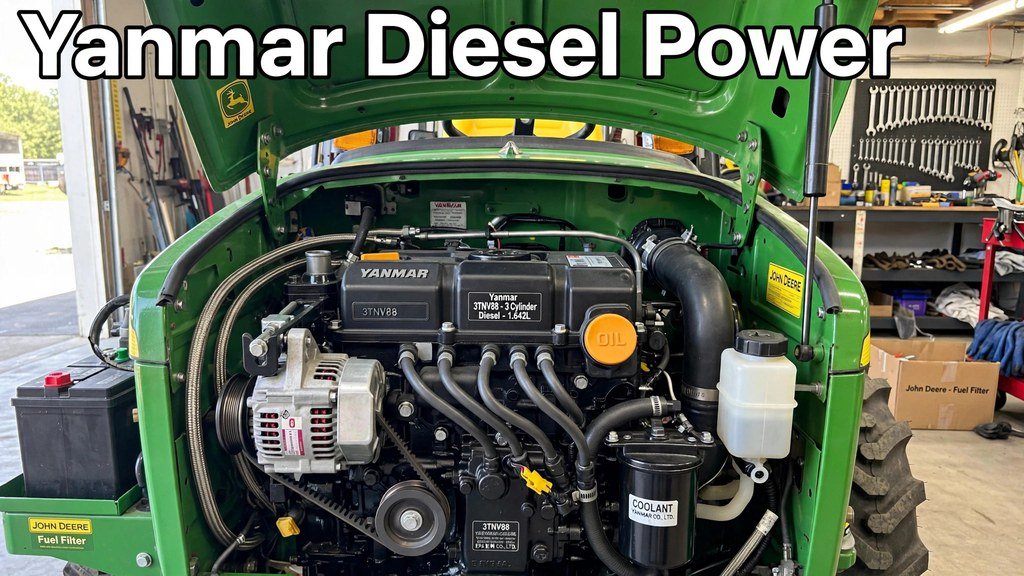
Under the hood is the Yanmar 3TNV80F-NCJT — a three-cylinder, 1.267-liter naturally aspirated diesel rated at 23.9 gross horsepower (24.2 PS) at 3,200 rpm. It meets Final Tier 4 emissions without a DPF or regeneration cycles, which owners cite as a reliability plus. Torque peaks around 39 to 41 lb-ft, giving the engine in this John Deere 1025R review strong lugging ability for a sub-compact.
PTO power is where the 1025R pulls away from the 1023E. Deere’s current spec lists 17.2 PTO horsepower (12.8 kW), while many dealer listings round it to 18 hp — either way, a meaningful step up from the 1023E’s 14.9 hp, enough for 5-foot rotary cutters, 50-inch tillers, and the 60-inch deck in normal conditions. Rear PTO is 540 rpm and mid PTO 2,100 rpm, both independently clutched.
The two-range hydrostatic transmission with Twin Touch pedals works like an automatic: pick a range, set the throttle, and press. MFWD is standard, a mechanical differential lock sits underfoot, and cruise control — standard on the R, absent on the E — makes long mowing passes far less tiring. Owners call the drivetrain the easiest part of the tractor to live with, and fuel burn stays modest: expect roughly a gallon per hour mowing, with the 6.3-gallon tank delivering five-plus hours per fill. Our 1025R performance and fuel usage guide has the full gallons-per-hour breakdown by task.
Dimensions, Weight, Fuel Capacity, Hydraulics and Lift Capacity
The 1025R’s dimensions explain the agility praised in this John Deere 1025R review: a 57.1-inch wheelbase, about 8.2 feet of turning radius, and shipping weight of 1,444 to 1,556 pounds depending on spec year. It fits through a standard garden gate and onto a 16-foot trailer, yet with wheel weights or a ballast box it stays planted during loader work.
Fuel capacity deserves a note in any John Deere 1025R review because sources differ: Deere’s current spec lists 24 liters (6.3 U.S. gallons), while older manuals and dealer spec sheets show 5.6 gallons. Either way, plan on a full working morning per tank. Hydraulics run an open-center system at 2,000 psi with 6.3 gpm total flow — 3.5 gpm to implements and 2.8 gpm to steering — adequate for the loader, backhoe, and implements in this class. The limited Category 1 hitch lifts 758 lb at 24 inches behind the link arms — enough for box blades, landscape rakes, and rear blades. The spec table below collects the key figures from this John Deere 1025R review in one place.
| Specification | John Deere 1025R |
|---|---|
| Engine | Yanmar 3TNV80F-NCJT, 3-cylinder diesel, 1.267 L |
| Gross power | 23.9 hp (24.2 PS) at 3,200 rpm |
| PTO power | 17.2 hp per Deere spec (dealers list ~18 hp) |
| Emissions | Final Tier 4, no DPF, no regeneration |
| Transmission | Two-range hydrostatic, Twin Touch pedals |
| Drive | MFWD standard, differential lock, cruise control |
| Fuel tank | 6.3 gal (24 L) current spec |
| Shipping weight | ~1,444–1,556 lb depending on spec year |
| Hydraulics | Open center, 6.3 gpm total, 2,000 psi |
| 3-point hitch | Limited Category 1, 758 lb lift at 24 in. |
| Wheelbase | 57.1 in., ~8.2 ft turning radius |
| Warranty | 6-year / 2,000-hour powertrain |
John Deere 1025R Attachments and Capabilities
Attachments are where the 1025R justifies its premium — the 120R loader, a factory backhoe option, and the position-control hitch that makes grading work precise. If you are buying the tractor as a system rather than just a mower, read this section of the John Deere 1025R review twice.
Front Loader, Backhoe and AutoConnect Mower Deck
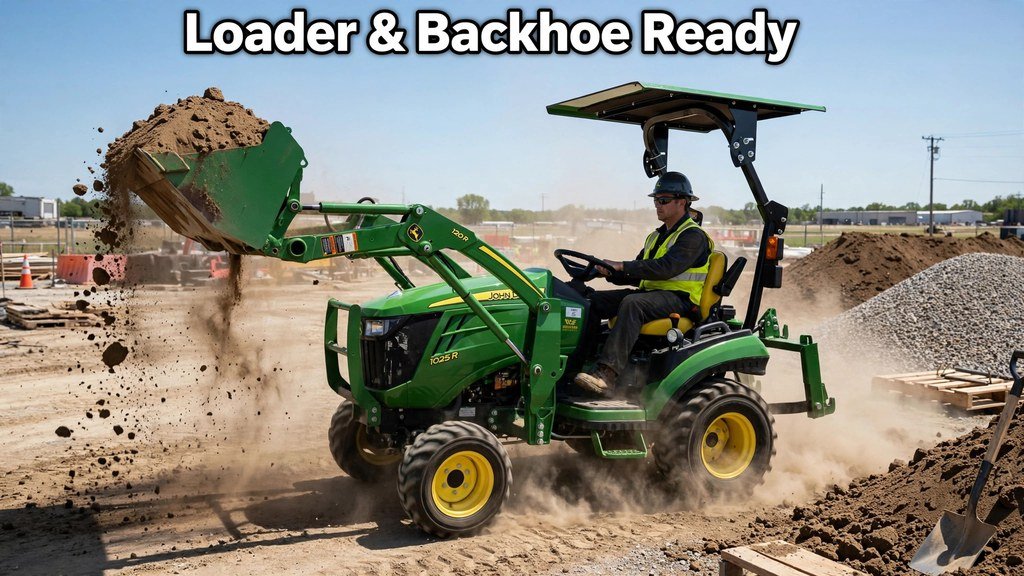
The 120R front-end loader is the signature attachment: Quik-Park mounting for tool-free removal, 553 lb of lift as standard and up to 726 lb with the mechanical self-leveling option, and enough height to load a pickup bed. Owners move soil, gravel, mulch, and firewood by the bucketful, and the hydrostatic transmission’s inching control makes grading and backfilling precise.
The 260B backhoe is the 1025R’s headline capability — roughly 6 feet 2.5 inches of digging depth, 150-degree swing, and a subframe mount that goes on and off without tools. One correction for this John Deere 1025R review: Deere’s own price pages list the 260B for both the 1023E and 1025R built after July 14, 2017 (around $6,398 on the published sheet), so it is not strictly R-exclusive — but the 1025R’s extra power and position-control hitch make it the better backhoe platform.
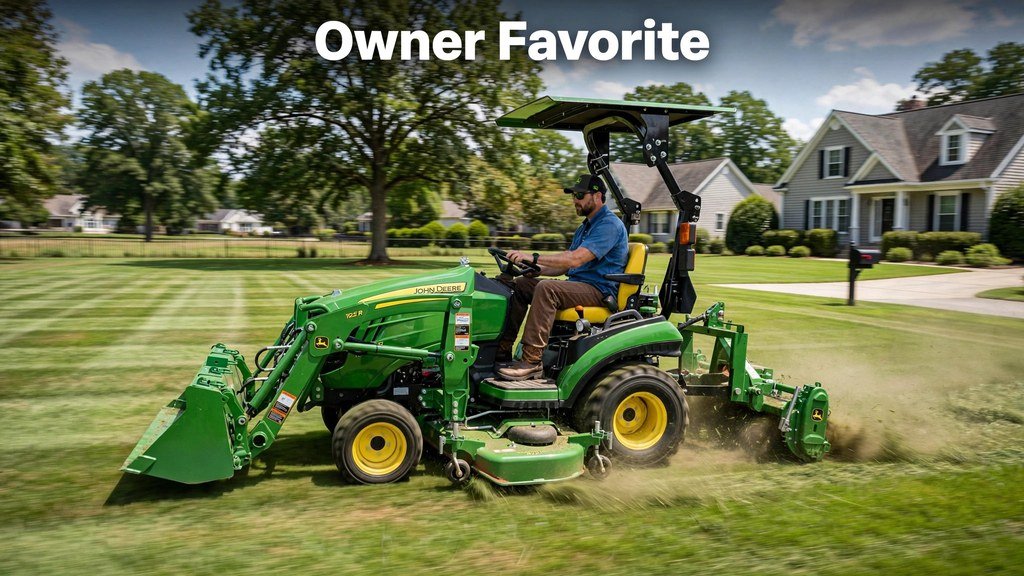
For mowing, the AutoConnect 54D and 60D drive-over decks attach in minutes without leaving the seat — the feature owners praise most in this John Deere 1025R review. The mid PTO’s 2,100 rpm keeps blade speed steady, and the 17.2-hp PTO handles the 60-inch deck in normal grass. An Everglades Equipment 1025R TLB package page shows how dealers bundle the tractor, loader, and backhoe for buyers who want the full digging setup.
Implement Compatibility and Work Limitations
Beyond Deere’s own attachments, the 1025R runs the standard sub-compact menu: 4- and 5-foot rotary cutters, 48- to 50-inch tillers, box blades, landscape rakes, rear blades, post-hole augers, pallet forks, and grapples via a third-function kit. The iMatch quick-hitch compatibility and the position-control rockshaft — standard on the R — make implement swaps and grading work noticeably easier than on the E, a practical edge this John Deere 1025R review highlights.
The limitations are honest sub-compact physics. Ground clearance under 8 inches means rocky or deeply rutted ground needs care; the light weight that protects lawns also demands rear ballast for serious loader work; and continuous commercial-scale brush hogging belongs to a bigger frame. None of this surprises owners. And as with any working tractor, neglected service is what sidelines machines: our 1025R maintenance and reliability guide covers the schedule that keeps the hydraulics and drivetrain healthy.
John Deere 1025R vs. 1023E and Kubota BX
No 1 Series purchase happens in a vacuum. The 1025R’s natural rivals are its cheaper sibling and Kubota’s BX line, and the price gaps are big enough to matter. This final comparison in our John Deere 1025R review lays out exactly what the extra money buys.
Differences in Power, Features and Capabilities
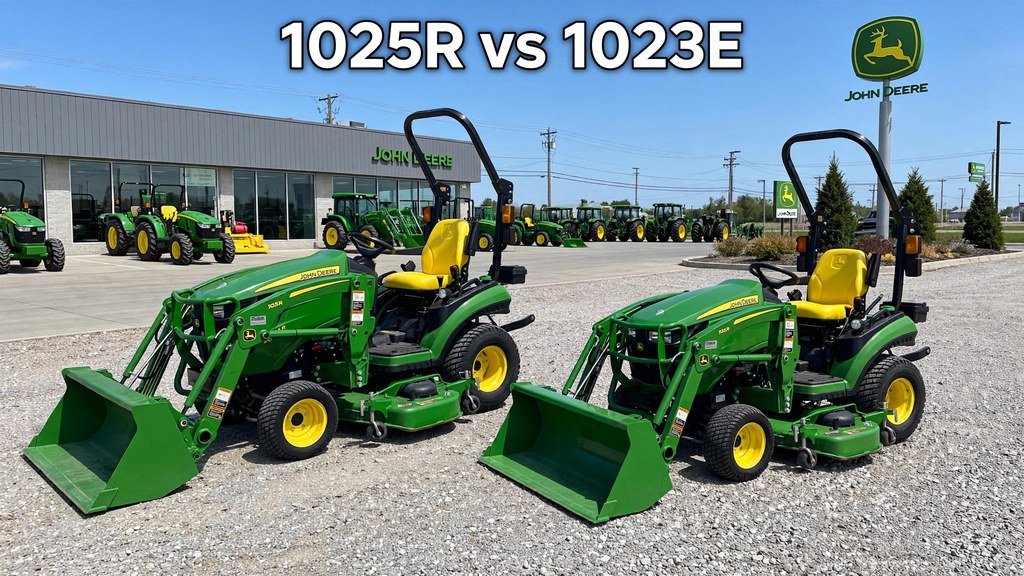
Against the John Deere 1023E, the 1025R brings a larger Yanmar (23.9 vs 21.5 gross hp), more PTO power (17.2 vs 14.9 hp), and the comfort list: cruise control, tilt steering, suspension seat with armrests, work lights, toolbox, floor mat, and position-control hitch. In real work, dealers who have run both say the felt power difference is smaller than the numbers suggest. Where the R wins is the operator experience on long days, plus features like cruise control that matter for big mowing jobs. A Good Works Tractors comparison of the two siblings reaches the same conclusion: the roughly $2,000 premium buys convenience, not muscle.
Fuel use between the two is nearly identical at around a gallon per hour mowing — a finding this John Deere 1025R review shares with owner forums — so economy should not drive the decision; see our 1023E performance and fuel usage guide for the detailed numbers. Against the Kubota BX series (BX1880, BX2380, BX23S), the contest is closer: similar size and capability, with the choice usually coming down to dealer support, ergonomics, and price. Kubota’s BX23S counters with its own factory backhoe, while the 1025R answers with the AutoConnect deck system and Deere’s parts network. Owner reviews on TractorByNet’s 1025R review section show the same pattern this John Deere 1025R review found: happy owners on both sides, with dealer experience tipping the scales.
Which Sub-Compact Tractor Offers Better Value?
Value in this John Deere 1025R review depends on the buyer. For pure work-per-dollar on one to five acres, the 1023E is arguably the stronger buy — same frame, nearly the same real-world capability, roughly $2,000 less. For operators who mow for hours, want cruise control and a better seat, or simply prefer the premium feel, the 1025R earns its premium many times over. Our 1023E ownership cost guide versus the 1025R numbers show the R costs more up front but holds value nearly as well, so the five-year gap narrows.
Against Kubota, value is a wash on paper — price both with the attachments you need, sit on both, and weigh which dealer answers the phone when something breaks. For most USA buyers cross-shopping these three, this John Deere 1025R review lands here: buy the 1023E if budget rules, buy the 1025R if comfort and features matter, and buy the BX only if your local Kubota dealer beats Deere on price and support.
Frequently Asked Questions About the John Deere 1025R
Straight answers to the questions USA buyers ask most about the 1025R, drawn from published specs, dealer listings, and documented owner experience in this John Deere 1025R review.
How much does a new John Deere 1025R cost?
The bare tractor lists around $17,800; 2026 dealer inventory with the 120R loader is advertised at $19,013 to $19,250. A mower deck or the 260B backhoe pushes the price higher — a full tractor-loader-backhoe package can pass $25,000. Dealer discounts are common, so the advertised cash price is often well below MSRP. This John Deere 1025R review found that shopping two or three dealers typically saves over a thousand dollars on identically equipped machines.
What is the PTO horsepower of the 1025R?
Deere’s current specification lists 17.2 PTO horsepower (12.8 kW), though many dealer listings round it to 18 hp. Either figure is a solid step up from the 1023E’s 14.9 hp and is enough for 5-foot rotary cutters, 50-inch tillers, post-hole augers, and the 60-inch AutoConnect mower deck. The rear PTO runs at 540 rpm and the mid PTO at 2,100 rpm.
Can the John Deere 1025R run a backhoe?
Yes — the 260B backhoe is the factory option, with about 6 feet 2.5 inches of digging depth and a 150-degree swing. Deere lists it for 1023E and 1025R tractors built after July 14, 2017 (the published list price is around $6,398), and the tractor must have a front loader plus the Power Beyond hydraulic kit. The 1025R’s extra power and position-control hitch make it the better backhoe platform of the two, which is why most backhoe buyers choose the R.
How big is the fuel tank, and how long does it last?
Deere’s current spec lists a 6.3-gallon (24-liter) tank, though older manuals show 5.6 gallons. At the typical mowing burn of roughly a gallon per hour, owners report five-plus hours of seat time per fill, enough for a full working morning. Idling and light work stretch that further, while heavy loader or PTO work shortens it.
Should I buy the 1025R or the 1023E?
Buy the 1023E if budget is the priority — same frame, nearly the same real-world capability, about $2,000 less. Buy the 1025R if you value cruise control, tilt steering, the suspension seat, work lights, and the position-control hitch, or if you plan to add the backhoe. Fuel use and reliability are near-identical between the two, so the decision comes down to features and comfort rather than capability. This John Deere 1025R review’s bottom line: the R is worth it for long days in the seat.
Is the John Deere 1025R reliable?
Yes — the 1025R has one of the strongest reliability records in the sub-compact class, a simple Yanmar diesel with no DPF, backed by Deere’s 6-year/2,000-hour powertrain warranty. Owner-reported issues are mostly minor: safety-switch no-crank complaints, cold hydraulic sluggishness, and wear items like belts and batteries. One item to verify on any used 2017–2024 machine: the September 2024 CPSC brake-linkage recall covered the 1025R alongside the 1023E and 2025R, with free dealer repairs — check the serial number in Deere’s recall lookup before buying used. That warranty backing is a big reason this John Deere 1025R review rates its long-term prospects highly.