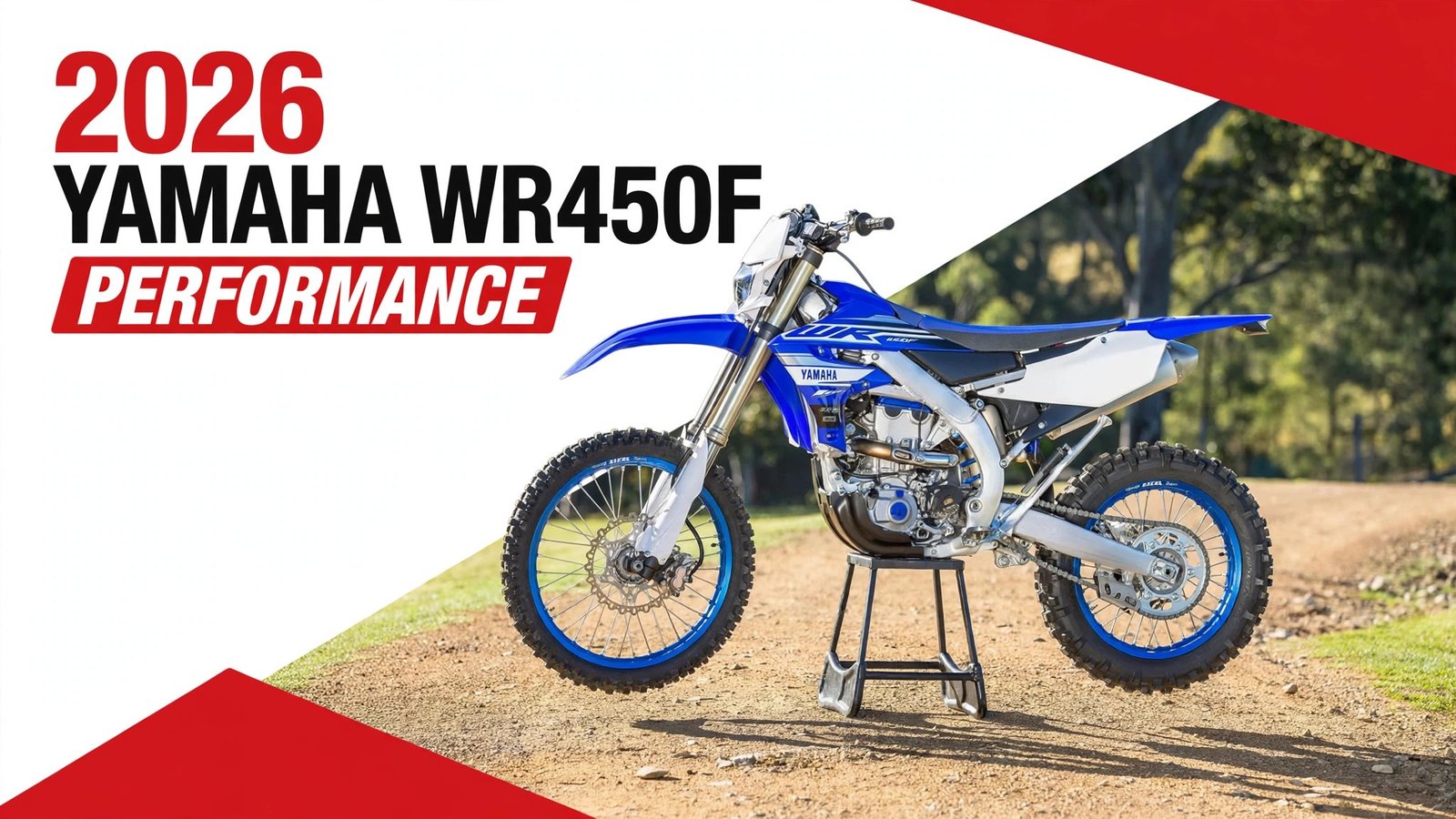
Yamaha WR450F performance is the reason this 450cc enduro bike has such a loyal following: a YZ450F-derived engine retuned for the trail, a wide-ratio five-speed gearbox that covers tight trees and open desert, and a chassis light enough to change direction all day. The point of Yamaha WR450F performance is usable speed off-road — strong midrange torque, a gearbox that rarely leaves you hunting for the right ratio, and suspension that stays composed on rough trails.
This guide to Yamaha WR450F performance separates tested figures from estimates. Dyno numbers come from Dirt Rider’s named 2021 test, specifications come from Yamaha and period spec sheets, and top-speed and range figures are labelled wherever no instrumented test exists. The full WR450F review covers the model-year history behind these numbers.
Yamaha WR450F Engine Performance and Power Delivery
The heart of Yamaha WR450F performance is a liquid-cooled, DOHC, four-valve single-cylinder displacing 449cc, with a 97.0 x 60.8 mm bore and stroke and a 13.0:1 compression ratio. It breathes through a Mikuni 44 mm throttle body, with the reversed cylinder-head layout Yamaha pioneered on the YZ450F — the foundation of Yamaha WR450F performance. Yamaha WR450F performance is tuned for enduro rather than motocross: different ECU mapping, a spark-arrestor muffler and softer suspension trade a little peak output for tractability.
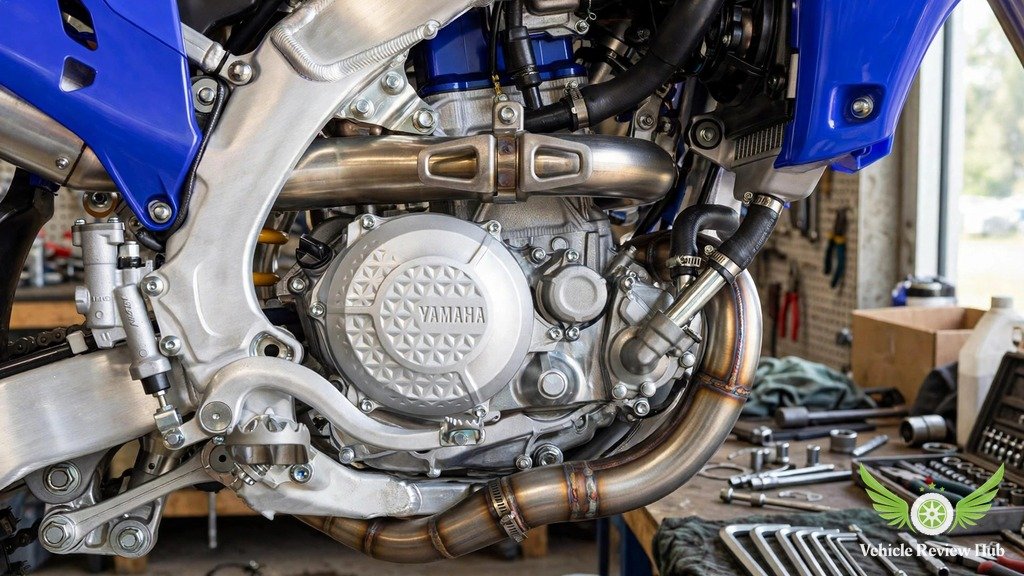
Dirt Rider Dyno 48.9 HP at 9,000 RPM for the 2021 Model Explained
The most quoted number in Yamaha WR450F performance comes from Dirt Rider’s 2021 test: on the magazine’s in-house dyno, the WR450F made 48.9 hp at 9,000 rpm and 31.8 lb-ft of torque at 7,200 rpm. That is deliberately less than the YZ450F motocrosser makes, and testers counted that as a virtue — with less peak power, a rider can be heavier-handed on the throttle in the low to mid range without losing traction.
The 2021 bike shared its new cylinder head, camshafts, piston and connecting rod with the YZ450F, but ran dedicated enduro ECU tuning, a spark-arrestor muffler and softer KYB settings, and Dirt Rider measured it at 264 pounds wet. Treating Yamaha WR450F performance as “about 49 rear-wheel horsepower, measured” is accurate; treating it as a Yamaha-claimed figure is not, because Yamaha publishes no horsepower figure at all.
| Test source | Rear-wheel horsepower | Rear-wheel torque |
|---|---|---|
| Dirt Rider, 2021 WR450F | 48.9 hp @ 9,000 rpm | 31.8 lb-ft @ 7,200 rpm |
The 2024 redesign complicates the dyno picture. The 2024 engine gained larger 39 mm intake valves, a new piston, connecting rod and bearings, revised crank inertia and a dry-sump layout. Motorcycle News, testing the 2024 bike, estimated around 45 bhp. No independent dyno figure for the 2024-on engine has been published by the major US outlets, so the 48.9 hp figure remains the tested anchor — for the 2021 generation.
Five-Speed Wide-Ratio Gearbox, Hydraulic Clutch and Power Delivery
Yamaha WR450F performance leans heavily on its five-speed wide-ratio gearbox. Dirt Rider’s testers laid out the gears plainly: first for tighter wooded trails, second for starting and stopping, third for faster single-track, and fourth and fifth for wide-open sections. Dirt Bike Test put the spread at roughly 30 percent wider than the motocross gearbox. The 2024 gearbox kept five wide ratios but stacked them vertically in a tri-shaft layout borrowed from the YZ450F — a packaging win for Yamaha WR450F performance.
The clutch story needs a year split, because the heading promises a hydraulic clutch that most WR450Fs do not have. Through the 2026 model, the WR450F uses a cable-operated wet multiplate clutch — confirmed by tests of the 2024 and 2026 bikes, the latter calling it one of the last cable clutches left in the 450 class. Yamaha sells a GYTR hydraulic clutch kit (Brembo master cylinder and lever, braided line, $299.99) for the 2024–2025 WR450F. A hydraulic clutch becomes standard only with the 2027 model.
Electronics shape Yamaha WR450F performance more with each generation. The 2021 bike’s ECU was locked in stock trim, so it would not talk to Yamaha’s Power Tuner app without GYTR parts. The 2024 bike changed that, with three traction-control settings — High, Low or Off — and the 2026 bike keeps that system, adjustable only through the app, with two maps selectable from the handlebar switch.
Yamaha WR450F Top Speed and Acceleration
Top speed is where Yamaha WR450F performance reporting gets sloppy online, so this section keeps every figure labelled: no verified, instrumented top-speed test of a stock WR450F exists from a major outlet.
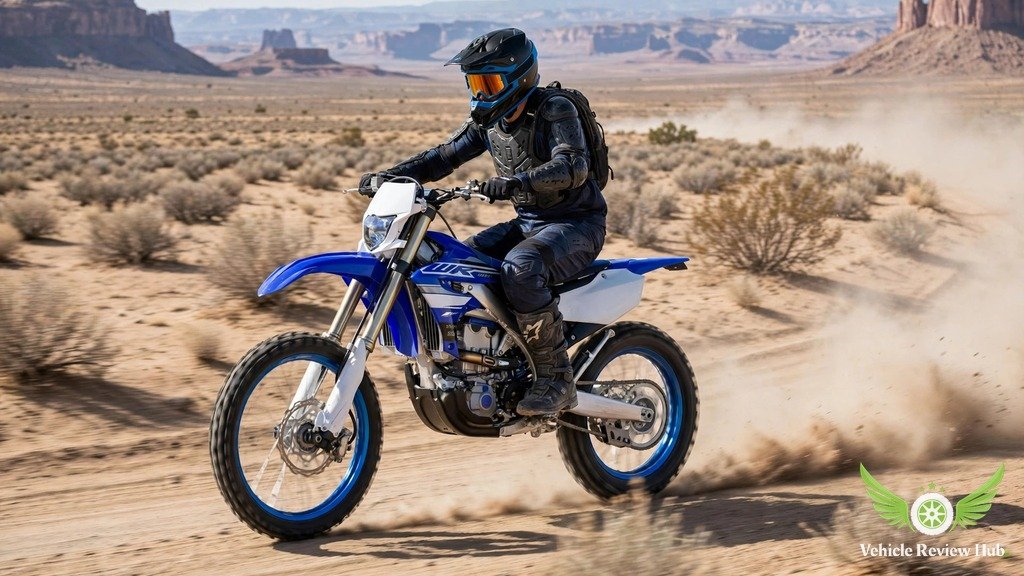
Why No Official or Controlled-Test Top Speed Exists for the WR450F
Yamaha publishes no top-speed figure, and the testers who know the bike best have not measured one either. Australian Motorcycle News, testing the 2024 WR450F, lists top speed bluntly as “not measured” — and fuel consumption the same way. That is the correct answer for Yamaha WR450F performance: any article quoting an exact stock top speed is dressing up a guess. Dirt Bike Test, riding the 2016 bike, wrote that fifth gear “pulls into the 90’s for sure” and that the bike had about the same top speed as the YZ450FX, around 95 mph. Riding the 2019 bike, the same outlet saw close to 80 mph and guessed the high 90s.
Putting those observations together gives the honest band for Yamaha WR450F performance: a stock bike should reach the mid-to-high 90 mph range on open ground, depending on gearing, tires and rider weight.
Gearing 13/50 Then 13/51: How Sprockets Change Claimed Top Speeds
Gearing is why two owners can report very different top speeds for the same model. The stock final drive through the 2026 model is 13 teeth on the countershaft and 50 on the rear wheel — the 13/50 combination in the 2024 specifications. A taller ratio raises speed in each gear and lifts top speed, at the cost of duller low-end pull and more clutch work in technical terrain. A shorter ratio does the opposite — livelier Yamaha WR450F performance out of corners, lower top speed.
For 2027, Yamaha changed the rear sprocket from 50 teeth to 51, because the T51 improves low-speed control and reduces stalls. That is a small change with a clear direction — Yamaha spent the 2027 rework making the 450 easier to ride slowly, not faster at the top end. When comparing Yamaha WR450F performance figures, always ask whether the bike was stock-geared.
Yamaha WR450F Mileage and Fuel Economy
Fuel economy is the most practical chapter of Yamaha WR450F performance for trail riders, because it decides how far apart fuel stops fall — and whether a loop is even possible on one tank.
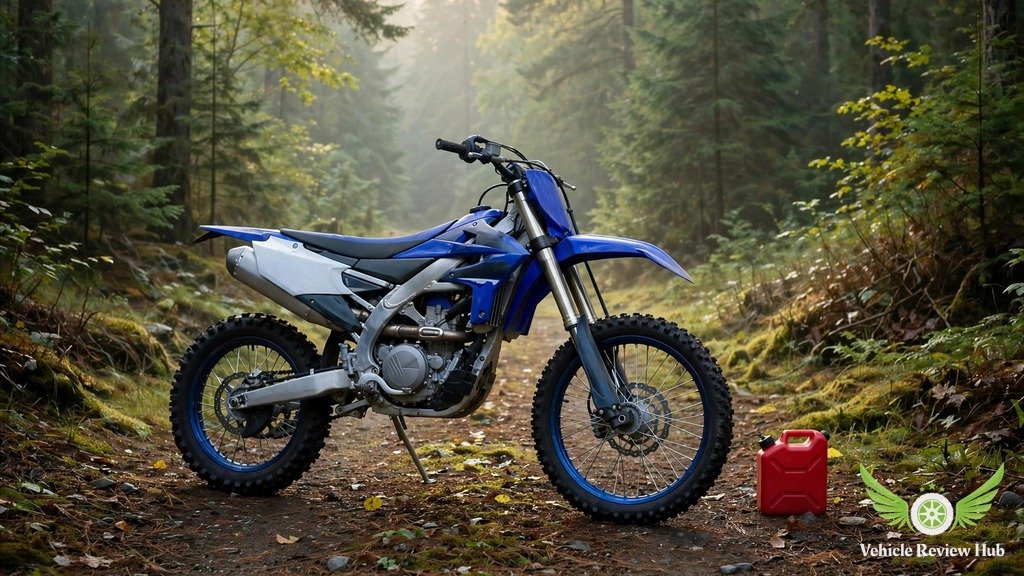
Yamaha Publishes No MPG Figure: 2.0-Gallon Tank and Trail Range Instead
Yamaha lists no fuel-economy figure for the WR450F, so Yamaha WR450F performance has to be judged on tank size and range. Tank size varies by generation: the 2021 bike carried about a 2.2-gallon tank (2.15 gallons on some spec sheets), while the 2024 redesign trimmed it to 2.0 gallons in the USA (7.4 litres in Australia), a roughly 0.2-gallon cut made for slimmer bodywork. The 2026 bike keeps the same 7.4-litre tank. The 2024 WR450F first look confirms the 2.0-gallon US figure.
| Generation | Tank size | Tested range observation |
|---|---|---|
| 2024-on WR450F (AU test) | 2.0 gal / 7.4 L | 80–90 km (50–56 miles) measured in testing |
| Planning estimate, all years | 2.0–2.2 gal | Roughly 50–60 trail miles per tank |
Australian Test Around 50 to 56 Miles Per Tank as Indicative Context
The best measured range figure for Yamaha WR450F performance comes from Australia, and it must be labelled as what it is: an Australian test of an Australian-spec bike, useful as indicative context, not a US tested figure. MCNews, testing the 2024 WR450F in New South Wales, calculated an 80–90 km fuel range from the 7.4-litre tank — 50 to 56 miles per tank. That matches the older US observation: Dirt Bike Test, riding the 2016 bike in the desert, reported a safe 50 miles out of a tank.
Yamaha WR450F Real-World Riding Performance
On the trail, Yamaha WR450F performance feels less like a small bike working hard and more like a full-size racer tuned for control. The engine’s broad, torque-rich delivery, the wide-ratio gearbox and the soft-but-controlled KYB suspension combine into a bike testers call fun rather than intimidating — the essence of Yamaha WR450F performance.
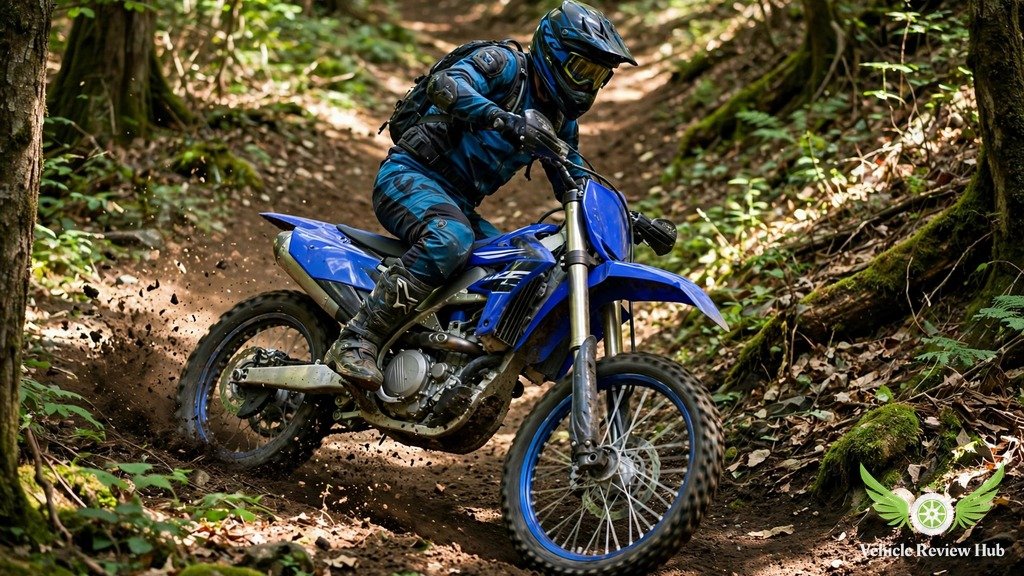
Single-Track, Woods Riding and Everyday Trail Acceleration
Single-track is where Yamaha WR450F performance earns its reputation — and where it also asks the most of its rider. The wide-ratio gearbox means first gear covers crawling speeds without constant clutch slipping, while the engine’s clean low-end pull lets the bike tractor over roots and rocks without stalling. The 2024 redesign sharpened exactly this side of the bike: both suspension ends sit 10 mm lower, the bodywork is slimmer, the seat is flatter and the pegs are lower. Testers of the 2026 bike noted the same trait from the other direction — the big 450 motor wants to keep rolling, so a higher gear makes tight turns easier than fighting the bike in first gear.
Everyday trail acceleration is the WR450F’s party piece for Yamaha WR450F performance. Third gear became the favourite gear of testers on flowing trails: the engine pulls from low revs to high without a hole in the middle, and the traction-control settings on 2024-on bikes let a rider dial the hit back on slick roots.
Open Desert, Hill Climbs and Long-Distance Limitations
Open desert and hill climbs expose the honest limits of Yamaha WR450F performance — and they are narrower than the bike’s reputation suggests. In fast, open terrain the 450 comes into its own: flowing fire roads, steep loose hill climbs on torque, and fifth gear pulling deep into the 90s where there is room to run. For Yamaha WR450F performance, the bike is outstanding inside its envelope — woods, single-track, enduro loops and desert racing — and merely adequate outside it. Long-distance adventure is the weak point: at roughly 50 to 60 miles per tank, a desert crossing needs fuel planning or a bigger tank, and the bike has no wind protection, no luggage provision and a firm, slim seat built for standing, not sitting.
The video below shows a WR450F out on a solo hard-enduro day — single-track and technical climbs. It is an owner’s ride video, not a studio test, but it shows Yamaha WR450F performance in the real world: the traction, the stalling risk, and the work of muscling a 450 through the tight stuff.
Riders whose weekends are mostly open desert or long-distance adventure should weigh that range limit, and used prices make the practical case in the WR450F buying guide. The hour-based service pattern matters for Yamaha WR450F performance too, because a 450 ridden hard needs its oil changed on race intervals, not road-bike intervals.
Yamaha WR450F Handling, Braking and Stability
Handling is the surprise chapter of Yamaha WR450F performance for riders coming from bigger bikes. The WR carries its weight low, steers quickly without feeling nervous, and uses suspension derived from Yamaha’s motocross program, retuned softer for enduro — a combination that flatters Yamaha WR450F performance on rough trails.
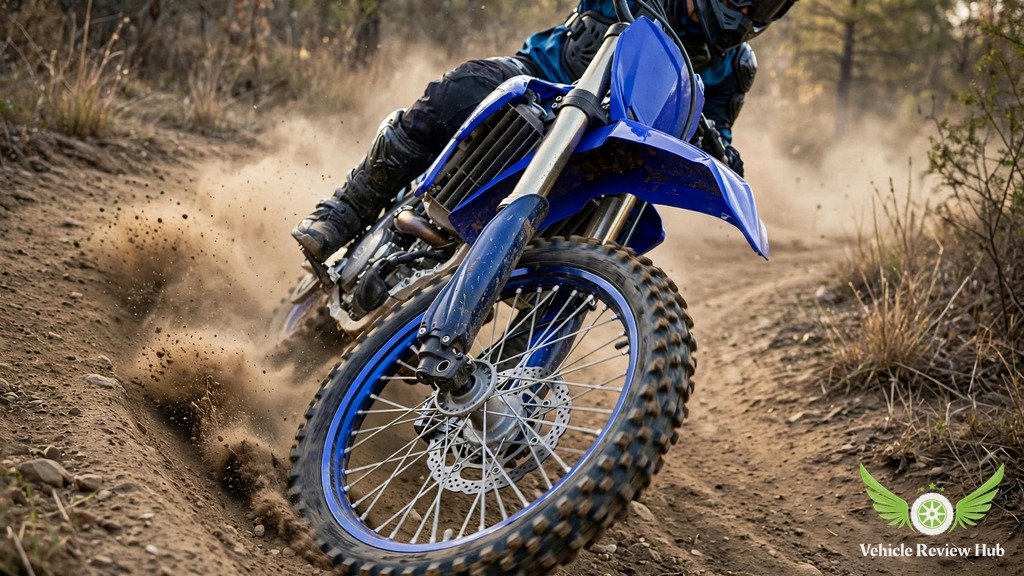
KYB Fork and Hand-Adjustable Shock, Chassis and Dunlop AT82 Tires
Yamaha WR450F performance starts at the KYB Speed-Sensitive System coil-spring fork and KYB single shock, fully adjustable. The 2024 redesign lowered both ends by 10 mm, fitted a tool-free compression clicker on top of the forks, and gave the shock enduro-specific damping; travel is 300 mm at the fork and 306 mm at the shock. The 2027 bike keeps the 48 mm fork with revised settings and adds a new KYB rear shock with a hand-adjustable low-speed compression clicker and a new piston.
Tires follow the same year-split honesty as the rest of Yamaha WR450F performance. The US-spec 2024 bike ships on Dunlop Geomax MX33F front and MX33 rear rubber, while Australian bikes ship on Dunlop Geomax EN91F and EN91 enduro tires — same sizes in spirit (90/90-21 front, 140/80-18 rear in Australia) but different compounds. The Dunlop Geomax AT82, the cross-country tire in this section’s heading, is not the stock fitment on either bike: it is the popular replacement choice for mixed terrain, with Progressive Cornering Block Technology and a bi-directional rear tread.
270mm Front and 220mm Rear Discs and Off-Road Braking Features
Braking on the WR450F is a 270 mm front disc with a Nissin two-piston caliper and a single-piston rear caliper — the headline figures for Yamaha WR450F performance in this section. The year split matters again: through the 2026 model, the rear disc is 240 mm. For 2027, Yamaha shrank the rear disc to 220 mm, with a smaller master cylinder, smaller piston diameter, revised caliper and hose and new pad material — changes that save about 180 grams (roughly six ounces) and, Yamaha says, improve rear brake control. For Yamaha WR450F performance, the 2027 change is a control upgrade, not a cost cut: a smaller rear brake is easier to modulate on steep descents.
Yamaha WR450F Performance Compared With Other Enduro Bikes
Yamaha WR450F performance sits in the middle of the 450 enduro class on paper and near the top on versatility. Its rivals are sharper in places, but none matches the WR’s combination of wide-ratio gearbox, trail equipment and tuning.
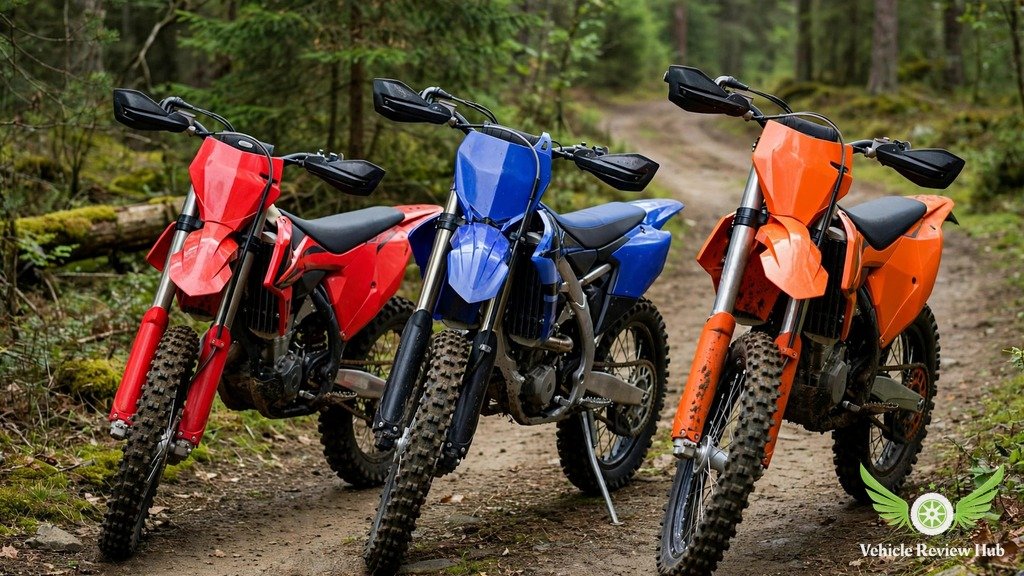
Yamaha WR450F vs Honda CRF450RX and KTM 450 XCF-W
Against the 2026 Honda CRF450RX ($9,999 plus $600 destination), Yamaha WR450F performance trades a little sharpness for breadth. The Honda is lighter at 256 lb curb weight with a five-speed close-ratio gearbox, a 2.1-gallon tank and a 37.7-inch seat, and it runs a 13.5:1 Unicam single — a closed-course cross-country racer with off-road upgrades, but no headlight, meter, fan or kickstand. The WR, at $10,299 for 2026, carries all of those, plus a wide-ratio gearbox and a fan. The reworked 2027 WR450F costs $10,499 and adds the hydraulic clutch and lighter rear brake.
The KTM 450 XCF-W is the other direction: the 2026 bike lists at $12,499, roughly $2,200 more than the WR, and answers with a six-speed gearbox, WP XACT closed-cartridge fork and PDS shock, and a 449.9cc engine. For Yamaha WR450F performance, the KTM wins on gearbox breadth and outright race spec, and loses on price and on the Yamaha’s dealer network and parts depth. The 2024 WR450F test reached the same verdict.
| Model (2026) | Price | Weight | Gearbox / tank | |
|---|---|---|---|---|
| Yamaha WR450F | $10,299 | $10,299 | 258 lb wet (2024) | 5-speed wide-ratio / 2.0 gal |
| Honda CRF450RX | $9,999 + $600 dest | 256 lb curb | 5-speed close-ratio / 2.1 gal | |
| KTM 450 XCF-W | $12,499 | About 237 lb (dealer-listed) | 6-speed / 2.25 gal |
Is the Yamaha WR450F Suitable for Expert Riders and Enduro Racing?
Yamaha WR450F performance suits expert riders and enduro racing first, and everyone else second. For racing, the answer is straightforward: the WR is built for enduro, hare scrambles and GNCC-style competition, and its wide-ratio gearbox, fan, lights and meter are the equipment those races demand. Testers of the 2026 bike put it bluntly: most riders would be quicker and less exhausted on a 250. The bike rewards experts who can use 450 torque without fighting it, and punishes novices with stalling in technical sections, a 37.6-inch seat and a throttle that demands respect.
Yamaha WR450F Performance: Frequently Asked Questions
These questions cover the numbers riders actually ask about Yamaha WR450F performance.
How much horsepower does the Yamaha WR450F make?
Yamaha publishes no horsepower figure. Dirt Rider’s 2021 test measured 48.9 hp at 9,000 rpm and 31.8 lb-ft at 7,200 rpm, so a realistic Yamaha WR450F performance figure is about 49 rear-wheel horsepower, measured — not a factory claim. The 2024-on engine has no published independent dyno figure.
What is the top speed of the Yamaha WR450F?
There is no verified instrumented stock top-speed test for Yamaha WR450F performance. The honest estimate band for Yamaha WR450F performance is the mid-to-high 90 mph range: Dirt Bike Test put the 2016 bike at about 95 mph, and Australian Motorcycle News lists the 2024 bike’s top speed as not measured. Stock gearing is 13/50 through 2026, 13/51 for 2027.
What MPG does the Yamaha WR450F get?
Yamaha publishes no MPG figure. The best measured range data for Yamaha WR450F performance is 50 to 56 miles per tank from an Australian test of the 2024 bike (80–90 km from its 7.4-litre tank), plus a 50-mile desert observation from Dirt Bike Test’s 2016 test. Plan fuel stops from tank size and that range.
How far can the Yamaha WR450F go on a tank?
Plan on roughly 50 to 60 trail miles per tank for Yamaha WR450F performance: about 50 miles at the tested floor on the 2.0-gallon 2024-on tank, more on gentle fire roads, less on hard single-track.
Does the Yamaha WR450F have a five-speed gearbox?
Yes, a wide-ratio five-speed on every recent generation — a key part of Yamaha WR450F performance, giving a low first gear for technical trails and a tall fifth for open sections. The KTM 450 XCF-W uses a six-speed. Dirt Rider’s testers wished for a sixth gear, like the WR250F has.
Does the Yamaha WR450F have a hydraulic clutch?
Only from 2027, when Yamaha made a hydraulic clutch standard. Pre-2027 WR450F models use a cable-operated wet multiplate clutch, so do not expect a hydraulic clutch on an older used bike — though Yamaha’s GYTR hydraulic kit ($299.99) fits the 2024–2025 models as an option, and it is a popular Yamaha WR450F performance upgrade.
Is the Yamaha WR450F good for beginner trail riders?
It suits experts and progressing riders far more than beginners: the 37.6-inch seat is tall, the 450 engine demands respect in technical terrain, and most riders would be quicker and less tired on a 250. Yamaha WR450F performance rewards experience; the 2027 rework narrows that gap.