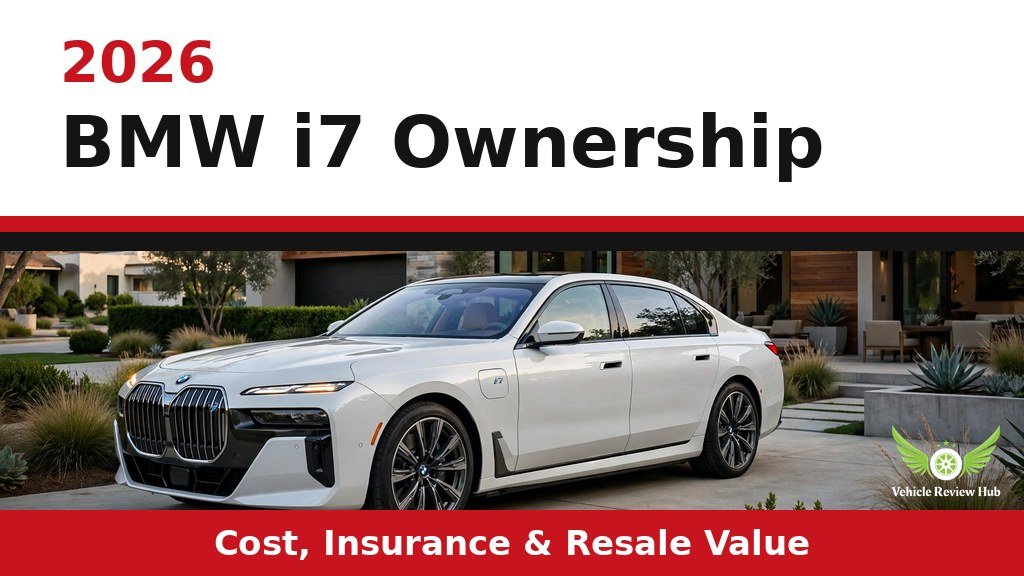
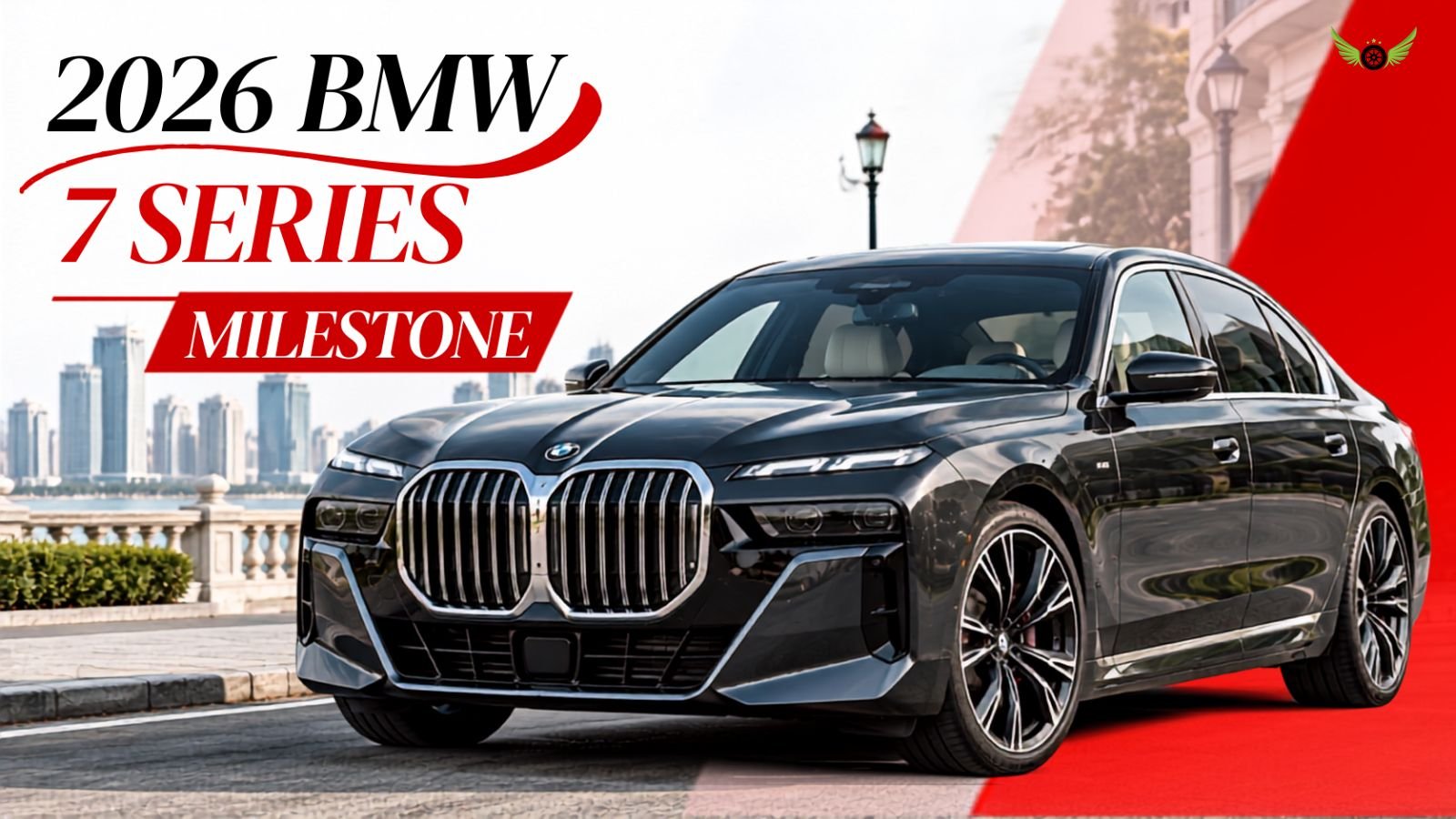
The 2026 BMW 7 Series is a full-size luxury sedan that balances fuel efficiency, strong acceleration, and long-distance comfort across three main powertrains: the 740i, 750e xDrive plug-in hybrid, and 760i xDrive. For U.S. buyers, EPA ratings put the 740i at up to 28 mpg combined, while the 750e xDrive is rated at 24 mpg combined and the V8-powered 760i xDrive at 20 mpg combined.
Performance varies sharply by model. The 740i uses a 375-hp turbocharged 3.0-liter inline-six, the 750e xDrive combines the same basic engine with an electric motor for 483 hp, and the 760i xDrive uses a 536-hp twin-turbo 4.4-liter V8. BMW lists 0–60 mph times of 4.9 seconds for the 740i xDrive, 4.6 seconds for the 750e xDrive, and 4.1 seconds for the 760i xDrive.
According to our experience, the most important difference is how each powertrain delivers its capability. The 740i is the efficiency-focused choice, the 750e adds the flexibility of electric driving, while the 760i provides the strongest acceleration. Independent testing also shows the 760i can be considerably quicker than its BMW estimate, with Car and Driver recording 3.5 seconds to 60 mph.
This guide looks at BMW 7 Series Mileage, BMW 7 Series MPG, performance, everyday driving behavior, and the 750e’s plug-in-hybrid capability to help U.S. buyers understand what these numbers mean in normal use.
BMW 7 Series Mileage, MPG & Fuel Economy
The 2026 BMW 7 Series has a wide fuel-economy range depending on powertrain. The 740i is the most fuel-efficient gasoline model, while the 760i xDrive uses more fuel in exchange for V8 performance. The 750e xDrive sits between them on gasoline MPG but can use substantially less gasoline when its battery is charged regularly. BMW lists a 19.5-gallon fuel tank for the 740i/740i xDrive and 760i xDrive, while the 750e xDrive has a 17.2-gallon tank.
EPA City, Highway & Combined MPG by Powertrain
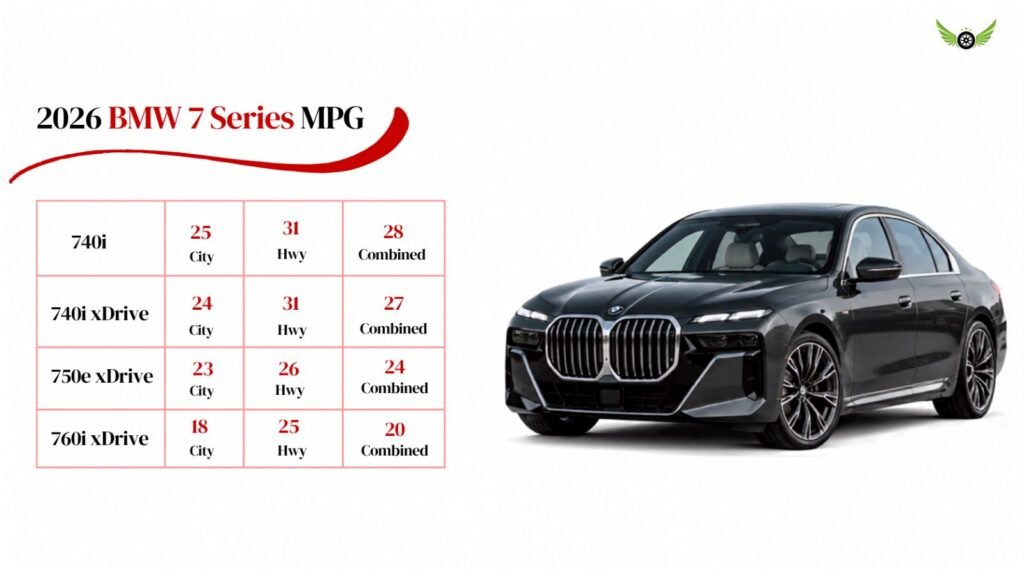
For U.S. models, the EPA ratings are 25 city/31 highway/28 combined mpg for the rear-wheel-drive 740i, 24/31/27 mpg for the 740i xDrive, 23/26/24 mpg for the 750e xDrive, and 18/25/20 mpg for the 760i xDrive.
2026 BMW 7 Series | City | Highway | Combined |
740i | 25 mpg | 31 mpg | 28 mpg |
740i xDrive | 24 mpg | 31 mpg | 27 mpg |
750e xDrive | 23 mpg | 26 mpg | 24 mpg |
760i xDrive | 18 mpg | 25 mpg | 20 mpg |
The 750e also has an EPA-estimated 35 miles of all-electric range and 70 MPGe when its battery is used as intended.
Real-World BMW 7 Series Mileage & Premium Fuel Costs
Actual BMW 7 Series Mileage varies with traffic, speed, weather, and driving style, so EPA figures should not be treated as guaranteed real-world results. Independent testing gives some useful context: Car and Driver recorded 30 mpg at a steady 75 mph with a 760i xDrive, while Edmunds reported 24.0 mpg in mixed driving with the same powertrain.
Fuel cost is also significant because BMW recommends premium gasoline. Using AAA’s September 3, 2026 U.S. national average premium price of $5.0335 per gallon, the estimated gasoline cost works out as follows:
Model | EPA Combined MPG | Tank | Approx. Full Tank Cost | Fuel Cost per 100 Miles* |
740i | 28 mpg | 19.5 gal | $98.15 | $17.98 |
740i xDrive | 27 mpg | 19.5 gal | $98.15 | $18.64 |
750e xDrive | 24 mpg | 17.2 gal | $86.58 | $20.97 |
760i xDrive | 20 mpg | 19.5 gal | $98.15 | $25.17 |
Calculated from EPA combined MPG and AAA’s national-average premium price of $5.0335/gal; actual local prices and real-world MPG will vary. The 750e’s gasoline-only calculation does not include electricity costs.
According to our experience, the 740i makes the strongest case for predictable fuel costs among the gasoline-powered 7 Series models. The 760i xDrive costs roughly $7.19 more per 100 miles in fuel than the 740i at the current national premium price, while the 750e’s biggest efficiency advantage appears when owners regularly charge and use its electric range rather than relying only on gasoline.
BMW 7 Series Performance & Acceleration
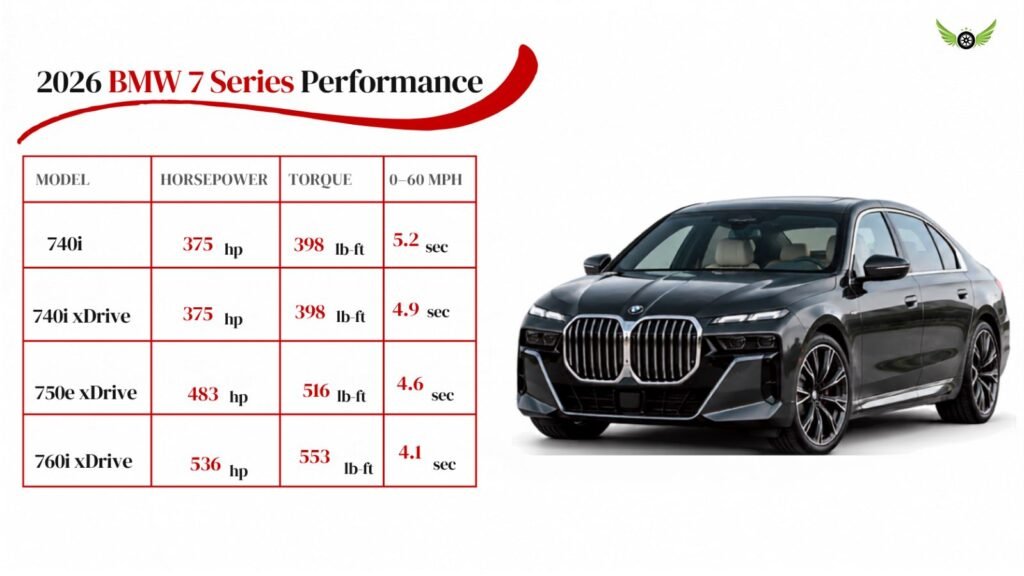
The 2026 BMW 7 Series offers three very different powertrain personalities. The 740i uses a 375-hp turbocharged inline-six, the 750e xDrive combines that six-cylinder engine with an electric motor for 483 hp, and the 760i xDrive uses a 536-hp twin-turbo V8. All three use an 8-speed automatic transmission.
740i vs 750e vs 760i Performance Comparison
For most buyers, the 740i already provides more than enough acceleration for daily driving and highway use. BMW lists 0–60 mph in 5.2 seconds for the rear-wheel-drive 740i and 4.9 seconds for the 740i xDrive. The 750e xDrive improves that to 4.6 seconds, while the 760i xDrive reaches 60 mph in 4.1 seconds.
Model | Power | Torque | 0–60 mph |
740i | 375 hp | 398 lb-ft | 5.2 sec |
740i xDrive | 375 hp | 398 lb-ft | 4.9 sec |
750e xDrive | 483 hp | 516 lb-ft | 4.6 sec |
760i xDrive | 536 hp | 553 lb-ft | 4.1 sec |
The 750e xDrive is particularly interesting because its electric motor adds immediate torque to the gasoline engine, while the 760i delivers the strongest sustained acceleration. Independent testing of the current-generation 760i xDrive recorded 3.5 seconds to 60 mph by Car and Driver and 3.8 seconds by Edmunds, both quicker than BMW’s published 4.1-second figure.
Power Delivery, 8-Speed Automatic & Driving Response
The 740i’s inline-six delivers smooth, progressive power and is well suited to merging, passing and relaxed highway driving. The 750e xDrive feels more immediate at lower speeds because the electric motor supplements the combustion engine, while the 760i’s V8 provides the strongest response when rapid acceleration is required.
The 8-speed automatic prioritizes smoothness during normal driving but responds quickly when the throttle is opened further. Edmunds found the 760i xDrive exceptionally strong for highway passing, although its test noted that the car can feel somewhat lethargic at low speeds. The standard air suspension, adaptive dampers and rear-wheel steering also help the large sedan remain composed and more agile than its dimensions suggest.
According to our experience, the BMW 7 Series feels fastest when its power is used for effortless passing rather than aggressive cornering. The 740i is the balanced choice, the 750e adds responsive hybrid power, and the 760i is the clear option for buyers who want maximum acceleration from this flagship sedan.
BMW 7 Series Real-World Driving Experience
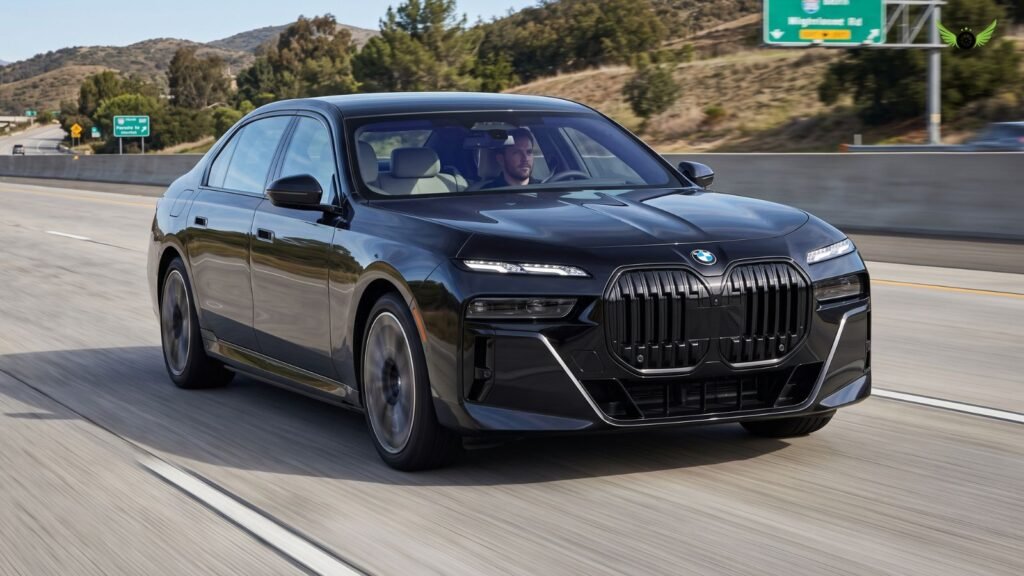
The 2026 BMW 7 Series is more focused on comfort, stability, and highway refinement than sporty handling. Its adaptive air suspension helps absorb bumps, while available rear-wheel steering makes the large sedan easier to maneuver. Edmunds rated its comfort 9.3/10 and found stable handling, strong braking, and substantial highway-passing power during independent testing.
Ride Comfort, Handling & Highway Refinement
The adaptive air suspension is one of the 7 Series’ strongest features. Independent testing found that it handles potholes and broken pavement with impressive isolation while keeping the body controlled at normal road speeds. MotorTrend similarly reports that the suspension tames bumps and potholes effectively.
Rear-wheel steering improves the car’s response in both city and highway driving. At lower speeds, it helps reduce the turning circle; at higher speeds, it improves stability during lane changes. Edmunds found the steering light but precise, with the system making the large sedan more nimble than its size suggests.
The 7 Series is not particularly sporty when pushed through corners. MotorTrend notes noticeable body roll, while Edmunds found that the car’s strengths are stability and power rather than aggressive handling. That makes the chassis better suited to relaxed high-speed travel than enthusiastic back-road driving.
City Driving, Cabin Quietness & Everyday Usability
Despite its substantial size, the 7 Series is manageable in urban driving when equipped with rear-wheel steering. The system makes tight turns and parking easier, while the surround-view camera provides useful visibility around the car. Edmunds specifically found these features helpful when maneuvering the large sedan in confined spaces.
Cabin isolation is another major strength. Consumer Reports describes the cabin as quiet with superb ride comfort, and Autocar measured 59 dBA at 50 mph in a tested 750e xDrive. The large seats, generous rear legroom, and strong suspension isolation make the car particularly well suited to long journeys.
According to our experience, the BMW 7 Series is at its best when driven as a luxury cruiser. Its smooth suspension, quiet interior, stable highway behavior, and rear-steering system create a relaxed driving experience, while buyers seeking sharp cornering response may find the chassis too comfort-oriented.
BMW 750e Plug-In Hybrid Driving & Charging Experience
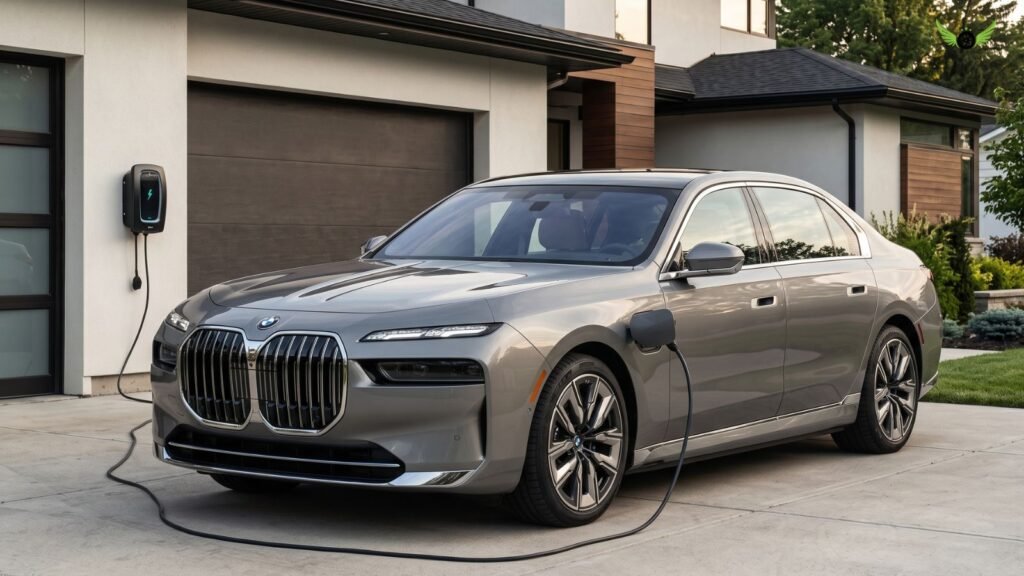
The 2026 BMW 750e xDrive combines a 3.0-liter turbocharged inline-six with an electric motor to produce 483 hp and 516 lb-ft of torque. It uses an 8-speed automatic transmission and all-wheel drive. For U.S. buyers, its main advantage is the ability to cover short daily trips using electric power while retaining a gasoline engine for longer journeys.
Electric Driving Range & Daily PHEV Usability
The 750e xDrive has an EPA-estimated 35-mile electric range and achieves 70 MPGe combined, with an EPA gasoline rating of 23 city/26 highway/24 combined mpg when the battery is depleted. Its 22.1-kWh lithium-ion battery gives it enough electric range for many short commutes and local errands, provided the vehicle is charged regularly.
2026 BMW 750e xDrive | EPA / BMW figure |
Electric range | 35 miles |
Combined MPGe | 70 MPGe |
City/highway MPG | 23/26 mpg |
Combined MPG | 24 mpg |
Battery capacity | 22.1 kWh |
System output | 483 hp |
System torque | 516 lb-ft |
Actual electric range will vary with temperature, traffic, driving style, tires, and other conditions. Car and Driver also notes that it has not independently tested the 750e’s electric range, so the 35-mile figure should be treated as an EPA estimate rather than a guaranteed real-world result.
Home Charging, Long Trips & Fuel-Saving Potential
The 750e is well suited to home charging. BMW lists 11.5 kW Level 2 charging and an estimated 1 hour 45 minutes for a full AC charge. Edmunds lists approximately 2 hours at 240 volts, so charging time can vary with the equipment and charging conditions.
For longer trips, the plug-in-hybrid system removes the need to depend entirely on public charging. When the electric energy is low, the vehicle automatically switches to gasoline operation, with an EPA rating of 24 mpg combined. Edmunds estimates approximately $3,025 in first-year fuel costs for the 750e under its five-year ownership assumptions, compared with $3,630 for the 760i xDrive.
The fuel-saving benefit therefore depends heavily on charging frequency. A driver who charges at home and completes most daily trips within the electric range can reduce gasoline consumption considerably. According to our experience, the 750e makes the strongest case for buyers with short daily driving patterns and reliable home charging, while frequent long-distance drivers will use its gasoline engine more often.
BMW 7 Series vs Competitors for Comfort & Performance
The 2026 BMW 7 Series takes a more driver-oriented approach to flagship luxury than some rivals while still delivering a highly refined ride. The current 740 xDrive produces 394 hp and BMW rates it at 4.9 seconds to 60 mph, combining strong acceleration with an 8-speed automatic and all-wheel drive.
Driving Experience Compared with Other Flagship Sedans
The main alternatives are the Mercedes-Benz S-Class, Genesis G90, and Audi A8. The S-Class places greater emphasis on ride isolation and rear-seat luxury, while the G90 focuses heavily on quietness, comfort, and value. The A8 remains smooth and composed but its 335-hp V6 is less powerful than the 7 Series’ current six-cylinder. MotorTrend recorded 5.4 seconds to 60 mph for the 2026 A8.
Sedan | Main strength | Driving character |
BMW 7 Series | Comfort + performance | More driver-focused |
Mercedes-Benz S-Class | Ride + rear-seat luxury | Smooth and composed |
Genesis G90 | Comfort + value | Quiet and relaxed |
Audi A8 | Refinement | Balanced and understated |
Car and Driver’s 2026 full-size luxury ranking gives the S-Class 9.5/10, while the G90 and 7 Series each receive 9/10. Its evaluation considers acceleration, handling, comfort, efficiency, value, and real-world driving.
Which Luxury Sedan Offers the Best Balance?
For buyers who want strong performance without giving up flagship-level comfort, the BMW 7 Series is one of the strongest all-round choices. The S-Class has the edge if maximum ride isolation and rear-seat comfort are the priority, while the G90 is particularly attractive for buyers who place high value on comfort and overall value. The A8 remains refined, but its lower output and slower tested acceleration make it less compelling for performance-minded buyers.
A personal test drive is still the best way to judge differences in steering weight, suspension response, seat comfort, and cabin isolation because those qualities are difficult to measure with specifications alone. From the available independent testing, the BMW 7 Series offers one of the best compromises between luxury comfort and driver-focused performance in this segment.
BMW 7 Series Mileage, MPG, Performance & Real-World Driving FAQs
The 2026 BMW 7 Series offers several powertrain choices, so fuel economy, acceleration, electric driving capability, and everyday driving behavior vary by model. The questions below cover the key points U.S. buyers are most likely to consider, from BMW 7 Series Mileage and performance to the 750e plug-in hybrid and long-distance comfort.
Is the 2026 BMW 7 Series fuel-efficient?
Yes. The 740i is the most fuel-efficient version, with an EPA rating of 25 mpg city, 31 mpg highway, and 28 mpg combined. The 740i xDrive returns 27 mpg combined, while the 750e xDrive and 760i xDrive are rated at 24 and 20 mpg combined, respectively.
Which 2026 BMW 7 Series is the fastest?
The 760i xDrive is the fastest. Its 536-hp twin-turbo V8 gives it a BMW-rated 4.1-second 0–60 mph time. Car and Driver independently recorded 3.5 seconds, making the V8 model considerably quicker than its official estimate in that test.
Is the BMW 750e good for daily driving?
Yes. The 750e xDrive provides about 35 miles of EPA-estimated electric range and can operate as a gasoline-powered hybrid after the available electric energy is used. That makes it particularly practical for drivers with short daily commutes who can charge regularly at home.
How long does the BMW 750e take to charge?
About 2 hours using a 240-volt connection, according to EPA/Edmunds specifications. BMW’s technical information lists an 11.5-kW AC charging system, while the exact charging time can vary with the electrical installation and charging conditions.
Is the BMW 7 Series comfortable on the highway?
Yes. The sedan uses adaptive air suspension and rear-wheel steering, and independent testing finds it particularly composed and comfortable during highway driving. Car and Driver also recorded 30 mpg at 75 mph with a 760i xDrive during its highway fuel-economy test.
Is the BMW 7 Series easy to drive in the city?
Yes. Rear-wheel steering helps reduce the effort required to maneuver the large sedan at lower speeds. Edmunds lists a 39.7-foot turning circle for the 740i and a 40.4-foot turning circle for the 750e xDrive, which helps explain why the car is easier to position in tight urban spaces than its dimensions might suggest.
Does the 2026 BMW 7 Series require premium gasoline?
Yes. Edmunds lists premium unleaded as required for the 740i and 750e xDrive. Buyers should therefore calculate running costs using premium fuel rather than regular gasoline prices.
Is the 740i or 760i better for everyday use?
The 740i is the better choice for most everyday drivers. It produces 375 hp, reaches 60 mph in 5.2 seconds in rear-wheel-drive form, and achieves 28 mpg combined. The 760i is better for buyers who specifically want V8 power and much stronger acceleration, but its EPA combined rating falls to 20 mpg.
Does the BMW 7 Series have good real-world MPG?
Yes, but actual mileage depends on the powertrain and driving conditions. In Car and Driver’s testing, the 760i xDrive returned 20 mpg overall and 30 mpg at a steady 75 mph. Edmunds recorded 24.0 mpg in mixed city/highway driving with a tested 760i. These independent results show that highway driving can produce substantially different mileage from the EPA combined figure.
Which 2026 BMW 7 Series offers the best balance of performance and efficiency?
The 740i offers the best balance for most buyers. Its 375-hp inline-six provides strong acceleration while delivering the highest EPA combined rating in the lineup at 28 mpg. The 750e xDrive is the better alternative for drivers who can regularly charge at home and want electric driving for shorter trips.