The 2026 BMW 7 Series is a flagship luxury sedan, so its ownership cost is shaped by more than the purchase price. Fuel, insurance, maintenance, repairs, depreciation, financing, and taxes can all have a significant effect on the long-term cost. BMW offers the 2026 7 Series in 740i, 740i xDrive, 750e xDrive, and 760i xDrive configurations, with different powertrains and running-cost considerations.
For a useful real-world ownership picture, Edmunds estimates that a 2026 740i xDrive could cost about $138,536 over five years, including depreciation, financing, taxes and fees, fuel, insurance, maintenance, and repairs. Its estimate for the 740i is about $132,061, while the 760i xDrive reaches approximately $146,514. These are estimates based on 15,000 miles per year, not guaranteed owner costs.
According to our experience, the biggest financial consideration with a BMW 7 Series is not simply routine servicing; depreciation and the overall cost of ownership can have an even larger impact. This guide examines the BMW 7 Series Ownership Cost, BMW 7 Series Insurance, BMW 7 Series Resale Value, and long-term running expenses to help buyers understand what owning this flagship sedan can realistically involve.
BMW 7 Series Total Ownership Cost
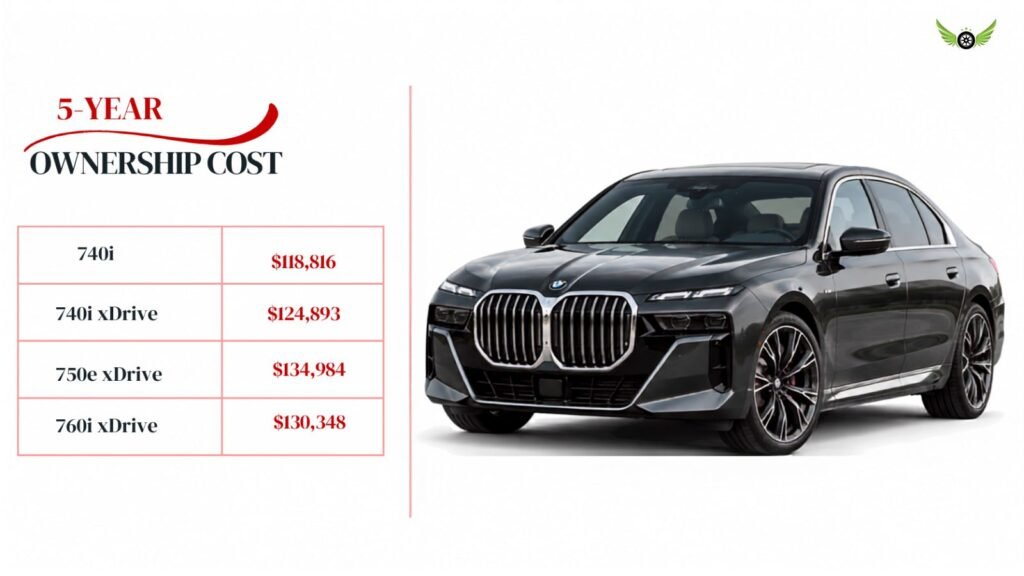
The 2026 BMW 7 Series has a high ownership cost, but the amount varies significantly by powertrain. Edmunds currently estimates five-year ownership costs of $118,816 for the 740i, $124,893 for the 740i xDrive, $134,984 for the 750e xDrive, and $130,348 for the 760i xDrive, based on 15,000 miles per year. These estimates include depreciation, financing, fuel, insurance, maintenance, repairs, and taxes and fees.
The 740i is the least expensive version to own in this estimate, while the 750e xDrive has the highest projected five-year cost. The difference comes from the vehicle’s purchase price, depreciation, fuel use, financing, and other ownership expenses rather than from maintenance alone.
Fuel, Maintenance, Repairs & Other Running Expenses
Fuel economy is one of the clearest differences between the models. The 2026 740i is rated at 28 mpg combined, the 740i xDrive at 27 mpg, the 750e xDrive at 24 mpg, and the 760i xDrive at 20 mpg. BMW lists the 740i with a 3.0-liter turbocharged six-cylinder and the 760i xDrive with a 4.4-liter turbocharged V8.
Model | Combined MPG | 5-Year Fuel Cost | 5-Year Maintenance | 5-Year Repairs |
740i | 28 | $12,037 | $9,709 | $2,887 |
740i xDrive | 27 | $12,486 | $9,704 | $3,055 |
750e xDrive | 24 | $14,037 | $9,704 | $3,055 |
760i xDrive | 20 | $16,845 | $9,787 | $3,055 |
Edmunds five-year estimates assume 15,000 miles annually. Actual costs vary with mileage, fuel prices, driving conditions, and maintenance needs.
BMW includes scheduled maintenance through 3 years or 36,000 miles, whichever comes first, for qualifying vehicles under BMW Ultimate Care. Once that period ends, routine servicing and repairs become the owner’s responsibility.
Financing, Taxes & Long-Term Ownership Costs
Financing and depreciation can have a larger financial impact than fuel or routine service. Edmunds estimates five-year financing costs of $20,302 for the 740i, $21,183 for the 740i xDrive, $23,192 for the 750e xDrive, and $26,762 for the 760i xDrive. Its estimated five-year depreciation ranges from $58,769 for the 760i xDrive to $73,146 for the 750e xDrive.
Model | 5-Year Financing | 5-Year Taxes & Fees | 5-Year Depreciation |
740i | $20,302 | $4,286 | $62,607 |
740i xDrive | $21,183 | $4,461 | $66,540 |
750e xDrive | $23,192 | $4,862 | $73,146 |
760i xDrive | $26,762 | $5,574 | $58,769 |
These are Edmunds’ estimated five-year ownership figures, not guaranteed costs. Taxes and fees vary by location, while financing depends on the buyer’s loan terms and credit profile.
The long-term takeaway is straightforward: the 740i offers the lowest projected ownership cost, while the higher-output 750e and 760i require a larger budget. For buyers planning to keep the sedan for several years, depreciation, financing, insurance, and post-maintenance-plan expenses should be considered alongside fuel and routine service.
BMW 7 Series Insurance Cost
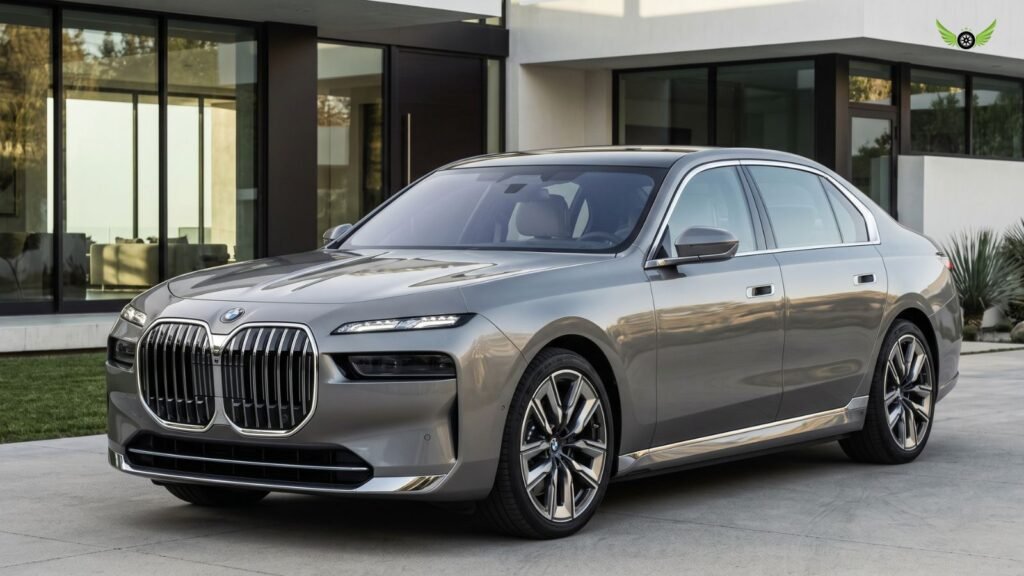
The cost to insure a 2026 BMW 7 Series is above what many buyers would expect from an ordinary sedan. MoneyGeek’s latest data shows an average $222 per month for full coverage and $114 per month for minimum coverage. Its standardized figures are based on a specific driver profile, so the actual premium can be significantly different.
The vehicle’s value, repair costs, powertrain, location, driving record, age, mileage, claims history, and coverage level all influence the final rate. The Zebra currently reports an average $304 per month for full coverage, again using its own standardized driver profile. The difference between these published averages shows why insurance pricing should be viewed as driver-specific rather than a fixed cost.
Factors That Affect BMW 7 Series Insurance Rates
The vehicle’s repair and replacement expense is one important factor. MoneyGeek estimates average annual maintenance for the 7 Series at $2,173, which is the second-highest maintenance figure among the 30 BMW models in its comparison. Insurers can also consider vehicle trim, performance, equipment, theft risk, and potential claim severity when setting rates.
Driver-related factors can be equally important. MoneyGeek’s standard 7 Series calculation assumes a 40-year-old unmarried male with good credit, a clean driving record, no previous claims, and 12,000 miles per year. Changing those variables can materially alter the premium.
Coverage selection also affects the price. Full coverage costs more than minimum coverage because it provides broader protection, while the deductible, liability limits, and selected optional coverage can further change the premium.
How Trim, Location & Driver Profile Affect Premiums
The 2026 lineup consists of the 740i, 740i xDrive, 750e xDrive, and 760i xDrive. Edmunds’ current five-year ownership estimates show meaningful differences in insurance expense between these versions.
2026 model | 5-year insurance estimate |
740i | $5,636 |
740i xDrive | $6,408 |
750e xDrive | $5,636 |
760i xDrive | $9,771 |
The 760i xDrive therefore has an estimated $4,135 higher five-year insurance cost than the 740i in Edmunds’ model. Its 4.4-liter turbocharged V8 and higher performance are among the key differences between these configurations.
Location can have an even larger effect. MoneyGeek reports minimum-coverage averages ranging from $48 per month in Wyoming to $226 per month in Louisiana for the 7 Series. Local accident frequency, theft, weather-related claims, repair costs, and state insurance regulations contribute to this variation.
Driver profile is another major variable. MoneyGeek’s data shows that age affects premiums substantially, with younger drivers generally paying much more than mature drivers. The insurer also considers driving history, claims, credit where permitted, and annual mileage.
According to our experience analyzing luxury vehicle ownership costs, the best way to budget for insurance is to compare personalized rates using the exact model, location, mileage, coverage limits, deductible, and driving history rather than relying on a national average.
BMW 7 Series Resale Value & Depreciation
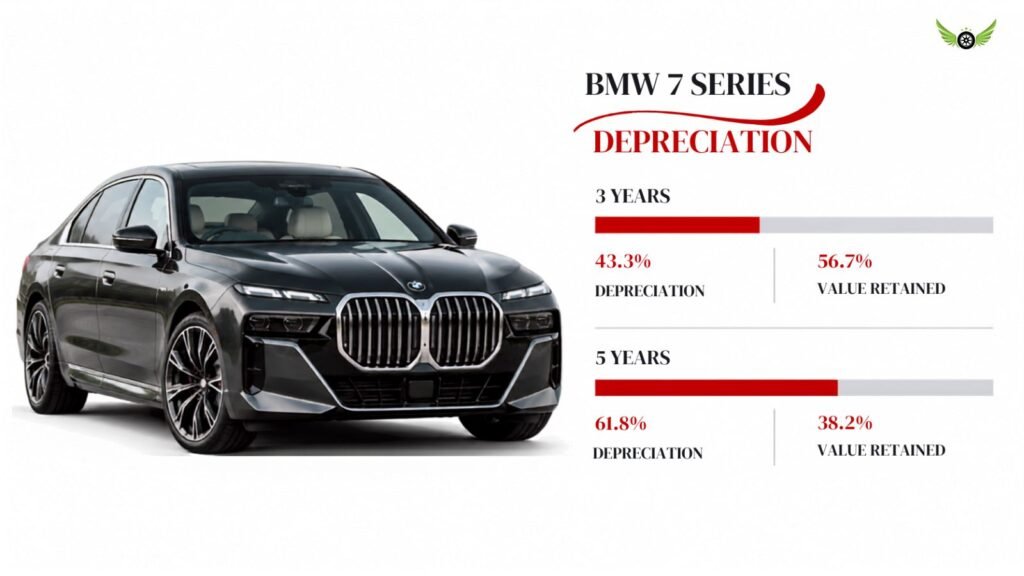
The BMW 7 Series Resale Value is a weak point compared with many other luxury large sedans. iSeeCars analyzed more than 15 million vehicles and estimates that a new 7 Series loses 43.3% of its value after three years and 61.8% after five years. Its estimated resale value is $56,302 after three years and $37,914 after five years. By comparison, the luxury-large-car segment averages 36.6% depreciation after three years and 54.9% after five years.
For buyers planning to sell within three to five years, this depreciation should be treated as a major ownership expense. The figures are historical market-based estimates, not guaranteed future selling prices for a 2026 model.
Expected Depreciation Over 3 and 5 Years
iSeeCars estimates $42,998 in depreciation after three years and $61,386 after five years for the 7 Series. That leaves approximately 56.7% of the original value after three years and only 38.2% after five years.
Ownership period | Depreciation | Estimated resale value | Value retained |
3 years | 43.3% | $56,302 | 56.7% |
5 years | 61.8% | $37,914 | 38.2% |
The plug-in-hybrid version has depreciated even faster in iSeeCars’ historical data, with 50.1% depreciation after three years and 65.1% after five years. Its estimated five-year resale value is $38,414.
Resale Value Compared with Other Flagship Luxury Sedans
Against several competing large luxury sedans, the 7 Series has relatively high depreciation. iSeeCars’ current comparison data shows five-year depreciation of 48.7% for the Lexus LS 500 and 58.5% for the Genesis G90, while its broader 7 Series data puts BMW at 61.8%.
Model | 5-year depreciation | Value retained |
Lexus LS 500 | 48.7% | 51.3% |
Genesis G90 | 58.5% | 41.5% |
BMW 7 Series | 61.8% | 38.2% |
These figures show that the Lexus LS 500 has stronger value retention in the available iSeeCars comparison. The 7 Series therefore makes more sense financially when the buyer values its luxury, technology, comfort, and driving experience enough to accept higher depreciation.
According to our experience, resale value should be considered before buying rather than only when it is time to sell. A well-maintained example with reasonable mileage and desirable equipment can be easier to sell, but its actual market value will still depend on condition, mileage, local demand, and used-car market conditions
BMW 7 Series Long-Term Ownership Experience
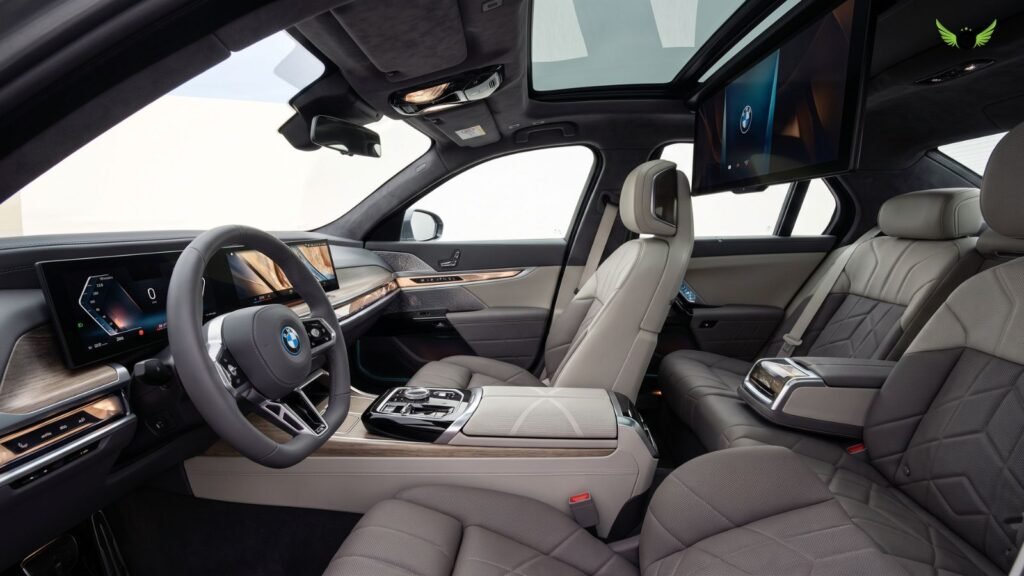
The 2026 BMW 7 Series is still too new for a large body of high-mileage, generation-specific reliability data. iSeeCars currently gives the broader 7 Series a 6.7/10 reliability score and estimates an average lifespan of 94,492 miles, but it lists the 2023–2026 generation as having insufficient data for a separate reliability rating. JD Power is more positive, giving the 2026 model an 86/100 Quality & Reliability score.
That makes maintenance history more important than simply assuming a particular mileage will be trouble-free. BMW covers scheduled maintenance for 3 years or 36,000 miles, while the new-vehicle limited warranty runs for 4 years or 50,000 miles.
High-Mileage Ownership Expectations
There is no reliable 2026-specific evidence showing that a major engine, transmission, suspension, or electronic component will fail at a particular mileage. The available reliability data supports a more practical conclusion: long-term condition will depend heavily on regular servicing and how the car is used.
The current generation also has a recent recall history that buyers should check by VIN. For example, NHTSA recall 26V525000, dated August 11, 2026, covers certain 2024–2026 750e xDrive vehicles because the driveshaft-to-rear-differential connection can become damaged. Dealers are instructed to inspect and, where necessary, repair the affected vehicles free of charge.
For a high-mileage example, keeping service records and completing recall work are therefore more useful indicators than relying on a claimed mileage lifespan. According to our experience, buyers considering long-term ownership should pay particular attention to maintenance history once the car moves beyond BMW’s included maintenance and warranty periods.
740i vs 750e vs 760i Long-Term Running Costs
The 740i has the lowest projected running costs of the three. Edmunds rates it at 28 mpg combined, compared with 24 mpg for the 750e xDrive and 20 mpg for the 760i xDrive. The 750e can also drive on electricity, with an EPA-rated 35-mile electric-only range, making charging habits important to its real-world fuel use.
Model | Combined MPG | 5-Year Fuel Cost | 5-Year Maintenance | 5-Year Repairs |
740i | 28 mpg | $12,037 | $9,709 | $2,887 |
750e xDrive | 24 mpg | $14,037 | $9,704 | $3,055 |
760i xDrive | 20 mpg | $16,845 | $9,787 | $3,055 |
Edmunds estimates assume 15,000 miles per year.
The difference becomes larger over five years. Edmunds estimates total ownership costs of $118,816 for the 740i, $134,984 for the 750e xDrive, and $130,348 for the 760i xDrive. The 740i therefore has the lowest projected ownership expense, while the 750e and 760i require a larger budget.
For buyers focused on long-term running costs, the 740i is the most balanced choice. The 750e is more attractive when its electric capability will be used regularly, while the 760i is aimed at buyers willing to accept higher fuel costs for its 536-hp V8.
Is the BMW 7 Series Worth Buying in 2026?
Yes, the BMW 7 Series is worth buying in 2026 if your priorities are flagship-level comfort, powerful powertrains, advanced technology, and a genuinely premium cabin. Independent reviews support that position: Car and Driver rates it 9/10 and ranks it No. 3 among full-size luxury cars, while MotorTrend gives it 9.2/10 and ranks it No. 2 among luxury full-size sedans.
The financial side is less convincing. Edmunds estimates five-year ownership at $118,816 for the 740i, $124,893 for the 740i xDrive, $134,984 for the 750e xDrive, and $130,348 for the 760i xDrive. Depreciation is one of the largest expenses in each case.
Who Should Buy the BMW 7 Series?
The 7 Series makes the most sense for buyers who want a large luxury sedan for comfortable daily driving, long-distance travel, or executive-style rear-seat comfort. Its standard air suspension, available rear-wheel steering, extensive cabin technology, and three different powertrains give buyers considerable choice.
The 740i is the strongest choice for most buyers. Its 375-hp turbocharged inline-six provides ample performance without the V8’s higher fuel consumption. The 750e xDrive is more suitable for buyers who can charge regularly; BMW lists its system output at 483 hp and Level 2 charging from 0–100% at approximately 1 hour 45 minutes. The 760i xDrive is for buyers who specifically want the 536-hp twin-turbo V8.
This sedan is less suitable for someone mainly looking for low depreciation or inexpensive long-term ownership. Edmunds estimates five-year depreciation of $62,607 for the 740i, $73,146 for the 750e xDrive, and $58,769 for the 760i xDrive.
Final Long-Term Ownership Verdict
The 2026 model is a strong luxury sedan, but it is not the obvious choice for buyers focused purely on financial value. Car and Driver highlights its smooth powertrains, quiet cabin, and comfort, while also noting that its technology can feel overwhelming and its steering lacks feedback.
For long-term ownership, the 740i is the best overall balance. It has the lowest Edmunds five-year ownership estimate at $118,816, compared with $134,984 for the 750e xDrive and $130,348 for the 760i xDrive. JD Power currently gives the 2026 model an 86/100 Quality & Reliability score but only 66/100 for predicted resale, reinforcing the importance of considering depreciation before buying.
According to our experience, the 740i is the version we would recommend to most buyers who want the full 7 Series experience without taking on the highest running costs. Choose the 750e if regular charging fits your routine, and choose the 760i when V8 performance is a priority rather than minimizing ownership expense.
FAQs About BMW 7 Series Ownership Cost, Insurance, Resale Value & Long-Term Ownership
Before buying a 2026 BMW 7 Series, buyers usually want to know one thing: what will this car really cost to own over several years? The FAQs below cover the main ownership questions, including purchase and running costs, insurance, depreciation, maintenance, powertrain differences, and long-term value. Current ownership estimates and BMW’s 2026 specifications are used where exact figures are available.
Is the 2026 BMW 7 Series expensive to own?
Yes. Edmunds estimates five-year ownership costs of $118,816 for the 740i, $124,893 for the 740i xDrive, $134,984 for the 750e xDrive, and $130,348 for the 760i xDrive. These estimates include depreciation, financing, fuel, insurance, maintenance, repairs, and taxes and fees.
Is the 740i the cheapest 7 Series to own?
Yes. The 740i has the lowest Edmunds five-year ownership estimate at $118,816. Its estimated five-year fuel cost is $12,037, compared with $14,037 for the 750e xDrive and $16,845 for the 760i xDrive.
Is the 2026 BMW 7 Series expensive to insure?
Yes. Edmunds estimates five-year insurance costs of $6,988 for the 740i, $7,464 for the 740i xDrive, $6,988 for the 750e xDrive, and $9,556 for the 760i xDrive. Actual premiums depend on the driver, location, coverage, deductible, and insurer.
Does the 760i cost more to run than the 740i?
Yes. The 760i xDrive uses a 536-hp 4.4-liter V8 and is rated at 18 mpg city and 25 mpg highway, while the 740i uses a 375-hp 3.0-liter inline-six and is rated at 25 mpg city and 31 mpg highway.
Is the 750e xDrive cheaper to run than the 760i?
Yes, based on current five-year estimates. Edmunds projects $14,037 in fuel costs for the 750e xDrive versus $16,845 for the 760i xDrive. The 750e also offers an estimated up to 35 miles of electric range, so drivers who charge regularly can make greater use of its plug-in-hybrid system.
Does the BMW 7 Series depreciate quickly?
Yes. iSeeCars estimates that the 7 Series loses approximately 61.8% of its value after five years, leaving about 38.2% of its original value. Depreciation can vary with mileage, condition, equipment, market demand, and the actual purchase price.
Is the 2026 BMW 7 Series reliable for long-term ownership?
It is too early to give a definitive yes. The current generation does not yet have enough long-term, high-mileage data to establish a proven reliability record. That makes regular maintenance and service history especially important for buyers planning to keep the car for many years.
Is the 2026 BMW 7 Series covered by a warranty?
Yes. BMW’s 2026 new-vehicle limited warranty provides 4 years or 50,000 miles, whichever comes first. BMW also provides scheduled maintenance coverage through its applicable Ultimate Care program for the initial ownership period.
Is the BMW 7 Series worth buying in 2026?
Yes, if luxury, comfort, technology, and performance are more important to you than minimizing ownership costs. The 740i is the strongest choice for buyers who want the best balance of performance and running expenses, while the 750e and 760i appeal to buyers with more specific powertrain priorities.
Is the 740i the best 7 Series for long-term ownership?
Yes, for most cost-conscious buyers. Its lower projected five-year ownership cost and better fuel economy make it the most balanced choice. According to our experience, it offers the most sensible combination of luxury, performance, and long-term running costs within the 2026 lineup.