How thirsty is 700+ horsepower — and which M car sips fuel while still going fast? The short answer: BMW M models mileage ranges from 19 mpg combined for the M2, M3, and M4, to 47 MPGe for the plug-in hybrid M5, down to 16 mpg combined for the X5 M and X6 M. Real-world owners typically see 17–20 mpg in the six-cylinder cars and low-teens in the V8 SUVs. In this guide, we break down BMW M models mileage and MPG by model, real-world fuel costs, 0–60 performance comparisons, driving impressions, xDrive vs rear-drive choices, and which M car best balances speed with everyday practicality.
For pricing and full specs, start with our 2026 BMW M models review before diving into BMW M models mileage, efficiency, and driving details below.
BMW M Models Mileage, MPG & Fuel Economy
BMW M models mileage is never going to win efficiency awards — but the BMW M models mileage spread across the range is wider than you might expect. The lightweight six-cylinder cars are genuinely reasonable daily drivers, while the hybrid M5 rewrites what a 717-hp sedan can achieve.
Fuel Economy Differences Between BMW M Cars and M SUVs
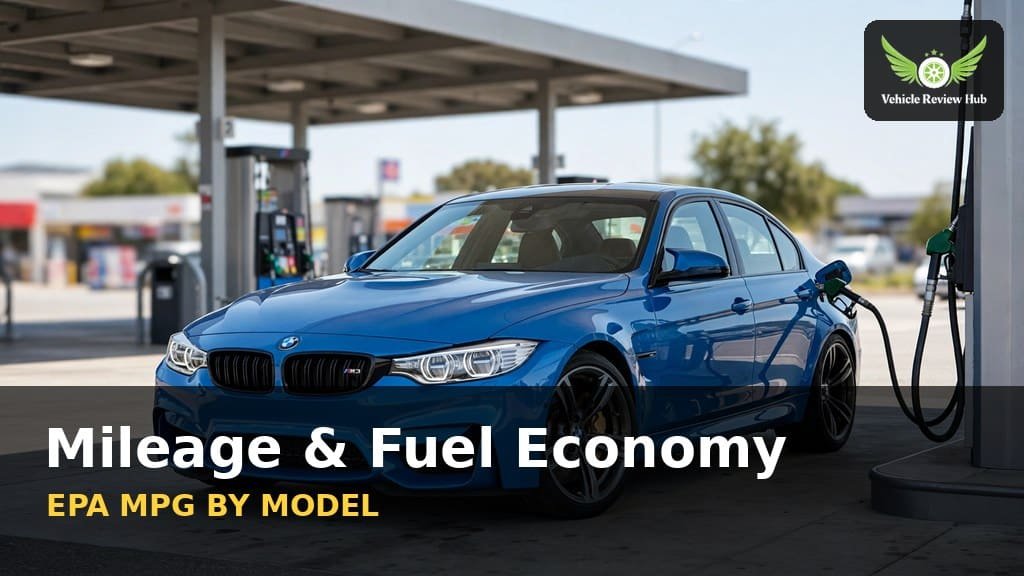
EPA ratings split the BMW M models mileage story into three tiers: the efficient six-cylinder cars, the hybrid M5, and the thirsty V8 SUVs.
| Model | City MPG | Highway MPG | Combined MPG |
|---|---|---|---|
| M2 Coupe | 16 | 23 | 19 |
| M3 Sedan (RWD) | 16 | 23 | 19 |
| M3 Competition xDrive | 16 | 22 | 18 |
| M4 Coupe (RWD) | 16 | 23 | 19 |
| M4 Competition xDrive | 16 | 22 | 18 |
| M5 Sedan (gas only) | 12 | 17 | 14 |
| M5 Sedan (hybrid mode) | — | — | 47 MPGe |
| M5 Touring (gas only) | 12 | 16 | 13 |
| X5 M Competition | 14 | 19 | 16 |
| X6 M Competition | 14 | 19 | 16 |
The M2, M3, and M4 share the S58 inline-six and nearly identical BMW M models mileage figures — 19 mpg combined for rear-drive versions, 18 for xDrive. The M5’s plug-in hybrid system transforms its rating to 47 MPGe when charged, though gas-only driving drops to 14 mpg combined. The X5 M and X6 M sit at 16 mpg combined. Every BMW M model requires premium unleaded fuel. A detailed M2 vs M3 comparison with EPA figures is published on CarBuzz.
Real-World Mileage, Premium Fuel Costs & Daily Efficiency
EPA numbers are a starting point; real-world BMW M models mileage depends heavily on your right foot. Real-world BMW M models mileage for M2/M3/M4 owners typically runs 17–20 mpg in mixed driving, with 23–25 mpg achievable on gentle highway cruises. Drive them hard and single digits appear — the S58 drinks when pushed. X5 M owners report 14–16 mpg mixed and up to 20 mpg on long highway runs, per owner-reported X5 M fuel economy data.
What does it cost? At roughly $4.00 per gallon for premium and 12,000 miles per year, annual fuel spending runs about $2,525 for the M2/M3/M4 (19 mpg), $3,000 for the X5 M/X6 M (16 mpg), and $3,430 for the M5 running gas-only (14 mpg). Charge the M5 regularly and fuel costs can drop below the M2’s. Fuel is a meaningful running cost on these cars — for the full picture including service and tires, see our BMW M models maintenance cost guide.
BMW M Models Performance & Acceleration
Efficiency is context; performance is the point. BMW M models mileage figures exist so you know the price of admission — here is what that admission buys: some of the quickest acceleration figures of any cars on sale.
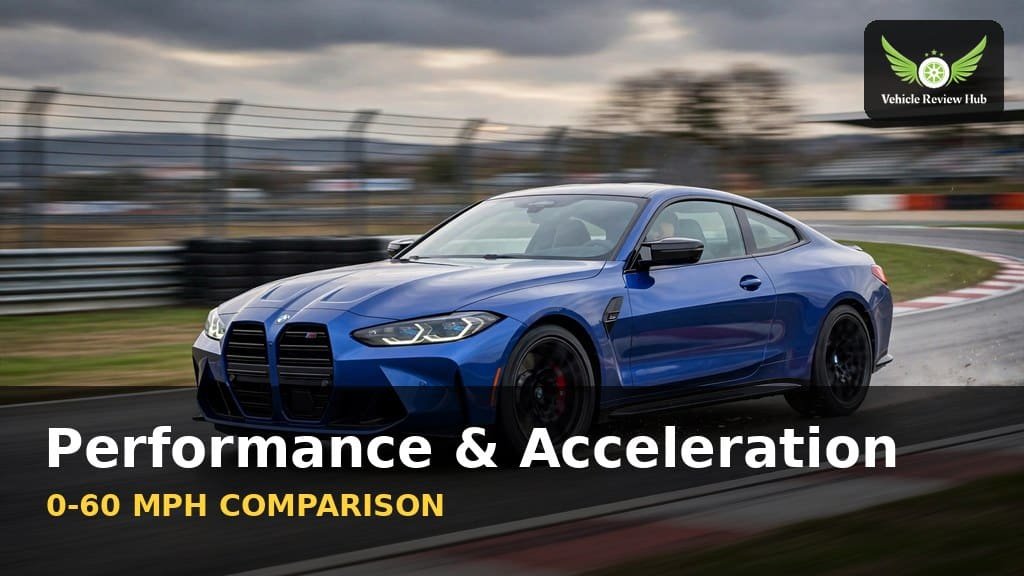
M2, M3, M4 and M5 Performance Comparison
| Model | Power | 0–60 mph | Top Speed |
|---|---|---|---|
| M2 Coupe | 473 hp | 4.1 sec (manual) / 3.9 sec (auto) | 155 mph (177 w/ M Driver’s Pkg) |
| M3 Sedan | 473–523 hp | 4.1–3.4 sec | 155 mph (180 w/ M Driver’s Pkg) |
| M4 Coupe | 473–523 hp | 4.1–3.4 sec | 155 mph (180 w/ M Driver’s Pkg) |
| M5 Sedan | 717 hp (hybrid) | 3.4 sec | 155 mph (190 w/ M Driver’s Pkg) |
| M5 Touring | 717 hp (hybrid) | 3.5 sec | 155 mph (190 w/ M Driver’s Pkg) |
The M2 is the purest driver’s tool — 473 hp, rear-drive, and the lightest chassis. The M3 and M4 scale the same S58 engine from 473 to 523 hp, with the Competition xDrive hitting 60 mph in 3.4 seconds — independent tests have recorded high 2-second runs. The M5’s 717-hp hybrid system makes it the quickest BMW M model ever, with a 10.9-second quarter-mile. Each step up the range buys roughly half a second to 60 mph.
BMW M SUVs and High-Performance Hybrid Models
The X5 M and X6 M Competition pack 617 hp and 553 lb-ft from their mild-hybrid 4.4-liter V8s, hitting 60 mph in 3.7 seconds — quicker than most purpose-built sports cars, in 5,400-lb SUVs. Rear-biased M xDrive, active roll stabilization, and massive M compound brakes keep them composed at speeds that defy their size.
The hybrid story centers on the M5: its 194-hp electric motor fills torque gaps instantly, delivers 25–29 miles of silent electric commuting, and enables the 717-hp combined output. The XM extends hybridization to SUV form as a standalone M model. Electrification has not diluted BMW M models — it has made the fastest ones faster while improving BMW M models mileage where it counts: the daily commute.
BMW M Models Real-World Driving Experience
Numbers tell half the story. According to our experience evaluating owner reports and professional reviews across the M range, the defining trait of BMW M models is duality — savage when provoked, civilized when not. No rival balances these extremes quite as well.
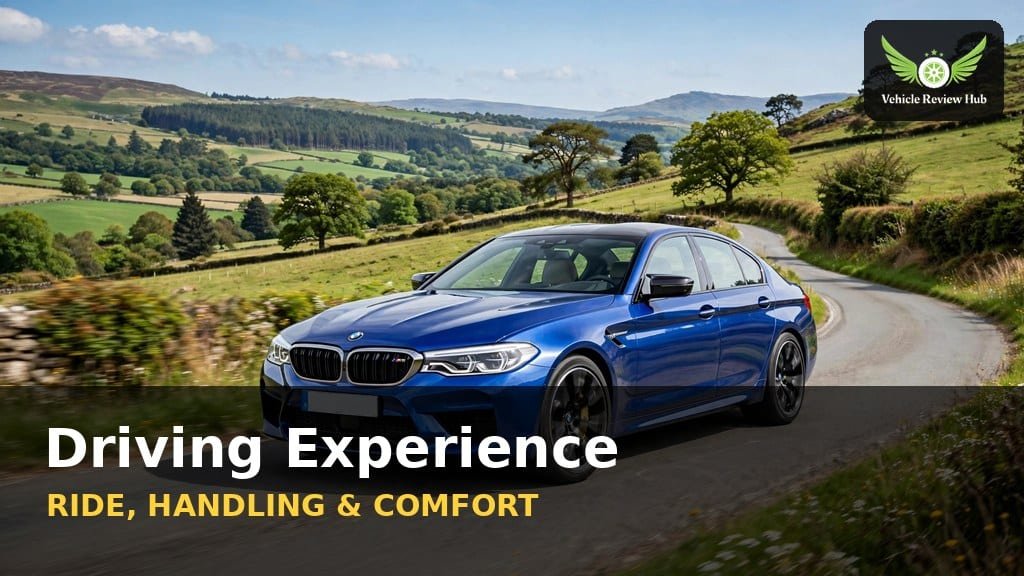
Ride Comfort, Handling, Braking & Steering Feel
Handling is the M division’s signature: sharp turn-in, neutral balance, and an active M differential that puts power down cleanly. Steering is precise and well-weighted, though electrically assisted as in all modern cars. The adaptive M suspension offers a genuinely broad range — Comfort mode absorbs broken pavement respectably, while Sport Plus transforms the car for track work.
Braking is a standout: standard M compound brakes resist fade through repeated hard use, with carbon-ceramics optional for track regulars. Ride comfort is the compromise — even in Comfort mode, BMW M models ride firmly, and the M2/M3 on 19/20-inch wheels transmit road texture constantly. It is acceptable daily, but long highway slogs favor the M5’s more compliant setup.
City Driving, Highway Comfort & Everyday Usability
Around town, BMW M models are surprisingly easy. Light steering at low speeds, good visibility (except the X6 M’s coupe roofline), and smooth automatics make traffic painless. The M2’s compact size slips through gaps; the X5 M’s ride height gives commanding views. Fuel economy in the city is where BMW M models mileage suffers most — expect 13–15 mpg in stop-and-go regardless of model.
On the highway, the larger BMW M models shine. The M5 is a supreme long-distance car — quiet, stable, and effortlessly fast, with adaptive cruise easing the miles. The M3 is nearly as good with better BMW M models mileage. The M2 is the least relaxing cruiser: louder, busier, and with a smaller 13.7-gallon tank limiting range to about 300 miles. For a complete financial view of daily use, see our BMW M models ownership cost guide.
BMW M xDrive, Rear-Wheel Drive & Transmission Choices
Two choices define the BMW M driving experience more than any option package: which wheels get the power, and who shifts the gears. Get these right and the car feels made for you.
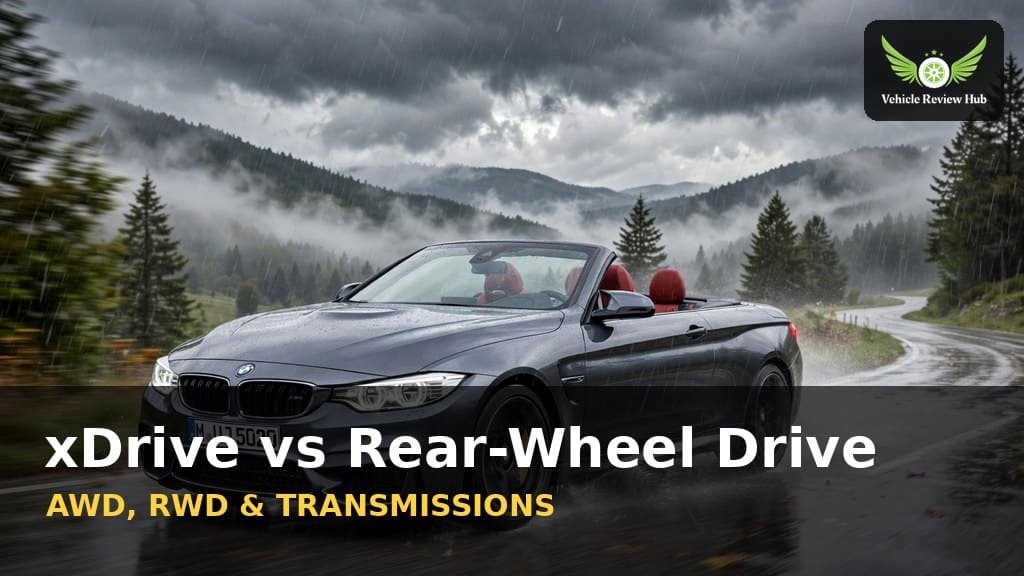
AWD vs Rear-Wheel Drive Performance and All-Weather Driving
M xDrive is rear-biased all-wheel drive that sends power rearward until slip demands otherwise — and every xDrive BMW M model includes a 2WD mode that disconnects the front axle entirely for traditional rear-drive behavior. The performance case for xDrive is clear: the M3 Competition xDrive hits 60 mph in 3.4 seconds versus 3.8 for the RWD Competition, thanks to launch traction.
The cost is weight (roughly 100+ lbs), about 1 mpg of BMW M models mileage, and a small purity penalty. For snowy climates, xDrive transforms a BMW M model into a year-round car. For dry-climate enthusiasts, rear-drive remains the purist’s choice — lighter, more playful, and available with the manual. There is no wrong answer, only different priorities.
Automatic vs Manual BMW M Driving Experience
The 8-speed M Steptronic automatic is objectively superior: faster shifts, launch control, and quicker acceleration in every model. It is also the only transmission on xDrive models, the M5, and the X5 M/X6 M. For outright pace, the automatic wins without debate.
The 6-speed manual — available on the M2 and base M3/M4 — is the emotional choice. The clutch is well-weighted, the shifter mechanical and precise, and active rev matching makes every downshift satisfying. It is slower to 60 mph and slightly thirstier, but manual BMW M models hold their value better and deliver the engagement no automatic can replicate. With manuals disappearing across the industry, each one may be the last of its kind. Watch this detailed look at the manual-equipped 2026 M2:
BMW M Performance vs Everyday Practicality
The final question every buyer faces: how much performance can you actually use every day? BMW M models mileage, comfort, and running costs all factor into a car you will drive 12,000 miles a year — not just admire.
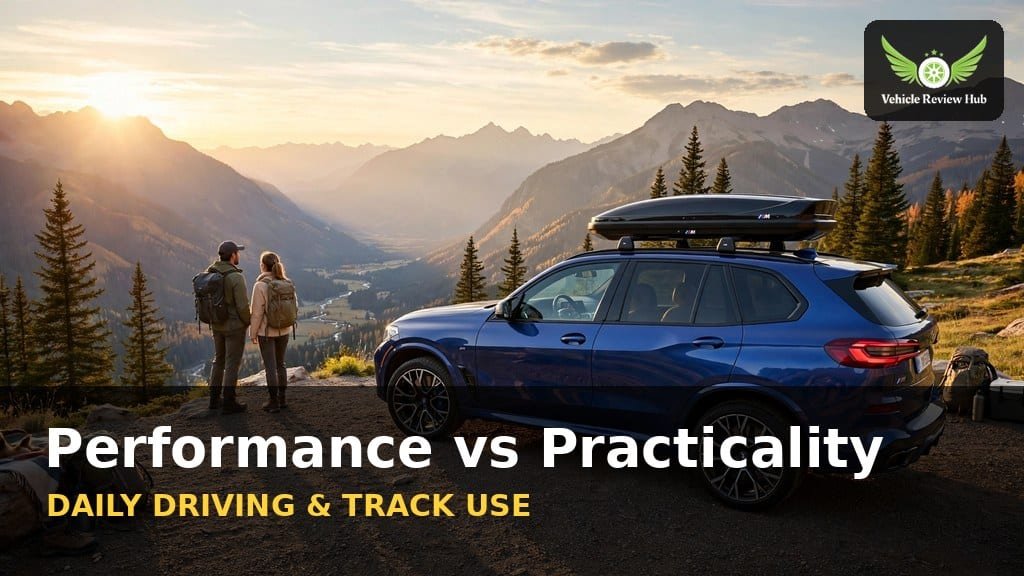
Which BMW M Model Is Best for Daily Driving?
The M3 Competition xDrive is the consensus daily-driver pick: four doors, all-weather traction, 523 hp, 18 mpg combined BMW M models mileage, and a ride civilized enough for commuting. The M5 is even more comfortable but thirstier and far more expensive to run. The M2 is the most fun daily if your commute is short and your roads are good — its compact size and manual gearbox make every drive an event.
The X5 M is the practical daily for those needing space and ride height, accepting 16 mpg combined as the price. Avoid the carbon bucket seats if you daily-drive — their tall bolsters make entry/exit a chore. Standard M sport seats are the smart daily choice across the range.
Track Performance vs Comfort and Fuel Economy
On track, BMW M models are in their element: the cooling systems, brakes, and differentials are engineered for sustained lapping. The M2 is the track-day sweet spot — lightest, cheapest to run hard, and most communicative. Expect track-day BMW M models mileage in the single digits and a set of tires per handful of events.
The trade-off is unavoidable: track capability means firm suspension, aggressive alignment, and sticky tires that wear fast and tramline on highways. M Drive Professional’s telemetry helps you improve, but the running costs of regular track use dwarf any fuel-economy concerns. For most owners, the sweet spot is a BMW M model that is 90% daily comfort and 100% weekend weapon — which describes the M3 Competition xDrive perfectly.
FAQs About BMW M Models Mileage & Performance
Quick answers to the most common questions about BMW M models mileage, fuel economy, and real-world performance.
What is the most fuel-efficient BMW M model?
The plug-in hybrid M5 Sedan at 47 MPGe when charged. Among non-hybrids, the M2, M3, and M4 tie at 19 mpg combined (18 with xDrive). The X5 M and X6 M are the thirstiest at 16 mpg combined.
How fast is the 2026 BMW M5 0–60 mph?
The M5 Sedan hits 60 mph in 3.4 seconds and the M5 Touring in 3.5 seconds, thanks to 717 hybrid horsepower. The M3/M4 Competition xDrive match the sedan’s 3.4 seconds, while the X5 M and X6 M manage 3.7 seconds.
Do BMW M models require premium gas?
Yes — every BMW M model requires premium unleaded gasoline (91+ octane). Using regular fuel risks knocking and reduced performance, and BMW M models mileage figures assume premium fuel.
Is M xDrive better than rear-wheel drive?
M xDrive is quicker off the line (3.4 vs 3.8 seconds in the M3 Competition) and far better in rain and snow, with a 2WD mode for rear-drive fun. Rear-drive is lighter, slightly more efficient, and the only way to get a manual transmission. Choose based on your climate and priorities.
Which BMW M model is best for daily driving?
The M3 Competition xDrive: four-door practicality, all-weather traction, 523 hp, and 18 mpg combined BMW M models mileage. The M5 is more comfortable but costlier to run; the M2 is more fun but less practical.
What is the real-world highway range of BMW M models?
With typical tanks and highway BMW M models mileage: the M2 manages ~300 miles (13.7-gal tank), the M3/M4 ~350 miles, the M5 ~280 miles gas-only, and the X5 M ~400 miles (21.9-gal tank). Gentle cruising extends all of these figures.
BMW M models mileage proves performance and efficiency are not enemies — from the 19-mpg M2 to the 47-MPGe hybrid M5, there is an M car for every balance of speed and sensibility. Pick the drivetrain that suits your climate, the gearbox that suits your soul, and budget for premium fuel: the driving experience is worth every gallon.