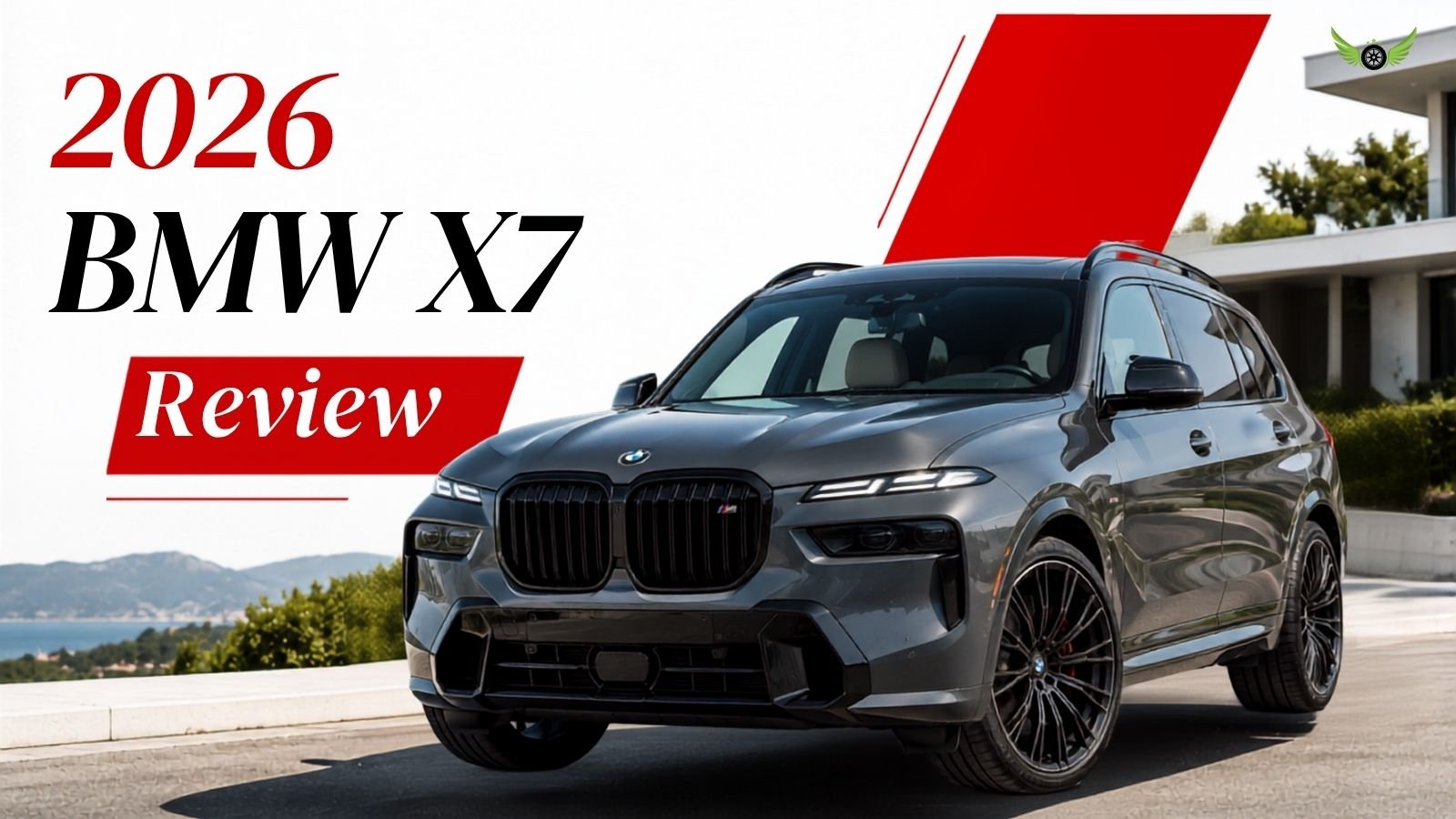
The 2026 BMW X7 is a three-row luxury SUV designed for buyers who want premium comfort, strong performance, and practical family space in one vehicle. In the USA, the lineup offers powerful turbocharged engines, standard all-wheel drive, advanced technology, and a maximum towing capacity of up to 7,500 pounds with the proper equipment.
For 2026, the BMW X7 Price starts at approximately $87,500 including destination, according to current market listings, although pricing can vary by source, configuration, and destination charges. The xDrive40i uses a 375-horsepower turbocharged inline-six, while the M60i delivers 523 horsepower from a twin-turbocharged V8. An ALPINA XB7 version is also available for buyers seeking significantly higher performance and exclusivity.
This BMW X7 Review focuses on the information buyers need before making a decision: trims and pricing, real-world performance, interior comfort, technology, safety features, key competitors, and overall value. The X7 stands out for delivering more engaging driving dynamics than many large luxury SUVs, though buyers who prioritize maximum third-row or cargo space may find some rivals more practical.
Our BMW X7 Buying Guide will help you understand which version best fits your needs and whether the X7 offers the right balance of luxury, performance, space, and value for your budget.
BMW X7 Trims, Pricing & What's New
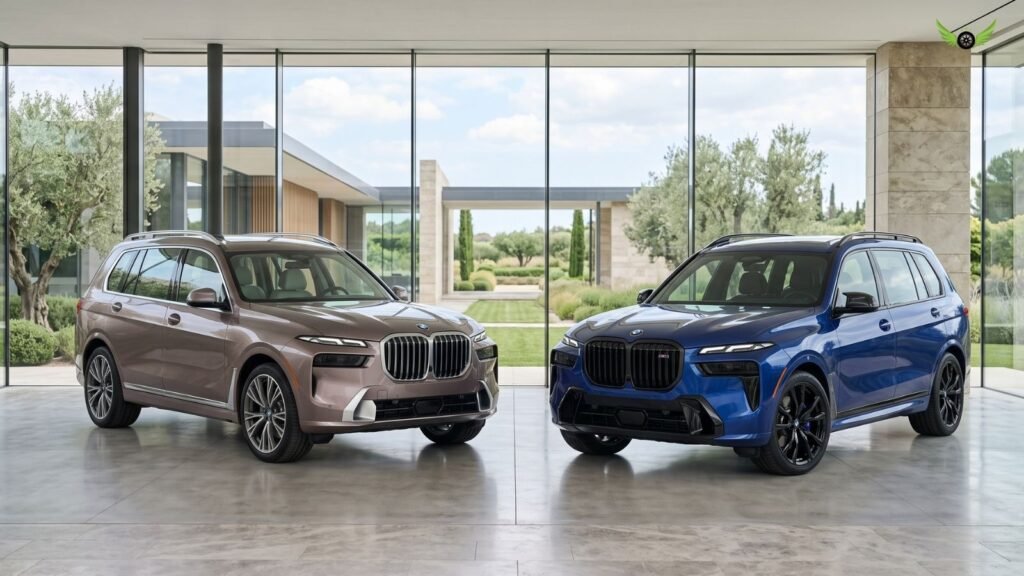
The 2026 BMW X7 is offered in two main trims for most U.S. buyers: the xDrive40i and the performance-focused M60i. BMW currently lists starting MSRPs of $87,500 for the xDrive40i and $115,000 for the M60i. The lineup also includes the ALPINA XB7, starting at $156,000, for buyers seeking a higher-performance luxury model.
For 2026, the regular X7 lineup remains largely unchanged. One notable update is the removal of American Red Metallic and BMW’s gesture-control feature, while the ALPINA XB7 receives a limited Manufaktur edition for its final production run.
BMW X7 xDrive40i vs BMW X7 M60i
The biggest difference between these trims is performance. The xDrive40i uses a 375-horsepower turbocharged inline-six, while the M60i gets a 523-horsepower twin-turbo V8. BMW lists 0–60 mph times of 5.6 seconds and 4.5 seconds, respectively. Both models use standard all-wheel drive and an eight-speed automatic transmission.
Feature | X7 xDrive40i | X7 M60i |
Starting MSRP | $87,500 | $115,000 |
Engine | 3.0L Turbo Inline-6 | 4.4L Twin-Turbo V8 |
Horsepower | 375 hp | 523 hp |
Torque | 398 lb-ft | 553 lb-ft |
0–60 MPH | 5.6 sec | 4.5 sec |
According to our experience, the xDrive40i is likely to satisfy most luxury SUV buyers because it already delivers strong acceleration and premium comfort. The M60i is the better fit for drivers who specifically want V8 power and a more performance-oriented driving experience.
BMW X7 Packages, Options & Best Value Trim
Available equipment can significantly change the final BMW X7 Price, so buyers should focus on features they will actually use. BMW offers packages and options that can add advanced driver assistance, additional comfort features, upgraded interior materials, and enhanced chassis technology. Package availability can vary by trim and configuration.
For most buyers, the xDrive40i offers the best overall value. It provides the same three-row layout, premium cabin, standard xDrive all-wheel drive, and modern powertrain at a substantially lower starting price than the M60i. The M60i is easier to justify when performance is a major priority rather than simply an added benefit.
BMW X7 Engine, Performance & Specifications
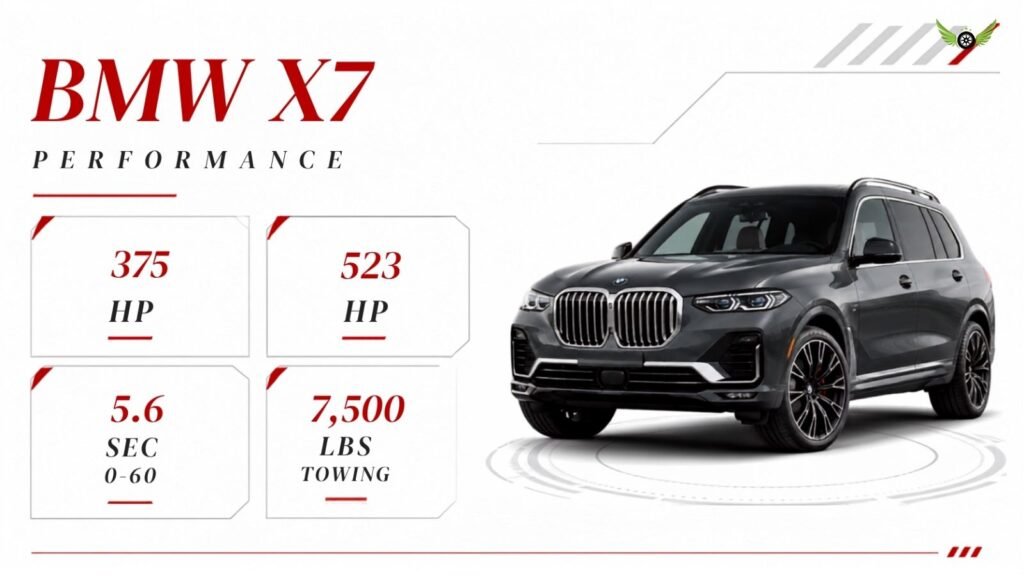
The 2026 BMW X7 offers two distinct powertrain choices for U.S. buyers: a turbocharged inline-six in the xDrive40i and a twin-turbocharged V8 in the M60i. Both use a 48-volt mild-hybrid system, an eight-speed automatic transmission, and all-wheel drive. The main decision comes down to whether you prioritize everyday efficiency and value or significantly stronger performance.
3.0L Turbo Inline-6 Mild Hybrid vs 4.4L Twin-Turbo V8
The xDrive40i’s 3.0-liter turbocharged inline-six produces 375 horsepower and up to 398 lb-ft of torque, giving the large three-row SUV strong everyday acceleration. The M60i’s 4.4-liter twin-turbo V8 raises output to 523 horsepower and 553 lb-ft, making it the choice for buyers who want substantially quicker performance and stronger low-end power.
According to our experience, the inline-six should provide more than enough power for most families and daily driving. The V8 is more appealing if performance is a major part of your buying decision, but it also comes with higher fuel consumption. The xDrive40i is rated at 23 mpg combined, compared with 18 mpg combined for the M60i.
Horsepower, Torque, 0–60 MPH & 7,500-lb Towing Capacity
The performance difference is clear: BMW lists a 0–60 mph time of 5.6 seconds for the xDrive40i and 4.5 seconds for the M60i. Both versions can tow up to 7,500 pounds when properly equipped with the factory-installed trailer hitch, making the X7 capable of handling many boats, trailers, and recreational equipment.
Specification | xDrive40i | M60i |
Engine | 3.0L Turbo Inline-6 | 4.4L Twin-Turbo V8 |
Horsepower | 375 hp | 523 hp |
Torque | 398 lb-ft | 553 lb-ft |
0–60 MPH | 5.6 sec | 4.5 sec |
Maximum Towing | Up to 7,500 lbs* | Up to 7,500 lbs* |
*When properly equipped. Actual towing capability depends on vehicle configuration and equipment.
For most buyers, the six-cylinder model delivers the better balance of performance and efficiency. The M60i is the stronger option for those who want the extra power and acceleration of a V8 without compromising the SUV’s luxury and towing capability.
BMW X7 Interior, Technology & Safety
The BMW X7 offers a luxurious three-row cabin, advanced digital technology, and a strong range of standard and available driver-assistance features. Its biggest strengths are first- and second-row comfort, premium materials, and modern convenience features. The third row is useful for families, but independent reviews suggest it is less spacious for adults on long trips than the largest full-size SUVs.
Three-Row Seating, Cargo Space & Premium Cabin
The X7 can seat up to seven passengers, while an available second-row captain’s-chair configuration provides a six-seat layout. BMW positions the cabin at the top of its SUV range, with available features such as Full Merino Leather and five-zone automatic climate control adding to its luxury appeal.
For cargo capacity, BMW USA lists 46.8 cubic feet with the seats up and up to 90.4 cubic feet with the seats folded down. These figures make it practical for family travel and larger loads, although cargo space behind the third row is naturally more limited when all three rows are in use.
Interior & Cargo | Capacity / Configuration |
Seating | Up to 7 passengers |
Cargo Space with Seats Up | 46.8 cu ft |
Maximum Cargo Space | 90.4 cu ft |
Available Second Row | Captain’s chairs (6-seat layout) |
According to our experience, the cabin is best suited to buyers who value luxury and comfort as much as passenger capacity. Families should find the first two rows especially comfortable, while buyers who frequently carry adults in the third row may want to compare it with larger alternatives before purchasing.
BMW Curved Display, iDrive & Driver Assistance Features
The dashboard features BMW’s Curved Display, combining a 12.3-inch digital instrument cluster and a 14.9-inch central display. The system supports touchscreen, voice, and iDrive controller inputs, giving drivers multiple ways to access navigation and vehicle functions.
For safety, the 2026 model comes standard with Active Driving Assistant, including Active Blind Spot Detection, Frontal Collision Warning with City Collision Mitigation, and Lane Departure Warning. The available Driving Assistance Professional Package adds more advanced support, including Highway Assistant with Active Lane Change, which can enable hands-free driving on suitable controlled-access highways at speeds up to 85 mph. The driver must remain attentive and be ready to take control.
According to our experience, the technology is most valuable for buyers who spend significant time on highways or take frequent long trips. However, these systems are driver-assistance features—not self-driving technology—and their operation depends on road and system conditions.
BMW X7 vs Mercedes-Benz GLS, Audi Q7 & Cadillac Escalade
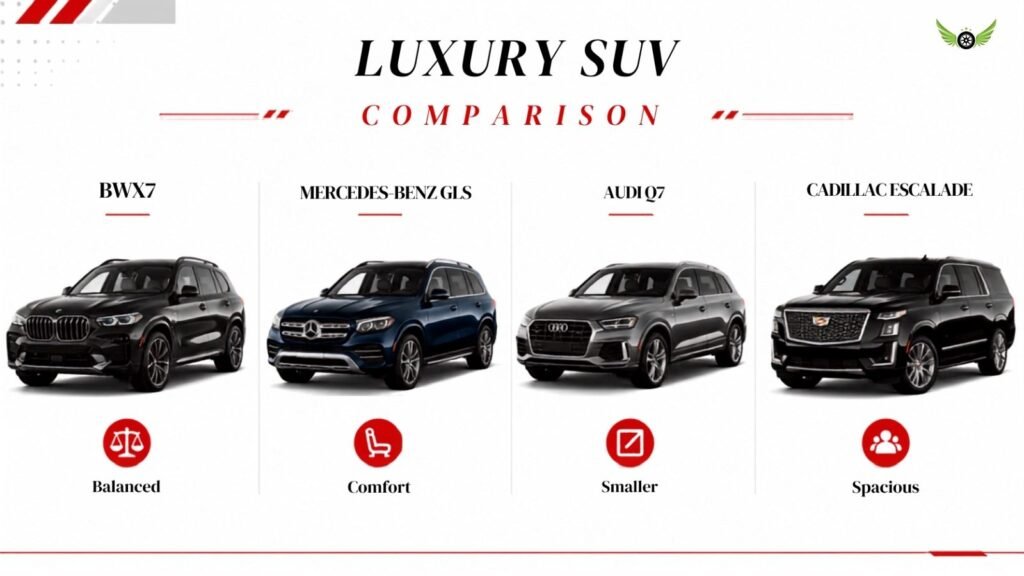
The BMW X7 faces different types of competitors in this comparison. The Mercedes-Benz GLS is its closest direct rival, while the Cadillac Escalade is a larger, more space-focused full-size SUV. The Audi Q7 is smaller and less expensive, making it a practical alternative for buyers who do not need the size of the X7. The best choice depends mainly on driving performance, passenger space, and budget.
Performance, Luxury & Technology Comparison
The X7 xDrive40i and GLS 450 are closely matched. Both use a 375-horsepower turbocharged inline-six, but BMW lists a quicker 5.6-second 0–60 mph time compared with Mercedes-Benz’s 5.8 seconds for the GLS 450. The GLS, however, has a 7,700-pound maximum towing capacity, slightly higher than the X7’s commonly quoted 7,500-pound maximum when properly equipped.
The Escalade takes a different approach, prioritizing size and capability. Its standard 6.2-liter V8 produces 420 horsepower and 460 lb-ft of torque, with up to 8,100 pounds of towing capacity and 25.5 cubic feet of cargo space behind the third row. That makes it the stronger option for buyers who regularly carry passengers and luggage or tow heavy loads.
The Audi Q7 is the smallest vehicle here. For 2026, the Q7 55 TFSI uses a 335-horsepower V6 and Audi lists a 5.5-second 0–60 mph time. Its lower starting price makes it appealing, but it should be viewed as a midsize alternative rather than a direct full-size competitor.
SUV | Starting MSRP | Power | Best For |
BMW X7 xDrive40i | $87,500 | 375 hp | Balanced luxury and driving performance |
Mercedes-Benz GLS 450 | $90,250 | 375 hp | Comfort-focused luxury |
Audi Q7 45 TFSI | $62,000 | 261 hp | Lower price and easier everyday size |
Cadillac Escalade | Check current configuration | 420 hp | Maximum space and towing |
MSRPs and vehicle specifications can change by model year and configuration. Audi’s published 2026 specifications are preliminary and subject to change.
According to our experience, the X7 is the strongest choice for buyers who want a three-row luxury SUV that balances comfort with a more engaging driving character. The GLS feels more focused on traditional luxury comfort, while the Escalade clearly wins when interior space and towing are the priority.
Which Full-Size Luxury SUV Offers Better Value?
Value is not simply about the lowest starting price. The Q7 costs considerably less, but it is smaller and serves a different type of buyer. Between the more directly comparable X7 and GLS, the BMW starts at a lower MSRP while offering the same 375-horsepower output.
According to our experience, the BMW X7 offers the best overall value for buyers who want performance, luxury, and three-row practicality in one package. Choose the GLS if ride comfort and the Mercedes-Benz luxury experience matter most. The Escalade makes more sense for buyers who will regularly use its significantly larger cargo area or higher towing capacity.
BMW X7 Buying Guide
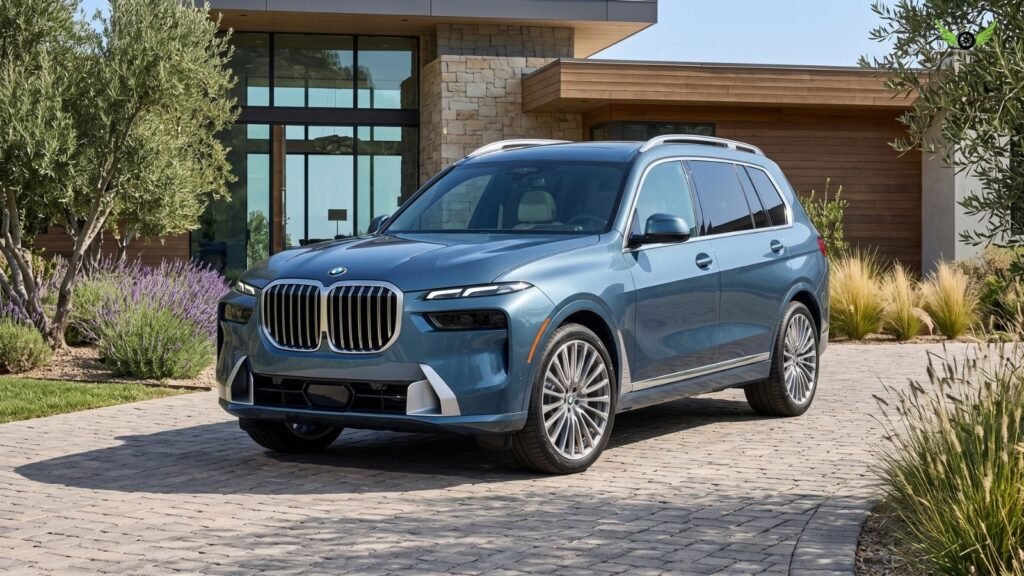
The BMW X7 is a strong choice for buyers who want a premium three-row SUV with better driving dynamics than most vehicles of its size. Its biggest strengths are powerful engines, a comfortable ride, and a high-quality interior. The main compromises are its high price, limited third-row space for adults, and less cargo room than larger rivals such as the Cadillac Escalade.
Best BMW X7 Trim for Different Buyers
According to our experience, the xDrive40i is the best choice for most buyers. Its 375-horsepower turbocharged inline-six provides more than enough power for daily driving and highway travel while offering better fuel economy than the V8. BMW lists the xDrive40i at a starting MSRP of $87,500, compared with $115,000 for the 523-horsepower M60i. Recent Edmunds testing also recommends the xDrive40i as the trim that offers the best balance of performance, efficiency, and available features.
Choose the M60i if strong V8 performance is a priority and the higher price is not a concern. It offers significantly quicker acceleration and more power, but those benefits may not justify the additional cost for buyers primarily looking for a comfortable family luxury SUV.
Pros, Cons & Final Verdict
Pros
- Strong performance and engaging handling for a large three-row SUV
- Comfortable ride and premium first- and second-row seating
- Powerful 375-hp standard engine
- Up to 7,500 pounds of towing capacity when properly equipped
Cons
- Third row is tight for adults on longer trips
- Less cargo space than some full-size luxury rivals
- Many functions rely on touchscreen controls
- High purchase price and optional features can increase the final cost
According to our experience, the BMW X7 is one of the best all-round choices for buyers who value driving performance as much as luxury and practicality. The xDrive40i delivers the best overall balance for most buyers, while the M60i is better suited to those who specifically want V8 power. If maximum third-row space or cargo capacity is your priority, a larger alternative may be a better fit.
2026 BMW X7 Review, Price, Specs & Buying Guide: FAQs
The following questions cover the key information buyers typically want to know before choosing the 2026 BMW X7, from pricing and performance to seating, technology, and overall value. BMW offers the X7 with three rows, standard xDrive all-wheel drive, and two main powertrain options for the 2026 model year.
How much does the 2026 BMW X7 cost?
The 2026 X7 xDrive40i starts at $87,500 MSRP, while the performance-focused M60i starts at $115,000 MSRP, according to BMW USA. Options, taxes, fees, and dealer pricing can increase the final purchase price.
What is the difference between the BMW X7 xDrive40i and M60i?
The xDrive40i uses a 3.0-liter turbocharged inline-six with 48V mild-hybrid technology and produces 375 horsepower. The M60i uses a 4.4-liter twin-turbocharged V8 with 48V mild-hybrid technology and produces up to 523 horsepower in Sport mode, making it the more performance-focused option.
How fast is the 2026 BMW X7?
BMW lists a 0–60 mph time of 5.6 seconds for the X7 xDrive40i. BMW notes that this is a preliminary manufacturer test result and actual acceleration can vary depending on vehicle specification and testing conditions.
Does the BMW X7 have three rows and enough space for families?
Yes. The X7 has three rows and seating for up to seven passengers with a second-row bench as standard. An optional six-seat layout with second-row captain’s chairs is also available. It is a practical choice for families, although buyers who frequently carry adults in the third row should compare interior space with larger alternatives.
Is the BMW X7 all-wheel drive?
Yes. All 2026 BMW X7 models come standard with BMW xDrive intelligent all-wheel drive, which is designed to improve traction and control in varying driving conditions.
Is the BMW X7 better than the Mercedes-Benz GLS or Cadillac Escalade?
There is no single answer for every buyer. The X7 is a strong choice for buyers who value a balance of luxury, performance, and driving dynamics. The GLS is a closer direct competitor with a comfort-focused luxury character, while the Escalade is better suited to buyers who prioritize maximum interior space and capability.
Which BMW X7 trim offers the best value?
According to our experience, the xDrive40i offers the best overall value for most buyers. Its 375-horsepower powertrain provides strong performance, while its lower starting price makes it easier to justify than the M60i for buyers who do not specifically need V8 power.
Is the 2026 BMW X7 worth buying?
The 2026 model is worth considering if you want a premium three-row SUV with strong performance, advanced technology, and a more engaging driving experience than many large luxury SUVs. Before buying, compare trims and options carefully, as the final price can increase significantly with optional equipment.