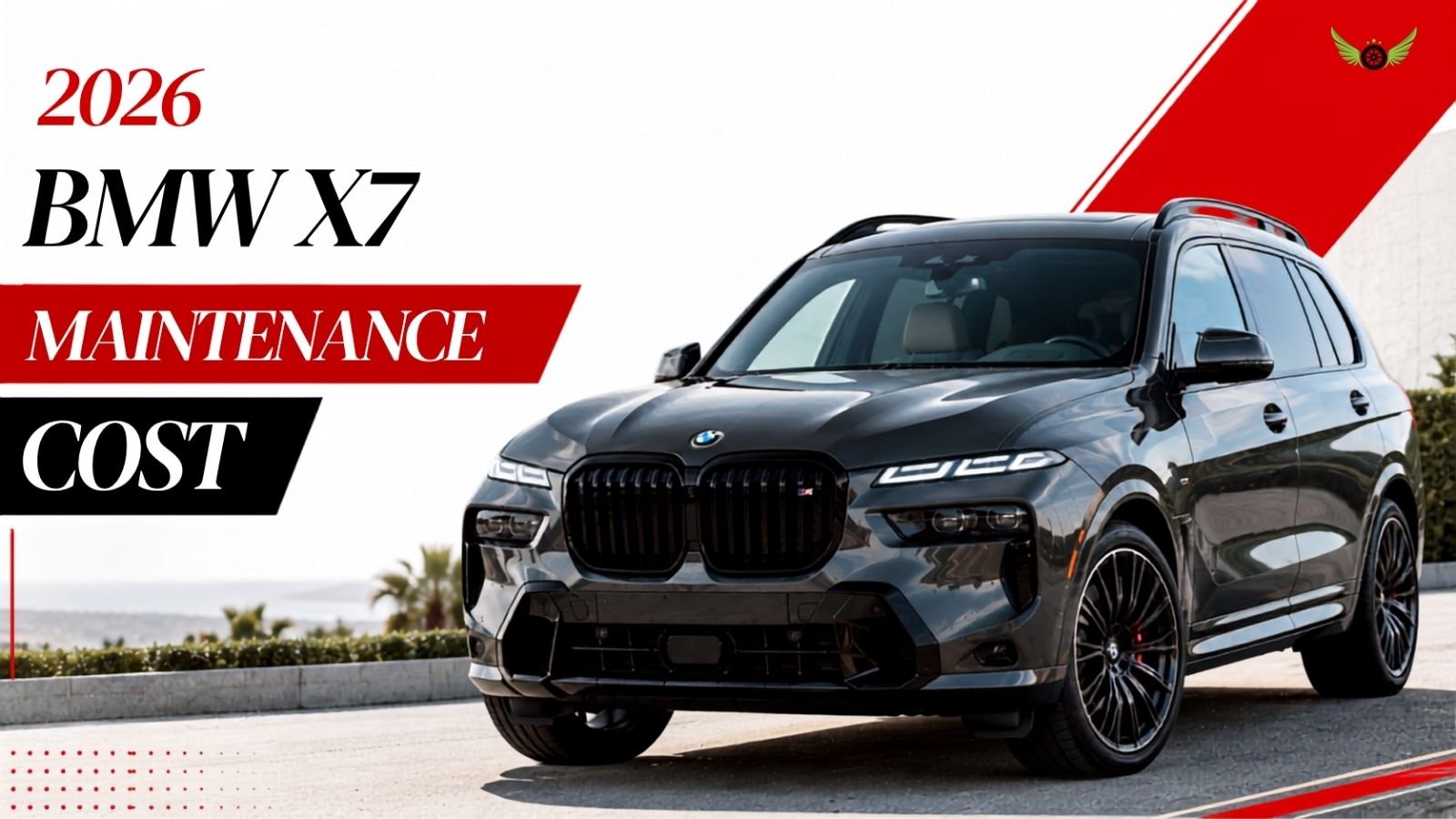
The 2026 BMW X7 is a premium three-row luxury SUV, but its real cost goes far beyond the purchase price. Buyers in the USA should consider fuel, maintenance, insurance, financing, depreciation, and long-term repair costs before deciding whether the X7 fits their budget. BMW currently lists the X7 lineup starting at $87,500 for the xDrive40i, while higher-performance versions cost significantly more.
According to our experience analyzing luxury SUV ownership data, depreciation and ongoing operating costs can have a major impact on the total cost of owning a BMW X7. Estimates also vary by trim and ownership assumptions. For example, Edmunds estimates a five-year True Cost to Own of approximately $108,496 for the 2026 X7 xDrive40i based on 15,000 miles per year, while the M60i estimate is approximately $138,925. These are estimates rather than guaranteed costs, and your actual expenses will depend on location, insurance profile, mileage, financing, and vehicle condition.
This guide examines BMW X7 Ownership Cost, BMW X7 Insurance, expected depreciation and BMW X7 Resale Value, along with the practical costs of keeping this luxury SUV for the long term. The aim is to give USA buyers a clear, realistic picture of what ownership may cost before making a purchase decision.
BMW X7 Ownership Cost Breakdown
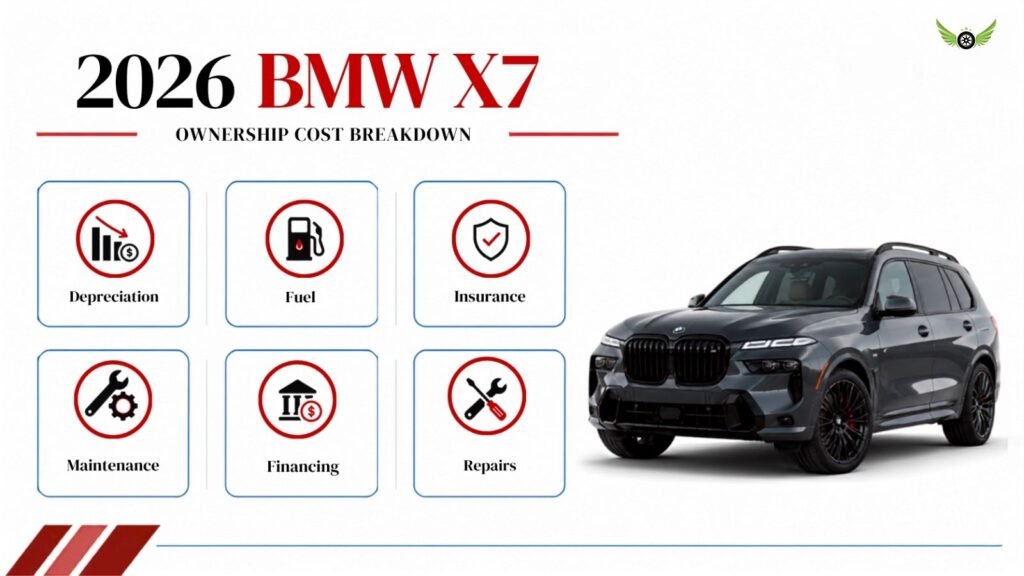
The BMW X7 Ownership Cost is shaped by more than its purchase price. Over five years, major expenses include fuel, maintenance, financing, insurance, repairs, and depreciation. For most buyers, the xDrive40i offers lower running costs, while the V8-powered M60i requires a larger long-term budget.
According to our experience, the best way to evaluate a luxury SUV is to look at the complete ownership picture rather than the monthly payment alone. The following costs show where most of the money goes and what buyers in the USA should consider before purchasing.
Fuel, Maintenance & Financing Costs
Fuel spending varies significantly between trims. The 2026 xDrive40i is rated at 23 mpg combined, while the M60i is rated at 18 mpg combined, so drivers who cover more miles can expect the V8 model to cost noticeably more to fuel.
Edmunds estimates five-year fuel costs of $14,468 for the xDrive40i and $18,486 for the M60i, based on 15,000 miles per year. Its estimates also put five-year maintenance at $9,789 and $10,798, respectively. Financing costs depend heavily on the loan and interest rate, but Edmunds estimates $18,253 for the xDrive40i and $22,758 for the M60i under its ownership assumptions.
Estimated 5-Year Costs | xDrive40i | M60i |
Fuel | $14,468 | $18,486 |
Maintenance | $9,789 | $10,798 |
Financing | $18,253 | $22,758 |
Edmunds estimates based on 15,000 miles driven per year. Actual costs will vary by fuel prices, loan terms, driving habits, and location.
Total 5-Year Ownership Cost
The total five-year cost provides a more realistic view of long-term ownership because it includes depreciation and other expenses that are easy to overlook. According to Edmunds’ current estimates, the 2026 xDrive40i has a five-year True Cost to Own of $108,496, while the M60i is estimated at $138,925.
5-Year Cost Category | xDrive40i | M60i |
Depreciation | $52,644 | $70,788 |
Fuel | $14,468 | $18,486 |
Insurance | $6,263 | $8,081 |
Financing | $18,253 | $22,758 |
Maintenance | $9,789 | $10,798 |
Repairs | $3,055 | $3,055 |
Taxes & Fees | $4,024 | $4,959 |
Total 5-Year Cost | $108,496 | $138,925 |
Source: Edmunds True Cost to Own estimates. These figures are planning estimates, not guaranteed personal expenses.
According to our experience, this comparison makes the ownership trade-off clear: the xDrive40i is the more practical choice for buyers focused on lower operating costs, while the M60i’s stronger performance comes with substantially higher fuel, depreciation, and overall ownership expenses.
BMW X7 Insurance Cost
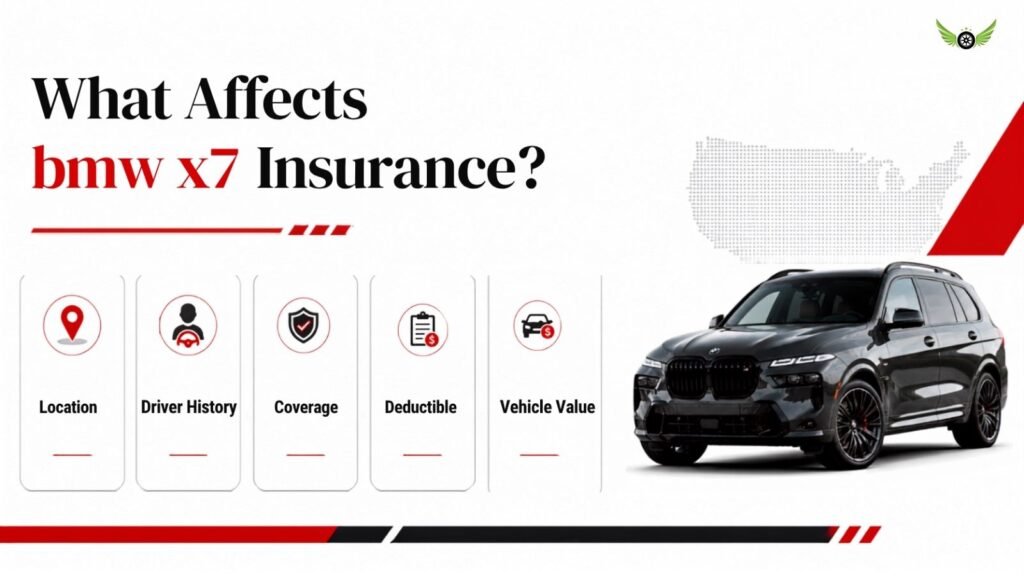
The BMW X7 Insurance cost is typically higher than that of many mainstream SUVs because of its high vehicle value and the cost of repairing luxury components and technology. However, the amount an owner pays can vary substantially depending on the driver, location, coverage, and insurance company.
According to our experience, the most useful approach is to use national averages as a budgeting guide and then compare personalized quotes before buying. This is particularly important for a luxury SUV, where insurance pricing can differ significantly between insurers.
Average Insurance Premium
MoneyGeek’s May 2026 analysis estimates average insurance costs for the X7 at $1,971 per year for state-minimum coverage and $3,858 per year for full coverage. That works out to approximately $164 and $321 per month, respectively. Its analysis also identifies the X7 as one of the more expensive luxury vehicles to insure in its dataset.
Coverage Level | Average Monthly Cost | Average Annual Cost |
State-Minimum Coverage | $164 | $1,971 |
Full Coverage | $321 | $3,858 |
Source: MoneyGeek, 2026. Rates are averages based on the source’s methodology and should be used as a benchmark, not a personalized quote.
Other datasets produce different results. For example, Compare.com’s current BMW insurance data lists an average full-coverage premium of $276 per month for the X7, while CarEdge estimates a higher annual cost under its own standardized driver assumptions. These differences are mainly due to methodology and driver-profile assumptions, which is why one estimate should not be treated as the exact cost for every owner.
According to our experience, a realistic budget should allow for insurance costs to vary rather than relying on one advertised average. Comparing quotes is especially valuable because the insurer you choose can have a meaningful effect on the final premium.
Factors That Affect Insurance Rates
Your actual premium is mainly affected by the following factors:
- Location: State and ZIP code influence rates through local accident, theft, weather, and repair-cost trends.
- Driver history: Accidents, traffic violations, and previous claims can increase premiums.
- Age and driver profile: Insurers use approved rating factors that can vary by state and insurer.
- Coverage and deductible: More protection and lower deductibles generally mean higher premiums.
- Vehicle configuration and repair costs: A higher-value or performance-focused trim may cost more to repair or replace.
- Insurance company: Each insurer prices risk differently, so the same driver can receive significantly different quotes.
The variation between current insurance datasets supports the importance of comparing multiple quotes rather than assuming a single national average will apply to every driver.
BMW X7 Resale Value & Depreciation
The BMW X7 Resale Value is competitive in the luxury large SUV segment, but depreciation remains one of the biggest ownership costs. Over time, mileage, condition, service history, trim, and used-car demand can all influence how much the vehicle is worth when you sell it.
According to our experience, depreciation deserves attention before buying because it can have a larger financial impact than many routine running costs. Buyers who plan to sell within three to five years should consider expected value retention alongside the purchase price.
3-Year & 5-Year Depreciation
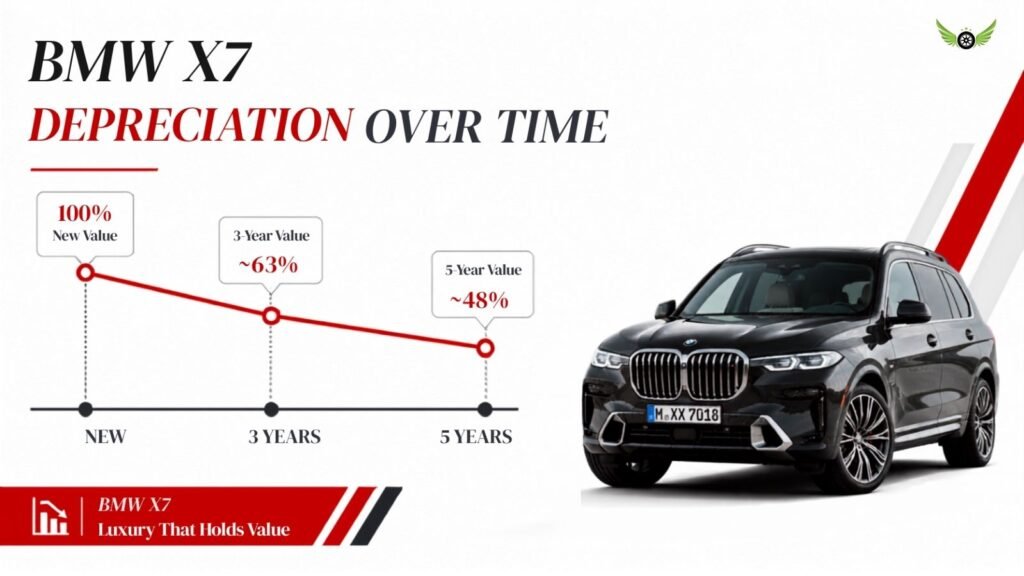
iSeeCars’ current model-level analysis estimates that the X7 depreciates 31.9% after three years and 55.6% after five years. Based on the same analysis, it retains approximately 68.1% of its value after three years and 44.4% after five years. The estimates are based on iSeeCars’ analysis of more than 15 million vehicles and should be viewed as market projections rather than guaranteed resale prices.
Ownership Period | Estimated Depreciation | Estimated Value Retained |
3 Years | 31.9% | 68.1% |
5 Years | 55.6% | 44.4% |
For additional context, iSeeCars estimates the luxury large SUV category loses 54.3% of its value over five years, placing the model slightly below the category average for value retention in its model-level analysis.
Kelley Blue Book also identifies depreciation as a major ownership expense. For the 2026 xDrive40i, its current estimate shows approximately $53,432 in depreciation over five years, although the dollar amount varies with trim and vehicle price.
BMW X7 vs Full-Size Luxury SUV Competitors
Compared with major rivals, resale performance is mixed. iSeeCars’ current head-to-head comparisons show that the Mercedes-Benz GLS has a small advantage in five-year value retention, while the X7 performs better than the Cadillac Escalade and Land Rover Range Rover in those comparisons.
Luxury SUV | Estimated 5-Year Depreciation | Estimated Value Retained |
BMW X7 | 58.0% | 42.0% |
Mercedes-Benz GLS | 56.1% | 43.9% |
Cadillac Escalade | 60.9% | 39.1% |
Land Rover Range Rover | 64.0% | 36.0% |
*Source: iSeeCars‘ current head-to-head model comparisons. View these comparison figures separately from the 55.6% estimate on iSeeCars’ model-level resale page, because the datasets and calculation context can differ.
According to our experience, the practical takeaway is to look at depreciation as part of the complete ownership cost rather than judging resale value alone. The X7 is competitive against several full-size luxury rivals, but buyers focused on maximizing resale value should compare the exact trim, expected mileage, and local used-car market before making a decision.
BMW X7 Long-Term Ownership Experience
Long-term ownership can be rewarding for buyers who value comfort and performance, but running costs become more important as the vehicle ages. The 2026 model includes a 4-year/50,000-mile limited warranty and BMW Ultimate Care scheduled maintenance for 3 years or 36,000 miles, after which owners are responsible for more routine maintenance and repair expenses.
According to our experience, the most important factor in long-term ownership is not simply how many miles the vehicle has—it is how consistently it has been maintained. A complete service history and timely repairs are especially important for a technology-heavy luxury SUV.
High-Mileage Ownership Expectations
There is no exact mileage at which a BMW X7 becomes expensive to own, and the 2026 model itself does not yet have long-term reliability data. However, ownership-cost estimates show that expenses can rise after the included maintenance period ends. Edmunds estimates maintenance and repair costs for the 2026 xDrive40i increase substantially in years four and five under its 15,000-miles-per-year ownership model.
For high-mileage ownership, buyers should expect normal wear items and a greater possibility of repairs involving suspension, electronics, and other complex systems. According to our experience, buying a well-maintained example with documented service history is more important than focusing on mileage alone. This is particularly relevant for used luxury SUVs, where deferred maintenance can lead to higher costs later.
Mild Hybrid vs V8 Ownership Costs
The xDrive40i and M60i both use mild-hybrid systems, but their ownership profiles are quite different. The xDrive40i has a turbocharged 3.0-liter inline-six, while the M60i uses a 4.4-liter twin-turbo V8. The six-cylinder model delivers 375 horsepower and 23 mpg combined, compared with 523 horsepower and 18 mpg combined for the M60i.
Ownership Factor | xDrive40i | M60i |
Engine | 3.0L Turbo Inline-6 Mild Hybrid | 4.4L Twin-Turbo V8 Mild Hybrid |
Combined Fuel Economy | 23 mpg | 18 mpg |
Estimated 5-Year Fuel Cost* | $14,468 | $18,486 |
Estimated 5-Year Maintenance* | $9,789 | $10,798 |
Estimated Total 5-Year Cost to Own* | $108,496 | $138,925 |
*Edmunds estimates based on its five-year ownership methodology and 15,000 miles driven per year. Actual costs can vary by location, driving habits, fuel prices, and financing.
According to our experience, the xDrive40i is the better fit for buyers focused on long-term operating costs, while the M60i is better suited to those who prioritize V8 performance and are comfortable with higher fuel and ownership expenses. Both can be expensive to maintain over time, so budgeting beyond the warranty period is important.
Is the BMW X7 Worth Buying in 2026?
Yes, the BMW X7 is worth buying in 2026 for buyers who want a luxury three-row SUV with strong performance, a comfortable interior, and engaging driving dynamics. However, its high purchase price and long-term ownership costs mean it is best suited to buyers with room in their budget for premium ownership expenses.
The 2026 model has no major changes, and independent testing continues to rate it highly for its combination of comfort, performance, and practicality. Edmunds highlights its strong engines and smooth ride, while noting its high price and limited cargo and third-row space compared with some rivals. Car and Driver also ranks it highly among full-size luxury SUVs, praising its driving character while noting the smaller third row and cargo area.
Who Should Buy the BMW X7?
The X7 is a strong choice for buyers who want:
- A premium three-row SUV with a comfortable, well-appointed cabin.
- Strong performance without giving up everyday usability.
- More engaging handling than many traditional full-size luxury SUVs.
- The flexibility of choosing between the more efficient inline-six and a powerful V8 model.
According to our experience, the xDrive40i is the better choice for most buyers because it provides strong performance with lower fuel and projected ownership costs than the M60i. BMW lists the xDrive40i with a starting MSRP of $87,500, while the M60i starts at $115,000, making the six-cylinder model the more practical entry point into the lineup.
Buyers who need the largest possible third row or maximum cargo space should compare alternatives carefully, as the X7 prioritizes driving dynamics and luxury over outright interior volume.
Final Ownership Verdict
The BMW X7 is one of the more appealing choices in the full-size luxury SUV segment, particularly for drivers who want a vehicle that feels more engaging to drive than its size suggests. But it is not a low-cost ownership proposition. Edmunds estimates five-year ownership costs of $108,496 for the xDrive40i and $138,925 for the M60i under its standardized assumptions, illustrating the importance of budgeting beyond the purchase price. Actual costs will vary by location, mileage, financing, and driving profile.
According to our experience, the final decision comes down to priorities: if you value luxury, performance, and driving enjoyment and can comfortably manage premium running costs, the X7 is a compelling 2026 purchase. For most long-term owners, the xDrive40i offers the better balance of performance and ownership costs, while the M60i is best suited to buyers who place a higher value on V8 performance.
BMW X7 Ownership Cost, Insurance, Resale Value & Long-Term Ownership FAQs
The real cost of owning a luxury SUV goes beyond its MSRP. Buyers usually want clear answers about five-year costs, insurance, depreciation, resale value, long-term expenses, and which trim makes the most financial sense. These FAQs cover those core ownership questions directly. Cost estimates can differ by source because of different assumptions, so individual expenses may vary by location, mileage, financing, and driving profile.
How much does it cost to own a 2026 BMW X7 for five years?
According to Edmunds, the estimated five-year True Cost to Own is $108,496 for the xDrive40i and $138,925 for the M60i, based on 15,000 miles per year and its standardized assumptions. These estimates include depreciation, fuel, insurance, financing, maintenance, repairs, and taxes and fees.
What is the biggest long-term cost of owning a BMW X7?
Depreciation is one of the largest ownership costs. Edmunds estimates $52,644 in five-year depreciation for the xDrive40i, while iSeeCars estimates the model loses approximately 55.6% of its value over five years. The exact amount will depend on trim, mileage, condition, and market conditions.
Is BMW X7 insurance expensive?
Yes, insurance can be expensive compared with mainstream SUVs, although the actual premium varies significantly by driver and location. For example, Edmunds estimates $6,263 in five-year insurance costs for the xDrive40i under its methodology, while other cost models use different assumptions and produce different estimates. A personalized quote is the most reliable figure for an individual buyer.
Does the BMW X7 hold its resale value well?
The X7 has competitive but not exceptional value retention within the luxury large SUV segment. iSeeCars estimates approximately 31.9% depreciation after three years and 55.6% after five years. Service history, mileage, condition, and used-market demand will ultimately affect the actual resale price.
Is the xDrive40i or M60i cheaper to own?
The xDrive40i is the more affordable option to own based on current five-year estimates. It has lower projected fuel, financing, insurance, and depreciation costs than the V8-powered M60i. According to our experience, it offers the better ownership balance for buyers who want strong performance without the higher running costs of the V8.
What should buyers expect after the warranty period?
Owners should expect maintenance and repair costs to become more important as the vehicle ages and mileage increases. The 2026 model is still too new for complete long-term reliability data, so future high-mileage performance cannot yet be confirmed. According to our experience, consistent maintenance and a documented service history are especially important for reducing long-term ownership risk.
Is the BMW X7 worth buying in 2026?
Yes, if you want a premium three-row SUV and are prepared for luxury-level ownership costs. Buyers focused on comfort, performance, and driving experience may find it a strong choice, while those prioritizing the lowest long-term expenses should carefully compare the full ownership budget before buying. For most buyers, the xDrive40i provides a more balanced ownership proposition than the M60i.