The 2026 Honda Africa Twin starts at $15,199 for the six-speed manual and $15,999 for the automatic DCT version, and it remains one of the most dirt-capable big adventure bikes from a mainstream manufacturer. This Honda Africa Twin review covers the current CRF1100L in full: its 1084cc Unicam twin, its 510 lb manual and 535 lb DCT curb weights, its prices from 2024 to 2026, its electronics, and how it feels on the highway and the trail. The short answer in this Honda Africa Twin review is that the standard Africa Twin is the off-road-first member of Honda’s adventure family, with a 21-inch front wheel and a 5.0-gallon tank.
Honda Africa Twin Overview and Model-Year Updates
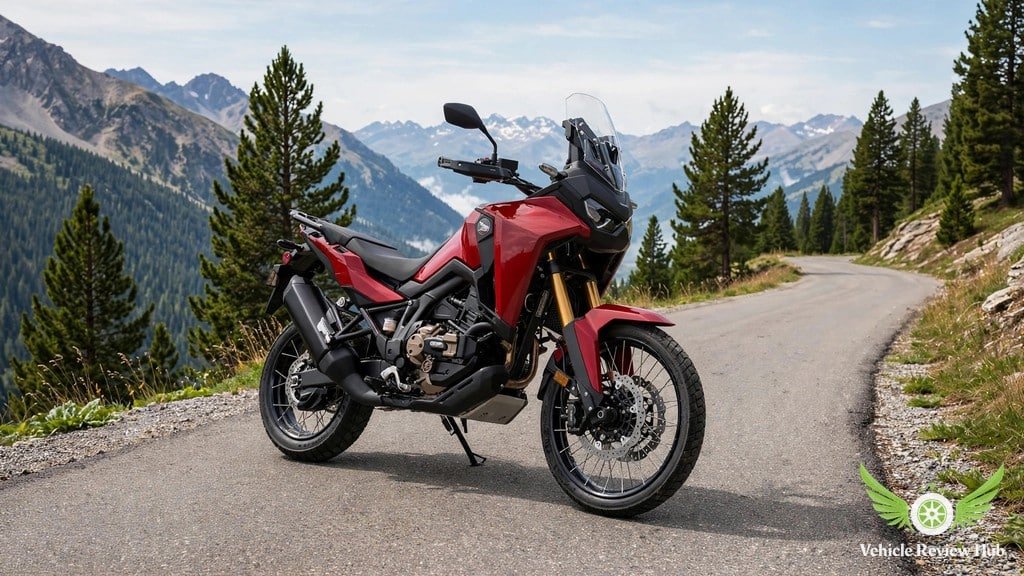
The Africa Twin, the subject of this Honda Africa Twin review, is Honda’s flagship large adventure motorcycle, built around a narrow parallel-twin engine and a rally-bred chassis. In this Honda Africa Twin review, the focus is the standard model: the lighter, more dirt-oriented bike with the 21-inch front wheel, rather than the road-biased Adventure Sports ES.
What Is the Honda Africa Twin and Who Is It Designed For?
The Honda Africa Twin is a large adventure motorcycle for riders who want one bike that can cross a state on the highway and then turn onto forest-service roads without changing anything. In this Honda Africa Twin review, its formula is simple: a slim, torque-rich twin, long-travel suspension, wire-spoked wheels, and a riding position that works standing on the pegs as well as sitting down.
This Honda Africa Twin review identifies the intended buyer as an experienced rider who rides mixed surfaces. As this Honda Africa Twin review explains, it is a dual-purpose tool first and a touring bike second.
US History: CRF1000L 2016, CRF1100L 2020, No 2023 Model and 2024 Update
In this Honda Africa Twin review, the Africa Twin name dates back to Honda’s XRV650 of 1988 and the XRV750 that followed in Europe, but the modern bike arrived in the United States for 2016 as the CRF1000L, powered by a 998cc parallel twin. This Honda Africa Twin review notes that first generation ran through 2019 and built the model’s reputation for durability and easy handling. For 2020, Honda replaced it with the CRF1100L: a larger 1084cc engine, a revised frame with a bolt-on aluminium subframe, a six-axis IMU, a 6.5-inch TFT touchscreen, and cruise control as standard.
American buyers then saw something unusual, this Honda Africa Twin review records: the Africa Twin was missing from Honda’s 2023 United States lineup entirely. It returned for 2024 with a revised airbox and valve timing, a higher 10.5:1 compression ratio for stronger low and midrange torque, a redesigned fairing, a five-position windscreen, tubeless tires, and revised DCT software. The 2025 models carried those updates over unchanged, and this Honda Africa Twin review tracks the 2026 price increase in the pricing section below.
Honda Africa Twin Engine and Specifications
The heart of the Africa Twin is its 1084cc Unicam parallel twin, a deliberately narrow engine that keeps the bike slim between the rider’s knees. This Honda Africa Twin review looks at the numbers that matter most: power delivery, weight, seat height, and the suspension and braking hardware that define how the bike behaves off the pavement.
1084cc Unicam Parallel Twin, Manual Gearbox and DCT Options
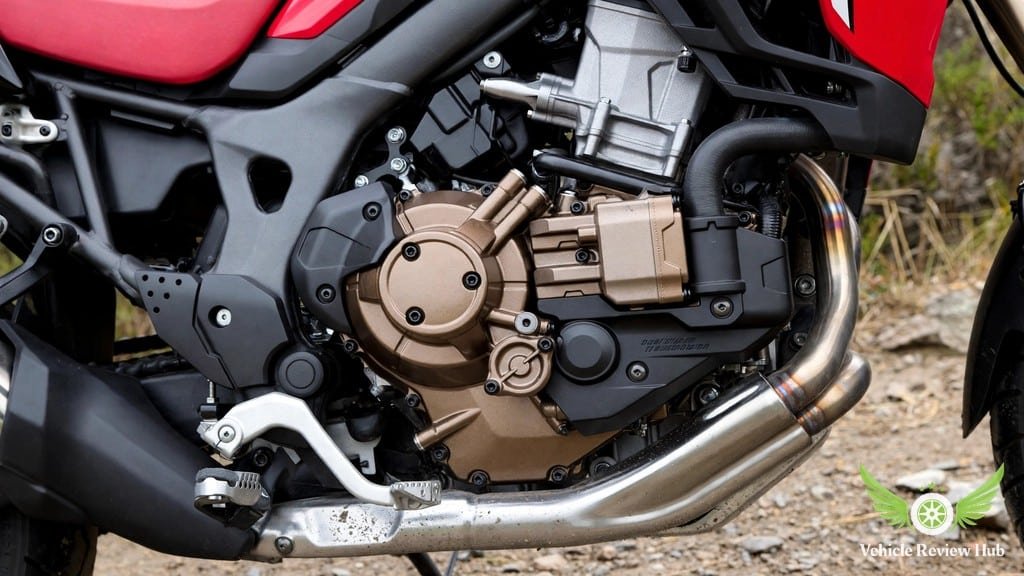
The engine examined in this Honda Africa Twin review is a liquid-cooled, 1084cc parallel twin with Honda’s Unicam SOHC valve train, four valves per cylinder, and a 270-degree crankshaft that gives it the uneven, V-twin-like pulse riders praise for traction feel on loose surfaces. Honda’s United States specification page does not publish a horsepower figure; press materials citing Honda put claimed output at about 101 hp at 7,500 rpm with roughly 83 lb-ft of torque at 5,500 rpm. This Honda Africa Twin review treats those as crankshaft claims, not rear-wheel measurements.
In this Honda Africa Twin review, buyers choose between a six-speed manual gearbox with a slipper clutch and Honda’s six-speed Dual Clutch Transmission, which shifts automatically or by handlebar paddles and offers Drive plus three Sport modes. Measured performance figures are covered separately; for this Honda Africa Twin review the key point is flexibility: the twin pulls cleanly from low rpm, and the DCT option suits riders who prefer not to manage a clutch in traffic or on technical trails.
Weight 510 lb Manual and 535 lb DCT, Seat Height and Specifications
For this Honda Africa Twin review, Honda lists the standard Africa Twin at 510 lb curb weight with the manual gearbox and 535 lb with DCT, measured with all standard equipment, required fluids, and a full 5.0-gallon tank. Seat height, a key figure in this Honda Africa Twin review, is 34.3 inches (standard) and 33.5 inches (low), with accessory Comfort and Low seats available. The steel semi-double-cradle frame carries a 45mm inverted Showa SFF-BP fork and a Pro-Link Showa rear shock.
| Specification | 2026 Honda Africa Twin (manual) | 2026 Honda Africa Twin (DCT) |
|---|---|---|
| Engine | 1084cc liquid-cooled parallel twin, Unicam SOHC | Same |
| Bore x stroke / compression | 92.0mm x 81.5mm / 10.5:1 | Same |
| Transmission / final drive | 6-speed manual / #525 chain, 16T/42T | 6-speed DCT / #525 chain, 16T/42T |
| Curb weight | 510 lb | 535 lb |
| Seat height / fuel capacity | 34.3 in (standard) / 33.5 in (low) / 5.0 gallons | Same |
| Wheelbase / ground clearance | 62.0 in / 9.8 in | Same |
| Front / rear brakes | Dual 310mm discs, 4-piston calipers / single 256mm disc | Same |
| Warranty | Transferable one-year limited warranty | Same |
The table above follows Honda’s 2026 Africa Twin specification page, the authoritative source for the current model’s weights and dimensions, and this Honda Africa Twin review uses those figures throughout.
Honda Africa Twin Price and Market Availability
Pricing is where the Africa Twin, in this Honda Africa Twin review, makes its strongest case against European rivals: it undercuts most large adventure bikes while including the full electronics package as standard. This Honda Africa Twin review lists the verified United States prices for the standard model from its 2024 return through 2026, plus the Adventure Sports ES figures for comparison.
Honda Africa Twin Price by Year in the USA: 2024 to 2026
The standard Africa Twin returned for 2024 at $14,799 for the manual and $15,599 for the DCT, and those prices carried over unchanged for 2025. For 2026, Honda raised both by $400: the manual now lists at $15,199 and the DCT at $15,999, with a $775 destination charge added in all three years. All prices in this Honda Africa Twin review exclude tax, title, registration, and dealer fees.
| Model year | Africa Twin manual | Africa Twin DCT | Adventure Sports ES manual | Adventure Sports ES DCT |
|---|---|---|---|---|
| 2024 | $14,799 | $15,599 | $17,599 | $18,399 |
| 2025 | $14,799 | $15,599 | $17,599 | $18,399 |
| 2026 | $15,199 | $15,999 | $17,799 | $18,599 |
| Destination charge | $775 | $775 | $775 | $775 |
The 2024 and 2025 prices above are confirmed by Rider Magazine’s 2024 first look and Motorcyclist’s 2025 preview, while the 2026 figures come from Honda’s own model pages. Note that some low-quality aggregator pages quote a $14,399 base price for 2025; that figure is wrong, and this Honda Africa Twin review uses the $14,799 figure confirmed by multiple established outlets. Shoppers should also check current used prices.
Pearl White and Matte Black Colours and Official US Dealer Availability
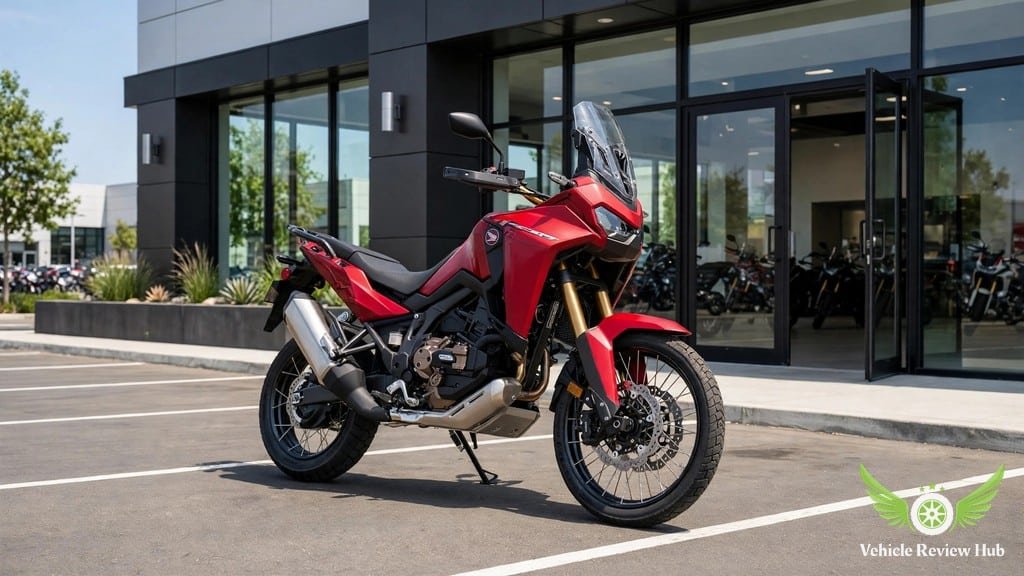
Colours have changed almost every year, so this Honda Africa Twin review advises checking the model year before assuming a colour is available. The 2024 standard Africa Twin came only in Grand Prix Red. For 2025, the standard and DCT versions were dressed in Matte Black Metallic, while the Adventure Sports ES versions came in Pearl White. For 2026, Honda lists the standard Africa Twin in both Pearl White and Matte Black Metallic, each at the same $15,199 manual price.
Availability in the United States is through Honda’s official powersports dealer network, and the Africa Twin is a regular catalog model rather than a limited edition, so most large dealers can order one if they do not stock it. This Honda Africa Twin review recommends verifying colour and trim on Honda’s model page or with the dealer.
Honda Africa Twin Design, Features and Technology
The Africa Twin’s design, assessed in this Honda Africa Twin review, follows its Dakar inspiration: a slim rally-style fairing, a tall windscreen, a high front fender, and a narrow seat-to-tank junction that lets the rider move around off-road. This Honda Africa Twin review separates the standard model’s hardware from the Adventure Sports ES, because several headline features differ between the two, and confusing them is the most common mistake in online summaries.
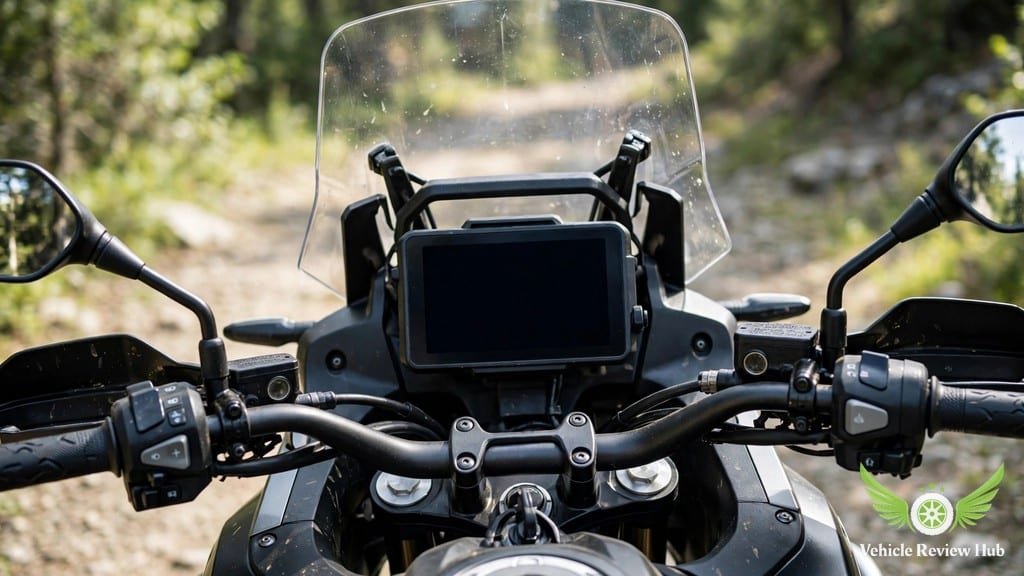
21-Inch Front Wheel, Tubeless Tires From 2024 and Adventure Styling
The standard Africa Twin rides on a 21-inch front wheel and an 18-inch rear wheel, both wire-spoked, wearing a 90/90-21 front tire and a 150/70R-18 rear. The 21-inch front rolls over obstacles more easily and pairs with the long-travel suspension on rough ground. From 2024, those wire-spoked wheels use tubeless rims, a major practical upgrade, because a tubeless puncture can usually be plugged at the roadside without removing the wheel.
This Honda Africa Twin review finds styling functional rather than decorative. Ultimate Motorcycling’s 2024 buyer’s guide confirms the tubeless change and the standard model’s dirt-ready chassis, and this Honda Africa Twin review stresses the point: if your riding includes real trails, the standard model’s 21-inch wheel is the reason to choose it.
Six Ride Modes, Cornering ABS, Cruise Control and TFT With CarPlay
Electronics, a highlight of this Honda Africa Twin review, are standard across the range, not reserved for the ES. A Bosch six-axis IMU feeds cornering-aware ABS with an off-road setting that disables rear ABS, seven levels of Honda Selectable Torque Control, three levels of wheelie control, rear lift control, and engine-braking control. Six riding modes are available: Tour, Urban, Gravel, and Off-Road as presets, plus two fully customizable User modes. Cruise control, this Honda Africa Twin review confirms, is standard on every Africa Twin, including the standard model, which surprises buyers who assume it is an ES-only feature.
The 6.5-inch TFT touchscreen display offers three display options and supports Apple CarPlay and Android Auto as standard, with Bluetooth audio for optional headsets. Honda groups accessories into four packs, Rally, Adventure, Travel, and Urban, covering engine guards, panniers, a top box, a centerstand, heated grips, fog lights, and a quickshifter for the manual model. Heated grips are standard on the ES but an accessory on the standard bike, so this Honda Africa Twin review advises budgeting accordingly for cold-weather riding.
Honda Africa Twin Riding Experience and Comfort
On the move, the Africa Twin feels lighter than its 510 lb curb weight suggests, thanks to a low center of gravity and a compact engine. This Honda Africa Twin review draws on published first rides and owner feedback rather than invented test miles, and the consistent message is balance: stable at highway speed, manageable at walking pace, and capable when the pavement ends.
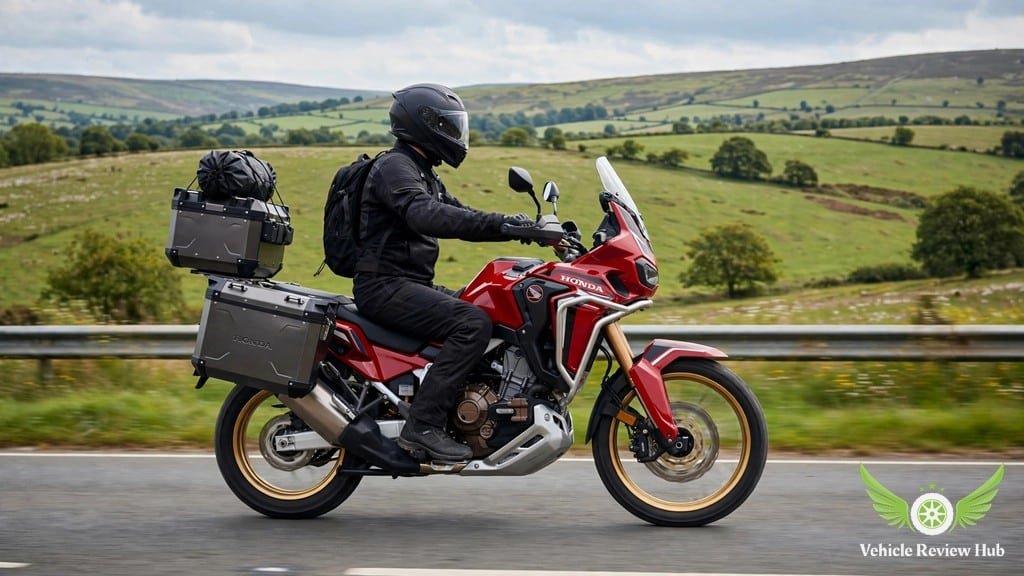
Riding Position, Handling and Low-Speed Maneuverability
The riding position is upright and roomy, with wide handlebars, a slim seat-to-tank junction, and footpegs placed for both seated cruising and standing off-road. At low speed, smooth torque and a light clutch make U-turns less stressful, and the DCT version removes clutch management entirely.
This Honda Africa Twin review finds handling rewards a relaxed style. The 21-inch front wheel steers more slowly than a 19-inch or 17-inch wheel, which feels stable on gravel and at speed but slightly less eager in tight corners. The video below shows a first ride on a 2026 Africa Twin build over pavement, logging roads, and rougher terrain.
Watch this first ride to see how the Africa Twin handles mixed-surface riding:
Highway Comfort, Off-Road Riding and Everyday Practicality
On the highway, the five-position windscreen, cruise control, and smooth twin make long days easy, and the fairing keeps wind off the rider’s chest . Fuel range needs planning: Honda publishes no MPG figure, and with a 5.0-gallon tank, riders should plan fuel stops around 200 miles. Owner-logged data (Fuelly, 2017 CRF1000L ABS) averages 47.8 mpg, or roughly 200 to 240 miles per tank, and that range is examined in the performance figures analysis.
Off-road, the standard model in this Honda Africa Twin review comes into its own. The 21-inch front wheel, 9.8 inches of ground clearance, long-travel suspension, and off-road ABS setting give it an advantage over road-biased rivals, and the G switch on DCT models helps on steep, technical ground. Overall, this Honda Africa Twin review rates it as a strong all-rounder.
Honda Africa Twin Review: Pros, Cons and Verdict
The verdict in this Honda Africa Twin review is clear: the standard Africa Twin is the best value in Honda’s adventure range for riders who leave the pavement. It gives up some touring comfort, this Honda Africa Twin review notes, to the Adventure Sports ES, but it costs roughly $2,600 less than the equivalent ES and keeps the hardware that matters off-road.
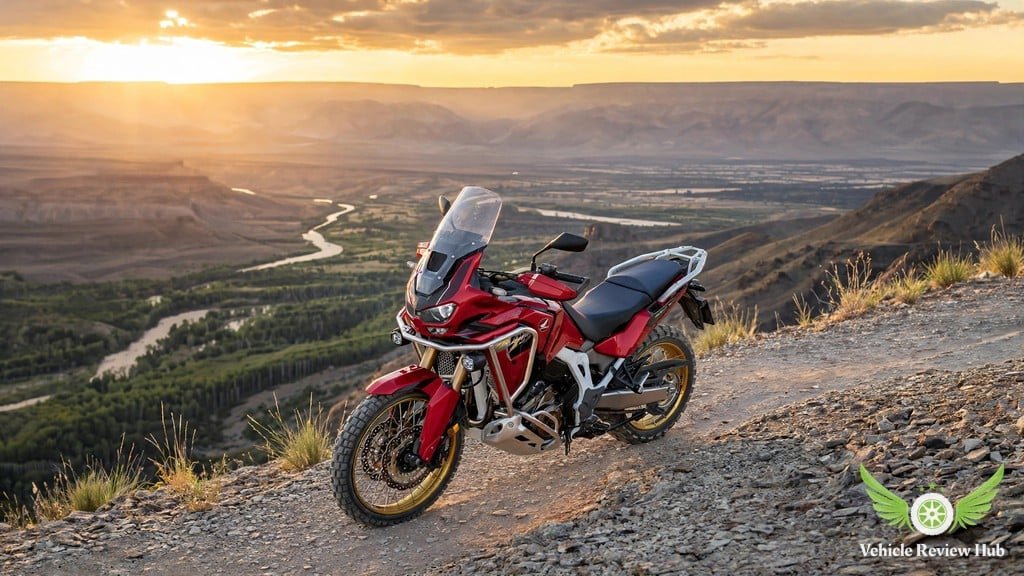
Main Advantages and Limitations of the Honda Africa Twin
The table below weighs the standard model’s strengths against its compromises, all covered in detail above.
| Advantages | Limitations |
|---|---|
| 21-inch front wheel and long-travel suspension for real off-road ability | Tall 34.3-inch seat height excludes shorter riders without the low seat |
| Full electronics package standard, including cruise control and CarPlay | 5.0-gallon tank limits range compared with the ES and some rivals |
| Competitive pricing from $15,199 with a $775 destination charge | Chain final drive needs regular maintenance versus shaft drive |
| Tubeless wire-spoked wheels from 2024 for easy puncture repair | No 2023 US model, so used buyers face a one-year gap in listings |
| Manual or DCT choice with the same engine and chassis | Honda publishes no horsepower or MPG figure for direct comparison |
Long-term durability and service costs are covered in the reliability and maintenance guide, which prospective owners should read alongside this Honda Africa Twin review before committing.
Who Should Consider the Honda Africa Twin Over the Adventure Sports ES?
Choose the standard Africa Twin for regular dirt roads, trails, or rough surfaces. Its 21-inch front wheel, lighter weight, and lower price make it the better tool for that use.
| Difference | Standard Africa Twin | Adventure Sports ES |
|---|---|---|
| Front wheel | 21-inch wire-spoked | 19-inch wire-spoked |
| Fuel tank | 5.0 gallons | 6.6 gallons |
| Seat height | 34.3 / 33.5 inches | 33.7 / 32.9 inches |
| Curb weight (manual / DCT) | 510 / 535 lb | 535 / 559 lb |
| 2026 price (manual / DCT) | $15,199 / $15,999 | $17,799 / $18,599 |
Choose the Adventure Sports ES instead, this Honda Africa Twin review suggests, if your riding is mostly paved or you want the longest range between fuel stops. For everyone else, this Honda Africa Twin review recommends the standard model.
Honda Africa Twin Review: Frequently Asked Questions
These answers cover the questions buyers ask most, using the verified figures from this Honda Africa Twin review.
How much does a Honda Africa Twin cost in the USA?
The 2026 standard Africa Twin costs $15,199 with the manual gearbox and $15,999 with DCT, plus a $775 destination charge. The 2024 and 2025 models were $14,799 manual and $15,599 DCT, so the 2026 increase is $400. Taxes, title, registration, and dealer fees are extra.
What engine does the Honda Africa Twin have?
The current Africa Twin uses a liquid-cooled 1084cc parallel twin with Honda’s Unicam SOHC valve train, four valves per cylinder, and a 270-degree crankshaft. Claimed output is about 101 hp at 7,500 rpm with roughly 83 lb-ft of torque at 5,500 rpm
How heavy is the Honda Africa Twin?
Honda lists the standard Africa Twin at 510 lb curb weight with the manual gearbox and 535 lb with DCT, measured with a full 5.0-gallon tank.
What is the seat height of the Honda Africa Twin?
Seat height is 34.3 inches in the standard position and 33.5 inches in the low position, which is tall for many riders. Honda offers accessory Comfort and Low seats, and the bike’s narrow midsection helps shorter riders reach the ground.
What is the fuel range of the Honda Africa Twin?
Honda publishes no MPG figure, so range depends on riding style. With a 5.0-gallon tank and owner-logged data (Fuelly, 2017 CRF1000L ABS) averaging 47.8 mpg, a realistic planning figure is roughly 200 miles between fuel stops
Does the Honda Africa Twin have tubeless tires?
Yes, from 2024 onward, this Honda Africa Twin review confirms. The standard model’s 21-inch front and 18-inch rear wire-spoked wheels use tubeless rims, so most punctures can be plugged at the roadside without removing the wheel. Earlier CRF1100L models used tubed tires.
What is the difference between the Africa Twin and the Adventure Sports ES?
In this Honda Africa Twin review, the standard Africa Twin is the off-road model with a 21-inch front wheel, a 5.0-gallon tank, conventional suspension, and a lower price. The Adventure Sports ES is the touring model with a 19-inch front wheel, a 6.6-gallon tank, electronic suspension, a lower seat, and heated grips as standard.
Are there any recalls on the Honda Africa Twin?
United States recall actions have covered the CRF1100 range, including an FI-ECU software issue and a left-handle-switch wiring harness issue, and used buyers should run the VIN through Honda’s or NHTSA’s recall lookup before purchase. Full details are covered in the reliability and maintenance guide.
Is the Honda Africa Twin good for beginners?
Its power delivery is friendly and its electronics are confidence-inspiring, but its 34.3-inch seat height and 510 lb weight make it a challenging first motorcycle. This Honda Africa Twin review recommends it for experienced riders, or for confident newer riders coming from a lighter adventure or dual-sport bike.