Yes, the Honda Africa Twin is reliable. Honda Africa Twin reliability rests on a strong engine, gearbox and frame that rarely trouble owners, backed in the United States by a transferable, one-year, unlimited-mileage limited warranty, with extended HondaCare cover available. The honest picture of Honda Africa Twin reliability has more detail: early spoke corrosion, fork stiction, touchscreen trouble, and three recalls to check before you buy. This guide covers Honda Africa Twin reliability: scores, problems, schedule, tires, brakes, costs and recall checks.
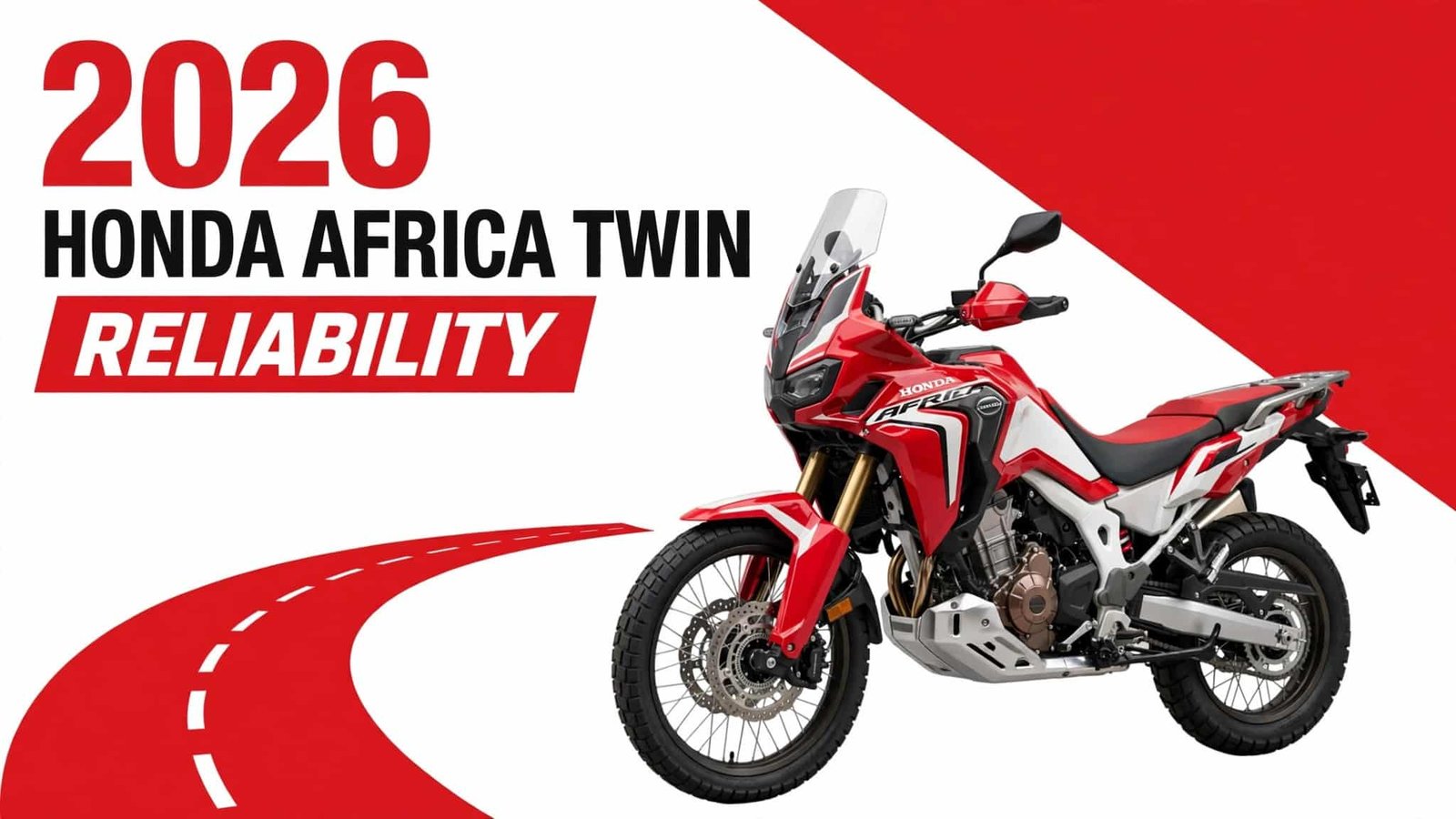
The standard bike pairs a 1084cc Unicam twin with a 21-inch front wheel and a 5.0-gallon tank; our Africa Twin review covers its riding impressions. For Honda Africa Twin reliability, do not confuse it with the Adventure Sports ES, a different line with electronic suspension, a 19-inch front wheel and a 6.6-gallon tank.
Honda Africa Twin Reliability Overview
Honda Africa Twin reliability is best judged in two parts: the powertrain, which rarely troubles owners, and the running gear and electronics, which reward inspection.

MCN Owners 4.6 Out of 5 and Reliability 4.8 From 15 Reviews
MotorCycle News lists the standard CRF1100L (2020 onward) at 4.6 out of 5 from owners and 4.8 out of 5 for reliability. For Honda Africa Twin reliability those are strong numbers, but from only 15 owner reviews, so treat them as a signal, not a precise measurement. Compare the range in MCN’s Honda adventure listings, but keep sample sizes in view.
| Model | Owners | Reliability | Reviews |
|---|---|---|---|
| CRF1100L standard | 4.6 out of 5 | 4.8 out of 5 | 15 |
| CRF1000L (2016–2019) | 4.4 out of 5 | 4.2 out of 5 | 41 |
| Adventure Sports | 4.2 out of 5 | 3.8 out of 5 | 4 |
| ES DCT | 2.0 out of 5 | 2.0 out of 5 | 1 |
The table shows why model lines must not be mixed. The earlier CRF1000L has a broader base of 41 reviews and a lower reliability score of 4.2, fitting its known spoke issue. The Adventure Sports figure comes from 4 reviews and the ES DCT figure from one. For Honda Africa Twin reliability, the only score worth quoting for the standard bike is the 4.6 and 4.8 pair from 15 reviews, always with the small-sample warning attached.
How Mileage, Maintenance History and Previous Use Affect Reliability
Mileage alone tells you little about Honda Africa Twin reliability. A 40,000-mile bike with dealer stamps every 8,000 miles is usually safer than a 12,000-mile bike that sat unridden, missed services and shows spoke corrosion. Service history matters more than the odometer because valve and fork work are interval- and condition-driven. Ask for receipts, not just a stamped book: they show whether oil, filters and chain actually changed and whether recalls were completed. Previous use matters too: a touring bike typically shows even tire wear, while a hard off-road bike may show bent levers and weeping fork seals. Buyers checking a used example should follow a structured pre-purchase inspection before money changes hands. That discipline is what Honda Africa Twin reliability looks like when buying used.
Honda Africa Twin Common Problems and Wear Items
Honda Africa Twin reliability has no single defining fault: spoke corrosion, fork stiction, touchscreen trouble, and consumables like chains and sprockets.
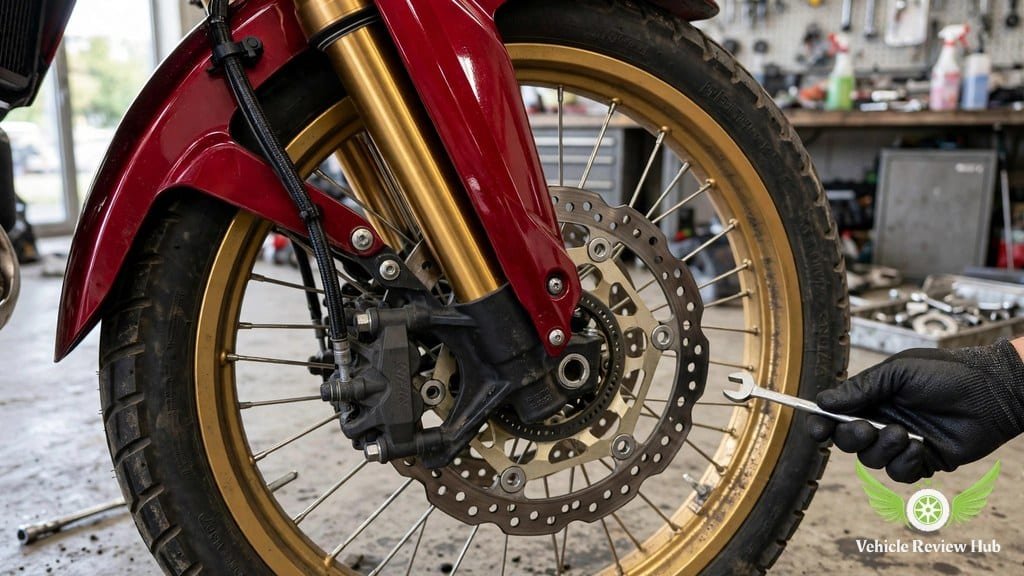
Spoke Corrosion on 2016-2017 Bikes, Fork Stiction and TFT Screen Issues
Spoke corrosion is the best-documented early problem for Honda Africa Twin reliability. Original spokes on 2016–2017 bikes corrode quickly, even with anti-rust spray, and Honda replaced many wheels under warranty. The 2018–2019 models use stainless steel spokes, so a 2016 or 2017 bike with bright spokes has usually had warranty wheels or a re-spoke; dull, rusty spokes are a bargaining point. Bennetts’ CRF1000L buying guide records the same pattern and notes fastener corrosion.
Fork stiction needs a balanced telling for Honda Africa Twin reliability. On some 2016 and 2017 bikes, upper fork-tube anodizing wears where the upper bushing rubs near the lower triple clamp, causing notchiness over small bumps, sometimes after as little as 6,000 miles. Shops address it with hard-anodizing and bushing replacement. Honda’s response, through a US representative, was that complaints mostly came from compressing forks while stationary, warranty claims were few, and investigation with Japan found no functional problem with some fork wear. There is no recall for fork stiction.
TFT trouble is a known Honda Africa Twin reliability niggle on later, touchscreen-equipped bikes. Owners report the 2021-onward touchscreen dash stopping responding to touch, particularly in colder climates, and faulty units have been replaced under warranty, though some replacements develop the same issue. Because the strongest TFT complaints come from Adventure Sports and ES listings, do not treat an ES-only complaint as a standard-model fact: on a standard CRF1100L, check the touchscreen responds across the display and Bluetooth pairs.
DCT System, Chain, Sprockets, Battery and Electrical Checks
The Dual Clutch Transmission has a good record for Honda Africa Twin reliability, and forum talk of gearbox trouble is described as very, very rare. What the DCT adds is a second oil filter: the clutch oil filter, part number 15412-MGS-D21, is replaced when the engine oil filter is replaced, so DCT servicing costs slightly more. The chain most affects day-to-day Honda Africa Twin reliability: Honda calls for inspection and lubrication every 600 miles, and a dry or uneven chain wears sprockets fast. Check both sprockets for hooked teeth and replace chain and sprockets as a set when either is worn. Bennetts also reports starting faults from sticking starter switches and some headlight and DCT switchgear faults, which is why the 25V-583 recall below matters.
Honda Africa Twin Maintenance Schedule and Servicing
The factory schedule is the backbone of Honda Africa Twin reliability: oil every 8,000 miles, a valve inspection every 16,000 miles, and routine checks in between.
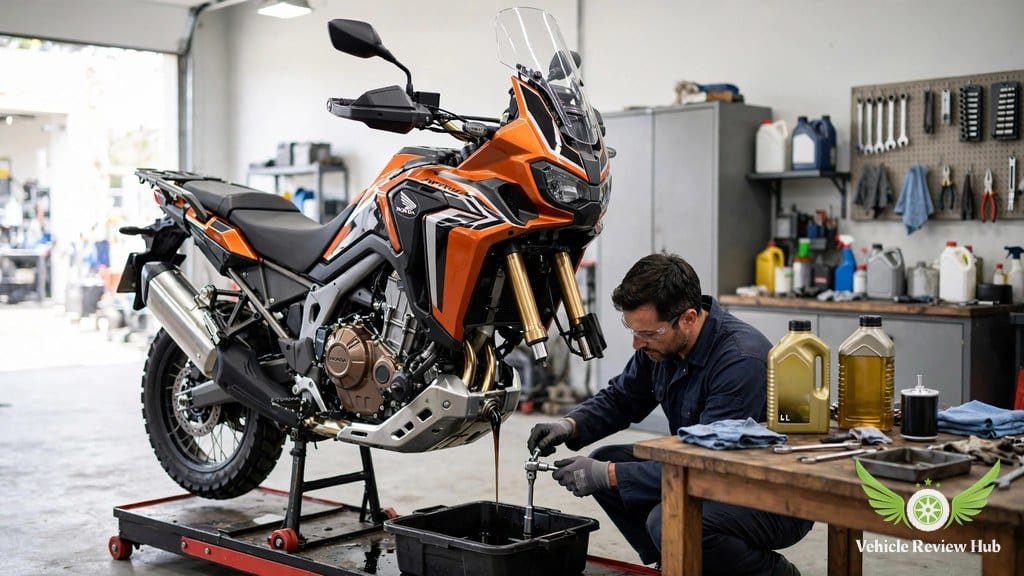
Oil Every 8,000 Miles, Filters and Routine Maintenance Checks
Engine oil changes fall every 8,000 miles or 1 year, whichever comes first, after an initial service at 600 miles: the single most important habit for Honda Africa Twin reliability. The manual specifies JASO MA, SAE 10W-30, API SJ or higher, excluding Energy Conserving or Resource Conserving oils. Capacities differ by gearbox: a manual CRF1100A takes 4.1 quarts after draining and 4.2 with a filter change, while a DCT CRF1100D takes 4.2 after draining and 4.4 with the engine and clutch filters changed. The oil and air filters are replaced every 16,000 miles (air filter as a dealer service), spark plugs every 32,000 miles with a 16,000-mile inspection note, brake fluid every 2 years, and the chain every 600 miles. See the 2022 owner’s manual maintenance chart and the CRF1100L maintenance schedule.
| Item | Interval | Notes |
|---|---|---|
| First service | 600 miles | Initial service |
| Engine oil | Every 8,000 miles or 1 year | 10W-30, JASO MA |
| Oil filter | Every 16,000 miles | DCT adds clutch filter |
| Air filter | Every 16,000 miles | Dealer service |
| Valve clearance | Every 16,000 miles or 2 years | Adjust if needed |
| Spark plugs | Every 32,000 miles | Inspect at 16,000 |
| Chain care | Every 600 miles | Freeplay 35–45 mm |
| Brake fluid | Every 2 years | Replace |
The video below walks through a 6-speed CRF1100 oil change.
Valve-Clearance Inspection Every 16,000 Miles Explained
Valve clearance is the small camshaft-to-valve gap, which changes slowly as valves and seats wear. Too little clearance and a valve may not close fully, risking poor starting, lost compression and a burnt valve. Too much clearance makes the valvetrain noisy and costs a little performance. The manual calls for inspection every 16,000 miles or 2 years, adjusting only valves outside specification. On the Unicam head the work needs the tank and bodywork off, feeler gauges, and shims, so most owners leave it to a dealer. Treat a used bike approaching 16,000 or 32,000 miles without a valve receipt as a bike with a bill coming. Valve receipts at the right intervals tell you more about Honda Africa Twin reliability on that bike than any advert claim. Valve health is a quiet part of Honda Africa Twin reliability.
Honda Africa Twin Tires, Brakes and Suspension Maintenance
Tires, brakes and suspension decide how an Africa Twin feels and stops, and good maintenance here protects Honda Africa Twin reliability directly.
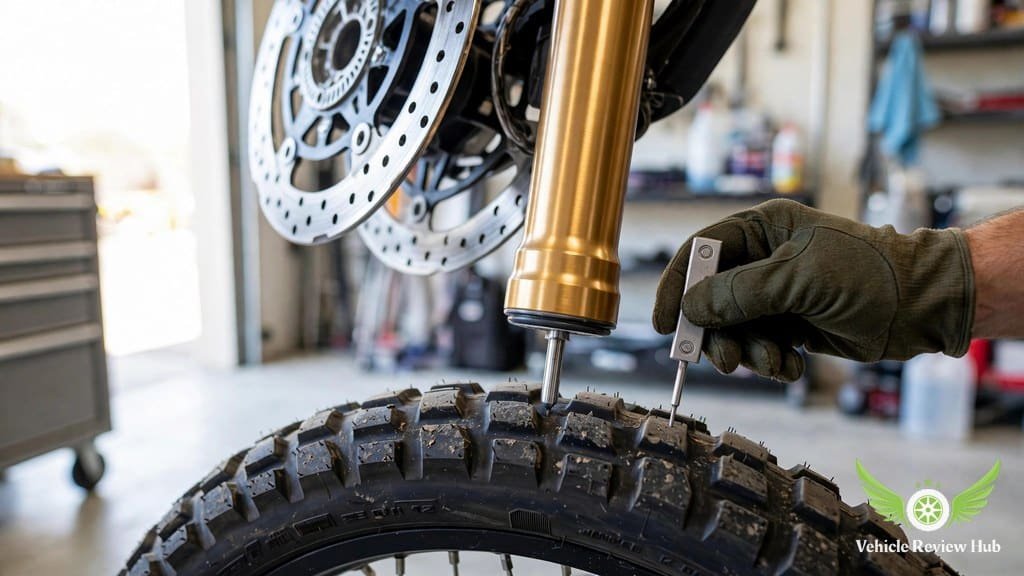
Tire Condition, Pressure, Tread Wear and Replacement
The standard Africa Twin uses a 90/90-21 front tire and a 150/70-18 rear tire, and from 2024 its wire-spoke wheels carry tubeless rims, simplifying roadside puncture repair. Cold pressures from the manual label are 33 psi front and 36 psi rear for rider only, and 33 psi front and 41 psi rear with a passenger. Check pressures cold, since a hot reading misleads. Tread condition matters more than age: look for squared-off rear profiles, sidewall cracking, and cuts or stones from off-road use. Knobby tires wear faster on pavement; road-biased tires last longer but give up off-road grip. Correct tire care is part of Honda Africa Twin reliability: keep the sizes correct, since a wrong-size tire changes handling and ABS behaviour.
Brake Pads, Brake Discs, Forks and Rear Suspension Checks
Braking comes from dual 310 mm front discs with four-piston calipers and a single 256 mm rear disc, with ABS as standard; the DCT version adds a cable-actuated parking brake. Check pad thickness at every service: pads worn to backing plates score discs and turn a cheap job expensive. Check discs for warping, felt as pulsing at the lever, and for scoring or a lip, and replace brake fluid every 2 years, since old fluid absorbs moisture and softens the lever. The front suspension is a 45 mm inverted fork with 9.1 inches of travel (230 mm): look for oil mist on the tubes, feel for notchiness suggesting the stiction wear described earlier, and keep tubes clean. At the rear, check shock and linkage for leaks, play and corrosion, and set sag and preload for your load. For Honda Africa Twin reliability, maintained suspension feels precise at high mileage; ignored suspension is why a used adventure bike feels tired. Brake care matters just as much for Honda Africa Twin reliability, since worn pads and old fluid degrade stopping power long before they cause a failure.
Honda Africa Twin Maintenance and Ownership Costs
Ownership costs are moderate for a large adventure bike, dominated by fuel, tires and servicing: the practical meaning of Honda Africa Twin reliability.
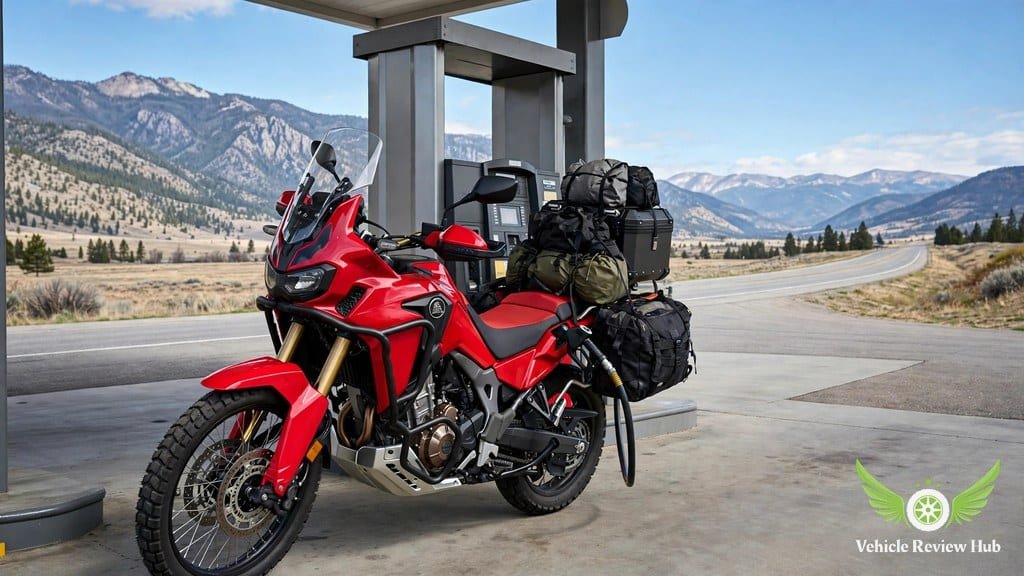
Fuel, Routine Servicing, Tires and Replacement Parts
Fuel is the most frequent cost, and disciplined fuel and servicing habits underpin Honda Africa Twin reliability. The standard bike carries 5.0 gallons including a 1.0-gallon reserve, and Honda USA publishes no official MPG figure. Owners and testers commonly report roughly 40–50 mpg in mixed use, or roughly 200–250 miles per standard tank; headwinds, luggage, knobby tires and off-road riding pull the figure down. The fuel economy picture is covered in the performance analysis, but for budgeting, plan around the low end of that range. Doing your own oil changes saves labour but not the oil itself, at 4.1–4.4 quarts per change plus filters, and the DCT bike’s extra clutch oil filter adds a small parts cost. Tires are the other regular bill: adventure tires wear faster than road tires, knobby tires fastest. Replacement parts are a strength for Honda Africa Twin reliability: pads, chains, sprockets, filters and fork seals are stocked items, not special orders.
Repair Expenses, Parts Availability and Long-Term Ownership Costs
Repair expenses stay low when maintenance stays on schedule, because expensive failures are rare. Low repair frequency is itself a Honda Africa Twin reliability strength. The repairs owners do face are mostly the wear items in this guide: fork work, TFT replacement, wheel work on corroded spokes, and off-road crash damage. Recall remedies are free, which matters when pricing a used bike: the ECU reprogram, switch assembly replacement and Adventure Sports fuel-filter remedy cost the owner nothing at a dealer. Parts availability is good for both generations. Long-term costs are helped by the one-year transferable unlimited-mileage factory warranty and the optional HondaCare extended plan. Over a long ownership, the cost story is steady rather than cheap, and that steadiness supports Honda Africa Twin reliability in resale.
How to Keep a Honda Africa Twin Reliable
Keeping Honda Africa Twin reliability strong means doing the small jobs on time and checking known weak points before they become bills.
Preventive Maintenance, Proper Lubrication and Regular Inspections
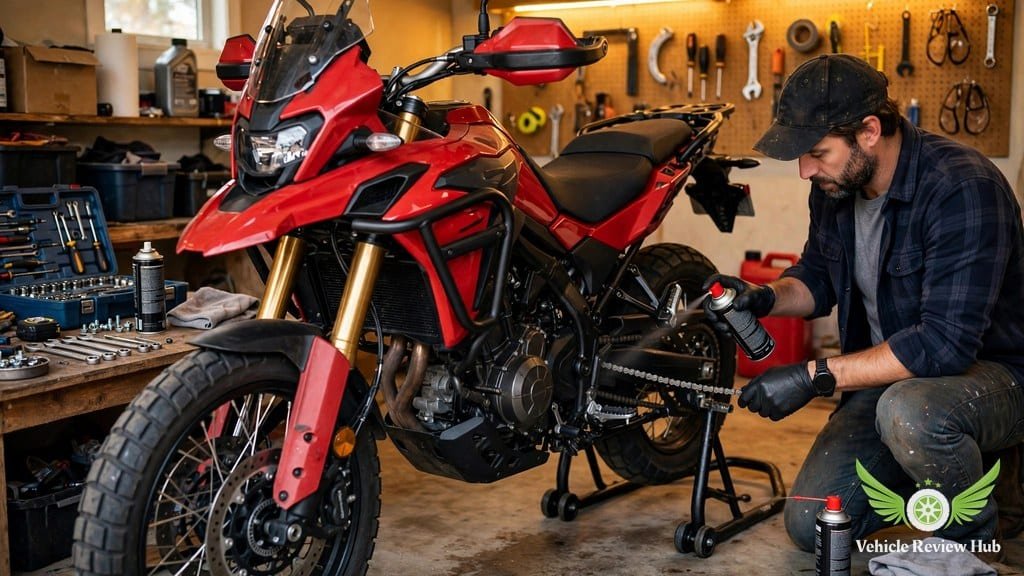
Start with the chain, the highest-frequency job: inspect and lubricate every 600 miles, keep freeplay at 35–45 mm, clean off grit before lubricating, and replace chain and sprockets together when wear appears. Change the oil every 8,000 miles or yearly, and use the specified 10W-30 JASO MA oil, not a car oil with friction modifiers. Wash the bike after off-road riding and winter use, including spokes, fasteners and the underside, and dry it before storage. Keep the battery on a tender during storage. Before every long ride, check cold tire pressures, chain, pads, coolant level with a cold engine, lights, horn and both handlebar switches. Once a year, check fork seals, linkage play, brake fluid age, air filter state, and spoke finish, especially on a 2016 or 2017 bike. All of it is what Honda Africa Twin reliability consists of in practice: a strong engine protected by an owner who does the routine work.
Recall Checks: ECU 24V-882, Switch Harness 25V-583, Fuel Filter AS Only
Recall checks belong in every purchase, because all three recalls are free to remedy and checked by VIN in minutes. Run the VIN through Honda’s recall lookup and the NHTSA recall tool before you buy, and ask the seller for recall completion paperwork, not just an assurance. The ECU recall, NHTSA campaign 24V882000 and Honda campaign KR1, covers certain 2022 and 2024–2025 CRF1100 Africa Twins, 4,205 units, for an FI-ECU software error that can cause stall or power loss when Wheelie Control is activated; dealers reprogram the software free of charge, and owner letters were mailed in January 2025. The switch harness recall, NHTSA campaign 25V583000 and Honda campaign KS8, covers certain 2020–2022 and 2024–2025 CRF1100 Africa Twins, 7,492 units, for corrosion at the left handlebar switch harness joint terminals that can cause horn or headlight beam loss, failing Federal Motor Vehicle Safety Standard No. 108; dealers replace the switch assembly free of charge with a redesigned part, with interim owner letters in November 2025 and remedy letters anticipated in January 2026. The fuel-filter recall, NHTSA campaign 20V797000 and Honda campaign KL4, covers certain 2018–2019 CRF1000L Adventure Sports and certain 2020 CRF1100L Adventure Sports models, 2,690 units, for zinc-oxide contaminants from welding the larger Adventure Sports tank clogging the fuel filter; dealers drain and clean the tank and replace the filter free of charge. That recall is Adventure Sports only; Honda’s bulletin states standard models are not affected. The separate Adventure Sports ES line carries its own service and recall history.
Honda Africa Twin Reliability FAQs
These are the questions buyers and owners ask most about Honda Africa Twin reliability.
Is the Honda Africa Twin reliable?
Yes. Honda Africa Twin reliability is strong across both generations: the engine, gearbox and frame have no major pattern of failure, and the standard CRF1100L carries MCN ratings of 4.6 and 4.8 from only 15 reviews.
What is the most common problem on a Honda Africa Twin?
There is no single dominant fault affecting Honda Africa Twin reliability. The best-documented issues are spoke corrosion on 2016–2017 bikes, fork stiction, and touchscreen trouble, plus normal consumables.
How often does a Honda Africa Twin need an oil change?
Every 8,000 miles or 1 year, whichever comes first, after an initial service at 600 miles. That interval is the foundation of Honda Africa Twin reliability. Use SAE 10W-30 meeting JASO MA and API SJ or higher.
When does the Honda Africa Twin need a valve-clearance inspection?
Every 16,000 miles or 2 years. Honda Africa Twin reliability depends on this check, which measures the camshaft-to-valve gap and adjusts only valves outside specification.
Does the DCT version affect reliability?
The DCT system has a good record for Honda Africa Twin reliability, with gearbox trouble described as very, very rare, though servicing costs slightly more for its clutch oil filter and parking brake.
Are 2016 and 2017 Africa Twins less reliable than later bikes?
They carry one weakness for Honda Africa Twin reliability: their original spokes corrode quickly, and Honda replaced many wheels under warranty. The 2018–2019 models switched to stainless spokes.
What recalls should I check on a Honda Africa Twin?
Three recalls matter for Honda Africa Twin reliability: ECU 24V-882 (free reprogram), switch harness 25V-583 (free redesigned assembly), and fuel-filter 20V797, which covers Adventure Sports models only.
Does the fuel-filter recall affect the standard Africa Twin?
No. Honda Africa Twin reliability reporting is often confused here, but the fuel-filter recall covers Adventure Sports models only, since the problem comes from contaminants in the larger Adventure Sports tank.
How long do the chain and sprockets last on an Africa Twin?
There is no fixed mileage, and that variability is normal for Honda Africa Twin reliability. Honda calls for inspection and lubrication every 600 miles, and chain and sprockets should be replaced as a set.
What tire pressures should a Honda Africa Twin run?
Measured cold, 33 psi front and 36 psi rear for rider only, and 33 psi front and 41 psi rear with a passenger. Correct pressures protect Honda Africa Twin reliability.
Is the TFT touchscreen a common problem?
Touchscreen trouble is a known Honda Africa Twin reliability niggle on 2021-onward bikes, with some units stopping responding to touch, particularly in colder climates.
What warranty does a Honda Africa Twin carry in the USA?
A transferable, one-year, unlimited-mileage limited warranty is included, with extended cover available through a HondaCare Protection Plan. That warranty supports Honda Africa Twin reliability for new buyers, and recall remedies are free regardless of age.
Is a high-mileage Honda Africa Twin worth buying?
Often yes, provided the service history is complete. Honda Africa Twin reliability at high mileage depends on the file, not the odometer: on-schedule servicing and recall completions usually beat a low-mileage bike with patchy records.