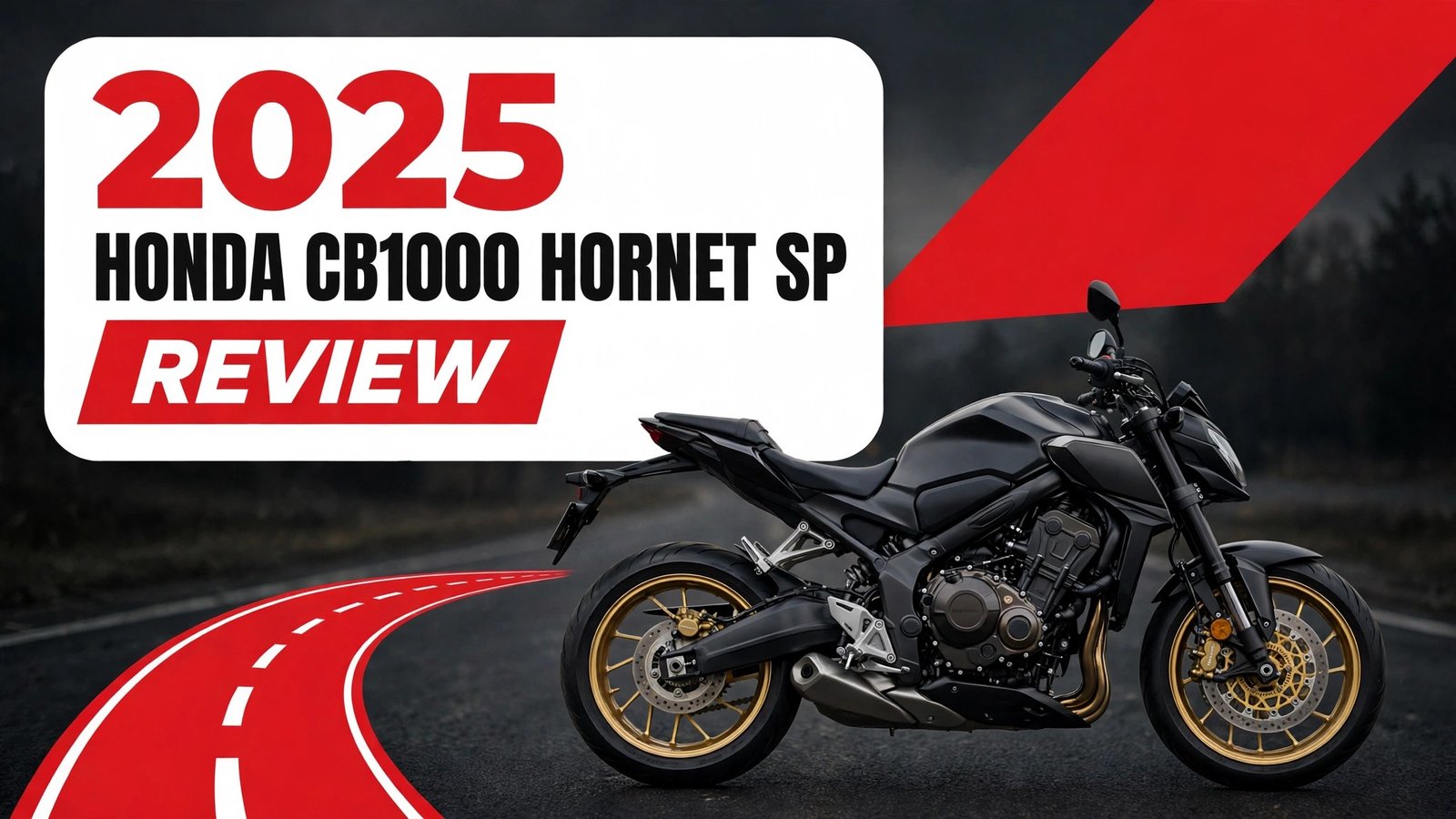
Short answer: the Honda CB1000 Hornet SP review verdict is that Honda built a sharper, cheaper, better-equipped replacement for the CB1000R — a 999cc naked with Öhlins suspension, Brembo Stylema brakes, and a $10,999 sticker that undercuts its predecessor by $2,000. This Honda CB1000 Hornet SP review covers the US bike only: the SP trim, Matte Black Metallic, sold in America from April 2025. It is not the European base Hornet, which was never sold in the USA, and it is not the CB1000R it replaced. Read this Honda CB1000 Hornet SP review with that identity straight, and the rest of the bike makes sense.
One warning belongs up front in any honest Honda CB1000 Hornet SP review: the US engine is strangled by emissions tuning in a way the European bike is not, and the bike carries three 2025-only recalls. Neither fact kills the bike, but both shape the buying decision, and this Honda CB1000 Hornet SP review reports them plainly rather than burying them.
Honda CB1000 Hornet SP Overview and Model-Year Updates
The Hornet SP arrived as Honda’s new litre-naked flagship, and this Honda CB1000 Hornet SP review starts with what changed: a new frame, a new engine tune, premium suspension and brakes as standard, and a price that embarrasses the bike it replaced.

US Launch in April 2025 After the Long European Lead-In
The Honda CB1000 Hornet SP review story begins in Europe, where the Hornet went on sale in late 2024 at £9,999 before America got it. US buyers waited until April 2025, when the SP landed as the only Hornet variant offered here. That long lead-in matters because most early reviews — including the MCN launch film embedded below — tested the European bike, and this Honda CB1000 Hornet SP review flags every European figure as European rather than letting it stand as an American fact. The US bike is built in Japan, like the CB1000R before it, and it reached dealers as a genuine 2025 model, not a late-year carryover. For the performance numbers behind this Honda CB1000 Hornet SP review, see our Honda CB1000 Hornet SP performance guide.
SP Only in the USA: the Base CB1000 Hornet Was Never Sold Here
American buyers never got a choice between a base Hornet and the SP — the SP is the whole US range, and this Honda CB1000 Hornet SP review treats that as a strength, not a limitation. The SP badge buys the Öhlins TTX36 rear shock, the Brembo Stylema calipers, the up/down quickshifter, and the gold five-spoke wheels as standard equipment. In Europe the base bike runs a Showa rear shock and lesser brakes, so a European “Hornet” review that praises or criticises the base bike’s suspension does not describe the American motorcycle. If a listing or video shows a non-SP Hornet in US colours, it is either a European import or a mislabel — check the VIN before believing it, because this Honda CB1000 Hornet SP review covers the SP only.
Honda CB1000 Hornet SP Engine and Specifications
The engine is the heart of this Honda CB1000 Hornet SP review, and it is also where the most confusion lives. Five different power figures circulate for this bike, and they are not interchangeable.

999cc Inline-Four at 11.7:1 From the 2017 CBR1000RR Design
The Honda CB1000 Hornet SP review engine is a 999cc liquid-cooled DOHC inline-four — 76.0 by 55.1 mm bore and stroke, 11.7:1 compression, PGM-FI through 44 mm throttle bodies, throttle-by-wire, and a 4-2-1 exhaust — derived from the 2017 CBR1000RR Fireblade and retuned for midrange street use. That last clause matters: the Fireblade made its power at 13.0:1 compression with 48 mm throttle bodies, while the Hornet SP trades peak revs for usable torque, a slip/assist clutch, and a three-level up/down quickshifter. The gearbox is a six-speed, final drive is a #525 chain running 15T/45T sprockets, and the whole package sits in a steel twin-spar frame — the first of several clean breaks from the CB1000R. Revzilla’s first ride confirms the Fireblade lineage and notes that American Honda does not publish a horsepower figure for this bike.
Steel Twin-Spar Frame, Not the CB1000R Mono-Backbone Design
Frame design is the second clean break this Honda CB1000 Hornet SP review must underline. The CB1000R used a steel mono-backbone frame and a single-sided swingarm; the Hornet SP uses a steel twin-spar frame with a conventional cast-aluminium swingarm and Pro-Link rear suspension. Geometry reads 25.0 degrees of rake, 3.9 inches of trail, and a 57.3-inch wheelbase, with a 31.9-inch seat height and a 465-pound curb weight including a full 4.5-gallon tank. The mass-forward layout puts 50.6 percent of the weight on the front wheel, which testers credit for the bike’s dart-like turn-in. Do not let any source paste the old bike’s chassis onto this one: the twin-spar frame, the conventional swingarm, and the 180/55-17 rear tyre are Hornet SP facts, and this Honda CB1000 Hornet SP review keeps them that way.
Honda CB1000 Hornet SP Price and Market Availability
Price is where this Honda CB1000 Hornet SP review turns enthusiastic, because Honda priced the new flagship below the bike it replaced while adding better hardware. That is a rare combination.
Price in the USA: $10,999 Plus $775 for Both 2025 and 2026
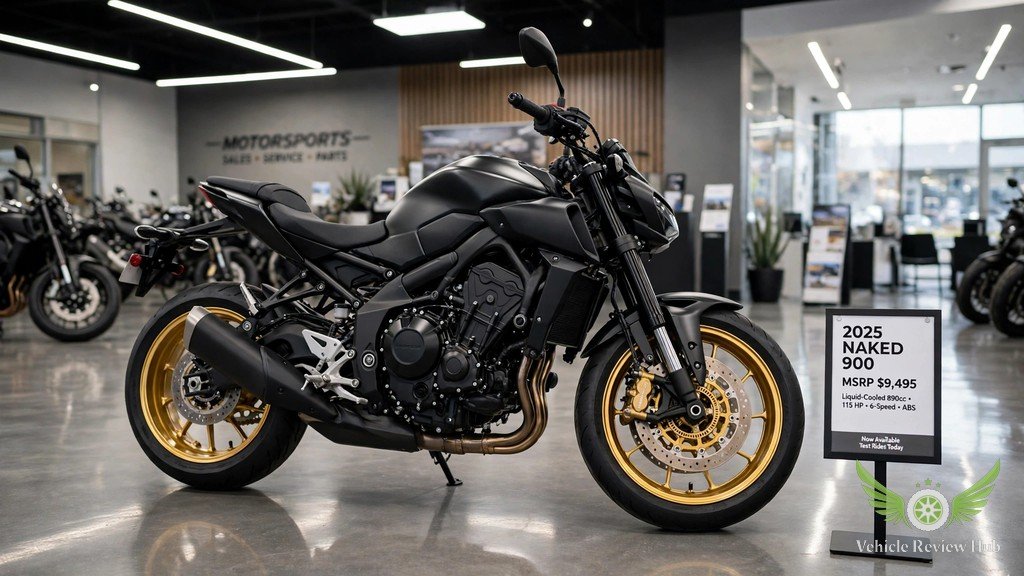
The Honda CB1000 Hornet SP review price is $10,999 plus $775 destination for both the 2025 and 2026 model years, for $11,774 before tax and dealer fees. That figure is confirmed on Honda Powersports’ own Hornet SP pages for both years, and it held flat across the carryover — 2026 brought no price rise and no published specification change. For context, the Suzuki GSX-S1000 asked $11,909 in Cycle News’ September 2025 comparison, so the Honda undercuts its closest Japanese rival by $910 while offering the Öhlins shock and Stylema brakes the Suzuki lacks. The warranty is a transferable one-year unlimited-mileage limited warranty, with HondaCare extended coverage available. For the servicing costs behind the sticker, see our Honda CB1000 Hornet SP reliability guide.
Matte Black Metallic Only and $2,000 Less Than the Old CB1000R
Colour choice in this Honda CB1000 Hornet SP review is short: Matte Black Metallic only, with gold five-spoke wheels and gold accents, in the United States. European buyers got more colours, but American buyers get one — and it suits the bike’s stealth-fighter look, even if Cycle News called the matte black “a little too black” and suggested a graphics kit for riders who want contrast. The $2,000 saving against the old CB1000R’s $12,999 sticker is simple arithmetic, and it reframes the whole purchase: this Honda CB1000 Hornet SP review is about a new bike with a full warranty that costs less than the discontinued bike it replaced, and less than a clean used Black Edition in many markets. That is the headline, and Honda deserves credit for it.
Honda CB1000 Hornet SP Design, Features and Technology
Design and technology are where the SP badge earns its money, and this Honda CB1000 Hornet SP review rates the hardware highly — with one honest electronics caveat that buyers must understand.

Öhlins TTX36 Shock, Brembo Stylema Brakes and Quickshifter
The Honda CB1000 Hornet SP review hardware list reads like a parts catalogue from a bike costing thousands more. Up front, a fully adjustable 41 mm Showa SFF-BP inverted fork with 5.1 inches of travel; at the rear, a fully adjustable Öhlins TTX36 Pro-Link shock with a hydraulic preload knob and 5.5 inches of travel. Braking is dual 310 mm front discs with radial-mount Brembo Stylema four-piston calipers and a radial-mount Brembo master cylinder, plus a single 240 mm rear disc with a Nissin caliper. The three-level up/down quickshifter is standard, as are the tank-shroud winglets and the five-spoke gold wheels. Testers consistently praise the Stylema brakes as a standout, and the Öhlins shock, once dialled in, transforms the ride. Motorcycle.com’s first ride covers the premium component story in depth.
No IMU: ABS and Traction Control Are Not Cornering Systems
The electronics caveat in this Honda CB1000 Hornet SP review is plain: there is no IMU, so the ABS and traction control are not cornering or lean-sensitive systems. Traction control runs four levels (1–3 plus off) with integrated wheelie control, and five ride modes — Sport, Standard, Rain, plus two customisable User maps — adjust power delivery, engine braking, and traction control. The 5-inch TFT dash with Honda RoadSync adds Bluetooth, turn-by-turn navigation, music, and calls, plus a USB-C charging port under the seat. What you do not get is cruise control or heated grips as standard (heated grips are a $157.95 accessory). For a $10,999 bike, that electronics package is fair, but buyers cross-shopping a Kawasaki Z900 or a BMW S 1000 R should know the IMU gap before they buy — this Honda CB1000 Hornet SP review will not pretend otherwise.
Honda CB1000 Hornet SP Riding Experience and Comfort
On the road, this Honda CB1000 Hornet SP review finds a bike that is brilliant in the chassis and compromised in the engine — at least in US stock form. Both halves of that sentence matter.

Riding Position, Handling and Low-Speed Maneuverability
Riding position in this Honda CB1000 Hornet SP review is supermoto-upright: wide bars, a 31.9-inch seat, and a commanding view over traffic, with the mass-forward chassis making low-speed manoeuvres easy and turn-in genuinely dart-like. The narrow 180-section rear tyre helps the bike tip in faster than the old CB1000R’s 190-section rear, and testers praise the planted, composed feel on winding roads, with the Öhlins shock absorbing rough tarmac without bucking. One caveat from Cycle News: the front end can feel slightly nervous under hard braking and turning compared with the Suzuki’s KYB setup. At parking-lot speeds and in city traffic, though, the Hornet SP is friendly and confidence-inspiring — exactly what a litre naked should be when it is not being ridden hard. The video below is MCN’s launch review of the Hornet SP, honestly labelled as a European launch film — the bike is the same SP, but its engine runs the freer European tune, so treat its power impressions accordingly.
Highway Comfort, Passenger Use and Everyday Practicality
Highway comfort is the weaker half of this Honda CB1000 Hornet SP review. There is no windscreen, so wind hits the rider’s chest from around 75 mph, and the flat, thinly padded bench-style seat is fine for short rides but painful on long ones — testers say so in nearly identical words. The passenger pad is best described as an afterthought, and the 4.5-gallon tank, combined with real-world economy in the high 30s, gives roughly 175 miles of range, so touring means frequent stops. Everyday practicality is better: the USB-C port charges a phone, RoadSync navigation works well with a headset, the quickshifter makes commuting effortless, and the 465-pound weight is manageable. Just do not buy this Honda CB1000 Hornet SP review bike as a two-up tourer — it is a solo back-road weapon that commutes well, not a sport-tourer.
Honda CB1000 Hornet SP Review: Pros, Cons and Verdict
The verdict in this Honda CB1000 Hornet SP review is a conditional yes — one of the strongest value propositions in the litre-naked class, held back by one fixable flaw and one paperwork chore.
Main Advantages and Limitations of the CB1000 Hornet SP
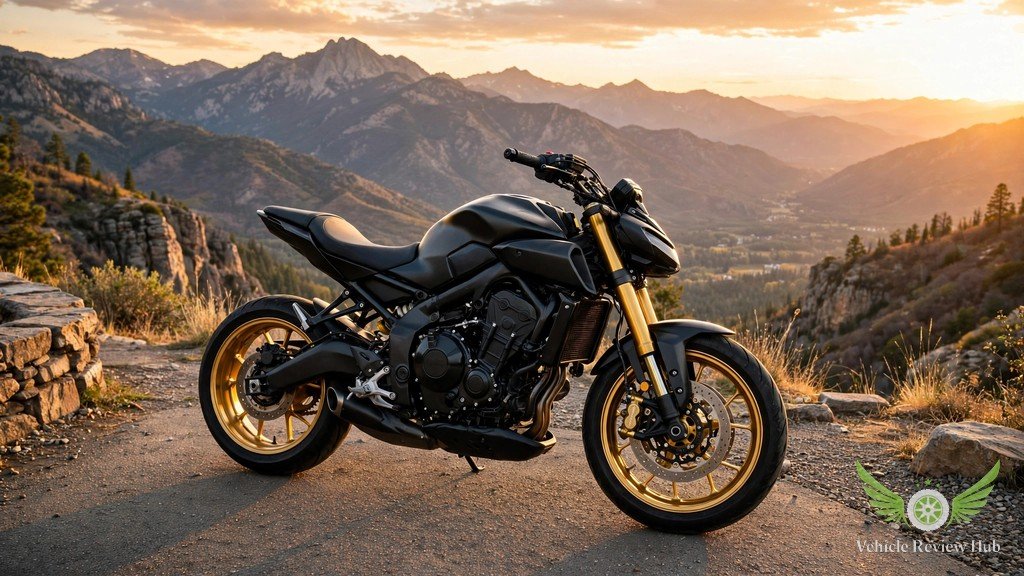
Advantages first in this Honda CB1000 Hornet SP review: the $10,999 price, the Öhlins and Brembo hardware, the sharp twin-spar chassis, the slick quickshifter, and the TFT with RoadSync. Limitations, stated with equal weight: the US engine’s emissions-tuned delivery — an abrupt closed-throttle opening, a flat spot just after 4,000 rpm, and drive that falls away after 9,000 rpm on the US bike — plus the thin, hard seat, the lack of an IMU, and the three 2025 recalls that every buyer must clear by VIN before paying. Cycle News gave its comparison to the Suzuki GSX-S1000 on engine feel, and this Honda CB1000 Hornet SP review agrees with that verdict on the stock bike: the Suzuki’s engine is smoother and keeps charging past 9,000 rpm. But the Honda wins on price, brakes, suspension hardware, and nimbleness — and an ECU flash plus an aftermarket muffler reportedly fixes the delivery, for owners willing to modify. For the buying decision in full, see our Honda CB1000 Hornet SP buying guide.
Five-Inch TFT With RoadSync and Two User Riding Modes
The final verdict note in this Honda CB1000 Hornet SP review is the electronics package, which punches above the price. The 5-inch full-colour TFT is clear and easy to navigate, RoadSync pairs cleanly for navigation and music, and the two User riding modes let a rider build custom maps for power, engine braking, and traction control rather than accepting the presets. Combined with the three-level quickshifter and the adjustable engine-brake control, the Hornet SP feels a generation ahead of the old CB1000R’s dash — and ahead of the Suzuki’s interface, too. Buy the Hornet SP if you want the best hardware per dollar in the litre-naked class and you will check the recalls by VIN; buy the Suzuki if stock engine feel matters more than hardware; and buy neither without sitting on both. That is the honest close of this Honda CB1000 Hornet SP review.
| Honda CB1000 Hornet SP at a glance | Figure | Label |
|---|---|---|
| US price | $10,999 + $775 destination | Both 2025 and 2026 |
| Engine | 999cc inline-four, 11.7:1 | 2017 Fireblade-derived |
| Curb weight / tank | 465 lb / 4.5 gallons | Honda specs page |
| Suspension / brakes | Öhlins TTX36 / Brembo Stylema | SP standard |
| Summary | Best hardware per dollar; check recalls by VIN | 2025 recalls: 3, all VIN-first |
Honda CB1000 Hornet SP Review FAQs
Direct answers to the Honda CB1000 Hornet SP review questions buyers ask most.
How much does the Honda CB1000 Hornet SP cost in the USA?
$10,999 plus $775 destination, says this Honda CB1000 Hornet SP review — $11,774 before tax and fees, for both 2025 and 2026.
Is the Honda CB1000 Hornet SP the same as the CB1000R?
No, says this Honda CB1000 Hornet SP review. The Hornet SP replaced the CB1000R for 2025 with a different frame, engine tune, swingarm, and suspension — a different motorcycle, not a trim.
What engine does the Honda CB1000 Hornet SP have?
A 999cc inline-four derived from the 2017 CBR1000RR, says this Honda CB1000 Hornet SP review, with 11.7:1 compression, 44 mm throttle bodies, and a 4-2-1 exhaust.
How much horsepower does the Honda CB1000 Hornet SP make?
It depends on the box, says this Honda CB1000 Hornet SP review: 155 hp claimed in Europe, 144.6 bhp on MCN’s dyno, 116 hp on Cycle News’ US dyno — and Honda USA publishes no figure.
What colours does the US Honda CB1000 Hornet SP come in?
Matte Black Metallic only, says this Honda CB1000 Hornet SP review, with gold wheels. Other colours are European, not American.
Does the Honda CB1000 Hornet SP have recalls?
Yes — three, all naming only 2025 bikes, says this Honda CB1000 Hornet SP review. Check all three recall statuses by VIN before paying, even on a 2026 bike.
Is the Honda CB1000 Hornet SP good for beginners?
No, says this Honda CB1000 Hornet SP review. It is a litre-class naked with over 110 rear-wheel horsepower — an experienced rider’s bike, not a first bike.
Does the Honda CB1000 Hornet SP have cruise control?
No, says this Honda CB1000 Hornet SP review. There is no cruise control and no heated grips as standard, and no IMU for cornering electronics.
How far can the Honda CB1000 Hornet SP go on a tank?
Around 175 miles from the 4.5-gallon tank, says this Honda CB1000 Hornet SP review, based on Cycle News’ measured 38.9 mpg in US testing.
Should I buy the Hornet SP or the Suzuki GSX-S1000?
Buy the Hornet SP for hardware value and agility, says this Honda CB1000 Hornet SP review; buy the Suzuki if stock engine feel matters most — Cycle News gave the comparison to the Suzuki on engine feel.
Is the Honda CB1000 Hornet SP worth it?
Yes, with the VIN check done first, says this Honda CB1000 Hornet SP review. At $10,999 with Öhlins and Brembo hardware, it is one of the best value litre nakeds on sale.