Short answer: Honda CB500 Hornet performance is the story of a friendly middleweight that punches above its price, not a superbike in disguise. The US bike is the renamed CB500F, a 471cc parallel twin that put 43.14 rear-wheel horsepower on Cycle World’s dyno, returns around 59 miles per gallon in Cycle World’s average riding, and costs $5,899 plus $600 destination for 2026. This Honda CB500 Hornet performance guide keeps every figure in its correct column, because its numbers are easy to mix up with the faired CBR500R and with European claims.
That discipline matters for Honda CB500 Hornet performance, because the same 471cc platform wears two names and two sets of brochure figures. In Europe the bike is the Hornet and the headline is the A2 limit of 47 horsepower; in America it was sold as the CB500F until 2025 and only took the Hornet name for 2026. This Honda CB500 Hornet performance guide never presents a European claim as an American test result, never borrows the faired CBR500R’s figures, and says plainly where no American test exists.
Honda CB500 Hornet Engine Performance and Power Delivery
The engine is the foundation of Honda CB500 Hornet performance: a 471cc liquid-cooled DOHC parallel twin with a 67.0 x 66.8mm bore and stroke, 10.7:1 compression, a 34mm throttle body, and a six-speed gearbox with an assist and slipper clutch. It is a friendly, rev-happy twin built for everyday riding, and that character defines everything else in this Honda CB500 Hornet performance guide.
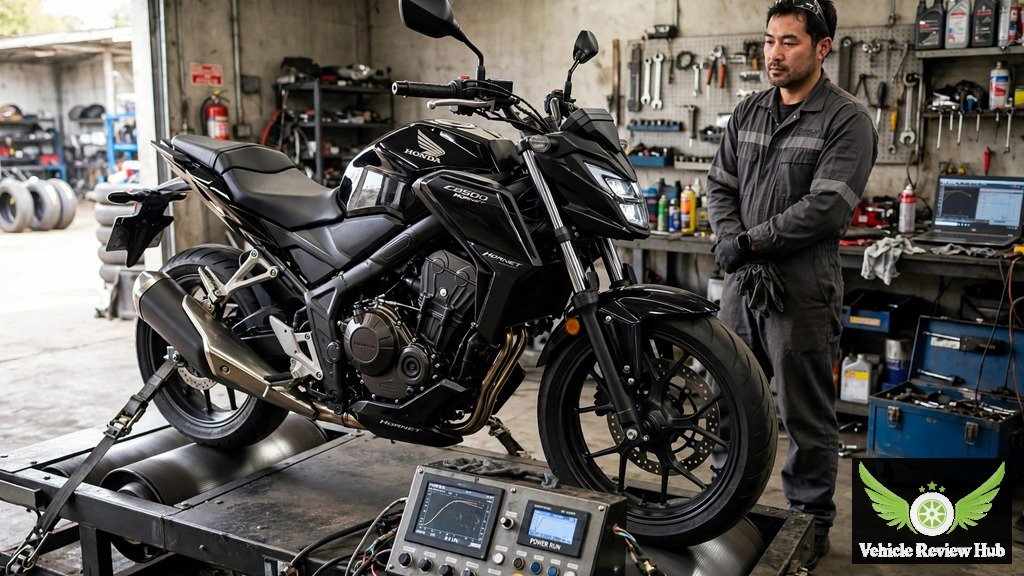
Cycle World Dyno: 2022 CB500F Makes 43.1 HP at 8,300 RPM
The most important rear-wheel figure for Honda CB500 Hornet performance comes from Cycle World’s 2022 test of the CB500F, the same motorcycle under its old American name: 43.14 horsepower at 8,270 rpm, which the doc rounds to 43.1 horsepower at 8,300 rpm. The paired CBR500R made 43.20 horsepower at 8,280 rpm in the same test — a different column, not the naked bike’s number. Older context, labelled by year: Rider’s 2017 test recorded 46.1 horsepower, but that was a pre-2022 bike. For the full model story, see our Honda CB500 Hornet review.
Power delivery in Honda CB500 Hornet performance terms is friendly rather than frightening. The twin pulls cleanly from low revs, builds smoothly through the midrange, and rewards a rider who keeps it spinning without ever feeling peaky or intimidating. That is exactly what a middleweight naked bike should do.
Torque 29.4 lb-ft at 6,600 RPM and Midrange Character
Torque is where Honda CB500 Hornet performance wins its everyday arguments. Cycle World’s 2022 test recorded 29.43 lb-ft at 6,610 rpm for the F, rounded in the doc to 29.4 lb-ft at 6,600 rpm, against 29.77 lb-ft at 6,450 rpm for the paired CBR500R. The difference is small, but it matters: torque that arrives early makes city traffic, top-gear roll-ons, and passing without a frantic downshift all easy. The European torque claim is a different box, at 43 Nm, about 31.7 lb-ft, at 6,500 rpm on Honda Europe’s sheet, and this Honda CB500 Hornet performance guide never blends that crankshaft claim with the American rear-wheel measurement. The assist and slipper clutch cuts lever effort by around 45 percent, per Honda, and resists rear-wheel hop — worth more to a newer rider than any peak figure.
| Power figure | Value | Source and label |
|---|---|---|
| EU / A2 crank claim | 47 hp @ 8,500–8,600 rpm | Honda Europe claim, not a US test |
| Cycle World dyno (F) | 43.14 hp @ 8,270 rpm; 29.43 lb-ft @ 6,610 rpm | US bike, rear wheel, 2022 test |
| Cycle World dyno (R, for contrast) | 43.20 hp @ 8,280 rpm; 29.77 lb-ft @ 6,450 rpm | Faired CBR500R, same test, NOT the Hornet |
| Rider dyno (2017 F) | 46.1 hp @ 8,300 rpm | Older generation, labelled by year |
| Summary | Never average the dynos or swap the F and R columns | Different bikes, days, and generations |
Honda CB500 Hornet Top Speed and Acceleration
Acceleration and top speed are where Honda CB500 Hornet performance coverage needs the most honesty, because the headline figures everyone quotes come from outside the United States. This section keeps those figures labelled, and says plainly what does not exist for the American bike.
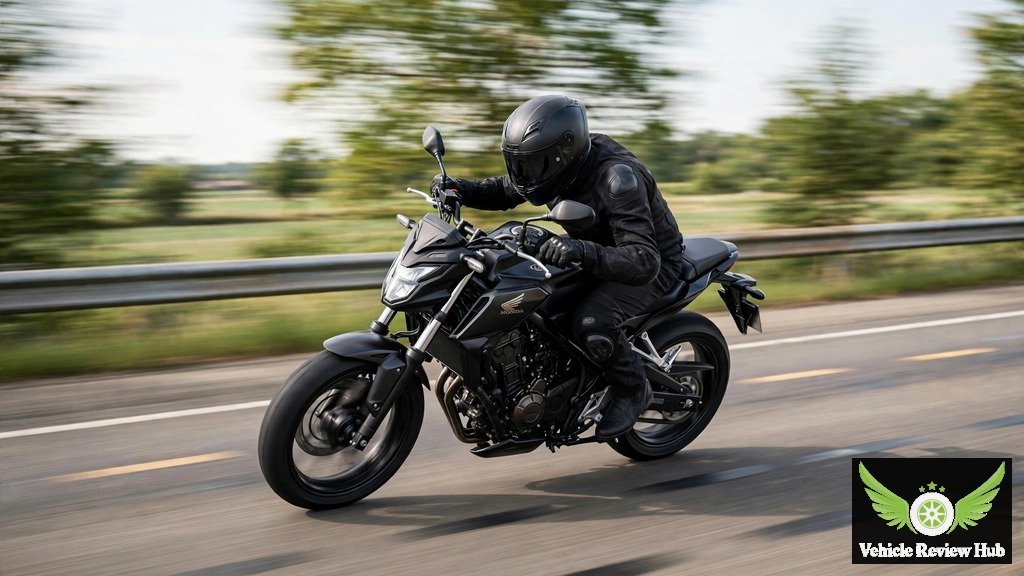
No US Instrumented Top-Speed Test Exists for the F or Hornet
The doc heading for this section stands exactly as written in this Honda CB500 Hornet performance guide: no US instrumented top-speed test exists for the F or the Hornet. No Cycle World or Rider GPS top-speed run was found, and this guide will not fill that gap with a guess or a borrowed figure. That matters because an upright naked rider meets far more wind than a tucked faired rider, so the CBR500R’s 116.8 mph figure belongs to that bike alone.
What American testing did measure is acceleration over a quarter mile. Cycle World’s 2022 instrumented test recorded a quarter mile of 14.30 seconds at 94.19 mph for the CB500F, and this Honda CB500 Hornet performance guide reports it as the one American instrumented acceleration figure on record. It is not a drag-bike number: it is the number of a friendly middleweight that gets away from traffic lights briskly and merges without drama.
Non-US Evidence Brackets Speed Around 100 to 112 MPH
Non-US evidence brackets Honda CB500 Hornet performance at the top end between about 100 and 112 mph, and this Honda CB500 Hornet performance guide reports that bracket with its sources attached. MotoStatz’s CB500F test aggregation lists 0–60 mph in 4.34 seconds, a quarter mile of 13.36 seconds at 98 mph, and a top speed of 112 mph, with the tester’s own caveat of 100–105 mph real-world for most riders. MotoStatz is an aggregator, not a US magazine GPS test. European listings of 185–188 km/h, about 115–117 mph, are listed figures, not tested figures, and are never presented here as test results.
Honda CB500 Hornet Mileage and Fuel Economy
Fuel economy is the quiet superpower of Honda CB500 Hornet performance. This is a motorcycle that sips fuel like a commuter while still being fun on a back road, and its small running costs are a large part of why owners keep recommending it. The figures below carry their test labels, because two Cycle World samples are easy to confuse.

Cycle World Average 59.0 MPG and Rider Tested 62.4 MPG
The headline mileage figures for Honda CB500 Hornet performance are both verified and both labelled. Cycle World’s 2022 spec-box average for the CB500F is 59.0 miles per gallon, against 58.4 for the paired CBR500R in the same test, and this Honda CB500 Hornet performance guide keeps those columns separate just as it does with the dyno figures. Rider’s 2017 test recorded 62.4 miles per gallon and 274 miles per tank, reported here with its year attached, since the 2017 bike predates the 2022 update. A second Cycle World sample needs care: in a canyon-heavy test ride, Cycle World recorded 65 miles per gallon for the F, with the reserve warning past 225 miles. That is a different riding sample from the 59.0-mpg average, and this Honda CB500 Hornet performance guide does not present it as the average. The honest band is high fifties to low sixties in normal mixed riding.
Real-World Range Around 250 Miles From 4.5 Gallons
Range math for Honda CB500 Hornet performance must show its working. The current bike carries a 4.5-gallon tank, 17.1 litres, a figure that has applied since 2016; earlier bikes carried 4.1 gallons, so quoting 4.1 for a current bike, or 4.5 for a 2013–2015 bike, is quoting the wrong generation. At Cycle World’s 59.0-mpg average, 4.5 gallons gives about 265 miles in theory; at Rider’s 62.4 mpg, about 281 miles. This Honda CB500 Hornet performance guide nevertheless keeps around 250 miles as its planning figure, because reserve, headwinds, and a rider’s right hand all eat into theory. Plan fuel stops around 200–230 miles and never trust the last bar of the gauge. For servicing intervals that keep this economy honest, see our Honda CB500 Hornet reliability guide.
| Economy figure | Value | Source and label |
|---|---|---|
| Cycle World average (F) | 59.0 mpg | 2022 spec-box average, F column |
| Rider test (2017 F) | 62.4 mpg / 274 miles | 2017 bike, labelled by year |
| Cycle World canyon sample (F) | 65 mpg, reserve past 225 miles | Different riding sample, NOT the average |
| Planning range | Around 250 miles from 4.5 gallons | Conservative planning figure, not theoretical max |
| Summary | Theoretical max about 265–281 miles | 59.0–62.4 mpg × 4.5 gallons, shown working |
Honda CB500 Hornet Real-World Riding Performance
On real roads, Honda CB500 Hornet performance feels like a motorcycle designed by people who ride to work and then ride for fun on the weekend. The engine is friendly, the position is upright and honest, and the bike never asks its rider to apologise for its modest peak output.
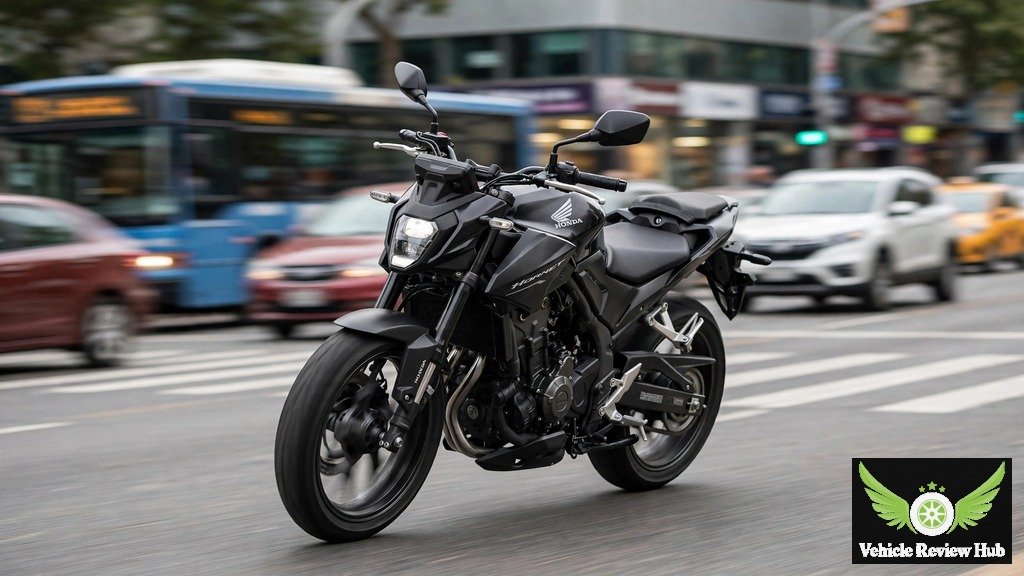
City Riding, Traffic Performance and Everyday Acceleration
City riding is where Honda CB500 Hornet performance surprises first-time buyers in the best way. The 31.1-inch seat height lets most riders put both feet down, the 414-pound claimed curb weight, 417 pounds on Cycle World’s scales, is light enough to paddle through a parking lot without drama, and the light slipper-clutch lever makes stop-and-go traffic far less tiring than on a bigger twin. Throttle response is smooth and everyday acceleration is brisk enough for any urban gap. The video below is Modern Classic Motorcycle News ride footage of the Hornet on real roads — genuine riding impressions, not a studio walkaround.
One honest city limit belongs in any Honda CB500 Hornet performance account: at very low speeds the suspension is set firmly, and a heavy rider or a rough city street will feel that firmness. It is a sporting middleweight, not a sofa, and its comfort comes from its ergonomics and light controls rather than plush suspension.
Highway Riding, Wind Blast and Open-Road Passing
On the highway, Honda CB500 Hornet performance is capable with a clear, honest limit: wind blast. Without a fairing, the rider takes the full wind at sustained highway speeds, and that is tiring on a long day in a way no faired bike suffers. The engine cruises without strain in sixth gear and has enough midrange for passing without always downshifting. A small flyscreen helps, but this is not a touring bike. It is a commuter and back-road bike that tolerates highways well. For the buying picture, see our Honda CB500 Hornet buying guide.
Honda CB500 Hornet Handling, Braking and Stability
Handling is where Honda CB500 Hornet performance earns its reputation among testers. The chassis is light, the steering is neutral, and the brakes were genuinely improved in the 2022 update. Nothing here is exotic: well-chosen parts, working together, beat a spec sheet full of compromises.

Wider, Higher Bar Preferred by Testers Over the R Clip-Ons
The handlebar is a small part with a large effect on Honda CB500 Hornet performance, and testers prefer it. The naked bike’s wider, higher bar gives more leverage at low speed, a more upright position, and easier control in traffic than the faired CBR500R’s clip-ons, and this Honda CB500 Hornet performance guide attributes that preference to testers rather than presenting it as a measured figure. The steel diamond frame, 55.5-inch wheelbase, 25.5 degrees of rake, and 4.0 inches of trail add up to stability without sluggishness. The 41mm Showa SFF-BP fork, 4.7 inches of travel, arrived with the 2022 update; testers praise a bike that steers willingly and holds a line.
Dual 296mm Discs and Radial Calipers From the 2022 Update
Braking on the current Honda CB500 Hornet performance package is dual 296mm front discs with radial-mount four-piston calipers, ABS standard, and a single 240mm rear disc, all fitted from the 2022 update. That update matters for used buyers: pre-2022 bikes do not carry the same front-brake package, so check the discs and calipers rather than assuming every F or Hornet brakes the same way. Tyres are sensible 120/70R-17 front and 160/60R-17 rear sizes with cheap replacements. No instrumented F-specific braking-distance test was found for this Honda CB500 Hornet performance guide, and it says so rather than borrowing a figure from another motorcycle. The 2024 update added HSTC, Honda Selectable Torque Control, standard and defeatable, alongside the five-inch TFT dash, per Ultimate Motorcycling’s 2024 first look under the F name in America. European bikes add RoadSync on the TFT; American Honda’s release does not list it, so this guide does not claim it for US bikes.
Honda CB500 Hornet Performance Compared With Other Naked Bikes
Comparison is where Honda CB500 Hornet performance numbers need the most care, because the rivals and the prices have both moved. This section compares spec, price, and character, with trim-labelled prices, and never pretends a brochure comparison is a test result.

Honda CB500 Hornet vs Kawasaki Z500 and CFMOTO 450NK
The Kawasaki Z500 ABS is the Hornet’s closest rival on price and purpose, and the CFMOTO 450NK is its closest rival on value. The Hornet costs $5,899 plus $600 destination for 2026, $6,499 before tax and fees, while the Z500 ABS costs $5,699 plus $650 destination, $6,349 out the door, so the Honda is $200 dearer on MSRP and $150 dearer once destination is included, per Motorcycle.com’s 2026 Z500 specification page. The Z500 counters with a 451cc twin, while the Honda answers with its larger engine and dealer network. The CFMOTO 450NK undercuts both on MSRP at $5,399 on dealer sheets, $500 under the Hornet before destination. On character, the Honda rests on balance: neither cheapest nor most powerful, but easiest to live with. Visordown’s 2024 Hornet first ride praised exactly that balance.
| Model (2026, new) | Price | Key performance note |
|---|---|---|
| Honda CB500 Hornet | $5,899 + $600 destination | 471cc twin, 43.14 hp CW dyno, 59.0 mpg average |
| Kawasaki Z500 ABS | $5,699 + $650 destination | 451cc twin, closest price rival, $150 cheaper out the door |
| CFMOTO 450NK | $5,399 MSRP (dealer sheets) | Value rival, $500 under Hornet MSRP, verify destination |
| Honda CBR500R | $6,399 + $600 destination | Faired sibling, $500 more, clip-ons, NOT the naked bike |
| Summary | Hornet wins on balance, not on one number | Fuel, weight, dealer support, predictable character |
Is the Honda CB500 Hornet Suitable for Beginner Riders?
Yes, with the honest caveat that belongs in every Honda CB500 Hornet performance verdict: suitable does not mean slow, and beginner-friendly does not mean beginner-only. At 43 rear-wheel horsepower, a 31.1-inch seat, and 414 pounds claimed, the Hornet is approachable for a newer rider who has completed training, while still being enjoyable for an experienced rider who wants a light, economical second bike. Predictable throttle, light clutch, defeatable HSTC, and neutral handling all help a newer rider. Caveats: it is still a 471cc motorcycle, it still demands respect in the wet, and no electronics package replaces training.
Honda CB500 Hornet Performance FAQs
Direct answers to the Honda CB500 Hornet performance questions riders ask most often.
How much horsepower does the Honda CB500 Hornet make?
Cycle World’s 2022 test recorded 43.14 rear-wheel horsepower for the CB500F, the same motorcycle under its old name, per this Honda CB500 Hornet performance guide. The European claim is 47 horsepower, an A2 licence figure, not an American test result.
What is the top speed of the Honda CB500 Hornet?
No US instrumented top-speed test exists, per this Honda CB500 Hornet performance guide. Non-US evidence brackets it around 100 to 112 mph, with MotoStatz listing 112 mph and its own real-world caveat of 100–105 mph.
What is the Honda CB500 Hornet quarter-mile time?
Cycle World’s 2022 instrumented test recorded 14.30 seconds at 94.19 mph, per this Honda CB500 Hornet performance guide. MotoStatz aggregates 13.36 seconds at 98 mph, a different kind of figure that should never be averaged with the Cycle World result.
What MPG does the Honda CB500 Hornet get?
Cycle World’s 2022 average is 59.0 miles per gallon, and Rider’s 2017 test recorded 62.4 miles per gallon, per this Honda CB500 Hornet performance guide. Expect high fifties to low sixties in normal mixed riding.
How far can the Honda CB500 Hornet go on a tank?
Around 250 miles is the planning figure from its 4.5-gallon tank, per this Honda CB500 Hornet performance guide, although the theoretical maximum at test economy is about 265–281 miles.
Is the Honda CB500 Hornet good for beginners?
Yes, for riders who have completed training, per this Honda CB500 Hornet performance guide. Its predictable throttle, light clutch, low seat, and neutral handling help newer riders, but it is still a 471cc motorcycle that demands respect.
Does the Honda CB500 Hornet have E-Clutch in the USA?
No. Honda USA lists a six-speed manual with no E-Clutch option for the American bike, per this Honda CB500 Hornet performance guide. Europe offers E-Clutch for 2026, but that option does not apply to US bikes.
What is the difference between the CB500 Hornet and the CB500F?
Nothing mechanical: the Hornet is the CB500F under a new name, per this Honda CB500 Hornet performance guide. America kept the F name through 2025 and adopted Hornet for 2026, while Europe renamed it for 2024.
How much does the 2026 Honda CB500 Hornet cost?
The 2026 bike costs $5,899 plus $600 destination in the United States, in Black only, per this Honda CB500 Hornet performance guide. That is exactly $1,000 less than the 2025 CB500F, a price cut rather than a redesign.
Is the Honda CB500 Hornet faster than the CBR500R?
No, not on published figures, per this Honda CB500 Hornet performance guide. The faired CBR500R’s MotoStatz figure of 116.8 mph belongs to the faired bike alone, and the naked Hornet’s non-US bracket is 100–112 mph.
What brakes and suspension does the Honda CB500 Hornet have?
Dual 296mm front discs with radial calipers, ABS standard, and a 41mm Showa SFF-BP fork, all from the 2022 update, per this Honda CB500 Hornet performance guide. The 2024 update added a five-inch TFT dash and defeatable HSTC.