Short answer: Honda CBR1000RR performance is the story of a superbike that wins on balance rather than brute force. The current base RR makes a verified 149.63 rear-wheel horsepower on Cycle World’s dyno, returns a Motorcycle.com-observed 38.2 mpg in hard shootout use, and carries the lightest, most confidence-inspiring chassis Honda has ever put under the Fireblade name. This Honda CBR1000RR performance guide sticks to named tests and separates the verified record from the two exaggerations that follow this bike everywhere: European power claims quoted as American figures, and a European top speed quoted as an American one.
That discipline matters because Honda CBR1000RR performance is easy to misquote: the RR-R Fireblade SP, a different motorcycle with a different engine, dominates search results under the same “CBR1000RR” name, and its 214-horsepower European claim and 165.42-horsepower American dyno figure get pasted into base-RR articles every week. This Honda CBR1000RR performance guide never does that.
Honda CBR1000RR Engine Performance and Power Delivery
The engine is the foundation of Honda CBR1000RR performance: a 999cc liquid-cooled DOHC inline-four with 16 valves, a 76.0 x 55.0mm bore and stroke, 13.0:1 compression, 48mm throttle bodies, and a six-speed gearbox driving the rear wheel through a chain. It is tuned for a broad, usable spread of power rather than a single peak number, and that choice defines everything else in this Honda CBR1000RR performance guide.
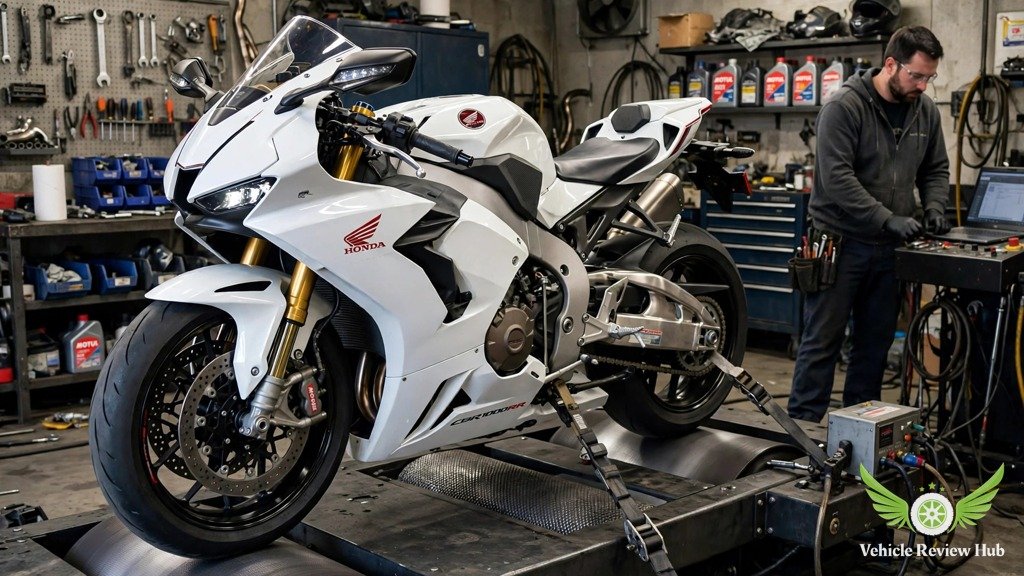
Cycle World US Dyno 149.63 HP at 10,540 RPM for the 2017 Bike
The anchor number for Honda CBR1000RR performance comes from Cycle World’s dyno testing: the 2017 US base CBR1000RR recorded 149.63 horsepower at 10,540 rpm and 75.97 pound-feet of torque at 10,180 rpm at the rear wheel. Cycle World published that figure inside its later RR-R dyno article as the outgoing bike’s benchmark, which also confirms the gap to the RR-R’s 165.42 horsepower on the same dyno. Power delivery in Honda CBR1000RR performance terms is linear and deceptively fast: testers describe a motor that pulls cleanly from the midrange, builds without steps or holes, and rewards revs without demanding them. For the full model story behind these numbers, see our Honda CBR1000RR review.
Motorcycle.com Shootout 153.2 HP and Why the US Bike Trails EU Claims
A second, independent dyno figure belongs in any honest Honda CBR1000RR performance account: Motorcycle.com’s 2017 Superbike Street Shootout recorded 153.2 horsepower at 10,600 rpm for the Honda. That is a different dyno, a different day, and a different test bike, so this Honda CBR1000RR performance guide reports both figures side by side and never blends them into one. The gap between the American dyno figures and Honda’s claimed 189 horsepower at 13,000 rpm (with 84 pound-feet at 11,000 rpm) is the normal distance between a crankshaft claim and a rear-wheel measurement, widened on the US bike by intake, exhaust, and emissions restrictions. Any Honda CBR1000RR performance article that quotes 189 horsepower as what an American bike makes at the wheel is quoting the wrong number in the wrong place.
Honda CBR1000RR Top Speed and Acceleration
Acceleration is where Honda CBR1000RR performance impresses most, and top speed is where it gets exaggerated most. This section keeps those two things apart.

Cycle World 2012: 0-60 in 2.6 Seconds and Quarter Mile in 9.82
The doc heading for this section carries Cycle World’s 2012 figures for the CBR1000RR: 0-60 mph in 2.6 seconds and a quarter mile in 9.82 seconds. This Honda CBR1000RR performance guide reports those figures exactly as the doc states them, and states plainly that they could not be re-verified from the accessible text of Cycle World’s 2012 Superbike comparison: that narrative confirms the Honda’s 154-horsepower dyno figure, its fastest workhorse lap time of 1:40.74 at Miller Motorsports Park, and test rider Eric Bostrom’s verdict that it was the class leader for balance, but the spec-box acceleration lines for the Honda do not appear in the accessible text. Treat the 2.6-second and 9.82-second figures as doc figures pending verification against the full test data, not as freshly confirmed results. What the accessible test text does confirm is more useful anyway: the Honda, down on power to the BMW, Suzuki, and Kawasaki, was essentially as fast or faster on the straights because it carried more corner speed, and it won the lap-time contest on comfort and confidence rather than horsepower.
No Verified US Top Speed for the SC77: MCN 186 MPH Is EU Only
There is no verified US top speed for the SC77-generation CBR1000RR, and this Honda CBR1000RR performance guide says so rather than filling the gap. The 186-mph figure that circulates for this bike comes from MCN’s testing of a European motorcycle, unrestricted and unrepresentative of the American bike, and it must never be presented as a US top speed. For context only, and clearly labelled as a different test on a different generation: in Cycle World’s 2012 comparison, the BMW S1000RR’s top speed of 185 mph was 7 mph faster than the second-fastest machine, the GSX-R1000. That context describes 2012 motorcycles, not the SC77, and this Honda CBR1000RR performance guide does not substitute it for a missing SC77 figure.
Honda CBR1000RR Mileage and Fuel Economy
Fuel economy is the least glamorous part of Honda CBR1000RR performance and the most useful for planning real miles.

Motorcycle.com Observed 38.2 MPG, Best in Its Shootout Group
The best real-world Honda CBR1000RR performance fuel figure comes from Motorcycle.com’s 2017 Superbike Street Shootout, which observed 38.2 mpg for the Honda — the best figure in its seven-bike group, ahead of the Aprilia RSV4 RR’s 33.6 mpg. Motorcycle.com itself warns that its use is worst-case: flogging, photo passes, and repeated full-throttle runs, so a rider’s own mileage will be better. In ordinary mixed riding, Honda CBR1000RR performance fuel economy should beat 38.2 mpg.
Fuel Range From the 4.2 to 4.3 Gallon Tank by Model Year
Tank size drifts by model year in Honda CBR1000RR performance coverage, and this guide reports the drift rather than blending it: Honda’s 2017 page lists 4.2 gallons, while some later pages round to 4.3 gallons. Range math must show its working: at the shootout-observed 38.2 mpg, a 4.2-gallon tank gives about 160 miles (38.2 x 4.2 = 160.4), and a 4.3-gallon tank gives about 164 miles (38.2 x 4.3 = 164.3). Gentle riding at 45 mpg stretches those figures to roughly 189 and 194 miles. Plan fuel stops every 140 to 150 miles on a spirited day. For servicing intervals that keep this economy honest, see our Honda CBR1000RR reliability guide.
| Honda CBR1000RR performance item | Figure | Source |
|---|---|---|
| Engine | 999cc DOHC inline-four, 76.0 x 55.0mm, 13.0:1 | Honda specifications |
| Claimed power (crank) | 189 hp @ 13,000 rpm; 84 lb-ft @ 11,000 rpm | Honda manufacturer claim |
| Dyno (rear wheel) | 149.63 hp @ 10,540 rpm; 75.97 lb-ft @ 10,180 rpm | Cycle World 2017 US test |
| Dyno (second test) | 153.2 hp @ 10,600 rpm | Motorcycle.com 2017 shootout |
| 2012 dyno / lap | 154 hp; fastest workhorse lap 1:40.74 | Cycle World 2012 comparison |
| Fuel economy | 38.2 mpg observed, best in shootout group | Motorcycle.com 2017, worst-case use |
| Tank / range | 4.2–4.3 gal by year; ~160–164 mi at 38.2 mpg | Honda year pages; range math shown |
| Top speed (US SC77) | No verified US test figure exists | MCN 186 mph is EU-only |
Honda CBR1000RR Real-World Riding Performance
On real roads, Honda CBR1000RR performance feels like a superbike that forgot to be intimidating: the electronics do the hard work quietly, the chassis forgives mistakes, and the engine’s midrange means the bike is fast without being frantic.

City Riding, Traffic Performance and Everyday Acceleration
City riding is where Honda CBR1000RR performance surprises first-time literbike buyers. Throttle-by-wire gives a smooth, predictable connection between the right hand and the rear wheel, and Honda Selectable Torque Control (HSTC) with nine levels lets a rider dial in a safety net for the conditions. The riding position is committed but not punishing, the clutch is light, and the bike’s low-speed balance makes filtering and parking-lot work far easier than the superbike badge suggests. Everyday acceleration is the bike’s party trick: roll on from 4,000 rpm in any gear and the Honda gathers speed with a smoothness that feels slower than it is. The video below is a dedicated dyno run of a 2019 CBR1000RR from Fast Bikes — a rear-wheel power measurement, not a road test — and it shows what the base SC77 actually puts down, well short of the claimed crank figure.
One honest city limit: the engine makes real heat in stop-and-go traffic, and city fuel range falls well short of the highway figures above.
Highway Riding, Canyon Use and Track-Day Capability
Highway riding is where Honda CBR1000RR performance settles into its stride: sixth gear is tall, the fairing takes the worst of the wind off, and the engine cruises without strain. In canyons the bike comes alive in the way that made Cycle World’s testers call it the class leader for balance: it changes direction willingly, holds a line without drama, and lets a rider carry corner speed that faster bikes on paper cannot match. On a track day the five-axis IMU, HSTC, selectable power modes, and HESD electronic steering damper work as a coordinated safety net. The quickshifter deserves a precise note in Honda CBR1000RR performance terms: it is a paid Honda accessory on the standard bike, not standard equipment — Motorcycle.com’s track shootout notes it as a $579 option — so check a used bike rather than assuming it.
Honda CBR1000RR Handling, Braking and Stability
Handling is where Honda CBR1000RR performance has always won its reputation. The chassis is the reason testers forgave the bike’s power deficit: it made every rider faster without trying.
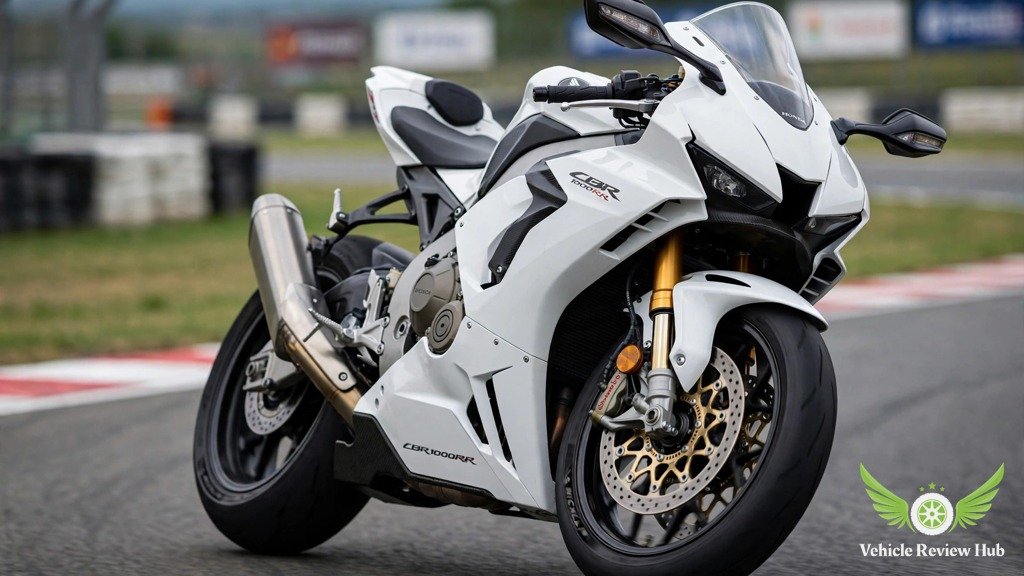
Showa BPF Fork and BFRC Rear on the Standard Bike Explained
The standard SC77 carries a 43mm Showa Big Piston Fork (BPF) up front and a Showa Balance Free Rear Cushion (BFRC) shock at the rear, both fully adjustable, plus Honda’s Electronic Steering Damper (HESD), which firms up with speed. Together they produce the Honda CBR1000RR performance handling signature: stability at speed, neutrality in corners, and feedback that arrives early enough to act on. Weight helps too: Honda cut a claimed 33 pounds from the previous generation, for a fueled wet weight of 432 pounds on the 2017 bike, and the doc’s weight drift — 430 pounds and a 32.3-inch seat against 432 pounds and 32.8 inches — reflects year-to-year variation that this Honda CBR1000RR performance guide reports rather than resolves into a single blended spec. Check the Honda page for the year you are buying.
Tokico Radial Brakes Against the SP Brembo Monobloc Setup
Braking on the standard bike is dual 320mm front discs with radial-mounted four-piston Tokico calipers and a single 220mm rear disc, with ABS on the RA model adding gyro-assisted cornering ABS with rear-lift control. The SP, by contrast, carries Brembo monobloc calipers and Öhlins NIX30 fork and TTX36 shock hardware — SP equipment that must never be described as standard-bike equipment. In practice, the standard Tokico setup is strong and progressive, and more than adequate for road and novice-to-intermediate track use; the Brembo advantage shows at advanced track pace. For most Honda CBR1000RR performance buyers, the standard brakes are not a reason to pay the SP premium. A related material note, resolved here: Motorcycle.com’s reveal coverage states explicitly that the SP’s titanium fuel tank is carried over to the regular RR, and the titanium muffler saves 6.2 pounds — so the doc’s titanium claim for the SC77 stands, while Cycle News’s wording implying SP-only fitment is best read as loose phrasing.
Honda CBR1000RR Performance Compared With Other Superbikes
Comparison is where Honda CBR1000RR performance numbers need the most care, because the rivals have moved in different directions.

Honda CBR1000RR vs Kawasaki ZX-10R and Suzuki GSX-R1000
The Kawasaki ZX-10R is the closest rival and the toughest comparison for Honda CBR1000RR performance. For 2026 the ZX-10R starts at $16,999 with an $840 destination charge — exactly matching the Honda’s $16,999 base price for 2026, with destination charges differing ($840 Kawasaki, $775 Honda) — and its ABS version runs $17,999, per Ultimate Motorcycling’s 2026 ZX-10R review. The Kawasaki brings World Superbike pedigree and a sharper, more aggressive character; the Honda answers with balance, comfort, and the best observed fuel economy of any bike in its shootout group. The Suzuki GSX-R1000 is the value answer: TopSpeed’s Suzuki coverage puts the GSX-R1000 at $16,399 after its price cut, $600 under the Honda, with a claimed 193 horsepower and 81 pound-feet, a 447-pound wet weight, and a 32.5-inch seat. On paper the Suzuki out-muscles the Honda; on the road the Honda’s lighter feel and friendlier delivery close much of that gap.
| Model (2026, new) | Price | Key performance note |
|---|---|---|
| Honda CBR1000RR | $16,999 + $775 destination | 999cc four, 149.63 hp dyno (2017), 38.2 mpg observed |
| Kawasaki ZX-10R | $16,999 + $840 destination | 998cc four, WSBK pedigree, sharper character |
| Suzuki GSX-R1000 | $16,399 | 999cc four, 193 hp claimed, 447 lb wet |
| Honda CBR1000RR-R SP | $28,999 (2027) | Different bike (SC82), rival only, never a base-RR trim |
| Honda CBR1000RR (2027) | $17,099 + $775; ABS $17,399 | Pearl White only, July availability |
Is the Honda CBR1000RR Suitable for Experienced Riders Only?
Yes, with a qualification that matters for Honda CBR1000RR performance buyers. This is a 150-rear-wheel-horsepower, 430-pound superbike with handling that rewards commitment; it is not a beginner motorcycle, and no responsible Honda CBR1000RR performance guide should suggest otherwise. The qualification is that among literbikes, the Honda is the forgiving one: its power delivery is linear rather than violent, its electronics are genuinely helpful, and its chassis communicates early. An experienced rider stepping up from a 600 will find it fast but manageable; a brand-new rider should not start here, no matter how good the price looks.
Honda CBR1000RR Performance FAQs
Direct answers to the Honda CBR1000RR performance questions riders ask most often.
How much horsepower does the Honda CBR1000RR make?
Honda claims 189 horsepower at the crank, but the verified American rear-wheel figure is 149.63 horsepower at 10,540 rpm on Cycle World’s dyno, with Motorcycle.com’s shootout recording 153.2 horsepower on a different dyno, per this Honda CBR1000RR performance guide.
What is the top speed of the Honda CBR1000RR?
No verified US top speed exists for the SC77 generation, states this Honda CBR1000RR performance guide. The 186-mph figure in circulation is from MCN’s European test bike, never an American result.
What is the Honda CBR1000RR 0-60 mph time?
The doc heading cites Cycle World’s 2012 figures of 0-60 mph in 2.6 seconds and a 9.82-second quarter mile, but those figures could not be re-verified from the accessible text of the 2012 test, notes this Honda CBR1000RR performance guide — treat them as doc figures pending verification, not freshly confirmed results.
What MPG does the Honda CBR1000RR get?
Motorcycle.com observed 38.2 mpg in worst-case shootout use — the best figure in its group — and ordinary mixed riding should beat that, per this Honda CBR1000RR performance guide.
How far can the Honda CBR1000RR go on a tank?
About 160 miles from a 4.2-gallon tank or 164 miles from a 4.3-gallon tank at the observed 38.2 mpg, and roughly 189 to 194 miles at a gentle 45 mpg, with the working shown, per this Honda CBR1000RR performance guide.
Does the Honda CBR1000RR have a quickshifter?
Not as standard. The quickshifter with auto-blipping downshifter is a paid Honda accessory on the standard bike — Motorcycle.com’s track shootout notes it as a $579 option — so check a used bike rather than assuming it, advises this Honda CBR1000RR performance guide.
Does the Honda CBR1000RR have ride modes and traction control?
Yes: throttle-by-wire, a five-axis IMU (not the RR-R’s six-axis unit), HSTC torque control with nine levels, selectable power modes, and HESD electronic steering damping, per this Honda CBR1000RR performance guide.
How does the CBR1000RR compare with the ZX-10R?
For 2026 both start at $16,999 before destination ($775 Honda, $840 Kawasaki), per this Honda CBR1000RR performance comparison. The Kawasaki is sharper and more aggressive; the Honda answers with balance, comfort, and better observed fuel economy.
How does the CBR1000RR compare with the GSX-R1000?
The Suzuki undercuts the Honda at $16,399 with a claimed 193 horsepower, but the Honda counters with a lighter feel, friendlier delivery, and the best shootout fuel economy, per this Honda CBR1000RR performance comparison.
Is the Honda CBR1000RR good for beginners?
No. With around 150 rear-wheel horsepower and superbike handling, it suits experienced riders and skilled step-ups from a 600, not brand-new riders, per this Honda CBR1000RR performance guide.
Is the Honda CBR1000RR good for track days?
Yes. Its balance, BPF fork, BFRC rear, and coordinated electronics make it confidence-inspiring at novice and intermediate track pace, per this Honda CBR1000RR performance guide.
Is the Honda CBR1000RR good for highway riding?
Yes, with a tall sixth gear and a working fairing, though the 4.2 to 4.3-gallon tank means fuel stops every 140 to 150 miles on spirited days, per this Honda CBR1000RR performance guide.
What is the Honda CBR1000RR redline?
Peak claimed power arrives at 13,000 rpm, with the Cycle World dyno peak at 10,540 rpm and the Motorcycle.com shootout peak at 10,600 rpm, notes this Honda CBR1000RR performance guide.
Is the 2027 Honda CBR1000RR the final year of the standard bike?
Honda has not announced that. One dealer listing used “final year” phrasing, but Honda’s own release describes the 2027 bike as returning, so this Honda CBR1000RR performance guide does not repeat the dealer claim as fact.
Does the Honda CBR1000RR have a titanium tank and muffler?
Motorcycle.com’s reveal coverage states the SP’s titanium fuel tank is carried over to the regular RR and the titanium muffler saves 6.2 pounds, which supports the doc’s claim, notes this Honda CBR1000RR performance guide; Cycle News’s looser track-test wording implied SP-only fitment.
How much does the 2026 Honda CBR1000RR cost?
The 2026 base bike costs $16,999 plus a $775 destination charge, with the ABS model at $17,299, in Pearl White; the 2027 bike costs $17,099 plus $775, with ABS at $17,399.