The short answer in this Honda CMX500 Rebel buying guide is simple: buy the bike, not the badge on the listing. CMX500 is Honda’s model code for the Rebel 500, so a “CMX500 Rebel” and a “Rebel 500” are the same motorcycle, and this Honda CMX500 Rebel buying guide treats them as one bike throughout. A clean used example usually costs between $4,300 and $6,700, while a new 2026 model costs $6,799, or $6,999 for the SE, plus a $600 destination charge. Check every bike by VIN for the handlebar-screw recalls, verify ABS by model code and hardware, and budget for chain, tires and insurance.
One overlap warning belongs at the top of this Honda CMX500 Rebel buying guide. Honda’s paperwork calls this bike the CMX500, dealers and riders call it the Rebel 500, and both names describe one 471cc parallel-twin bobber built from 2017 onward. Engine, frame, seat height and service schedule are shared, and a part or recall listed for the Rebel 500 applies to the CMX500.
Honda CMX500 Rebel Price and Market Availability
Used prices in this Honda CMX500 Rebel buying guide start with the market as it actually looks.
What Does a Used Honda CMX500 Rebel Cost in the USA by Year?
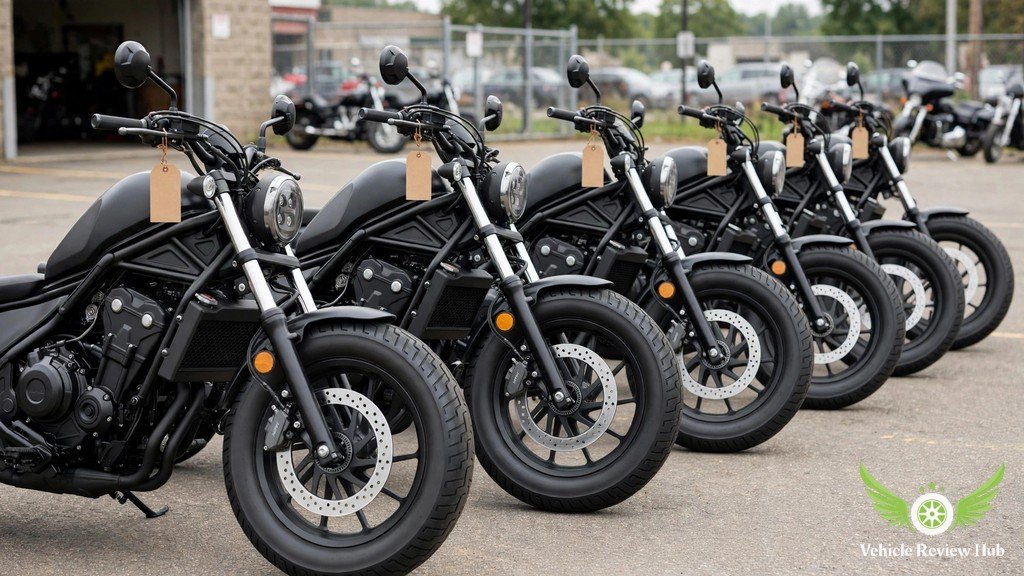
Used prices in this Honda CMX500 Rebel buying guide are asking prices from dealer and private listings surfaced in November 2026 research, not completed sale prices. Early bikes cluster in the low four thousands, mid-era bikes in the high four to mid five thousands, and late bikes in the five to high six thousands. Examples in this Honda CMX500 Rebel buying guide include a 2019 ABS listed by Throttle Society in Fremont, Ohio, at $4,293; a 2020 ABS with 19,389 miles listed by Pinnacle Motorsports in Bessemer, Alabama, at $4,599;; a 2022 ABS listed by Mid-South Motoplex in Clarksville, Tennessee, at $5,488; and a 2024 ABS SE listed by Powersports of Greenville in Greenville, South Carolina, at $6,699.
| Model years | Typical asking range (Nov 2026) | What to expect |
|---|---|---|
| 2017–2019 | $3,500–$4,800 | Pre-slipper-clutch bikes, ABS often optional |
| 2020–2021 | $4,300–$5,200 | Slipper clutch fitted, reflector recall years |
| 2022–2023 | $4,800–$6,000 | SE trim common, check handlebar-screw recall by VIN |
| 2024–2025 | $5,500–$6,700 | Newest used bikes, 2024 sits outside recall 26V-500 |
| 2026 (new) | $6,799 / $6,999 SE + $600 destination | ABS standard on both trims, full warranty |
One caution goes with that table in this Honda CMX500 Rebel buying guide: it could not verify a claimed 258-mile 2021 SE that circulates in older write-ups. No traceable listing turned up, so it is not repeated here as a real example, and any seller quoting it should be asked for the listing itself.
Is the Honda CMX500 Rebel Available Through Official US Dealers?
Yes, and the answer follows from the code question that opens this Honda CMX500 Rebel buying guide. Because the CMX500 is the Rebel 500, official availability means Honda Powersports dealer availability for the Rebel 500. Honda’s 2026 Rebel 500 page lists the base model at $6,799 with a $600 destination charge, Model ID CMX500A, in Pearl Black or Pearl Smoky Gray, and the SE at $6,999 in Pearl Blue, with ABS standard on both trims. For a used bike, this Honda CMX500 Rebel buying guide recommends franchised Honda dealers for the newest examples. If a dealer cannot show you the VIN, service history and recall status, walk away.
Honda CMX500 Rebel Insurance and Ownership Costs
Insurance is a quiet advantage here, if you read the benchmarks correctly, as this Honda CMX500 Rebel buying guide explains.
The $399 a Year Benchmark Is a 45-Year-Old Rider Profile, Not a Quote
The $399-a-year figure in this Honda CMX500 Rebel buying guide is real, but it is a profile, not a price anyone can expect to be quoted. ValuePenguin’s average motorcycle insurance study puts the national average for full coverage at $33 a month, or $399 a year, and its methodology states plainly that the quotes are for a 45-year-old single man who owns a 2018 Honda CMX500 Rebel, with a full-coverage policy carrying higher liability limits than the state minimum plus comprehensive and collision cover. The number describes that rider, not you. A younger rider, a rider with claims or violations, or a rider in a high-cost state will pay something different, often much more. For contrast, MoneyGeek’s October 2026 data for a 40-year-old with a clean record on a 2018 Rebel 500 gives about $141 a year for liability-only cover and $364 for full coverage. Neither figure is a quote, and this Honda CMX500 Rebel buying guide recommends getting three real quotes, with your age, ZIP code, riding history and garaging, before treating any benchmark as your budget.
How to Estimate Fuel, Maintenance, Parts and Other Ownership Expenses
Running costs are where this Honda CMX500 Rebel buying guide gets practical, because the purchase price is only the first bill. Fuel is the smallest regular cost: using Rider Magazine’s genuine 2020 test average of 49.2 mpg, a 3.0-gallon tank gives roughly 148 miles to empty, so a rider covering 5,000 miles a year at around 50 mpg uses about 100 gallons. Maintenance follows a short, cheap schedule, set out in the companion CMX500 Rebel reliability coverage: first service at 600 miles, oil every 8,000 miles or one year, valve-clearance inspection at 16,000 miles, and chain care every 600 miles. Budget a few hundred dollars a year for routine shop maintenance, plus tires and a chain and sprocket set when worn, as a planning estimate in this Honda CMX500 Rebel buying guide. Parts availability is a genuine strength, since the bike has been in production since 2017 with minimal changes. Avoid time-based neglect on a low-mileage bike: a five-year-old bike with 1,000 miles still needs fresh tires, brake fluid, coolant and a battery check.
How to Inspect a Used Honda CMX500 Rebel
A used CMX500 rewards a slow inspection, and this Honda CMX500 Rebel buying guide puts the recall check first because it can stop a sale outright.
Verify ABS by Model Code and Hardware, Not the Seller’s Listing Title
ABS is the single most mis-described feature on used Rebel listings, so this Honda CMX500 Rebel buying guide treats the listing title as a claim to verify, never as evidence. Honda’s 2026 spec page lists Model ID CMX500A for the base bike; the code on the VIN plate and paperwork, not an advertisement headline, is what counts. Physically, an ABS bike carries a sensor ring at the wheels and a dash light that goes out once rolling; a non-ABS bike has neither. Check both: read the model code, then look for the slotted sensor ring at the front wheel and confirm the dash light behaves correctly on a test ride. ABS was a paid option worth about $300 in the years when it was optional, so the distinction also affects price. If the seller cannot confirm ABS by code and hardware, price the bike as a non-ABS bike, and this Honda CMX500 Rebel buying guide would rather you walk away from a listing that insists on ABS it cannot show. The same applies to the SE: it brings a brown diamond-stitch seat, black fork boots and a color-matched headlight cowl, so an SE claim without those parts is not an SE.
Inspecting the Frame, Tires, Brakes, Chain, Suspension and Electrics
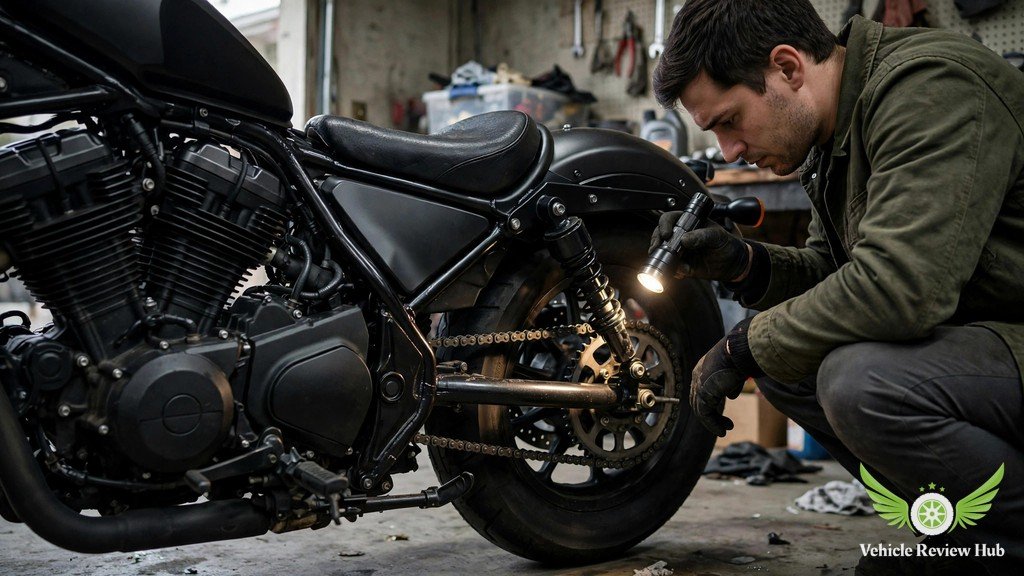
Start cold, as this Honda CMX500 Rebel buying guide advises. A cold engine that starts promptly and idles steadily is worth more than a warm engine run to hide a starting problem, so ask the seller not to warm the bike before you arrive. Work through the bike in order: frame and forks for crash damage and bent levers; tires for tread depth and age codes, since a tire older than five or six years needs replacing even with tread left; brakes for pad thickness and fluid colour, with brake fluid due every two years; and suspension for fork-seal weep and rear-shock leaks. The chain deserves its own minute, because the CMX500 is chain-driven, not shaft-driven: check slack against the 25–35 mm range, look for tight spots and rust, and ask when the chain and sprockets were last replaced. Finish with the electrics: lights, indicators, horn, starter and the LCD dash, and look for non-standard accessory wiring, a common source of flat batteries. A bike passing this inspection in this Honda CMX500 Rebel buying guide is worth the asking price; one failing two or more checks is a negotiation, not a purchase.
Honda CMX500 Rebel Model Years and Features to Compare
The CMX500 changed slowly, and this Honda CMX500 Rebel buying guide groups the run into two eras that matter.
Comparing 2017-2019 Models With 2020-On Slipper Clutch Versions
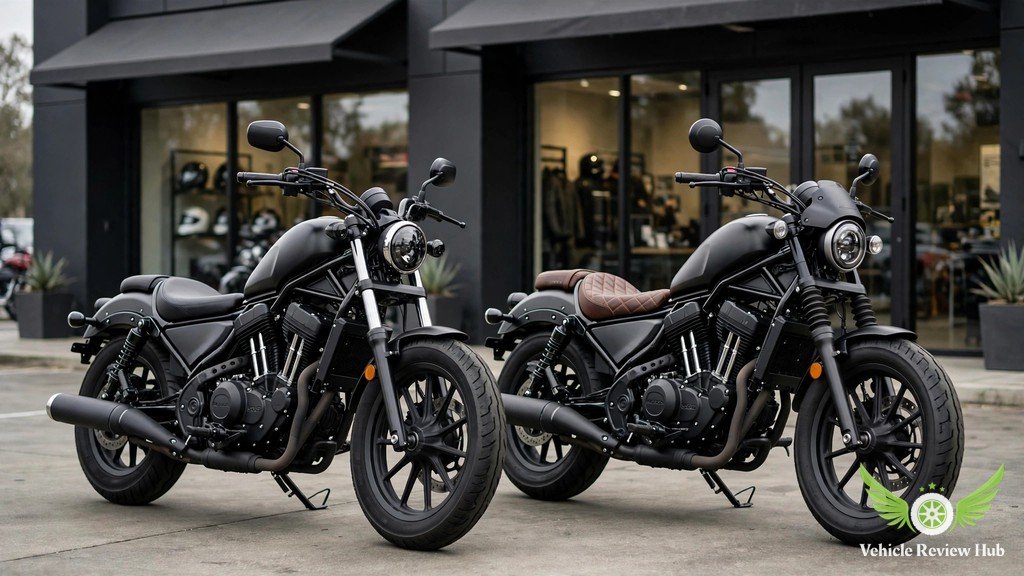
The dividing line in this Honda CMX500 Rebel buying guide is the 2020 update, when Honda fitted an assist-and-slipper clutch. The 2017–2019 bikes are mechanically the same 471cc parallel twin and six-speed gearbox, but without the slipper clutch, and their front brake was a smaller 264 mm disc against the 296 mm front disc fitted from 2020 onward, with a 240 mm rear disc. The LCD dash never became a TFT display in any year. A 2017–2019 bike is fine if the price reflects the older brake and clutch; a 2020-on bike is worth a modest premium for the slipper clutch and larger front brake. The companion CMX500 Rebel performance coverage and CMX500 Rebel review cover the road feel and full specifications.
2026 Note: 2024 Sits Outside Recall 26V-500, Check Every Bike by VIN
This heading in this Honda CMX500 Rebel buying guide is the one most likely to save a buyer from a false assumption, so it is stated plainly. Recall 26V-500, Honda campaign KU8, covers certain 2017–2023 and 2025 CMX500 motorcycles, plus certain Rebel 300 and SCL500 models, 43,913 motorcycles in total across those models, because a handlebar lock screw may loosen and detach and interfere with steering. 2024 sits outside that list, while 2025 is in it; a 2024 may still sit inside the earlier campaign 26V-146, Honda campaign KUO, covering certain 2023–2025 models, 19,406 motorcycles in total. Hence this Honda CMX500 Rebel buying guide insists on a VIN check for every bike, including a 2024: “outside 26V-500” does not mean “outside every recall”. The other recall to check is 21V-382, Honda campaign KM3, for a dim rear reflector on certain 2020–2021 models, including 1,504 Rebel 500s from 2020 and 2,090 from 2021 within a 28,528-motorcycle multi-model campaign, with a free reflector replacement. Run the VIN through the NHTSA recalls lookup and Honda’s recall search before paying, and treat an open recall as the seller’s problem to fix.
Honda CMX500 Rebel vs Kawasaki Eliminator: Which One to Buy in the USA
The Eliminator is the CMX500’s closest rival, compared here on price and character in this Honda CMX500 Rebel buying guide.
CMX500 Rebel at $6,799 Against the Eliminator From $6,499
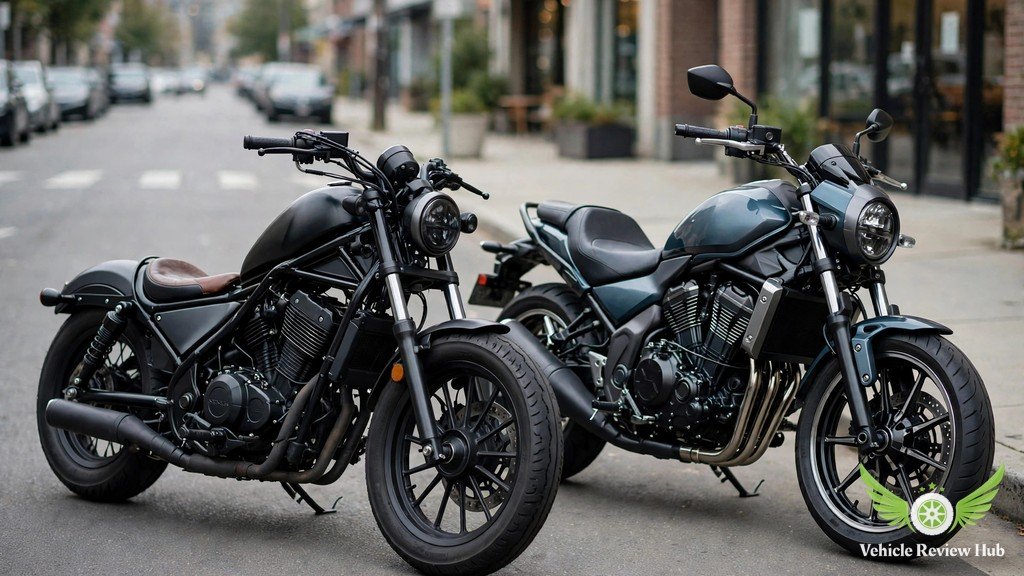
On new-bike price, the Eliminator undercuts the Rebel, as this Honda CMX500 Rebel buying guide states honestly. The 2026 Kawasaki Eliminator starts at $6,499 for the non-ABS version, or $6,799 with ABS, plus a $650 destination charge, against the Rebel’s $6,799, or $6,999 for the SE, plus $600 destination. The non-ABS Eliminator is therefore $300 cheaper than the base Rebel before destination, while the ABS Eliminator matches the Rebel’s base price and adds a $50 destination difference. In character, the Eliminator’s 451cc parallel twin feels livelier and more modern, while the Rebel’s 471cc twin is tuned for low-end ease, with a lower 27.2-inch seat. Total Motorcycle’s 2026 Eliminator guide lists the same $6,499 US starting price. This Honda CMX500 Rebel buying guide suggests sitting on both: the Rebel wins on lowest seat and simplest ownership, the Eliminator on newer-feeling engine. Compare out-the-door prices, not sticker prices.
When an SCL500, Super Meteor 650 or Rebel 1100 Makes More Sense
Three other bikes beat the CMX500 for specific buyers, and this Honda CMX500 Rebel buying guide names them rather than pretending the Rebel fits everyone. The SCL500, Honda’s scrambler-styled 471cc twin, makes more sense if you want the same proven engine with a more upright riding position and light unpaved-road ability, and the companion SCL500 review sets out that case. The Royal Enfield Super Meteor 650 makes more sense if you want a larger-feeling, classic-styled cruiser. The Rebel 1100 makes more sense if you have outgrown the 500’s power and can live with the higher price and weight, and the Rebel 1100 review covers that step up. The Rebel 300 (CMX300 in Honda’s coding) is the smaller beginner option; see the Rebel 300 buying guide. If none fits and the CMX500 still feels right after a test ride, that is your answer in this Honda CMX500 Rebel buying guide.
Is Buying a Used Honda CMX500 Rebel Worth It?
Yes, with two conditions attached, stated here first in this Honda CMX500 Rebel buying guide.
Benefits and Risks of Buying a Used Honda CMX500 Rebel
The benefits in this Honda CMX500 Rebel buying guide are concrete: a proven 471cc twin with a huge parts supply, a 27.2-inch seat, ABS on most later bikes and standard on 2026 models, and used prices that leave room for tires, a chain and a proper service. The risks are equally concrete: an open handlebar-screw recall on a 2017–2023 or 2025 bike, a mis-described ABS or SE trim, time-based neglect on a low-mileage garage bike, and chain-drive maintenance that a shaft-drive cruiser buyer may not expect. None of those risks is a reason to avoid the bike; all are reasons to inspect it properly and check the VIN. The video below walks around a used 2023 Rebel 500 listed at $6,199.
US-Market Alternatives: Vulcan S, Meteor 350 and Rebel 300 E-Clutch
If the CMX500 you find fails inspection or the price is wrong, three alternatives deserve a test ride before you settle, and this Honda CMX500 Rebel buying guide lists them in order of closeness. The Kawasaki Vulcan S is the modern, adjustable alternative, with a 649cc parallel twin. The Royal Enfield Meteor 350 is the budget alternative, a smaller single-cylinder cruiser that costs less to buy and run but gives up the Rebel’s highway ease. The Rebel 300 with E-Clutch, at $5,349 for 2026, is the beginner alternative inside Honda’s own range: lighter and cheaper, with clutch automation that removes stalling anxiety. The companion Rebel 500 review is the same bike under its familiar name, and reading it alongside this Honda CMX500 Rebel buying guide is the fastest way to confirm that nothing about the CMX500 code changes the motorcycle underneath.
Honda CMX500 Rebel Buying Guide FAQs
Direct answers to the questions used CMX500 shoppers actually ask, drawn from the research in this Honda CMX500 Rebel buying guide.
Is a Honda CMX500 Rebel the same as a Honda Rebel 500?
Yes. CMX500 is Honda’s model code for the Rebel 500, so they are the same motorcycle, and this Honda CMX500 Rebel buying guide treats them as one bike throughout.
How much does a used Honda CMX500 Rebel cost?
November 2026 asking prices run from about $3,500 for an early bike to about $6,700 for a late example, per this Honda CMX500 Rebel buying guide.
How much is a new 2026 Honda CMX500 Rebel?
The 2026 Rebel 500 costs $6,799, or $6,999 for the SE, plus a $600 destination charge, with ABS standard on both trims, per this Honda CMX500 Rebel buying guide.
Can I buy a CMX500 Rebel from an official Honda dealer?
Yes, through Honda Powersports dealers, per this Honda CMX500 Rebel buying guide.
How much does Honda CMX500 Rebel insurance cost?
No single figure applies to every rider. ValuePenguin’s $399-a-year full-coverage average is a 45-year-old single man on a 2018 CMX500 Rebel, not a quote, and this Honda CMX500 Rebel buying guide recommends three real quotes before budgeting.
Is a 2024 Honda CMX500 Rebel affected by recall 26V-500?
No. Recall 26V-500 covers certain 2017–2023 and 2025 CMX500 motorcycles, so 2024 sits outside it, but every bike should still be checked by VIN, per this Honda CMX500 Rebel buying guide.
What other recalls should I check on a used CMX500 Rebel?
Check 26V-146 for the handlebar screw on certain 2023–2025 bikes and 21V-382 for a dim rear reflector on certain 2020–2021 bikes, by VIN, per this Honda CMX500 Rebel buying guide.
How do I verify ABS on a used CMX500 Rebel?
Verify by model code on the VIN plate and paperwork, and by hardware: an ABS sensor ring at the wheel and a dash ABS light that goes out once the bike rolls, per this Honda CMX500 Rebel buying guide.
What is the difference between the CMX500 Rebel and the SE?
The SE adds a brown diamond-stitch seat, black fork boots and a color-matched headlight cowl, and costs $200 more than the base bike for 2026, per this Honda CMX500 Rebel buying guide.
Is the Honda CMX500 Rebel good for beginners?
Yes, for most new riders: a 27.2-inch seat, gentle power and standard ABS on new models, per this Honda CMX500 Rebel buying guide.
How far can a Honda CMX500 Rebel go on a tank?
About 148 miles, from Rider’s 49.2 mpg average and the 3.0-gallon tank, per this Honda CMX500 Rebel buying guide.
Should I buy a CMX500 Rebel or a Kawasaki Eliminator?
Buy the Rebel for the lowest seat and simplest ownership, and the Eliminator for a livelier engine, per this Honda CMX500 Rebel buying guide.
Does the Honda CMX500 Rebel have a TFT display or E-Clutch?
No. US models through 2026 use an LCD dash, not TFT, and have no E-Clutch, DCT or traction control, per this Honda CMX500 Rebel buying guide.
Is buying a used Honda CMX500 Rebel worth it?
Yes, if the VIN is clear of open recalls, ABS and SE are verified by code and hardware, and the chain, tires and fluids are in good shape, per this Honda CMX500 Rebel buying guide.