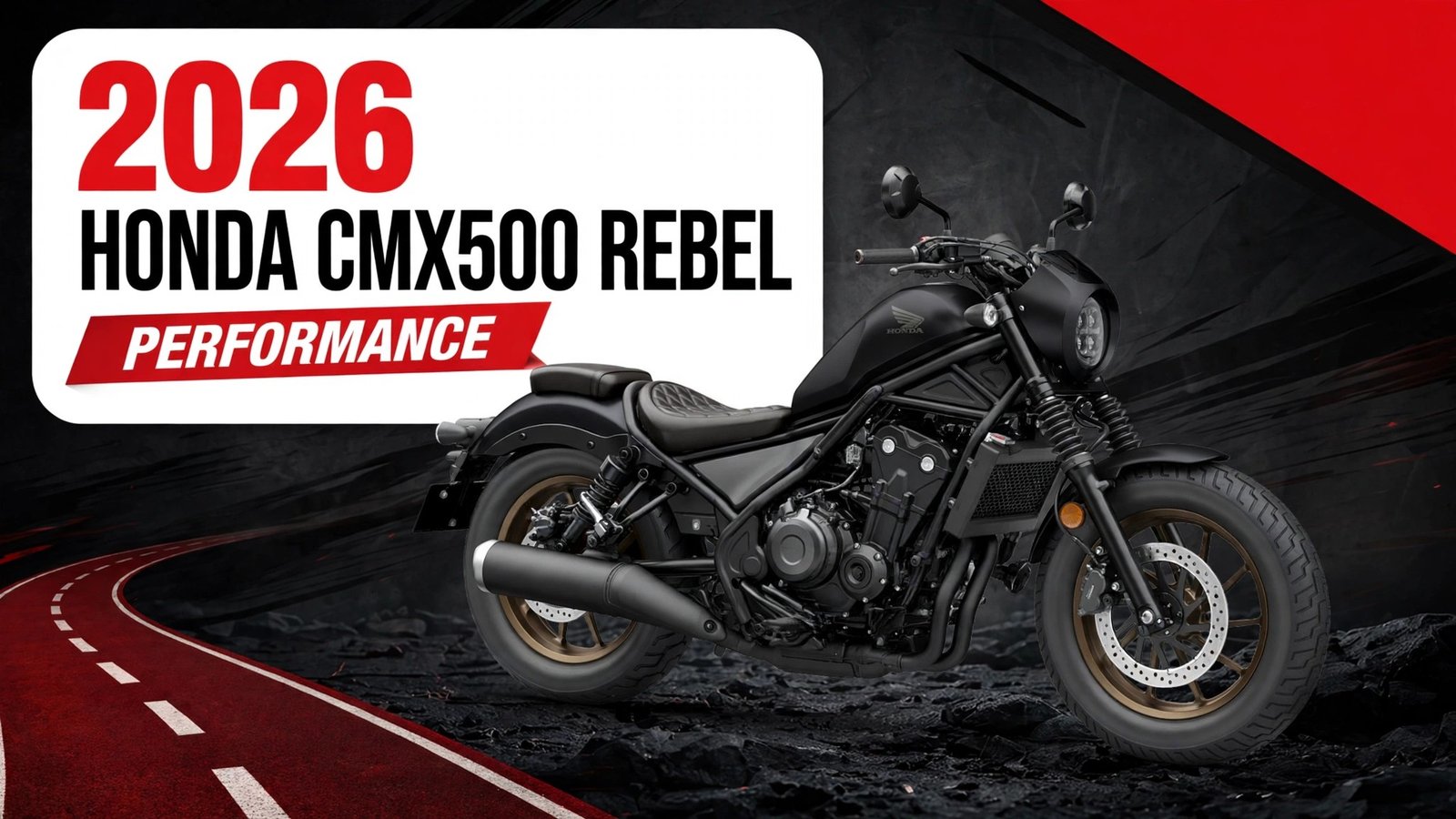
Short answer: Honda CMX500 Rebel performance is friendly, not fast. The 471cc parallel twin makes a measured 40.83 horsepower at the rear wheel, returns a tested 49.2 mpg on average, and holds highway speed without drama — but it is not a top-speed machine, and no major magazine has published a timed 0-60 run. This guide separates tested numbers from estimates and compares Honda CMX500 Rebel performance with the Eliminator and Vulcan S. One identity note first: CMX500 is simply the model code for the Rebel 500 — the two names describe the same motorcycle, not two different bikes.
Honda CMX500 Rebel Engine Performance and Power Delivery
Honda CMX500 Rebel performance starts with an engine Honda has barely changed since 2017: a liquid-cooled 471cc parallel twin with dual overhead cams, four valves per cylinder, programmed fuel injection, and 10.7:1 compression, driving the rear wheel through a six-speed gearbox and chain. Honda publishes no horsepower figure for this bike, so every power number here comes from an independent test or a clearly labelled overseas claim — the rule for Honda CMX500 Rebel performance figures here.

Cycle World Dyno 40.83 HP at 7,880 RPM for the 2020 Model
The central number in Honda CMX500 Rebel performance is Cycle World’s 2020 dyno test: 40.83 horsepower at 7,880 rpm and 29.91 pound-feet of torque at 6,300 rpm, measured at the rear wheel on its in-house dyno. Those are rear-wheel figures, not crankshaft claims, which is why they sit below the roughly 46 horsepower quoted for the same engine in European markets at 8,500 rpm. The two numbers measure different things, and Honda CMX500 Rebel performance should always be quoted with that distinction attached. Cycle World also noted the delivery’s shape: about 26 pound-feet just above 2,000 rpm and a broad, flat torque curve, so Honda CMX500 Rebel performance pulls cleanly from just above idle, peak power serving highway work rather than drag-strip bragging.
Throttle Response, Gear Ratios and Slipper Clutch Behaviour
Throttle response is where Honda CMX500 Rebel performance wins its reputation. Rider’s 2020 road test praised the engine’s predictable torque curve and healthy pep, noting roll-on power left above 65 mph — what merging and overtaking need: a twist in sixth gear, or a drop to fifth for a faster pass. First gear is short enough for clean launches, sixth tall enough to keep the engine relaxed, and short shifting hides the vibration felt when the engine is wrung out hard, as Rider noted.
The slipper clutch is the other half of the story. Honda added an assist-and-slip clutch for 2020, cutting clutch pull by about 30 percent according to Honda, with a wide friction zone that makes setting off easy. For Honda CMX500 Rebel performance, the slipper function matters on downshifts: an aggressive downshift that would otherwise hop the rear wheel is smoothed. The clutch is cable-actuated and wet, the final drive an O-ring chain with 15-tooth front and 40-tooth rear sprockets, tuned for low-end and midrange rather than top-end rush.
Honda CMX500 Rebel Top Speed and Acceleration
Honda CMX500 Rebel performance at the very top end is the weakest-documented part of the bike, and this article says so plainly: no major American magazine has published an instrumented top-speed run, and no verified 0-60 mph or quarter-mile time exists from Cycle World, Rider, or Motorcycle.com. What exists instead is a consistent band of owner reports and secondary estimates, labelled as such throughout this Honda CMX500 Rebel performance guide.

Top Speed Around 95 to 105 MPH as Estimates Only
The realistic band for Honda CMX500 Rebel performance at full throttle is around 95 to 105 mph, every figure an estimate, not a test result. Owner reports cluster lower: many report around 95 mph solo, 90 to 98 mph attainable on a flat road, with fewer brief bursts to 100 or 101 mph, often downhill or with a tailwind. Secondary sources quoting 109 or 110 mph trace back to spec-sheet copies or single downhill runs, not repeated testing — do not quote them as the bike’s top speed. The honest summary: about 95 mph is repeatable, 100 mph possible in favourable conditions, and anything above that an outlier — rider weight, wind, gradient, and luggage all move the number.
Why No Instrumented 0-60 or Quarter Mile Test Could Be Verified
The absence of a verified acceleration time is itself a finding about Honda CMX500 Rebel performance. Cycle World’s dyno article reports power and torque only; Rider’s 2020 test reports fuel economy, weight, and handling, but no timed acceleration. Owner forums repeat a figure around 5.9 seconds to 60 mph, attributed to shared CB500X gearing, but that is a forum calculation, not an instrumented Rebel 500 test, and this article does not present it as verified. Until a major outlet publishes a timed run, Honda CMX500 Rebel performance off the line is best described as testers describe it: brisk for a 414-pound cruiser, quick enough to stay ahead of traffic from a light.
Honda CMX500 Rebel Mileage and Fuel Economy
If top speed is the weakest-documented part of Honda CMX500 Rebel performance, fuel economy is the strongest — but note one distinction first: Honda’s current US pages list no MPG figure at all, so the mileage numbers in this Honda CMX500 Rebel performance guide come from Rider’s testing and are labelled as such.

Rider Tested 64.3 MPG High, 49.2 Average and 43.1 Low
Rider’s 2020 road test of the Rebel 500 ABS gives the most useful fuel figures in Honda CMX500 Rebel performance: 64.3 mpg high, 49.2 mpg average, and 43.1 mpg low, on 86-octane minimum fuel. The spread matters as much as the average: 64.3 mpg shows gentle riding, 43.1 mpg hard riding, and 49.2 mpg is the mixed-riding planning figure. That average is a genuine Rider test figure, not a Fuelly average or Honda claim, driving every range calculation below. In Honda CMX500 Rebel performance, a light throttle and early upshifts return mileage in the high 50s or better, while sustained high-speed running pulls it toward the low 40s — a swing of more than 20 mpg driven mostly by throttle.
Around 148 Miles to Empty by Arithmetic and the 3.0-Gallon Tank
Two numbers circulate for the same tank, so the Honda CMX500 Rebel performance range figure needs explanation. Honda’s current US pages list 3.0 gallons; 11.2 litres converts to 2.96 US gallons, the same tank rounded two ways, while older pages list 2.9 gallons. There is no 3.9-gallon tank and no second tank size — the difference is rounding. Rider lists 3.0 gallons, the last 0.58 gallon triggering the low-fuel warning — about 2.4 usable gallons before it. The arithmetic: 49.2 mpg × 3.0 gallons = 147.6 miles, about 148 miles to empty, confirming the doc heading’s figure. At 64.3 mpg the tank stretches to about 193 miles; at 43.1 mpg it shrinks to about 129 miles. In practice, plan a stop around 120 to 130 miles.
| Rider 2020 test figure | Value | Range on 3.0 gallons |
|---|---|---|
| High | 64.3 mpg | About 193 miles |
| Average | 49.2 mpg | About 148 miles |
| Low | 43.1 mpg | About 129 miles |
| Planning figure | About 50 mpg mixed | Stop around 120 to 130 miles |
Honda CMX500 Rebel Real-World Riding Performance
Honda CMX500 Rebel performance in daily use is defined by a low seat, a light chassis, and early torque. At about 414 pounds ready to ride with a 27.2-inch seat and low centre of gravity, it feels lighter than its weight suggests at parking speeds.

City Riding, Traffic Performance and Everyday Acceleration
Around town, Honda CMX500 Rebel performance is at its best: light, stable steering, low clutch effort, smooth shifting, and a 27.2-inch seat that lets most riders plant both feet flat. Second and third gear cover nearly all city riding, the clutch’s wide friction zone makes stop-start traffic painless, and low-end torque pulls away cleanly. Everyday Honda CMX500 Rebel performance is brisk rather than startling: quick away from lights, undramatic merging, and predictable in the wet. The 16-inch wheels limit tyre choice, as Rider noted, but they also keep the seat low and steering light.
Highway Riding, Overtaking Ability and Load Capacity
On the highway, Honda CMX500 Rebel performance is competent within clear limits. The bike holds 65 to 75 mph all day, with roll-on power left above 65 mph for overtaking: a twist in sixth gear, or a drop to fifth for a faster pass. Passing at 70 mph is easy; at 90 mph it takes planning, as the engine nears the top of its comfortable range and wind becomes the bigger opponent. The video below shows a Rebel 500 at the relaxed pace it suits best.
Load capacity needs the same plain treatment. The stock US Rebel 500 ships solo: the manual states a bike without the optional passenger seat kit was not designed to carry a passenger, and one may only be carried once a seat with strap and footpegs designed for the bike are securely installed. Maximum weight capacity is 346 pounds for rider, passenger, cargo, and accessories together, so two adults plus luggage approach that limit quickly. Two-up Honda CMX500 Rebel performance is realistic for short trips with the kit fitted and the load inside the limit, but the bike is best solo or lightly loaded; regular two-up luggage touring suits the larger Rebel 1100 instead.
Honda CMX500 Rebel Handling, Braking and Stability
Honda CMX500 Rebel performance in corners and braking reflects the bike’s brief: long, low, stable, forgiving. The steel diamond frame, 28.0-degree rake, 4.3 inches of trail, and 58.7-inch wheelbase give straight-line calm and predictable direction changes.

41mm Fork With 5.5 Inches of Travel, Dual Shocks and Cornering
The Honda CMX500 Rebel performance suspension story contains a genuine conflict, worth naming rather than smoothing over. Honda’s current US pages list a 41mm fork with 5.5 inches of travel and dual shocks with 3.7 inches, confirmed on the 2026 SE page, while Rider’s 2020 test described 4.8 inches front and 3.8 inches rear, with stiffer springs and higher fork oil than the 2017 bike. The difference is a specification-page revision against a period test measurement, not a visible physical change: front travel 5.5 inches today against 4.8 inches in 2020, rear 3.7 against 3.8 inches. Either way, the fork is non-adjustable, the rear shocks preload-adjustable twins, and the ride firm over sharp edges: Rider noted hard hits from expansion joints deliver a solid jolt. Cornering is confident at normal road speeds, the mid-mount footpegs allowing a decent lean angle before the feelers touch down. Tyres are 130/90-16 front and 150/80-16 rear.
Tested Wet Weight 418 lb Against the Claimed 414 lb Explained
The Honda CMX500 Rebel performance weight conflict is small, with a boring, reassuring explanation. Honda lists 414 pounds curb for the base model, including all standard equipment, required fluids, and a full tank, ready to ride; the SE is listed at 419 pounds. Rider weighed its 2020 ABS test bike at 418 pounds full of fluids; Cycle World lists 418 pounds, 422 with the saddlebag accessory. The four-pound gap is therefore not a contradiction: a base model on Honda’s scales versus an ABS test bike, with accessories, on a magazine’s scales. The useful figure is the tested one — about 418 pounds, still light for a cruiser and the main reason the bike feels manageable. Braking matches that lightness: a single 296mm front disc with a two-piston caliper and a single 240mm rear disc, both with ABS standard on current trims. Rider found plenty of braking power with a linear front pull, though feel is vague. Pre-2020 bikes used a smaller 264mm front disc, so a used buyer should check disc size and ABS hardware rather than trusting a listing title; our companion CMX500 Rebel reliability guide covers the brake and chain checks in detail.
Honda CMX500 Rebel Performance Compared With Other Middleweight Cruisers
Against its closest rivals, Honda CMX500 Rebel performance trades outright speed for ease, economy, and price: not the quickest bike here, but the lightest, lowest-seated, and cheapest to run.
Honda CMX500 Rebel vs Kawasaki Eliminator and Vulcan S
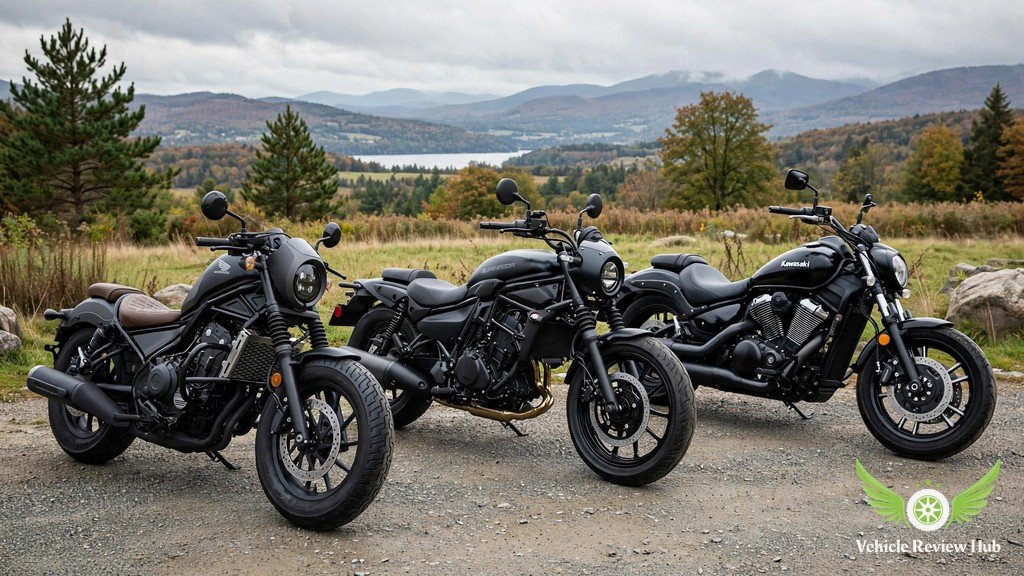
The Kawasaki Eliminator is the closest rival for Honda CMX500 Rebel performance, also a lightweight parallel twin aimed at newer riders. The Eliminator uses a 451cc Ninja-derived twin, lists from $6,499 without ABS and $6,799 with ABS plus $650 destination, weighs about 388 pounds with ABS, and sits at 28.9 inches — taller, lighter, and sportier than the Rebel. Against it, the Rebel feels torquier at low revs and more relaxed cruising, the Eliminator livelier when revved. The Vulcan S is the other direction: a 649cc parallel twin claiming 60 hp at 7,500 rpm and 46.5 lb-ft at 6,600 rpm, priced at $7,649 without ABS and $8,149 with ABS plus $685 destination, at 492/498 pounds without/with ABS, with a 27.8-inch seat. The Vulcan S is quicker and more adjustable, thanks to Ergo-Fit, but gives up the Rebel’s lightness and price advantage. The Vulcan S specification page confirms those figures, and the table below keeps measurement methods separate: Rebel power is a rear-wheel test figure, Vulcan power a manufacturer crankshaft figure — not a like-for-like gap.
| Specification | CMX500 Rebel (2026) | Kawasaki Eliminator | Vulcan S (2026) |
|---|---|---|---|
| Engine | 471cc parallel twin | 451cc parallel twin | 649cc parallel twin |
| Power (as quoted) | 40.83 hp rear wheel (Cycle World, 2020) | About 51 hp crank (ISO figure) | About 51 hp crank (ISO figure) |
| Seat height | 27.2 in | 28.9 in | 27.8 in |
| Curb weight | 414 lb base / 419 lb SE | About 388 lb ABS | 492 lb / 498 lb ABS |
| Base price + destination | $6,799 + $600 | $6,499 + $650 | $7,649 + $685 |
The 2026 Rebel 500 SE page confirms the current Honda CMX500 Rebel performance specifications, and the full model story is in our companion CMX500 Rebel review.
Is the Honda CMX500 Rebel Suitable for Beginners and Touring?
Yes for beginners, with reservations for touring. For a beginner, the Honda CMX500 Rebel performance case is strong: gentle, predictable power, a 27.2-inch seat, light steering, a forgiving slipper clutch, and ABS standard on current trims. Rider’s test concluded the bike builds confidence, and the dyno result shows why: torque arrives early and stays flat, so a new rider is never surprised. For touring, the honest answer is narrower: Honda CMX500 Rebel performance suits day trips and weekend rides, especially with an accessory windscreen and a better seat, but the small tank means a stop every 120 to 130 miles, with no cruise control, no wind protection as standard, and tiring speeds above 80 mph. Two-up interstate touring suits the Rebel 1100 better; solo back-road touring at 60 to 70 mph suits the 500 well. For the ownership side of that decision, see our companion CMX500 Rebel buying guide.
Honda CMX500 Rebel Performance FAQs
Direct answers to the questions buyers ask most about Honda CMX500 Rebel performance, drawn from the tested figures in this article. Where no verified figure exists, the answer says so.
How much horsepower does the Honda CMX500 Rebel make?
Measured Honda CMX500 Rebel performance is 40.83 hp at 7,880 rpm at the rear wheel (Cycle World, 2020), with 29.91 lb-ft at 6,300 rpm. Honda publishes no figure; the roughly 46 hp European figure is a crankshaft claim.
What is the top speed of the Honda CMX500 Rebel?
No instrumented top speed exists. Honda CMX500 Rebel performance at full throttle is estimated at 95 to 105 mph from owner reports, with about 95 mph repeatable.
Does the Honda CMX500 Rebel have a verified 0-60 time?
No. For Honda CMX500 Rebel performance, no major magazine has published a timed 0-60 or quarter-mile run for the Rebel 500, and forum figures are borrowed or calculated, not instrumented.
What MPG does the Honda CMX500 Rebel get?
For Honda CMX500 Rebel performance, Rider’s 2020 test recorded 64.3 mpg high, 49.2 mpg average, and 43.1 mpg low. For planning, use about 50 mpg mixed, since Honda publishes no MPG figure for the US bike.
How far can a Honda CMX500 Rebel go on a tank?
Honda CMX500 Rebel performance range is about 148 miles to empty by arithmetic: 49.2 mpg multiplied by the 3.0-gallon tank. In practice, plan a stop around 120 to 130 miles, the low-fuel warning lighting with about 0.58 gallon remaining.
Does the Honda CMX500 Rebel have a slipper clutch?
Yes, Honda CMX500 Rebel performance includes a slipper clutch from 2020 onward. The assist-and-slip clutch cuts clutch pull by about 30 percent according to Honda and reduces rear-wheel hop on aggressive downshifts.
How much does a Honda CMX500 Rebel weigh?
For Honda CMX500 Rebel performance weight, Honda lists 414 pounds curb for the base model and 419 pounds for the SE, while Rider and Cycle World measured 418 pounds on an ABS test bike. The four-pound gap is a base-versus-ABS difference, not a contradiction.
Can the Honda CMX500 Rebel carry a passenger?
For Honda CMX500 Rebel performance passenger use, only with the optional passenger seat kit fitted: the stock US bike ships solo, and the manual states it was not designed to carry a passenger without that kit. Maximum capacity is 346 pounds for rider, passenger, cargo, and accessories.
Is the Honda CMX500 Rebel good on the highway?
Yes up to about 75 mph, where Honda CMX500 Rebel performance is settled and comfortable. Above 80 mph, wind buffeting and vibration grow, with no windscreen or cruise control as standard, so long high-speed days are tiring.
Is the Honda CMX500 Rebel a good beginner motorcycle?
Yes, for most new riders: Honda CMX500 Rebel performance is gentle, predictable, and forgiving, with a low seat, light weight, and a slipper clutch, though taller riders may find the position compact and the stock seat firm on long rides.
CMX500 Rebel vs Vulcan S, which should I buy?
For Honda CMX500 Rebel performance value, buy the CMX500 Rebel for lightness, the 27.2-inch seat, and the lower price; buy the Vulcan S for more power and adjustable ergonomics.