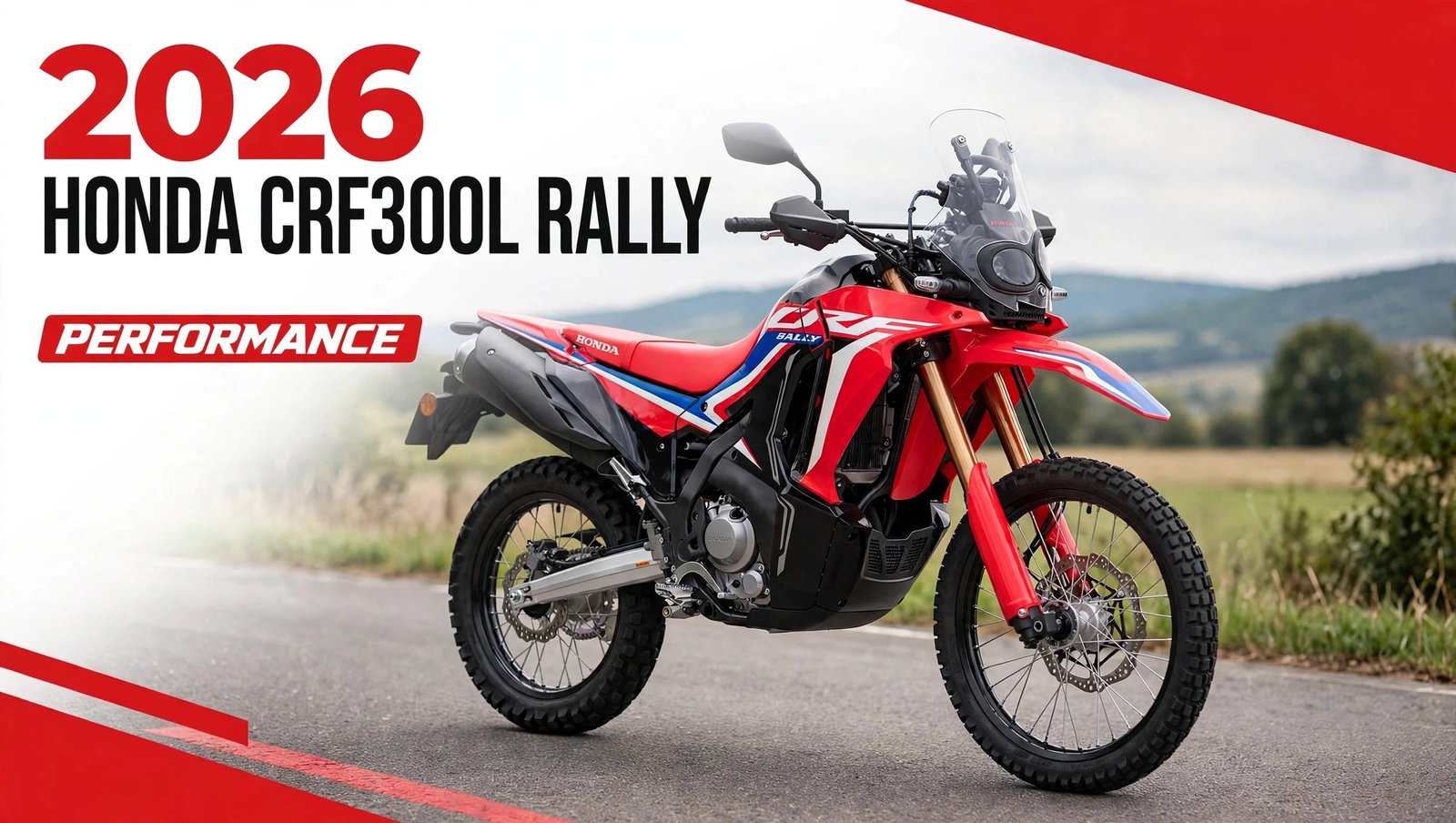
Short answer: Honda CRF300L Rally performance is the standard CRF300L’s performance with touring clothes on. The same 286cc single, the same six-speed gearbox, and the same 22.7 rear-wheel horsepower measured on the standard bike’s dyno run now carry 22 extra pounds, a fairing, and a 3.4-gallon tank. Top speed sits in the low 80s, fuel range roughly doubles over the naked bike, and highway comfort improves without ever turning the Rally into a fast motorcycle. Anyone judging Honda CRF300L Rally performance by horsepower alone will miss the point: this is a light, frugal, long-legged dual-sport, and its performance case is built on range and ease, not speed.
Honda CRF300L Rally Engine Performance and Power Delivery
The engine is the foundation of Honda CRF300L Rally performance, and it is deliberately unstressed. A 286cc liquid-cooled single with double overhead cams, four valves, and fuel injection through a 38mm throttle body, enlarged from the old CRF250 Rally’s 249cc by lengthening the stroke from 55mm to 63mm. Honda’s own specification page lists the bore and stroke at 76.0mm by 63.0mm with a 10.7:1 compression ratio, and Honda CRF300L Rally performance tuning favors low and mid-range torque rather than peak power, exactly as it does on the standard bike.
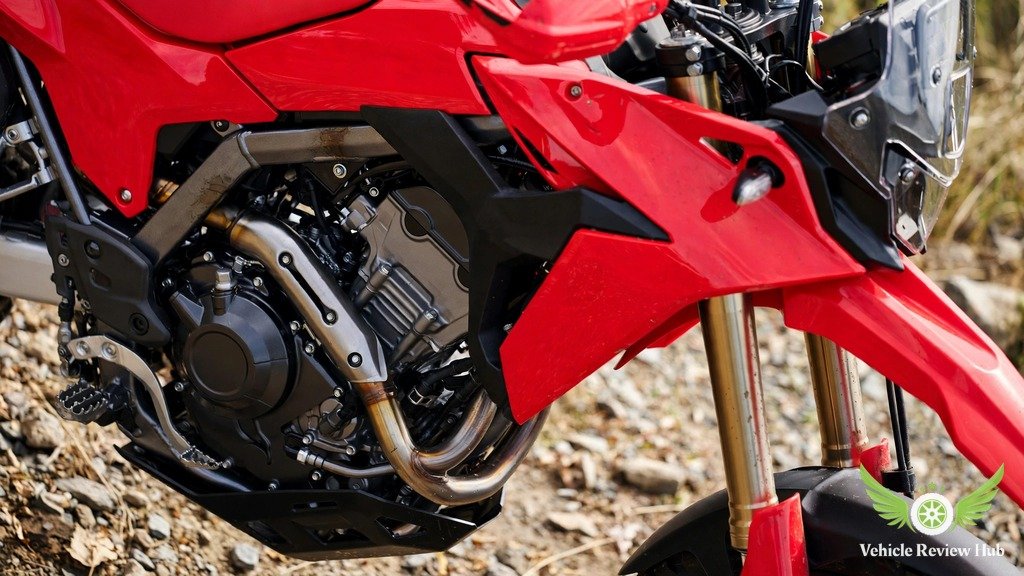
Shared-Engine Dyno 22.7 HP From the Standard L, Labelled as Shared Data
The single most important honesty note in this article is that no major outlet has published a Rally-specific dyno test, so the headline dynamometer figure for Honda CRF300L Rally performance is shared data from the standard CRF300L, and it is labelled as such throughout. Motorcyclist’s buyer’s guide reproduces Dirt Rider’s tested specifications for the standard bike: 22.7 hp at 8,400 rpm and 16.7 lb-ft of torque at 6,400 rpm, both measured at the rear wheel on a dynamometer. Honda’s claimed figures are 27 hp at 8,500 rpm and 19.6 lb-ft at 6,500 rpm, measured at the crankshaft before drivetrain losses. Judged fairly, Honda CRF300L Rally performance is a 22 to 23 rear-wheel horsepower motorcycle, and that is the number to compare against other dyno-tested bikes.
| Figure | Claimed (crank) | Shared dyno, standard L (rear wheel) |
|---|---|---|
| Peak power | 27 hp @ 8,500 rpm | 22.7 hp @ 8,400 rpm |
| Peak torque | 19.6 lb-ft @ 6,500 rpm | 16.7 lb-ft @ 6,400 rpm |
| What it means | Engine output before losses | Power actually reaching the ground (standard bike) |
Six-Speed Gearbox, Same Gearing as the L and Power Delivery
The six-speed gearbox is shared with the standard bike, and it shapes Honda CRF300L Rally performance more than the peak power figure does. The first five ratios are kept short for strong low-end response on trails and in stop-and-go traffic, while sixth is deliberately tall to keep revs and vibration down on the open road. An assist and slipper clutch lightens lever pull and keeps the rear wheel settled on hard downshifts, and the final drive is a #520 chain with 14T/40T sprockets. The Rally’s extra weight blunts acceleration slightly against the standard bike, an estimate rather than a measured difference, since no back-to-back acceleration test exists. That friendly delivery is why Honda CRF300L Rally performance feels stronger than 22.7 horsepower suggests at trail speeds, and why it feels thin when the road opens up and the revs sit high for a long time.
Honda CRF300L Rally Top Speed and Acceleration
Top speed is where Honda CRF300L Rally performance meets its hardest limit, and the honest answer is that this bike is not built for going fast. Every credible figure lands in the same narrow band, and no instrumented test exists to narrow it further.

EU Claim 84 MPH Top Speed and Why No Rally Test Figure Exists
Published European figures for the Rally cluster around 82 to 84 mph, and the spread itself is worth explaining. Honda materials quoted in independent testing cite 132 km/h, roughly 82 mph, while some European listings quote 135 km/h, roughly 84 mph, which is the figure carried in this article’s outline. For practical purposes, Honda CRF300L Rally performance tops out at roughly 80 to 84 mph, and any online claim much above that should be treated as speedometer optimism rather than a measured result. No Rally-specific top-speed test from a major outlet exists, which is why this article quotes a band rather than a single figure.
Why No GPS Top Speed or 0-60 Test Exists From a Major Outlet
No major outlet has published an instrumented 0-60 mph or GPS-verified top speed test for the CRF300L Rally, and this article does not invent one. The nearest useful context for Honda CRF300L Rally performance comes from the standard bike’s predecessor: the CRF250L recorded 8.6 seconds to 60 mph in published testing, and the 300 platform is quicker than the 250 thanks to its larger engine, but by how much has never been measured for the Rally by a major outlet. Treat any forum 0-60 claim about Honda CRF300L Rally performance as an estimate, not a test result. That absence of data is part of the Honda CRF300L Rally performance story: buyers shopping on numbers alone will find less here than on rival pages, and the bike has to be judged on how it rides rather than on a spec sheet.
Honda CRF300L Rally Mileage and Fuel Economy
Fuel economy is the strongest card in Honda CRF300L Rally performance, and the bigger tank is what turns good economy into genuine touring range. The figures below come from independent testing and Honda’s own test-cycle data, because Honda USA publishes no MPG figure for this motorcycle.

Honda USA Publishes No MPG Figure and the 3.4-Gallon Tank
Honda’s own 2026 CRF300L Rally specification page lists fuel capacity at 3.4 gallons and gives no fuel-economy figure at all, which is standard practice for Honda’s US dual-sport pages. Riders judging Honda CRF300L Rally performance on touring range need to think in terms of fuel stops every 200 miles or so, not every 100 miles as on the standard bike. Honda CRF300L Rally performance in this area is therefore a trade resolved in the rider’s favor: superb efficiency, now with a genuinely useful absolute range.
Real-World Range Around 190 to 240 Miles and the 250-Mile Claim Checked
Independent testing converges on a 60 to 70 mpg band for mixed use, and that band defines Honda CRF300L Rally performance at the pump. RevZilla’s first ride of the platform recorded 65 to 70 mpg in mixed riding, The 250-mile claim, by contrast, checks out only as a laboratory figure: Honda’s own 2025 Rally material says range is over 250 miles in testing, quoting a WMTC figure of 32.2 km/l, which converts to about 75.7 mpg and a theoretical 257 miles. MCN’s review makes the same distinction, giving a theoretical range of 254 miles but a real-world range of almost 200 miles. So the 250-mile claim is real, but it is a test-cycle claim, not a promise for loaded touring at highway speed. That distinction is central to honest Honda CRF300L Rally performance reporting.
Honda CRF300L Rally Real-World Riding Performance
On the road, Honda CRF300L Rally performance divides cleanly into two zones: everything up to about 60 mph, where the bike feels eager and light for its size, and everything above it, where it feels busy and strained. The fairing shifts the balance toward the road without changing the engine’s character.

City Riding, Traffic Performance and Everyday Acceleration
Around town, Honda CRF300L Rally performance is genuinely good, with one caveat the standard bike does not share to the same degree: size. For commuting and running errands, Honda CRF300L Rally performance is at its happiest, and the standard CRF300L performance story is a useful contrast: the naked bike is lighter and easier in tight spaces, but the Rally adds weather protection and range that matter the moment the ride gets longer than a commute. Honda CRF300L Rally performance in the city is a genuine strength, not a consolation prize.
Highway Riding, Screen Comfort and Long-Distance Limitations
On the highway, the picture improves over the standard bike without changing fundamentally for Honda CRF300L Rally performance. A 65 to 70 mph cruise is achievable and sustainable, with the windscreen taking pressure off the rider’s chest, and independent testing describes a comfortable 70 mph at 7,000 rpm with 80 mph reachable but strained and tingly at around 8,000 rpm. A long interstate commute is still not what Honda CRF300L Rally performance is built for, but a day of back roads with highway links very much is.
The video below is an owner’s highway test of the Rally on a long northern road trip, including gravel detours and bad weather. It is not a laboratory test, but it shows what the bike actually does on real highways, which is more useful than a speedometer screenshot for judging Honda CRF300L Rally performance.
Honda CRF300L Rally Handling, Braking and Stability
Handling is where Honda CRF300L Rally performance asks for the most compromise, because the touring hardware adds weight to a chassis tuned for lightness. The frame is a steel semi-double-cradle with a 57.2-inch wheelbase, 10.9 inches of ground clearance, and a 27.5-degree rake, numbers that give Honda CRF300L Rally performance its stability on the road without making it clumsy on the trail.

Same Travel as the L, Extra Weight, Soft Suspension and Cornering
The suspension hardware matches the standard bike exactly: a 43mm inverted fork and a Pro-Link single rear shock, each with 10.2 inches of travel, with the fork non-adjustable and the shock offering preload adjustment only. The problem is the extra 22 pounds of fairing, screen, and fuel, plus whatever luggage a touring rider adds, all carried on the same soft springs. The 2025 platform update answered directly, with stiffer springs and reworked internals, and Honda’s 2025 Rally material notes a 9-pound weight reduction, updated geometry, and upgraded suspension for that year. That improvement is a meaningful part of Honda CRF300L Rally performance in its current form, and it is a reason to prefer a 2025 or 2026 bike over an early one.
296mm Front Disc, Weak Brake Feel in Tests and Rear-Switchable ABS
Braking is the Rally’s most counterintuitive chapter, and it deserves a careful telling. Honda’s own 2026 specification page lists a single 296mm front disc with a twin-piston caliper and a single 220mm rear disc, both with ABS, and the rear-wheel ABS can be switched off for dirt riding while the front ABS stays on. The 296mm front disc is 40mm larger than the standard bike’s 256mm unit, yet testers report weaker feel: Motorcycle.com’s first ride notes that despite the larger rotor, the Rally’s front brake managed to feel weaker, possibly because of fork dive or bedding, and MCN’s review is blunter, calling the brakes very weak in their performance while praising the ABS itself. Stopping power in Honda CRF300L Rally performance terms is adequate for the bike’s speed and weight, but the lever feel is not a strong point, and buyers should test it themselves rather than trusting the disc size.
Honda CRF300L Rally Performance Compared With Other Light ADV Bikes
Against its rivals, Honda CRF300L Rally performance looks exactly like what it is: the lightest, most frugal, and least powerful bike in the comparison, at a price that undercuts the stronger machines while beating the standard bike on range. The 2026 Rally stickers at $6,499 plus $600 destination, unchanged from 2025 according to Dirt Rider’s first look, which also confirms the Rally was the only CRF300L-platform model Honda unveiled for 2026.

Honda CRF300L Rally vs KTM 390 Adventure and Himalayan 450
The KTM 390 Adventure is the stronger, more expensive rival in Honda CRF300L Rally performance comparisons. Rider magazine’s test of the 2025 KTM 390 Adventure R lists it at $6,999 with a 399cc single making 45 horsepower and 28.8 lb-ft of torque, a 388-pound wet weight, a 34.2-inch seat, a 3.7-gallon tank, and 9 inches of suspension travel. The Royal Enfield Himalayan 450 is the value rival: the 2026 model starts at $5,999, undercutting the Rally by $500, with a 452cc single making 39.5 horsepower, a 432-pound wet weight, 21/17-inch spoked wheels, switchable ABS, and nearly 8 inches of travel. For pure pace both rivals win the Honda CRF300L Rally performance comparison; for lightness, economy, and ease of use the Honda answers back, and its 3.4-gallon tank gives it a range argument neither rival can dismiss. Honda CRF300L Rally performance is not the fastest in this class, but it is the easiest to live with, and for many buyers that is the right trade.
| Model | Price + destination | Engine | Weight | Seat height | Tank |
|---|---|---|---|---|---|
| Honda CRF300L Rally (2026) | $6,499 + $600 | 286cc, 27 hp claimed | 333 lb | 35.2 in | 3.4 gal |
| KTM 390 Adventure R (2025) | $6,999 + dest. | 399cc, 45 hp claimed | 388 lb wet | 34.2 in | 3.7 gal |
| Royal Enfield Himalayan 450 (2026) | $5,999 + dest. | 452cc, 39.5 hp | 432 lb | — | — |
Is the Honda CRF300L Rally Suitable for Beginner Riders and Touring?
Yes, with two honest caveats, and Honda CRF300L Rally performance is a big reason why. The engine’s friendly delivery, the light weight by adventure-bike standards, the manageable power, and the forgiving chassis make Honda CRF300L Rally performance one of the best beginner adventure packages on sale, and its touring ability is genuine: a 3.4-gallon tank, wind protection, 10.2 inches of suspension travel, 10.9 inches of ground clearance, and proper 21/18-inch wheels mean it can handle real touring and real off-road terrain, not just gravel driveways. The caveats are the 35.2-inch seat height, tall for shorter beginners, and the soft suspension under touring loads, which heavier riders should budget to upgrade. For a beginner who can reach the ground comfortably, Honda CRF300L Rally performance is pitched exactly right: enough to learn on and tour on, not enough to get into serious trouble with, and cheap enough to run that the learning curve costs very little.
Honda CRF300L Rally Performance FAQs
These answers cover the questions buyers actually ask about Honda CRF300L Rally performance, with the same honesty rules as the main article: shared dyno figures labelled as shared, test-cycle range claims separated from real-world range, estimates labelled, and no test result invented where none exists.
What is the top speed of the Honda CRF300L Rally?
Published European figures cluster around 82 to 84 mph, and independent testing describes a comfortable 70 mph cruise with 80 mph reachable but strained. That 80 to 84 mph band is the honest Honda CRF300L Rally performance ceiling.
How fast is the Honda CRF300L Rally 0-60?
No major outlet has published an instrumented 0-60 time, so Honda CRF300L Rally performance has no official acceleration figure. Its platform predecessor, the CRF250L, recorded 8.6 seconds, and the 300 platform is quicker than the 250, but by how much has never been measured for the Rally.
How much horsepower does the Honda CRF300L Rally really make?
Dirt Rider’s dyno measured 22.7 hp at 8,400 rpm at the rear wheel for the standard CRF300L, with 16.7 lb-ft of torque at 6,400 rpm, and that shared Honda CRF300L Rally performance figure applies because the Rally uses the identical engine. Honda claims 27 hp at 8,500 rpm and 19.6 lb-ft at 6,500 rpm at the crankshaft.
What MPG does the Honda CRF300L Rally get?
Tested Honda CRF300L Rally performance figures fall in a 60 to 70 mpg band for mixed use, matching the platform’s first-ride testing of 65 to 70 mpg.
How far can the Honda CRF300L Rally go on a tank?
Expect 190 to 240 miles of Honda CRF300L Rally performance range in real-world use. The tank holds 3.4 gallons, so 60 mpg gives 204 miles and 70 mpg gives 238 miles in theory, but the need for a reserve means most riders stop sooner.
Is the 250-mile range claim true?
Only as a test-cycle figure. Honda’s own 2025 Rally material says range is over 250 miles in testing, quoting a WMTC figure of 32.2 km/l, which converts to about 257 miles in theory, and MCN gives a theoretical 254 miles. Real-world Honda CRF300L Rally performance range is almost 200 miles by MCN’s own account, so treat 250 miles as a laboratory number, not a touring promise.
Is the Honda CRF300L Rally good on the highway?
For day rides and highway links, yes; as a daily high-speed commuter, Honda CRF300L Rally performance falls short. A 65 to 70 mph cruise is sustainable and the screen cuts fatigue, but above 70 mph the engine feels strained, passing needs planning, and taller riders report buffeting.
Are the Honda CRF300L Rally brakes weak?
Testers say the feel is weak, even though the hardware looks strong. The Rally has a 296mm front disc, 40mm larger than the standard bike’s, yet Motorcycle.com’s first ride found it feeling weaker, possibly from fork dive or bedding, and MCN called the brakes very weak while praising the ABS. Honda CRF300L Rally performance braking is adequate for the bike’s speed, but test the lever feel yourself before buying.
Is the Honda CRF300L Rally faster than the standard CRF300L?
No, and Honda CRF300L Rally performance is marginally slower in acceleration terms, as an estimate. The engine and gearing are identical, but the Rally carries about 22 extra pounds of fairing, screen, and fuel, so the standard bike has a small weight advantage.
Is the Honda CRF300L Rally good for beginners and touring?
Yes, with the seat-height caveat, and Honda CRF300L Rally performance is pitched exactly right for learning and light touring.