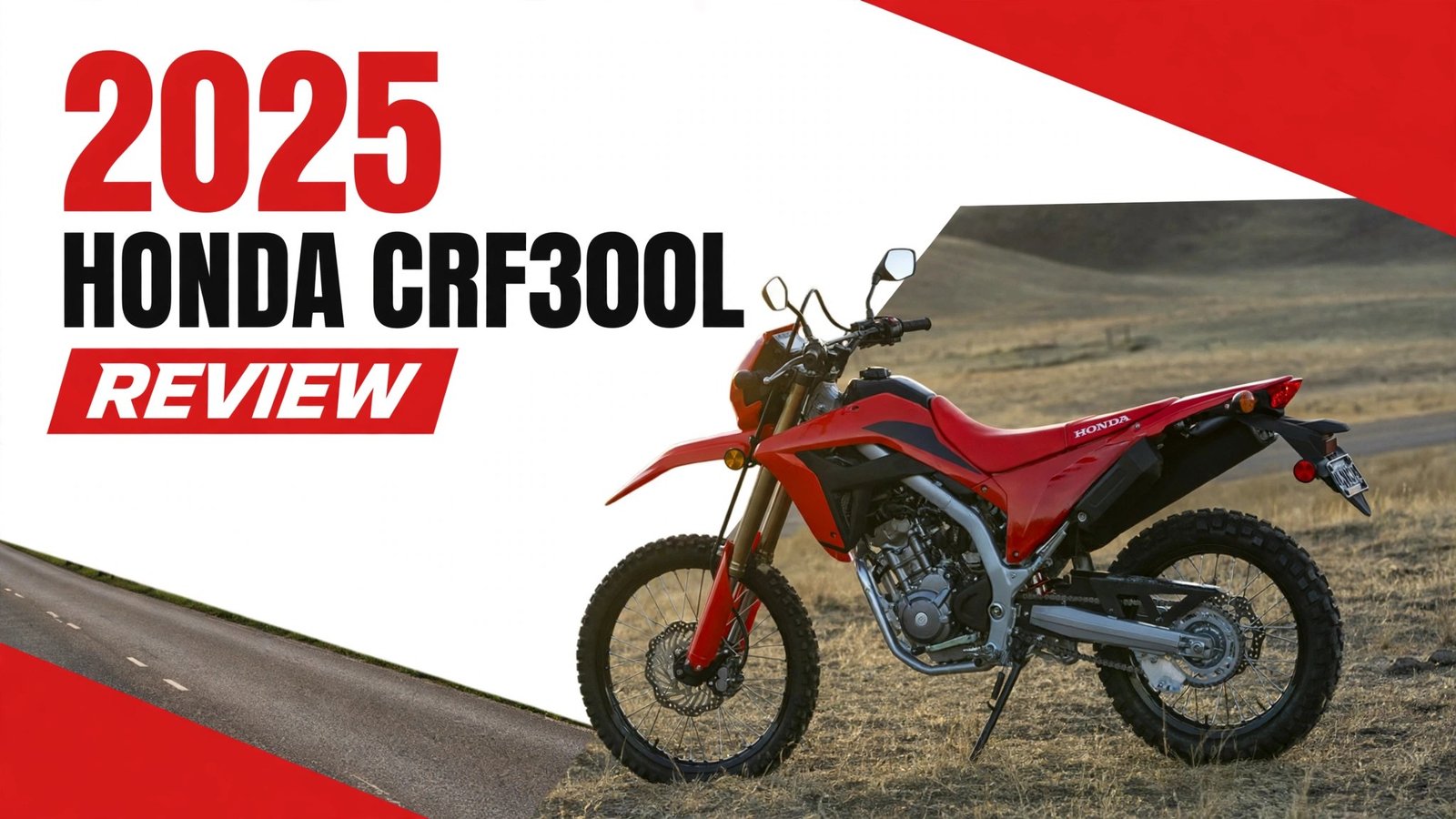
Short answer: this Honda CRF300L review finds a motorcycle that does one job better than almost anything else at its price — it takes a new or returning rider anywhere, on road or off, without demanding experience, money, or mechanical sympathy. The CRF300L is Honda’s street-legal dual-sport: a 286cc single that weighs 311 pounds, costs $5,749 in 2025 form, and asks for very little in return. It is not fast, it is not plush, and its 2.1-gallon tank will have you planning fuel stops, but as an honest, affordable way into real trail riding, this Honda CRF300L review rates it very highly.
The CRF300L replaced the long-running CRF250L for 2021, growing displacement by 36cc and shedding weight. Then Honda skipped the standard model for 2026, announcing only the Rally version, which makes the 2025 bike the newest standard CRF300L you can buy. That is the starting point for this Honda CRF300L review.
Honda CRF300L Overview and Model-Year Updates
A dual-sport motorcycle is a dirt bike with a license plate, and the CRF300L is one of the purest examples of the breed — and the subject of this Honda CRF300L review. It is built around a steel frame, long-travel suspension, and 21/18-inch wheels, yet carries the lights, mirrors, and signals that make it fully legal on public roads. That combination is what this Honda CRF300L review keeps coming back to: one motorcycle for the commute, the fire road, and the trailhead.

What Is the Honda CRF300L and Who Is It Designed For?
The CRF300L is designed for riders who want one motorcycle that does two jobs — the lens of this Honda CRF300L review. New riders get a light, forgiving bike that will not punish a ham-fisted throttle hand. Returning riders get a cheap second bike for trails and errands. The 34.7-inch seat height is the one real barrier: shorter riders should sit on one first, because the tall saddle is the price of 11.2 inches of clearance. For everyone who can reach the ground comfortably, this Honda CRF300L review finds the bike remarkably easy to live with.
US Launch 2021 Replacing the CRF250L and the 2025 Update Explained
Honda launched the CRF300L in the United States for 2021, replacing the CRF250L that had served since 2013. The new bike’s 286cc engine delivered about 10 percent more peak power and 18 percent more torque than the 250, while a new frame and tapered aluminum swingarm cut roughly 9 pounds. RevZilla’s 2021 first ride praised the package at its $5,249 launch price. The 2025 update was the first meaningful revision: stiffer suspension, a new radiator and shroud that push hot air away from the rider, a new LED headlight and LED turn signals, a revised LCD dash with a USB port, and black-finished rims. This Honda CRF300L review treats the 2025 model as the one to buy, because it fixes the old bike’s weakest point.
Honda CRF300L Engine and Specifications
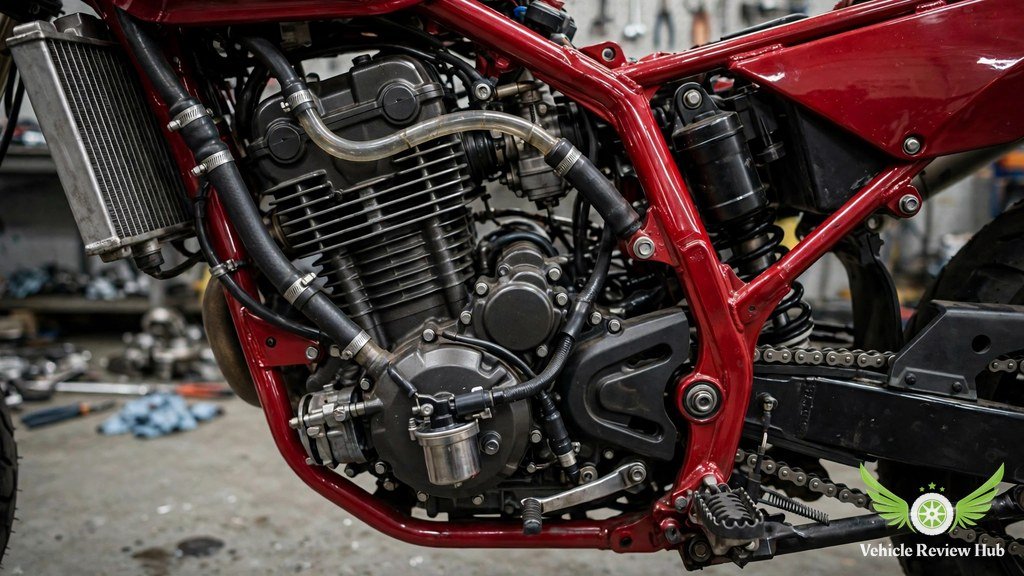
The engine is the heart of this motorcycle’s appeal, and it is deliberately unexotic — a theme this Honda CRF300L review keeps returning to. A liquid-cooled, DOHC, four-valve single with fuel injection and a 38mm throttle body, it makes its power low in the rev range. There is no ride-by-wire, no riding mode, and no traction control to learn — just a throttle cable, a six-speed gearbox, and an assist-and-slipper clutch that lightens lever pull by 20 percent and calms downshifts. That simplicity is a feature, not a gap, in this Honda CRF300L review.
286cc Liquid-Cooled Single Engine, Six-Speed Gearbox and Slipper Clutch
The 286cc single displaces 76.0mm by 63.0mm, runs a 10.7:1 compression ratio, and breathes through programmed fuel injection. Honda’s European materials claim 27 horsepower at 8,500 rpm and 19.6 lb-ft of torque at 6,500 rpm, measured at the crankshaft. The six-speed gearbox deserves praise: closely spaced lower gears for city and trail work, taller top gears for cruising. The assist-and-slipper clutch helps new riders by preventing rear-wheel hop on clumsy downshifts. Nothing here will impress a spec-sheet racer, yet this Honda CRF300L review finds the drivetrain perfectly judged for the bike’s mission — a point this Honda CRF300L review returns to in the riding section.
Weight 311 lb With ABS, Seat Height 34.7 Inches and Specifications
The headline numbers define the riding experience. Curb weight is 311 pounds with ABS, including a full tank of fuel — among the lightest street-legal motorcycles Honda sells. Seat height is 34.7 inches, ground clearance 11.2 inches, and wheelbase 57.2 inches. Those three numbers explain much of what this Honda CRF300L review praises about the bike’s agility. The table below gathers the key specifications from Honda’s own 2025 CRF300L specification page, which remains the authoritative source for this Honda CRF300L review.
| Specification | 2025 Honda CRF300L ABS |
|---|---|
| Engine | 286cc liquid-cooled DOHC single, four valves |
| Claimed power (EU, crank) | 27 hp at 8,500 rpm; 19.6 lb-ft at 6,500 rpm |
| Transmission | Six-speed manual, assist-and-slipper clutch |
| Curb weight | 311 lb (ABS model, full tank) |
| Seat height / ground clearance | 34.7 inches / 11.2 inches |
| Suspension travel | 10.2 inches front and rear |
| Fuel capacity | 2.1 gallons (0.5-gallon reserve) |
| Brakes | 256mm front disc, 220mm rear disc, ABS |
| Wheels / tires | 21-inch front / 18-inch rear, IRC GP tires |
| Warranty | One-year transferable limited warranty |
Honda CRF300L Price and Market Availability
Price is where the CRF300L makes its strongest argument: the current bike costs $5,749 before a $600 destination charge — less than many 300cc scooters, and thousands less than any European dual-sport — the value case this Honda CRF300L review opens with. Dealer stock of new 2025 bikes remains available in late 2026, and with no 2026 standard model announced, the 2025 is effectively the current bike — a key buying point in this Honda CRF300L review.

Honda CRF300L Price by Year in the USA: 2021 to 2025
Prices rose modestly: 2021 at $5,249, or $5,549 with ABS; 2022 at $5,349, or $5,649 with ABS; 2023 at $5,399, with ABS again a $300 option; 2024 at $5,449, or $5,749 with ABS, according to Cycle World’s 2024 buyer’s guide. The 2025 bike simplified the range: ABS became standard at $5,749, plus the $600 destination charge. That is a total increase of just $500 over the 2021 base price across five model years. This Honda CRF300L review notes that destination charges rose from $400 in the early years to $600, so the out-the-door gap is slightly larger than the MSRP walk suggests.
Red Only, ABS Standard for 2025 and Why There Is No 2026 Model
Every US-market CRF300L has come in one color: red. There have been no special editions or alternative paint options in the United States, which keeps the used market simple. For 2025, Honda made ABS standard and dropped the non-ABS version. As for 2026: Honda’s March 2026 announcement covered the Transalp and the CRF300L Rally only, and Dirt Rider’s 2026 Rally first look confirms only the Rally of the three CRF300L-platform models had been unveiled for 2026. No standard 2026 CRF300L appears in Honda USA’s 2026 lineup. That may change, but as of November 2026, the 2025 bike is the newest standard model, and this Honda CRF300L review prices and judges it accordingly.
Honda CRF300L Design, Features and Technology
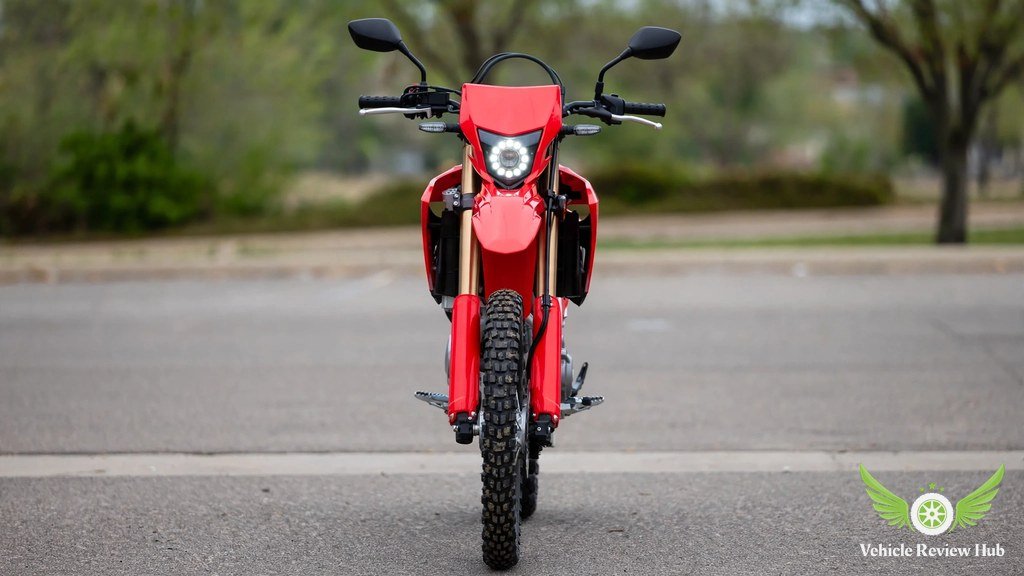
The CRF300L looks like a shrunken CRF450R, and that is deliberate — the styling story of this Honda CRF300L review. The bodywork carries Honda’s CRF Performance styling cues — a slim tank shroud, a high front fender, and a flat, narrow seat for moving around off-road. There is no fairing, no windscreen, and no luggage beyond an optional rack, which keeps the bike light and honest. The 2025 changes are subtle: revised graphics, black rims, and new LED lighting. That restraint is part of why this Honda CRF300L review rates the design so well. Nothing about the design chases fashion; it chases function, and this Honda CRF300L review counts that as a virtue.
Dual-Sport Styling, LED Lighting for 2025 and Black Rims
The 2025 LED headlight and LED turn signals draw less power, last longer, and throw a cleaner beam than the old halogen units — useful on unlit back roads. The black rim finish, new for 2025, hides trail rash more gracefully than silver rims did. The revised LCD dash is easier to read in sunlight and now includes a side USB port for charging a phone. The dash remains simple, showing speed, fuel level, trip meters, and gear position. For a bike at this price, that restraint feels right, and this Honda CRF300L review prefers it to a fussy TFT system.
Two-Channel ABS With Rear-Wheel Switch and No Electronics Package
The braking system is a two-channel ABS setup: a single 256mm front disc with a twin-piston caliper and a single 220mm rear disc. The key detail is the rear-wheel ABS switch, which disables ABS at the rear wheel only, letting the rider lock the back brake for controlled slides on dirt while front ABS stays active. Beyond that, there is deliberately no electronics package: no traction control, no riding modes, no IMU, and no cornering ABS. Some buyers will miss those features, but they add cost, weight, and complexity, and on a 27-horsepower motorcycle they would solve problems the bike does not really have — which is why this Honda CRF300L review does not count their absence as a flaw. The Honda NX500 review covers a Honda that does offer traction control, for riders who want that safety net in a heavier adventure package.
Honda CRF300L Riding Experience and Comfort
On the move, the CRF300L feels exactly like its numbers suggest: light, narrow, and willing, and that first impression sets the tone for this Honda CRF300L review. The upright position gives a commanding view of traffic, and the bars and pegs suit trail work and standing. Around town it is a joy — the bike threads gaps and parks anywhere. On trails it is confidence-inspiring for a beginner and entertaining for an experienced rider, within the limits of its budget suspension — the 2025 stiffer settings help, but this is still not a bike for aggressive jumping. Comfort is good for an hour or two; beyond that, the slim, firm seat reminds you this is a dirt bike first. Heat management improved with the 2025 radiator and shroud redesign, which directs hot air away from the rider’s legs — another 2025 fix this Honda CRF300L review credits.

Riding Position, Handling and Low-Speed Maneuverability
At 311 pounds with a 57.2-inch wheelbase, the CRF300L changes direction with a thought. Low-speed maneuverability is a genuine strength: U-turns and tight trail switchbacks are easy, and the light weight means a tip-over is an embarrassment rather than a rescue operation. The 34.7-inch seat height works against shorter riders at stops, but once moving it becomes an advantage, giving vision over traffic and room to shift weight. Handling on pavement is neutral and predictable, with the knobby IRC tires giving up some grip and a little hum — a fair trade for a tire that works in mud. This Honda CRF300L review finds the bike’s manners its single best quality: it flatters new riders instead of intimidating them.
City Riding, Trails, Heat Management and Everyday Practicality
As a daily rider, the CRF300L is more practical than its dirt-bike looks suggest. Fuel economy in the 65 to 70 mpg range and a 2.1-gallon tank give roughly 120 to 140 miles between fill-ups, which covers a week of commuting for many riders. There is no storage beyond what you strap on and no wind protection, so the fuel light becomes a familiar friend. But the bike starts instantly, sips fuel, costs little to insure and maintain, and turns every unpaved shortcut into a small adventure. The video below, a long-term owner’s honest pros-and-cons review, matches this Honda CRF300L review’s own findings closely, including praise for low-end torque and complaints about the stock suspension and firm seat.
Honda CRF300L Review: Pros, Cons and Verdict
So where does that leave the verdict? The CRF300L is not the best at any single thing, but it is the best value in its class. It undercuts every rival on price, weighs less than all of them, and carries Honda’s dealer network and reliability reputation behind it. Its weaknesses are real but manageable: the small tank, the firm seat, the tall saddle, and suspension that is good rather than great. This Honda CRF300L review recommends it without hesitation to new riders, returning riders, and anyone wanting a second bike for trails.

Main Advantages and Limitations of the Honda CRF300L
The advantages stack up quickly: 311-pound weight, $5,749 price, Honda reliability, standard ABS with rear-wheel switch, 65 to 70 mpg economy, and a 2025 update that fixed the suspension and lighting complaints — the full list this Honda CRF300L review weighs against the drawbacks below. The limitations are equally clear: a 2.1-gallon tank limiting range to roughly 120 to 140 miles, a 34.7-inch seat that challenges shorter riders, a firm seat on long days, and suspension that cannot match a KTM or a dedicated enduro bike. None of these limitations changes the verdict of this Honda CRF300L review, but all of them should shape the purchase decision.
Who Should Consider the Honda CRF300L Over the KLX300?
The Kawasaki KLX300 is the obvious rival, and the comparison is close. The 2026 KLX300 lists at $5,649 plus a $650 destination charge on Kawasaki’s own KLX300 page — $100 under the Honda’s MSRP, but the higher destination fee makes the out-the-door difference negligible. The Kawasaki offers a 292cc engine and adjustable suspension, while the Honda counters with lighter weight, a broader dealer network, and fresher 2025 lighting and dash. Choose the KLX300 if you prefer its ergonomics or your local Kawasaki dealer is stronger. Choose the Honda if you value light weight, the rear-ABS switch, and low running costs. Riders wanting more highway ability should look at the Honda NX500 review instead; riders wanting a bigger dual-sport should read the Africa Twin review. For everyone else, this Honda CRF300L review says the Honda is the default choice in the lightweight class.
Honda CRF300L Review FAQs
These are the questions buyers actually ask before spending money on a CRF300L, answered from the verified prices and specifications in this Honda CRF300L review. If your question is not here, the rule of thumb from this Honda CRF300L review still applies: buy the 2025 model while dealer stock lasts.
How much does a Honda CRF300L cost?
The 2025 Honda CRF300L ABS costs $5,749 plus a $600 destination charge, the headline price in this Honda CRF300L review. Earlier years were cheaper: $5,249 in 2021, $5,349 in 2022, $5,399 in 2023, and $5,449 in 2024, with ABS a $300 option until 2025.
Is there a 2026 Honda CRF300L?
As of November 2026, Honda has announced only the CRF300L Rally for 2026, at $6,499. No standard 2026 CRF300L appears in Honda USA’s 2026 lineup, so the 2025 model is the newest standard bike available — a finding this Honda CRF300L review verified against Honda’s own announcements.
How much horsepower does the Honda CRF300L make?
Honda’s European claim is 27 horsepower at 8,500 rpm, measured at the crankshaft, with 19.6 lb-ft of torque at 6,500 rpm. Rear-wheel dyno figures are lower, as drivetrain losses apply, and this Honda CRF300L review quotes the crank figure only with that label attached.
What is the Honda CRF300L seat height?
Seat height is 34.7 inches, which is tall for a beginner bike. Shorter riders should sit on one before buying, and note that the suspension compresses under rider weight, so the effective height at a stop is a little lower than the published figure — practical advice this Honda CRF300L review stresses for new riders.
How far can a Honda CRF300L go on a tank?
With a 2.1-gallon tank and tested economy of 65 to 70 mpg, real-world range is roughly 120 to 140 miles. That is an arithmetic estimate, not a Honda claim — Honda USA publishes no MPG figure for the CRF300L, a gap this Honda CRF300L review flags rather than fills with a guess.
Does the Honda CRF300L have ABS?
Yes. The 2025 model has two-channel ABS as standard, with a switch that disables ABS at the rear wheel only for off-road riding. Earlier years offered ABS as a $300 option alongside a non-ABS version, as documented in this Honda CRF300L review.
Is the Honda CRF300L good for beginners?
Yes, with one caveat: the seat height. The engine is forgiving, the weight is low, the clutch is light, and the price is the lowest in its class. A beginner who can flat-foot one side comfortably will find it one of the best learner bikes sold in the United States — the core recommendation of this Honda CRF300L review.
Is the Honda CRF300L good on the highway?
It is adequate, not comfortable. The bike will cruise at 65 mph, but it feels strained above 60 to 65 mph, has no wind protection, and its small tank means frequent stops. It is a back-road and trail bike first, and a highway bike only for short stretches — an honest limit this Honda CRF300L review states plainly.
What is the Honda CRF300L’s fuel economy?
Honda USA publishes no MPG figure. Independent testing lands in the 65 to 70 mpg range in mixed riding, which this Honda CRF300L review treats as the realistic band for planning fuel stops — the same band this Honda CRF300L review uses for its range arithmetic.
Should I buy the Honda CRF300L or the Kawasaki KLX300?
Buy the Honda for lighter weight, Honda’s dealer network, and the 2025 LED lighting and revised dash. Buy the KLX300 if you prefer its ergonomics or your local Kawasaki dealer is stronger. On price the two are effectively tied: $5,749 for the Honda against $5,649 plus $650 destination for the 2026 KLX300 — the closing comparison of this Honda CRF300L review.