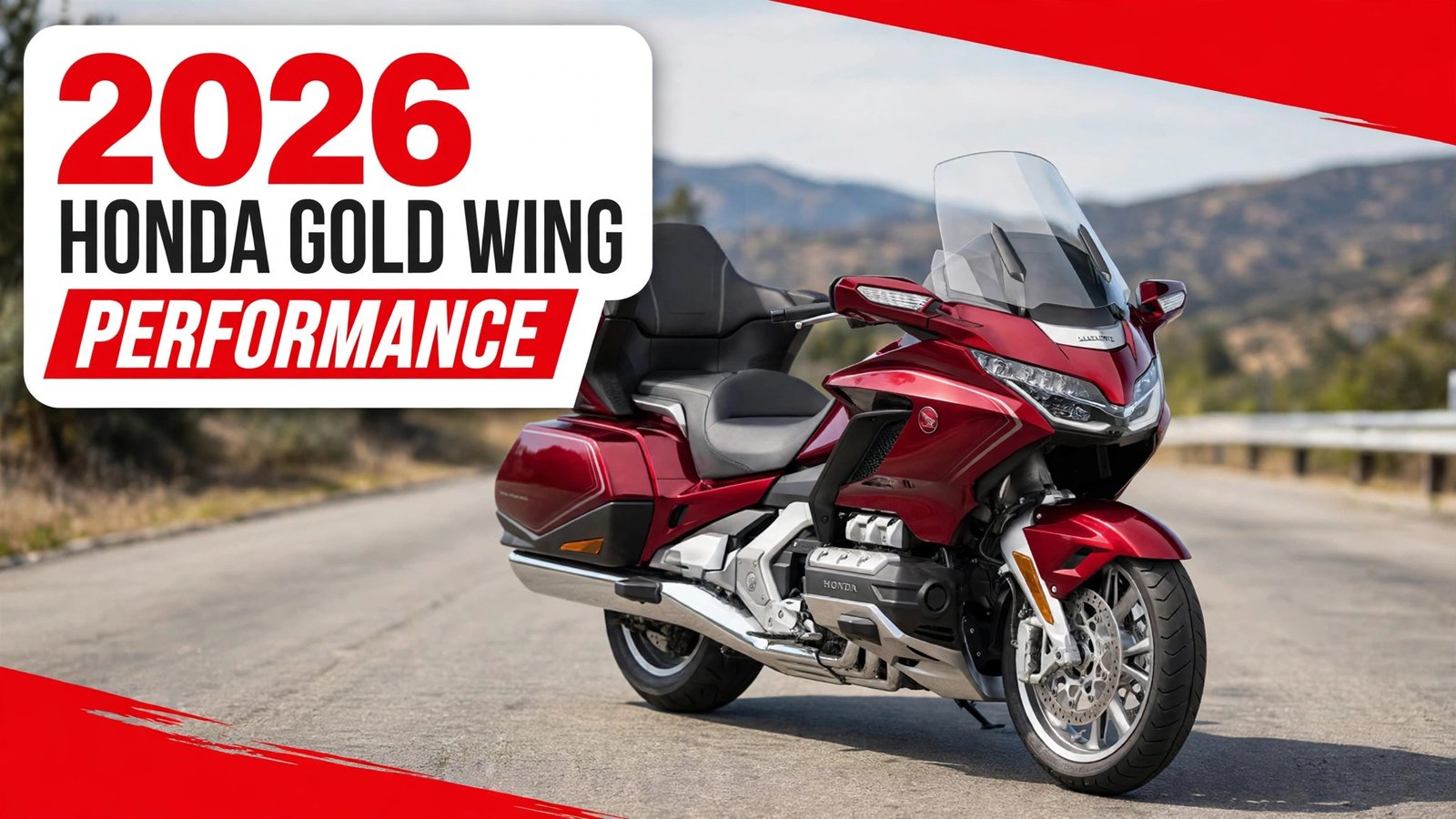
Short answer: Honda Gold Wing performance is defined by effortless torque, not headline horsepower — a 1,833cc flat-six that pulls hard from idle, a seven-speed DCT that shifts itself, and a touring chassis that stays calm at highway speed. The honest numbers are these: Cycle World measured 97.85 horsepower at the rear wheel on the manual bike and 90.01 horsepower on the Tour DCT, with torque above 100 lb-ft from essentially idle to around 3,500 rpm. This Honda Gold Wing performance guide keeps every figure in its own labelled box, because Honda USA publishes no horsepower or torque figure of its own, and the crank claim, the dyno figures, and the doc’s test summaries are three different things.
One framing fact belongs up front: everything here is about the sixth-generation Gold Wing, the redesigned bike sold from 2018 onward. The previous generation (2001–2017) was heavier, used a different chassis, and had no DCT option, so none of its figures appear here. For the full model story, prices, and trims, see our Honda Gold Wing review.
Honda Gold Wing Engine Performance and Power Delivery
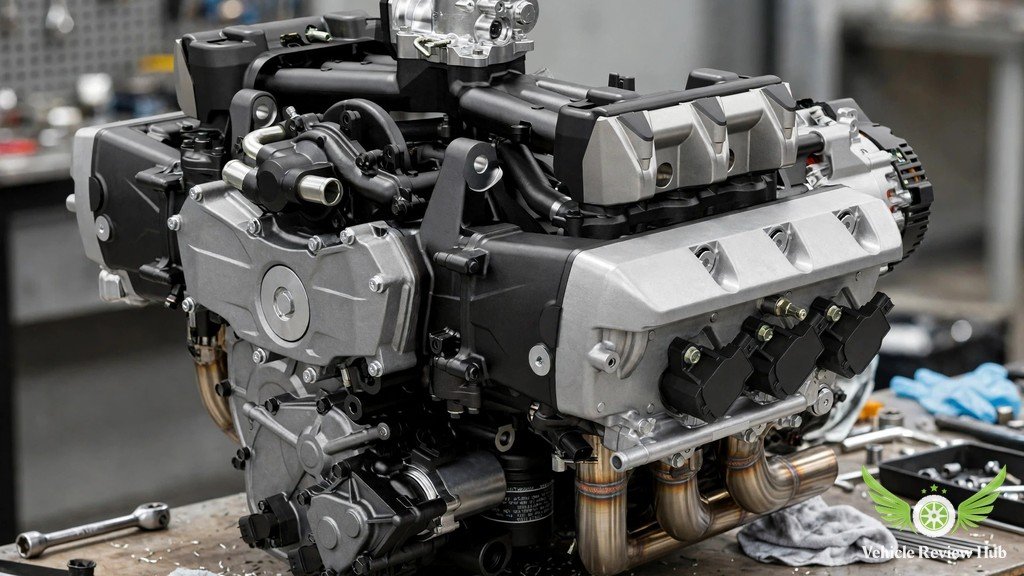
The engine is the whole story of Honda Gold Wing performance: a liquid-cooled, horizontally opposed flat-six of 1,833cc, with Unicam single-overhead-cam heads, four valves per cylinder, a square 73.0 by 73.0 mm bore and stroke, and 10.5:1 compression. It is tuned for a flat, wide torque curve rather than a high-rpm peak, and that tuning shapes every other part of Honda Gold Wing performance.
Cycle World Dyno: Manual 97.85 HP, Tour DCT 90.0 HP
Cycle World dyno: manual 97.85 hp, Tour DCT 90.0 hp — those are the two rear-wheel figures that anchor this Honda Gold Wing performance guide, and they come from Cycle World’s Dynojet 250i testing, not from Honda. The manual bike made 97.85 horsepower at 5,500 rpm and 108.41 lb-ft of torque at just 1,210 rpm. The Tour DCT made 90.01 horsepower at 5,420 rpm and 102.51 lb-ft at 1,370 rpm. The gap is explained: the DCT’s oil pump is engine-driven, costing roughly 7.8 horsepower and 5.9 lb-ft at the wheel. Against both figures stands Honda Japan’s crank claim of 126 horsepower at 5,500 rpm and 126 lb-ft at 4,500 rpm — a manufacturer claim from Japan, not a US figure and not a dyno measurement. Honda USA publishes no horsepower or torque number at all. The Cycle World DCT dyno test lays out both the manual comparison and the DCT numbers in full.
Rider Dyno 101.4 HP and Torque Over 100 lb-ft From Idle
Rider dyno 101.4 hp and torque over 100 lb-ft from idle — that is the second dyno data point in this Honda Gold Wing performance story, and it carries a label the reader deserves: it is a doc figure, not re-verified in this pass, attributed to Rider’s testing summary. It sits a little above Cycle World’s manual figure, which is normal — different dynos, different days, different bikes. What matters more than the peak is the shape both testers agree on: torque stays above 100 lb-ft from essentially idle to just under 3,500 rpm. Twist the throttle at 2,000 rpm in top gear and the bike simply goes.
| Power figure | Value | What it actually is |
|---|---|---|
| Honda Japan crank claim | 126 hp @ 5,500 rpm / 126 lb-ft @ 4,500 rpm | Manufacturer claim, Japan — not a US figure, not a dyno figure |
| Cycle World, manual (rear wheel) | 97.85 hp @ 5,500 rpm / 108.41 lb-ft @ 1,210 rpm | Independent Dynojet 250i measurement |
| Cycle World, Tour DCT (rear wheel) | 90.01 hp @ 5,420 rpm / 102.51 lb-ft @ 1,370 rpm | Independent measurement; DCT pump costs ~7.8 hp |
| Rider dyno (doc figure) | 101.4 hp | Doc test summary, not re-verified this pass |
| Honda USA published figure | None — Honda USA publishes no hp or torque | Do not quote a US horsepower figure as Honda’s own |
Honda Gold Wing Top Speed and Acceleration
Acceleration is where Honda Gold Wing performance surprises people who expect a heavy tourer to feel slow. The flat-six’s torque and the DCT’s quick shifts make the big bike genuinely quick off the line, even if its top speed is deliberately limited. This section of the Honda Gold Wing performance guide separates the measured acceleration figures from the unmeasured top-speed claims.

Tour DCT: 0-60 in 4.17 Seconds, Quarter in 12.91 at 104.89
Tour DCT: 0–60 in 4.17 seconds, quarter in 12.91 at 104.89 — those are the headline acceleration figures for Honda Gold Wing performance, and they need their label read aloud: they are doc figures, not re-verified in this pass, attributed to the doc’s test summary for the Tour DCT. For a motorcycle weighing around 845 lb before rider and luggage, a sub-4.2-second run to 60 mph is strong, and it is the torque curve doing the work. The video below is Ultimate Motorcycling’s 2018 first ride review of the redesigned bike — honestly a first ride, not an instrumented acceleration test, and it shows the DCT working in the real world.
No US Instrumented Top Speed: Limiter Around 112 MPH by Owners
No US instrumented top speed: limiter around 112 mph by owners — that is the honest headline for the top end of Honda Gold Wing performance. No American magazine has published an instrumented top-speed test of the sixth-generation bike. What exists instead is consistent: the German outlet 1000PS lists 180 km/h (112 mph) for the Tour DCT, and owner reports put the limiter at around 112 mph. The two agree — 180 km/h converts to 111.8 mph — but agreement is not a test, so this Honda Gold Wing performance guide reports the limiter as an owner-reported figure, never as a tested top speed.
Honda Gold Wing Mileage and Fuel Economy
Fuel economy is the most practical part of Honda Gold Wing performance, because it decides how far you ride between stops. There is no EPA motorcycle fuel-economy rating for the Gold Wing, so every mileage figure here comes from a magazine test or a labelled calculation, never from a government sticker. That distinction matters for Honda Gold Wing performance honesty.

Cycle World Tested 37.1 MPG on the 2019 Manual Bike
Cycle World tested 37.1 mpg on the 2019 manual bike, and that single figure is the best-anchored economy number in Honda Gold Wing performance coverage. It comes from a Cycle World comparison test on the manual bike, in real riding. Against the 5.5-gallon tank, 37.1 mpg works out to about 204 miles of range by simple arithmetic, and this Honda Gold Wing performance guide labels that range as arithmetic, not a tested result. Two-up touring with luggage at 80 mph will do worse; gentle back-road riding in Econ mode will do better.
Range Around 224 Miles Recorded by Rider on the DCT
Range around 224 miles recorded by Rider on the DCT — that is the second range data point for Honda Gold Wing performance, and it carries the same label as the acceleration figures: a doc figure, not re-verified this pass, attributed to Rider’s DCT testing summary. The useful planning number for a Gold Wing rider is therefore a band, not a point: roughly 200 to 225 miles between fuel stops in mixed touring use, with the low-fuel warning leaving a sensible reserve. That range is adequate rather than generous, and it is the one practical compromise in Honda Gold Wing performance: the 5.5-gallon tank is smaller than the previous generation’s. For the servicing costs behind those miles, see our Honda Gold Wing reliability guide.
| Economy figure | Value | Source and label |
|---|---|---|
| Cycle World tested (2019 manual) | 37.1 mpg | Magazine comparison test, real riding |
| Range at 37.1 mpg (arithmetic) | ~204 miles on 5.5 gallons | Calculated, not a tested result |
| Rider DCT range (doc figure) | ~224 miles | Doc test summary, not re-verified this pass |
| EPA motorcycle MPG rating | None exists for the Gold Wing | Never quote an “EPA” figure |
| Planning band | ~200–225 miles between stops | Mixed touring use, by tester band |
Honda Gold Wing Real-World Riding Performance
On the road, Honda Gold Wing performance is better than the spec table suggests in town and more relaxed than the acceleration figures suggest on the highway — the Honda Gold Wing performance reality check.

City Riding, Traffic Performance and Everyday Acceleration
City riding is where Honda Gold Wing performance most surprises new riders, because the bike’s weight suggests it should be a handful in traffic and it mostly is not. The flat-six’s torque means you rarely need more than a quarter throttle in traffic, the low centre of gravity keeps the bike balanced at low speed, and the DCT removes the clutch work that makes heavy bikes tiring in stop-and-go riding. The Ultimate Motorcycling Texas Hill Country test captures that character well — a big bike that shrinks around the rider once it is moving. The caveats are honest ones: at a standstill the weight is real, U-turns on a cambered road demand respect, and the wide fairing makes filtering through tight gaps a judgement call.
Braking 60-0 in 126.63 Feet and Walking Mode for Parking
Braking 60–0 in 126.63 feet and Walking Mode for parking — two figures that belong together, because both are about controlling a heavy bike at the extremes of speed. The braking number comes from Cycle World’s test of the 2020 Tour DCT (the doc records 126.63 feet; Cycle World’s published figure rounds to 126.6 feet — the same test, a rounding difference, not a conflict). For an 845 lb touring bike, stopping from 60 mph in about 127 feet is strong, thanks to Combined ABS working dual 320 mm front discs with six-piston calipers and a single 316 mm rear disc. At the other extreme, Walking Mode on DCT bikes creeps the bike forward or backward under power at parking speed. Manual bikes get a powered reverse gear instead. Either way, Honda Gold Wing performance includes a genuine answer to the question every heavy-tourer buyer asks: what happens when I need to move it slowly?
Honda Gold Wing Handling, Braking and Stability
Handling is where the 2018 redesign earns its keep in Honda Gold Wing performance. The double-wishbone front end, the stiffer aluminium frame, and the electronics package together make a bike that holds a line through corners far better than its size suggests — the Honda Gold Wing performance chassis story.

Double-Wishbone Front End and Electronic Damping on Tour
The double-wishbone front end and electronic damping on Tour models are the two chassis headlines of Honda Gold Wing performance. The front suspension is not a conventional telescopic fork: a double-wishbone setup with 4.3 inches of travel separates steering from suspension movement, which reduces the dive under braking and the vague feeling that plagued the old bike’s front end. The rear uses Honda’s Pro-Link single-sided Pro-Arm with 4.1 inches of travel. On Tour models, electronic suspension damping adjusts itself to the riding mode — firmer in Sport, softer in Rain — so the bike’s character changes with a button press. The frame itself is die-cast aluminium, and the whole 2018 redesign came in roughly 90 lb lighter than the previous generation. None of this makes the Gold Wing a sport bike. What it does is make a 66.9-inch-wheelbase tourer feel planted and predictable on a winding back road.
Combined ABS, HSTC and Four Riding Modes Explained
Combined ABS, HSTC, and four riding modes explained — the electronics trio that shapes Honda Gold Wing performance every time you ride. Combined ABS links the front and rear brakes, so either control works both ends, with dual 320 mm front discs and a 316 mm rear disc underneath. HSTC is Honda’s traction control: it trims power when it detects rear-wheel slip, and it can be switched off. The four riding modes — Tour, Sport, Rain, and Econ — work through throttle-by-wire and change three things at once: throttle response, DCT shift mapping, and (on Tour models) suspension damping. Tour is the default balance. Sport sharpens the throttle and holds gears longer. Rain softens everything for wet grip. Econ mutes power delivery for fuel economy. One trap: Idling Stop is Canada-only — never list it as a US feature.
Honda Gold Wing Performance Compared With Other Touring Bikes
Comparisons are where Honda Gold Wing performance either justifies its price or loses the argument, because the touring class has genuine alternatives with different strengths. This Honda Gold Wing performance comparison keeps prices like-for-like, with destination charges labelled.

Honda Gold Wing vs BMW K 1600 GTL and Grand America
Honda Gold Wing vs BMW K 1600 GTL and Grand America — the comparison every touring buyer makes, and the closest one in Honda Gold Wing performance terms. The BMW K 1600 GTL’s inline-six makes more peak power than the Gold Wing’s flat-six and revs higher doing it, while the Gold Wing answers with a flatter torque curve, a lower centre of gravity, and the DCT option the BMW does not offer. On price: the 2026 GTL starts at $29,995 before a $1,195 destination charge, while the 2027 Gold Wing Tour starts at $29,700 before a $775 destination charge — compare MSRP to MSRP or out-the-door to out-the-door, never mixed. The Motorcycle.com BMW-versus-Gold Wing shootout is the best single head-to-head for how the two bikes actually ride against each other. For the buying decision in full, including used prices and inspection, see our Honda Gold Wing buying guide.
| Bike | Engine and power character | Honda Gold Wing performance verdict |
|---|---|---|
| Honda Gold Wing Tour DCT | 1,833cc flat-six; 90.01 hp rear wheel (CW) | Flattest torque curve; DCT + Walking Mode; calmest at speed |
| BMW K 1600 GTL | 1,649cc inline-six; higher peak power, higher revs | Faster at the top end; no DCT; $29,995 + $1,195 destination (2026) |
| Price anchor (like-for-like) | Tour $29,700 + $775 (2027) | Compare MSRP to MSRP, never mixed with destination |
Is the Honda Gold Wing Suitable for Experienced Riders Only?
Mostly yes, with a qualification, and this is one of the least controversial claims in the Honda Gold Wing performance story. The case for experience is simple: 806 to 856 lb of motorcycle, a 5.5-gallon tank, and a price from $25,700 to $34,000 before destination for 2027. A new rider can physically ride one, but the consequences of a slow-speed drop are expensive, and the bike rewards a rider who already handles weight at parking speed. The qualification is the DCT itself: for a returning rider, or a rider with a physical limitation that makes clutch work painful, the DCT Gold Wing is genuinely the easiest big tourer to ride, and Honda Gold Wing performance in DCT form is the most accessible version of this bike ever sold. The honest close of this Honda Gold Wing performance question is therefore: experienced riders will get the most from it, but a careful returning rider on the DCT is not making a mistake.
Honda Gold Wing Performance FAQs
Direct answers to the Honda Gold Wing performance questions buyers ask most, with every figure labelled by tester and source.
How much horsepower does the Honda Gold Wing make?
97.85 horsepower at the rear wheel on the manual bike and 90.01 on the Tour DCT, says this Honda Gold Wing performance guide — Cycle World dyno figures. Honda Japan claims 126 horsepower at the crank; Honda USA publishes no figure.
What is the top speed of the Honda Gold Wing?
Around 112 mph at the electronic limiter by owner reports, says this Honda Gold Wing performance guide — no US instrumented top-speed test exists, and 1000PS lists 180 km/h for the Tour DCT.
How fast is the Honda Gold Wing from 0 to 60 mph?
4.17 seconds for the Tour DCT, says this Honda Gold Wing performance guide — a doc figure, not re-verified this pass, with a quarter-mile of 12.91 seconds at 104.89 mph.
What mileage does the Honda Gold Wing get?
37.1 mpg in Cycle World’s test of the 2019 manual bike, says this Honda Gold Wing performance guide — there is no EPA motorcycle rating for this bike.
How far can the Honda Gold Wing go on a full tank?
About 204 miles at Cycle World’s 37.1 mpg on the 5.5-gallon tank by arithmetic, says this Honda Gold Wing performance guide — Rider recorded around 224 miles on the DCT as a doc figure. Plan on roughly 200 to 225 miles between stops.
Is the Gold Wing DCT slower than the manual?
Yes, slightly, on the dyno, says this Honda Gold Wing performance guide — 90.01 horsepower for the DCT against 97.85 for the manual, because the DCT oil pump is engine-driven. On the road the DCT’s quick shifts close most of the gap.
Does the Honda Gold Wing have traction control?
Yes, says this Honda Gold Wing performance guide — HSTC traction control is standard and switchable, alongside Combined ABS, on all current trims.
What are the Honda Gold Wing riding modes?
Tour, Sport, Rain, and Econ, says this Honda Gold Wing performance guide — they change throttle response, DCT shift mapping, and Tour-model suspension damping through throttle-by-wire.
How good are the Gold Wing brakes?
Strong, says this Honda Gold Wing performance guide — Cycle World stopped the 2020 Tour DCT from 60 mph in 126.6 feet, using dual 320 mm front discs and a 316 mm rear disc with Combined ABS.
What is the engine size of the Honda Gold Wing?
1,833cc, says this Honda Gold Wing performance guide — a liquid-cooled flat-six, 73.0 by 73.0 mm bore and stroke, 10.5:1 compression, shaft final drive.
Is the Honda Gold Wing good for beginners?
Mostly no, says this Honda Gold Wing performance guide — it suits experienced riders best, though the DCT version is the easiest big tourer to ride and a reasonable choice for a careful returning rider.
Does the US Gold Wing have Idling Stop?
No, says this Honda Gold Wing performance guide — Idling Stop is Canada-only; US bikes do not have it.